Showing posts with label WR3A. Show all posts

Fair Trade Recycling Offsets in West Africa - Phase 1

 Less Blogging. Less Tweeting. Less Opining. More Doing.

World Reuse, Repair and Recycling Association - dba "Fair Trade Recycling" doesn't do much fundraising. But I'm extremely proud of our contributions.

We have launched the next phase of the Fair Trade Recycling "Offset". My company has exported approximately 100 sea containers of working and repairable electronics to Africa since 2001. At approximately 15 tons per containerload, that leaves 1,500 tons of waste generated in African cities like Douala, Limbe, Accra, Lagos, Dakar, Kinshasa, Nairobi to now fund with the profits that both Africa's Tech Sector and OECD Reuse companies made through trade.

The Tech Sector in Africa is not "primitive", and I've long bristled at the fake claims that 80% of what they buy was not reused, but dumped. The photos NGOs used to promote that belief CLEARLY show electronic imported 30 years earlier, collected by the scrap sector from African consumers after decades of repair and maintenance.

That said, Africa has a problem with LITTER COLLECTION. WR3A has funded this study to see how many tons of ocean-bound plastic can be diverted from gutters before rainy season comes. Very proud of our collaboration with Dr. Asi Quiggle Atud - who was 4 years old when I said goodbye to him in Ngaoundal, Cameroon, in 1986.

Reviewing the report this weekend. Thanks Maia Nilsson and Sean Plasse and Laura Dubester for contributing to last year's GoFundMe campaign - and thanks to American Retroworks Inc and other WR3A members for raising the balance.

In phase 2, we'll pit Dr. Q's team of researchers against city scrappers in a contest of who can divert the most litter from city gutters and canals, before the monsoons come. My hope is that Plastic Manufacturing companies will then pitch in, and help "Offset" the packaging Africans rely on for food and drink in Emerging Markets.

#circulareconomy #fairtraderecycling


If Recyclers like my company commit to helping valedictorians lead efforts to collect and offset one ton of litter for every ton we have exported for reuse, we can establish a model for the Petrochemical and Plastics Trade Associations to follow.

"Might as well be me."

Thanks to the three or four people who contributed to our GoFundMe campaign. I matched the gifts 30 fold, personally, because I believe we have to do something.  I'm not a good fundraiser. But I have this unique perspective that Africa City Dumps aren't full of just coconut shells and banana peels, and that the Techs of Color who created the #criticalmassofusers that led to Mass Communications (my Dad was professor of that at U of Arkansas and Fresno State, a graduate of University of Missouri Journalism school).

Let's want to offset 1500 tons in 5 years. 

<blockquote class="twitter-tweet"><p lang="en" dir="ltr">Less blogging. Less tweeting. More doing.<br><br>Fair Trade Recycling Offset entering phase 2. Impressive report by Doctor Q - Asi Quiggle Atud of University of Cameroon.<br><br>I&#39;m committed to offsetting 1,500 tons of waste from African cities.<a href="https://t.co/RBE7kjd5p2">https://t.co/RBE7kjd5p2</a> <a href="https://t.co/EW4u01BMwN">pic.twitter.com/EW4u01BMwN</a></p>&mdash; Robin I (@WR3A) <a href="https://twitter.com/WR3A/status/1444319882837995520?ref_src=twsrc%5Etfw">October 2, 2021</a></blockquote> <script async src="https://platform.twitter.com/widgets.js" charset="utf-8"></script>


Anti-Anti-Liberals: Moore (In)digestion of "Planet of the Humans"


Renewable energy is only necessary, certainly not sufficient. Planet of the Humans is too harsh on its arguable over-emphasis, but anti-Moore reaction misses an important point... Carbon policy needs to share Earth Day's platform with rain forest action, emerging market litter collection, palm oil plantation reform, and other environmental causes. People don't care about 4 degree average temperature, even if that would be fatal. People care about baby animals, and extinction, and those thinks are disappearing at a rate that 350.org is not addressing.  To boil it all down to a tweet:

Planet of the Humans? Bushmeat hunting + overfishing + burning rainforest for pastures + palm oil demand + wet markets + shark fin soup adds up to a disaster is more critical than carbon. But none of those crises add to anti-corporation thesis Fixing climate is necessary, not sufficient

That's the best I can do at defending, and de-fanging, Planet of the Humans. As a documentary, it sucks. The reporter is trying to be at the center of his own story. Second, it's a case study in "gotcha-ism", the presentation of anecdotes for the sole purpose of damaging the personal reputations of decent people, not just the flaws in their positions. That's a recipe for bad journalism.

Here is a link to addressing @MMFlint (Michael Moore) and @JeffGibbstc and their army of detractors, harvesting the best arguments from both sides... Followed by my meta-comments.


Fair Trade Recycling "EWaste Offset" Program: 8 Steps Forward, 3 Steps Back, 4 Marching in Place

We launched the FTR E-Waste Offset Program from Ghana, Africa, through this blog in 2017.  Time for an update on how the program evolved.


Briefly, here are highlights of our progress.

1) We initially had a firm quote from Camacho in Spain to take back full loads of CRT televisions, ones that had been imported in the 1970s, 1980s, and 1990s, at an extremely competitive cost... under $5k including shipping. This would have been very easy to finance with the discounts on sale of current reuse shipments.

2) Camacho needed a letter from the Ghana EPA allowing the "waste" TVs to be shipped to Spain... a demand from the Spain EPA. Turns out that was foreshadowing friction with Spain EPA that would lead to Camacho closing their purchase orders not only for Africa, but for USA as well.

3) WR3A hired an intern from Antioch University in NH, John Sumani of Wa, north Ghana. Sumani was getting his Ph.D and had previously worked at Ghana EPA. It took him about 3 months to get the requested letter (working with WebElement, a formal sector recycler in Ghana). But by the time they got the letter, Camacho's offer had vanished.

continued...

How Agbogbloshie Should Have Been Presented (Katie Jane Fernelius)

Once you get the sensationalist headline out of the way, this week's article in The Nation provides stunning contrast with the reporting that began 5 years ago about the so-called "Largest E-Waste Dump On Earth".


"The Global Garbage Economy Begins (And Ends) In This Senegalese Dump"
https://www.thenation.com/article/garbage-china-senegal-economy/

The tamer subtitle, "How Dakar’s trash depot became a battleground for Chinese industry, the World Bank, and Senegalese organized labor" reflects a deeper assessment by New Orleans based writer Katie Jane Fernelius

I'll kick off the New Year by posting a few excerpts. But it's better to read the whole article, as it contrasts incredibly sharply with the lazy photojournalism which depicted African scrappers as helpless primitive victims. Fernelius obviously listens, and either wasn't being fed any Mike "Fishing As A Boy" Anane nonsense, or took the time to research and collect the type of data that would prevent the kind of journalism malpractice applauded a decade ago.

#OwnVoices 1: Ten Years of Video of Firsthand Accounts of Secondhand Trade


For over Ten Years, WR3A has been collecting video interviews, showing firsthand accounts by both the Second-hand tech sector and recycling (scrap) sector in places like Ghana, Senegal, China, Cameroon, Egypt, Peru, Mexico, Indonesia, etc etc.  There is a new hashtag for this. 

#OWNVOICES. It's  about marginalized people telling their own story, especially when it differs from - or opposes - "their" story as told by big money and charity industrial complex "saviors". 

It is Overdue.  Marginalized reuse techs - labelled "collateral damage" (2013) by Jim Puckett of BAN.org - have to to take the mic.


One huge takeaway from author Adam Minter's visit (his 3rd) to Middlebury last week was his ability to transition the story of Secondhand to "OWN VOICES". Google search top result for definition is a good start:


Open Letter to WR3A / Fair Trade Recycling Interns 2007-2019

Hello summer 2019 team, and past WR3A interns

Thought you'd appreciate this coverage of Adam Minter's new book, Secondhand.  He has already been interviewed by NPR OnPoint and Marketplace, and will be on Fresh Air on Cyber Monday.  The concluding chapters of his book focus on our work, at Good Point, and in Ghana, on Fair Trade Recycling.

This has been a long and steady slog. Adam's research was enormously supported by interns from 2007 thru 2019.  Adam was inspired to write this book at the 2013 Middlebury College Fair Trade Recycling Summit, and the research by interns at Memorial University, Univesidad Pontifica Catholica (Peru), USC, MIT, Middlebury, U of Amsterdam, U de Paul Cezanne, Univ Monterrey de Guadalajara, developed a tome of documentation and research (much of which was consolidated in the excellent 2018 MIT Press publication Reassembling Rubbish by Dr. Josh Lepawsky).

On Adam Minter's second trip to Ghana, he followed up on the fate of the laptop "Junkyard Planet" was written on

Jaleel of Chendiba Enterprises identified a bad video chip, 

A Short, Short 3 Minute explanation of Ghana's Agbogbloshie Scrapyard

Intern Nanja Horning and Liotolio Gahd whipped up this brief and  entertaining short video to explain to people what Agbogbloshie is, and isn't, about.


Dinky funky funny rap on whitesaviorcomplex and the geeksofcolor who pay the price for sensationalism.


Certification and Racketeering: Part 1 Ahmed Hussein Suale RIP

International Crime does take place.

"Racketeers offer a deceitful service to fix a problem that otherwise wouldn't exist."
Let that definition sink in.

"On 16 January, Ahmed Hussein-Suale, a Ghanaian investigative journalist who had collaborated with the BBC, was shot dead near his family home in Accra. Ghanaian police believe he was assassinated because of his work." - BBC

His work exposed bad calls from African referees, paid bribes to control the outcome of soccer matches. It's a textbook racketeering case, with a deceitful service (bad calls) sold to change the play that had occured on the field. People were convicted, resigned, or fired as the truth spread. And Africans who had watched the matches on TV and seen the bad calls with their own eyes, grew to esteem the Tiger Eye Team of Hussein-Suale and Anas Aremeya Anas.

Lessons from EWaste: Listening to "Others" Perspectives

Happy New Year. 

The E-Waste Export Controversy died in 2017.  All around, I see people leaving the bandwagon, addressing new emergencies (piles of CRT glass abandoned domestically), addressing new waste concerns (markets for plastics, mattress processing)

It took 5 more years after the key proponent of the "shocking" statistic about 80% e-waste dumping overseas basically admitted to making it up while soliciting donations (no proceeds of which went to the children in their "e-waste" photos) for the press to stop breathing new life into the ewaste export hoax.

Here and there, a few neophytes still refer to the E-Waste Export Controversy, recalling Annie Leonard's Story of Stuff cartoon or a poorly written UNEP press release.  UNEP for too long used photos to imply widespread dumping, working "90%" into release with pictures of kids standing on junk, despite chart after chart that disproved the 2010 narrative.  Self promoting "Ewaste Tech" fundraisers claim to have eyewitnessed thousands of orphans burning circuit boards in Agbogbloshie.  And wanna-comeback glam-rockers like Placebo's Brian Molko film scrappers holding burning rubber tires over their heads, paying them for a nice dinner... paying scrappers to monkey around with fire that otherwise fails to support itself (adding little if any value to wire).

The game is over.  Today, most reporters following up on a BAN press release find plenty of studies and articles, from numerous sources, debunking the NGO's past "reports".  BAN's executive leader often writes an op-ed attacking the credentials of the critic, but that has shown diminishing returns.  We said it here ten years ago:  "Pay no attention to that man behind the curtain".

Taking a page from Scott Adams Dilbert blog, I'll take a minute to boast about my forecast of the defeat of the e-waste hoax, predictions of the ties that would emerge from the NGO's IRS990s, the involvement of "Big Shred" and "Planned Obsolescence" funding, and the shadow of racial profiling.  In 2010's Blog "Slums and Recycling and Environmental Justice"  diagnosed and foreshadowed the ailment.  In future blogs, I will tell you my secrets, with which you too may win bigly. 

"Out of the hottest fire comes the strongest steel." Chinese Proverb


Electronics Recycling Conference 2017 Presents Jim Lynch Lifetime Achievement Award To

Scary Times in New Orleans...

What a great time I had last night, here in New Orleans, Louisiana.  I'm here to attend the 2017 ERC conference, run now by Sarah Cade of Chicago.  The annual international conference is a unique group of people, which took off from the launching pad of an organization, TechSoup, run by my pal Jim Lynch of San Francisco.  Jim's a legend, and each year this electronics reuse conference presents an achievement award in his name.

While the Bourbon Street Halloween Parade was truly a sight to behold, and Jazz Saxophonist Gary Brown was giving rare encores late into the night, the pinnacle of the evening, for me, came early.  At 6PM, I was presented a "Lifetime Achievement Award" for alleged contributions to the field of electronics repair and reuse. The honor was bestowed on me by Jim and Sarah, based on a vote of past Jim Lynch honorees, such as the distinguished Nancy Jo Craig of Baton Rouge, Charles Brennick of InterConnection in Seattle, Kyle Wiens (founder of IFIXIT!) and others.

Thanks.

Not cultural appopriation b/c photo snapped by Swiss woman? Oh and Halloween. That.

Jim Lynch himself introduced the award.  I was touched that he spoke about the several hour drive he and I shared together coming back from Retroworks de Mexico. He hit the sweet spots of my career, and my passion for defending reuse techs in emerging markets.


WR3A is Fair Trade Recycling - 10 Years


The World Reuse, Repair and Recycling Association, doing business as Fair Trade Recycling, was legally incorporated in Vermont a decade ago.  How have we done, and what it the status?

The group originally had great success by finding very very large import orders (places like Malaysia's Net Peripheral) and working as a collective to supply those orders from USA companies willing to export to the right people.  It was financially interesting to both the buyer and seller.  However, this model created a disincentive to add more members (increasing supplier members diluted USA members, recruiting demand members diluted vetted overseas companies).  Membership reached a critical mass it could not grow from.  We added more USA suppliers, the price of exported goods went down, etc.

The coop model severely imploded in 2012, when a copy of one of our audits of the Malaysia company was sent by a USA Big Shred investor to the Malaysia Department of Environmental Conservation.  The import letter was valid, Malaysia officials said, but they also visited the factory and took away the import permit.

"No good deed goes unpunished."


"Poverty was not created by export of used goods. Wealth was created by import of used goods."

How To Pay For Africa E-Waste Cleanup?

15 years later, let's just ask what he imports
After 2 weeks back in Ghana, the #1 Finding of our research still stands.  E-Waste NGOs made up fictitious numbers about the percentage of imports to Africa that are "waste" and the percentage of waste in places like Agbogbloshie that come from faulty used good imports ("Exaggerations have been made" said Jim P. on our Salzburg panel).  Photojournalists flew to Accra (Agbogbloshie is about 20 minutes from the airport, 9 minutes from Accra's finest hotel), and took close-up photos of Africans in exotic poses.  And EU policymakers got project funding to "save" Africans from e-waste dumping.

Neither the NGOs, nor the journalists, nor the EU Policy funders checked out existing data on Accra stormwater runoff (the water quality at the Odaw Korle lagoon was hideous in the 1970s), the number of households with televisions in Accra 15 years ago, or the number of people employed in the scrap industry generally as compared to the number seen in Old Fadama slum of Accra. They didn't even find it on mapquest, which would show it's at the center of Accra, not a remote fishing village on the outskirts (as should have been suggested by the cab ride from the hotel). They would have found the phrase "Sodom and Gomorrah" appears in a 2002 AMA publication calling for razing the slum to build shopping malls and parking lots.

There was no basic secondary research.  No control group.  No null hypothesis.

Jujitsu Lesson: Toxic Culture of Victim Identity

Over the decades, this poverty identity has grown from subconscious awareness to thematic.

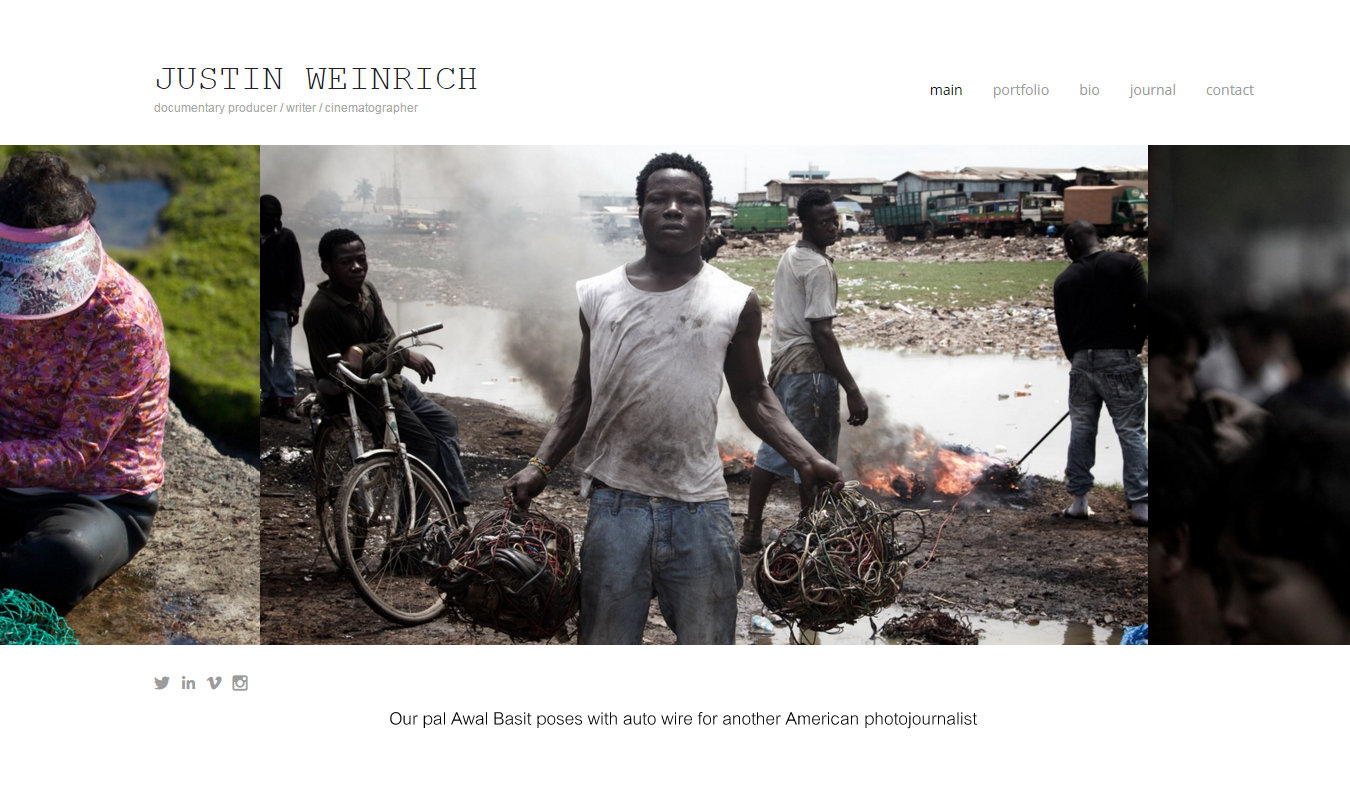
A few weeks ago, Awal Basit [E-waste Scrapper, Dying for Attention, 1/16], one of the leaders of the "Scrap Men" (rather than "scrap boys", cred to Lalouschek/Wondergem) was calling my cell phone a ridiculous number of times per day.  I try to keep relationships with people I spent weeks with in Ghana.  Drive by saviorism isn't sustainability.

The technicians - Kamaldeen, whose dad made me the fairtraderecycling,com bracelet, Elvis, Yussif, Kamal and his wife, etc [all from Chendiba Enterprises]- might call occasionally, and we chat by Facebook Messenger or WhatsApp at least a few times per week.


How's it going?  How's the family?  Hey, it's national service day.  yeah? what's that?  You know, it's good to stay acquainted.

Awal and the scrappers are the Ghanaians of the north who never went to school.  He struggles even with Pidgin English.  Awal's text messages, outside of a few platitudes, are a mystery.  He's from the other side of Tamale's tracks.

The young men burning wires in Agbogbloshie typically don't have the parenting or resources of Chendiba dudes.  Geeks of color are typically valedictorians. Awal and his crew are not just "out of Africa", they are out of an unpenned Soukous Hilife William Faulkner novel.  They all live in a poor country, they all come from the same tribe and language and region.  But the Chendiba Techs are using downloaded schematics to fix TV tunerboards. They feel somewhat awkward around the guys who took the bus to the big city and live in a lean-to on Agbogbloshie's skid row.

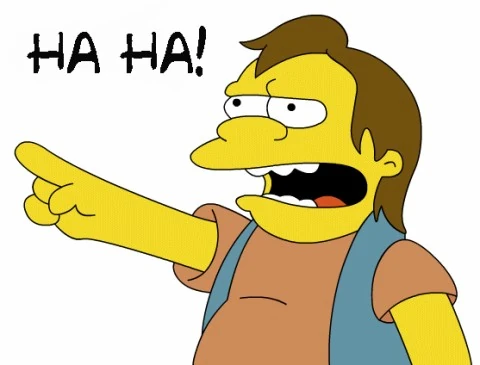
In the Simpsons, the Chendiba techs are Lisa, and Awal is ("ha-ha") Nelson.  Awal is on the streets and he has to show he's tough.  He calls me whenever he feels like, having evolved far afield of pleasantry and shyness.  When I get perturbed and stop taking his calls (usually when I've forgotten to turn on airplane mode and my phone goes off at 3AM with the whispering distinctive ring I've applied), he starts sending photos on whatsapp.  Photos of burning wire.

"Your guilt gives me leverage!"
As I said before, he wants attention.  He's alone.  He sees an opportunity but doesn't understand what to do with it  Like the proverbial dog who caught the bus, Awal has a personal relationship with someone he may imagine to be as rich as Donald.  And what got him that attention, and the interviews with Justin Weinrich and other photojournalists, is burning wires.

When someone begins to feel that their disadvantage is their attraction, it can become toxic in a whole new sense.  As in toxic employee, toxic manager.  I'm important because of my gripe.  My victimhood, my lack of privilege, is the only currency I have.  Your guilt gives me leverage.

Open WR3A Letter to CWIT / @Interpol on #Ewaste

DRAFT OPEN LETTER

Please send edits, suggestions, comments either by commenting under this draft or by email or tweet to yourname at wr3a.org.


Mr. Pascal LeRoy
Mr. David Higgins
Countering WEEE Illegal Trade (CWIT


Dear Sirs,

As you may know, WR3A (dba "Fair Trade Recycling") is an NGO business consortium which seeks to support businesspeople in emerging markets.  WR3A offers discounts on the cost of legitimate used electronic devices as an incentive to create takeback and proper recycling channels in those emerging markets.

We appreciate the advance copies of the CWIT literature [links below] which will guide the discussions in Lyon, France, next week.   While I will be in Lyon (previously scheduled) a few days later, I cannot afford to change my ticket.  Worse, the Association has just completed a major field work in Ghana and does not have the resources to bring representatives of Africa's Tech Sector to the meeting.   Therefore I have prepared this letter to convey our thoughts on this process.

The CWIT report contains a chart (from World Bank) showing electrification rates in several African countries.  We immediately noticed that the first statistic for Ghana was incorrect, perhaps because it is frequently updated.   Understandable, since the statistics on electricity and teledensity in Africa are changing at double and triple digits each year.

What we would like CWIT to learn from this is that import of used electric and electronic devices is not driven by European shredding costs.  It is actually driven by this rapidly changing statistic.

Stating the percentage of household electrification rates in Africa without stating the rate of growth can lead to wrong conclusions.   The relatively low percentage of homes with electricity (as compared to the EU) might imply, to some, that the sales of used electronic appliances are less likely to be "legitimate".

In fact, it is the rate of growth of electrification which predicts demand.

In the USA, for example, the poorest parts of the country were the last to get electricity.  When hydroelectric dams came to the Ozark Mountains, my family members drove to cities like Chicago or St. Louis to purchase used appliances.  Memphis, though closer, had a higher poverty rate, fewer used appliances, and more buyer competition.  If you are poor but making progress, your smartest move is to purchase used goods from wealthy geographies.

Similar modelling accounts for sales of automobiles in geographies which were rapidly paving roads (again, the Ozarks is a good example).   The last place to get paved roads had the highest rates of purchase of both new and used cars, and the ratio of used cars to new cars looked very similar to the rates of used vs. new sales of electronics in Africa.

The CWIT Interpol literature uses works like "illegitimate" and "informal" and "criminal" to describe well established supply and demand patterns.  Perhaps when Germany was reunited, the demand for used cars in East Germany and Poland was driven by a desire in Western Germany to avoid the cost of properly recycling autos...  But if Interpol had targeted auto mechanics in East Germany and Poland, it would have been a poor use of limited enforcement resources, discouraged agents of conscience, and thus attracted criminal enterprise to an otherwise mundane exchange of "good enough" products.

The growth of teledensity (internet, television, cell phone) in Africa is a marvelous story, and one written by canny Africans in the Tech Sector.   The best and brightest students are reading tech repair manuals, hacking phones, and finding the cheapest display devices (ones which last 20 years but are replaced in the West after 4 years are a ripe target).

Language with biblical and "halloween" references, and many photos describing "e-waste" businesses, tend to marginalize, exoticize, and otherize these technicians.  The UNEP's recent use of Agbogbloshie photos to describe Africa's Tech Sector was thoughtless and ill considered.  Similar propaganda was used to describe Simon Lin, Terry Gou, Lee Byung-chul, Chung Ju-jung, and others who repaired and tinkered their way into multibillion dollar economies which lifted the living standards of their compatriots in the most sustainable and environmentally sound manner available - through sustainable reuse, repair and refurbishment.   

If Africa is to meet its own potential, mining ores and shredding working devices is the least sustainable path.  But the demand will be met... there is no "Eden" to shepherd Africans to, and no "Sodom and Gomorrah" to take them away from.  It is fruitless and pointless to try to arrest all the geeks and nerds in Africa.  They are too many.  Crackdowns on internet cafe investors have already occurred in Africa, using "e-waste" as an excuse.   As we say in the Ozarks, "We don't have a dog in that fight."

Export for reuse and repair is explicitly legal in the Basel Convention, Annex IX.  The title of the UNEP Report contains a line about "inconsistencies", which describes well the challenges Interpol will face in enforcing EU interpretations which create new interpretations of the Convention, lined against the forces of supply and demand.   We would ask why, when rhino poaching and child labor and sex trafficking and arms trafficking and conflict metal mining are such a blight, Europe would want to add reuse and repair of electronics to the list that only criminals would succeed at.  Africans have real problems.  Reusing goods is not one of them.

Unintended consequences, collateral damage, friendly fire... These have been offered as excuses for false descriptions of statistics for ten years.  We are asking Interpol to suspend the enforcement of Project Eden until you have met the technicians who not only import used electronics, but have raised Africa's teledensity far beyond the wildest goals set by the most aggressive UN ICT or UNCTAD planners in the 1990s.   Decriminalizing things which should not be criminal is the most difficult, but wisest, challenge for regulators. 

Robin Ingenthron

DRAFT


Founder, WR3A
fairtraderecycling.org


Stunning, Profound Ignorance Of International Cultures: 3B3K

I was watching a Nigerian television interview with pop singer Nneka Lucia Egbuna this morning, and making travel plans with Ghana Electronics Technician and new WR3A Board Member Emmanuel Eric Prempeh Nyaletey.   Eric will be attending this year's Resource Recycling E-Scrap Conference in Orlando.

Nigeria has morning news programs, kind of like our Today Show, or CBS This Morning, which people in Lagos watch while drinking coffee in their apartment buildings, getting ready for the morning traffic jams and commute to work.

Over the years, WR3A has sponsored travel to E-Scrap conferences for many international representatives.  Su Fung and Allen Liu of Malaysia, Roberto and Alice Valenzuela, and Oscar A. Orta and Mariano Huchim of Mexico, Wahab Muhammed Odoi of Ghana, Souleymane Sao of Senegal, Hamdy Mousa of Egypt, to name a few.  Emmanuel Eric is special, however.  He's a geek from Accra who was head technician for Good Point Recycling in Vermont for 2 years, and he flew back to Ghana last spring to revisit Agbogbloshie and the tech/repair warehouses in Accra.

Emmanuel Eric Prempeh Nyaletey fixes Good Point Security Camera
Emmanuel Eric will be circulating the #FreeHurricaneBenson petition, and trying to get people to renew their WR3A.org memberships.  He'll also be answering questions about Africa.

No, they don't all have Ebola.   No, they don't pay money to import e-waste for copper value.  Yes, they have had television and computers for decades and generate their own e-scrap. 

Emmanuel Eric is now on a full scholarship for coding at Georgia Tech, but we are looking for people to help us pay him to keep him at least part time working for Fair Trade Recycling.

@RecyHub: The Case for Reformed Electronics Recycling Exports

  White's move...  


In the comments section on Sunday, reps from @RecyHub posted the following questions about the Fair Trade Recycling Model.  As a reminder, WR3A/FTR encourages export of used electronics to Africa, hand picked by Africans, under defined purchase orders and contracts, to meet the desire and needs of African cities.

EU RecyHub writes:
There are some issues in my mind that I think are not cleared out by your model:

- Child labour. In Agbogbloshie there are kids working with the e-waste, burning cables. Somehow, they should be considered in a model that takes into account human development, not only economical development. 

- Non-recyclable parts. Not 100% of the components are recyclable. There are hazardous parts that need to be removed and treated separately, and there are plastics that don't have any secondary market value. Those parts will be travelling together with the reusable electronics. 

How do you approach these two issues?

First, it is now very well established that the junk show in primitive scrap yards is primarily generated by Africa's cities themselves.   The two problems - child labor and difficult-to-manage components - are products of the emerging nations themselves.   A trade ban does nothing to address these problems.

Second, and on the contrary, the WR3A / fair trade recycling model uses the value of the goods to create incentives to address these problems. Instead of paying $7,000 for a containerload of televisions, the African trader could pay just $4,000 in return for a contract to eliminate child labor, recycle the plastic, etc.

This is the only model which creates $3k (or $4k, $5k, $7k) to fund proper recycling. African traders import from wealthy countries because the scrap is so much higher in (reuse) value, and OECD nations are foolish to shred that value. Keeping it out of the hands of African techs is a lose-lose proposition.

 Check. 

Fair Trade Recycling: Interpol Promises Fact Check

Not bathwater: Baby bassinet found at Mexican dump 2008
Here's a novel idea.  Habeus Corpus.  Find the body.   Make sure a crime has been committed before you start arresting people.  Witch hunts and mob justice have plagued democracies for thousands of years, and our system of justice has learned, over the centuries, that accusations need to be investigated before arrests take place.

Environmental Crime enforcement thus reminded itself last week.   Interpol, the Lyon, France-based international police force, announced that it would take a year to re-study the WEEE or used electronics trade.  Why is a study a victory for Fair Trade Recycling?  It's called "back to the drawing board"... Interpol studied it once, gobbled up some baloney Basel Action facts, and started an enforcement campaign it is now going to revisit.  Mockingbird will be retried.
11/7/2013 "The impact of pollution caused by the dumping and mishandling of waste is global, affecting the quality of our air, water and soil," said Cees van Duijn, a Specialized Officer with INTERPOL's Environmental Security Unit.
"Through Project Eden INTERPOL will support its member countries in their efforts to implement national legislation and regulate the international movement of waste to ensure healthier local environments and help protect the overall integrity of our environment worldwide," added Mr Van Duijn.
With the recent launch of the Countering WEEE Illegal Trade (CWIT) Project, INTERPOL and its partners will conduct extensive research into the illegal e-waste market in Europe and provide technical and policy recommendations.
- See more at: http://www.noodls.com/view/1E03CF366C333C703F1EE40A61E2A293816DCAF3#sthash.ysnd6TSY.dpuf
Now Interpol's "Project Eden" doesn't sound all that big a departure from the past 12 months of seizures, arrests and enforcement.   Why do I assume there could be good news here?

"INTERPOL and its partners will conduct extensive research..."

What caused Interpol to take a breather, and to make sure of its prosecution?  WR3A, the World Reuse, Repair and Recycling Association, monikered "Fair Trade Recycling", perhaps played a  role.   Our organization introduced Interpol to researchers from Memorial University, PUCP Peru, USC, MIT, and Middlebury College.  We introduced them to importers from Ghana and Mexico and Burkina Faso.  We introduced them to recent studies by UNEP and US International Trade Commission.   And I took a few days from my vacation in July to meet Interpol at their offices in Lyon, en route to Geneva and Copenhagen, and to my meeting with Mr. Collateral Damage himself, Joseph Benson.

TVs replaced at London hotel by flatscreens make false arrests
Fair Trade Recycling applauds legitimate investigation of the used WEEE and electronics export trade.  Cees (pronounced "case") van Duijn, the head of Interpol's environmental unit, met with me in Lyon in July, extended his hand, and promised to do what is right.  And I believe him.  He was not there when the enforcements and seizures and questionable arrests based on "80%" baloney statistics got started.  He was not holding a torch, and does not seem to be in the lynching business.

We are on the heels of a year of arrests and seizures of exporters of used electronics, following a great E-Waste Hoax.  Interpol had taken a fake, false, hootenanny statistic from a puny Seattle non-profit, and based on the fake number, had seized hundreds of containers or used computers, displays, televisions, and cell phones.  Items, it turns out, which are reused or repaired 91% of the time.

Habeus Corpus means "Habeus Stuff", habeus #ewaste.  Start at the crime scene, start at the dump. "Stuff" is not, by itself, evidence of environmental injustice.  Just keep the facts straight, that's where justice begins.

USA Today Recognizes Fair Trade Recycling!

Breaking news!   Banning Exports is a Bad Idea

PLEASE take the time to read the excerpts below, and if you agree with them, post a comment at the USA Today web site.  41 African traders have been arrested for "e-waste" dumping in the past 13 months, based on hyperbole.  A major United Nations Environmental Programme research team spent 2 years examining seized sea containers and found 91% reuse - higher than brand new product sold in Africa.   The World Bank found 6.9 million households in Lagos had TV, and the ones burning at dumps were mostly generated by cities like Lagos, NOT imported.   BAN has reviewed the UNEP study and applauded it (though they still say 80% of it is burned as junk in this article!)

Please also support and join fairtraderecycling.org  Exports aren't perfect, but shredding working equipment and forcing Africans to buy in back alleys is not making them better.  Legal and safe reuse and recycling is our goal.


"Two years ago, Ingenthron launched a movement he calls Fair Trade Recycling to influence public opinion on e-waste. Fair Trade Recycling is based on the same Fair Trade principles Green Mountain Coffee Roasters has used so effectively with coffee, working to ensure growers the Waterbury company buys from in Central America and around the world receive a fair price for their beans and are able to steadily improve their living and working conditions."

"Katharina Kummer Peiry served as executive secretary of the Basel Convention for five years, from 2007 to 2012. Peiry, a Swiss attorney and specialist in international environmental law, helped to create the Basil Convention when she joined the United Nations Environmental Program in 1988. She believes public opinion is lagging behind the facts on the question of whether e-waste is being dumped.

"My perception is this issue was a significant issue 10 years ago but the situation has now changed in that the material price has gone up," Peiry said. "New technologies not available at that time make this material quite valuable. It doesn't make sense to dump it."

"Peiry says Basil Action Network has a "very strong stamp of credibility" built up over time and has been able to seize the high moral ground in the public discussion of e-waste. That concerns her for the same reason Ingenthron is concerned. She's afraid the legitimate and productive trade in recycled electronics will fall victim to concerns about dumping.

"There's a strong perception in the United States that the Basel Convention prohibits exports," Peiry said. "That's not the case. At this point there is relatively little awareness in my perception that discarded electronics are not always a problem, but can be useful."

"Josh Lepawsky, a professor of cultural, economic and political geography at Memorial University of Newfoundland in St. John's, is hoping to shed some light on the dumping debate with a $469,000 grant from the Social Sciences and Humanities Research Council in Ottawa. Ingenthron is a collaborator on the grant.

"Lepawsky and several of his graduate students have already done field work in Dhaka, the capitol of Bangaladesh, and reached conclusions similar to those drawn by Katharina Kummer Peiry.

"When we surveyed the people in this trade most of their imports were coming from elsewhere in Asia, principally China," Lepawsky said. "There are shipments that come from the United States to Bangladesh, but in terms of sheer number, they're in the middle to low end."

"Lepawsky and his students also found that most of the so-called e-waste shipped to Dhaka was being repaired, recycled or refurbished in some way, a business that presumably will disappear if a ban on exporting electronics is put in place.

"If the dangers of in-ground smelting need further study, Lepawsky is less reluctant to give his opinion of the consequences of banning e-waste exports.

"Bans are going to do something along the lines of the following," Lepawsky said. "They will harm people's livelihoods who are already at the margins in terms of economic survival. On that account, they may not be the best thing to do."

USA TODAY - Dan D'Ambrosio 9/27/2013