Showing posts with label fairtrade. Show all posts

Game Theory 3: Monopoly Itch Mite Cure

Part of what makes game theory interesting is the use of analogies to analyze rules.   Gedankenexperiment (Thought experiment) is a game theory approach to philosophy and ethics.   And for an Ethical E-Waste blog, its a way to view a situation from 20,000 feet.

Wikipedia - Schrödinger coined the term Verschränkung (entanglement).

What if one player uses a different set of dice than another player?  If that player won 60% of 1,000 games, you'd want to control for imbalanced dice... but you'd have spent a lot of time playing in order to prove it, so it seems better if both players have to use the same die without the effort to prove one set of dice is faulty.  That requires an umpire, an authority, an NFL, and NBA, a regulator.

In non-democratic communist governments, the authority is itself a monopoly.  Regulators can be paid off, and you can't go to court to appeal weighted the dice.  In capitalism, the use of patents and trademarks create temporary, time-sensitiv,e monopolies... the authorities enforce your monopoly for a limited amount of time, which does promote research and invention.  The use of a combination of government regulators and capitalist corporations is a horrible system, the worst, except for all the other ones.

As this week's thought experiment, lets look at a theoretical entanglement of ethics and patent law.

What about... PermaChiggerInc?

What if a corporation - PermaChigger - cross bred some kind of chigger and itch mite to develop a type of scabies resistant to sulfur, to permathrin, and neem  oil.. resistant to every treatment except their trademarked GMO petrochemical?  The entire world is scratching its collective butt off, and the money rolls in.   The GMO treatment can be manufactured at scale, cheaper to produce and more profitable.  Empty bottles of PermaChigger become as common as litter from bottled water.

That's about the worst capitalist system I can think of.  It's similar to AIDS conspiracy theories of a decade ago, but the AIDS conspiracy doesn't make sense because it kills the clients.  Mite management might make more sense.

Short of being caught contaminating people on purpose, the corporation has engineered itself a guaranteed profit.  They don't even need to do the dirty work of enforcing it, they have government trade commissions and international police to stop the sale of counterfeit and copied product.  I'm not anti-capitalist, and the system here is the one which AIDS and Ebola have the highest chance of being brought under control.

Profit ensues.

Now imagine a Nigerian man, Benson, who has never been to school, from a pidgin speaking corner of an inner city Lagos slum, has the itch.  A six foot six man weighing 260 pounds, he's black as they come and looks scary as all hell when he gets mad.  He has the genetically modified mites, his wife has it, his kids have it, all their neighbors in Lagos are scratching their thighs off.  But they can't afford the Capitalist GMO treatement.  It's not a fatal condition, but life would be a lot better if he thought of a solution.

USA Today Recognizes Fair Trade Recycling!

Breaking news!   Banning Exports is a Bad Idea

PLEASE take the time to read the excerpts below, and if you agree with them, post a comment at the USA Today web site.  41 African traders have been arrested for "e-waste" dumping in the past 13 months, based on hyperbole.  A major United Nations Environmental Programme research team spent 2 years examining seized sea containers and found 91% reuse - higher than brand new product sold in Africa.   The World Bank found 6.9 million households in Lagos had TV, and the ones burning at dumps were mostly generated by cities like Lagos, NOT imported.   BAN has reviewed the UNEP study and applauded it (though they still say 80% of it is burned as junk in this article!)

Please also support and join fairtraderecycling.org  Exports aren't perfect, but shredding working equipment and forcing Africans to buy in back alleys is not making them better.  Legal and safe reuse and recycling is our goal.


"Two years ago, Ingenthron launched a movement he calls Fair Trade Recycling to influence public opinion on e-waste. Fair Trade Recycling is based on the same Fair Trade principles Green Mountain Coffee Roasters has used so effectively with coffee, working to ensure growers the Waterbury company buys from in Central America and around the world receive a fair price for their beans and are able to steadily improve their living and working conditions."

"Katharina Kummer Peiry served as executive secretary of the Basel Convention for five years, from 2007 to 2012. Peiry, a Swiss attorney and specialist in international environmental law, helped to create the Basil Convention when she joined the United Nations Environmental Program in 1988. She believes public opinion is lagging behind the facts on the question of whether e-waste is being dumped.

"My perception is this issue was a significant issue 10 years ago but the situation has now changed in that the material price has gone up," Peiry said. "New technologies not available at that time make this material quite valuable. It doesn't make sense to dump it."

"Peiry says Basil Action Network has a "very strong stamp of credibility" built up over time and has been able to seize the high moral ground in the public discussion of e-waste. That concerns her for the same reason Ingenthron is concerned. She's afraid the legitimate and productive trade in recycled electronics will fall victim to concerns about dumping.

"There's a strong perception in the United States that the Basel Convention prohibits exports," Peiry said. "That's not the case. At this point there is relatively little awareness in my perception that discarded electronics are not always a problem, but can be useful."

"Josh Lepawsky, a professor of cultural, economic and political geography at Memorial University of Newfoundland in St. John's, is hoping to shed some light on the dumping debate with a $469,000 grant from the Social Sciences and Humanities Research Council in Ottawa. Ingenthron is a collaborator on the grant.

"Lepawsky and several of his graduate students have already done field work in Dhaka, the capitol of Bangaladesh, and reached conclusions similar to those drawn by Katharina Kummer Peiry.

"When we surveyed the people in this trade most of their imports were coming from elsewhere in Asia, principally China," Lepawsky said. "There are shipments that come from the United States to Bangladesh, but in terms of sheer number, they're in the middle to low end."

"Lepawsky and his students also found that most of the so-called e-waste shipped to Dhaka was being repaired, recycled or refurbished in some way, a business that presumably will disappear if a ban on exporting electronics is put in place.

"If the dangers of in-ground smelting need further study, Lepawsky is less reluctant to give his opinion of the consequences of banning e-waste exports.

"Bans are going to do something along the lines of the following," Lepawsky said. "They will harm people's livelihoods who are already at the margins in terms of economic survival. On that account, they may not be the best thing to do."

USA TODAY - Dan D'Ambrosio 9/27/2013

Response to The Lancet: Electronic waste—time to take stock

Electronic waste—time to take stock

A member of WR3A based on Sao Paulo, Brazil, emailed me a copy of an article in the respected journal "The Lancet" yesterday.   It reminded me of the Charlie Schmidt article in Environmental Health Perspectives in 2006, when I was interviewed, and unfortunately, kept a hand tied behind my back.   Charlie erred on the side of "white guilt" and wrote an article that supported J. Puckett's of BAN.org now completely discredited allegation that African importers were "mostly" importing TVs to be burned for copper.   Puckett only recently admitted (in the comment section of an article by Bloomberg) that he had done no research while in Africa and made the "80%" statistic up.  He simply made it up.

Profiling kids at dumps
I now realize that once an allegation is printed in a respected journal, like EHSP or The Lancet, especially when accompanied by "poverty photos" of kids at dumps, that the "presumption of guilt" shifts, rather violently, against reuse FIXers techs geeks of color.  The white guilt ricochets around, and in the end, it's the African, like Hamdy of Egypt or Benson of Nigeria, who is accused, arrested, loses his business.

For that reason, my new policy is to never let a "reporter", like Dr. Jack Caravanos, off the hook as easily as Charles Schmidt.  I haven't met him yet, am certain he's a good guy, just like Therese Shyrane and David Higgins of Interpol, and UK enforcement leaders lik Graeme Vickery  (a supporter of Joe Benson's arrest).  All good people, armed with the statistics Basel Action Network hallucinated, who think that most African importers are guilty of #wastecrime.


OPEN LETTER TO THE LANCET AND JACK CARAVANOS

Dear Mr. Caravanos,

Are you the author of the piece in the Lancet?  http://www.thelancet.com/journals/lancet/article/PIIS0140-6736(13)61465-8/fulltext  First, I want to congratulate you on entering the discussion, and second, to introduce you to three professors who are working on a grant together to explore reform, rather than ban, of the trade.  Dr Lepawsky is from Memorial University, Dr. Goldstein from USC, and Dr. Kahhat teaches engineering at PCU Peru.

"Much e-waste (estimated to total 45·6 million tons in 2012) originates in developed countries. Treaties such as the 1989 Basel Conventionprohibit the export of defunct electronic equipment for disposal in developing countries. However, a loophole that allows the export of electronic equipment for re-use results in most of this retired equipment ending up in developing countries—a problem exacerbated by a lack of resources to test equipment for functionality. E-waste output from developing countries is also rising rapidly, and will soon overtake the developed world as the dominant source."

While there is definitely an element of truth here, and while the aspects of bored children burning things in landfills is completely unacceptable, I'd like to invite you to revisit the article from another point of view.   According to several studies, the import of used electronics cannot really be explained, economically, by any economics of "externalization".  Externalization of recycling costs definitely exists, but would not explain the sorting of loads sold.   From what I've personally observed, cities like Accra and Lagos have had television and electronics for several decades, and the way their own eventual discards are treated bears reform in the same way ours did two decades ago.

Nigeria, in 2007, had 6,900,000 households with television (World Bank).  And according to a 2012 storty, the UNEP, which intercepted and tested 279 sea containers imported by Nigerian techs, found 91% reuse in those containers - actually higher reuse rate than brand new product sold in Africa.  I'll share two quotes from the UNEP studied (funded in part by a grant from the Basel Secretariat).

"The majority of refurbished products stem from imports via the ports of Lagos. The interim results from project component 2, the Nigerian e-Waste Country Assessment, show that 70% of all the imported used equipment is functional and is sold to consumers after testing. 70% of the non-functional share can be repaired within the major markets and is also sold to consumers. 9% of the total imports of used equipment is non-repairable and is directly passed on to collectors and recyclers."
Final report of the UNEP SBC, E-waste Africa Project,  Lagos & Freiburg, June 2011 
Here's another quote from the Nigeria E-Waste Assessment Study:
"Refurbishing of EEE and the sales of used EEE is an important economic sector (e.g. Alaba market in Lagos). It is a well-organized and  a dynamic  sector that holds the potential for further industrial development. Indirectly, the sector has another important economic role, as it supplies low and middle income households with affordable ICT equipment and other EEE. In the view of the sector’s positive socio-economic performance, all policy measures aiming to improve e-waste management in Nigeria should refrain from undifferentiated banning of  second-hand imports and refurbishing activities and strive for a co-operative approach by including the market and sector associations."
If you simply mean that most of the used goods imported to Africa work or are repaired, but will eventually be discarded in a decade or two, I'd agree with that, since 70% of the sales documented (product in use) are used product.  I don't think that mining more lead, tin, copper etc. to make brand new product, however, would either eliminate the eventual dumping problem.  It would certainly elevate the exposure of Africans to lead and other pollution - hard rock metal mining is the primary source of toxics in both the USA and Africa.

The photo above, taken from a film by Greenpeace, shows a typical load of imports.  Frequently these are used CRTs taken out of hotels, upgraded for flat screens.  The Africans who purchase them are very picky, and you will not see a lot of variety of age or type of e-waste in these loads.

I'd invite you to visit my plant in Vermont, or to come down and meet with you at CUNY.  Our organization, Fair Trade Recycling (fairtraderecycling.org) is dedicated to improving quality of loads sold to repair and refurbishing markets.. The moral of your article seems to be that the "reuse" is some kind of a "loophole", and that people should be somehow ashamed if some of the goods sold or repaired in Accra or Lagos originated in New York.   I'm afraid that "boycott" attitude has not been very effective, driving entrepreneurs into back alleys to find the computers and televisison Africans need but cannot afford to buy new.

Robin Ingenthron


So that's my "open letter" to Jack Caravanos.  I hope I didn't burn any bridges.  I still correspond with Charles Schmidt, who unfortunately cannot get an editor interested in exhuming the bodies for DNA tests.

more->

Why I'm Pro Globalization

First, the anti-Globalists have to admit there's not much we have to say in the matter.

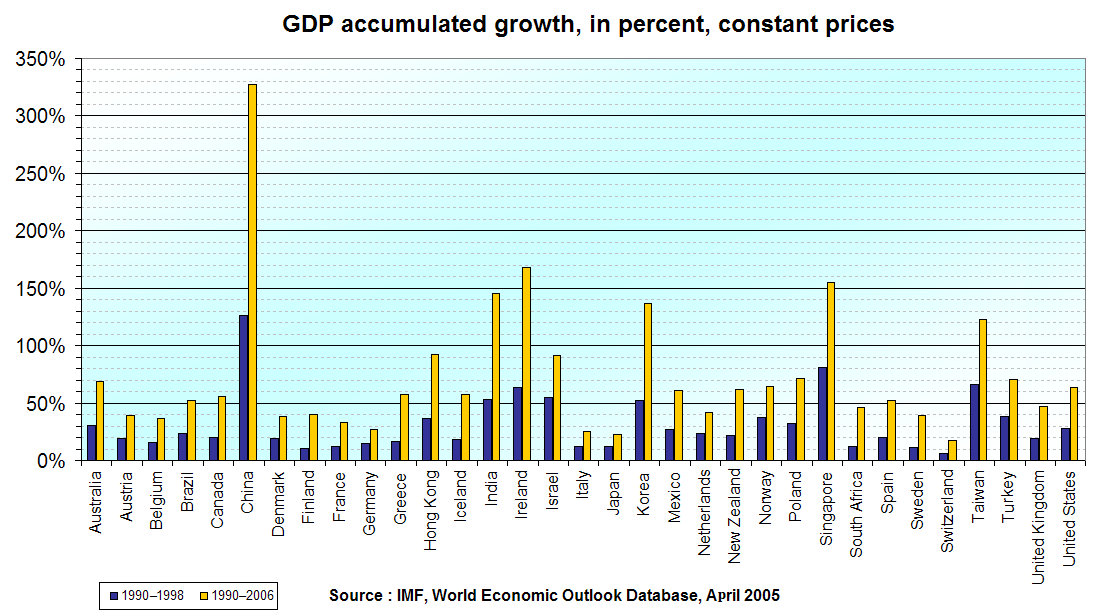
Pretending that the USA and Europe can isolate themselves, and that Asia, Africa, and Latin America's 6 billion people are going to develop better or more slowly without us is an a priori joke.  There simply is no solution to "globalization" and kvetching about it is like complaining about getting old.  Hippy grandparents yearning for the good old days of starvation and smallpox in poor countries is not my scene.  Wealth is increasing (see chart below) in countries which trade most.

No thank you, Daisy Racism
So, if the cat is out of the bag, so to speak, are ideas like alter-globalization and fairtrade going to do better if the rich and well regulated consumers get on the sidelines and boycott the emerging markets?  Of course not. The poor benefit more when they have more choice of people to trade with.

Third, having lived in Africa and having opened a recycling factory in Latin America, and having traded millions of dollars of goods with Asia, I can tell you that the Tin-Tin comics image of the emerging world is about as accurate as Uncle Toms Cabin in describing Atlanta.   The image of "primitive wire burning" recyclers around the world is intensely over-played, to the point of racial profiling, and belongs with "Arab terrorist" and "American cowboy" and "Japanese kamikaze".  All those anecdotes exist, but if that's your primary image of Dubai, Houston or Tokyo, you are ignorant.  Ignorant means "stupid with hope for a cure", though I'm sometimes afraid the condition is chronic.

Boycott as a response to "globalization" is like burning libraries to prevent pornography.  It's that damn stupid.  As a lifelong environmentalist who had devoted my life to recycling, I am ashamed to the point of tears that the "green movement" has harbored racist images of fixers and tinkerers, technicians and geeks.  We hurt the American economy when we shred items of value which could have been exported, and we hurt the buyers who then buy used product from Hong Kong or Shanghai with fewer choices.  Worse, when we shred up rare earth magnets and turn circuit boards into "fluff" to avoid superior hand disassembly, we help mining.
Mining is what builds the roads that kill the gorillas.  Mining "non-toxic" tin from Indonesian coral islands is what kills the sharks.  White eco-witch-doctors need to stop prescribing death.

If you are a "green" environmentalist, and you have friends who are global isolationists, tell them to get on a fair trade bandwagon, because boycotts are the new segregation, giving sinister meaning to "the new black".

Give the developing world a choice of jobs besides warrior, miner, poacher, sex worker... let them refurbish and recycle, give them incentives and tools, implement contracts to reduce child labor by paying adult wages.  Give boy scout badges for recycling to the poster children, and say "shame on you" to "watchdogs" who exploit poster children for money and don't share a dime with the kids.

I'm a globalist because I have friends in Africa, Latin America, and Asia who I met through trade, and we treat each other as equals, and we have all benefited.  My children eat with their children, my wife meets with my partners and their sisters and brothers.  None of this would have happened if I had been afraid to cross the tracks and trade with brown people.  I see my friends profiled, and I'm called names for expressing my loyalty to them.  Very harsh names.   I was too young to join the Civil Rights marches in the American south. But I learned enough about those marches, from my home in Arkansas, that I can spot a person using "inference" to make recycling, repair, and trade look  like it's causing poverty.


EWaste: Where We Go With What We Know? (AFRICA)

I'm an optimist about the future, not an apologist for the present.  Recoiling from poverty is not the same thing as compassion.  We have to get our hands dirty helping Africa, not just keep our consciences in shiny isolation.  
Scientific study, UN participation, interviews with importers and exporters, surveys by ISRI, mapping of transport by geographers, measure of display sale shipments, measure of growth of online access... in the past ten years we've learned a lot about electronic scrap recycling that we didn't know when "exporting harm" (NGO's first video) hit the circuit.

Some in the OECD* want us to think there are still too many unknowns to "risk trade" with surplus electronics overseas.   But with what we know, where do we go to make progress for the 83% of the world in "non-OECD" countries?


What happens to "E-Waste" In Africa?

 -    Most of the junk being burned by kids was in use for years, collected from offices and homes in Accra.

 -    Most of the money and jobs in the African recycling economy come from the added value of repair and refurbishing.  There are 30,000 technicians, only a few hundred "scrap boys".

 -    Most technicians prefer to work on electronics from rich people which they can resell and reuse.

 -    Most of the scrap boys have no other place to go except war, drugs, mining, and crime.

 -    Most end-of-life computers are hand-disassembled, which adds economic and environmental value -  
    stripped to the bone for reuse and parts potential, and every metal is graded and cleaned.

 -    Rich in Africa get new computers, middle class get used computers, the poor inherit the scrap.  The
       problem in the imagery poverty.  Poor won't get richer via economic isolation.


Who has the Supply of Electronic Scrap, surplus and waste in the USA?

 -    Most wealthy generators of technology are risk averse, won't risk to be accused  of dumping.

 -    Most wealthy generators of new technology buy new (upgrade) rather than repair and reuse.

 -    Most wealthy generators of new technology live in states which ban the export of used computers.

 -    Most recyclers of technology don't have time or experience in Africa.

 -    Most of the "worst e-waste" is processed in the USA, clean scrap value is sold on world markets.


What happens to surplus electronics in the USA?

 -    Most businesses who export to Africa don't get big contracts which ban export to Africa.

 -    Most Africans who buy from the USA don't buy from companies with big contracts in USA.

 -    Most containers of electronics, copiers, displays, unloaded in Africa are sourced from smaller e-waste
      businesses without the capacity to shred the bad and buy new.

 -    Most domestic reuse techs prefer first dibs on USA laptops, servers and computers.


What does Fair Trade Recycling do?

 -    Creates a trading window for big USA companies to sell their best stuff to African Techs.

 -    Gives wherewithal and incentives to Africans to adapt best recycling practices.

 -    Provides for 3rd party verification and mediation when best laid plans go wrong (containers tipped,
      demand changes, expectations aren't met).


Who Opposes Fair Trade Recycling?

 -    Companies which have invested millions in shredding and e-Stewards Standards.

 -    Refurbishers who see "tested working" as guarantee against competition from African Techs.

 -    New Manufacturers who see market cannibalization in reuse and refurbishing markets.

 -    Junk sellers who like the idea that "export is good" but don't want 3rd party verification and mediation.

 -    Dictators who want internet to be difficult and expensive, accessible only to the connected.

 -    Software companies with concerns about spread of unlicensed ware in unlicenseable nations.

 -    Legitimate E-Scrap Recyclers with concerns about an under-funded "certification" process.

How Do We Jump-Start Fair Trade Recycling?  (Suggestions wanted)


 - 


 - 


 - 
_______________________________________________________________________________


* OECD = Obsessive Electronic Consumption and Demand Nations (tips hat to Slashdot submitter)

Bloomberg News Sucks Covering Victoria's Secret

Bloomberg:  Children Toil With Bare Hands in Burkina Fields

Bloomberg reporter Cam Newton gets attention for his story slamming "fair trade" cotton.   He reports that "Victoria's Secret" uses "fairtrade cotton" and that a 13 year old girl worked for 6 months in the fields.   Slate attempts to put the story in a little more perspective (organic cotton means that weeds are pulled by hand, the girl is not a "slave")... but still, "Tsk-Tsk" is the word.

View outside my best friends home in Cameroon 1986
I work with fair trade and attempts to organize and improve life in Africa.   Specifically, I had Burkina Faso refugee in my home for 6 months, and lived in DR Congo and Cameroon.   The Slate correction to this story needs to be amplified.   Women are typically/frequently married at 13 in Burkina Faso, and for a foster child to be forbidden to work means... I guess bad news for foster children.  Because the farm went "organic" and used manure rather than chemical fertilizers, the farmer let his foster daughter carry the manure to the fields and put it on the crops.   Bloomberg says "gotcha"... thirteen year olds should be in school.

So what does Cam Newton leave us with?  Companies like Victoria's Secret will see that "no good deed goes unpunished", and the neighboring Burkina Faso fields which are not participating at all in Fair Trade will be happy they used chemical fertilizers and never got involved with "do-gooders".

This "gotcha" journalism, man-bites-dog story, attacking people who are trying to make a difference, deserves no praise.  Bloomberg is the profiteer in this story.  The reporter gets interviewed on NPR (J School 101:  Reporter Becomes Part of the Story) like some kind of a Scott Pelly Jr.  Melissa Block speaks to him as if he had done something brave, not asking a single difficult question.  I've visited the cotton plantations in the Sahel, and know how brave it ain't.  This is not war-time footage, this is not child soldiering, or toxic mining. This is black faces growing crops.

"Sparse mud walled hut home to Burkina Child Worker".  How very brave of the reporter to visit.  We are so grateful.   Listen, I lived in a house like that, and all my friends (African friends) did too.   And to suggest that we should not buy cotton from people because they are poor is beneath contempt.  If we just DON'T buy fair trade cotton, I'm not sure Clarisse will live in a ranch house, go on to college and leapfrog the whole situation...