Showing posts with label exports. Show all posts

What Makes a Competitor "Ilegitimate"? And how does Transportation Cost affect Recycling Competition?

The crime we fear to commit is discarding something. That root of "ethics" is one aspect.

The crime we should be more aware of is buying / consuming something.

Something we buy is produced either from recycled content, or earth-extracted content.

Meanwhile, an enormous amount of energy we consume is moving stuff across the globe. And the cost to recyclers is enormous. How does a recycler compete against the costs of shipping below (TransportDive)? 


When recycling critics talk of the cost of transporting recyclables, they have to consider the costs of moving mined ores, refined secondary ores, and finished virgin raw materials around the same globe. Recycling's competitor is not really overseas recycling, but overseas extraction.

Is the UNU E-waste Research Program Ever Going to Learn?

 I'm a little behind in editing and posting a number of draft blogs, but just sent this email to a university professor who shared a Grist article with me.

The Grist article is not that bad. But listen as I go on a tear of the UNU program (source of data in the Grist article). I used to have a friendly relationship with the UNU e-waste program. But they are fricking racists, and it's time to drop the mic on uncle bubba.

When I meet with the UNU boys (who are convincingly nice) I can smell the ruffled feathers. But they doubled down specifically on Joseph "Hurricane" Benson, and when proven completely wrong, hid their BS 80% press release statistic (switching from "primitively managed" to "undocumented" means "we didn't know what we were talking about when we said primitively managed but we don't want to retract our 80% BS statements in the past used to sentence the guy we applauded the arrest and sentencing of, so we use "informal sector" to imply that black techs are to be mistrusted")

Now that I have our attention, I share what I really think via the email below. Wake up, UNU. Every Univesity researcher who read you study has discredited it as Criminal Negligence. The fact that it's still being cited by environmental publications like Grist just show you to be the Thomas Midgely of surplus electronics management.


5. How Too Quietly Big EWaste Lies Buried: Top Five E-Waste Lies Mapped

Let's ReMap the Five Biggest E-Waste Lies (before the April Fool's Blog traditionally comes out).  In Part Five, let's look at five geographic places the bodies of the truth were buried underneath a pile of false narratives and bogus "E-waste Export" claims. If you are doing a thesis or term paper on electronics recycling this semester, take the blue pill and see how normal ordinary places were sensationalized with poverty narratives despite prima facia evidence that the story was bogus.

We can forgive reporters and news producers like Solly Granatstein (CBS 60 Minutes) at the proximate time that they report. We can roll our eyes at well-meaning do-gooders who react to false claims with alarm, out of a sense of liability. 

But I question why so few reporters do as Ira Glass did following his sharing of Mike Daisy's Foxconn exaggerations and lies. This American Life is alone in re-tracing its steps, and learning that activists and environmentalists are not immune from biased reporting, sensationalism, and creating bricks that build the House of Big Lies.

The Big Lies are about PLACES visible on Google Earth. Please, I need some unprejudiced university student help to link and map these, and I can provide the photos.

1.Guiyu.

2. Foshan

3. Basel

4. Accra

5. Hong Kong

Punjab / Faisalabad is the Sixth Man... Penang, Malaysia gets honorary mention.


Seven Secrets Of SECONDHAND Professionals - A Guide thru Adam Minter's Dilemmas

Blog 1,430. Fresh on the media blitz of author/journalist Adam Minter's second blockbuster - Secondhand: Travels in the New Global Garage Sale - there are a lot of questions about how to deal with the growing mountains of secondhand stuff.

First, a shameless self-promoting plug. Based on my experiences - Africa Peace Corps volunteer 1980s, grandson of Ozark hillbilly families with no electricity or running water, tales-of-the-Depression-dinnertable-correspondent, used electronics recycling company entrepreneur, and former state Recycling division director (MA DEP) - I've had a chance to answer more than a few dozen of Adam Minter's questions over the years.

In fact (shameless plug), we met ten years ago next month. December 1, 2010, kicked off a period of "dueling banjo blogs", when Adam was writing about secondhand and scrap markets from Shanghai (ShanghaiScrap.com).  Here in Vermont, I was writing blog about my heroes in emerging markets, telling positive stories about differently abled poor people ingloriously described as "primitives" by white savior barbies who insist all used electronics be shredded rather than traded, and who described the purchases of secondhand stuff "illegal dumping".

[The concluding 2 chapters of his book are a distillation of ten years of correspondence between me and Adam, including his 8 trips with me to Ghana, Vermont, Boston, and the Bronx NY.]

Yesterday, before going on air (NPR On Point), Adam sent me an email reminding me of that inspiration. We met when he had just given a shoutout to the Best Recycling Blog in the World. Shameless plug, but I'll take it again, because the blogs he was attracted to were about racial profiling of secondhand reuse markets as "primitives". I'm proud that he has carried that message forward in Secondhand, and has joined the fight for Right To Repair, and against shaming secondhand trade with poverty porn.

Meet Adam in Person Thursday Nov 14 at University of Vermont Davis Center.


SEVEN SECRETS OF SECONDHAND PROFESSIONALS
A Guide Through Adam Minter's Dilemmas

Triage.  At Good Point Recycling in Middlebury, Vermont and Brockton, Massachusetts, our 40 staff have to manage up to 500,000 pounds per month of used electronics. A few of those devices are recently "electively upgraded", with a good resale value. But alas, like by Minter's other Secondhand firehose drinkers (Goodwill, Salvation Army, Japan's BookOff) we find that the vast majority has been in a closet for way too long. We send very little (5%) to the dump - mostly Ikea-grade wood from older electronics. But most of the items are going to be de-manufactured or shredded into little pieces of copper, aluminum, glass, black plastic, white plastic, circuit boards, etc.

There is a lot of value, a lot of waste, and a lot of emotional baggage. Fortunately, some things are easier than we make them out to be.

So there's a training program for the staff, based on the concept of "TRIAGE". There's a first sort, to get stuff to the department where there's an expert in that stuff (usually, de-manufacturing). Then there's a "second sort", which may mean testing the electronics to see if they work, looking up demand for them online, or removing 36 screws with 8 different screwheads using power drills. Sometimes, with things like "vintage" or antique electronics, or items that might have a hazard like lithium battery, there's a third sort, or reason to ship the third sort equipment to a different electronic specialist.

And also this hits home... All of us eventually are called to sort and settle our loved ones possessions.  Last month I flew to my 77 year old mother's home in very rural Marshal Arkansas. 29 years before my dad passed away in 2017, he had moved his own mothers STUFF from his super revered grandfather's home in Taney County Missouri. I wish I'd had 40 employee company when he did that, a lot of valuable antiques were lost, and dad  tried to save a lot of things that had only sentimental value.

Dad moved a few tons of those things to an abandoned house on their new property in Marshall, down the hill from mom's.  As giant oak trees are wont to do in Arkansas wind storms, one had sliced the abandoned house practically in half, and by the time I got there several rains (and a couple of meth-heads) had been through the place (one methhead kindly forgot all the silverware in a cottage cheese bucket near the door, probably set it down and couldn't find it again).  Anyway, I came down as a professional to "TRIAGE" the damage, and cherry pick the 20% of non- ruined stuff worth saving.

The thing I'm most grateful for finding in the destroyed home was a wood carving by my grandfather, Clarence Fisher of Ridgedale, Missouri. He taught me early on about quality, repair, and the good-enough market. He was probably born to the poorest hillbilly family in the county (his father did not read or write, signed his name with an "x"). A self-taught carpenter and subsistence farmer, he left a deep imprint on me. Adam Minter had a similar relationship with his own grandfather.

The carving I salvaged from the house is the lower one (the top carving Pa gave us as a gift, it was his last carving). He told me he was worried he might not be able to do one for everyone in the family. But later it turned out he had an idea, to make a wood carving template, so he could "mass produce" them, or some other carpenter could.  That lower one I found on the floor of his daughter (my mom in Arkansas) in the house the tree destroyed.


Adam is going to get a lot more coverage this month - C-SPAN, NPR Marketplace, and Fresh Air. And check the reviews so far in Nature, Publishers Weekly, Waste Dive, Recycling International, and NPR to name a few.  It's a great read, and if you want to hear some secret advice on the dilemmas he addresses, directly from a Reuse Pro, read on.

10 Things we Know about Basel Action Network's "Earth Eye", and 1 We Don't


  1. We know BAN is not placing GPS trackers into any devices that don't LOOK ready to reuse. Not a single CRT or projection TV (over 50% of ewaste) was tracked by BAN, ever.
  2. We know BAN claims to be "cutting wires" to sabotage the devices, which likely get repaired anyway.
  3. We know that BAN controls distribution of who gets what type of device... 14% of all GPS trackers BAN released in Canada went to one guy who had a lawsuit vs. BAN.
  4. We know BAN has a financial interest in the outcome (through E-Stewards) worth millions of dollars.
  5. We know that BAN's press releases interchange their proposed "Ban Amendment", which has not passed, for Basel Convention international law, which allows export for legitimate recycling and repair.
  6. We know that BAN mysteriously "obfuscated" several end points in Asia, when devices arrived at legitimate reuse and legal recycling centers.
  7. We know that BAN picks specific people to accuse, even in cases when that person exported nothing.
  8. We know that BAN profiles the overseas tech sector and reuse technicians as "primitive" and "informal".
  9. We know that the "developing nations" BAN describes as "primitive" had cities with TV stations and millions of households using electricity a half century ago, and produce most of the "ewaste" at their own dumps.
  10. We know that the first instance of GPS tracking, of TVs sold to Nigerian born TV-repairman Joseph Benson of BJ Electronics, led to false testimony ("80% not reused") by the UK prosecutor, and environmental injustice (imprisonment of Benson).


What I can't figure out is why the press gives this organization any ink.

Follow the money. 

This is the To Kill a Mockingbird moment for the environmental community. You either sat by while this NGO made this happen, or you spoke up to #freejoebenson


Nuance Delivery 1: Awal is Sasha Rainbow's Tire Burning Boy

Another reminder from the Placebo "Life's What You Make It" controversy a year ago... Sasha Rainbow, who made the Placebo music video in Agbogbloshie, didn't ever - even once- respond to me or talk to me.  She said I was a liar.


Here (in Pidgin English) is an interview with Awal Muhammed of Savelugu (village north of Tamale).  Oh, he's also featured in BBC reporter Reggie Yates feature on Agbogbloshie.

Sasha's documentary is coming out soon, I've been told.  Good for her that she spent more time down there.  I've heard nice things about Sasha Rainbow from people I know in Accra. 

UNU Gets Closer To Ewaste Truth (B-): But it is LEGAL not ILLEGAL

I T    I S   L E G A L

See video of African Reuse

The "fine print" behind in the UNEP / UNU headline.  75% of the imported used electronics work, and are preferred by African consumers because they perform better than affordable new ones. Of the 25% that require repair, Nigeria's Tech Sector is the best on earth at repairing them. 

First the Good News about United Nations University's "Person in the Port Project" (2018).  "Assessing Import of Used Electrical and Electronic Equipment Into Nigeria"...

  1. The 2018 PiP report avoids the pitfall of poverty porn  photos (its 2015 report was cringeworthy)
  2. The report correctly describes the use of otherwise "unused space" in automobiles (West Africa's #1 used goods import) to move laptops, computers, and other household electronics (and clothes, and jacuzzis, etc).
  3. They involved 2 African authors, Olusegun Odeyingbo (UNU), and Dr. Innocent Nnorom, BCCC Africa (along with Dr. Olmar Desozer of UNU - ViE SCYCLE)
For a really excellent description of what "drives" the export trade, see section 5.8.1 Economic Relevance of UEEE Trade, Refurbishment and Recycling (complete quote at bottom, in blue).
"The high skill level of Nigeria’s refurbishing sector, with the ability to fix many technical defects in UEEE at reasonable service cost, also motivates importers to import both functioning and non-functioning electronic equipment to Nigeria." 
Well done.

The problem is in the press release, and the headline.  They claim something that is rational and environmentally sound is nevertheless illegal.  And the press release (apparently written by a freaked out white Starbucks barista) calls for law enforcement... without quoting or interviewing the black people who loaded and unloaded the containers.

Africans are in control of this whole trade.  This report does a lot to document that, reversing the narrative that unethical OECD sham recyclers are responsible.

So it doesn't get an "F".  It correctly describes the loading and unloading, and the financial transactions.  Better dressed, better facts, and with credible African co-authors.  But where is the crime?  Where is the waste dumping?

Recalling Booker T. Washington - the report reads like a compromise.  It describes the good outcomes in Africa, but still extends a sturdy olive branch to the WEEE policy hawks who constantly impugn trade with geeks of color in rapidly emerging markets like Nigeria.  A sturdy branch for the European E-Wastes lynch mob, who continue hunting down African technicians.

Fair Trade Recycling Launching Ewaste Offset - Countdown in Ghana 2018

Ghana's Tech Sector abandons Environmental NGO "Missionary Position" on imports, launches shipments of junk back to OECD, ton for ton, to offset imports for reuse.

Emmanuel Nyaletey gave an excellent 30 minute presentation to IERC 2018 in Salzburg, Austria 2 weeks ago, where he documented the growth and use and consumption of household electronics since construction of the Okosombo (Volta) dam in the early 1960s (and 4 subsequent dams have failed to keep up with demand since then - see draft presentation on google).

Rather than treat Africa's Tech Sector as "competition for strategic metals", Fair Trade Recycling proposed to organize Africa's Tech Sector to send back one ton of decades-old e-scrap for every ton of equipment they buy for import.

We are now 2 weeks into our interviews with Tech Sector repairers in Ghana, who are enthusiastic about sending decades old waste back rather than "prove" they have the skills to use, sell, or fix the "Stuff" that they buy. We have learned perhaps the most from surviving mentors (original TV repair trainers) from the 1970s and 80s, who shed light on the market for 'home used' electronics, and how it has evolved over 50 years.

5 years of CRTs (imported 10-30 yrs ago) abandoned at Tamale TV Shop

Defending the 20 Percent: LET'S INTEGRATE RECYCLING


American Retroworks Inc. is a USA corporation based in Middlebury, Vermont. Established as a consulting company in 2001, ARI developed one of the first electronics take back and recycling ventures in the USA (Good Point Recycling), which now employs 30 staff. ARI has recycled, or diverted for reuse, over 20M kilos of “e-waste” over the decade plus we have collected in New England.  We create blue collar jobs in Addison County, we train our staff to meet new opportunities, and almost all of the $40M we have brought into the county came not just from out of state, but from big manufacturing companies - OEMs, steel and copper smelters, plastics molders - in other countries.

This blog is about the 20%.  Of people, partners, and product. 

The Fireworks Economy of Agbogbloshie, Part 2

Fire is the dynamic that attracts teenagers and young men to a wire burning site.  Fireworks economy.  Build a bonfire, attract a crowd.  The wages at the wire burning site on the Odaw River are so low because 1) the youth suffer chronic unemployment and, 2) burning wire adds very little value. There less plastic on the wire, which makes it worth a little more, but the clump of wire weighs less, because the plastic is gone.

Who else is attracted to fires?  You got it, photojournalists.

Enter photojournalist #10.

Shin Woong-jae


Shin is from South Korea and came to NYC to study photography, according to his bio.  His instagram and twitter feed was all about wire burning, and I'm sure he's the "China Man" the Musketeers told me about a little while ago.  He seems like a nice guy.  Not a credible scrapyard expert (see Adam Minter or Jon Spaull's reporting for that), but at least gets the jist of the philosophical question of whether photojournalists wars can create "collateral damage".  Seems sincere in understanding the pitfalls of "photographer protagonist".


How To Steer Environmental Movements: 15 Year Quarterbacking

I was rather concerned 15 years ago that the Al Gore - led carbon global warming movie was gathering so much steam that it was cannibalizing the "Rainforest" focus of the previous decade. I was concerned that, tactically, it was recruiting people away from Rain Forest action more than it was attracting non-environmentalists (though I conceded it was doing both). My suggestion then was that Gore, McKibben, and cohorts make habitat preservation as a "carbon sink" more front and center than energy generation.

About 10 years ago, a reporter friend, Ingrid Lobet, who had worked on NPR's Retroworks de Mexico coverage let me know she was going on assignment to Indonesia, where the burning of the rainforest was exposing so much peat and carbon sequestered (deep organics under trees) that it was turning the geography (former rain forest) from a "sink" into a top emitter of carbon.


Here's news about an agency making dead rain forest carbon a top issue. https://eia-international.org/our-work/ecosystems-biodiversity/forest

BBC E-Waste Recycling Documentary on Agbogbloshie: Reggie Yates 2017

BBC Insider Series 2:1. Reggie Yates A Week in a Toxic Waste Dump 2017


If Agbogbloshie is the "largest e-waste dump in the world", or one of the largest, how can we explain the uncanny coincidence that everyone who visits there, even for an hour, meets the same people?

[Edit 9/28/17: While several other Reggie Yates BBC video docs remain on Youtube, this one has been pulled as of today]

DailyMortion has made the documentary accessible again here

The Insider S01E01 Reggie Yates A Week in a... by Eirador

Also on Reddit


Reggie Yates is a British journalist who is (like Vero, DK, Heather, etc) a second generation Ghanaian immigrant.  In this video documentary, he decides to live the life of three random wire burners from the Old Fadama slum.  The 53 minute documentary, like previous "Euro Agbo Journo" experiences last summer, revolves around the byline.  The journalist is the protagonist, and the background research  (into actual dumping claims) is practically nil (gleaned from Anane youtube appearances). I cringed at the opening montage of myths, assuming the hyperbole would once again propel the story.

But watch the video... there is progress...

Surprise!  He immediately hooks up with our pals Yahro, Razak, and Awal!  The same three musketeers who travelled with me (and PalmAndPlay, and Adam M) to stay with "Ghana Tech" and pal Wahab Odoi, a translator and importer from their Dagomba-speaking tribe around Tamale.  The ones who took us to meet their families, where we observed the tech sector, the charcoal stove fuel business, and copper jewelry craftsmen in the area. (See May press release on 'e-waste offset')


These shots are mine - taken when the guys stripped wire by hand to make "fair trade recycling bangles" like the one they give to the BBC reporter at the end of the documentary.


I've been to many slums before, and to this one several times over the years. I know Yahro, Awal, and Razak well.  I visited their families in Savelugu and Tamale, have pictures with their kids, and we chat a few times each month by Whatsapp. Reggie Yates' personal contact with them seems very genuine, if he perhaps misunderstands some of the Pidgin (for example Yahro doesn't say he hasn't seen his family for 4 years, in fact he was there with me in January and February 2017 - 4 Months).

You have to hand it to these Three Musketeers.  Awal has learned that photographers are attracted to flames, and by squeezing the most fuel into a tire, he can take control of every film crew.  Not that there is much competition... we only counted 25 people at the wire burning site on most days.  (Not thousands).

Our trip north to meet 3 muskateer fams
While it is irksome that BBC's Reggie Yates gets his information about Basel Convention and export from quite discredited claims from 5+ years ago, this is worth watching.  Not for "facts" about "e-waste exports" - Yates displays no evidence of reading research funded by Secretariat of Basel Convention, Interpol, MIT, Memorial University, and others who investigated - and dispelled with prejudice - the original Basel Action Network propaganda.

It's worth watching because, at least for 'e-waste', yes, this really is it. The 7 days Yates spends there pretty much capture the entire Agbo e-waste scene.  You can watch this whole thing and pretty much know everything.

Did you miss the 500 sea containers being unloaded?  Nope. There aren't any.  With time, I hope Yates will go see what 10 tons of e-waste actually looks like, at a facility like mine, and imagine seeing that arrive in an hour by wheelbarrow.

The only African Tech Sector representative appears in the video when Awal takes Yates to buy scrap from an imported goods shop.  The (unnamed) secondhand shopkeeper tells Reggie they are not importing "waste" or "scrap".  Study after study has proved the shopkeeper is, for the most part, correct.  Importers cannot afford to import junk, and they don't.  They fly and inspect goods, they will sample store returns to see if it's an easy repair.  The cost of shipping from the UK is about $5,000 and they certainly don't import VCRs (the junk Awal buys for scrap).  Reuse shops did import VCRs 10-30 years ago, used.  But today, Ghana residents bring them in for repair or exchange for something newer, a laptop or cell phone perhaps, leaving them at the secondhand shops.

Yates does find a UK store return at the shop and raises his eyebrows.  I've seen imported recalls, perhaps the one he saw in the shop.  But they are usually purchased and tested in the UK.  Yates doesn't plug it in, or find out how representative the sample is (this is photojournalism not data-journalism).  Certainly he can see that the shopkeeper isn't selling it for scrap, and that it's too expensive for Awal to buy for scrap, and stuff he sees at the junkyard is much older... nothing adds up.  Awal buys the scrap VCRs, not the store return. In any case, I challenge anyone to find enough "bad goods" in Accra shops to fill the Agbogbloshie they describe. Yates implies it's evidence of controversial import of bad goods. This "tidy little shop" isn't newsworthy... but Yates handling of Awal's negotiation gives us another glimpse of the reporter as protagonist.

The film does capture a lot of junk at the scrapyard. Junk cars, junk bikes, junk tires, junk coconut shells... Junk that comes from African Consumers, living African lives, in African cities.  The cell phone Razak points at Reggie will, in a few years, be scrapped for boards at the junkyard.

Reggie hasn't quite made the case that Agbogbloshie is anything but a city junkyard, similar to one in Essex or Dublin or Marseille, but with lower wages, more smoke, and lesser tools.  And I think if he sits and has a beer with me in a year or two, he'll agree the situation is kinda ordinary.

African consumers have been "consuming" electronics since at least the 1980s (when I lived in Cameroon for 30 months). A lot of "waste" is eventually generated in West Africa.  The more affluent the African city, the more e-waste.  If the export economy was really based on externalization and poverty, that wouldn't be the case.  Yates shows us the scrap exchanges up close, and we can see with our own eyes that it's being collected house-by-house, piece by piece, not dumped by container ships.

Yates shows how Awal buys the VCRs for a scrap metal price, and they wheel them to a consolidator, who pays Awal for footwork.

The journey of the scrap VCRs, by foot, is an example of where the documentary shines. The 3 musketeers do not remain "props", and are not nameless faceless viet cong in this BBC production.  Though he has no Dagbani translator, Reggie Yates deserves credit for listening, as best he can, to the individuals who make the fires. The guys told me this morning that Reggie was cool.

Here's a screenshot of Awal, in the documentary, who you will also recognize was the Blazing Tires "child" filmed by @itsSashaRainbow for the @officialPlacebo MTV video early this summer.


Even if it's not his intentional focus, Yates finds himself surrounded by a slum full of smart phones, FIFA jerseys, and rappers.  We can see with our own eyes that even the lowest scrapper has a TV set in his room.  Yates notes the traffic on a nearby highway.  He says he's been to Accra many times, and didn't know the slum was there.

World Bank data clearly demonstrates that Ghana is not a "primitive" place, and that the vast majority of Accra households owned at least one television in 2001.  World Cup and Africa Cup viewership is nearly universal. 20 TV channels are viewable in Accra, and there were 250 TV stations in Africa in 1977, for heavens sake.  The amount of junk at the Agbogbloshie scrapyard is if anything too light for a city of 3M residents... probably because Africans hang onto their electronics as long as they can.

Inline image 1


Of course, up close and personal is also the "byline trap". When a reporter's name or face features prominently in a story, it too often stops being journalism, and becomes a kind of talking-head on reality-tv. Yates remains seduced by his role in the lives of "the boys", and while he obviously means well, a great deal of footage is wasted on him demonstrating just that.  I learned after Peace Corps that having been to a brave and exotic place can help one seem interesting, help you pick up chicks, etc. Etc! Etc.

Like tire fires, journalism can be a testosterone high, or what I call a "graffiti economy" (time spent which is not really explained by monetary added value of the product).

Reggie Yates producers could have contacted some of the experienced reporters (Minter, Spaull) and researchers (Akese, Lepawsky, Miller) who have dispelled most of the hysteria about "hundreds of sea containers" being dumped and "pawed through" by "thousands of orphans" (I'm not exaggerating, the claims - with "millions of tons" - published in 2010-2014).  He should demand a follow up.  We can arrange for him to visit laptop repair shops and other importers, without whom Accra would never have had the "critical mass of users" to invest in cell phone towers, internet cable, etc.  I usually go to Agbogbloshie with savvy tech sector workers from Tamale, who translate the Dagbani language with Razak, Awal, Yahro, Muhammed etc.

We made the copper bangles (bracelets), and filmed the process, and I encourage the "boys" (I call them guys, musketeers, or men) to give them out to reporters if they have been honest and fair with them.  I take it from Reggie's parting gift that he passed that test.


Anyway I've been in touch with the guys and shared Yates photo - they remember him and seem to think well of him.  So I won't bash him, just gently chide BBC for re-publishing these outlandish crazy stories about hundreds of sea containerloads being dumped there.  And, yes, thank him for showing how little scrap is there, how many people (30 in e-waste, 250 in car scrap), how specialized a place it is, how little money is made in fire compared to hustle, how wheelbarrows (not sea containers) drive sales.  If you turn the sound off, you can learn a lot.

Agbogbloshie workers are a living, breathing part of the Circular Economy.  And that circle does not revolve around Europe.  While the used goods may disappear into reuse for decades, all the copper and circuitboards eventually get purchased and re-enter the world economy.  The TV on Joe Benson's sea container goes on a much deeper dive, has a much longer life, but the copper will emerge, bringing wealth to a place that added value. #freejoebenson

Euro Agbo Porno Journos need to meet one challenge.  In composing your "takeaway", please do not advocate for those who insist that arresting geeks and boycotting emerging markets does something compassionate. You can push the button on the shredder yourself, but you haven't done anything to improve anyone's lives.  You probably made them worse.

Instead of leaving UK citizens with a foolish notion that arresting #freejoebenson and boycotting #geeksofcolor and shredding, rather than exporting, used electronics will somehow benefit these young men, reporters could promote the clean copper recycling process.  You can buy the same bangles, made by the same men and women, and actually put some money on the table, and share the contacts Reggie Yates and others are making among your friends. The conditions of fair trade bangles include the safety measures (masks, gloves, doctors visits, etc) that Yates 'invents'.

With "fair trade rules", you only resell the copper rings, earrings, and bracelets that are collected without burning.  By doing that, you use the trade with Africa to actually make a difference in Awal, Razak, Yahro, Muhammed etc.s lives.

Reggie Yates was there in June (Ramadan), the anniversary of the AMA bulldozing and forced evictions (not mentioned), and 4 months after Awal posed with this copper bangle, filmed in a fair trade process, near the home of Kamaldeen - the laptop technician whose father is the metalsmith.  Kamaldeen is about the same age as the three musketeers, speaks the same local tongue, and grew up in the same places.  Kamaldeen did not drop out of school - he went on to college and got a degree in electrical and electronic engineering.  Today he fixes and resells laptops in a shop in the center of Tamale.  Reggie should meet him, too.

Reggie Yates gets a recycled copper Agbo bangle
One other theme I'm noticing is the territorialization of Agbogbloshie reporting as 'cultural appropriation'.  Increasingly, investigators (Agyepong, Yates, Vero) make their own bi-nationalism front-and-center of their reports.  It appears an evolutionary reaction to Hollywood's #whitesaviorcomplex. But it also forces the investigator to meet a broader range of African experts - scrap sector, tech sector, importers and regulators - to gain personal credentials.

If Reggie Yates and BBC want to go back and tell the other side of the Exotic Story of E-Waste in Africa, give me a call and I'll show you the intersection of Agbogbloshie and Chendiba Enterprises.  You will feel a little bit better about Europe and UK's roles in "exports".  I "f*king promise", Reggie.


see more by following #agbogbloshie on twitter


Boogeyman E-Waste: Stats the Charitable Industrial Complex Won't Share

Well, in another week I may or may not be in Championsgate (Orlando) Florida for the next E-Scrap Conference.  I've long made peace with not speaking or presenting at the Resource Recycling conference... speaking to groups of peers who mostly feel they know what you know is a more thankless task than many realize.

This blog is inspired by Max Rosers 2017 paper, "Our World in Data."


If the conference isn't cancelled due to Hurricane Irma (there will be about a week to clean up the airports), I'll go to attend the E-Life documentary screening, and to make the usual noise about the boogeyman approach to environmental awareness.

SEERA, HR 917 - A New Protectionist Message?

First let me say that there are several paying members of the Coalition for American Electronics Recycling (CAER) who I really respect.  We use several of them as subcontractors for our company. (My hunch is that they wouldn't want to be thanked here individually).

They haven't reached out to me directly, but appear to have taken serious note of admonishment on the blog.  They have dropped references to the "80% Dumping" claim (which was still on their website after Basel Action Network disavowed it).

The "perception - reality" logo, featuring the African guy carring a 1977 white Magnavox at Agbogbloshie is gone from the website.  "Primitive" Africans no longer feature in the press releases for the legislation that CAER was formed to promote...


But their interest is the same as any other heavy industry.  "Big Shred" are the companies with multi-million dollar investments in big heavy machines to automate electronics recycling.

How To Pay For Africa E-Waste Cleanup? Part II

So we've established that so far, "saving Africa from e-waste" has made a handsome profit for EU Policy makers, NGOs, Big Shred, and lazy photojournalists and prosecutors. 

We've established that like USA in the 1990s, Africans have a growing volume of junk televisions and computers.  Imported in the 1980s, 1990s, and 2000s, the CRT televisions alone represent a modern "urban mining" project.

The kids at left - ALL of their grandparents had a TV when their parents were born.  This is not a "recent import" or "Basel Convention" disorder.

Here's the problem - Africa's Tech Sector, the repair and upgrade professionals, used to be able to sell third hand televisions and computers, collected from African consumers who traded them in or abandoned a repair after 'elective upgrade'.  They are increasingly finding it hard to resell 20, 30 and 40 year old "third hand" electronics.

Correctly diagnosing the problem is the first step to treatment.  Paying for the solution is the second step.

How to pay for the safe and effective recycling of used electronics abandoned at African repair shops - not by Europeans or Americans, but by African consumers who, eventually, decide not to pay for the repair of a 45 year old television set?

First, stop wasting money on environmental malpractice.


How To Categorize People Properly: Beware Those Who Accept 80%ism

Do's and Don'ts for categorizing people.

80/20 Rule is useful enough... which is why we must be careful with it as is.  Exaggerating that "80%" of someone or something is bad is over the top, the worst insult.

We all need to make simplifications, rules, and shortcuts to efficiently survive.  The most famous and useful generalization is the "80 / 20 Rule", aka the Pareto Principle, which says that 80% of the value is in 20% of the transactions or stuff.  It's a risk management principle as well - 80% of the danger is in 20% of something.  I applaud this principle, and use it all the time in business, especially in training new staff.  What we teach people the first month on the job is the 20% of things they need to know to get 80% of the work right.  The learning curve is eventually going to kick in if training is regular and consistent.

But the 80-20 rule has a downside, too.  Donald Trump is on his way to being infamous based to his brute appeals to this kind of generality.

We can all imagine how we'd feel if the generality was actually reversed... there is nothing that feels more racist and insulting than to have your own demographic group called 80% stereotype.   Consider these horrible insults...

80% of men are rapists
80% of women are incompetent
80% of German citizens are Nazi apologists
80% of white Americans are racists
80% of black Americans are drug dealers

Most readers would agree that the statements above are difficult to even read.  They are simplifications that appeal - in the worst and falsest way - to the human instinct to generalize.  I'd call it hate-speech.  When I even use these as examples in conversation, I can see my friends blood pressure rising.

Now imagine I make it about how professionals do their work.  It's not racist, but a class of people nonetheless.

80% of doctors mistreat their patients.  
80% of carpenters build homes that fall down.
80% of environmentalists perpetuate hoaxes.
80% of soldiers shoot innocent civilians.
80% of police falsely accuse innocent suspects.

Ok, it no longer counts as "hate speech" if it's about a profession rather than a culture or race or demographic, right?


"80% of used computer importers dump junk to pollute their countries."

Imagine how Jaleel, 34, above, feels about that?  Jaleel is a guy who worked very hard in school, excelled beyond expectations for people from his village.  He was a great saver, a marshmallow experiment prodigy (see Standford Marshmallow experiment below for the "type" of person he is).

Or Jaleel's young son?


Or Jaleel's boss, Kamel?


Or his co-workers?


Or his father?


Or the people he buys stuff from, every day, in the market?  See, just how the "white lie" pervaded Europe, it is pervading Africa in the opposite direction.   The Africans all know the 80% lie.  Just the same as you'd know it if something extreme like that was said about you.


The number of educated European policy students and professors and German photo-journalists may well be impressed.  If your audience is the Privileged, you have safely made their discard decisions easier to navigate, and they will applaud you.

But the collateral damage to your organization from the people who know people who could not possibly have afforded internet, television, cell phone, or other teledensity measure if-not-but-for Jaleel and his world, is enormous insult.  They have never actually lived in a world where they are a "minority", and they really don't have first hand experience with Racism against Minorities, which is the subject or most writings on the R-word.

But it looks like a duck, and walks like a duck.

 It's 80=percent=ism.

I'm defining as "80%ism" the reverse of the Pareto 80/20 rule.  It is the description of 80% of something in the worst possible way, knowing that human nature may confuse it with the 80% of the perceived risk that comes from 20% of the population.  My hunch is that the 80/20 rule is used subconsciously by so many people that we perceive its 80% bad as a hyperbolic insult, and at the same time fear that people will "compromise" emotionally and consider 20% of us to be bad as a "likelihood".


So how do we harness the awesome power of the Pareto Principle, to simplify and economize the way we treat people, without triggering fear of generalizations and false identifiers?  Like a gun, most of us want the simplification method to be in the hands of authorities who protect us.  But we don't want it to be a short-cut or label for whole groups of geographies and demographics and religions and sexual orientations, etc.  To some, "politically correctness" verges on "disarming the police".  But none of us like it when it happens to us.  As comedian Chris Rock said, if a guy goes ballistic and kills his co-workers, it's probably a white guy.  But that's actually what occurred in San Bernadino, CA, and because it WASN'T a white guy, candidate Trump used the occasion to invoke the infamous "Muslim Ban".  That's how sharp the 80-20 simplification knife cuts.  Today it's pointed at a threat, and you feel a little safer that if only 20% of the people cut really were a threat (and 80% were innocent), that it's not your problem.  But when you are the subject of the "great rounding of numbers", nothing feels more threatening.

So I'm out of time, but here are two very famous psychological studies from the 1960s and 1970s which can help you to properly generalize people... and not by race or culture.  Not at all.  But these are really the things that you should be concerned by.

Stanford Marshmallow Experiment - This study looked at kids who were tested as follows.  They had to sit still at a table, hungry, and look at a sweet (marshmallow) for an hour or 30 minutes or something.  They were told that if they waited the whole time and didn't eat it, they would get two marshmallows (double ROI return on investment).  If they ate it, they would not.  The Stanford researchers kept track of the students, and found that those who had NOT waited for the second marshmallows performed poorly (economically) the rest of their lives.  Whether that's because they lacked discipline, lost accrued interest, or otherwise succumbed to instant gratification, is speculation.  Perhaps (I have pointed out) they lived in a culture where the Authority Figure (the one who made the "deal" over the marshmallows) is less likely to be truthful.

If so, then the Authoritarian Regimes the Global South is notorious for (to generalize) have a long term effect on the citizenry and the economics.  Accrued interest, Einstein supposedly noted, is the most powerful force in the known universe... nothing naturally observed grows at that rate since the Big Bang.

Milgram Experiment - this infamous experiment tested unwitting participants willingness to inflict pain on a third party if told to do so by an authority.  Just to simplify, about one third of people will refuse to do harm to the third party on moral grounds, about one third will inflict the pain or harm on the third party if told to do so by an authority.  And one third in the middle has to somehow be convinced, or it depends, or it's a little unknown.

What Nazis did was scare the hell out of that middle group by not threatening them directly, but by selecting a minority - should be kept at 5% or under - and applying the 80% Racist Stereotype against them.  Kill them.  Show absolute authoritarian power.  The "follows authority" group will do so, the wishy-washy middle just want to make sure they are not IN that minority.

This is how we should catergorize other humans.

By what they do when told something by an authority.

And who is willing to tell the most vulgar, exaggerated lie -  not that 20% of some people are unsafe to deal with, but that EIGHTY percent are unsafe.  That's the hypnotic power of evil, taking the naturally assumed, frequently good-enough 80/20 rule, and reversing it so that privileged white people in Europe actually feel really good about putting TV repairman Joe Benson in prison for fixing TVs.  They actually are hypnotized or persuaded that by doing so, they are agents of conscience, doing something good for the environmnet, saving the poor.

The problem is the false authority.

For Jaleel's network of humans, it's the Ayatollah of E-Waste.  He doesn't know it, but he threatens them with poverty and all the death, destruction, lack of education, etc. that goes with it.  And the most dangerous authorities are not evil people, they actually believe their simplism.  They know perhaps it's only 20%, not 80%, of exporters are violators, but they write laws focused on their own fame, and the number of people who believe they saved Africans, rather that dropped bombs on them.

Sorry, "collateral damage" is not an excuse for reversing the 80-20 rule to create a stereotype that makes bomb-dropping more acceptable to the privileged third of people following your authority.  You lied.  You damaged people.  And there is no way to cover this up, hundreds of students are doing forensics on it.  You


For Our New German Blog Readers: See You in Salzburg


The number of blog visits is up in 2016, compared to 2015.  Hopefully that is a sign that I've been engaged more relevant topics. Views from Europe, India and Africa grew in number and duration.

"Why We Should Ship Our Electronic 'Waste' To China and Africa" ran in Motherboard Vice five years ago.  Klaus N. read it in Germany and decided to do a piece on it for 3Sat (German language equivalent of PBS, I'm told, which broadcasts in several countries).  That led to a pretty steady dozen or so readers in West Europe.  This year, the number is close to 100.

Some of the attention is probably "reflected from the mud".  Kevin McElvaney published the arm-flailing Mike Anane's absurd claims about Agbogbloshie ("the biggest e-waste dump on earth") Sodom and Gomorrah? Fishing as a Boy?..."), which led to interviews in all kinds of German news, and led to a flurry of follow up visits to Ghana by other aspiring documentarians.  A textbook case of photojournalism running off the reservation without a hint of datajournalism to support it.  The posts here which provide links to World Bank and other data seem attractive to the photographically inspired.

In any case, Fair Trade Recycling is now a curiosity, if not a known quantity, in Europe.   I'm preparing my presentation for ICM, 16th International Electronics Recycling Congress IERC 2017 in Salzburg, Austria, where I will sit side by side with Jim Puckett of Basel Action Network on a panel in front of hundreds of European regulators and researchers.

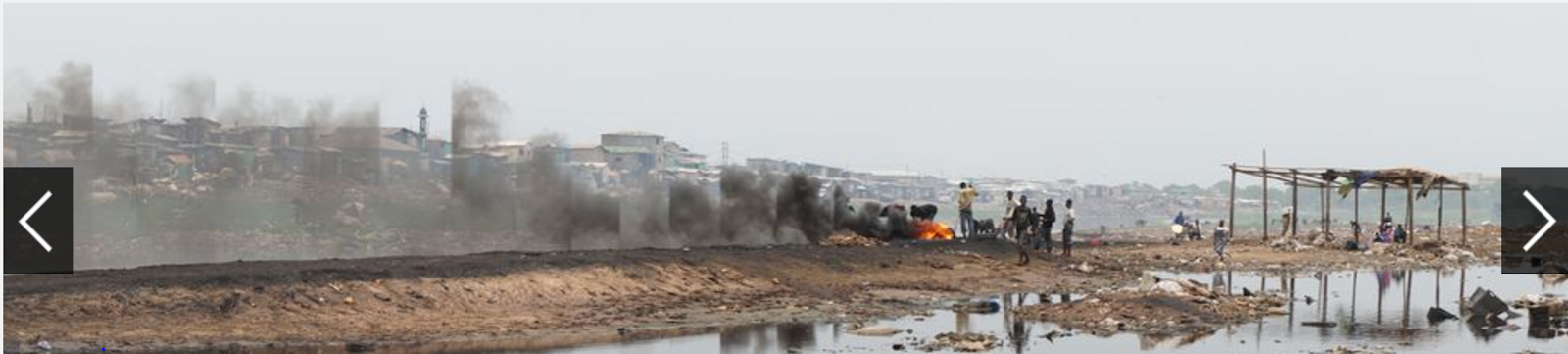
Landscape shot of the small small site at Agbogbloshie where close ups of kids perched on monitor casings takes place
I offered to do a presentation on how incredibly small and insignificant our topic is.  How bland, how navel gazing our concerns are from the perspective of the slum dwellers we wring hands and handkerchiefs about.  The background of the landscape photo I took shows the Old Fadama slum in central Accra.  The dump is across the lagoon.  And the most photographed, if not the largest, ewaste dump on earth is there in the center, on this side of the lagoon.

No kidding, folks. This is it for wire burning. I got photos of photographers on that tiny, barren spot, posing young slum ruffians on top of some of the few dozen devices found scattered on the lagoon bank.   See the "close up" of the same site at bottom... same tent in the background.

Above is another (landscape) view of this exact site and the 25 people burning wires there. Note tent behind girl

Editors Note: Status of WR3A Good Point Blog

Blog Status December 6, 2016.

Wahab, left, points to photo in Washington Post of Idrissa, who was struck and killed by a truck in 2013 or 14
Catching up on editing 4 blog articles (from "Collateral Damage" series) and one magazine article, and preparing for my presentation at ICM in Salzburg, Austria.  Also getting all my vaccinations for the re-visit to Ghana.   I'm double checking things from the draft Fair Trade Recycling report (2015 visit).

1- Does something bad happen  at Agbogbloshie?  Bad for health, for the environment, etc.?

2- If something bad happens, is it related to unfair export and import trade?

3- If something bad happens, due to unfair trade, is it illegal or a "loophole"?

4- If something bad happens, due to unfair trade, and it is illegal, should Joe "Hurricane" Benson and other Tech Sector African businesspeople pay fines or go to prison for it?

The answer to the first question is yes and no.  Or rather, some bad things happen, and some good things (better than if the goods were in the USA or EU) happen.  The worst thing is probably the men who burn wire and then use their bare hands to scrape metal out of the dirt and ashes.  The earth there will be contaminated by lead.  Some of the lead is from automobiles, some from leaded casings in older electric wire (not computers).  If they aren't washing their hands really well, they are likely to suffer consequences.

The good thing is that the goods are used for far longer than westerners use the goods.  Even after westerners have finihsed using the electronics, Africans will tend to reuse them twice as long as that. And hand disassembly is better for the environment than shredding.  And the cost of achieving internet, phone, TV, radio and other teledensity measures, per African is a TINY FRACTION of the upstream environmental cost per capita done by Western countries.  And most of THAT damage, from mining, occurs in places like Africa.
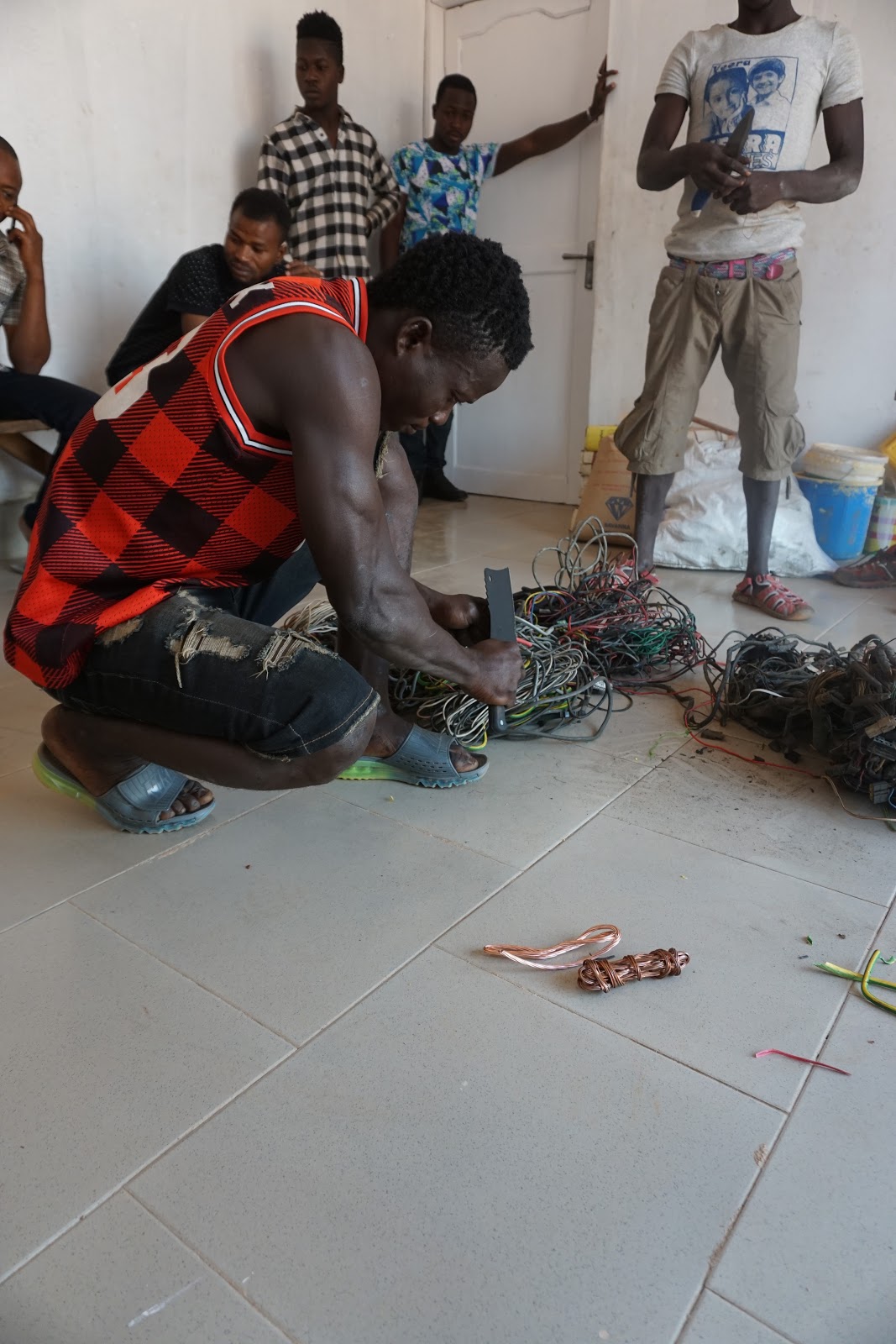
2 - No.  The junk in Agbogbloshie is far more likely to be collected from African city residents and businesses after 10-20 years of use than it is to be imported. The people saying that it came from sea containers being dumped to avoid recycling costs are making it up at best, and in some cases lying.

3. Not under Basel Convention Annex IX.  But - in reaction (over-reaction) to lies about #2, some EU countries have passed stricter laws.  It's like if you thought bananas were poison, and passed a law against selling bananas... yeah, banana sellers would be criminals.  But seriously.

4. No. This was a witch hunt.

Geography Baiting 3: Retribution Strikes Press Release from BAN

While we wait patiently for answers from MIT about the ethics questions we have on Senseable City's "joint project" with Basel Action Network, BAN strikes.
"40% of  e-Waste given to Recyclers gets Shipped Illegally to Polluting Operations Overseas" - Jim Puckett, Basel Action Network
Since we have sent multiple letters to MIT and emails to BAN, offering to meet to show our processes and all downstream information, we know that BAN is conscious of the false and derogatory information embedded in this statement, explained below.  The question is, do they do it purposefully to cause harm?

1.  It is NOT 40% of e-Waste given to Recyclers.

BAN never tracked 65% of the weight (CRT and projection TVs that practically never get exported).  They sample tracked 3 types of device (printers, CRT monitors, LCDs) and found - of those - that about 36% were exported.   36% of 35% is not 40%.

2.  Most of the 40% tracked was NOT shipped illegally.

We showed here on the blog devices tracked to reuse and refurbishing operations.  Also, Hong Kong doesn't consider printers hazardous waste and BAN attacks them for classifying them as non-hazardous waste even as BAN calls them "clearly" hazardous waste in their report.

3. Most Overseas Operations are NOT Polluting.

The one BAN focuses all their attention on - Mr. Lai's Printer Farm - is visually concerning, and it was NOT identified as a destination on our downstream tracking.  So kudos on that.  But to say it is representative of the 40% of 35% is racist and insulting.  Other devices went to places overseas anyone should be PROUD to work with.

But the point of BAN's report is clear.  They do not go after companies that pack and export.  They do not track most of the destinations.  They track my company in several pages.  It's because I spoke out about them.  I believe that is the message here, to make other recyclers afraid to speak up on behalf of the geeks of color, to intimidate those of us who object to racial profiling, who do NOT pay them tribute money via E-Stewards (using an E-Steward company shows prominently on the press release, though the GPS tracking didn't show that to be determinate).

My company baled 95% of the printers we received for shredding - some by E-Stewards, all by R2 certified companies.  Of the FIVE (5%)* our crew found potentially reuse and repairable, we either tested them ourselves or more likely sent them to another R2 company which listed reuse as a potential outcome (not 100% shredder).   It was one of those 5% nice-looking ones that we sent to a USA company, which had listed certified Hong Kong destinations as their partners.  And, notably, one of those BAN and MIT chose to send to us.

When BAN and MIT hide the data we requested since last May, it just makes it hard for us to respond.  BAN plays the Bilbo Baggins Riddle "What (data) have I got in my pocket?"   We did find some of the tracked devices DID go to the Hong Kong EcoPark. If ours did not - and I accept that now - we have to find out who misdirected it (the USA company or the Hong Kong certified company).  Even if it was legal, it may not be acceptable.

For all we know, the device WOULD have been reused and repaired if not but FOR BAN's Sabotage.  I don't open all the halloween candy I buy to make sure no one sabotaged it.  Until now, I doubt anyone has opened a repairable printer and cut up the guts to make it unrepairable.  There's a word for that, but it's not a polite one.

The point is that BAN is a bully and directs its Reports and Press Releases not to enlighten, but to casuse people to fear them, and to pay them tribute.  It is because I read the Report, studied it, tracked devices to different places, made 14 pages of comment and critique, that my company is profiled in the report.  What I want to know is why people at MIT would not see this for what it is.

We did not, NOT export the device.  We send printers we have DETERMINED to be unusable to a shredder, and that is MOST of the printers.  If BAN intended to show we export, they'd choose a printer that sells for ten times scrap value on ebay and Amazon, and they'd make it unrepairable with internal damage.  We did not export even THAT (Jim stated we "exported to Chicago" in his email).  This is a spray-paint job by BAN.  And while our Chicago partner has offered to just let me "push him under the bus" (and claim it wasn't us), I prefer to out this Senator Joe McCarthy.

At long last, NGO, have you no sense of decency?  Have you no shame?

* (Ed correction -. first edition of blog mistakenly reported on 95% not repairable by omitting the word "not". Only 5% of printers at my company have been set aside for potential reuse in 5 years)

Press Release Below.

Secret Tracking Project Finds that Your Old Electronic Waste Gets Exported to Developing Countries
40% of  e-Waste given to Recyclers gets Shipped Illegally to Polluting Operations Overseas
September 15, 2016. Seattle, WA. Utilizing high-tech methods to track high-tech wastes, the environmental watchdog, Basel Action Network (BAN) as part of their e-Trash Transparency Project, funded by the Body Shop Foundation, planted GPS trackers into 205 old printers and monitors and then delivered them to charities and recyclers. The new report, entitled Scam Recycling: e-Dumping on Asia by US Recyclers, revealed that of those that were handed over to American electronics recyclers, 40 percent did not get recycled in the US as expected by customers, but were instead exported to highly-polluting and unsafe operations in developing countries -- mostly in Asia.  

"The American public continues to be scammed by unethical companies greenwashing themselves as 'recyclers'," said BAN Executive Director Jim Puckett.
"The toxic chemicals released by the crude breakdown of our old electronics in the junkyards in Hong Kong not only harms workers and communities abroad, but comes back to hurt us as well. We are the only developed country in the world that ignores this problem. It's time to stop say 'enough is enough'."
Among the findings of the report, BAN found that:
  • 40% of the 152 deliveries to US electronics recyclers went offshore -- mostly to China
  • 96% of the exports are likely to be illegal under international or US law 
  • 93% of the US e-waste exports moved to developing countries
  • 75 companies were involved in a chain of transactions that led to export of e-waste.*
  • Many recyclers involved in export made website claims of never exporting
  • "R2" Certified Recyclers exported at greater than average rates, e-Stewards
    Certified Recyclers at less than average
  • Hong Kong electronics junkyards expose workers and the environment to dangerous toxins such as mercury. 
The exported tracked devices, travelled to Hong Kong (37), Mainland China (11), Taiwan (5), Pakistan (4), Mexico (3), Thailand (2), Canada (2), and one each in United Arab Emirates, Togo, Kenya, Cambodia, and the Dominican Republic. MIT's Sensable City Labs worked in partnership with BAN to produce an interactive online map
 to show the pathways of all of the 205 trackers.
Most of BAN's trackers had found their way via ship and truck to 48 different sites in a semi-rural part of Hong Kong known as New Territories. BAN travelled there and visited the precise locations where the trackers ended up. They found massive volumes of LCD monitors, printers and other electronics being smashed each day and broken apart by hand in hidden junkyards, allowing the release of printer toners, and mercury phosphors easily inhaled by workers both unprotected from, and unaware of, the hazards.  
BAN also looked at the electronics certification programs designed to improve ensure recycling management. The "R2" certification program created as a result of an EPA convened multi-stakeholder process has about 5 times more certified recyclers than the e-Stewards program (a more rigorous standard), but it was found that "R2" members had a higher rate of being associated with export than even uncertified recyclers. Recyclers certified to the e-Stewards Standard had the lowest export rate. The e-Stewards Standard was created by the Basel Action Network together with industry leaders. It is designed to be fully consistent with international law and is the only e-recycling program that utilizes tracker technology to verify conformity with the standard.
The BAN report calls for the following key recommendations:
  • All consumers and businesses concerned about preventing pollution of the global environment should make exclusive use of e-Stewards Certified Recyclers
    .
     
  • President Obama should sign an executive order to prevent US government e-waste from being exported overseas.  All others can sign petition for this
    .
     
  • Manufacturers, governments and recyclers should commit to full transparency of where they send all of their hazardous electronic waste.
Hong Kong government should ban all imports of hazardous e-waste and close the informal New Territories junkyards.

Download the report here:

For more information:

Jim Puckett, Executive Director, Basel Action Network