Showing posts with label International. Show all posts

For Our New German Blog Readers: See You in Salzburg


The number of blog visits is up in 2016, compared to 2015.  Hopefully that is a sign that I've been engaged more relevant topics. Views from Europe, India and Africa grew in number and duration.

"Why We Should Ship Our Electronic 'Waste' To China and Africa" ran in Motherboard Vice five years ago.  Klaus N. read it in Germany and decided to do a piece on it for 3Sat (German language equivalent of PBS, I'm told, which broadcasts in several countries).  That led to a pretty steady dozen or so readers in West Europe.  This year, the number is close to 100.

Some of the attention is probably "reflected from the mud".  Kevin McElvaney published the arm-flailing Mike Anane's absurd claims about Agbogbloshie ("the biggest e-waste dump on earth") Sodom and Gomorrah? Fishing as a Boy?..."), which led to interviews in all kinds of German news, and led to a flurry of follow up visits to Ghana by other aspiring documentarians.  A textbook case of photojournalism running off the reservation without a hint of datajournalism to support it.  The posts here which provide links to World Bank and other data seem attractive to the photographically inspired.

In any case, Fair Trade Recycling is now a curiosity, if not a known quantity, in Europe.   I'm preparing my presentation for ICM, 16th International Electronics Recycling Congress IERC 2017 in Salzburg, Austria, where I will sit side by side with Jim Puckett of Basel Action Network on a panel in front of hundreds of European regulators and researchers.
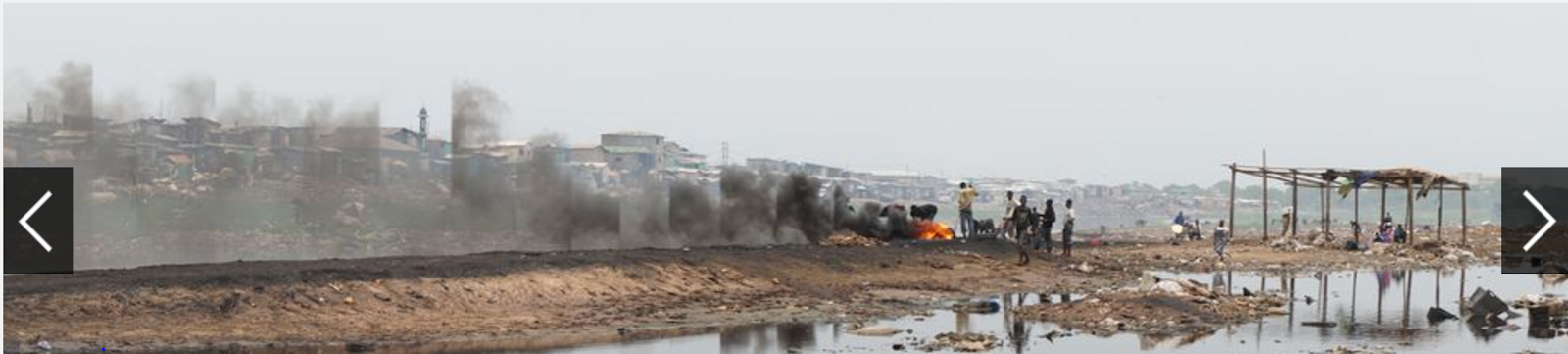
Landscape shot of the small small site at Agbogbloshie where close ups of kids perched on monitor casings takes place
I offered to do a presentation on how incredibly small and insignificant our topic is.  How bland, how navel gazing our concerns are from the perspective of the slum dwellers we wring hands and handkerchiefs about.  The background of the landscape photo I took shows the Old Fadama slum in central Accra.  The dump is across the lagoon.  And the most photographed, if not the largest, ewaste dump on earth is there in the center, on this side of the lagoon.

No kidding, folks. This is it for wire burning. I got photos of photographers on that tiny, barren spot, posing young slum ruffians on top of some of the few dozen devices found scattered on the lagoon bank.   See the "close up" of the same site at bottom... same tent in the background.

Above is another (landscape) view of this exact site and the 25 people burning wires there. Note tent behind girl

Fair Trade Recycling Summit in Vermont Earth Week 2013


Middlebury College Environmental Studies is hosting a Summit of researchers of "e-waste" or WEEE exports on April 16.  The Summit will be streamed online at www.fairtraderecycling.org.   It is funded in part by a Canadian grant of $479,000 to Memorial University, University CP de Peru, and University of Southern California (LA).

Researchers organized the Summit in order to interview actual importers of used electronics in five countries.  They will be joined by experts from MIT, Monterrey Tech Guadelajara, University of Amsterdam, and Universite Paul Cezanne of France.  A representative of the Swiss Basel Convention will speak about 2-year studies in Nigeria and Ghana, and the US International Trade Commission will update attendees on its new 2013 calculation, that 88% of used electronics exports are reused.

In fact, Researchers from Peru, Basel Convention, US ITC, and elsewhere have consistently found 85%-90% of the used electronics purchased by Africans, Asians, and South Americans are reused, and that the 10-15% fallout is comparable to new goods.   Most experts say that material filmed at dumps is collected from cities in emerging markets which have used up the equipment imported decades earlier. IT importers from Egypt, Ghana, Burkina Faso, Peru, Indonesia, Malaysia, Mexico, Angola, and Colombia are attending the Summit, to meet students, and explain that they cannot afford to pay $21 per unit, plus thousands in shipping, to burn material on the ground.

Fair Trade Recycling, an international NGO based in Vermont, organized the Summit.  EPA, Interpol, and other enforcement agencies have committed to participate online.  The enforcement agencies will be asked who originated the statistic that 75% of the imports are dumped and burned (creating a presumption of guilt among used IT importers).  FTR representatives hope to shift the burden of proof, so that exports of used IT are not presented as de facto "e-waste", and to address the need for appropriate recycling techniques and hand disassembly systems.  The association of exports with "primitive" or "informal" recycling and dumping (via widespread coverage by CBS 60 Minutes, Frontline, USA Today, Oprah, NPR Fresh Air, etc.) doesn't address the problem if those wastes were not recently imported.  (a Seattle NGO has emerged as the probably source of the claim that 75%-90% of used IT imported by Africans are immediately sent to be burned in dumps).

List of Speakers and Biographies, 2013 Vermont Fair Trade Recycling Summit

Another Rich Story Ends: Yadji Moussa


Yadji Moussa was a man I met in Cameroon.  He became my most trusted friend there.  We spent many mornings speaking philosophy, over a cup of sugared tea into which I'd dip the fresh local bread. I trusted him to give it to me straight if I wanted to know the "African Street".  He kept me under his wing.


He told me he had problems in the past, that he had been at "rock bottom", and described those tough times in detail, with humor, making me laugh.  


During the 30 months I lived there, he only seemed to do better and better.  I have written about times that he was a hero in the town of Ngaoundal in Adamawa Province.  He had a way of being covertly confrontational, leaving friends and authorities to puzzle whether he was religiously passive, or feigning self-effacement, or ready to cut to the chase with a direct challenge.

He continued to do better and better after I left Cameroon, and Renee, my peace corps volunteer replacement, agreed he was something special.   They married and had two kids, Innah and Adamou, and returned to the USA to live in Michigan, around 1989 or 1990 I think.


He revisited rock bottom a few times, and the marriage broke up in 2000.   I owed him a lot from my time in Cameroon, and brought him to Vermont to start a business with me.  Yadji worked with me for 12 years in Middlebury.  

Yadji drowned June 21, while I was celebrating my twins birthdays in Arkansas.  I got a lot of calls in the spotty coverage of the Ozarks.  I wrote most of the blog while sitting in my parents living room in Searcy County, trying to decide whether to take my kids canoeing on the Buffalo River.  We decided to return and assist with the arrangements for Yadji, who for many years I described as my best friend, and for many times I was furious with, as only a brother can be.  I've decided to give this rewrite, to give the record another shot, because Yadji Moussa deserves the best.

Government and Recycling International

"Avoided disposal costs" economics, which I helped pioneer in the 1970s and 1980s, has turned "toxic".

Normally, economically developed economies throw out more and more waste (garbage) as consumers gain confidence, buy new, and discard things of marginal value which take effort to maintain.  When your neighborhood is wealthy, no one wants your "free" black and white television, and it goes into an attic or basement or garage.

Hong Kong Modern Lined Landfill SE New Territories
As my generation became aware of population growth, finite resources, and habitat consumption, we were alarmed.  We wanted to save trees, to avoid mining, to save endangered species, preserve habitat, and conserve energy and carbon.  Recycling was a concrete, conservative, karma yoga way to do all of those things.

It seemed risky to say I'd get a job "recycling".   At the time, Recycling was akin to dishwashing. I didn't know anyone wealthy doing it (unless you counted the same mills switching to using virgin material according to price points).  The economics of making more money collecting scrap were at odds with providing the scrap more cheaply, which is what the Big Picture wanted.  Recycling needed to be plentiful and cheap to win over mill consumers, and not owning a mill, I was at the collection end of that equation.