Showing posts with label export. Show all posts

The “E-Waste” That Built China’s Good-Enough Computer Market

 I started this blogspot in 2006. 


The “E-Waste” That Built China’s Good-Enough Computer Market

I started this Blogspot in 2006. Considering a move to Substack.

At the time, blogs could still attract professors, journalists, regulators, recyclers and overseas buyers into the same argument. Some consequential things happened here. The blog helped expose the “80 percent of e-waste is exported” statistic as a press-amplified hoax. It documented the African technicians and importers whom Interpol’s Project Eden treated as environmental criminals. Eventually, those arrests stopped.

Today, attention spans are shorter. Most of my new blog posts are little longer than a weekly LinkedIn or Facebook post. Worse, because embedding a funny or provocative YouTube music video was considered clever 15 or 20 years ago, Google now appears to penalize or de-link many of those older posts. I may have to revisit hundreds of them and remove the dead or distracting video inserts.

Honey badger don’t care.

The evidence in those posts still matters.

Two stories about China that no one connected


In September 2007, Harvard Business Review published an article by Bain & Company chairman Orit Gadiesh and Bain partners Philip Leung and Till Vestring titled “The Battle for China’s Good-Enough Market.”

The authors described a rapidly expanding Chinese middle market for products that were reliable enough and affordable enough for consumers who could not—or would not—pay the premium demanded by Western brands. Chinese manufacturers were learning to serve that market at enormous scale and could eventually use the same skills to compete in India, Brazil and even developed economies.

The Bain article understood something that most Western environmental journalists did not: “good enough” was not a euphemism for garbage. It was a sophisticated manufacturing strategy.

But Bain told only half the story.

Two years earlier, at RECCON-05, Helen Su had presented slides showing one of the supply chains feeding that Good-Enough Market: semi-knockdown, or SKD, factories purchasing used CRT monitors as reusable manufacturing cores.

These were not primitive dumps where Americans abandoned unwanted computers. They were factories testing imported monitors, recovering functional cathode-ray tubes and combining them with new or replacement electronics, wiring and plastic cabinets to manufacture affordable displays.

The Bain consultants saw the Good-Enough Market from the boardroom.

Helen Su showed us what it looked like on the factory floor.

Almost no one connected the two.

Emmanuel Nyaletey and BridgeSolarPower.com

Emmanuel Nyaletey and BridgeSolarPower.com

One must always balance the expression of joy against the "humble brag".  From time to time, I can't resist open enjoyment of the staffers and buyers who came to Good Point 


At this year's Orlando E-Scrap Conference, Emmanuel Nyaletey (and Patty Whiting) will be on a panel with our old friend, Jim Puckett.

Blog Readers will doubtless remember Jim Puckett's description of Agbogbloshie ("on the outskirts" of Accra rather than "dead center") in his creative writing essay "A Place Called Away". Less familiar, perhaps, was Emmanuel's 2014 X.com (TWITTER) video describing what Agbogbloshie actually is/was, from the point of view of a Ghanaian who grew up blocks away and who refurbished computers as a kid in Ghana.

The BridgeSolarPower.com plan is to work with OBADA.io to create Digital Product Passports. Africans who purchased secondhand solar panels - upgraded due to high real estate costs in OECD nations - can tag (QR code, blockchained) and regularly report on reuse for carbon credits.

Who might be against that?

Civilization corrals the Amygdalas: Howler Monkey Gods

Amygdala Hijacking sounds uncivilized. But it's hard to imagine a society without it.

Societies will always vote for a dictator over chaos, or in reaction to a fear of anarchy.  But this isn't a political post, at least not yet. 

First a disclaimer... I believe in "Western Civilization", but think the term "West" is in some ways a historical accident. The great library burnings in the mideast, Alexandria, and most especially the Aztec/Inca libraries destroyed by self-proclaimed Spanish "Christians" hid the evolution of other logical and obviously city-pyramid-construction-capable cultures. 

But while "cultural cleansing" is a historically obvious problem, the current DEI narrative fails to recognize its universality. Am I mistaken, or didn't Hopi Indians build pueblo structures whose sole purpose was to protect them from the Apache "race". Incas had wars and who knows how many libraries were burned by Alexander the Great? Or how much of the greatest loss - the library of Alexandria - was pilfered from other libraries in Mesopotamia and south Asia conquests?

So the theme today is taking an actual provable problem and weaponizing it to achieve Authority. And as the symbol of that authority let's not use "high priest" or "ayatollah of e-waste" or "priestatollah", but the Mayan Howler Monkey God.

The Torching Critical Mass of Used Solar Voltaic Panels at Africa Barber Shops

Accra, Ghana:  Every barber in the city knows the other barbers in the city.

Every person in the city knows a barber in the city.


The leasing of used solar panels, imported from Vermont, can light a torch - so to past-speak - on rapid adaptation of solar panel electricity in Africa.  And Africa is obviously the fastest growing population on the grandest continent. Unless our plan is for Africans to live without electricity and not cook their food, they will continue to buy expensively off of a limited electric grid, and buy illegally deforested charcoal to cook their meals.

Jim and Daniel Puckett, just come here right now and attack this export of used solar panels for good and proper use. That's your thing...Get it over with.

The electric grid in Africa was meticulously studied before I lived in Africa as a Peace Corps Volunteer+-3

See these African Tech Geniuses getting free secondhand panels and measure the gallons / liters of diesel they save every day, every single day, from the ubiquitous diesel powered electric generators which are feeding demand since IMF and World Bank ran out of rivers to Akosomba Dam Hydroelectric fund.

The Battle for Reuse "Good Enough" Market: Solar Panel's "Primitive" Recyclers

There is a nascent discussion at SERI R2, 
at EPA, and E-Stewards 
about what the "maximum life" of solar panels are. 

I've had several discussions with experts like Cascadeem.com's Curt Spivey, Veolia's Paul Conca, and solar panel manufacturing experts on what "specification" a panel must meet before a buyer is allowed to be "legitimate". 


Curt and Paul are smart, but they are nervous about their own "accountability" - that they may be held to if they sell their clients' electively upgraded panels overseas.  Other recyclers are taking a strong a priori stand against export of solar panels for reuse.  Note that these are potential sellers of used equipment, discussing which buyers are "legitimate" or "primitive". 

It's a continuation of privilege. No one seems to worry about the mining of raw materials in developing countries, despite the fact that the cleanest virgin material mining is worse than the worst possible recycling. But are the others good enough people to get their electricity from a reused solar panel? If in doubt...

The video above is a 42 year old solar panel sent to Good Point Recycling for end of life recycling. It's widespread "truth" that panels function for 30 years. But that "30 year estimated life" statistic was put in print before any panel was more than 10 years... it was (like "80% of ewaste" stats) made up by someone with zero knowledge of the future life of the panel... ostensibly I'm told it had something to do with a procurement specification or waranty request.  But "30 years" is hocus pocus, not reality.

Why RERA/SEERA is BAD Export Policy - baby projects thrown out with the bathwater

Much time away from the blog this spring... The RERA/SEERA (Responsible Electronics Recycling Act, rebranded as the Secure E-Waste Export and Recycling Act) made it's sneaky appearance in the House "America Competes Act" in February 2022. I've been writing letters, and editorials against Section 30612.

That's scary. Under the Texas (always Texas, since Green Thompson) amendment, and now 

S.1260 - United States Innovation and Competition Act of 2021.

But rather than blog about it again, I want to list the cool projects Good Point is working on that might be ruined by the anti-export law.

1. Reopen refurbishing factory in North Africa.


more

OXPECKER BIRD 1: SEERA Goes Off Like a Forgotten Land Mine in H.R. 4521


My company has long flittered around like a Red Oxpecker Bird, landing on the shoulders of great 

investors in the USA "E-Waste" industry.  We are occasionally recognized, allowed to sing, and hop about conferences looking for parasitic ideas in the ears of our industry. But the worst thing to happen in 20 years may be buried in the text of a major House bill, H.R. 4521. (annotated text link)

(helpful hint, don't open US Congress bill in Chrome, use MS Edge, there's a Chrome bug)


Here is the 2009 Version HR 2791 (don't try in Chrome)  H.R.2791 - 113th Congress (2013-2014): Responsible Electronics Recycling Act | Congress.gov | Library of Congress


Here is the 2016 Version  HR3559 (don't try in Chrome) 

Text - H.R.3559 - 116th Congress (2019-2020): Secure E-Waste Export and Recycling Act | Congress.gov | Library of Congress

And Here is the current Recycled Version, which finally made it out of the House of Representatives.

H.R.4521 - 117th Congress (2021-2022): America COMPETES Act of 2022 | Congress.gov | Library of Congress

Notice the 2022 bill, which passed the House, is buried inside the language of a much longer bill. This was not able, in 13 years, to survive on its own. This is Jedi Lobbyist, not NGO. No Senate member has heard any testimony This is an unmarked land mine.

Because the USA has strong OEM warranty laws (Magnusson Moss Warranty Act of 1975), OEMs have for years used more copper, stronger materials, and extra testing. Our electronics, internationally speaking, have "bullet-proof" reputaton. USA Home-Used is a stronger brand in Ghana or Cameroon than brand new from China. The USA has no competition in used goods. Our used goods are sought out, "solid state", it's a unique advantage USA consumers have if they want to sell their used goods abroad.

"America Competes Act" should recognize that simply by DEMANDING a #Right To Repair, we are bolstering our competitive position in the secondhand goods market.

This may take a few blogs but for the Swordfish Readers who follow the history and origins of these anti-reuse, anti-repair, anti-DIY, anti-#RightToRepair, Pro-Obsolescence, greedy mess makers behind this bill, some history boxes need to be checked.

The "short answer" to the Senate reconciliation or Conference Committee is why allow this RERA, SEERA, 13 year old land mine to enter the Senate version of the bill without ever a discussion or debate? Why does the self-same restrictive language supported by #ProvenFalse 80% bad export claims, #ProvenFalse bad for USA recyclers claims, suddenly get branded as a "national security" concern? The argument seems to be that if TV parts are allowed to be exported, that they might wind up as a reuse chip embedded in a US soldier's walkie-talkie. This absurdity is why the language of the bill, which has barely changed even as it's justifications could fail a high school creative writing class, is suddenly buried 13 years later, like a forgotten land mine.

It's the Anti-Reuse-Terminator 13. I'm 60 years old now, and it keeps reaching out and grabbing me like an unfriendly anti-Iron-Giant (classic animated movie about fear used to justify violence, and the potential for self-repair is the silver lining as the destroyed robot's screws, chips and pieces are seen to reassemble the friendly giant at the closing credits).

Universal Waste and the Fallacy of Failure

 Had a long and frustrating conversation with a pal of mine who is presenting to a council on CERCLA - the law enacted to clean up pollution disasters. CERCLA, or Superfund, is backward looking. It is not a seat belt or an air bag, it's a law to clean up the highway accidents by assigning cleanup costs to those who drove the car or fueled the tank.

First, here is the photojournalist take of a large failed warehouse.

Landlord warehouse in Columbus OH, courtesy of Resource Recycling magazine.


The pal called to present his recent takeaway from Closed Loop Refining and Recovery failure, an abandonment of CRTs and CRT glass at facilities CLRR rented in Arizona and Ohio. That highway accident was perhaps the biggest blemish on Electronics Recycling Programs across the country. Or perhaps, it's not. But owing to the landlord's use of CERCLA (Superfund Law) language to go after clients of the CRT Recycling company, CLRR certainly made the news, and elevated what was not the largest of CRT glass markets to become emblematic of the CRT recycling industry.

Cars driving the speed limit on the highway don't make the news. CRT recyclers who continually processed CRT glass, under the conditions of the EPA CRT Rule, were able to move far more material than CLRR - because they were moving it.

CLRR was driving twice the speed limit day after day by the end of the third quarter 2013. And by speed limit, I'm referring to limits on the conditional exemption to hazardous waste law - rules against speculative accumulation, and processing deadlines to produce "furnace ready cullet".

The consulting pal said that the root cause of the failures was the EPA CRT Rule - which I helped write in 1999. He said that had the EPA instead classified the CRTs as "Universal (Hazardous) Waste", that CLRR would not have happened.

This thinking is typical of CERCLA, which only focuses on disasters. People can make up whatever they want about coulda-shoulda-woulda, and the disaster appears to be the evidence that if "mistakes were made", that the wording of the laws in place that didn't prevent this accident must be to blame.

This is like a call to lower the highway speed limit from 70 to 50 MPH, when CLRR was driving 140. The fact is that if any regulator, certifying body, landlord doubling rented space, or supplier doing normal due diligence on CLRR had examined the requirements of the existing CRT Rule, and mass balance records from CLRR, they could only draw one conclusion by the end of 2013. I know, because I did the diligence, and cut off shipments to CLRR in 2013 until and unless the company corrected the expired and exceeded requirements of my diligence.  And I cut them off despite them lowering their fees to my company, and despite it being the beginning of the worst year in the history of my company - the Vermont Opt Out Plan settlement of 2014.

Michael Shellenberger's Mad at Solar Panels. Too Cute Substack Fallacy.

SEE VIDEO: WHY DECOMMISSIONED SOLAR PANELS ARE NOT DEAD YET.  

Like flip phones, CRT monitors, hotel TVs, ex-boyfriends, and used cars, your decision to electively upgrade to a newer solar panel does not mean the ex-panel's life won't go on.


I was coached that people don't have time to read everything, so here's the jist... Shellenberger's thesis is that solar panels are being upgraded far sooner than their 30 year warranty or 40 year estimated lifespan would have buyers assume. That's true, I just gave a presentation on that at NERC.org.  But the reason for the upgrades is not that the used panels are failing or are waste... It's because 
  • the price and efficiency are falling, 
  • the number of roofs is finite, 
  • the cost of siting big solar fields near populated areas is skyrocketing
  • early adapters like to upgrade to something new
  • AND by 2028, virtually every older working will panel be cost-driven to replace
I have a whole presentation explaining this (Start at 2h 30min, NERC.org recorded session). Like desktop CRTs and Pentium 4 laptops, the solar panels are all going to get electively upgraded.

BUT  like those other items, the secondhand market is gobbling up replaced solar panels. And here's where the circular economy doesn't revolve around you, Michael Shellenberger - a 50% efficient panel replaced by a 100% efficient panel in Vermont GENERATES MORE KW IN AFRICA THAN THE NEW ONE DOES IN VERMONT.

Check out @AdamMinter's Twitter reply string to @ShellenbergerMD (he's not an MD, btw, he uses his first and middle initial).

MORE >

Don't Let #CircularEconomy Mean #PropertyColonialism

 The previous blog opened with a some photojournalism chestnuts from a decade ago - when Greenpeace slipped reporters a mickey, and showed journalists a sea container full of identical CRT TVs from a hotel upgrade shipped to Tema, Ghana - and then a 70 year old black and white Magnavox kitchen table TV housing in Agbogbloshie. What should have been proof that Agbogbloshie was an #ewastehoax was passed around as evidence of #environmentalinjustice.

There IS environmental injustice on display - it's when Western NGOs conflate the recent importer, the valedictorians in the Tech Sector, the "Geeks of Color", with wire-burning "primitive" recyclers from the slums who eventually gather used imports after DECADES of reuse in the #goodenoughmarket.

This week, we see evidence of the same tactic, via another NGO.  "How Romania Turned Into an Illegal Dumping Ground for EU Waste".

Check out these photos from the article, which claims that "rusting" metal farm equipment is "burned" in Romania landfils. Shocking, but not in the way the writer intended.


The claim that the "rusty" meatals are "burned in landfills" after being purchased in Western Europe is bigoted, stupid, and every bit as stupid as the 2010 claims that Joe Benson was importing the 1970 kitchen Magnaox watched by Prince Nico Mbarga.

WasteDive Asks: Are Solar Panels the Next CRT Recycling Problem?

 Our small Vermont company gets 2 big stories in July.

First, Recycling International is publishing a 2 page interview with Yours Truly, whose small Vermont Recycling Company has catapulted to #36 on the Magazine's list of Notable Recyclers worldwide (and that's not just "e-waste").

Do we belong on a list that includes Robin Weiner of ISRI at #15, or author Adam Minter at #6?

My only explanation is ironic - compared to similar lists a decade ago, Recycling International now realizes there are hundreds of well-managed recycling companies in places like Ghana, India, China, Pakistan, Indonesia, Singapore.  After reading their interview of me, I realized the irony that a) thanks to us (and this blog), the list is much harder for a white American to get onto, and b) we are deliciously placed several rows above Basel Action Network (screenshot below), which tried to get me labelled as a pariah after being called out for profiling Joe "Hurricane" Benson as a "primitive recycler" (rather than a 25 year expert at reuse export) based on his nationality.


But before I "bury" the lead about solar panel recycling ---  it's been my honor to put together an esteemed panel on how Solar Panel Reuse in Emerging Markets may offer the same solutions as it offered SVGA computer monitors 20 years ago... Register at NERC.org for a front row on Zoom, as I participate with Emmanual Nyalete of Ghana, Lennart Banaszak of Germany, and Good Point Recycling's very own Solar Nerd Trevor de Young (who's trailer home is almost completely "off grid" with salvaged solar panels - including some deliberately smashed by the solar de-installers in an botched "end of life" crime).

(see hammer marks, which rendered this panel 50% efficient. If it is relocated to Ghana, the 50% efficient panel will produce more KWH - due to abundant sunlight - than it produced in Vermont before it was "sabotaged" to prevent reuse).

Katie Pyzyk's interview in WasteDive explores our pilot program for solar panel reuse... and finds parallels to the CRT Reuse concerns that resulted in California SB20 and piles of shredded leaded CRT cullet across the West.

Ethical Automobile Airbags - Sodium Azide. Carcinogen, Mutagen, Toxin saving lives at EOL

 Work up this morning wondering where automobile airbags wind up when used cars are sold for reuse in Africa. 

The automobile airbag, mandated after valiant effort to protect consumers by Ralph Nader's organization in the 1970s, is a wonderful invention.  Here's a video of one deploying.


Cool huh? But after your life is saved in the crash, what happens to the airbag? 

How it works (at least in older models of cars, most often exported to Africa) is that a highly toxic, known mutagen, suspected carcinogen, CDC advisory toxic chemical SODIUM AZIDE is triggered by an electrical charge.

Part 2: How (too) Quietly The E-Waste Big Lies Are Buried.

 Ok, here's a short but important point about the Basel Convention, and the press releases (like today's from Basel Action Network) that seek to expand it to cover normal non-toxic secondary raw materials like plastic, ROHS compliant circuit boards, and even secondhand reuse.

#FLOWCONTROL

"Non-OECD" meant one thing in 1960 when the (all white country) OECD was assembled (Japan was an afterthought).  "Non-OECD" meant a completely different thing in the mid-1980s when the Basel Convention sought to keep pollution abatement costs / regulations in OECD nations from being subverted through international dumping (like the Trafigura toxic waste scandal of 2006).

"Non-OECD" is, today, a caricature of 72% of the whole world. It's a post-colonial era systemic system of flow control that has been used by Western Nations to try to keep their Big Shred companies from competing against what is now the MAJORITY of manufacturing capacity.


Many Blog Posts are Emails To Academics: Urbanization Politics of Agbogbloshie

This is an email I just sent to a European graduate student, who is attempting to do a major research (thesis?) paper on Agbogbloshie.

I always have taken time to encourage researchers. It is part of my "fishing for swordfish, surrounded by perch" philosophy of blogging. The blogs are ignored by most people, because most people don't have the bandwidth to really focus on them, or to do a deep dive, or review ground already covered.

But these emails and blogs reach people who are truly concerned, and who ultimately discover that there is an almost sinister systemic manipulation of "do-gooders" empathy to accomplish monetary gains. I usually talk about the Western (and now Asian) lobbies - Big Shred, Planned Obsolescence, and Charity Industrial Complex.  But in this morning's email to the Swiss based graduate researcher, I like to remind us that Africans have Agency, even if some of their agency is systemically marginalized by the desire for shiny white consciences. 

In Accra, Ghana, it's the land value stupid. Agbogbloshie, for decades (IMF and World Bank papers go back to the 1960s) has been an urban scrapyard next to the Old Fadama slum.  If you want to know what is ultimately going to happen, read about the Kowloon slum in Hong Kong. All the "recycling" story is just using BAN propaganda to leverage demolition and expulsion of some of the most valuable real estate in one of the richest African urban centers.

It's not about you, or your old computer.


Revenge of the Certification - SERI, E-Stewards Make Threats

As a former regulator, I know better than to let a regulated party "get my goat" and draw me into a pissing match. While I had the power of "you can't fight city hall", the regulated party merely has to create the "appearance of impropriety", not prove impropriety itself.

I've been glared at and - in the case of E-Stewards - directly threatened. "Stop saying bad stuff about us. I don't want to have to go after you." Promise, that was said.


The Righteousness Trap: Do Ewaste Exports Pollute, or Empower, Africa?


The Righteousness Trap.

A problem recognized years ago comes into comically dramatic form in the Netflix Series "Tiger King". When megalomaniacs think their opinion is righteous, their followers and staff - and Big Cats and Export Markets - become collateral damage.

By Chris McAndrew - https://api.parliament.uk/Live/photo/bxXGHuLA.jpeg?crop=MCU_3:4&quality=80&download=trueGallery: https://beta.parliament.uk/media/bxXGHuLA, CC BY 3.0, https://commons.wikimedia.org/w/index.php?curid=67598764 Righteousness Trap

Lord Chris Smith [LCS] (Christopher Robert Smith, Baron Smith of Finsbury, PC, to be exact) inspired INTERPOL's Project Eden. He wanted to show he meant it, and demanded the prosecution of Joseph Benson. Over the course of Project Eden's 5 year mission, LCS ignored multiple studies that disproved his claim of "80%" waste dumping. He is not a bad human. He just got trapped.

He strives to be a righteous human. So righteous, in fact, that he gloried in others following him...

Into the Righteousness Trap.

The initial assumption - that Africans were coming to Europe to BUY Europe's worthless e-waste - paying thousands per container to prepare, ship, and clear it through customs - and then dumping 80% of it into a city landfill - was preposterous. There is no way that Lord Chris Smith or his team interviewed a single person in Africa's Tech Sector.  They had zero physical evidence of their public contention that 80% of these exports were for scrap.  They wallpapered announcements with photos of African children, and described African metal recycling community with words like "pawed at" and "primitive". To an experienced exporter and former Peace Corps volunteer like yours truly, Project Eden was fundamentally bigoted at the outset. 

Righteous environmentalists - like priests and ayatollahs - can become blinded by praise and pride. Unconscious of their institutional racism, they never checked whether junk in Agbogbloshie is decades older than what is being imported to Africa today. They never even took the most basic step - available in seconds via online World Bank data, to see how many millions of Ghana households had at least one TV set 15 years earlier, or to compute how many TVs would be "normally" in the junkyard.  They went directly to rewrite the rules to criminalize Joe Benson's business, and then spent five years making his life miserable and flagrantly declaring his guilt in the press.

Exports of functional and repairable electronics empowered Africans with the critical mass of users profoundly necessary since 1960 to support the infrastructure of electric grids, radio and TV broadcasts, internet cable, dedicated satellites, and mobile phone towers. If not but FOR #freejoebenson, Africa would not have been "EDEN", your holiness, any more than Joe Exotic was preserving tiger habitat. The control of the trade by one party is control of empowerment.

Do ewaste Exporters pollute Africa, or empower Africans?  

A handful of experts who knew next to nothing about Africa's Tech Sector, electric grid, mass communications, consumer demand, or scrap metal recycling sector were holding meetings and conferences with each other to write the rules for Africa. They decided their answer.

Interview with Ghana TV Repair Veteran, and Black Elk Speaks by John G. Neihardt

A Great Gift - The Ability to Interview Elders

Why do some of us become very attached to our grandparents, and others of us secretly dread the holiday base-touch?  Why do some of us spend thousands of dollars per year flying back and forth to visit elderly relatives, and others don't bother to make a ten minute drive, more than once a year?

The gift of boredom.  It's something perhaps lost on the current generation of non-fisher, non-hunter (I'm neither, either), non baseball-watcher generation.  The ever-ready internet is at our fingertips. The cell phone has balmed our boredom so thickly that even minutes lead to fidgets.

Will this reduce book reading?  Great books have made me better than who I am. Could I have finished reading them if I'd had internet in the 1960s, 1970s, or 1980s?  I appreciate many people who know history and still read books (many far more often than I do). But in wondering at my own weakness for distraction, I fear that great books will not die in fire... but in ice.

Master Baba of Tamale Ghana, retired Tech Sector, on the history of West Africa Television


Intercon Sentencing, Defamation, and Charity vs Charity Grudge Match

Chicago's Hall of Mirror Balls

Several people heard a "whoosh" sound while reading the April Fools Day Blog.  The BAN vs ERA of Canada - two recognized tax charities - defamation lawsuit was dropped about the same time.  But ERA's leader Bojan Paduh (a refugee of Bosnia during the 1990s civil war) is someone I got to know as a result of the lawsuit.  His anger at BAN is absolutely seething in a way I have not heard since Brian Brundage sued the NGO 6 years ago. (For April Fool reference, see email from BAN at bottom).

I told Bojan that I had indeed, more than once, considered a defamation lawsuit against BAN. Brian Brundage (like Bojan) had asked if I was interested in joining class action (shared legal cost) approach.  I spoke to an attorney about it in 2012, when Basel Action Network told a Chicago Newspaper that I was "lying through my teeth" and that the "state of the art" reuse and recycling facilities I had visited and eyewitnessed in Asia were a "myth". According to the reporter, BAN warned him against even listening to me, stating I was mentally ill and that everyone in the recycling community knew it.
"Most libel cases are filed by private citizens. There are reasons for that. Private citizens have a much lower bar to hurdle. They have to prove that the statement was factually wrong, that it was published, that it referred to them and damaged their reputation—and that somebody is responsible for it. That the person who made the statements was negligent." - Guy Bergstrom, "To Sue or Not to Sue: Libel"
Now BAN has learned a thing or two from their experience paying attorneys to defend them in defamation and liable lawsuits.  The 2012 attack on me was certainly explicit and personal, not against a company and not a vague "opinion".  They explicitly warned a reporter not to talk to me, and gave reasons why I was not credible.  Because BAN had to take the unusual step of apologizing and retracting their statements, I get contacted a lot for advice from others wanting to sue BAN. But they have learned to be a little more cautious in some cases (like using the term "likely illegal" against ERA, instead of "illegal", as they claimed in 2012).


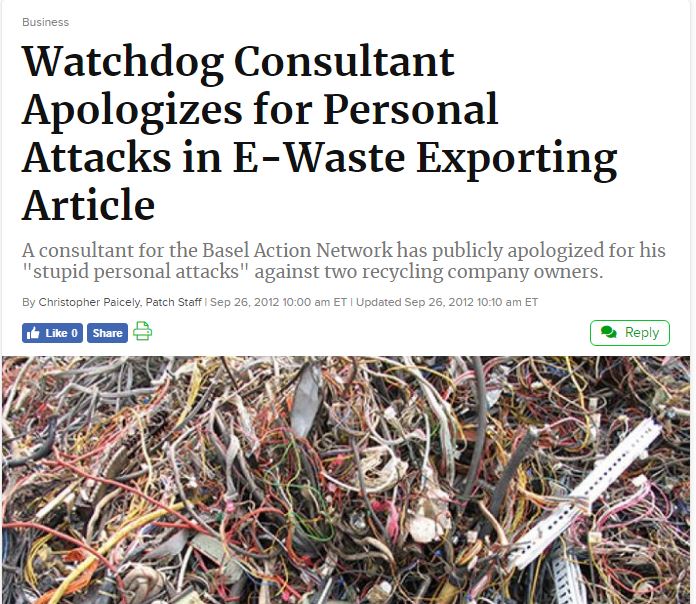
Instead of suing, I accepted BAN's apology, which was run in the same Chicago Patch newspaper. I was not really satisfied with the apology, because it did not remove the insult or racial profiling I originally objected to. I was not the person being defamed, it was the Tech Sector overseas, the poor people who make a lot more money repairing rich peoples stuff than they can make repairing poor peoples stuff.


Certification and Racketeering 5: Analysis of Seven GPS Tracking Studies

2018 GreenTrack Report found only 5% export, including export to OECD countries grntrac.com DWE
In the next blogs of this series "Certification and Racketeering", we look at a chart comparing 6 actual and 1 hypothetical use of GPS Tracking Devices to follow largely unwitting and unwilling subjects.  We compare methods of placement, tracking, and financial involvement of lead investigators. From there, we will delve into whether the study acts as "Environmental Watchdog" or merely protects the claims of being an authority when those claims are threatened. If, for example, a GPS tracking study specifically seeks to discredit or scandalize someone who has a beef with the Investigator, does that influence the mechanics of the study?

In the 7th hypothetical GPS Tracking study, I've deliberately created a clearcut "Racketeering" use (using the tracking study to offer a solution to a problem that would not otherwise exist without the financial interest of the investigator). The hypothetical would clearly be a matter for the American Civil Liberties Union, or EFF, or Interpol or Bob Mueller to decide. We then correlate the studies to see which ones have more in common with the Racketeering Hypothesis.  Then we look at quotes and behavior of the lead investigator.

Certain MIT students, when they get older, may want to come forward and disclose specific methods used to drop specific devices at specific places. I can promise anonymity and cover your costs. I can also put you in touch with MIT's own attorney, who took over correspondence after MIT Senseable City Lab excused themselves from further collaboration with BAN.org

Fair Trade Recycling Geek in Tamale, Ghana
Later, we will visit ("Take Your Pic") the use of cringy photos to jolt emotions when the actual statistical findings are not doing the trick. The art of a deal "selling" an unnecessary service, deceitful or otherwise, involves provocative / race-baiting imagery.

In the DWE tracking study, Dennis Ward    @dward_dennis gives us charts. In report by BAN, we have constant tear-jerking imagery evocative of our worst fears and perceptions of their so-called "Third World". But let's first focus on the methodology in 7 separate GPS Tracking Reports.

GPS trackers show exchange of products between two consenting parties.  There is not a single case of direct dumping of used electronics at foreign landfills. Who are we guilty of doing business with? And what makes our partnership suspicious?


Cross Cultural Training in Ewaste #2: IRS FORM 13909

Two NGOs take opposing positions on trade w/ "Third world" aka "emerging markets". What's Tech? What's Scrap? Who decides? Which is a "watchdog"? Which is registered as a "charity"? Who beats up other non-profits?


Ten years ago, the mission of WR3A.org dba Fair Trade Recycling was to vet exporters. And by that we meant to identify USA companies it was safe to export FROM, and not foreign companies it was safe to export TO.

To me, it's an amazingly simple explanation, but it takes weeks sometimes to get it through to journalists and documentary makers.

If you begin with the assumption that the Tech Sector in an emerging market enlists the very best and brightest, the valedictorians, and assume they are flying to purchase something from the Scrap Sector in the wealthy nation - as I did - then the purpose of a civil contract between the two parties is to increase efficient and fair trade.

Earlier this decade [post WR3A California Compromise] we realized that before we could broker loads, we had to first serve the Tech Sector by advocating on their behalf against a very strongly funded defamation campaign. To complicate matters, that campaign was being promoted by "the Left", people who were quite self-certain that they didn't have a single racist idea in their minds.  People who championed "environmental justice" were in fact committing "environmental malpractice", but that was a hard message to deliver.


If I can't fundraise to pay the WR3A credit card bills, maybe we can do the next best thing and "level the playing field". Basel Action Network is registered as a 501-c(3) charity - an organization that attests it does not advocate for legislation, does not perform work to benefit any private business or organization, and provides charitable services.  If reporters are looking for a story, we got another one for you....