Showing posts with label trade. Show all posts

Michael Shellenberger's Mad at Solar Panels. Too Cute Substack Fallacy.

SEE VIDEO: WHY DECOMMISSIONED SOLAR PANELS ARE NOT DEAD YET.  

Like flip phones, CRT monitors, hotel TVs, ex-boyfriends, and used cars, your decision to electively upgrade to a newer solar panel does not mean the ex-panel's life won't go on.


I was coached that people don't have time to read everything, so here's the jist... Shellenberger's thesis is that solar panels are being upgraded far sooner than their 30 year warranty or 40 year estimated lifespan would have buyers assume. That's true, I just gave a presentation on that at NERC.org.  But the reason for the upgrades is not that the used panels are failing or are waste... It's because 
  • the price and efficiency are falling, 
  • the number of roofs is finite, 
  • the cost of siting big solar fields near populated areas is skyrocketing
  • early adapters like to upgrade to something new
  • AND by 2028, virtually every older working will panel be cost-driven to replace
I have a whole presentation explaining this (Start at 2h 30min, NERC.org recorded session). Like desktop CRTs and Pentium 4 laptops, the solar panels are all going to get electively upgraded.

BUT  like those other items, the secondhand market is gobbling up replaced solar panels. And here's where the circular economy doesn't revolve around you, Michael Shellenberger - a 50% efficient panel replaced by a 100% efficient panel in Vermont GENERATES MORE KW IN AFRICA THAN THE NEW ONE DOES IN VERMONT.

Check out @AdamMinter's Twitter reply string to @ShellenbergerMD (he's not an MD, btw, he uses his first and middle initial).

MORE >

Part 2: How (too) Quietly The E-Waste Big Lies Are Buried.

 Ok, here's a short but important point about the Basel Convention, and the press releases (like today's from Basel Action Network) that seek to expand it to cover normal non-toxic secondary raw materials like plastic, ROHS compliant circuit boards, and even secondhand reuse.

#FLOWCONTROL

"Non-OECD" meant one thing in 1960 when the (all white country) OECD was assembled (Japan was an afterthought).  "Non-OECD" meant a completely different thing in the mid-1980s when the Basel Convention sought to keep pollution abatement costs / regulations in OECD nations from being subverted through international dumping (like the Trafigura toxic waste scandal of 2006).

"Non-OECD" is, today, a caricature of 72% of the whole world. It's a post-colonial era systemic system of flow control that has been used by Western Nations to try to keep their Big Shred companies from competing against what is now the MAJORITY of manufacturing capacity.


For Thankgiving 2018: Yes, You Are Probably Better Off Than Your Parents*


On social media, I sometimes try to "referee the internet".  That's what I call engaging in political debate or argument. I like dialectic. Constructive argument is better than smile-and-wave, or sweep-under-the-rug, etc. If you have the right touch, the friendship survives.

One of the arguments that is ongoing is over the pessimism vs. optimism for globalisation.

Other species, and the environment, I'm tragically not optimistic about.  My optimism about human lives is actually, in part, to get us to focus on worrying about things that really matter.  Also, I think that unnecessary panic and pessimism, whether to Trump or Bernie, distracts us from making investments that might really matter.

So here goes. When we look at an optimistic video, like GapMinder (Hans Rosling), about more girls going to school, fewer diseases, less poverty, the statistics and facts are clear.  Here is an interesting graphic - The World Poverty Clock.

57,913 people escaped poverty today (income levels increased)
11,508 people fell into poverty (especially in places like Venezuela, Nigeria, Syria and Yemen)

World Poverty Clock Screenshot

The graphic shows red (newly poor) and black (newly rich) stick figures, and shows countries in red or black according to how their own population is faring.  I have some funnier videos at bottom.

Here's the argument people most often push back. Many people believe that the current generation of AMERICANS or EUROPEANS is less likely to be better off than their parents generation.

But there are two ways to pose the question. Are we living better than a previous generation? And if so, how did we afford it?

Fair Trade Recycling invited to present at IERC Conference in Salzburg, Austria

"Writing export rules for used electronics without consulting Africa's Tech Sector is like writing health rules without ever talking to a doctor." - Emmanuel Nyaletey, 2018 IERC Congress


One week ago, one of Fair Trade Recycling's representatives and board member, Emmanuel Nyaletey, presented on a panel to address European Union representatives on their e-waste export policies, especially the ones directed at Africa.

Breaking News: GPS Recycling Miscegeny Trackers Flatten Circular Economy

[SEATTLE, WA 01.04.2015 00:01 april fools] MIT Sendable City lab announced today that a study with NGO Basel Acting Network has revealed a startling outcome, and a next stage.  The circular economy is flat.  And a Next Generation Tracking Devices has been developed to find reuse trade as it occurs.

The team will keep tracking the devices, as they move around between repair and reuse markets. But the next generation of trackers, the NI88ERGPS, will clearly identify boundries in the gray market.

"In our first effort, we thought that Basel Acting Network had tracked each of the GPS devices to its final resting place.  We called that end point 'Overseas'.  We thought we were finished," said Dr. Carl Ratty of MIT Sendable City Lab. "It turns out there are a lot of different places over there, and stuff keeps moving around."

The 1st Generation of GPS devices are still in motion.  88 different nations have continued to use, pass along, and exchange the devices.  Reuse is spiralling out of control, and it will take a new generation of trackers to make the crime - not disposal, but point of exchange - more black and white.

A 'point of pollution' requires that the device stop somewhere, in a dump. BAN's actual target is the exchange of goods and services between rich and poor, an act he labels electronic miscegenation.  These are not geographic "positioning" tracers.  They will trace "possession".

Continuing Final Outcomes:

"In 2016, we were certain that when the GPS devices landed in Faisalabad, Pakistan, that they were surely and finally buried, deep in the soil of a 3rd story electronics mall with escalators and dozens of reuse shops," said Basel Acting Network CEO Jim Plunckett.

But the first trial continued to track the property for as long as the batteries last.  Devices disposed in a primitive computer company's third shelf eye-level retail shop moved to a dormitory at Faisalabad University, 3 blocks away.


"We updated the report to show the devices new locations.  But they keep moving," said Ratty.

Devices sent to Tin Shui Wai in Hong Kong's Yuen Long district could be tracked going up an elevator, the a 14 floor apartment.  One device appeared to be in use in a hospital mobile cart.  A display device attached to a blood gas analyzer, the GPS tracker showed the cart moving up and down hallways, floor by floor in the Cairo General Childrens Hospital.

Plunckett sees a better solution than tracking an "end point".

Africa's Tech Sector Becoming Africa's Banking Sector

WSJ Reports

"Sub-Saharan Africa accounted for more than half of the 255 live mobile money services across the globe in 2014, with monthly mobile money transactions in the region topping $10 billion in late 2014, according to GSMA."

Startup Fuels Africa’s Mobile-Payment Boom

MFS Africa’s mobile-payment platform is used by 55 million people in 17 African countries

Full article here (may be paywalled).  But check out the numbers.  This network is built on the refurbished cell phones and phone towers set up by Geeks of Color a decade ago.  This is incredible, and helps explain why it makes me furious that Basel Action Network, Greenpeace and PureEarth are making money by hustling and over-producing films depicting Africans as "primitive".


The Geeks of Color are going to inherit the continent, and people are fools to boycott America's access to the ground floor.  More Africans are going to college in China today than are going to college in the USA.

#freejoebenson

#thanksobama


An African Tech Reacts to "The E-Waste Tragedy"

EntertainmentEmmanuel E.P. Nyaletey is an electronics technician, currently on scholarship at Georgia Tech in Marrietta, where he's pursuing a degree in coding.    Emmanuel grew up a few blocks from the alleged largest "e-waste dump" of Agbogbloshie.    He went back to visit Agbogbloshie in March 2014.  Emmanual and I both attended the USA premier of Cosima Dannoritzer's documentary, The E-Waste Tragedy hosted by Jim Puckett of Basel Action Network... the inspiration of my past 6 blog posts.

Nyaletey has written an essay, reacting to the film, and it was posted on the ISRI.org blog last week.
It is worth a humble read.

Link:    My Reaction to the Film 'The E-Waste Tragedy' by Emmanuel Nyaletey.

The urbanization, electrification, and rapid development in African cities and other "emerging markets" is changing not just the landscape of Africa, but the foundations of the Guilt-AID industry.

 Since the BAN.org NGO publicly denied its previous claims that most of Africa's imports are "reuse excuse" junk, destined for "primitive recycling", the internet has begun to explode with exasperation, much of it (like Emmanuel's essay) written as eyewitness accounts.

William Buffett's essay, "The Charitable Industrial Complex", Cassandra Herrman's documentary #Framed, Heather Agyepong's "The Gaze on Agbogbloshie", and the "Rusty Radiator Awards" are well-heeled responses this blog has been inspired by over the past year.   What's harder to document are the less well produced, naturally exasperated reactions by ordinary businesspeople (like Joseph Benson) who trade "good enough" product to Africa's metropoleses (new articles in New Republic and the Guardian at bottom).

Check out the reaction to Bob Geldoff's "Band AID" on this UK talk show program.

Ghana Geek fixes Camera at Good Point Recycling
The lens is turning.  The photographers, and exotic gaze itself, is being examined by a new generation, born decades after "loving vs. virginia".  Touche pas a mon pote, biensur.

Europe: Comfortable With OECD and Nation Lines on Maps


Late, late cocktails on the fjords of western Denmark can generate some great conversations.   I said to my hosts last week, "You know, in 100 years, I don't think 'nations' and 'nationality' will mean much to people.  Nations will probably be obsolete."

shooting lines were different
We had been talking about World War II, and I was headed for "Catalan France".   It seemed at the time to be harmless enough discussion, and I've said it many times before.  I think my grandchildren will have more "loyalty" to their dot-com address than they will to their "passport".   But in Europe, where I normally expect high falluting philosophical speculation to achieve flight, the idea of non-nationality fell with ze thud.

The lips of our Dane and Norwegian friends drew downward.   They explained the frown:  the idea of "the end of nations" meant "end of democracy".
That idea never occurred to me, an American who votes in state and national elections.  Losing a label does not mean surrendering a freedom.

Well before the end of nations and nationalities, I said that there would be universal democracy, as we are seeing now in the green revolution.  Democracy tends to support peace, not war, and nationalism is most strengthened by threat of war.  The way it would happen would be that cities would vote for mayors, and it would increasingly become meaningless whether a neighboring city - like Barcelona to Perpignan, or Boston to Montreal, or Kansas City MO - Kansas City KS, was inside some other hand drawn line or not.

If City A is a democracy, and City B is a democracy, and both cities have vibrant free trade economies, how are future children to keep up with the lines?

City A is EU, City B is non-EU?
City A is OECD, City B is non-OECD?
City A speaks X, City B speaks Y?
City A is Sunni, City B is Shia?
City A is Catholic, City B is Protestant?
City A ratified the Omega Treaty, City B signed but did not ratify the Omega Treaty?
City A is in WTO, City B is not in WTO?
City A uses Linux, City B uses Microsoft?
City A watches analog TV on PAL, City B watches analog TV on NTSC?

If I was better at math at 9 AM, I could tell you how many different-different, same/different permutations there are of the 9 silly "alpha-beta" tests above. Same-Same-Different-Same-Different-Same-Different-Different-Same squared?


The past century has largely celebrated erasing of lines.   Women vote.  Our children are taught to ignore race.  In northern Europe, that's both easy (they are very liberal) and difficult (they don't have many dark skinned people to practice not noticing). But they are very comfortable crossing language barriers.  My friends are a Norwegian and Dane, raising 3 kids in Bergen, but vacationing chez granny in Jutland.


They scribble through conversations in Danish, Norwegian, and English with easy, not really conscious of which language they are thinking in.   That's really difficult for most Americans to imagine.  We spoke Franglais to keep up.

Geographical Labels on Social Movements

This occurred to me when I was discussing "Americanization" that's occurred in Europe since I first visited here in 1979.  I'm travelling Europe by car rather than train or RyanAir/EasyJet for the first time, and using the freedom to retrace my steps.  Luxembourg was my first EU stop (from Iceland Air), where I slept on a park bench.  Then I tried sleeping in the Bern Switzerland train station, was kicked out, and brought home by a 300 lb red headed swiss deutsch taxi driver who showed me snapshots of nude teen boys all evenining....  ok that's a digression best described over a tall beer.

Anyway, in discussing the fact I'm travelling by car for the first time, I decided it's silly to apologize for that.  The highways are jammed with Europeans in cars, stopping at rest stops, lining up at McDonalds and fueling up.   The experience driving in Europe, other than the speeds on the Autobahns and freeways, is pretty familiar.  The speed is familiar compared to my drive across West Texas.

Anyway, in discussing the "typical American" (my friend Gitte in Denmark was asked by her kids, 17 and 22, whether my family fits that label), or the a-typical drive across Europe, I'm suddenly struck by this insight.  Humans give geographical labels to social movements.

It makes perfect sense.   Over centuries, plagues and fashions and traded inventions arrived from another "place" and changes occured slowly enough for mankind to talk about "occidental" and "oriental" for solid goods, like silk or wool.   The sheep giving the wool from Scotland has as little to do with the silkworm in China as a Big Mac has to do with cheese fondue.   But the geography is completely relative and arbitrary, and as energy access allows us to shorten distances in time, the geographical label is just quaint.

In Vermont, the "true Vermonters" complain about non-Vermont-ness (you have to have your parents to have come from Vermont, more difficult to arrange than a green card - I'm an Ozark Mountain "flatlander").  Williston Vermont, where the big-box stores are found (Staples, WalMart, Dicks Sporting Goods, Best Buy) is referred to as "New Jersey" by the Cool.

In literature, it's called "The Other".  Camus' "L'etranger" is one of the easiest to read French books for an American of my literary/language skill.   I'm sitting at a coffee table across from a francophone literature specialist Ph.D (my wife)

Peace Through Trade Between Recycling Tribes

"How can there be peace without people understanding each other; and how can this be if they don't know each other?"   -  Nobel Peace Prize laureate Lester B. Pearson

How can there be fair trade without people trading with each other, and how can this happen if they don't know each other?

I make many arguments about the wisdom of prohibitions, and the unintended consequences of isolationism in the name of anti-exploitation.   Drawing the blinds on Africa won't make the poor children go away.  

But I also know that the e-waste being generated by the "other billions of people" in the non-OECD is piling up, just as it is here.  Exporting used equipment may not be the direct cause of those piles, but it  will not by itself solve those piles.   Fair Trade Recycling is intended to attach conditions to the sale of used equipment which seed the collection and proper recycling of that equipment in the nations generating it.

When IT buyers from Africa come over to inspect equipment they may buy, they are exposed to a facility which is properly dismantling the equipment they don't want.   They don't see a big heavy shredder that they could never hope to afford.  Instead, they see hand disassembly, people doing jobs they can imagine their family or tribe members doing.

(Yes, I used the word tribe.   It's cool, trust me.)

Fair trade recycling is about getting to know each other.  Even if no price is agreed to and no sale takes place, simply agreeing to meet an African, Chinese, or South American buyer, to shake their hands, and to listen carefully to learn what it is they want to buy, that is getting to know the e-waste trade.

Creating laws and corporate policies which ban the trade preserves ignorance. 

I hung out with a couple of very nice people at the ISRI recycling trade show this week.  Excellent people.  They were talking about people who stack and pack old televisions, like the ones that make up 60% of our collections.  I said I'd never met such a person.  I think that maybe if they relax their policies against exporting used equipment, they will hear out more of the buyers, and get to know them.

Whether or not they make money, they'll learn how make a little more rare the stereotype that never actually exists.  Most of the information that has been provided online and through the press about used electronics trade and recycling has been concocted by people who don't know what they are talking about, and are making it up as the go along.   That's the same problem with people who criticize alternative marriages, or want to choose neighborhoods or co-workers based on race or color.  

The more we isolate ourselves, the more we don't learn good.


Term Paper V (5): "E-waste" Export, Geog of Env Justice


Back to the "Term Paper" (for those following).   Here is how I overlay the "regulated areas" of "environmental justice" and "property value" on an actual case of "non-OECD".

(You may need to go back to "Term Paper 1-IV").  This is an academic post, which goes well with a video, but we also want these accessible in nations which csor videos, so here's a link to a "geographic" song, Rue St. Vincent, sung by Yves Montand.  Open and listen in another window...


Case Study:   Singapore and the Malay Peninsula

Malaysia, the nation, also includes huge rain forests in Borneo and Papua New Guinea - home to both the most biologically diverse and unstudied rain forests on the planet, disappearing orangutans, and the OK Tedi Copper and Gold mine (#evil).  Where it is green, Malaysia is very green.  But it's easier for the purpose of the case study to look just at the Malay peninsula, which Malaysia shares with the city-state of Singapore (at independence from the British empire, they were both part of Malaysia, but Singapore won independence fairly peacefully).

First, the "eyeballs diagrams" are NOT drawn to scale.  Singapore is 704 square kilometers, Malaysia has 338,550 square kilometers.  After a couple of years of co-governance, Singapore became independent in 1965;  it still had not rebuilt from Japanese occupation during WW2.  From Wikepedia 13.01.08:
Facing severe unemployment and a housing crisis, Singapore embarked on a modernisation programme that focused on establishing a manufacturing industry, developing large public housing estates and investing heavily on public education. Since independence, Singapore's economy has grown by an average of nine percent each year. By the 1990s, the country had become one of the world's most prosperous nations, with a highly developed free market economy, stronginternational trading links, and the highest per capita gross domestic product in Asia outside of Japan.[1]
Peninsular Malaysia has 131,598 square kilometers, so even eliminating the islands Borneo and PNG, it dwarfs Singapore.


Term Paper II: "e-Waste" Export, Geography of Environmental Justice


Yesterday's thesis about the relationship between land value, environmental enforcement, and pollution, used a map from http://scorecard.goodguide.com/env-releases/land/,  showing toxic release sites on a map of the USA, and a chart from the same website showing the relative amount of toxics generated in specific localities.  When the releases are charted as "an occurance" and each release is given a single data point, the map shows the "superfund sites" to be concentrated in urban areas.

The sites, when weighted by actual tons of pollutions, are 83.75% in the top 20 / 100 sites (suggesting the 80/20 rule or Paretto Principle may apply).  The top 10 sites are in Alaska, Nevada, Arizona, Utah, Nevada, Arizona, Nevada, Idaho, Missouri (Doe Run area), and Orange Florida.  Each of these sites has a "drilldown" function for data at Scorecard.Goodguide.com  Orange County Florida, the one non-western, non-mining area on the top ten list, has a NASA, USA Department of Defense, WR Grace, Dupont, Department of Energy, Chevron industry, etc. on its list of "potentially responsible parties" for lagoon pollution.  The nine sites above it are raw material extraction industry sites, none of which, my thesis states, could function economically inside a high-property value area.

1.NORTHWEST ARCTIC, AK481,382,100
2.HUMBOLDT, NV350,591,683
3.PINAL, AZ248,792,746
4.SALT LAKE, UT138,824,328
5.ELKO, NV83,494,740
6.GILA, AZ57,220,938
7.EUREKA, NV43,572,135
8.OWYHEE, ID28,887,324
9.REYNOLDS, MO27,313,480
10.ORANGE, FL24,032,977


The enforcement and likelihood that a site is identified as a threat is proportionate to its proximity to a landholder complaining about it.  For this reason, the "superfund" target sites on the USA map above are concentrated around cities and population centers.  This "NIMBY" or "Not In My Back Yard" dynamic is part of a normal democracy.  The spotlight on "environmental justice" in the USA focused on the difference the likelihood of enforcement correlated to race of neighborhoods;  that's an overlyer, according to my thesis, for economics and property values.  As I pointed out in one of the Slums Blogs last spring, 5th Avenue in Manhattan had auto repair shops a hundred years ago... but these relocated to Queens because it's easier to do repair work on an area with lower property value.

The Diagram Below generalizes the relationship between property value, wealth, and awareness of pollution. People live in rural villages, forests, and plains, but their population density is lower, and enforcement of all types is less likely in these areas.


The difficulty or unlikelihood of an enforcement paradigm outside of a population center is why emerging market city-states like Hong Kong and Singapore are more likely to achieve OECD-like status sooner than an emerging market like Malaysia or Indonesia or Brazil... the most recent nations admitted entry into OECD have been small.   Large nations admitted to OECD tend to have gained entrance early on, because of their econmic power (like the USA).  The USA was admitted into OECD while the pollution in Orange County was occuring, but as one of the "founders" of the OECD, the USA benefitted from a simpler formula - wealthy and white.  Not even Japan was not on the first OECD list.

Why I'm Pro Globalization

First, the anti-Globalists have to admit there's not much we have to say in the matter.

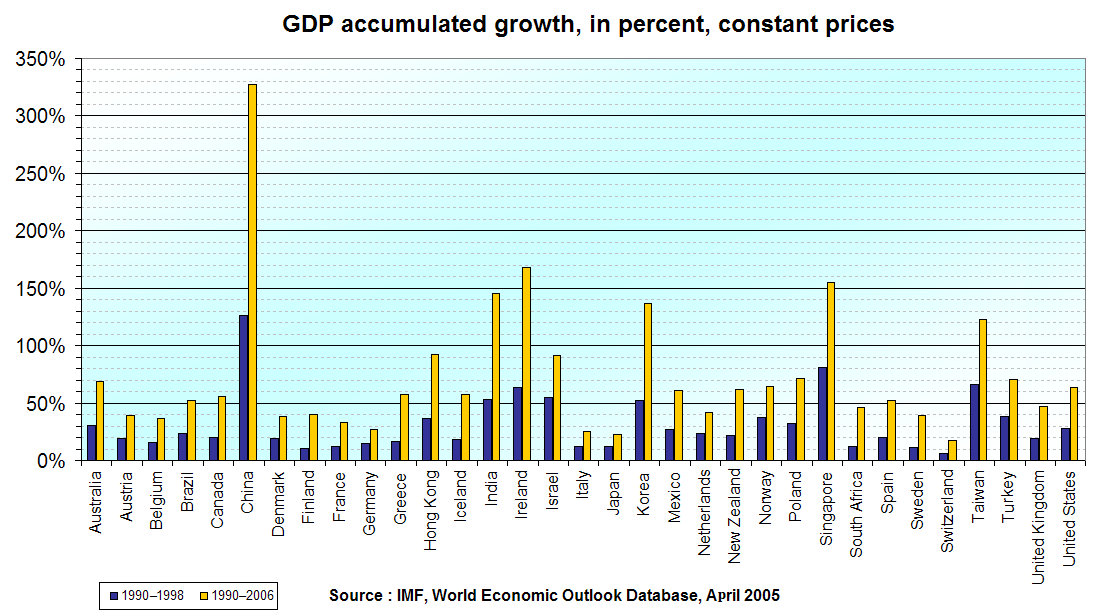
Pretending that the USA and Europe can isolate themselves, and that Asia, Africa, and Latin America's 6 billion people are going to develop better or more slowly without us is an a priori joke.  There simply is no solution to "globalization" and kvetching about it is like complaining about getting old.  Hippy grandparents yearning for the good old days of starvation and smallpox in poor countries is not my scene.  Wealth is increasing (see chart below) in countries which trade most.

No thank you, Daisy Racism
So, if the cat is out of the bag, so to speak, are ideas like alter-globalization and fairtrade going to do better if the rich and well regulated consumers get on the sidelines and boycott the emerging markets?  Of course not. The poor benefit more when they have more choice of people to trade with.

Third, having lived in Africa and having opened a recycling factory in Latin America, and having traded millions of dollars of goods with Asia, I can tell you that the Tin-Tin comics image of the emerging world is about as accurate as Uncle Toms Cabin in describing Atlanta.   The image of "primitive wire burning" recyclers around the world is intensely over-played, to the point of racial profiling, and belongs with "Arab terrorist" and "American cowboy" and "Japanese kamikaze".  All those anecdotes exist, but if that's your primary image of Dubai, Houston or Tokyo, you are ignorant.  Ignorant means "stupid with hope for a cure", though I'm sometimes afraid the condition is chronic.

Boycott as a response to "globalization" is like burning libraries to prevent pornography.  It's that damn stupid.  As a lifelong environmentalist who had devoted my life to recycling, I am ashamed to the point of tears that the "green movement" has harbored racist images of fixers and tinkerers, technicians and geeks.  We hurt the American economy when we shred items of value which could have been exported, and we hurt the buyers who then buy used product from Hong Kong or Shanghai with fewer choices.  Worse, when we shred up rare earth magnets and turn circuit boards into "fluff" to avoid superior hand disassembly, we help mining.
Mining is what builds the roads that kill the gorillas.  Mining "non-toxic" tin from Indonesian coral islands is what kills the sharks.  White eco-witch-doctors need to stop prescribing death.

If you are a "green" environmentalist, and you have friends who are global isolationists, tell them to get on a fair trade bandwagon, because boycotts are the new segregation, giving sinister meaning to "the new black".

Give the developing world a choice of jobs besides warrior, miner, poacher, sex worker... let them refurbish and recycle, give them incentives and tools, implement contracts to reduce child labor by paying adult wages.  Give boy scout badges for recycling to the poster children, and say "shame on you" to "watchdogs" who exploit poster children for money and don't share a dime with the kids.

I'm a globalist because I have friends in Africa, Latin America, and Asia who I met through trade, and we treat each other as equals, and we have all benefited.  My children eat with their children, my wife meets with my partners and their sisters and brothers.  None of this would have happened if I had been afraid to cross the tracks and trade with brown people.  I see my friends profiled, and I'm called names for expressing my loyalty to them.  Very harsh names.   I was too young to join the Civil Rights marches in the American south. But I learned enough about those marches, from my home in Arkansas, that I can spot a person using "inference" to make recycling, repair, and trade look  like it's causing poverty.


Persistent Irrational Belief


Read an article by a Wisconsin blogger/lawyer, Steven Bauer, To Speak the Truth.  The title of the post is "Irrational Persistence of Belief", and it focuses on the "given" that some people really don't change their minds.  Perhaps all of us refuse to change our minds, to some varying degree.

Psychologists now are researching things, like what areas of the brain are stimulated by photographic evidence, what areas of the brain are stimulated by logic, and what areas are stimulated by mathematical evidence.

I was researching this a while ago, before Basel Action Network re-published the "80% Exports" quotation (see yesterday's blog).   The question is, do they believe it despite the studies by UNEP, ASU, ISRI, WR3A, the UN, and their own Kenyan researcher?  Do they republish it without citation because they really care?  Or is this repeated, discredited statistic still showing up for $ome Other Rea$on?  What are the roots of persistent irrational belief?

Memorial Day: Fear and Greed Part 1

The more I try to crystallize the issue in this blog, the more it is about trade and exchange between rich and poor.  The exchange is a value, and the fear of exploitation is a value.  Some make their value in the margins of exchanges they make, others make their money through their authority over those transactions.

Whether we draw two big circles on a map and call them "OECD and non-OECD", or seven circles for continents, or 193 nations, or circles which show cities and peasants in those countries, or draw lines within a city between the high property values and the ghettos, it's ultimately about the transfer of wealth and value.   When a rich man employs a poor man, or a poor man buys something from a rich person, or a daughter marries across an economic line, opinions and suspicions sharpen.

Is trade between wealthy and poor exploitation, or opportunity?  Who is the authority or referee?

Jim Puckett says in his interviews in CBS 60 Minutes and Frontline that the deck is stacked against the poor in any exchange.  The economic have-nots will be abused and worse off due to the trade of second hand goods.  This line of thinking has some friendly listeners in the "environmental justice" arena, and the anti-globalization movement of Seattle.

I was a critic of how the USA's most toxic industry - hard rock non-ferrous mining - moved to rain forests where no one complains about the cyanide, mercury, and other toxic runoff.  Those concerns brought me into the recycling field, in fact.  And here I am in a battle of wits with a fellow environmentalist over how our raw material policy should play out worldwide.

My concerns about hard rock mining, however, were never pinned on a false hope of economic segregation.  Boycotting and segregating people we are uncomfortable or uncertain about has led to many "trail of tears", and many burned bridges.  Doing the right thing means doing something, but it isn't to throw a garbage can through the collective window of the recycling industry.  Fair trade makes more sense, and is not something Basel Action Network should try to make people afraid of.

Tech, Toxics, and Ju-Ju:  Leverage fear, create authority
In his editorial response to my first widely published column, "We Shouldn't Have to Make that Choice" (reprinted in E-Scrap in 2009), Jim Puckett said that he didn't think Fair Trade meant "poisoning people".   Toxics is a scare word.  Jim was clearly trying to make people afraid of the economic exchange.   He tells people that replacing or upgrading a part is hazardous, toxic, polluting.  He knows he's wrong, he just doesn't recognize why he's doing it. It is not, as he claimed, about a "loophole" of reuse.  If it's resolved, his authority diminishes, and he's not ready to retire.

Create concern, especially visceral concern (photos of children).  Promote yourself as an authority to reduce this concern. Sell certification.   Profit!

You do not create "environmental justice" by creating a vacuum or boycott of trade.  Justice is, by definition, a judgement call, a negotiation, and a settlement.   You do not stop exploitation by labeling people and segregating them.  

USITC study on US exports: "Made In Polaroid"

I'm in Washington, DC.

Preparing testimony for the US International Trade Commission's study on used electronics exports.

I'm going to describe a remote, exotic, primitive place.

The "non-OECD".   83% of the population of the earth lives there.

All the hard drives and all the smart phones are made there, and (a little more shocking to some readers) more than 50% of the patents, design and engineering of those devices also originated there.   Hold onto your chairs - "Polaroid" LCD televisions (a significant share of the market) are not being made in Waltham, Massachusetts.

In fact, they are made in this same, exotic, faraway land of "non-OECD".   In the same kind of factory that makes - Sony!  Oh, you thought Sony was made in Japan?  That's SO 1995.

Finally: The "Ayatollah of E-Waste" Apology

The Apology...  Happy Earth Day

[Photos here are from Cameroon, Africa, where I lived in Adamawa, a pluralistic area that was about 50% muslim, and everyone got along]

Half of my students were Muslim
This month I have worked, on and off, with the apology. Interest is high - the blog leading up to this apology got 200 hits in a short period.

One good piece of advice about apologies is to be specific (er.. and brief).  Find something you did which hurt someone, something you regret, and build the apology around that.

I'm sorry for calling Jim Puckett the Ayatollah of E-waste.  Here's why.


WR3A Adapts New Moniker


    WR3A is announcing a formal tradename adaptation and copyright of the trade name "Fair Trade Recycling".   WR3A has suspended its own certification and cooperative marketing strategy, and will instead offer its legal support and funding of R2 certification for overseas companies.  

    The cooperative marketing was a huge success from 2006 to 2010, but created conflicts of interest for members when purchase orders shrank.  For example, east coast members who were shipping to SKD factories which were offered California supply in the "California Compromise" discussion would have been negatively impacted.  


    The WR3A Board has decided that while experience and data collected from cooperative sales were outstanding, the future of the organization should follow the recommendations by University of Amsterdam researcher Brenda Wijnen, and establish independent rules and principles rather than acting as "shipper of record".   Individual WR3A members may choose to broker loads, but not under the WR3A name or umbrella.


EWaste Whiplash II: PriestaTollah, Reporters, Sex

"Why your daughter should not marry outside the village"
How E-Waste Trade is basically about Sex and the Church

Whiplash begins when you care, listen, "like", and "follow" people in a competition for your attention.

You are a farmer with 3 daughters.  One is educated, learned well in school.  A second is illiterate, she speaks only her native language, and she works in the fields.  A third daughter is only 10 years old.

A wealthy man comes from the capital city.  He is dressed in a fine suit, he has expensive gadgets, he is obviously very rich.  He asks about taking one of your daughters hands in marriage.

You want to check the guy out.  You go to the Priestatollah.

The Priestatollah emphatically says that he knows about the men from the City.

The Priestatollah came himself from the City... he knows what goes on there.

The Priestatollah will save the one thing most important to you... your family.

. . .


According to the Priestatollah:

  • The marriage will be exploitative.
  • The marriage is illegal and she will be arrested.
  • Your daughters will be abused and treated like slaves
  • The City men will take the daughter too young for marriage.
  • The City men will poison your daughter's blood with toxics.