Showing posts with label policy. Show all posts

Blowing The Whistle A Minute After The Goal Is Scored

My environmental philosophy was shaped by Lester R. Brown and the State of the World reports published by the Worldwatch Institute. Brown argued that the defining environmental challenge is not waste itself, but humanity's accelerating extraction of natural capital. Recycling matters not because it manages garbage, but because every kilogram recovered from the human economy is a kilogram that does not have to be extracted from forests, coral reefs, rivers, mountains, farmland, or indigenous lands. In almost every meaningful life-cycle comparison, a kilogram of copper recovered from discarded products has a smaller environmental footprint than a kilogram mined from virgin ore, transported, concentrated, smelted, and refined. Better still is a kilogram of copper that never needs to be recycled because the product containing it is repaired, refurbished, or reused for another decade. Extending the useful life of products preserves not only the metal itself but also the enormous investments of energy, labor, and environmental disturbance already embodied in their manufacture.

This is fundamentally a question of thermodynamics and material flows, not ideology. 

Should we switch to Substack?

There are still important things that we, in the actual trade in electronics reuse and recycling, can share. But if Google is de-platforming its own blogspot platform, I have to consider moving this entire discussion to Substack.

The risk is that we lose the 30-55 average blogspot views (way down from 2015) and have an unviewed substack. Substack is not showing up in my page 1 Google searches, there's probably a riff (maybe Google is "protecting" blogspot while another wing of the office is killing it?)

And here is your reward for reading this.


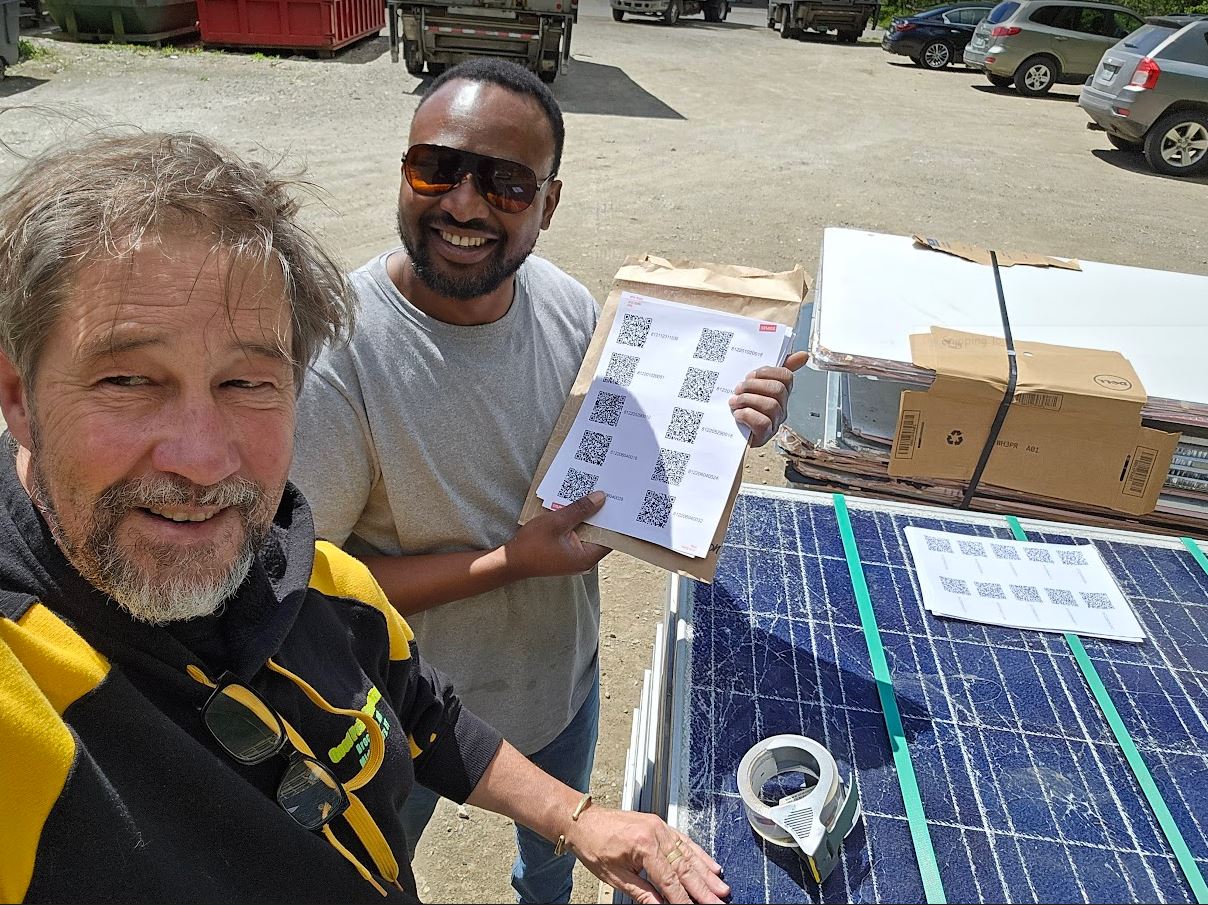
Reused solar panels will be tagged with these Avery Labelled stickers, with OBADA.io blockchain tracked QR codes, which Africans can scan with their mobile phones to upload photos - which have GPS location - proving it is NOT IN AGBOGBLOSHIE.

more

Recycling Vs. Non-Recycled Content: #SubsidyRecapture Is the Wet Cornflake on the Wall Part 1

Your raw material story in the Wall Street Journal might be about aluminum, it might be about lithium or cobalt for EV batteries, or it might be about petrochemicals.

But when it is about recycled content, there's always a narrative that the government is either needed or unwarranted to "tip the scale" towards more recycled content.


We've got a blog to write, the intention of which is to make better policies possible, and to make bad policies less likely. The bad policy example most international readers will understand from the Netflix Narcos Mexico series... you imagine marijuana is a problem to be eradicated, and give the police departments the assignment of stopping it. That's like anti-bacterial soap... it's not a big enough problem to be enforced, so the demand lies there and finds a market in a remote Mexico farm field, which creates a future El Chapo. By the time you realize and de-illegalize the marijuana trade, it's like taking anti-bacterial soap off the shelf. The ElChapos have created a set of tunnels and submarines and ass capsule systems, enforced by machine guns and torture and "lead or silver" bribes which will deliver fentanyl three decades later. It would have been very difficult for whoever the long forgotten marijuana legislation drafter to realize the unintended consequences of his anti-bacterial-soap solution, but he was part of a Room Full of Morons (RFOMs) who thought authority is and of itself a path to virtue.

Environmentalists today are desperately - and legitimately so - in search of a solution to the sustainability problem, and I've devoted my life's work to the cause. But I recently re-watched the 1970s Poseidon Adventure, and "walking downhill to the thickest section of the hull called and wants its shortsightedness back." (Got you into the 1990s)

There is definitely a sustainability problem, and it is definitely driven by consumption. How demand for that consumption is met needs some form of regulation. Most regulation is of human behavior which we can see, which we have a connection to, or at least can imagine.

This is a deep dive, and my deep dives generally require soaked humor or a damp analogy to stick to a swordfish's wall. The Watchman Quote, above, is my own personal handle to the "regulation and subsidy" put as a call to action or legislation.  

"If in doubt, leave it out." That's the Primum Non Nocere of raw material management. Left to its own devices, society will recycle first and throw away later. That is why our dresser drawers are full of obsolete electronics.  That is why, when I first went to China more than two decades ago, you couldn't litter a can or bottle if you tried... poor people on bicycles would pick up the scrap for its recycling value.

Interesting anecdote, but not a wet enough noodle. This plunge goes back to the Ayatollah of E-Waste analogy, which was funny at the time, and might be funny to someone who has not heard it before.

Regulation and Subsidy require Authority to make management of raw materials consumption, extraction and disposal align better with the Future Child, the babies yet to be born 500 years from now, who are my God, My Judge, and to whom I Grant all authority over my behavior.

That's a pretty dry noodle to throw at the wall, so dry it may scratch the paint. A 500 year Young baby is difficult to imagine, a whole society of them requires a Star Trek writer trained on my dad's high school and college paperback Sci-Fi bookshelf (which I spent a lot of summers reading when Lou Brock wasn't trying to steal bases on the General Electric black and white television).

2021 Pandemic Response - Seeking One True Size To Fit All

Here on a foggy mountaintop in Marshall, Arkansas (population 1300 and change), I'm preparing my family's bags to return to our disparate homes - Vermont, Barcelona, Amsterdam, Brooklyn and London. The kids are adults with careers and degree studies in Europe, my partner has a continued sabbatical in Spain. I should have more time to blog when I'm on my own again, though re-making this thing over and pruning back to the best branches seems daunting.

So let's try this. I can explain and represent the views of my conservative red-hat Trump was robbed family members to my more educated, more erudite liberal relatives. First, let me explain something to blog readers - the reddest of states has both.

Here is a conservative in my family who I wuld not want to become sick. He's 89. He loves oysters. He lives in the South of France, where vaccine hesitancy is highest. Today's blog will use CV-19 policy and opinion variance to illustrate how there is not "one correct answer". 


(Publishing prematureley as a place holder, last post of 2021 Coming back to edit, time to pack the car).

Many Blog Posts are Emails To Academics: Urbanization Politics of Agbogbloshie

This is an email I just sent to a European graduate student, who is attempting to do a major research (thesis?) paper on Agbogbloshie.

I always have taken time to encourage researchers. It is part of my "fishing for swordfish, surrounded by perch" philosophy of blogging. The blogs are ignored by most people, because most people don't have the bandwidth to really focus on them, or to do a deep dive, or review ground already covered.

But these emails and blogs reach people who are truly concerned, and who ultimately discover that there is an almost sinister systemic manipulation of "do-gooders" empathy to accomplish monetary gains. I usually talk about the Western (and now Asian) lobbies - Big Shred, Planned Obsolescence, and Charity Industrial Complex.  But in this morning's email to the Swiss based graduate researcher, I like to remind us that Africans have Agency, even if some of their agency is systemically marginalized by the desire for shiny white consciences. 

In Accra, Ghana, it's the land value stupid. Agbogbloshie, for decades (IMF and World Bank papers go back to the 1960s) has been an urban scrapyard next to the Old Fadama slum.  If you want to know what is ultimately going to happen, read about the Kowloon slum in Hong Kong. All the "recycling" story is just using BAN propaganda to leverage demolition and expulsion of some of the most valuable real estate in one of the richest African urban centers.

It's not about you, or your old computer.


Super Bowl of Reuse: Nabil Nasr, Adam Minter, Josh Lepawsky vs. PlannedObsoleteScience


Last weekend, we had a reflection on the previous decades of blogging, and our ability to declare successes and failures with the war against global reuse, as waged in the press.  There is a trifecta of 3 books - two of which the blog influenced, and one of which it was inspired by.

Three Most Important Re-Use Books of the Decade:

Reassembling Rubbish by Dr. Josh Lepawsky does an incredible job of surgically dismantling arguments widely cast by Basel Action Network and Greenpeace and other "do-gooders". He researched their IRS 990s, exposed the financial backing of Planned Obsolescence and Big Shred, and provides data to eyewitness the spray of filthy gossip about repairpeople in Asia, Africa and Latin America. While not an emotional read, that was not what we needed. If stoic in delivery, Lepawsky rubbed shoulders with #ownvoices. His team spent weeks living with emerging market recyclers and repairers, including several long visits to Las Chicas Bravas in Sonora Mexico (Retroworks de Mexico). Lepawsky re-thinks the incredible geographic scars of mining industry, comparing risks to the hand-wringing concerns over removing screws in slums like Agbogbloshie. It is incredibly well documented, footnoted, and sourced.

Secondhand by Adam Minter is about "Travels in the New Global Garage Sale". For a more visceral look at the "collateral damage"to the global good-enough markets, this is the best.  Adam turns the corner from being an extremely well-regarded trade journal writer, covering the scrap industry (first book, Junkyard Planet 2013), and dives into the mosh pit of reuse diaspora in Secondhand. Cleverly written, he first makes the used possessions personal - estate sale by estate sale, Goodwill by Goodwill, and his own grandmothers' basement chachkas. He then follows the billion dollar trade to the tech sector in India, China, Mexico, Benin and Ghana, and introduces us, face to face, with the talented and inspiring "others", letting the people in the USA, Europe and Japan hear the #OwnVoices of the racially profiled "primitives" we've been told are too ignorant and stupid to do more than burn the devices they carefully select, test, and purchase. He is a great listener.

Remanufacturing In the Circular Economy is the newest release by Dr. Nabil Nasr of RIT in Golisano Institute for Sustainability (Rochester, NY).  Unlike Lepawsky and Minter's books, I cannot say I've yet read Nasr's Remanufacturing, but I'm ordering a copy now.  I have been a fan of Dr. Nasr for decades (though he probably barely knew me until the 2013 Fair Trade Recycling Summit in Middlebury). Some of the oldest Good Point Ideas blogs have hyperlinks to Dr. Nasr's stats on remanufacturing, the industrialized growth of scaleable repair (I remember having to learn "hyperlink" code, copy and pasting). As I applied principles in the 2007 Harvard Business Review article "The Battle for China's Good Enough Market" to explain what Asia's tech sector was really doing with the desktop SVGA CRT monitors that CBS 60 Minutes claimed were burned in acid in Guiyu, I could always find sanity in Dr. Nasr's data.  Like Lepawsky, Nasr provides Datajournalists a place to fact-check "80%" of the slop sprayed at us in alarmist NGO press releases.

The team provides Super Bowl stature in the defense of reuse. The table is set for Fareed Zakaria (CNN Global Public Square) to invite these 3 authors and deliver the dagger to racial profiling.  He may want to invite Dr. Grace Akese, who has just recently moved to take a position at Bayreuth University in Germany. Grace provided key insights to Reassembling Rubbish, in particular an "OwnVoices" fact check of characatured Agbogbloshie. Good luck, Grace, in turning Germany's (Kevin McElvaney's) "mirror on itself" back in the right direction. Emmanuel Nyaltey of Fair Trade Recycling would also be a good score. This morning I twitterwarned Fareed (a personal hero from "Foreign Affairs" editor days) that I'd be sending him snail mail to pitch the episode.

Facultat d'Informàtica de Barcelona Presentation: Influencing Environmental Impact of Marketplace with "Zeroknowledge"

A gigantic crane is swinging overhead, no doubt carrying some new material for the erection of another spire atop the Sagrada Familia Basilica, here in Barcelona.

It's a distraction from this week's challenge. How to explain to a group of Catalan University Professors how markets for used devices work, and how they can be measured without influencing the way they move. The title of our talk is "ZeroKnowledge". It is about the so-called "Observer Effect" in scientific study, and in particular, how data collection in "e-waste", "e-scrap", or "surplus property" can affect the policies and contracts and trade that add up to the actual outcome.


In my first chart, above, we can recognize the so-called "Circular Economy", but also the gravitational shortcuts of efficiency. When a ton does not "show up" to meet the scrap shredder/refiner/urban miner's prediction (and the hours of use of their shredding machine suffers), you cannot state that the material is "lost". It probably went into a more efficient gravitational orbit of "reuse". And countries which are good at reusing and repairing devices also tend not to throw copper away.  We may object to the way they extract the copper when the device is eventually discarded after many more years of use, but the calculation of environmental cost must be honest about the fact that brand new device production to meet the demand in emerging markets is a far worse carbon scenario. The two choices are, let them reuse and repair, or keep them in the dark (nighttime in "project eden").


But I digress. Today's talk is not about what the Waste/Mineral Policy should be, but about how the study, monitoring, regulation, certification, blockchain tracking, warranty registration, and GPS tracking devices will spin it, and to what ends.


Above are 3 slides we worked on with the Barcelona EReuse.org group.

They are working with us and a larger OBADA group to get Catalonian computer procurement officials to put into the RFP for purchase of new laptops a "blockchain" which would allow a surplus property officer at end of life to insert a USB key, find the blockchain, wipe the drive, and "inflate" a "spare tire license" such as Chromium or Linux.  The Spanish government would pay $1 per PC for "pre-wiping", which would be save $5 per HD wiping fees, and allow the PCs to be sold directly through surplus property auctions.

(longtime readers will recognize this "spare tire licence" from my first business in 2001).