Showing posts with label risk. Show all posts

Einstein's Amygdala Part 3: The Predatory Business of Labelling Competitors as Predators

To reiterate the below-the-fold conclusion of Part 2:

Today, in most of the world, the highest risks to our health are affluence-related.

Over-eating. Driving cars too fast. Ingesting newly developed drugs. New inventions like handguns. But as compared to the highest risk of death a mere fractional 200 years ago, the biggest risk today is having lived twice as long as the average human 1% of evolution ago. The entire list of these affluence-related risks and outside risks today is a lower risk than faced by 30 year olds, centuries (seconds in evolution relativity) ago.

Einstein's theory of relativity places the fully formed amygdala in a perspective setting, similar to the relative speeds of sounds from trains, speed of light, all the great Einstein thought experiments explaining relativity. 

The press and social media constantly portray business and trade as if it takes place between predatory cats and baby rabbits. And it is natural for humans to give equal weight to every new fear.


Photo by me 2021. Lots of people photograph this cat in San Juan. Some of my
own photos over the years have been flagged by Google as unattributed, fodder for
another blog someday


2021 Pandemic Response - Seeking One True Size To Fit All

Here on a foggy mountaintop in Marshall, Arkansas (population 1300 and change), I'm preparing my family's bags to return to our disparate homes - Vermont, Barcelona, Amsterdam, Brooklyn and London. The kids are adults with careers and degree studies in Europe, my partner has a continued sabbatical in Spain. I should have more time to blog when I'm on my own again, though re-making this thing over and pruning back to the best branches seems daunting.

So let's try this. I can explain and represent the views of my conservative red-hat Trump was robbed family members to my more educated, more erudite liberal relatives. First, let me explain something to blog readers - the reddest of states has both.

Here is a conservative in my family who I wuld not want to become sick. He's 89. He loves oysters. He lives in the South of France, where vaccine hesitancy is highest. Today's blog will use CV-19 policy and opinion variance to illustrate how there is not "one correct answer". 


(Publishing prematureley as a place holder, last post of 2021 Coming back to edit, time to pack the car).

E-Waste Tragedy 4: The Perils Of Guidelines Drafted from False Perception (Ipsos MORI blog)

Ipsos MORI meets South Park's Satan...

This is the fourth part of a series of blogs following the documentary "The E-Waste Tragedy".  Emceed by Jim Puckett, premiered at the E-Scrap Conference 2014 in Orlando, the film by Cosima Dannonitzer purported to show junk electronics, dumped in Ghana.   They "followed the trail" back to the electronics origins in England.   I viewed the film with Emmanuel Eric Prempeh Nyaletey, who grew up a few blocks from Agbogbloshie, Accra's scrapyard.  He was carrying a petition to #FreeJoeBenson, the Nigerian expat sitting in prison in the UK for "violating e-waste export guidelines", and no one at the conference wanted to sign it.

Ipsos MORI is one of the UK's leading research organizations.   The website describes Ipsos MORI's 16,000 research staff in 84 countries.  Like Q-method, the organization relies on face-to-face interviews.   They get the real data for IMF, World Bank, and UN factbooks.   Last Month, Ipsos MORI published research titled "Perceptions are Not Reality:  Things the World Gets Wrong".

The Perceptions are Not Reality publication focuses on the "top ten" things which the majority of people in a society (14) perceive wrongly about themselves, about their own, local and national, civilization.  The web page starts with statistics, perceived and real, about facts on the ground in Great Britain:

"In Great Britain we get a lot of things very wrong…"
  1. Teenage pregnancy: the British think one in six (16%) of all teenage girls aged 15-19 give birth each year, when the actual figure is only 3%.
  2. Muslims: we hugely over-estimate the proportion of Muslims in Britain – we think one in five British people are Muslims (21%) when the actual figure is 5% (one in twenty).
  3. Christians: in contrast, we underestimate the proportion of Christians - we think 39% of the country identify themselves as Christian compared with the actual figure of 59%.
  4. Immigration: we think 24% of the population are immigrants – which is nearly twice the real figure of 13%.
  5. Ageing population: we think the British population is much older than it actually is – the average estimate is that 37% of the population are 65+, when it is in fact only 17%.
  6. Voting: we underestimate the proportion of the electorate that voted in the last general election - the average guess is 49% when the official turnout was much higher at 66%.
  7. Unemployment: we think nearly 24% of the working age population are unemployed when the actual figure is much lower at 7%.
  8. Life expectancy: we overestimate our life expectancy by three years, thinking the average for a child born in 2014 will be 83 years, when the actual estimate is 80 years.
  9. Murder rates: we are however one of the best informed countries on the murder rate: 49% saying it is falling (which is correct), and only 25% think it is rising

Unfortunately if not surprisingly, the USA perceptions aren't even as accurate as the UKs.

The perceptions of risks, and how those (mis-)perceptions are monetized when they go viral, has long been a theme of this blog.   But mis-perception and misconception, by itself, is not a tragedy.

Knowledge of the world around us is increasing, societies are becoming more aware of one another, and if Ipsos MORI continues to survey people over time, I hope they find that the trend in the perceptions will become more accurate.  We are more frightened by ebola than we should be, but 50 years ago, would we have known about ebola at all?

Misperception of facts do not make a "tragedy" unless we gear up to act on those "faux facts".   And what motivates society?

GREED and FEAR.

Got misperception?   Use it to motivate and market to regulators.

Game Theory 1: African Can't Fight UK City Hall


Hurricane Joe Benson (#FreeHurricaneBenson) spent years on appeal before concluding he couldn't fight "City Hall."   
 "In any dispute the intensity of feeling is inversely proportional to the value of the issues at stake." - Sayre's Law (Wallace S. Sayre)
In a small pond, big fish are kings.   And intellectuals talking about a rather obscure niche of world recycling policy have become empowered by the smaller audience.   You learn that the proportionality of Sayre's principle cuts both ways... the big stakes questions about recycling policy go "whoosh" over the heads of local decision makers.  And the small contracts, small business disputes, small business accusations, and "people from third world countries", can whip City Hall into a frenzy.

Game Theory is the study of strategic actions in multi-decision-maker scenarios.  Game Theorists may use math - especially statistics - to predict how the number of actors involved in a decision affect the outcome.  Or they may measure the wealth of the outcome, and how its control affects the behavior of stakeholders and decision makers.  Look at it this way - the strategy and outcome of a game of RISK is affected by the number of players.  If you have six players, a goal of controlling a continent is much more difficult to achieve than a game with three players.  If you get to keep the cards of an eliminated player, timing that player's elimination (so you execute their final play and get their cards) becomes more important than the extra pieces you achieve by controlling a continent.

As players are eliminated, the sea of stakeholders gets smaller and smaller.  The stakes in the economy, per player, get larger.

[Note:  I'm on my way to New Orleans for the Recycling Innovators Forum... leaving in 20 minutes.]

A small set of stakeholders interested in an outcome starts to resemble a "small pond", as goals and perspectives become less diverse.  This in turn defines the law, or the rules about behavior concocted by the remaining participants.  But as the economy or stakes become greater, more people want to play at the table.  This "game theory" analysis explains a lot about electronics recycling policy, perhaps so much that no one even notices the lack of actual data on the "risks" to be mitigated.  Free and fair trade is almost presumed guilty, and in a rush to make rules, any rule may do.  And the rules are being made by a small group of players:  OEMs, Big Shred, Poverty Pornographers, and the contract managers at City Hall.

Take an online game of poker, with real cash stakes, with players on 5 continents.   A vote comes up, which lettering to use on the playing cards, Chinese characters or western Arabic?

Australia, Europe, North America, and South America vote against the Asian card numbering... and like the JDowsett's Ferguson-themed Racism by Bike Blog, the game is subtly biased in a way that a Western observer won't even notice.   Language is in many ways a better lens than color or bike-vs.-car for studying how majority behavior dictates systems.  Debating use of language used at "City Hall" is a better study for "tyranny of the majority", perhaps, than calling darker skin a "minority" in a world geography, precisely because it takes us away from "You're not Trayvon" jingoism.

Apparently, I'm now defending JDowsett and the Racism by Bicycle Blog.   But I'm also trying to demonstrate how finger-pointing do-gooders can create a carnage of collateral damage in a rush to make rules they haven't the time to vet.   Primum non nocere ... first, do no harm.

Environmental Morality Debate: ADC is Landfilling. Exporting is Dumping. You're Throwing Away. Garbage!

1980s Moral/Environmental Superiority

"You threw your television away??  I reused it.  I sold mine at a yard sale, or donated it to a charity.

Yours went into a landfill where it will be blown in the wind and seep into the groundwater!"

1990s Moral/Environmental Superiority

"You threw your television and computer away??  I reused my computer, and the television was recycled back into a new television, the plastic, metal and glass reused.

Yours went into a landfill where it will be blown in the wind and seep into the groundwater!"

2000s Moral/Environmental Superiority 

"You threw your TV, PC and cell phone away??  I reused my cell phone.   The TV and computer were recycled back into new metals, plastic and glass products.

Yours went into a landfill where it will be blown in the wind and seep into the groundwater!  Or worse, got shipped to a country with poor people."

2010's  Moral/Environmental Superiority  

"You threw your TV, PC and cell phone away??  I sent mine to a shredding machine.   The metal and some of the plastic were recycled back into new metals and plastics.

The leaded glass from mine went on top of yours, as wind cover.  Like yours, it will be blown by the wind and seep into groundwater.

But mine will be on a layer on top of yours today.  Tomorrow, when the landfill reopens, another CRT will be dumped on top of my "yester-daily cover".  And another layer of shedded CRTs will be placed on that.  And so on..."

Environmental Moral superiority just ain't what it used to be.

In certified programs, almost nothing gets reused anymore.

This is "moral relativism" not across geographic boundaries, but across decades and their relative economies.

What does this "moral environmentalist standards evolution" tell us about Environmentalism?  Harken back to the Priestatollah Blog ("E-Waste Whiplash").  Beware moral fetishes attached to scientific environmental problems.   Environmental health studies, like human health and medicine, need to stay firmly in the science camp, and let's keep our ears, eyes, and minds open to scientific method, healthy reasoning.

State Hate 2: Marshmallow Test, Cognitive Risk of Investment= Tea Party


I like both the story of the Stanford "Marshmallow Test" and this follow up (Cognition, as covered by Maggie Steverns in Slate). In the 1972 experiment, a treat was put in front of kids, and the kids were told that if they didn't eat it, and waited 15 minutes, they'd get another one. The kids who waited grew up to be very successful, those who ate the marshmallow did not tend to do well. I believe that, for sure. What this follow up points out is that kids who don't wait, who eat the marshmallow rather than wait 15 minutes, tend to come from backgrounds or societies where marshmallow-givers (authorities, adults) are liars.

I observed this in Africa. When a government or business management is corrupt, the cynicism "trickles down" and undermines saving and achievement throughout society. The people not involved directly in the corruption still develop unsuccessful habits.

Yesterday's post was obnoxiously cross-referential (pedantic obfuscation is tautologous).   Today, marshmallow analogies.

"State hate" issues pan the political spectrum.   Anti-war protests, or anti-environmental-regulation...  Those who believe in active government (to either curb abortion, or to provide it) may dislike the current office holder immensely. But perhaps they don't actually hate the "state" itself. 

What if you invested, really sacrificed, stayed late moving TVs until 2AM, without pay, risking your family's savings, risking your good name (that you would do what you said you would do with the material), and someone in the government ate your @#$ing marshmallow?  That's where tea parties and anarchists find followers.

"Dead Reckoning": Cross Cultural Risk Part IV

 Bill Gates18 Nov
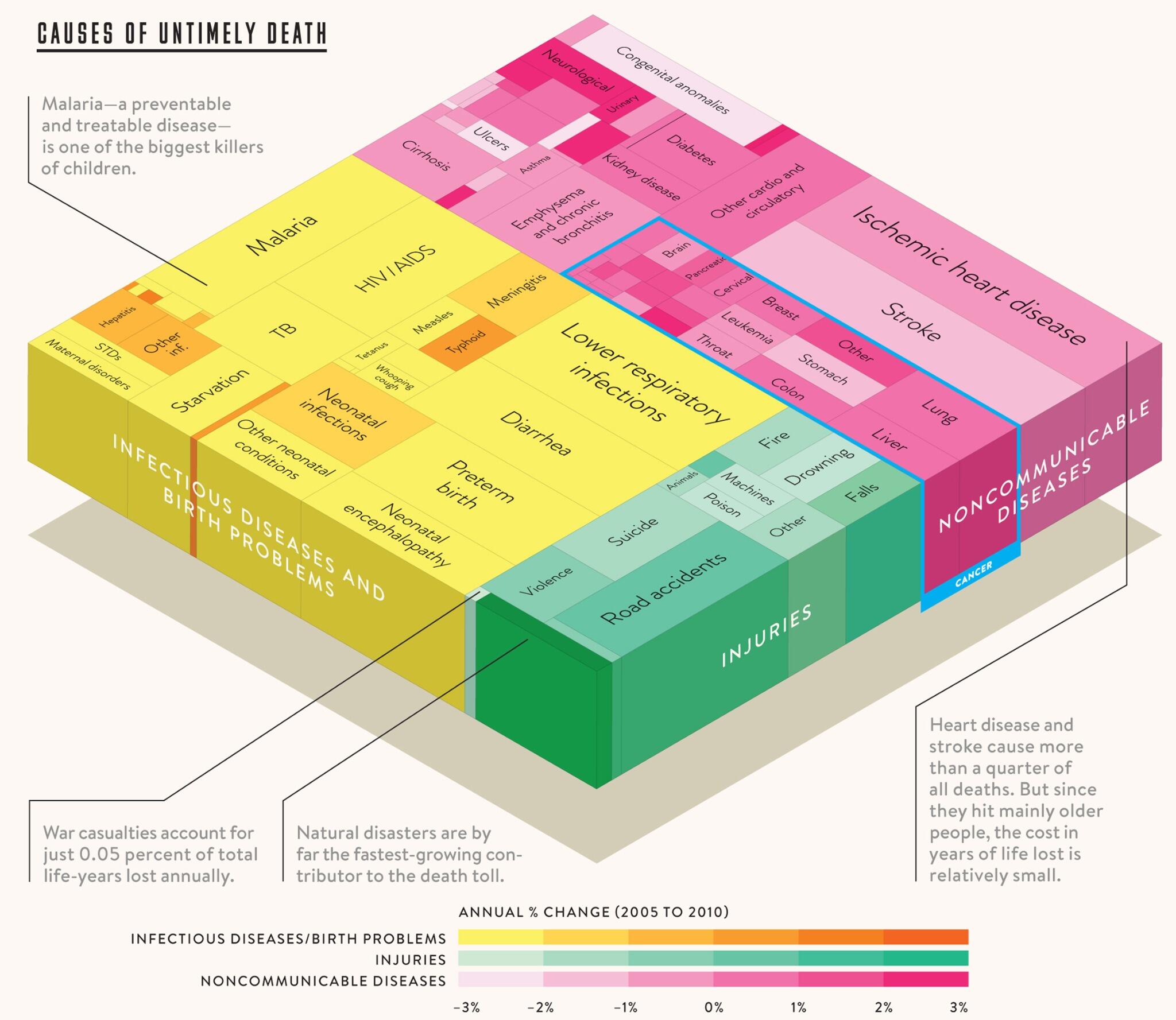
What is most likely to cause your untimely death?


Tweet from Mr. Bill Gates.   See?  Great minds think alike.  Infectious Diseases and Birth Problems.  Seizing used computers bound for hospitals to avoid "future disposal risks" of used PCs looks to me like an excuse for planned obsolescence in hindsight.  It helps to read the comment from Reddit:
"I feel like many people misunderstand exactly what this chart represents. This is not about the number of people who had an early death in each category. It's about the number of expected years of life lost. In other words
LIFE EXPECTANCY – AGE AT DEATH = YEARS LOST
The death of a child accounts for more years lost vs. an old man dying of a heart attack."
When people are running around making up numbers like "80% of all exports" to scare people out of reuse and recycling, and posing children at dumps to say that's where the Egyptian CRT purchases are burned,  it's not just untruthful, it impacts humans efforts to fix actual problems.   There are more than enough real actual risks, we don't need to go conjuring up new "e-waste" ones.

And Bill, while we're talking, I'd suggest letting go of the whole Windows Authorized User thing in Africa.  It's in your company's interest for Africans to grow up using Windows.  Make money on them later, when they have a little more of it.  I doubt the Microsoft Authorized Refurbishers effort in Africa pays for itself to begin with.


"Dead Reckoning": Cross Cultural Risk Part II


Second of 3 holiday blogs on Cross Cultural Risk Comparison, Assessment. 


 Peter Stackpole, 1955
These Thanksgiving posts on "Dead Reckoning" Risk Assessment were originally part of the "Broken Arrow" series.  I decided to split them out, in part because it remains dicey to name the names and actions that led the State of Vermont to engage in a battle of friendly fire on its own recycling infrastructure.

It is Sunday, November 30.  A few minutes ago I went to the kitchen, where I had to make an "executive decision" on holiday leftovers.   My wife and I have a system, I cook turkey dinner and we invite 2-3 friends over for Thanksgiving.  It's a 14-15 lb. free range Vermont turkey (leaner and tastier, well worth the $10 extra), and generates a lot of leftovers.  After the meal, as I was taught in the Ozarks by my hillbilly parents and grandparents, I salvage.  That means stripping the turkey of all the meat and putting the carcass in a pressure cooker to get out the remaining nutrients.   We have an open house pot-luck on Friday where many more friends come over and are encouraged to bring their leftovers, and I make a "second edition gravy" from the pressure cooker...

Unfortunately, I just had to throw away about a pound of turkey meat.  We had left it out (room in the fridge issues) all day Saturday.  This morning, I opened it and caught a slightly spoiled whiff.   Definitely something I would have still eaten in college, after rinsing and washing the pieces, which I started to do.   But definitely something my wife would not keep if she had opened it first.   I started the process of re-cooking it, hillbilly style... Then I reconsidered.  Rather than debate the risk/benefit analysis of food-borne-illnesses, I decided then to throw it away.

What are the ethics of serving, or disposing of, leftover food?  Here and now?  And how can the weighing of risks of these decisions be analyzed to provide insight to environmental policy today?

Wonder and Doubt: Solved by Machines

Reading about how IBM's Watson computer is learning to make pastries on NYTimes.   If we had the right Bayesian statistics, the right DNA code (to predict likelihood of gene X "liking" taste Y), and the supercomputer to put them all together... theoretically you'd have a Utopia where everyone always got precisely what they ordered in life.  The right taste, the optimum number of calories.  Maybe Watson can even do Kosher...

Taking the hypothesis of ultra intelligence to its next step, what if we really know the absolute outcome of every recipe we make in life?    Not fake, not "The Truman Show".  What if our experience and judgement and data and correct premises were increased a thousand-fold, or by a million?   If we could almost intuitively anticipate the "butterfly effect?"

It might make life incredibly boring.   Would we be like cattle or ants, grazing?   Grazing on lots of different ideas and information, but all predictable, and it would pass through us like cud.

Or we might replace the "risk" and uncertainty by expanding our horizons geographically, taking what we know and are certain of, and placing ourselves in new frontiers.  "Star Trek" or "Dr. Who" is a way we can always imagine shaking things up, going to other solar systems, to seek out new worlds and new civilizations, and boldly go where no one has gone before.

Trying new foods is good.  Eat the same thing, every time, is like ... eating grass.

What if we actually make ourselves feel more in command of all information by reducing the amount of information?  What if we limit our geography so much that we really do know and can anticipate an extremely high percentage of what we encounter?  Instead of a hypothesis where we increase our intellect a million-fold, and then reach outside the solar system, why don't we shrink our system so that the intellect, intelligence, and data we have is preponderant.

If we put our butterflies in fishbowls, or vacuum tubes, their effects will be easier to predict.

When an African really wants to buy something from me... not everything, not all assorted junk, not 75% of the "e-waste", but something rather specific - say a 17" display screen (which will light up in a slum with electric current too weak for a 27"), I may have to admit I don't know what will "ultimately" happen to it.  Perhaps I cannot predict the fate of the monitor in our custody.

If we shred it together with the 32" TVs and obsolete printers and clickety keyboards, and spit out a stream of shredded plastic, shredded copper, aluminum, and steel, drawn by magnets, optical sorters, and eddy currents, then I don't really need Watson to make the decision what to sell anymore.   Everything is now a commodity, a stream of raw material.

Moo.

Charm Offensive

Being charming and being offensive at the same time is tricky.   It's also fascinating, an entire Hollywood genre.

Anti-slavery advocate John Brown may be my hero... he created a space for Abraham Lincoln and Frederick Douglas to work inside.   But if you don't have a popularity guru, and aren't part of a Lincoln-F.Douglas team, it does help to build up chits, credits, and bitcoins of goodwill.  Count your cultural ammo before you embark on something really worth being contrary over.  It's not a secret, but it has to be a habit, like a banker saving interest, or a cowboy counting his bullets.

Sometimes we discover an injustice in our group, and we have to buy or earn attention to it, until we recruit our Great Communicator like Abe Lincoln, Mark Twain, or Frederic Douglas.

Until then, how do we promote justice while remaining acceptably affable?   How do we communicate the need for change to people who aren't really in the business and whose attention we are borrowing?  It's kind of like selling Civil Rights Movements at a Little Rock Garden Club meeting, or Women's Suffrage to a Chicago Country Club, in 1925.

Take note of what you are spending with this Charm Econ earnings report by Sebastian Drake.

13 Characteristics of Likeable People by Sebastian Drake
1. Smiling 
2. Eye contact – 
3. Touch – 
4. Not talking about yourself – 
5. Not talking too much 
6. Empathy – 
7. Not trying to impress – 
8. Showing praise and appreciation – 
9. Never criticizing, ever, for any reason –

10. Not trying to fix other peoples’ problems
 – 
11. Eliminate negativity 
12. Never complain –

13. Never impose weakness on others
 –

Maybe we can assign earnings per day to each habit and treat it like a checklist.  Follow these steps, and be less unpopular.  But when is Charm over-rated?

"How E-Waste Benefits Your Children"


It has always been "think about the children", perhaps.

Programming was made for children.   OEMs used it to sell the appliance to the parents.

Description:
                                                          file://M:\Courier
                                                          

                                                          Email\\Outbound
Images\image010(8).jpg

So, the electronics get sold to us via "cognitive risk" - that our children will be left behind socially and intellectually if they don't get the electric gadget.  Then, if we sell it for reuse (so someone doesn't buy a brand new one), we are sold the cognitive risk the "e-waste" poses to the poor black children.

It's all about consumption, selling consumption any way they can.  We own stocks and retirement IRAs in their corporations and can't complain too loudly about the way they market sans sustainability.  And ENGOs are really not any different at all in their use of this "think of the children" marketing.  But we can be smart about what panics us.

I'm from the WWF generation - that's "World Wildlife Fund".  That's when Greenpeace was powered by Jacques Cousteau, and caring about endangered species and whales.   It's a dicey topic to debate which we should care more about - whale, tiger, orangutan, and rhino extinction vs. toxics in a child's environment.

But let's start by being smart.  What are the real numbers?  What are the real risks?  Is this about children's health, or is it about planned obsolescence?  Look at the enormous resources spent on non-toxic ink cartridge refilling.  Grinding those cartridges into pieces of plastic to be plastic-recycled in China is a lot worse of a job than refilling those ink cartridges with new ink for the "grey market".   But look at the attention given to ink cartridge refill risk vs. plastic recycling.

It's howdy doody time, it's howdy doody time...

Memorial Day: Fear and Greed, Part 3


There is a cynical expression in Africa, used in response to "fears of the rich".   Why worry about toxics which may kill me seven years from now, when there are so many things that may kill me today?

Just as there are Useless Lists of Jobs Beneath Wealthy People, there are fears and phobias that the emerging markets don't have on their list of priorities.  That can be an opportunity for exploitation.  Yesterday's post described how EPA's Environmental Justice team came on board to make sure that "a clean local environment" was a right for every American citizen.

I learned today about careers in actuarial science (CNN).  It's about the statistics of risk and benefit, which (those who know me, know) I attribute to most of my life success.  (Taking credit for good luck, others call it).  Wikipedia 2012.05.28
An actuary is a business professional who deals with the financial impact of risk and uncertainty. Actuaries provide expert assessments of financial security systems, with a focus on their complexity, their mathematics, and their mechanisms (Trowbridge 1989, p. 7).
Actuaries mathematically evaluate the likelihood of events and quantify the contingent outcomes in order to minimize losses, both emotional and financial, associated with uncertain undesirable events. Since many events, such as death, cannot be avoided, it is helpful to take measures to minimize their financial impact when they occur.
According to the article, actuaries are one of the most sought-after degree holders, with virtually 0% unemployment.   What I'm curious about is what a professional actuary would say about "recycling" and "reuse" endeavors, with their associated benefits and risks, in a developing nation?  

One of the saddest stories I remember from Peace Corps in Africa was a young woman who spent a year teaching farmers to cultivate fish ponds.  Her favorite and most apt farmer/student lost his 1 year old son, who drowned in the fish pond she helped to dig, and she quit the service and returned to California.  Perhaps an actuary would say that the protein in the diet is worth the risk, if you learn from the lost life and make the fish ponds a little safer.  (Yes, this is similar to the story of the boy I helped bury who drowned in his father's well.  Not digging wells is not an option.  I taught by twins to swim by the time they were two years old).

Unlike the Peace Corps volunteers, the villagers really don't have much of an option to move to San Francisco.  If they try illegal emigration, that has its own risks.  My best friend from Africa married my Peace Corps replacement and they moved to the USA.  He was a muslim who fell into drinking in the USA, lost his family, and has been in and out of prison.

Finding a scapegoat for the things that killed us today is rarely useful.  The amount of fear that we can realistically project onto something that may kill us seven years from now is also practically useless, unless we find a scapegoat to leverage... the answer to that "unless" depends on the wealth of the scapegoat.  The environmental justice and Stewardship philosophies may not be built upon this attraction to leveraged wealth... but they cannot help but be influenced by it.

We can blame ourselves, or government, for the fish ponds.   We can blame corporations for the stewardship of the toxics.  But like actuaries on a battlefield, the entrepreneurs I've met in slums and emerging markets don't wait around for someone to blame.  They find the most value they can, the smartest way that they can.  It's not waiting for a big multinational corporation to pay for a modern shredder.   It's not taking back an exhausted 1980s TV from Lagos for repair.  The best thing they can do is get a laptop which needs the fan cleaned, or a computer with a dead capacitor, and repair it, earning a months wages in forty five minutes.  It may be safer for the white volunteer's shiny conscience to escape that, or say they shouldn't have had to make that choice.   I didn't leave, and don't intend to.

When a risk is a consequence of trade, and the trade is a good or service between someone wealthy and someone poor, it might be about exploitation and it might be about race.   But sometimes a cigar is just a cigar.  The actuarial science of life for the developing world says that Foxconn and contract management and low wages are a better path out of the poorest ditch than the promises of Mao or Al Qaeda.  Having a boss sucks.  But having a fair boss, or a good trading partner, doesn't suck nearly as much.

Does Spotify Turn Pandora into MySpace?

I have been an absolute lover and fan of Pandora Radio for years.  The music service is free, and you enter in an artist you like.   The artist may play, but as likely you will hear some other artist which people who liked the first artist are likely to also appreciate.  If you don't like a song, click thumbs down, and that gets factored into the future of your playlists on the station.

I love Neil Young, discover Greg Brown.  I find out that my dad's not just weird, that people who like Gordon Lightfoot also like Uncle John's Band by Grateful Dead (without liking other deadhead tunes quitesomuchthanks)... You can't choose what song to play next, but absent that choice it's like a radio station, background music.  I discovered some of my favorite songs during the past 5 years via Pandora.  Became a paid subscriber in January for my birthday present.

Now Spotify:  Similar to Pandora, but also like limewire or napster in it's display and order-by-artist-by-song selection, but legal and supported by ads.
(Note:  Recording Industry was a dumb idiot for not immediately embracing the technology and creating Columbia Record Club for big-value-teaser-downloads in the 1990s, the industry could have been Facebook now but chose to fight the last tape-recorder war over copyright.  ITunes finally kind of caught on but does kind of a lousy job in my opinion).
Love Spotify so far.  But would I have discovered MIA Paper Planes (a gem I discovered on Pandora) or Avalanches Frontier Psychiatrist (Boy Needs Therapy)?

(Note: savvy commenter already suggests grooveshark.com)

EWaste Risk: What Africans Typically Know

More on the UNEP Report... Risk Risk Risk.

Risk and Opportunities of E-Waste:  Where are WEee in Africa?
"Where are WEEE in Africa? sheds light on current recycling practices and on socio-economic characteristics of the e-waste sector in West Africa. It also provides the quantitative data on the use, import and disposal of electronic and electrical equipment in the region."

The report is not about landfilling e-waste.  The thing getting buried is the LEAD, not the lead.
Journalistic leads emphasize grabbing the attention of the reader.[5]
In journalism, the failure to mention the most interesting or attention grabbing elements of a story in the first paragraph is sometimes called "burying the lead." [wikipedia 2012.2.21]
The most interesting thing in the studies is the description of the Opportunity for reuse and repair markets, and the opportunities in safe recycling. I wish the Report was a celebration of the Geeks of Color.  The report finds 30,000 electronics repair techs in Ghana alone.  The report says the Tech in Africa earns ten times more than the "scrap boy".  The Fixers should be the story.  The reuse of the imports generates over $100M dollars in nations that need it.  The CRT monitors  get reused, not burned, most of the time.  But (tsk, tsk, tsk) "Opportunity" gets second billing.

Ok, after reuse, ten years later, as Africans generate twice-reused electronics, is that the Risk?  No - the report STILL talks about OPPORTUNITY.   Within the junk, the opportunity of recycling the end of life product, is still an opportunity, the report says.  The report implies that the only problem is that Africans don't know how to do it safely.

The report should be written in this order:

1.  Most of the used electronics imported are reused and repaired.
2.  The reuse and repair create most of the jobs and value.
3.  Africans continue to use and repair the devices for years.
4.  Finally, of the remaining 15%, there is also jobs and value, but we have safety concerns

The fourth is definitely a concern to me, too.  But it's not instruction the Africans need.   It's not technology, either.  Hand disassembly works better than shredding.  The problem is that African have tough choices on where to spend their money, and will face real risks.   They may take the low hanging fruit, the cash crop copper and gold, and leave the difficult stuff for later.  There is also a danger that Africans will suffer toxic consequences if they in turn pass the buck to other Africans, to people who aren't equipt or incentivized to recycle professionally.  That's what happened in China.

How risky is that risk?  Tomorrow I'll go public about the Toxic Risk from recycling e-waste in Africa.

The main risk
 in this whole trade is the risk of being accused, in the west, of being an exporter.   Clients feel that it risks their reputation, recyclers fear they will get photographed with a container in their yards, like Intercon or CRTR.   OEMs are primarily concerned about the risk that White Box Computer factories will crop up, refilling their stupid $22 ink cartridges and reusing their RAM sticks.

My thesis is that The West is primarily concerned about itself, and masquerades that as a concern about African boys working instead of being in school.   Most of us are concerned first with our own liability, and at best the risk to our own consciences, when we believed that most of the e-waste in the dumps was fresh off the boat.   Let's be honest, readers in the west want to hear about OUR stuff, our role.  No one seems to be covering that the UNEP Report is ABOUT Africans and the best things Africans can be doing right now.   I say that the best thing for Africa is to increase their choices of people supplying to them (IE end E-Stewards and SB20 prohibition), and work on as new a used product as they can get their hands on, and then find someone to pay them for the printed circuit boards who will also take the CRT tubes.

One last word about something Africans generally know better than Europe and USA counterparts... RISK.  Africans I know have Risk in perspective.  They know:

1.  Just how soon we are all going to be dead.
2.  Just how long we are all going to stay dead.

There is a perspective and a beauty and a friendliness in Africa that comes from this knowledge of "end of life".  It can also, perhaps, explain the shrugging off of horrible violence.  It also may help explain the joy of religion there. But in general, Africans don't exaggerate their self importance, and their waste, when they are really truly finished with it, isn't tinged by the importance of the generator, quite so very much.  And it means that stalling the internet access for ten more years is not a good option.

I've introduced Recyclers who don't export to people from Africa who wanted to buy from them.   I know what I saw in their eyes.  They are afraid to be voted out of the good people club.

The single biggest risk of recycling e-waste, it appears, is the high correlation to narcissim, and taking yourself way too seriously.  I should know.


Postscript: Entrepreneur E-Waste Recycler 2


January 2, 2012:  It being the winter break, I've tinkered with and re-edited yesterday's post on Entrepreneurism several times.  It's better, if not yet shorter, than when it was first posted.  I left the crazy long Mad Man title as kind of a warning that it would be difficult to skim.  The post centers on an essay by Kentin Waits, published in OpenForum.com

Five Essential Characteristics of the Entrepreneural Mind

1.  Creativity
2.  Suspicion of Predictors
3.  Comfort with Uncertainty
4.  Openness to Experimentation
5.  Functional Humility

This morning, I thought about people who are really looking to get into the recycling business, people who are thinking of becoming entrepreneurs.  For that audience, my own shanzai essay is a little one sided.

There are of course other true entrepreneurs who have entered the "e-waste" business on completely different terms than I have.  It takes creativity, suspicion, comfort with uncertainty, and experimentation to design an automated shredding and chopping and grinding machine, and to take a chance on not exporting when everyone else is donig so.   I don't look down on any of the companies which established the USA's domestic recycling infrastructure.  In fact, companies like mine NEED them to keep from sending toxics along for the ride, and for improving the junk in loads from 30% to 15% and better.

I can't even blame those who helped to fund the insulting and racist campaign that turned my Egyptian friend Hamdy and his brother Essam, both with medical degrees, into "waste tourists" and criminals.  Or at least, they were suspicious dark skinned exporters who no one felt comfortable trading with.  And the other recyclers can't blame me for taking credit for my own risk.  My ewaste company was on Hamdy's side when their friends twittered down the dictators regime.   If some of the 30,000 computers I sold there since 2001 played a part, I'm glad.

If some of those computers wind up in a Cairo dump 12 years later, with wire yokes scavenged by Zaballeen recyclers, the monitor would still have served its purpose 5 times as long as if it had been shredded after it was upgraded.  And it will have helped 5 times as many people.  And it did something besides play "Doom" or "Second Life".   Heck, the computer itself lived a second life.

Organic Recycling: Compost Happens

compost windrow - wikipedia
A 16 year old recycling worker was pronounced dead, and two others unconscious, at a compost operation in Bakersfield California yesterday.

Evidence suggests that when the three went into a drainage ditch, that heavier-than-air gas hydrogen sulfide had gathered there from the decaying compost windrows, and sunk to the lowest point in a ditch.  Employees went into the ditch for some reason, and were overcome by fumes... see Bakersfield Californian report, which interviews company, colleagues, and regulators.  It appears a "Lake Nyos" accident, heavy air pushing out oxygen.

Death from compost would be exceedingly rare, though NIMBY interests generally oppose them as neighbors (due to odors).   Allowing organic matter to gradually decompose seems about as passive a waste recycling activity as one could imagine.  There are no "witches brews" of unnatural electronics circuit toxics involved... though the regulator quoted notes that a ditch is a "confined space".  This is strictly organic recycling danger.

Too early to draw conclusions.  But much of what I've focused on in this blog is how people make law and policy from a bad impression... photos trip a "cognitive risk" lobe in our brain, and environmentalists might forget that mob law and sanctimony (sancti-money) are not something we are immune to.