Showing posts with label Environmental Malpractice. Show all posts

Nuance Delivery 4: Correcting Our Aim

Having trouble with the video editing software to get Oluu Orga's excellent video-bio on his years in Agbogbloshie up for view.  I had been using Picasa for the previous videos I edited. Alphabet (Google) is kind of the popular boyfriend/girlfriend that only dates you for a couple of years and then loses interest... Love their free products but they wind up dropping support and pulling the plug-ins.


While I keep working on it, I'm also getting ready to receive a bunch of African Fair Trade Recycling members. Wahab "Ghana Tech" is arriving in Boston. Emmanuel Nyaletey arrives tomorrow from Georgia Tech. Evans Quaye of Accra is networking in South Africa.  Web Element is completing their Fair Trade Recycling Waste Offset (re-export) paperwork at Ghana EPA. Our newest Fair Trade Recycling staffer, John Sumani of Wa (far Northwest), a Ph.D in environmental studies, has a good network at Ghana EPA. The Techs of Chendiba Enterprises check in politely now and then. And the "three musketeers of Agbo", Awal, Yaro and Razak, have their Whatsapp credits ready to spend (at all hours of day and night).

Nuance Delivery 2: Awal is BlackboxMedia's Tire Burning Boy

Well, I was working on a different Nuance #2 - the upcoming release of Juan Solera / Palm and Play's documentary "Blame Game" (former working title Clean Hands).

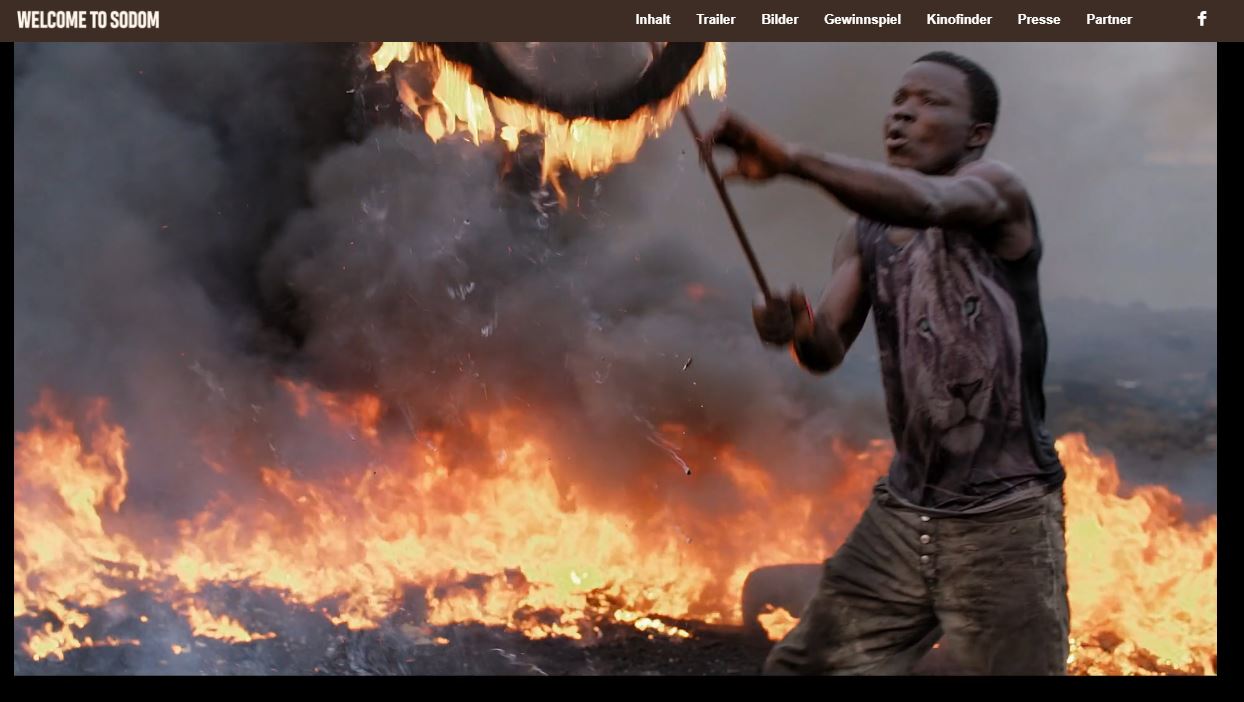
But before I could make an announcement, another German White Savior documentary has just been released!  "Welcome to Sodom" makes Awal Muhammed (and perhaps fellow Musketeers Yaro and Razak? Didn't see them in the trailer) return for another one of his tire-burning-circus acts.

In fairness, I have only been able to see the trailer.  But hey, here's the same theme.  Agbogbloshie in Ghana is presented as "Europe's Ewaste Dump". Shots of girls with water baskets on their heads. Shots of garbage being dumped (not even electronics) through a frame of a 1970 television husk.  But if the trailer and website is any indication, our hero is, once again, Awal Muhammed of Savelugu (north of Tamale) Ghana.

Here he is with his gasoline-filled-tire-burning-act (previously seen on Placebo's MTV video last year).  This is not something they do - use this much fuel to make this big a fire - except when European camerapeople are present. Awal is credited with figuring out that it's the fire that brings the cameras for your close up (a hint for Hollywood Extra Wannabees, perhaps).


Lifecycle Analysis: CleanTech, "BrownTech", and Export Markets


What is the tension between "CleanTech" - e.g. a new hybrid car - and (what I'll call) "BrownTech"?  Repairing an older gas guzzler to run another year before mining, refining, consuming for new?

Early adapters proudly display their new CleanTech device.  As they should. By electively upgrading to a newer, environmentally-efficient device, they are sending signals to the market and to investors.  The early adapters are on the front lines, bringing the scalability (lowered cost and efficiency) to the new wind, solar, sustainable, recycled-content, non-toxic, etc. markets.

But being able to afford these elective #CleanTech upgrades is a privilege not shared by poor people, especially those in Emerging Markets (so-called "third world" countries).  For them, they are upgrading from a black and white 1967 television to a color 19" CRT.  From not having a phone at all to a flip Motorola.

The new #cleantech device trade shows are exciting.  So are ghetto repair shops. We are on the same spectrum of Life Cycle Analysis.  The differences are economic and cultural.

https://upload.wikimedia.org/wikipedia/commons/thumb/Mariordo


2002 Article In Recycling Today Foreshadows WR3A, IFixIT, E-Stewards

While looking to upload some papers in Academia.edu, I ran across an article published by Recycling Today magazine in 2002 - by yours truly.  "Setting a Higher Standard" explained that boycotting the export market would be a "war on drugs" approach, forcing legit oversees reuse and recycling operations to meet demand via "back alleys".

Here are 3 conclusions about e-waste export policy at the end of the article (edited by Brian Taylor).

Looks sound.

1) Send Quality.  Meet the customers and find out what they want.  Just export that.  Don't throw a piece of junk on the container that you don't know what to do with.  This would become the foundation of WR3A.org and Fair Trade Recycling.

2) Support Reuse and Repair.  This forshadowed Ifixit.org, was influenced by repairfaq.org's Silicon Sam.  I'd used Sam's repair instructions while reviewing Chinese purchase orders, and found the Chinese buyers were giving instructions that would eliminate non-repairable units.  This led to the realization that China was not buying ANY CRT Televisions, only specific 15" and 17" CRTs, which meant the trade was not driven by cost externalization.  California SB20 went off a cliff that year.

3) Support Reputable USA companies.  This forshadowed R2 and E-Stewards.

Basel Action Network attacked me for writing the article, personally, and that is how I met Jim Puckett.  He blasted a response to the article via "Microsoft Outlook" and cc'd dozens of people whom I'd never met, but with whom I'd become acquainted over the years.

The article was sent to some folks at US EPA, who later hired me as a consultant for the 2006 Federal Register CRT Rule, which funded my second trip to Asia - this time bringing Craig Lorch of Total Reclaim and Lin King of UC Davis, to visit some of the "Big Secret Factories" that BAN was racially profiling as "primitive rice paddies".  (If you are researching MIT Senseable City Lab and BAN's Monitour project, there's a chestnut about this at the bottom of this blog).


How To Pay For Africa E-Waste Cleanup? Part II

So we've established that so far, "saving Africa from e-waste" has made a handsome profit for EU Policy makers, NGOs, Big Shred, and lazy photojournalists and prosecutors. 

We've established that like USA in the 1990s, Africans have a growing volume of junk televisions and computers.  Imported in the 1980s, 1990s, and 2000s, the CRT televisions alone represent a modern "urban mining" project.

The kids at left - ALL of their grandparents had a TV when their parents were born.  This is not a "recent import" or "Basel Convention" disorder.

Here's the problem - Africa's Tech Sector, the repair and upgrade professionals, used to be able to sell third hand televisions and computers, collected from African consumers who traded them in or abandoned a repair after 'elective upgrade'.  They are increasingly finding it hard to resell 20, 30 and 40 year old "third hand" electronics.

Correctly diagnosing the problem is the first step to treatment.  Paying for the solution is the second step.

How to pay for the safe and effective recycling of used electronics abandoned at African repair shops - not by Europeans or Americans, but by African consumers who, eventually, decide not to pay for the repair of a 45 year old television set?

First, stop wasting money on environmental malpractice.


Our Political New Year's Resolution: Ebony and Ivory

It's 6AM and I'm packing the car for another annual cross country road trip from (red state) Arkansas to (blue state) Vermont.  I was hired as a cross cultural trainer for new US Peace Corps volunteers arriving in Cameroon in 1987, and sometimes feel I never stopped.

Can't resist posting my note to the AirBNB host where we stayed in lovely Leslie, Arkansas.  She was the child of a hippie who grew up in the Ozarks and now lives in Seattle.

Finding yourself in liberal Seattle must be like me finding myself in Vermont. Generally I'm very relieved to be away from "ignorant and proud of it" politics here in the southern midwest. But also I find myself very aware of my coastal liberal friends and our own confirmation bias and "profiling" of conservatives, and attributing to 'denial' what may be legitimate skepticism over 'solutions'. Consider yourself a Peace Corps volunteer from a red state.

ebony and ivory stripes (wikipedia chain gang)
Confirmation bias. Profiling.  I'm not immune to it.  None of us can be. But when you walk a mile in another man's shoes - as I've done for a long time with the WEEE export entrepreneurs in emerging markets - you can sit on their jury.  The blindness of NGOs to the studies that show nuance is nothing new.  It's Captain Ahab.  It's Scarlet Letter.  It's Sir Gawain and the Green Knight.  It's in To Kill a Mockingbird.  It's Huckleberry Finn's crime.  These great works are all about people who start a mission based on justice (like environmental justice) and consider themselves jurists and agents of conscience, but are deafened by their own conclusions.

We need to keep it simple. If I'm skeptical of your trade ban on used electronics as a "solution" (to what? poverty?) that does not make me a "denier". Let's find something else to agree on, a simple message that might appeal to rural and urban and OECD and non-OECD.


Geography Baiting 1: MIT Senseable City Lab "MoniTour" Goes Offline

Has the correspondence from Unwitting, Unwilling Research Subjects finally got traction at MIT's Legal Office?  After 3 months of silent treatment, communications from MIT and BAN reignite the blog.

It is the end of summer vacation for Massachusetts Institute of Technology's Senseable City Lab. Professors have been on vacation, with little time to return calls or respond to our letters of May and June 2016.  But last week got a response back last week from MIT's Legal Department, saying that all future inquiries and correspondence should go through them.

This is one week after we cc'd MIT's Senseable City Lab Director, Carlo Ratti, in response to an email to Yours Truly from my an old pal, Jim Puckett, Executive Director of Basel Action Network.  BAN's parterner status with MIT is described in MIT's MoniTour website. You know, http://senseable.mit.edu/monitour


**** static ****

EDIT:  The website is restored now, and may have been unavailable only via my chrome browser which appears to be failing at several sites.  Speculation that MIT had taken the site down was wrong.

The site is 404, not available.  Could be a fluke, a temporary outage. But has been at least 3 days now. It might be premature to correlate MIT's shuffle with the written correspondence I've recently received from Basel Action Network and MIT's Legal Office.  But I predicted in my first response to the @KCTS PBS 9 airing of the "sting" on overseas electronics reuse, repair and recycling - MIT does not have a dog in this fight.  MIT has thousands of international students who know intimately the warts, beauty, sweat, and ingenuity across the oceans, and we predicted that MIT Ethics Committees would hold Carlo Ratti's Senseable City to a higher standard than to draw inferences on the "circular economy" based on BAN's notorious geography-baiting.

It's not exactly race baiting, since we don't know who in the USA owned or touched a device.  But BAN's descriptions of Hong Kong Province - which is wealthier per capita than the USA - with words like "primitive" and "rice paddy" should have been caught internally by MIT, without the help of a Vermont junk dealer's blog.

Someone commented that MIT might be engaged in a "cover up", but my friends in academia share my optimism.  The Massachusetts Institute of Technology's gravitas was clearly accepted as peer review and diligence by the reporters, and from MIT Senseable City Lab's response, it clearly was not merited or intended as such.

Google cache of the MIT-based webpage shows the original text which described the now AWOL web page as "A joint project between the Basel Action Network and the MIT Senseable City Lab".  And that's not BAN's claim, it's MIT Senseable City Lab indicating it's a "joint project" partner.  (copy and paste below, so you can recreate your own 404).

Monitour / MIT Senseable City Lab

senseable.mit.edu/monitour


Massachusetts Institute of Technology
A joint project between the Basel Action Network and the MIT Senseable City Lab ... this site in graphic form and will also be released in a series of reports by BAN. ... City Lab 2. a PDF copy of the publication is sent to senseable-press@mit.edu.
You've visited this page 2 times. Last visit: 8/27/16

Carlo Ratti's only direct response to my 14 pages of inquiries was 2 paragraphs. It could have been even shorter:  "It's BAN's project, not MIT's".  Or "People don't track People, GPS devices track people," or "GPS tags don't track people, they track peoples stuff".  "MIT just gave BAN the tools to track unwitting, unwilling participants, we didn't do it ourselves."

But Carlo Ratti spoke to PBS and clearly reviewed the pages on the now AWOL website stating that destinations, like Hong Kong, were "previously unknown".  The gist of my letter was:
"how did MIT determine my business transactions were 'previously unknown', unless it meant 'unknown to MIT and BAN', which isn't much of a defense of the ethical 'unwitting subject' test."
In fact, I'd been to Hong Kong (and Taiwan) one month before the PBS story aired.  Here's Video of Hong Kong from April 2016 below - with my 15 year old son, who I had taken to meet and have dinner with one of the best and brightest video display engineers I'd ever met (in Taipei).  Does the wifi-enabled, air-conditioned luxury ferris wheel ride among skyscrapers depict "typical Hong Kong"?  Of course not. Nor does +KCTS 9 film of a printer scrap yard in Yuen Long.  "Geographical Profiling" shortcut of the necessary effort to track each and every recyclable through each and every technician, and not to depict Asians as "primitives" with just obscured little points on a map.

You can't "obscure" destinations in Hong Kong on your website and then use photos of one location to "profile" anyone who does business with Hong Kong.  That's Geography-Baiting journalists and readers, appealing to their worst fears about recyclers and refurbishers in emerging markets.  You didn't show the Geeks of Color.

You can show Deliverance to depict America, but you've got to show Big Bang Theory, too.  Otherwise, it's propaganda, which BAN has been accused of for a long time, plenty long enough for MIT to vet them as a "joint partner" in describing emerging market "shantytowns" and "rice paddies" and "orphans" and "Sodom and Gomorrahs" and "E-Waste Hell" etc., etc., etc.

How does MIT's partner characterize the people who live and work in and built this location?

NGO Needle In Haystack Part 2: Methodology is "Base Rate Fallacy" Bingo

Part 2 in response to the Basel Action Network and E-Stewards public disparagement of Hong Kong LCD display refurbishing market.


This is being edited now that the PBS Report is available on live internet. Additions will be highlighted in Yellow, deletions in Gray.  


FAIR USE - Response to Criticism
We do not know exactly what Total Reclaim sent to Hong Kong, or the condition that it was in.  But it sure wasn't a console TV, a microwave, a copy machine, CRT monitor, or printer.

The methodology used by the NGO behind the story appears intended to prop up misinformation about refurbish and repair markets overseas.  The NGOs know that if they put a tracking device in a CRT television, it will wind up domestically recycled.  But by planting it in a smaller device with high repair potential and high reuse demand, they have once again ensured "collateral damage" - this time to their own Top Shelf E-Steward.

It is not an accident that the #trackingewaste demonstration caught one of the best-in-class Recyclers. And it's no mystery what would likely find its way back to the cradle of LCD manufacturing, warranty takeback, refurbishing and repair.  The highest percentage of display device engineers on the planet live in a triangle between Taiwan, Hong Kong, and Kunming, China, and if you know what someone will buy from that area, and what someone would track if they wanted to land there, you can guarantee a BINGO.  The game is rigged to obscure 2 key facts:

- Total Reclaim exported almost nothing, as a percentage of Seattle e-Waste.
- Hong Kong imports next to nothing, as a percentage of intact Seattle e-Waste

Here are 373 Companies which sell PARTS and COMPONENTS of digital displays in the area.

Environmental Anaphylaxis: Auto-immune Attacks by Environmentalists on Harmless Africans


Last week I was alerted to an editorial by Laura Seay and Alex de Waal (July 17)

This was via a tweet from AfricanSolarLLP, a boots-on-the-ground solar energy project coordinator based in Accra, Ghana, who (along with Alhassan Abdallah) has been bringing first-hand accounting of the Old Fadama / Agbogbloshie real estate evictions (vs. "Sodom and Gomorrah") via @Twitter.


The article (Q and A) addresses many of the cautions I've undertaken, and there's some heavy stuff to dish out to readers of de Tocqueville.  An increasing number of environmentalist intellectuals like myself, may remain ardent environmentalists, but still fear the "churchiness" of the environmental-regulatory complex.  This is also true of other "world savers", we can be ardently pro African while suspicious of what Peter Buffet called the Charitable Industrial Complex.  In fact, much of it could apply to Fair Trade Recycling, and is a reminder of the dangers in heroicizing our "geeks of color" and "hurricane bensons".

Making more people aware of an injustice by oversimplifying the problems and the remedies is Poster Child Policy.  Making sad photo-essays of orphans working in scrap yards, and representing those children to be "emblematic" or embodiment or archetypal of African importers, is wrong on the science, and leads to environmental malpractice.

The challenge is to neither write so densely that no one reads it, nor so simply that it sets people off with the equivalent of racial profiling.  Basel Action Network "simplified" the long and complicated Annex IX, B1110 rules on export for repair and refurbishment by telling virtually everyone that it meant "fully functional", creating a set of enforcement guidelines which Joe Benson eventually gave up and pled guilty to in return for a decreased sentence.  [NOTE: That is not "twice convicted of the same offense," the just-world-fallacy / panacea shared by CWIT].  But at the same time, we have to recognize that progress has been made in understanding the nuance of "ewaste exports", and I think I can report that arrests of other Africa Tech Sector geeks like Joe Benson are less likely.

The awareness of the misuse, and misapplication, of well-meaning guidelines should serve as a broader lesson for all environmental interventions.  First, do no harm.  Protection of the innocent takes precedence over the simplified profiling guidelines (what Emile Lindemiller of Interpol called "Proactive Enforcement" - get out there and accuse people before the crime has been committed, and less environmental harm will occur.

That's like giving snakebite kits to everyone and telling them to incise and suck out the venom, whether you know the snake was poison or not.

I'm happy to report that Interpol staff may not be electronic repair experts, but I'm reassured they can eventually see when their enforcement is being abused by interested parties.  Eventually, they will get it right.  What environmentalists need to learn is to take responsibility for our stewardship and environmental dumping enforcement "cures" before a proper diagnosis has been reached.

This is how the study of environmental health must learn the same lessons as the application of western medicine to promote human health.  It's ok for a doctor to make a mistake, a mistake is not malpractice.  It becomes malpractice when you have been provided information to correct your practice and don't follow it.  This is the pivot point.  We don't blame NGOs or Interpol for believing 80-90% of used computer purchases by Africa's techs were for "primitive burning" when they actually believed it, and were told so by the press.  Once the source of the statistics has been discredited (and we can safely say we are at that point), it is the way the agencies - International and Non-profit - comport themselves going forward which matters.


Environmental Malpractice: Old Fadama (Agbogbloshie) Still Shaken by Bullyboys

First the good news:   Three great articles came out making the same points that I've been trying to make for ten years, adding a great deal of intellectual value to the discussion of the E-Waste Export controversy.

Restart Project, Representations of Waste Matter
http://therestartproject.org/repair-elsewhere/representations-of-e-waste-matter/

Lepawsky, Goldstein, Schulz:  Criminal Negligence?
http://discardstudies.com/2015/06/24/criminal-negligence/

Minter, Anatomy of a Myth
http://shanghaiscrap.com/2015/06/anatomy-of-a-myth-the-worlds-biggest-e-waste-dump-isnt/

Ghana's Parliament is now involved, and is asking the same tough questions posed by the Twittersphere through the week.   If it's about flooding, why did they start in the rainy season?  Why did the AMA start on the populated side of the river, rather than dredge from the opposite (scrapyard and landfill) side of the water?  Why start on the first day of the holy Ramadan?

The bad news is that it's too little, too late to help the dispossessed refugees of the shantytown.   My friends and acquaintances there describe homeless children now sleeping on the floors of mosques, unable to purchase mandatory school uniforms and supplies burned or bulldozed.

But the worse news is the slum will be rebuilt much faster than the reputations of environmentalists and journalists.  Too many environmentalists are ignoring our role in the propaganda campaign.

We are living up to our label as "parasites of the poor".  We are losing a generation of influence, as the scrappers of Agbogbloshie grow to dislike us and distrust us, believing that the people repeating lies about them are raking in enormous sums of wealth.

Bullyboy environmentalist, Joe Benson called us.

Sadly, in proportion, it's more true what they say about us than what we are saying about them.  I'm sorry to be the bearer of that news, but don't kid yourselves, I'm not making it up, I have these conversations recorded on film.

My role as a blogger is to remind my fellow environmentalists, including the NGOs and EU-based bureaucrats who are making hundreds of thousands of dollars (or millions, in the case of one NGO) off of the #ewastehoax, that hyperbole harms.

6 Observations: UNEP Report Earns "F" on #E-waste


Illegally Traded and Dumped E-Waste Worth up to $19 Billion Annually Poses Risks to Health, Deprives Countries of Resources says UN Report


"a rapid response assessment"


Inconsistency in Cross-Border Regulations Challenge to Effective Control of Illegal Waste Trafficking”.  This is the sub-headline of the United Nations Environmental Programme’s May 12, 2016, press release.  The headline of the report states the trade is worth $19 billion, poses risks to health, and deprives countries (European countries) of resources.  

Say this slowly. Inconsistency in regulations... between countries... is a challenge to arresting people... for illegal activity... because it's not illegal.... in the other country? And therefore (by not making second hand goods illegal), the second country is "depriving (Europe) of resources?"

Four "e-waste experts" are on the team of 16 authors. I've highlighted their names at the bottom.

We counted 43 photos in the report, eight of which are taken at Accra scrapyard Agbogbloshie.

And the adjectives..."primitive", "informal", "deplorable"...

These are the insults slung at the geeks of color, the workers in Africa's tech sector and manual disassembly operations. Perhaps, the authors "assessed" and "responded" too "rapidly". My own report has been slowed down, in contrast. I planned 10 pages, but was dealt with two curve balls on my return to the USA. First, Interpol announced a big EWaste (CWIT) meeting in Lyon, France - where I already have a ticket (was going to be there anyway). The CWIT features another 2010 performance by Jim Puckett and Mike Anane.

How about this for a response? READ YOUR OWN DARN REPORT NUMBERS!!!

Doubt I have ever seen such an incompetently written press release. To rebut the UNEP's headline, look at the report's own figures. It appears the authors were so excited by the prospect of more funding that they looked only at the black children posed on obscure lonely pieces of Ghana generated e-waste (imported 20 years earlier, now discarded), and didn't study the numbers in the report itself. THE REPORT DISPROVES ITS OWN HEADLINE. If that's not a key indicator of Racial Profiling, I'm not sure what's a better one.

The UNEP Report announced that ten European Countries in 2012 (year of the E-Waste Country Assessments in Nigeria and Ghana, finding 85%-91% reuse) shipped 2,929 tonnes of "e-waste" (or reuse, the report doesn't specify) to five countries - 4 in West Africa plus Pakistan. Ghana is profiled as the biggest target, and eight photos of Agbogbloshie illustrate the case.

Spoiler - our analysis was that Agbogbloshie manages (outside of cars and white goods) about 910,000 POUNDS (not tons) of electronics scrap, delivered by hand cart from street collectors in Accra. This week Scrap Magazine (p.78) publishes an article by Adam Minter (Junkyard Planet author), who we met in Agbogbloshie. The cover page photo shows how most of the material is delivered.

See below left. By hand cart. Pickup trucks on occasion. Zero sea containers. But access roads into Agbogbloshie and outgoing wire, plastic, and circuit board (bottleneck) weights support the estimates of the workers there. Agbogbloshie manages between 20-50 pieces (TVs, VCRs, computers) per day. The pieces on the ground in the UNEP (Kevin McElvaney) photos look like they've been there a long time. And they have been.

About 910,000 pounds per year. Disassembled by hand, delivered by hand cart.


Now look at the UNEP Report figures, configured below.

Convert 2,929 million tonnes (metric) to pounds (x 2200) = 6,443,800,000 lbs. Six billion per year, from ten countries - not including the USA or Asia - of "e-waste". Divide 910k by 6,443,800k.
One of the five largest destinations handles about one fiftieth of one percent. 

Two conclusions are possible... if one assumes 100% of the material at Agbogbloshie is imported from Europe, and none of it was used for decades in Accra (which had tens of thousands of households with TV in the 1990s), then:
  1. Although Agbogbloshie is on the top 5 destinations list, it manages only about 2 percent of ONE percent (0.0002) of Europe's "ewaste".
  2. UNEP and Interpol are using Secondary Market (non-scrap, reuse) numbers in their "e-waste dumping" statistic.
Of course, if at least half of Agbogbloshie's volume was domestically generated, and the imports are one percent of one percent, the UNEP Report (shockingly) tries to explain that...

If the latter, the $19B suddenly becomes confusing if not meaningless. Africans buying used laptops on ebay is certainly legal... and Ebay has annouonced a $195 billion dollar market selling to emerging markets. Who knows what percentage of $195b is used electronics. But if it's 10%, then UNEP's $19B number looks low.

Below is an analysis of the UNEP Report which I've had to cut from my report (in order to respect my page limit).  It begins with UNEP making the massive case for millions of tons, then shows how Interpol's seizures only implicate 2-3 times the 9-15% waste estimate of the E-Waste Assessment studies.   Interpol accuses one third of the shipments of containing some waste.

It covers 6 observations about the report, Debate Team style.

OBSERVATION NUMBER ONE: One Third does not equal 90%
The report's own numbers disprove the 90% allegation.
"There were also checks in Ghana, Guinea, and Nigeria in Africa, a region considered to be a destination for this waste. Almost one-third of the checks resulted in the discovery of illegal electronic waste.”*
We found most of these to be electric, not electronic waste.  White goods being reused, illegal due to Ghana appliance refund-takeback program - which targeted WORKING fridges (because they were older and used more of Ghana's scarce electricity).  In any case this "discovery" is legally an allegation at this point.  And most importantly, how the heck do they explain the "90%" illegal headline if 2/3 of the cases against suspect containers are dismissed??? Finally, if you "discovered" some in 1/3 of the containers, how much of those containers was allegedly illegal?  If 50% of "almost one third"... we have verification of the Ghana E-Waste Assessment Study (15%), don't we?
One third contained "illegal" imported EEE. Not WEEE (unless W stands for "Working")
Our interviews with custom officials in Tema indicate that seizure of working but eligible-for-rebate refrigerators were the only items declared illegal at the Tema port courtyard.


OBSERVATION NUMBER TWO:  Prima Facia Evidence of Legal Incompetence.
The report's claimed 'cause' of illegal transport is disagreement over illegality.
“Identifying and classifying electronic and electrical equipment as waste may be challenging. One could argue that used or discarded equipment could still be of value to others and therefore should not be considered waste. However, the life span of second-hand goods is very short, and within a couple of years it becomes discarded waste. " 
Nuff said.  They are frustrated that it's legal. See #1 above. Also, brand new devices fail the same test (more often, according to African technicians).  Is this what "Project Eden" means, reversing Africa's teledensity? And on what is the objective evidence of "a couple of years"?  BAN claimed they were discarded "within days". BAN made up the 80% figure. What does UNEP ("90%", "couple of years") have in common with BAN? Fundraising is easier when numbers are more salacious.

OBSERVATION NUMBER THREE:  Theory of "Drivers" is Disproven by Evidence
The report's theory of causes of trade is disproved by the report.
“The main drivers of the trade in hazardous waste appear to be the high costs of proper treatment and the opportunities for illegal actors to operate in a market with relatively low risks and high financial benefit. In addition, low shipping costs and demand for certain types of used goods and constituents in some countries can be a driver for the illegal export of waste to developing countries (Bisschop 2012)." 
Ahh.  Appear to be... to you?  But the 5 countries shown on the chart have the highest shipping costs on the planet.  The low shipping cost (cited) was for China.  USA-Ghana is about $7,000 or $14 per CRT.  And the scrap value for the CRT is only $2, so the "demand for certain types of used goods" (and not others) is explained only by reuse.  "Appear to be" is in the eye of the group seeking funding for more studies... it appears to ME to be racial profiling.

OBSERVATION NUMBER FOUR: Evidence of Value is NOT Evidence of Waste.
Payment for goods shown in report is not evidence of "waste" or "illegality".
"The owner/producer of the waste can pay a waste broker to take the waste off his hands for further recycling. Waste brokers maximize their profit through getting paid first by the player disposing of the waste and second by the player who buys it as a reusable commodity. "
First, no one pays the "waste brokers" who ship to Africa (if they do, it probably really IS waste, like Trafigura, and UNEP should focus and enforce there!). Second, if it only works because it's a "reusable commodity"... See #1, and subtitle. Frustrating that you cannot enforce against the "wastecrime" because of that stubborn "reuse innocence" thing.

OBSERVATION NUMBER FIVE: Only Conviction Doesn't Fit Theory
Conviction example (Benson) undermines case, demonstrates Observations 1-4
"Investigators found the defendant had been collecting e-waste from a number of council-run sites in the London area and taking it to his licensed waste premises. Instead of processing the e-waste properly, he sold and loaded four containers of items – including cathode ray TVs and fridge freezers with ozone depleting substances– to brokers and shipping firms who then exported the waste to West Africa. He loaded items at the front of the containers that appeared to have been tested properly for functionality and even put “testing labels” on them."
We have 100+ pages of documented evidence in the case, none shows freon appliances in Benson's containers and he denies being in that business and there are none in the photos.  His company license was a REUSE license, not a "waste processing license".  But that's all secondary evidence, the point here is that it doesn't fit any of the theories presented in this UNEP report.  Shipping costs were high, cost for Benson to return items (which he documented doing, after failed testing) was $0 at the council-run sites.  And repair is legal, a "cut cord" (cited as evidence of not being tested) is a simple repair, a most obvious "for repair" case under Annex IX Basel Convention.  Benson would lose money on the bad ones, which he could recycle in the UK for free.


OBSERVATION NUMBER SIX: No habeus corpus.
See math. If Ghana is at top of 5 country list, and Agbogbloshie is the largest site in Ghana, hand carts and tire fires cannot possibly manage millions or hundreds of thousands or tens of thousands - or even 1% - of tons claimed in the report.

Larger diagram below
Number Five is Fair Trade Recycling's "Hurricane Benson".   Their star example, Joe Benson of BJ Electronics, as being the kingpin, the example of the bad dealer, and proudly trumpets his 16 month prison sentence... 

But all the math in their own report indicates there is no Benson material dumped at Agbogbloshie.  Tying black Benson, a TV repairman, to black Rachid, Awal, and Razak (my new chums in Agbogbloshie) is racial profiling - you may as well tie him to Kofi Anan or Nelson Mandela or Hurricane Carter or Joe Johnson (the boxer).

Joe Benson may not be perfect, I've met him only after his indictment, and have never traded with him.  But I have seen the "evidence" against him, and it's based on the same bad math as riddles this UNEP Report, making Joe Benson the most important example of legal abuse.  

  • Only reuse explains African incentives.
  • Only reuse explains African growth in teledensity.
  • Only reuse explains the $19B dollars cited.
  • Only reuse explains the costs paid to load, ship, and unload the electronics.

The authors of these reports have jobs to "solve" #ewaste, and the conclusions between the lines of their reports are that they need more resources, to arrest more #freejoebensons.  This is #whitesaviorcomplex at best, and #parasitesofthepoor or #charityindustrialcomplex at its worst.

So we meet, head to head.  Sixteen paid UNEP experts, armed with professional photography, vs. one lonely blogger.  

ENVIRONMENTAL MALPRACTICE AND FALSE PROSECUTION.
INJUSTICE AND RACISM AND PROTECTIONISM OF EU SHREDDING INTERESTS.
THIS IS A SCANDAL.  THIS IS #EWASTEGATE.

Academic peer review is occurring (Josh Goldstein and Josh Lepawsky are separately reviewing the UNEP Report), reporters like Adam Minter are taking the time to examine the case, Africans like Wahab Odoi Muhammed and Emmanuel Nyaletey are coming forward, and other photojournalists, less driven by "poverty porn" (like Heather Agyepong) are finding out about the Ewaste Hoax on their own.

Below is the rough analysis of the UNEP Report cut from my own Agbobloshie Report, which has larger paragraphs for better context of the quotes above (I have footnotes as well).  But it's almost 9 AM and I have a recycling factory to run... a plant which manually disassembles most of the electronics, because no one would want them or would want to pay to ship them to Africa.  Everyone in our business knows that.  Everyone in EScrap knows this is a hoax, that there are no Africans buying thousands of containers of packed junk.

Africa's best and brightest, the Tech Sector which brought double-digit and triple-digit teledensity growth to the "dark continent", year upon year.   The Tinkerer's Blessing is the opposite of the curse of natural resources.  We have met the enemy, and he is us.

E-Waste Hoax 2015: PKDs Myth Busting Trip To Africa

Ok readers, you know my thing.   Be that guy.  

"All right then, I'll go to hell."  

Winston Churchill Quote that having enemies means you stood up for something once in your life.

Now, how do I announce the trip I'm planning this morning, without setting myself up as the next generation of exotic #whitesaviorcomplex hero, cruising to Africa, to visit geeks of color who've visited me in Vermont?  Visiting People I've done a little bit of business with, though without much profit to show for it.

Actually, this business (both African trade, and "being that guy" who stands up for it) has cost my business and my employees tremendous stress.   And we have to ask ourselves, how seriously should we take junk?  Someone threw it out once already, how long will they want to be forced to think about it again?  And how can my clients support hiring us, having seen the PKDs? (see below).

PKD Africa 2007:   Photo I couldn't resist taking on my last trip to Africa

E-Waste Tragedy 8: Four Questions on Top 10 Pollution (Blacksmith Institute, Jack Caravanos)

The Tragedy of Agbogbloshie, the scrap neighborhood of Accra, Ghana, has been a "scene of the crime" which Joe Benson is in prison for.  Among the most credible sources for Benson's crime suspicions came a year ago this month, via Scientific American.  Ghana is not more polluted than any other emerging urban city.   So why, in 2014, is Ghana the  butt of the Scientific American headline?

"E-Waste Dump among Top 10 Most Polluted Sites

A list of the 10 most polluted places on Earth ranges from nuclear sites to e-waste dumps  

Dec 17, 2013 |By David Biello


Searching for #PovertyPorn
Is this the truth?  Is this metal scrapyard in Accra, Ghana, among, close to, remotely, being one of the ten most polluted sites on earth?   Scientific American is important and credible, as is the original source - Blacksmith Institute.

No.  Accra's scrapyard doesn't compare to Chernobyl or mining hotspots like Kabwe or OK Tedi.  It's not pretty, but it is pretty similar to dozens of other auto scrapyards in Guangzhou, Mumbai, Detroit, Jakarta, Rio, etc.

How did the headline above place Accra's automobile, white goods, and electronics scrapyard - and only their scrapyard - on a list with Chernobyl, Ukraine, Kabwe, Zambia, and other mining, smelting, nuclear and petroleum disasters?

In this blog, I'll show you where the research by Blacksmith Institute, behind this headline, was accurate and plentiful.   Unfortunately, one tragic citation led to false arrests, collateral damage, and potentially tarnished the brand of a really fine organization.  As Dr. Josh Lepawsky has described in "Mapping E-waste as a Controversy:  From Statements to Debates II", there has been a pollution of non-peer-reviewed "data" in the discussion of export policy.  It will lead to the end of "top ten" lists from Blacksmith Institute.  

Definition of PRIMUM NON NOCERE:  the first thing (is) to do no harm


E-Waste Tragedy 4: The Perils Of Guidelines Drafted from False Perception (Ipsos MORI blog)

Ipsos MORI meets South Park's Satan...

This is the fourth part of a series of blogs following the documentary "The E-Waste Tragedy".  Emceed by Jim Puckett, premiered at the E-Scrap Conference 2014 in Orlando, the film by Cosima Dannonitzer purported to show junk electronics, dumped in Ghana.   They "followed the trail" back to the electronics origins in England.   I viewed the film with Emmanuel Eric Prempeh Nyaletey, who grew up a few blocks from Agbogbloshie, Accra's scrapyard.  He was carrying a petition to #FreeJoeBenson, the Nigerian expat sitting in prison in the UK for "violating e-waste export guidelines", and no one at the conference wanted to sign it.

Ipsos MORI is one of the UK's leading research organizations.   The website describes Ipsos MORI's 16,000 research staff in 84 countries.  Like Q-method, the organization relies on face-to-face interviews.   They get the real data for IMF, World Bank, and UN factbooks.   Last Month, Ipsos MORI published research titled "Perceptions are Not Reality:  Things the World Gets Wrong".

The Perceptions are Not Reality publication focuses on the "top ten" things which the majority of people in a society (14) perceive wrongly about themselves, about their own, local and national, civilization.  The web page starts with statistics, perceived and real, about facts on the ground in Great Britain:

"In Great Britain we get a lot of things very wrong…"
  1. Teenage pregnancy: the British think one in six (16%) of all teenage girls aged 15-19 give birth each year, when the actual figure is only 3%.
  2. Muslims: we hugely over-estimate the proportion of Muslims in Britain – we think one in five British people are Muslims (21%) when the actual figure is 5% (one in twenty).
  3. Christians: in contrast, we underestimate the proportion of Christians - we think 39% of the country identify themselves as Christian compared with the actual figure of 59%.
  4. Immigration: we think 24% of the population are immigrants – which is nearly twice the real figure of 13%.
  5. Ageing population: we think the British population is much older than it actually is – the average estimate is that 37% of the population are 65+, when it is in fact only 17%.
  6. Voting: we underestimate the proportion of the electorate that voted in the last general election - the average guess is 49% when the official turnout was much higher at 66%.
  7. Unemployment: we think nearly 24% of the working age population are unemployed when the actual figure is much lower at 7%.
  8. Life expectancy: we overestimate our life expectancy by three years, thinking the average for a child born in 2014 will be 83 years, when the actual estimate is 80 years.
  9. Murder rates: we are however one of the best informed countries on the murder rate: 49% saying it is falling (which is correct), and only 25% think it is rising

Unfortunately if not surprisingly, the USA perceptions aren't even as accurate as the UKs.

The perceptions of risks, and how those (mis-)perceptions are monetized when they go viral, has long been a theme of this blog.   But mis-perception and misconception, by itself, is not a tragedy.

Knowledge of the world around us is increasing, societies are becoming more aware of one another, and if Ipsos MORI continues to survey people over time, I hope they find that the trend in the perceptions will become more accurate.  We are more frightened by ebola than we should be, but 50 years ago, would we have known about ebola at all?

Misperception of facts do not make a "tragedy" unless we gear up to act on those "faux facts".   And what motivates society?

GREED and FEAR.

Got misperception?   Use it to motivate and market to regulators.

Game Theory 2: #EWaste Players and Stakes

Live from New Orleans, International finalists for Recycling Innovator Prize (c: Resource Recycling)

Game Theory continues.    Can the policy over #ewaste, the tiny little environmental niche of electronic device recycling, be assessed best via the individual conflict and cooperation strategy of decision-makers?   Or rather by the environmental risk and benefit of the environmental impacts?

Competition, evolution, survival of the fittest... in societal groupthink, it's called Survivor.

I wasn't.  Ah well.  Neither was my reuse business model.

Over the years, this blog has examined how "legacy display devices" movement is better explained by reuse value than by "avoided disposal costs".  Used CRTs from the USA compete with new CRTs made in Chinese factories in 2002.   Used CRTs provide ten-fold increase in internet access in cities ruled by anti-democratic governments.   Cheap secondary devices compete against new.  The planned obsolescence, or anti-gray-market forces, join an alliance with "parasites of the poor".  The NGOs see the visibility of their "cause celebre" picked up by more journalists, turning donations into enterprise.

The rules in any game are bought into by the players at the table.   The rules are set by environmental officials who don't know an SVGA monitor from a monochrome flat panel display.   The rules are enforced by international police, beat cops who act on the information given by journalists, following the footsteps of Lord Chris Smith.   "I'm reporting on a really big and important story," says the journalist... and "80% exported to primitive wire burning operations" becomes the single critical ruling enforced by umpires on the field to protect Africa and China's Eden-ism (or the value of the primitive imagery to westerners, who seem to almost see huge African city-scapes - development itself - as a loss of vacation habitat).

The story builds interest in the Game.  And public interest in the game is currency.  Every perceived crisis is an opportunity.  Even if the water samples in Guiyu, China, actually measured textile dying factories from upstream, the awareness brought to "E-Waste" can be turned into a game changer.