Showing posts with label Project Eden. Show all posts

Wikipedia Talk: Solly Granatstein CBS 60 Minutes Meta Response


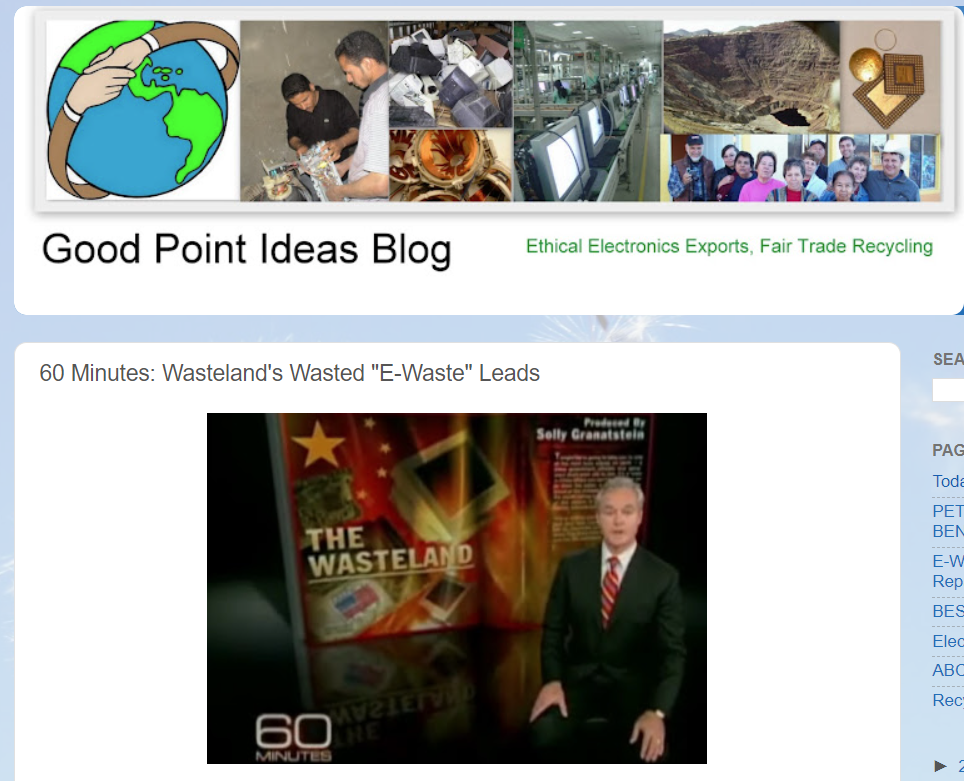
Thirteen years ago, this blog reported on CBS 60 Minutes sourcing of Jim Puckett for its George Polk awarded episode "The Wasteland".  

I traded emails with producer Solly Granatstein during the original November 2008 broadcast.  I had been background sourced prior to the episode and did not know what CBS was going to say or claim. For that reason, the year before after the original broadcast, I only blogged about the actual buyers of the CRT monitors CBS aired claims were dumped for primitive recycling.  But after being ghosted by Granstein for months, I published the blog above directly taking them on.

It is not too late to learn about the Charitable-Industrial Complex and Collateral Damage. 

Now the CRT reuse business is long expired.  CRT glass is found in pending superfund sites in Phoenix AZ and Columbus OH, not in Guiyu China.  And it has been a decade since BAN's Jim Puckett tried to deny his role in the E-Waste Hoax - evidence enough that Granastein's source needed to be cross-interviewed.

So I found a Wikipedia Bio on Solly Granatstein, and did not publicly alter it in any way, but left the comments below in the Editor Talk section.  It's a hail Mary pass.  Could Mr. Granatstein consider an Ira Glass turnaround (Mike Daisy episode) now that Spain has arrested 40+ African dyaspora workers in the Canary Islands, citing the false claims CBS first gave credence?

Here's my Wikipedia Editor Talk post below.  I will post now but update links later

Recent E-Waste News Predicted by Good Point Ideas Blog

News headlines travel faster these days through my @WR3A Twitter account and LinkedIn. As compared to the blog, those social media venues compete better for shorter attention spans (including yours truly).

The beat goes on.

That said, it's worth it to link today's news to the paradigms long established in the blog.

For example, former E-Stewards Executive Director has retired rather fitfully, and gone on record that both the R2 and E-Stewards Certifications are flawed... flawed in a way that this blog described a decade ago as follows - They don't know what they are talking about and are making it up as they go along.

Akers told me he was somewhat censored by Resource Recycling editors who are trained to flinch by angry outbursts from Jim "A Place Called Away" Puckett. He filled some gems in by email, but the Op-Ed itself is damning enough.

In My Opinion: Does today’s industry need e-Stewards or R2?

I’ve looked at the IRS 990 filings for both Basel Action Network (BAN), the owner of the e-Stewards standard, and Sustainable Electronics Recycling International (SERI), the owner of R2. The most recent filings publicly available online for both organizations cover 2019.

BAN’s filing shows gross revenue of $838,358 with total expenses of $817,088 for a net gain of $21,270 (the year prior, BAN had a net loss of $77,785). The organization reported only $83,351 in grant revenue, meaning the bulk of the revenue is from e-Stewards. The executive director was paid $133,741. Spending on travel totaled $39,234 and spending for advertising was $7,514. Another $314,701 was spent on other salaries.

The SERI filing shows gross revenue at $1,746,118, salaries of $508,775 and a net revenue of $742,097. The executive director was paid $159,650. Certification fees brought in $1,689,774 in revenue.

Both filings raise some questions. For BAN: Is this program sustainable? What happens to my e-Stewards certification if BAN folds? BAN is mostly a one-man show. What happens if that individual retires or becomes ill? Is there a business-continuation plan to protect my investment in an e-Stewards certification? Was any money spent on advertising to help drive business to e-Stewards or just to recruit more companies into the certification pipeline?

For SERI, the main question is: Is any of its revenue spent to help drive business to R2 recyclers?...

The main question really is: How much of those membership fees are being spent to aid the certified recyclers in the marketplace?

From looking at the 990 filings, the answer is not much.

Pouty Puckett has yet to respond in public to Akers cards on the table, though SERI's Corey Dehmey tried to direct us away from the man behind the curtain, and back to the Wizard of Obfuscation with his response last week.

Systems Founded in Byproduct Management: Ingenuity 101

Lucid Energy, Stormwater X, Toilet 3.0, and Africa's Tech Sector and Scrap Sector might solve 4 problems with byproduct management.

If you are an agent of conscience, and choose to either be perfect, or become someone guided by perfect intent, you need maintenance. Like a regular teeth-cleaning or oil change, you need to regularly evaluate your interior motives, your pridefulness, your righteous indignation, and cognitive biases.  Preemium primum non nocere.

Like a machine that has been well maintained, you will, through the cumulative exposure and effort towards the improvements you've devoted yourselves to, be in the right place when the right time for an insight, inspiration, or opportunity occurs. If, for example, you care about people living in slums in emerging markets, you might spend years doing Mother Theresa one-on-several assistance, and begin to be inured to the scale of the problem. Keep your ego in check, and your eyes open, because someone else may have a good idea and never have your insight into an application that would "save the world", or your piece of it.

Where is this going? Downhill to the problem, whose byproduct is opportunity


2010 Flashback to Europe's Decade of Racial Profiling E-Waste

Back in November 2010, I used a cover photo on a blog to convey how Europe was relying on photojournalism to set waste policy. WRONG, WRONG, WRONG was one of my most visited blogs that year - the year Interpol launched "Project Eden", an approach to Africa and Asian geeks that was as cringeworthy as the Eurotrash Art.


Euro Agbo Porno Photo Journos 1: Flog African Tech Sector "E-waste"

My last post kind of took on European "White Savior Complex" in the e-Waste story.  I hesitated before hitting "publish".  Was I being too hard on Europeans?

The latest "European photo-journalist safari" came out the day after.  Italian photojournalist Stephano Stranges announced fundraising for his, well, somewhat creepy African series "Victims of our Wealth" or "Le Vittime della nostra Rizzchessa". Screenshots below...


From his website "Stranges Images" (which is largely in English, though he's Italian), you get the picture, so to speak.  The metal mining exploits Africans to make electronics, and then the Africans are exploited a second time by the selfsame electronics in Agbogbloshie.
Coltan, in other words, the mineral that everyone carries around in his or her pocket, is the object of a long commercial chain that implicates serious consequences in terms of human and environmental rights.   This mineral which is used in the production of various high tech materials, is especially fundamental in making smartphones. 

The compulsive consumption and the continual updating of these objects, fed by by the media’s barrage of ad campaigns, has caused the coltan industry to grow exponentially since the end of the 1990’s. From that point, there has been the exploitation on the part of large multinationals and the catastrophic consequences regarding the people from areas like DR Congo.   My photographic project, therefore, starts in this area of the world, as the initial link in a process that begins with the extraction of the mineral followed by the production of the object (South East Asia) and then moves onto the excessive use in every corner of the planet, ending up in the immense African dump sites (in particular, Ghana).
Now in fairness, I am greatly concerned by the Coltan Mining in the Congo (have been upfront that Congo and Amazon metal mining was topic Numbro Una since 1980s - that's WHY I got into recycling!).  So I have some schadenfreude of my own in Stranges photos of African mining.  (Some historical confirmation at bottom).

So I figured what the heck, I'll talk to them about it... by twitter (next page below).

Look at the specific claim made to support the photojournalism. Data journalists log, Photojournalists flog...
Its name is Agbogbloshie, but when you look for it, you better ask for “Sodom and Gomorrah”, everyone knows it with that name. It is the black dump of the West. 100,000 tons a year including mobiles, fridges, televisions, computers. Here, they are burnt, opened, selected, recycled and re-sold, to then enter again the cycle of production and sale. 80,000 is the estimated population, mainly coming from the North and the most depressed areas of Ghana. 
80,000 residents managing 100k tons per year of foreign waste?  What does that look like? Do you see that in their photos?

I saw 25 people in Agbogbloshie, managing 500 lbs per day of wire.  It was mostly from automobile consoles.  It was not EVEN hysterically remotely close to the photojournalist claims, and the photojournalists own photos prove my points - and disprove theirs!

2002 Article In Recycling Today Foreshadows WR3A, IFixIT, E-Stewards

While looking to upload some papers in Academia.edu, I ran across an article published by Recycling Today magazine in 2002 - by yours truly.  "Setting a Higher Standard" explained that boycotting the export market would be a "war on drugs" approach, forcing legit oversees reuse and recycling operations to meet demand via "back alleys".

Here are 3 conclusions about e-waste export policy at the end of the article (edited by Brian Taylor).

Looks sound.

1) Send Quality.  Meet the customers and find out what they want.  Just export that.  Don't throw a piece of junk on the container that you don't know what to do with.  This would become the foundation of WR3A.org and Fair Trade Recycling.

2) Support Reuse and Repair.  This forshadowed Ifixit.org, was influenced by repairfaq.org's Silicon Sam.  I'd used Sam's repair instructions while reviewing Chinese purchase orders, and found the Chinese buyers were giving instructions that would eliminate non-repairable units.  This led to the realization that China was not buying ANY CRT Televisions, only specific 15" and 17" CRTs, which meant the trade was not driven by cost externalization.  California SB20 went off a cliff that year.

3) Support Reputable USA companies.  This forshadowed R2 and E-Stewards.

Basel Action Network attacked me for writing the article, personally, and that is how I met Jim Puckett.  He blasted a response to the article via "Microsoft Outlook" and cc'd dozens of people whom I'd never met, but with whom I'd become acquainted over the years.

The article was sent to some folks at US EPA, who later hired me as a consultant for the 2006 Federal Register CRT Rule, which funded my second trip to Asia - this time bringing Craig Lorch of Total Reclaim and Lin King of UC Davis, to visit some of the "Big Secret Factories" that BAN was racially profiling as "primitive rice paddies".  (If you are researching MIT Senseable City Lab and BAN's Monitour project, there's a chestnut about this at the bottom of this blog).


Open WR3A Letter to CWIT / @Interpol on #Ewaste

DRAFT OPEN LETTER

Please send edits, suggestions, comments either by commenting under this draft or by email or tweet to yourname at wr3a.org.


Mr. Pascal LeRoy
Mr. David Higgins
Countering WEEE Illegal Trade (CWIT) 


Dear Sirs,

As you may know, WR3A (dba "Fair Trade Recycling") is an NGO business consortium which seeks to support businesspeople in emerging markets.  WR3A offers discounts on the cost of legitimate used electronic devices as an incentive to create takeback and proper recycling channels in those emerging markets.

We appreciate the advance copies of the CWIT literature [links below] which will guide the discussions in Lyon, France, next week.   While I will be in Lyon (previously scheduled) a few days later, I cannot afford to change my ticket.  Worse, the Association has just completed a major field work in Ghana and does not have the resources to bring representatives of Africa's Tech Sector to the meeting.   Therefore I have prepared this letter to convey our thoughts on this process.

The CWIT report contains a chart (from World Bank) showing electrification rates in several African countries.  We immediately noticed that the first statistic for Ghana was incorrect, perhaps because it is frequently updated.   Understandable, since the statistics on electricity and teledensity in Africa are changing at double and triple digits each year.

What we would like CWIT to learn from this is that import of used electric and electronic devices is not driven by European shredding costs.  It is actually driven by this rapidly changing statistic.

Stating the percentage of household electrification rates in Africa without stating the rate of growth can lead to wrong conclusions.   The relatively low percentage of homes with electricity (as compared to the EU) might imply, to some, that the sales of used electronic appliances are less likely to be "legitimate".

In fact, it is the rate of growth of electrification which predicts demand.

In the USA, for example, the poorest parts of the country were the last to get electricity.  When hydroelectric dams came to the Ozark Mountains, my family members drove to cities like Chicago or St. Louis to purchase used appliances.  Memphis, though closer, had a higher poverty rate, fewer used appliances, and more buyer competition.  If you are poor but making progress, your smartest move is to purchase used goods from wealthy geographies.

Similar modelling accounts for sales of automobiles in geographies which were rapidly paving roads (again, the Ozarks is a good example).   The last place to get paved roads had the highest rates of purchase of both new and used cars, and the ratio of used cars to new cars looked very similar to the rates of used vs. new sales of electronics in Africa.

The CWIT Interpol literature uses works like "illegitimate" and "informal" and "criminal" to describe well established supply and demand patterns.  Perhaps when Germany was reunited, the demand for used cars in East Germany and Poland was driven by a desire in Western Germany to avoid the cost of properly recycling autos...  But if Interpol had targeted auto mechanics in East Germany and Poland, it would have been a poor use of limited enforcement resources, discouraged agents of conscience, and thus attracted criminal enterprise to an otherwise mundane exchange of "good enough" products.

The growth of teledensity (internet, television, cell phone) in Africa is a marvelous story, and one written by canny Africans in the Tech Sector.   The best and brightest students are reading tech repair manuals, hacking phones, and finding the cheapest display devices (ones which last 20 years but are replaced in the West after 4 years are a ripe target).

Language with biblical and "halloween" references, and many photos describing "e-waste" businesses, tend to marginalize, exoticize, and otherize these technicians.  The UNEP's recent use of Agbogbloshie photos to describe Africa's Tech Sector was thoughtless and ill considered.  Similar propaganda was used to describe Simon Lin, Terry Gou, Lee Byung-chul, Chung Ju-jung, and others who repaired and tinkered their way into multibillion dollar economies which lifted the living standards of their compatriots in the most sustainable and environmentally sound manner available - through sustainable reuse, repair and refurbishment.   

If Africa is to meet its own potential, mining ores and shredding working devices is the least sustainable path.  But the demand will be met... there is no "Eden" to shepherd Africans to, and no "Sodom and Gomorrah" to take them away from.  It is fruitless and pointless to try to arrest all the geeks and nerds in Africa.  They are too many.  Crackdowns on internet cafe investors have already occurred in Africa, using "e-waste" as an excuse.   As we say in the Ozarks, "We don't have a dog in that fight."

Export for reuse and repair is explicitly legal in the Basel Convention, Annex IX.  The title of the UNEP Report contains a line about "inconsistencies", which describes well the challenges Interpol will face in enforcing EU interpretations which create new interpretations of the Convention, lined against the forces of supply and demand.   We would ask why, when rhino poaching and child labor and sex trafficking and arms trafficking and conflict metal mining are such a blight, Europe would want to add reuse and repair of electronics to the list that only criminals would succeed at.  Africans have real problems.  Reusing goods is not one of them.

Unintended consequences, collateral damage, friendly fire... These have been offered as excuses for false descriptions of statistics for ten years.  We are asking Interpol to suspend the enforcement of Project Eden until you have met the technicians who not only import used electronics, but have raised Africa's teledensity far beyond the wildest goals set by the most aggressive UN ICT or UNCTAD planners in the 1990s.   Decriminalizing things which should not be criminal is the most difficult, but wisest, challenge for regulators. 

Robin Ingenthron

DRAFT


Founder, WR3A
fairtraderecycling.org


E-Waste Tragedy 10: The Crime is a Curiosity

This week, in one of my favorite magazines, The Atlantic, we get yet another "Gaze" on Agbogbloshie to finish the year.   Yepoka Yeebo recycles the story that suggest Africans like Emmanuel Nyaletey, Miguel Artur Aziz, Hamdy Moussa, Wahab Muhammed "Project Eden" comes to Africa's rescue, putting African Joseph Benson in prison.

The Tinkerer's Blessing is not "stuff".  The Blessing IS The Tinkerers themselves.  The reuse, repair, shangzhai, ifixit, repairers made Singapore, all the Asian Tiger economies, out of reuse.  They repaired for resale, harvested parts to build around.   Why don't we see that Africa's strongest economic growth is grown by GENIUSES in the same reuse/hacker mode?

The TRAGEDY is that we are putting Tinkerers in jail, accusing them of importing junk for burning (economically impossible), drafting Guidelines around "protecting Eden".  Bullets to the head of Africa's best and brightest, shot by green do-gooders, in a perverse friendly fire.


"The Crime is Curiosity" (1995's The Hackers)

In E-Waste Tragedy 1-6, we dug into the law - or rather "guidelines" for export of used electronics which BJ Electronics was accused of violating.  I believe Joe Benson pleaded guilty (in return for a reduced sentence) because he did not know how to argue that a "Guideline" is not a law.  The Guidelines were developed under the PACE committee, which was charged with reducing the alleged 80% bad exports.   A statistic which was a lie.

A lie supported by "Soddom and Gomorrah" images, and coverage by Scientific American of a fake, fudged, hoax claim mysteriously given credence by Blacksmith Institute a year ago (December 17, 2013).  The Atlantic, ironically, just treads safe ground in Agbogbloshie.

Something had to be done, and the Guidelines were something, therefore Joe Benson had to follow the Guidelines... even though the Guidelines never claim to be law, and the viable recommendations submitted to PACE by the geeks themselves ("elective upgrade") were ignored.  The Guidelines were drafted to provide "guidance" to environmental enforcement agencies, like Chris Smith's UK Environmental Agency, not as guidance for entrepreneurs like Souleymane, Wahab, or Hamdy.  Beat cops, like Cees Van Duijin of Interpol, needed something to tell them whether a sea containerload of used CRT televisions from a hotel LCD upgrade were evidence of #wastecrime.   PACE protected USA and EU refurbishing companies, allowing them to "determine" reuse, with no say from the expert buyers.

Stewardship's Hashtag Selfie  [Top 11 Parodies of "AID" in 2014]

Oxbow Incident: Lord Chris Smith, Interpol and BAN vs "Waste Tourists"

We have met the enemy, and he is us. Walt Kelley's Pogo comic was set in the deep south.

Here on the 50th anniversary of the Freedom Summer protests of Mississippi, a 52 year old from Arkansas is working to free Africans wrongfully accused of being "waste tourists" by a well meaning, but culturally tone-deaf, set of environmentalists.
  • David Higgins of Interpol
  • Lord Chris Smith of the UK Environmental Agency
  • Jim Puckett of Basel Action Network

Higgins had assigned a very young Dutch cop, Emile Lindemulder, to set up a task force to make some arrests of people accused of buying toxic e-waste to be burned by children in African city dumps.  This blog shows some of the history, and chronology, which led to the sentencing of Hurricane Joseph Benson in June 2014, and which fuels the momentum of Project Eden...

Project Eden.  Let's return Africa to its innocence, to a time without e-waste.  Here is the chain of events which led to the seizures and arrests and plant closures, stopping people reprocessing CRTs for Africa (Net Peripheral), repairing computers for African internet cafes (MediCom) or selling televisions which 6.9 million Nigerians were using to watch the World Cup in 2006.

Here's how good white people became involved in a modern Oxbow Incident, accidentally profiling the geeks of color I've been fascinated by since I lived in Cameroon, Africa 1984-1986.  The week I left Ngaondal, the first Cameroon television broadcasts in Adamoua Province showed the miniseries of Alex Haley's "Roots".  My landlord showed it in the adjoining house, his livingroom packed, children leaning against the windows outside his house.  He had purchased the first used CRT television in the town of Ngaoundal, a used RCA.

Sometime between December 1986 and now, I'm sure that TV wore out and created the first "e-waste" in my former village.   Some think that makes the person who sold it to my landlord, Sgt Ndjang, somehow guilty of a wastecrime.  As Graham Pickren pointed out in his doctoral thesis, the guilt of the white person who once owned the RCA seems attached, as if a fetish, to the RCA when it is discarded in Africa 15 years later.  What if we sell something to an African which will eventually become waste, VT ANR staff asked my clients?  By that measure, new product is also banned, and Africa will never gain access to the  tree of knowledge, remaining as "Eden" forever.

@RecyHub: The Case for Reformed Electronics Recycling Exports

  White's move...  


In the comments section on Sunday, reps from @RecyHub posted the following questions about the Fair Trade Recycling Model.  As a reminder, WR3A/FTR encourages export of used electronics to Africa, hand picked by Africans, under defined purchase orders and contracts, to meet the desire and needs of African cities.

EU RecyHub writes:
There are some issues in my mind that I think are not cleared out by your model:

- Child labour. In Agbogbloshie there are kids working with the e-waste, burning cables. Somehow, they should be considered in a model that takes into account human development, not only economical development. 

- Non-recyclable parts. Not 100% of the components are recyclable. There are hazardous parts that need to be removed and treated separately, and there are plastics that don't have any secondary market value. Those parts will be travelling together with the reusable electronics. 

How do you approach these two issues?

First, it is now very well established that the junk show in primitive scrap yards is primarily generated by Africa's cities themselves.   The two problems - child labor and difficult-to-manage components - are products of the emerging nations themselves.   A trade ban does nothing to address these problems.

Second, and on the contrary, the WR3A / fair trade recycling model uses the value of the goods to create incentives to address these problems. Instead of paying $7,000 for a containerload of televisions, the African trader could pay just $4,000 in return for a contract to eliminate child labor, recycle the plastic, etc.

This is the only model which creates $3k (or $4k, $5k, $7k) to fund proper recycling. African traders import from wealthy countries because the scrap is so much higher in (reuse) value, and OECD nations are foolish to shred that value. Keeping it out of the hands of African techs is a lose-lose proposition.

 Check.