Showing posts with label CBS. Show all posts

Wikipedia Talk: Solly Granatstein CBS 60 Minutes Meta Response


Thirteen years ago, this blog reported on CBS 60 Minutes sourcing of Jim Puckett for its George Polk awarded episode "The Wasteland".  

I traded emails with producer Solly Granatstein during the original November 2008 broadcast.  I had been background sourced prior to the episode and did not know what CBS was going to say or claim. For that reason, the year before after the original broadcast, I only blogged about the actual buyers of the CRT monitors CBS aired claims were dumped for primitive recycling.  But after being ghosted by Granstein for months, I published the blog above directly taking them on.

It is not too late to learn about the Charitable-Industrial Complex and Collateral Damage. 

Now the CRT reuse business is long expired.  CRT glass is found in pending superfund sites in Phoenix AZ and Columbus OH, not in Guiyu China.  And it has been a decade since BAN's Jim Puckett tried to deny his role in the E-Waste Hoax - evidence enough that Granastein's source needed to be cross-interviewed.

So I found a Wikipedia Bio on Solly Granatstein, and did not publicly alter it in any way, but left the comments below in the Editor Talk section.  It's a hail Mary pass.  Could Mr. Granatstein consider an Ira Glass turnaround (Mike Daisy episode) now that Spain has arrested 40+ African dyaspora workers in the Canary Islands, citing the false claims CBS first gave credence?

Here's my Wikipedia Editor Talk post below.  I will post now but update links later

Cultural Gulfs in Developing Markets 7: The Rusty Radiator Awards

Although I had a degree in International Relations, had spent a semester at the UN, and made a career in the science of development, I racially profiled someone in Singapore in 2005.    I know it now.   I deserve a rusty radiator for racism.

On my way back from Guangzhou, where I had gone for a second visit to see the second-hand shops of Foshan and the "Big Secret Factories" of CRT reuse, I stopped in Malaysia and Singapore for a couple of days.   Armed with my camera, I decided to hunt for some "exotic photos" to prove that I too, like Jim Puckett of BAN.org, had "been there".  Now, Interpol is trumpeting their act. with a project to describe their efforts to arrest "criminals" I refer to as the "geeks of color".

I understand where David Higgins' group at Interpol is coming from.  E-Waste is in the news, and we want to show our credibility, show we have been there, walked the streets, and have seen the problem.  We work for the (world) government, and are here to help. 

The shop below I presented in a Powerpoint slide at a NERC.org conference as an example (an olive branch to Puckett and Westervelt) of clearly bad imports.   I had stayed on the street, waiting for the man who owned this shop (Mr. Teck Recycle) to roll up the metal door.  He had a ladder on the inside, which he needed to physically climb up to the ceiling to start to descend items for resale on the street. 

I acted like I knew where this guy's material came from.   I didn't.

It seemed the guy had packed this 4M x 10M street shop "to the gills" with imports, and was never going to be able to reuse it all.  I represented this person as an example of "toxics along for the ride", of being an example of the primitive importer, and contrasted him with the SKD (semiknockdown or semi-knock-down) factories I wanted to "reform", in our view.

I confess that I assumed this was all recently imported material.  I had absolutely no evidence of that. We now know that the 6 billion people in the "non-OECD" generate far, far more used electronic scrap than the OECD does.

Lets teach them all the missionary position, put them in top hats, and certify them as non-primitives.

Was Mr. Teck Recycle importing at all?   Singapore, though not "OECD", was already as wealthy then as California.   It had become wealthy via the "Tinkerer's Blessing", the reuse and refurbishment trade, which evolved into contract assembly, then into ODM (Original Design and Manufacture).  Sure, some of this material may have been imported, but I had no idea how long before Mr. Teck Recycle got it.   What percentage came from residents of Singapore, which at that time had a higher percentage of engineering degrees, and higher percentage of online high speed bandwith, than the USA's Silicon Valley?   Why did I immediately assume the Singaporean shops were filled with USA "toxics along for the ride" (a phrase I pounded at the NERC audience?)

Sure, it was a sound theory.  Maybe some of this stuff did come "along for the ride".  But I had no proof, all I had was a need to position myself not-too-distantly from Basel Action Network's "80% Primitive Recycling" export statistic, which we now know is no more true than 80% of Los Angeles black teenagers are gang members and high school drop outs (BTW that's said tongue in cheek, it's obviously untrue, but the fact I have to apologize and point that out shows the root of whitey's problem).

Ghana TV repair 2014
Profiling.

Study Says CBS 60 Minutes, BAN, Wrong on E-Waste Exports

Another factual study, another blow to the E-Waste Hoax.   Basel Action Network has already admitted they made the statistic up, that 80% of used TVs etc. are exported for dumping.  It was never economically possible (see Monkeys Running the Environmental Zoo), it was not supported by BAN's own study (Kenya 2006), USITC and UNEP studies in Africa found it bogus. The "kids at dumps" are best explained by the cities, like Lagos... 6.9 Million households with TV in 2007.  China throws away far more, and exports used CRTs to South America and Africa.

Now yet another very long and arduous study (to read that is) has come out, from MIT, NCER and StEP.

Quantitative Characterization of Domestic and Transboundary Flows of Used Electronics   12/2013


Huabo Duan, T. Reed Miller, Jeremy Gregory, Randolph Kirchain 

"The results show that approximately 258.2 million units of used electronic were generated and 171.4 million units were collected in the US in 2010. Export flows were estimated to be 14.4 million units, which is 8.5% of the collected estimate on average. On a weight basis, 1.6 million tons of used electronics were generated in the US in 2010 and 0.9 million tons were collected. Of the amount collected, 26.5 thousand tons were exported, which is 3.1% of the weight collected." 
- Conclusion

Once again, the facts say that exporters WERE PROBABLY INNOCENT. The methodology by Interpol's young Emile Lindemulder, in the infamous 2009 "Matrix" Report is prima facia silliness.  "The Africans PAY for the TVs and the Shipping, payment shows organization, and since 80% is criminal dumping, it's organize + crime = ORGANIZED CRIME!"   Along with the "Away is a Place" halloween language by Jim Puckett, the anti-ewaste-export hoax has been blown out of the water by the MIT study.

It's a late footnote to the "Bullyboy" series of blogs.  What in the heck is "E-Steward" besides a whites only country club?   If 80% of recyclers were indeed primitive dumpers, the badge had meaning.  Now all we have are people organized to beat an old war drum about "e-waste" exports, with no habeus corpus, no crime to speak of, except that anything above zero is suspect.  It's easier to do a DNA test than an export certification.  CBS 60 Minutes created this mess, and won't go back to correct it.

Celebrity Expert: Ignorance, the Renewable Resource

Proper management of "e-Waste", WEEE, or scraps from used electronics is a very "niche" environmentalist concern.   When public attention, or a reporter, stumbles on a niche issue, it's hard to know who the "expert" is.   This leads to what I'd describe as "celebrity experts".    We know certain celebrities who are "famous for being famous".
"Even when a person's fame arises from a particular talent or action on their part, the term will sometimes still apply if their fame is perceived as disproportionate to what they earned through their talent or work."  wikipedia
Certain e-waste recycling experts are recognized as such because they've been recognized as such.

Photo owned by whom?
Ten years ago, Jim Puckett announced his organization was an expert.   He may well be an expert in Basel Convention, a truly niche environmental law.  But he got so many things wrong about Guiyu, that he's lucky the place was too obscure to recognize the truth behind.  Here on Columbus Day, we still call American Indians "Indians".  And people still think Guiyu was a resting spot for cathode ray tubes.  There are none there, or what few were photographed were small enough to be generated from homes in Guiyu itself.

But Puckett made Guiyu "about" a Swiss city, Basel, which I drove through last summer.   He did not explain the difference between the Basel Convention ratification by the USA and the ratification of an Amendment to the Basel Convention by everyone else - but he made the city name of "Basel" mean both, to most people in our industry.  His expertise created confusion.  Basel Convention, in Annex IX, allows export not only for reuse and repair, but actually for recycling (so long as no Annex III releases occur... so no burning, but if it's properly accounted for, it's legal.  See B1110).

The Basel Ban Amendment (proposed) was promoted in the mid 1990s as a cure for what Jim claimed was the "recycling loophole".  And this "amendment" has still never been passed by the Convention.  But hang on, derivatives of derivatives approaching...

File:Zsa Zsa Gabor - 1959.jpg
foreign, mysterious WEEE
Someone suggests that the "export for repair" legality in the Basel Convention should also be included into the proposed Basel Ban Amendment (the one still under "consideration" after 15 years).  That  suggestion was not voted in.   But now our celebrity expert gets National Coverage on not-amending-an-unpassed-amendment (Resource Recycling's E-Scrap News).  The headline becomes that repair is denied at a meeting of the Basel Convention.  

Nothing changed.  Repair is still legal under the Basel Convention (as is recycling).   And the Basel Convention "Amendment" still hasn't passed.  The wording to the 1995 Amendment was "not changed". And the celebrity expert, Jim Puckett, gets that into the national news.

Obscure meeting about 15 year old unpassed amendment generates headline.  See what he did there?  He can make anything a headline, just like Molly Cyrus, Tom Arnold, Kato Kaelin, or Paris Hilton.

BAN's an expert at being an expert.  You do have to grant them that. 

Rank The Environmental Atrocity: Is Fraud Visible from Outer Space?

Multiple Choice:  If you could correct one thing, to protect the planet, sustainability, endangered species, and the planet, what would you choose?
  • Hard rock metal mining?
  • Diverting Interpol enforcement from Ivory poaching, to arrest African internet cafe investors?
Critics accuse Freeport-McMoRan not only of underpaying workers but also of destroying the environment in remote Papua and of decades of complicity in human rights abuses by the Indonesian military. Here, an aerial photograph of the Grasberg mining complex.

To the degree the last one belongs on the list, it's because of fraud.   The first fraud was BAN and SVTC telling California that the CRT monitors being shipped in 2002 were destined for dumps. They were being purchased by SKD factories.

The second fraud was, again, BAN and SVTC telling California that diverting those CRTs to "recycling" companies represented international law or environmental progress.

The third fraud was allegedly committed by the cathode ray tube recycling company ("Dow Management" in Yuma) which evidently took money for the tubes, stuck them in a warehouse, and ran.


Our war should be on fraud.

First do no harm.  Be true to thine own self.  Truth is not conservative or liberal, blue or red or green, truth is transparent, and only environmental and recycling systems based on truth will be sustainable.

(By the way, I had access to other 'close up' photos with children in them, but believe it contributes to poster child exhaustion, we all need to de-escalate the emotional button-pushing)

Bullyboy 4: No Habeus E-Waste Corpus, And curious retraction

Too bad Interpol and the UK authorities didn't consider how easy TV repair was.   Two years after Export-Hoax-gate (see BAN's Night of Breaking CRT glass, Environmental Malpractice, and Clubbed to Death Blogs), Intercon police are still seizing African's containers, presuming the electronics were waste.  Like a parent taking toys out of a crib, the paternalism of the "Project Eden" (putting Africa back the way it was?) stands opposing the African Revolution, the Arab Spring, the democratization which flows directly through used display devices like twitter to teenagers.

The two "root causes"?  BAN made up a fake number, and rich countries know so little about electronics repair that we make museums about it.  "Once upon a time, we replaced capacitors too, honey".  Fixing things is so "hunter gatherer", it seems to belong in a stoneage village.

Meet the other side of the table.  If you live in a place, like Lagos, that still does a lot of electronics repair, you wonder why people don't ask you how to repair the TV they seized.  That's what the UNEP study finally did - and discovered 91% repair and reuse in Lagos.  But it was too late for Joe Benson.

Here is a minute of Joseph Benson, describing Bullyboys in his own words.


This is about power.  It's about BAN and Greenpeace showing they are watchdogs.  They follow Saul Insky's model, enforcing their vision of segregation of trade, in a weird money-making way.  This is about paternalistic decisions about who Nigeria or Ghana, Africa is allowed to trade with.  Is Africa to be denied the path of development followed by South Korea, Singapore, Japan, Taiwan, and Southeast Asia?   Or is Africa going to be relegated to mining raw materials for our new electronics, a resource-curse economy?  After Indonesia, Africa is the next battleground for Good Enough Markets, Tinkerer Blessing, and Resource Curse.

Puckett told me that - even if his math was wrong (It's 91% reuse, NOT 80-90% dumping)-  that the "law" was violated ("a technicality" he says justifies Benson's arrest).   What, exactly, is the crime the Africans are accused of?   Dumping?  Or like the Michigan case, is there some other technicality?  The facts of the case are like background music playing over a slide show of Pieter Hugo exotic photos.  The audio doesn't fit the video.

More cross examination:


Now, had Sky News or BBC or PBS or CBS etc asked Joseph Benson some questions, would they have still had a story?   Or would they have a lot more work?   Would Green and Thompson E-Waste Export Bill have been drafted?   It would have at least been Jim Puckett's word that the exports were 80% bad, vs. Joe Bensons.  Now they have the UNEP studies... but don't seem to be revisiting the story.

And they don't seem to have noticed the stealthy retraction two months ago, BAN back-stepping away from the initial accusation.
"Despite your reading diligence however, it is unfortunate that you did not start by questioning the baseless assertions made by Adam Minter in his reckless article.   Never has BAN ever stated that 80% of US e-waste is exported." 
http://retroworks.blogspot.com/2013/05/basel-action-network-explains-80-or.html

Executed Recycling: Colorado Conviction

Claimed Chinks and Gooks were bad
While I'm still on the topic of Environmental Malpractice, let me make the comment that I've never defended the Colorado firm, Executive Recycling, which was nailed by CBS 60 Minutes.

It's called a "straw man" fallacy.  BAN accuses me of supporting a liar, in order to discredit my defense of the truthful person.  I never defended Richter, I did the opposite.  But I defended people buying the monitors that he didn't send, the ones BAN circled in Hong Kong.

What Brandon Richter of CBS Wasteland did was to claim that Chinese were filthy bad recyclers and that people who used his company would know that he didn't export their stuff to China.  He was on the BAN WAGON.  He advertised that he didn't export to China, and represented China as a primitive place.  He was found guilty of FRAUD.

Env Malpractice 6.1: Joseph Benson, BJ Electronics, Contends Innocence, Temporarily Settles Plea

Profiling 3.0, Green edition
Revised based on contact from Benson's associate, following the Vermont Fair Trade Recycling Summit 2013.04.16.

Subsequent to my last post, about the arrest of "Hurricane Carter" (Joseph Benson), the UK agency @EnvAgency and newspaper reporter, Cahal Milmo (@CahalMilmo), of the Independent @Independent, released this news that Benson has just settled his plea, three years later, after unsuccessful appeals taken through the court system.

The UK Independent reporter Milmo and UK Environmental Crimes units seem to absolutely crow over the Eleven thousand British pound settlement (about $23,000), sending tweets and photos.   If Benson was interviewed, they don't use it.

Anyone in business knows that the cost of hiring a lawyer and running appeals was far, far more than the 11K plea settlement.  I have not spoken to or dealt with Mr. Benson, but my suspicion is that it's evidence he wanted to clear his intentions and good name with this long appeal.  Should I be going out on a limb for someone who has just accepted a financial settlement guilty plea ?  Benson's associate insists this is not a "guilty" plea, and that they expect the funds to return when Benson is exonerated.

Hurricane Benson was publicly accused (@Guardian as well as @Independent) in 2009 of primarily exporting TVs and electronics for primitive wire burning;  David Fedele, Pieter Hugo, and others take film of African dumps and tie it primarily to men and women like Mr. Benson.   That is thanks to one person:  Jim Puckett of Seattle Washington, who has told everyone in the world that the scrap burned in Agbogbloshie and Guiyu is a "dirty little secret", that it comes from wealthy nations recycling programs.

Grouchy Marxist Defamation or Groucho Marx Defense?

Groucho Marx
“I have nothing but respect for you -- and not much of that.”
― Groucho Marx


My company, Good Point Recycling, used to charge residents $10-20 per TV, which most people were willing to pay every 10 years when they threw one away.  Here is a 2006 article (Burlington Free Press) praising us for the process and markets we used,..  


Interestingly, it's reposted on the wall of Basel Action Network.  It was posted in 2006', in happier days when BAN called me regularly to help them "certify" Pledge signers (like "Tom", in the article), before their consultants accused me of lying about the factories described in the article, which BAN chose to post on its website.


So, the article goes into detail about the distinction between "unknown" export markets and the use of legitimate export refurbishing factories.  BAN not only posted this article about the distinction, but BAN has also inserted language into their E-Stewards program describing "semiknockdown" factories, with instructions that any parts which may be electively upgraded or replaced must be removed in the USA before the CRT is exported.  

BAN also negotiated for the same terms in our "California Compromise" agreement, which fell flat in 2010.

Groucho Marx
“Are you going to believe me, or what you see with your own eyes?”
― Groucho Marx


To finesse the obvious differences between factories (like the one in Indonesia, at left) and the dirty recycling in Guiyu China, Jim Puckett, the Chief Executive at BAN, wrote in an Op-Ed piece that the disposal of parts replaced (common in an elective upgrade at the contract manufacturing factories) would be illegal, and speculated that the "discarded parts" would be "poisoning people", ergo "fair trade" was not possible.

In my emails to BAN over the years, I have offered to prove or certify that any electively replaced parts could be shipped for recycling to a place BAN approved, such as Japan or Belgium, which would solve that dilemma.

In responding for BAN, Jim said that he was aware of that option but that he did not want to promote it, because he distrusted and resisted globalization.  He said that no matter how hard we tried, that the nature of "exporting jobs" to poor countries meant exploitation.  In other words, whether or not I found a way that Basel Convention said was legal, that he objected based on his philosophy, that rich people who employ less rich people are exploiting them... something Karl Marx would say.

I told Jim that the "tested working" and "fully functional" and "accidental breakage" would require the same downstream diligence, that trading with poorer people, if inherently unfair, would extend to other trade, including sale of new devices, purchase of new devices, and certainly the mining of metals to make new devices.   Jim actually said he objected to those things too, but they were outside the scope of "waste" and therefore outside of his mission statement in Basle.   He didn't buy my suggestion that the big factories which certified the recycling of breakage, returns, and parts would be very valuable in the countries they were in. In fact, one WR3A member factory became a licensed take-back program for CRTs generated in that country.  If BAN killed them, and the majority of the e-waste disposed of in those countries originated there (See Williams/Kahhat study, referenced below), he'd be making e-waste worse...

So my point here is not to delve back into the specific arguments over the Basel Convention Annex IX, which explicitly says that export for repair is LEGAL... I'm just trying to demonstrate what Donald Summers, the BAN consultant, was referring to when he described "the genuine policy debate at issue" with personal attacks.  The general policy debate was about globalization and Marxist economics, not about whether contract manufacturing (e.g. Foxconn factories which make all IPhones and IPads) were mythical.

In the BAN web page articles above, on BAN's own website, BAN admits these factories are refurbishing.   And BAN negotiated terms for the semiknockdown factories with me, and BAN met some of the factory executives via Skype at E-Scrap 2010.   And BAN chose to support language allowing Manufacturers (OEMs) such as Dell, HP, IBM, Lenovo, Samsung, etc. to continue to use the factories (which take warranty returns, for example) in the language of HR2284, the Responsible Recycling Act.  The factories are NOT MYTHS.

So Basel Action Network obviously knows these factories exist, and is willing to let OEMs use them, and is willing to let E-Steward Recyclers use them if certain parts are removed (like bad capacitors). BAN says nothing if the devices these SKD factories buy are tested working (in which case the parts are removed anyway) and sold to a middleman (but not directly to the factory).  If this is obvious and proven and not disputed, why do so many people I meet think that the genuine policy debate between R2 Certification and E-Stewards standard is about POISONING CHILDREN??????

Or is it about rape, murder, and arson?  (See BAN's depiction of ASU Professor Eric Williams below)...


Groucho Marx
“Next time I see you, remind me not to talk to you.”
― Groucho Marx

MYTHS in "E-Waste" Recycling: Chicago Defamation

Myths..  I was just approached yesterday about permission to re-print my Greenwala Editorial, Top Ten Common Myths About E-Waste.   My testimony to the Patch reporter about state of the art recycling in China was countered by BAN representative Don Summers thus:
Summers then criticized Ingenthron and Cade for promoting the "myth that there are all these wonderful high-tech facilities in China,' adding more harsh comments about Ingenthron's character.
In other words, while apologies should be accepted, beer with Obama and all, there remains a central dispute of fact about high tech recycling outside of the USA.  The defamation and character assassination is not against Robin, it's not against Brian, it's not against Willie.  It is against the geeks overseas, whom BAN seems to want to pretend to be mythical beasts.  They describe Africa, China, and Latin America as a kind of Heart of Darkness in recycling, they describe Guiyu's tech district as "E-waste Chernobyl".

See film of the people we are talking about below.

How to Reward or Man-Handle Reporters?

The Journalist's heroin is the byline.  When the journalists themselves become emotionally or physically involved in a story, it's fodder for awards and support of fellow interviewers and cameramen.

Gold Scrap Buyer Pushes Journalist - My joke Polk 
I just saw the interview of the journalist who worked on this story (NY Channel 4 NBC Local News) on a crackdown on gold scrap buyers in the NY area.  They were accused by regulators of not displaying their prices and scales, and probably some of them were being "shady" with consumers who don't know scrap prices.  Hey, not as bad as buying from crackheads who break into homes. But these are typically used by people in some desperate situation, selling jewels from a departed relative, or trying to raise money for surgery, and the consumer has to rely on the "professional".  We need regulation and investigation.

As a former regulator, I also understand that while the real problem is burglary and theft, that you pressure the regulated if you crack down on something lower key - advertising and buying.   It's similar to the "no graffiti" policy, if you enforce that little things are done right fewer big things go wrong.

Anyway, from one of these rather routine local enforcements on gold and silver scrap buyers in New York, a "NBC Local News Team" decided to go Scott Pelley 60 Minutes on their asses and take a camera to the scrap guy's store, put his storefront on camera as a centerpiece to the "fraud" headline.

And the younger scrap guy pushed the cameraman's camera into his face.  Sound familiar?

infamous "tidy little shop" purporting to be "other side" balance
It could happen anywhere...

The interview I just saw had this video footage in the background, but the interview was really of the reporter.  (uh-oh).   He describes how it's normal, businessmen should expect to be interviewed, you don't like it but it's how the game is played.  He described how his cameraman is his homie and how he spends more time with the cameraman than he does with his family, and how an eye socket could have been injured by the push of a camera, and how police came to the scene and a report of physical assault on the cameraman is now added to the enforcement on price display and scale visibility.

I'm not saying that this is the same as CBS in Guiyu.  But what I saw in the CBS 60 Minutes story on computer monitor recycling in Hong Kong was familiar in this NY Channel 4 news story.  And the reaction of the scrap dealers to having news cameras in their lots is familiar.

Two years ago I followed up my critique above with a more detailed shot-by-shot dissection of the CBS 60 Minutes Wasteland episode.   I never get a call back from CBS news crew, who took an hour of my time doing background on the story.   The lesson I took is that when the reporter has a choice between a story which is much more complicated and less exciting but more accurate than the one he set out on, or a story where he/she is a "hero" defending an assault on "their own" cameraman with footage that proves the businesspeople have "something to hide", that the latter story is easier and will appear "above the fold", so to speak.

The real "tidy little shops" fixing used electronics
What I do not understand is the decision to give a George Polk Award to these people.  Well... I do understand it.  The awards people didn't know anything about the SKD (semiknockdown) factories in Asia which were buying back CRT monitors for refurbishing to new-in-box condition for sale to Egypt, India, and Africa.   The Polk is a JOURNALIST award - that is, a reward to a single individual who is chosen to symbolize bravery, integrity and courage in journalism.  The Peabody Award is different, it recognizes a journalism organization (so I understand).

In either case, if it is discovered that a journalist did something in Guiyu China which was actually about as brave as NBC Channel 4 local news on gold and silver scrap buying, and that the exotic locale of China and Americans willingness to believe that the bottom of China's normal curve is "the truth" and that the factories which actually purchased and refurbished most of the monitors in Hong Kong harbor were defamed in the process...

Here is the formula:

  • Ingredient 1:  Something people don't understand completely (plastic, circuit boads, display devices) but which they feel familiar with, feel first hand experience with.


  • Ingredient 2:  Cognitive Risk word, "fraud" or "toxic" or "children" or "sex"


  • Ingredient 3:  Reporter with microphone shot in "exotic" locale, especially surrounded by brown skinned people in physical poverty.

Presto:  All the ingredients for a journalistic excellence award.   And as journalism rewards this, it breeds copycats.  The "we buy gold scrap in NY" expose above.  The "Fair Trade Cotton Victoria's Secret" where photos of the "mud hut" of the worker demostrate the "bravery" of the reporter.   The trembly-voiced Mike Daisy surrounded by ficticious machine guns at (the wrong) contract assembly plant (he was in Shenzhen, the iPhone worker poisoning happened at a different Chinese factory, literally hundreds of miles away, he was stealing a story from another reporter).

Idea... Hey, there are lots of reporters in China, working for cheap wages.   Maybe we can mass-produce these stories?  I'm thinking of the South Park Family Guy Manatee method, combine ju-ju technology words (polymer, flame retardant, megahertz, microwave) with a cognitive risk word (cancer, uterus, babies, negro), put a reporter in an untrained PR environment (shopping mall, scrap yard, battlefield) and voila.  If people with consciences care about it, it's difficult to understand, it has "profit" and "fraud" and "sex" and "race" ingredients, and a human nature ("get offa my lawn") reaction from the engaged businesspeople, we could go to town, and start minting these Peabody and Polk and Pulitzer puppies.

Defining E-Waste "Racism": Part I "Negativity"


- Overt Racism:  Purposeful, intended, blatant selection based primarily or partly on race.   
- Covert Racism:  Subtle or disguised racism, purposefully hidden or unacknowledged.
- Accidental Racism:  Someone who isn't racist at all finds out, despite fair-mindedness, they've accidentally (or subconsciously?) said/written/assumed something which someone else suspects as racist.   Normally they clarify or apologize. 
"Excuse me, sir.  You've accidentally spilt champagne on my sneakers"
"How dare you, sir, accuse me of purposefully pouring my drink on your shoes!" 
Part 1 of 2: To prove it's not an ad hominem attack on opponents, I'm including examples when I've been suspected of racialism.   In part II, I focus on  people actually arrested for environmental crimes based on racial (or national) profiling, by well intentioned people, and the people who make their living making the same overseas flight, who profile themselves as environmental heroes.
First things first.   I coined the phrase "accidental racist" in 2004, but I did not invent the reaction, from the southern hemisphere, to the images of children posed on smoking piles of garbage.  I'm the messenger.  If a bunch of someone elses call you a racist, and I'm defending your intentions, "accidental" is middle ground.

In the news this week, Greece expelled one of their Olympic athletes for a "racist tweet".  AP opens the story as follows:   "Triple jumper Voula Papachristou was expelled from Greece's Olympic team Wednesday for her comments on Twitter mocking African immigrants and expressing support for a far-right party."  The tweet that went viral and caused the stir was a joke about "West Nile Virus" which was reported in Athens.  With so many African immigrants in Greece, Papachristou tweeted, the mosquitos and virus would enjoy some "home cooking" (soul food?). 

The joke's not that bad, in my opinion.   But the "body of work" in other Papachristou tweets made this the last straw.  The Greek government felt this was either racist or covertly racist, and not something you want anywhere near the Olympics.  Ultimately, the ugly is in the eye of the "minority" beholder.

The repercussions of an accusation of "racism" are kind of unique to caucasian nations.  I assume it's because of the USA's history with slavery and the process of ending segregation.  Europe inherited James Baldwin from us, and has quickly come to speed. "Racist" is an ultimate sin against society, a label of ignorance, callousness, and meanness.  It exists in Africa and Asia, and it's a huge issue in South America.. but the concept of "minority" as underdog is very different.   When passed from one white person to another, a Greek on Greek or American on UK insult that ruffles white feathers.  The story on the Greek expulsion was selected for The Drudge Report for a reason.

In 2002, in China (with Lynn Rubinstein of NERC), I was on a tour with one of our translators from China's Guangzhou Electric Appliance Research Institute, Ms. Huang.  She had tip-toed up to the subject of the Basel Action Network, asking me what I thought of the BAN film, "Exporting Harm".  She seemed to be on guard, and kept asking me what I think.  I thought that it was a problem of "losing face", that it was a humiliating depiction of China, and that the bans on imports/exports were largely a result of that.  She seemed encouraged, and then said in her own, deferential way, that in her humble opinion, the film was a bit racist.   She furtively looked over her shoulder, almost instinctively, having said it... as if she'd used a bad word, and said that was only her, personal, view of it, and that she was not speaking on behalf of the Chinese government, etc, etc.

That sentiment about the BAN films was repeated by Souley of Senegal, by Fred of Burkina Faso, and by others from Africa and the middle east.

Me, too.   I was called a "racist" three times.   The first was by an  African buyer living in my house. It started out that I wanted $1 each for new laptop bags, he said he wanted them to help protect/cushion the computers.  In frustration he said all I care about is money not people.  I said "f*k you", and he got furious - and called me a racist.  He stomped out of my house and moved in for the night with my Cameroonian friend Yadji, who told me the buyer tried to convince him I was exploiting him.  We made up the next day. The African buyer said that when he told Yadji I was a racist, that Yadji told him point blank that there were two people in the world he trusted.   Yadji told him that one was Robin, and the other (pointing) was his cat.

Another time I was complaining about a certain habit among certain buyers in certain Mediteranean countries to haggle for reimbursement rather than discount, i.e.  to haggle after a load of computers was received, to revisit prices after the sale.  It was a new mideast/African buyer I was engaged with, and the load had not yet shipped.  I remembered the episode with the laptop bag pricing and I was trying to be careful.  My wife is French Catalan,(also Mediterranean).... so I thought I was on safe ground alluding to Mediteranean negotiations and discounts after shipment.   The buyer said that when I speak of Mediteranean, knowing he's mid-Eastern, that I sounded a bit "racist".

Last month, I wrote an extremely long and emotional piece about the drowning of my "African brother" from Cameroon, Yadji Moussa...   Someone I didn't know wrote a comment that my post was "covertly racist".  It was a shock, and came at a very bad time.

Rereading my Yadji Moussa epitaph blog (because one tends to get friends epitaphs right), I could see how someone who studied racism in school could find a lot of things I'd written about my friend which were "racist".    He had come to the USA as a hero of mine, 15 years ago. I'd described him as an "African Gandhi" to many people (including his future wife).  When exposed to alcohol, he had left his family and had recently been kicked out of the homeless shelter, and we all knew this and I didn't want to sugarcoat it.  I had partnered, fired, hired, fired and rehired him, a fourth time, and he was making real strides.  This post was making it about "me", my feelings, at Yadji's expense and he was not here to defend himself.   It was an emotional post, and I took the post down for a couple of weeks, and worked on this film, still pics without commentary, which we played at Yadji's memorial service.

Anyway, when the "covert racism" accusation slapped me, I had to park the blog and edit it.  Do I personally think of all Africans as loved ones with this deeply personal relationship?  Was it necessary to mention my bittersweet guilt, that he'd forgiven my call to the police (resulting in a year's imprisonment for drunk driving?).  In trying to cover up the anger, hope, disappointment, tragedy, and sadness, I'd captured my friend's decline from a disease in a way which someone actually could detect as a "white man's burden" essay.  I even had a clip of Shirley Temple dancing with Bojangles Robinson, and a link to an essay on Yir Yorant (which my dad had given me, and which I rejected, but it's mere presence in the article was a match for the accusation of racism).  What was I thinking?

No one likes to be called a racist, or to be accused of "accidental racism".  And white liberal people who mean well hate it especially when it comes from another white liberal.  With that said, the post is better without many of the items I deleted from it.

In Part 2, we will see actual people making a living by flying overseas to inspect used electronics.   One is identified in the press as an environmental hero, the other is profiled as an environmental criminal.

We have to discuss it because of the actual, realprofiling of brown businesspeople as "waste tourists".  I compare two e-waste professionals, ones who "fly and buy" and those who "fly  and lie".   I have included actual articles in news magazines showing real brown people who were arrested, imprisoned, and falsely accused of exporting waste, and ask why the environmental press broadcast allegations as a form of public lynching of people who were proven - yes, proven by Basel Secretariat and UNEP investigation - to be innocent.   Not one of the the western media which reported on the "waste tourists" and "waste criminals" has reported any retraction or even reported on the finding of innocence of the people they sold papers by defining as a criminal.

To me, this"e-waste export" policy must include this discussion of racial profiling.   

A final note on Yadji, and his views on racism.  In our last conversation, about AA and about his future plans, how we would put together a plan for him to return to his family in Michigan, etc., he told me that his mantra had become to eliminate 'negativity'.  He said his contribution, at AA and to his own life, was that he'd discovered there was "too much negativity", that we are all surrounded by it, and it owns us and gives us excuses.  He said his problems stemmed from negativity.  He said that it's best to just accept the election of Obama as evidence of the end of racism, because whether it was or not, that the negativity about the racism was doing more harm than the racism.

There is a negativity about African "waste tourists" which I write about in Part II.   And I'm forced to confront my own negativity, because there's nothing more negative to Americans and Europeans than an accusation of "racism".

Ultimately this is about "environmental justice" and "unintended consequences".  It's in the history of how recycled red metals, grey iron ore, and other raw materials are regulated based on who touched them last.

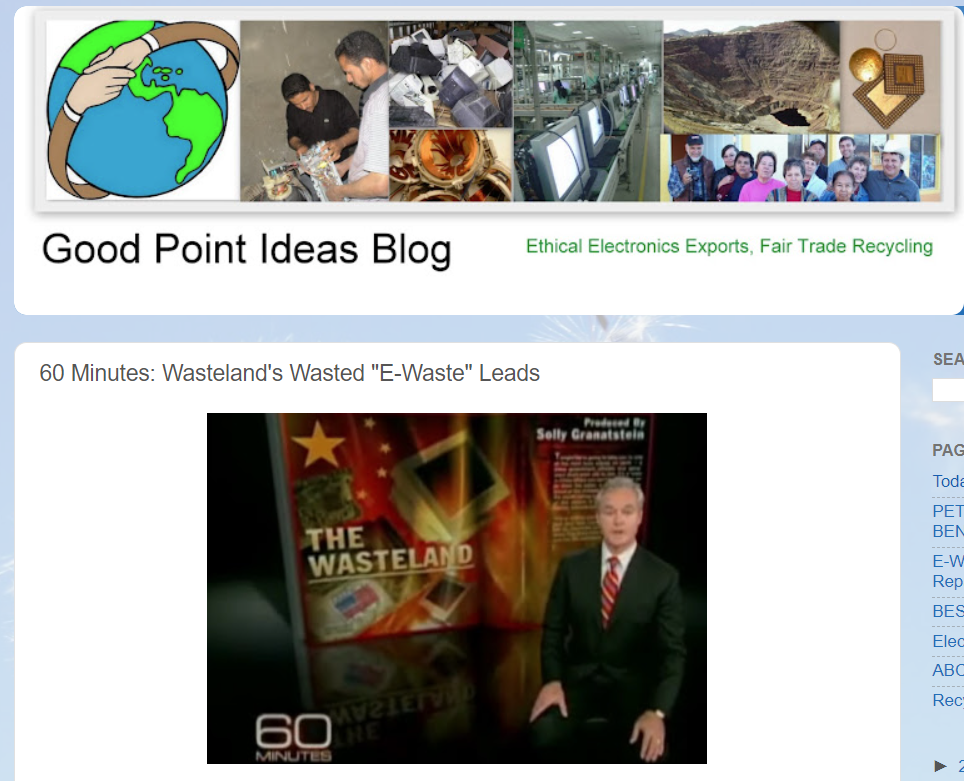
Daisey Chain, Foxconn, and Export Policy


I want to strongly recommend listening to the podcast (or at least reading the PDF) from the retractions in This American Life.

Ira Glass of This American Life has done a good job of trying to undo the ficticious Mike Daisey reporting about Foxconn.  In this episode, they try to correct the mistakes without excusing past abuses, or defusing legitimate concerns over fair trade with the workers who make Apple and other products.

The moral, to me, is that if an accident happens at a different factory in China (not Foxconn), 1000 miles to the west, two years ago, that it's not ok to say that you eyewitnessed the same accident happened at Foxconn's factory in Shenzhen.  This undermines the good factory, by making them the same as the bad factory.  The fact that both factories have brown people in them does not really excuse the shortcut.  The lesson is that if you are a journalist, and you give someone a soap box, you have to act swiftly to prevent a daisy-chain of bad journalism from taking route.

This is what CBS 60 Minutes allowed to happen, relying on Basel Action Network's Jim Puckett, in reporting that CRT monitors were scrapped in Guiyu, China, and not at the refurbishing factories I showed them pictures of.  They set into motion a chain of daisey-claims, infecting PBS Frontline, and Terry Gross' Fresh Air program, with fake statistics about e-waste exports.