Showing posts with label china. Show all posts

E-Waste Blamed for Dolphin Brain Pollution?


The Independent in the UK goes way back in the annals of waste-blaming. The Independent was one of the first to herald the arrest of Joseph "Hurricane" Benson, accepting that the African born technician was somehow making a financial gain by exporting used televisions for dastardly intentions - anything but reuse and repair. I tried corresponding with The Independent's reporter for years. Even when Benson was released, and Interpol's Project Eden closed after multiple researchers found Agbogbloshie's waste to be domestic city of Accra devices, not recent imports, the Independent never followed up.

So today's headline seems uncannily responsive to my last blog about the intelligence of dolphins. Weird.


E-waste found contaminating dolphin brains: ‘This is a wake-up call’  
Toxic chemicals in dolphins and porpoises seem to originate mostly from television and computer screens

Vishwam Sankaran

https://www.independent.co.uk/news/science/pollution-electronic-waste-brain-dolphins-b2928621.html

Recycling Is NOT a "LIE" Part 2. Alexander Clapp Fails Math On Plastic Recycling

Plastic recycling is not a lie. It's not perfect, but if you have to choose how your fresh spinach leaves are sold to people who live in Vermont, steel cans, copper, glass and paper may be easier to recycle at the end of package life... but lifecycle analysis of mining and refining and transportation also count for the environment. We need to keep working to fix the parts of plastic recycling that are not working, but attacking the plastic recyclers who ARE WORKING is shameful. Lying about PETE bottle bill plastic recycling will not fix the recycling prospects for a microgram of toothbrush at its end of life.

In part 1 of "Recycling is not a Lie" we shared just how aggravating it is to have African Geeks in the Tech Sector profiled as landfill scavengers. Yes they are both black, and yes they both make less money that the white guy running mobile phones through a shredder while wearing a white lab coat.  In the same kind of way, successful plastic recycling companies are being cast as failures because the word "plastic recycling" doesn't cover the toothbrush.  In both cases, the arrogant claim that "Recycling Is A Lie" profiles honest, incredible people as shameful.

PETE (#1) and HDPE (#2) Plastics are incredibly successful. They are not subsidized, they are not "a lie", and they are not thrown away at the recycling facilities. People who are telling us that may have a legitimate gripe about the film plastic your spinach leaves were transported in, but they don't have an answer other than "don't eat your spinach".  They might imagine that spinach farmers in Mexico will successfully ship it 3000 miles without most of it spoiling, or being packaged in material far heavier to transport and more harmful in lifecycle analysis (see Oregon DEP study on paper bags vs. single use plastic). But doing so, they imagine they are more truthful than Malaysian Plastic Recycling Factories.

I'll focus on Malaysia, because Malaysia and Indonesia are getting a lot of recycling hate, and I've got experience with successful plastic recyclers - inventors and investors - in both nations. Both nations have been "Asian Tigers", economies who have muslim-majority DEMOCRACIES. There is plenty to criticize (extinction of orangutans for palm oil plantations for starters), but attacking their plastic recyclers is just ignorant.

I have learned the hard way that it is dangerous to single out a single recycler unless they are already (a la Joe "Hurricane" Benson in the UK, or Semarang Indonesia's PT Imtech) falsely accused.  Saying "what is wrong with this factory" has drawn sick attacks, like Jim Puckett's letter shutting down my friends at Net Peripheral in Penang Malaysia after Adam Minter visited them and wrote about them in Recycling International. But let's just look at the largest Malaysia recycler on this list.


Oliver Franklin-Wallis, reporter at The Guardian and author of Wasteland, at least accepted my invitations to meet and speak about the potential for "collateral damage" in Emerging Markets. He visited Evans Quaye's shop in Accra (the smallest electronics refurbished I could risk introducing him to), and as a result wrote a nuanced chapter about his capacity to judge Africa's Tech Sector.  And to his credit, he admitted to me he had not visited a single plastic recycler in Malaysia or Indonesia while writing about their businesses (blamed covid travel restrictions). Oli is honest.  But Alexander Clapp has not responded to any of my twitter or Linkedin invitations.  Alexander Clapp is the one who told the NYTimes that people like me are LYING about recycling.


Here is a plastic recycling plant my Fair Trade Recycling Team visited in Semarang Indonesia about 15 years ago, when the factory was being "outed" by Basel Action Network as a "primitive" operation. We verified their ISO Certifications and photographed their ABS and HiPS plastic recycling lines. Colin Davis, my former VP and Middlebury College Grad (now CEO at Shacksbury Cider) visited in 2009 (I think).


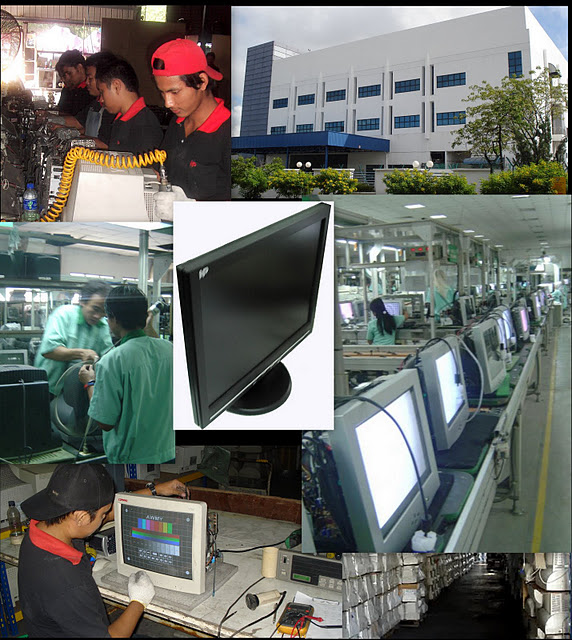
This factory used plastic from used computer monitor housings - removing their paper and foil labels - to peletize them, adding black die, and made brand new computer monitor plastic housings out of 100% recycled plastic.  Was the factory perfect? No, but it made brand new computer monitors as a contract manufacturer to OEMs before converting to a recycling and reuse operation... so making computer monitors out of old computer monitors seems like progress to me. The plastic was just one part of the operation - they reused 4 year old CRTs to make affordable new TVs and monitors as well... while USA companies were grinding those CRTs up to make abandoned piles of toxic dust, and accusing this factory (through BAN.org) of lying.  That was more than 15 years ago... my guess is that Alexander Clapp was in Junior High School at the time. Now he's "recycling" Puckett's stories about these genius entrepreneurs... sigh. Maybe someone in his friends and family circle will read this and suggest he is only "holding up a mirror" to factless journalism.

So back to the present day.  I've posted the image and link to the list of the largest plastic recyclers operating in Malaysia as of 2023.  Clapp and Puckett have accused the largest factory (in that they have accused ALL of them) of operating illegally.

The factory claims to recycle 60,000 tons per year of HDPE (milk jug), LDPE (film), and PP Plastic grades into pellets that can be extruded to make new products.  Putting a photo of domestically generated Indonesia river mixed-plastic litter hardly disqualifies their claims to employe hundreds of staff, or their ISO 14001 certification, or their import permits.  If Alexander Clapp wants to accuse this factory of lying, he has had more than 10 years to visit and show us how they manage to pay for the plastic (PETE and HDPE scrap sell for much more per ton than paper), pay for shipping, employ hundreds, document residuals management, and somehow are "lying" and somehow responsible for plastic litter in an Indonesian river thousands of kilometers away.

Burden of proof much?


Externalization Fallacy: Total Eclipse of the Truth 2002-2020

I recently met someone quite interested in Ethical E-Waste Blog who was 10 years old in 2002. 

Then I met someone who was 5 years old when CBS 60 Minutes broadcast "Wasteland" in 2008.

Both flattered me by saying this blog was "inspirational".  So I guess I gotta keep it up.

I also recently ran across a lot of film camera photos from my first visit to Guangzhou, China, in 2003. That was 21 years ago. It was a Shark Tank worthy experience.  Even if 5-6 blog visitors will find this to be a repeat, there are some new recruits whose minds have yet to be blown. And maybe some readers will be glad for the reminder.

Simon Lin. (Acer, Wistron)

Terry Gou. (Foxconn, Han Hoi Precision Inst.)

Rowell Yang. (Proview, "iPad")


These three men were the head of "contract manufacturing" when IBM, Dell, HP etc. declared that "display devices" were "commodities", not core manufacturing. Sony had, well, "colonized" Taiwan in the contract manufacturing of  CRT displays and now Guangdong Province had been "free=market" friendly thanks to Deng Xiaoping ... Who was famous for being patiently waiting for Mao to die while watching Taiwan and Hong Kong blow the gasket on free market manufacturing.

Used Ford Model As created the critical mass of users in the Ozarks and Appalachia who would vote to pave the roads.

Used VCRs and CRT televisions paved the roads for thousands of TV stations and satellites broadcasting to the "Global South".

Used CRT monitors paved the roads for internet cable investors.

Used Flip Phones paved the roads for 170,000 cell phone towers (2017 estimate) on the Africa continent.

Used Solar Voltaic Panels will pave the way for Africans to reduce diesel-electricity generation.

Despite the obvious facts about electricity access and consumption, the truth about the information and mass communications infrastructure, paved by progress from reuse and value-added repair, by the Tech Sector Auteurs, aka Geeks of Color like Simon Lin, Terry Gou, and Rowell Yang, the West (at least Europe and USA) press coverage of their bright past present and future has been eclipsed by an "externalization hypothesis" - that any capitalist trade between someone rich and someone poor is suspect. 

Imagine the Moon refusing to leave... a persistent, stubborn eclips of the truth...

My Brief Hypothesis On China and Africa - Virgin Production vs Reuse

A brief blog on how Twitter works. 

Here are 20+ year old photos on mass-reuse of CRTs in Asia.


Part 2: How (too) Quietly The E-Waste Big Lies Are Buried.

 Ok, here's a short but important point about the Basel Convention, and the press releases (like today's from Basel Action Network) that seek to expand it to cover normal non-toxic secondary raw materials like plastic, ROHS compliant circuit boards, and even secondhand reuse.

#FLOWCONTROL

"Non-OECD" meant one thing in 1960 when the (all white country) OECD was assembled (Japan was an afterthought).  "Non-OECD" meant a completely different thing in the mid-1980s when the Basel Convention sought to keep pollution abatement costs / regulations in OECD nations from being subverted through international dumping (like the Trafigura toxic waste scandal of 2006).

"Non-OECD" is, today, a caricature of 72% of the whole world. It's a post-colonial era systemic system of flow control that has been used by Western Nations to try to keep their Big Shred companies from competing against what is now the MAJORITY of manufacturing capacity.


Revenge of the Certification - SERI, E-Stewards Make Threats

As a former regulator, I know better than to let a regulated party "get my goat" and draw me into a pissing match. While I had the power of "you can't fight city hall", the regulated party merely has to create the "appearance of impropriety", not prove impropriety itself.

I've been glared at and - in the case of E-Stewards - directly threatened. "Stop saying bad stuff about us. I don't want to have to go after you." Promise, that was said.


Racketeering or Certification 6: Defamation Is The Only Product BAN Sells

The 2019 Certification or Racketeering series of blogs began about Total Reclaim of Seattle.  Craig Lorch and Jeff Zirkle were sentenced last week on their fraud case.  I offered to fly in to testify, and sent them a letter for the judge, to make the case (as in the blog) that the executives at Total Reclaim had been told by BAN that 80% of recyclers were shipping 80% of goods overseas, where 100% percent were smashed by hands in primitive conditions. As I testified at Brundage's sentencing hearing in Chicago, those were false claims.


  • BAN begins by defaming the Tech Sector overseas, with wild hallucinatory descriptions of thousands of orphans in rice paddies beating electronics with hammers. 
  • BAN creates a lie about the Basel Convention having been "amended" to criminalize legal exports (reuse, repair and recycling are ALL legal under the actual Basel Convention, not just "tested working")
  • BAN then defames those who (like yours truly) question or rebut the initial defamation, or correct information they give about the Basel treaty.
  • BAN defames the companies who don't pay tribute through E-Stewards certification, and defames the alternative certifications.
  • If the companies like Intercon or Total Reclaim threaten to withdraw from BAN, or defend themselves (Total Reclaim exported far less than 10% of the material they received), BAN's enforcement is to defame them.

Essentially, defamation and slander are BAN's only product. And at its root, the initial domino of defamation - of people in faraway geographies beating LCDs and CRTs with hammers - is a fake statistic. BAN is the most ruthless in attacking anyone who questions their credentials.


What percentage of what Total Reclaim exported became "waste"? Was that the source of the corporate profits? Or were those profits, and the repeated purchse of flat screens from Asians, evidence that the exports were likely NOT WASTED?  How does the Department of Justice conflate fraud, profit, and mercury to poison our minds with racist assumptions about Asia's Tech Sector when there is no evidence that the goods were dumped?  The crime Total Reclaim execs pled guilty to was lying about the export, not knowing the goods were dumped or that the buyers were poisoned.

It's a sin to kill a mockingbird.


A Word from The Recycling Industry that Sponsors Us

This blog is supported by international trade and recycling markets, which for centuries saved forests  and canyons and coral islands from the mining and forestry it takes to produce consumer goods from virgin material.

An excellent framing of today's so-called 'recycling crisis' is available today on Twitter. Follow @AdamMinter for decades of perspective.

This isn't to say there are not winners and losers. Buyers and Sellers markets always create those, and we don't want to discount the pain from those who have lost pay, or their recycling jobs. But the only way to truly lose is to stop recycling.


Cross Cultural Training in Ewaste #2: IRS FORM 13909

Two NGOs take opposing positions on trade w/ "Third world" aka "emerging markets". What's Tech? What's Scrap? Who decides? Which is a "watchdog"? Which is registered as a "charity"? Who beats up other non-profits?


Ten years ago, the mission of WR3A.org dba Fair Trade Recycling was to vet exporters. And by that we meant to identify USA companies it was safe to export FROM, and not foreign companies it was safe to export TO.

To me, it's an amazingly simple explanation, but it takes weeks sometimes to get it through to journalists and documentary makers.

If you begin with the assumption that the Tech Sector in an emerging market enlists the very best and brightest, the valedictorians, and assume they are flying to purchase something from the Scrap Sector in the wealthy nation - as I did - then the purpose of a civil contract between the two parties is to increase efficient and fair trade.

Earlier this decade [post WR3A California Compromise] we realized that before we could broker loads, we had to first serve the Tech Sector by advocating on their behalf against a very strongly funded defamation campaign. To complicate matters, that campaign was being promoted by "the Left", people who were quite self-certain that they didn't have a single racist idea in their minds.  People who championed "environmental justice" were in fact committing "environmental malpractice", but that was a hard message to deliver.


If I can't fundraise to pay the WR3A credit card bills, maybe we can do the next best thing and "level the playing field". Basel Action Network is registered as a 501-c(3) charity - an organization that attests it does not advocate for legislation, does not perform work to benefit any private business or organization, and provides charitable services.  If reporters are looking for a story, we got another one for you....


For Thankgiving 2018: Yes, You Are Probably Better Off Than Your Parents*


On social media, I sometimes try to "referee the internet".  That's what I call engaging in political debate or argument. I like dialectic. Constructive argument is better than smile-and-wave, or sweep-under-the-rug, etc. If you have the right touch, the friendship survives.

One of the arguments that is ongoing is over the pessimism vs. optimism for globalisation.

Other species, and the environment, I'm tragically not optimistic about.  My optimism about human lives is actually, in part, to get us to focus on worrying about things that really matter.  Also, I think that unnecessary panic and pessimism, whether to Trump or Bernie, distracts us from making investments that might really matter.

So here goes. When we look at an optimistic video, like GapMinder (Hans Rosling), about more girls going to school, fewer diseases, less poverty, the statistics and facts are clear.  Here is an interesting graphic - The World Poverty Clock.

57,913 people escaped poverty today (income levels increased)
11,508 people fell into poverty (especially in places like Venezuela, Nigeria, Syria and Yemen)

World Poverty Clock Screenshot

The graphic shows red (newly poor) and black (newly rich) stick figures, and shows countries in red or black according to how their own population is faring.  I have some funnier videos at bottom.

Here's the argument people most often push back. Many people believe that the current generation of AMERICANS or EUROPEANS is less likely to be better off than their parents generation.

But there are two ways to pose the question. Are we living better than a previous generation? And if so, how did we afford it?

Everyone Misunderstands China / Global Recycling Chains (#WSJ)

Wall Street Journal and others are running stories about the crash in recycling prices due to China's new import restrictions.  There is a grain of truth to the story, but there is so much more going on that I have to issue a quick explanation [US Recycling Companies Face Upheaval from China Scrap Ban].

It has little to do with the sentiment in China over "western garbage". That trite little meme is everywhere on Twitter.  It's something else entirely.

"IT'S THE MINING STUPID"


(AND FORESTRY, OCEAN BED EXTRACTION, AND CRUDE OIL REFINING)


Geography Baiting 5: How Can You Say No?

You are approached by an R2 Certified Chicago Recycler, who has decades of experience in copy machine refurbishing.  You have seen and photographed copy machine refurbishing, overseas, yourself.

The Chicago company has news about a state-of-the-art recycling facility in Hong Kong.  Hong Kong is wealthier, per capita, than the USA.  You know it's near the center of printer parts repurposing, and demand for recycled plastic - the plastic that you know is being lost in big shredding operation.

You check the downstream.  Hong Kong Environmental Department considers printers non-hazardous waste.  The facility identified in Hong Kong is also R2 certified.  You request verification of where the focus materials (circuit boards) go, and track them to Dowa and Umicore...

"You should have refused to ship there".

Really?  Why exactly, given the information above, should we have said "no"?


Deflection Option:  You can say you sent it to Chicago, not overseas.  But the fact is that you knew it could have gone overseas.  You just don't believe what BAN tells us about "primitives" in Hong Kong.

If you were to say no based on the Hong Kong facility, advertised as being state of the art, able to make the highest and best end use of the printers, how would you justify boycotting them?  How can you say no?  On what basis?

I could think of only one reason.  Bigotry. Racial profiling of Hong Kong as a place with "hundreds of junkyards" and "rice paddies".   Fear of the other.

How Little We Recyclers Even Care What Happens

Wow.  What a powerful emotional connection - to no one. Because embargoing trade proves how much you care. Don't exchange with anyone, Bodhisattva.   I thought I'd share the opening salvo of logic from KCTS9's "The Circuit: Tracking America's Electronic Waste".


Sure.  If I send work to the Chicas Bravas Womens Co-op at Retroworks de Mexico, the fact that the electronics crossed the border means I don't care about them.  I don't care about the people I send my children to visit, I don't care about the people whose godson comes live with me for a year.

I don't care about the former Attorney General from Burkina Faso, who I housed for months while a contract was put on his life by President Blaise Compere.  I don't care about the Egyptians, who hosted my family and stayed at my house, because I sold them computers.  I must not care about the investors who are trying to build a $45M state of the art printer recycling factory in Hong Kong, to supply Apple, Sony, and LG with recycled content for new devices.  I surely don't care about the technicians in Ghana who fed and housed me for 3 weeks, or the scrap men at Agbogbloshie who still WhatsApp or call me once a week.

Evolution of RERA #eWaste Legislation: Spinning H.R. 2791 Obsolescence

Lobbying for the RERA Bill, to bring EU style enforcement to bear on secondary market electronics, keeps shifting parameters.   Here's a blow by blow on why exports of used electronics should (or shouldn't) be banned.   The justifications for both RERA and Interpol enforcement seem to go "obsolete" every 18-24 months... Moore's Law for accusations?  

Summary: H.R.2791 — 113th Congress (2013-2014)

(Note, the dialogue is equally effective in summarizing INTERPOL's Project Eden enforcement)

"The legislation is necessary because 80% of USA e-scrap is exported and dumped.  It was necessary to arrest Joe Benson and more like him.".

- No, actually USITC and MIT show conclusively that most is not exported (otherwise why would we have all those CRT glass piles?)

"We meant, The legislation is necessary because of what IS exported, 75% is simply dumped and recycled in primitive conditions.   It was necessary to arrest Joe Benson and more like him."

- No, actually 85%-93% is reused, not dumped, according to multiple peer reviewed UN studies.

"Ahem.  Thanks to the attention we brought, and arrest of Joe Benson, the situation is greatly improved.  Legislation is needed to continue this improvement."

- No, the studies were on the containers seized during his arrest.  It was literally the accused containers that were found to be 85%-93% reused.  He didn't do what you said.

"While the 80% dumping was exaggerated, 9-15% dumping is still completely unacceptable.  Legislation is needed so Africa will leapfrog into new product..."

- No.  Actually, brand new product imported to Africa was found to fail more often than the used equipment, either due to lightweighting (less durable, cheaper components susceptible to Africa's electric grid fluctuations), or shipment of "new" ESD damaged warranty returns to Africa.

7 Steps To Create a Profitable Hoax (#ewastegate)

No one denies that the volume of unwanted electronic scrap is growing.   Gadgets improve lives around the world.   They don't work forever.  But they often have more than one life.

Display devices (more than half of all the e-Scrap) are like used automobiles.  The average life of an automobile (15k miles per year, 200k miles per car) is about 13 years... some last longer, some shorter.   But the average first ownership of cars is less than 50 months, or about 4 years.    


Some people (with means) like to buy new cars every 3-5 years. Same goes for television and video displays.   Just as the cars roll around for twice the number of years they were used by the first owner, there's a secondary market for TVs, PCs, and their display devices.   


How can a do-gooder create a $3M non-profit out of the used appliance (or used car) market? Two parts White Guilt, one part Exotic Locale Photos, one Fake Statistic.  Print millions, move on. 


For more, visit 2010 "Top Ten Myths of #ewastegate"


1.  Create a fake 'e-waste' news crisis  

Tell all the environmentalists that you have a "dirty little secret"... that most of the electronic material they have brought in to recycling centers didn't really get recycled in the USA, or at all.   CBS 60 Minutes, PBS Frontline, NPR, USA Today, BusinessWeek, BBC will come running to you with the microphone.  You are marketing a believable message to people who are already "activated" on the topic (already making the effort to bring old gear for recycling).

This is key, you aren't trying to convince people to care, you are taking people who already care and convincing them of a scandal.   For example:

Top Ten Myths about so-called "E-Waste" (Update)

by Robin Ingenthron- (Originally Published on Earth Day 2010 via Greenwala).  Updated May 2014, as a reminder that the "Great E-Waste Hoax" continues to accuse geeks of color in many countries.
'It ain't what you don't know that gets you into trouble. It's what you know for sure that just ain't so." - Mark Twain
Ranking the 10 Myths requires a definition of what the term "e-waste" means.   In the dictionary and in the courts, "waste" means the material that is discarded or disposed of… stuff that didn’t get recycled, but was dumped.  If two computers are exported, and one is repaired, and the other is thrown away, only the second one is "ewaste".
Definitions aside, the "E-Waste" scare was probably the biggest environmental hoax of the past decade.  Protectionists, alarmists, and gray market regulators bandied the term loosely.  Two Chinese officials told me that any property once owned by anyone is considered "discarded" if it changes possession... the entire used car economy is "waste" business by that definition.   I asked a Hong Kong regulator at an Interpol conference - what if I used a laptop for a week and then sold it to my friend?  "Definitely e-waste" was his response.  
So I always put the term "e-waste" in quotes. Many myths stem from the confusion between waste, reuse, and scrap commodities (like steel and plastic).  Many Myths also have a kernel of truth.  But too often there is no data to support them.  There may be a photo of a poor child, and a fictitious statistic, or a stereotype.  

Some of Myths amount to "green" propaganda produced to sell "cures" like shredding.
As economist Roger Brinner said, “The sum of anecdotes is not data.”   Myths feed cynicism, which generates reaction AGAINST recycling (see #1).   We need scientists and engineers, economists and lawyers,  more representatives from importing businesses, and fewer megaphones.

 10.  MYTH:  "There is a growing tsunami of ewaste."
The Pitch: "Electronics are more disposable, with shorter useful lives. There is evidence [Franklin Associates] that obsolete electronics are the fastest growing segment of the MSW stream. Changes in analog TV broadcasts make old "rabbit ears" TVs obsolete, unless they are connected to cable or satellite. The pile is just getting bigger and bigger."

These facts are true, but they do not describe production of electronics. 

Generation is faster.  But the units themselves are getting smaller. There is more computing power in a cell phone today than in a living-room-sized computer at NASA in the 1970s. The increasing tonnage is made up of "legacy" equipment.   Most of the products collected at "ewaste recycling" events (think projection and CRT televisions) is coming out after decades of storage. 

Cultural Gulfs in Developing Markets 7: The Rusty Radiator Awards

Although I had a degree in International Relations, had spent a semester at the UN, and made a career in the science of development, I racially profiled someone in Singapore in 2005.    I know it now.   I deserve a rusty radiator for racism.

On my way back from Guangzhou, where I had gone for a second visit to see the second-hand shops of Foshan and the "Big Secret Factories" of CRT reuse, I stopped in Malaysia and Singapore for a couple of days.   Armed with my camera, I decided to hunt for some "exotic photos" to prove that I too, like Jim Puckett of BAN.org, had "been there".  Now, Interpol is trumpeting their act. with a project to describe their efforts to arrest "criminals" I refer to as the "geeks of color".

I understand where David Higgins' group at Interpol is coming from.  E-Waste is in the news, and we want to show our credibility, show we have been there, walked the streets, and have seen the problem.  We work for the (world) government, and are here to help. 

The shop below I presented in a Powerpoint slide at a NERC.org conference as an example (an olive branch to Puckett and Westervelt) of clearly bad imports.   I had stayed on the street, waiting for the man who owned this shop (Mr. Teck Recycle) to roll up the metal door.  He had a ladder on the inside, which he needed to physically climb up to the ceiling to start to descend items for resale on the street. 

I acted like I knew where this guy's material came from.   I didn't.

It seemed the guy had packed this 4M x 10M street shop "to the gills" with imports, and was never going to be able to reuse it all.  I represented this person as an example of "toxics along for the ride", of being an example of the primitive importer, and contrasted him with the SKD (semiknockdown or semi-knock-down) factories I wanted to "reform", in our view.

I confess that I assumed this was all recently imported material.  I had absolutely no evidence of that. We now know that the 6 billion people in the "non-OECD" generate far, far more used electronic scrap than the OECD does.

Lets teach them all the missionary position, put them in top hats, and certify them as non-primitives.

Was Mr. Teck Recycle importing at all?   Singapore, though not "OECD", was already as wealthy then as California.   It had become wealthy via the "Tinkerer's Blessing", the reuse and refurbishment trade, which evolved into contract assembly, then into ODM (Original Design and Manufacture).  Sure, some of this material may have been imported, but I had no idea how long before Mr. Teck Recycle got it.   What percentage came from residents of Singapore, which at that time had a higher percentage of engineering degrees, and higher percentage of online high speed bandwith, than the USA's Silicon Valley?   Why did I immediately assume the Singaporean shops were filled with USA "toxics along for the ride" (a phrase I pounded at the NERC audience?)

Sure, it was a sound theory.  Maybe some of this stuff did come "along for the ride".  But I had no proof, all I had was a need to position myself not-too-distantly from Basel Action Network's "80% Primitive Recycling" export statistic, which we now know is no more true than 80% of Los Angeles black teenagers are gang members and high school drop outs (BTW that's said tongue in cheek, it's obviously untrue, but the fact I have to apologize and point that out shows the root of whitey's problem).

Ghana TV repair 2014
Profiling.

Cultural Gulfs in Developing Markets #5: Urban Youth

Basel Amendment to End E-Waste
When we discuss the rapid meshing of cultures in rapidly growing cities, and how the "last mile" of people tend to migrate to the first mile of track (and electric cable, TV broadcast, and internet), there's another factor to consider in making comparisons:

Age.

Rural families tend to be large.  My late buddy Yadji had a brother in Yenwa who had 12 kids and 4 wives, and said his goal was to have 25 kids.   I met other men in Cameroun who boasted of 30 children.  It has been well studied that this is a rural phenomena that tends to decluster within a couple of generations of living in a city.  Quarters are more cramped, school is expensive, and multilingualism is mandatory. Girls get to school more often, and educated women have fewer kids.

But life is tough in the slums for the first generation.  As Adam Minter told me, the young Cantonese may take the super-long workshift at Foxconn for a year or two, but they burn out and adapt more reasonable habits.   It's a difficult way out of rural poverty.  But the rural immigrants don't remain "suckers" for long...
It’s estimated there were 1.2-billion people in extreme poverty in 2010. That’s a decline of 700-million since 1990.  - Chronic Poverty Report
There are about six billion people in the "non-OECD", but "non-OECD" doesn't mean poverty or hunger for most.  The young kids from rural villages have it the worst, and they are the fodder for sex traders, child soldier warlords, pirates, drug runners, etc.  The worst jobs Africa has tend to fall disproportionately on the families with the most children.

Youths have a reputation in every country for thinking they are ten foot tall and bullet-proof.  If you want a challenging environment for OSHA rules, hire a bunch of recently graduated blue collar high schoolers.  The race of the kids doesn't matter, the geography doesn't matter, kids are willing to exploit themselves and to be explioted, especially if they are hungry.

But the flame of experience burns quickly.  You can fool them once.  You cannot exploit them permanently, you either have to hire more rural immigrants, or move to a place where they are more abundant.  And in the meantime,  you have grown an urban middle class which will stick around another 40-50 years.  Visit the demographics in Shanghai, Hong Kong, Taipei and Incheon.
[China's] costs have grown while surplus labour has shrunk, as three decades of the one-child policy means China’s working age population will likely fall by 20% in the next 40 years, and by a further 20% from 2050 to 2100.
Tweets responding to Fareed Zakaria's links (to Jack Goldstone in TheCoversation.com) always yield interesting links.   Jonathan Berman's Havard Business Review (10/13) article "Seven Reasons Why Africa's Time is Now" points out, among other things, that Africa will have more working population than China by 2050, and that investments in "assessembly" jobs are already coming strong.   Today only 24% of Africa's $2 Trillion economy come from natural resource extraction.  The "resource curse" in Africa is beginning to look a lot like Indonesia and Malaysia, which (as I've frequently written) are seesawing away from resource economies into "tinkerer blessing" repair-and-assembly economies... the same path as Singapore, Taiwan, South Korea and originally Japan followed.   The less rural land a country has drawn ("lines on maps") around it, the faster it makes this motion.  Singapore was originally part of Malaysia, and it's stunning growth is as attributable to its cessation from rural geography as it is the country's difference from Penang, KL or Jahor Bahru.  The growth of Taiwan correlates to its ability to concentrate on the "first mile of track".

Cities shrink families. Smaller families have more disposable income.  That's the parentage of e-waste at African dumps, smaller families from a generation passed own TVs, and the TVs are scrapped by kids from rural families, more recently immigrated.  It's ripe for improvement and reform, either through StEP or Fair Trade Recycling or by Indian and Taiwanese entrepreneurs.    It has nothing to do with ratification of the "Basel Convention".  

Ask Nneka Egbuna (Soul is Heavy artist)

@Nnekaworld

Fresh Air Rematch: Terry Gross interview with Adam Minter

http://www.npr.org/programs/fresh-air/

Have not listened yet, but can't wait.

November 13, 2013
wednesday's show
Coming Up: The author of Junkyard Planet explains the global billion-dollar trash trade, Wednesday on NPR's Fresh Air.

Fair Trade Recycling: Interpol Promises Fact Check

Not bathwater: Baby bassinet found at Mexican dump 2008
Here's a novel idea.  Habeus Corpus.  Find the body.   Make sure a crime has been committed before you start arresting people.  Witch hunts and mob justice have plagued democracies for thousands of years, and our system of justice has learned, over the centuries, that accusations need to be investigated before arrests take place.

Environmental Crime enforcement thus reminded itself last week.   Interpol, the Lyon, France-based international police force, announced that it would take a year to re-study the WEEE or used electronics trade.  Why is a study a victory for Fair Trade Recycling?  It's called "back to the drawing board"... Interpol studied it once, gobbled up some baloney Basel Action facts, and started an enforcement campaign it is now going to revisit.  Mockingbird will be retried.
11/7/2013 "The impact of pollution caused by the dumping and mishandling of waste is global, affecting the quality of our air, water and soil," said Cees van Duijn, a Specialized Officer with INTERPOL's Environmental Security Unit.
"Through Project Eden INTERPOL will support its member countries in their efforts to implement national legislation and regulate the international movement of waste to ensure healthier local environments and help protect the overall integrity of our environment worldwide," added Mr Van Duijn.
With the recent launch of the Countering WEEE Illegal Trade (CWIT) Project, INTERPOL and its partners will conduct extensive research into the illegal e-waste market in Europe and provide technical and policy recommendations.
- See more at: http://www.noodls.com/view/1E03CF366C333C703F1EE40A61E2A293816DCAF3#sthash.ysnd6TSY.dpuf
Now Interpol's "Project Eden" doesn't sound all that big a departure from the past 12 months of seizures, arrests and enforcement.   Why do I assume there could be good news here?

"INTERPOL and its partners will conduct extensive research..."

What caused Interpol to take a breather, and to make sure of its prosecution?  WR3A, the World Reuse, Repair and Recycling Association, monikered "Fair Trade Recycling", perhaps played a  role.   Our organization introduced Interpol to researchers from Memorial University, PUCP Peru, USC, MIT, and Middlebury College.  We introduced them to importers from Ghana and Mexico and Burkina Faso.  We introduced them to recent studies by UNEP and US International Trade Commission.   And I took a few days from my vacation in July to meet Interpol at their offices in Lyon, en route to Geneva and Copenhagen, and to my meeting with Mr. Collateral Damage himself, Joseph Benson.

TVs replaced at London hotel by flatscreens make false arrests
Fair Trade Recycling applauds legitimate investigation of the used WEEE and electronics export trade.  Cees (pronounced "case") van Duijn, the head of Interpol's environmental unit, met with me in Lyon in July, extended his hand, and promised to do what is right.  And I believe him.  He was not there when the enforcements and seizures and questionable arrests based on "80%" baloney statistics got started.  He was not holding a torch, and does not seem to be in the lynching business.

We are on the heels of a year of arrests and seizures of exporters of used electronics, following a great E-Waste Hoax.  Interpol had taken a fake, false, hootenanny statistic from a puny Seattle non-profit, and based on the fake number, had seized hundreds of containers or used computers, displays, televisions, and cell phones.  Items, it turns out, which are reused or repaired 91% of the time.

Habeus Corpus means "Habeus Stuff", habeus #ewaste.  Start at the crime scene, start at the dump. "Stuff" is not, by itself, evidence of environmental injustice.  Just keep the facts straight, that's where justice begins.