Showing posts with label povertyporn. Show all posts

Another EU EWaste Documentary: E-Life by Ed Scott-Clarke (Teaser)

Have only seen the E-Life Youtube trailer so far.  Ed Scott-Clarke did respond to my email and suggested I wait to see the documentary.  So... this is only a review of the trailer. A teaser of the teaser (I'll review the whole doc when I see it).

So far, same old same old. A 40 year old TV plastic housing is used as a frame to film men ("boys") burning wire on that spot on the lagoon shore.  Supposedly, 40 year old TVs and VCRs are being dumped on primitive tribesmen on the shores of Ghana.

http://www.edwardscottclarke.com/news/2017/8/3/e-life-wins-its-first-award

Executive Directors Lars Wogen, John Ditchfield, and James Scott-Clarke (relation?) had access to both sides of the story. The trailer shows one side. I can hold my breath, but the fact that they use the exact same "50 year old kitchen CRT TV plastic" in a smoky Agbogbloshie frame for their title shot makes me pessimistic.


Euro Agbo Photo Journo 5: Fotografiska Museum

Visited Stockholm Fotografiska Museum.

It is like the Photojournalist's "Rock and Roll Hall of Fame" in Sweden.  Photos are displayed both as works of art, and as important and beautiful storytelling.  The museum is in a retrofitted brick railyard building, with 3 floors. Lovely interior design, best restaurant and coffee shop ever seen.

There were 4 themes (These change year to year). Horses, Irving Penn, Scribbled on woman heads (skip it), and South Korean clone labs.

Upon entry, the first theme was "Like a Horse". Many new artists, but also vintage historical photography of horses.  Some blond haired, blue-eyed white children in Texas. Horse poop, spray-painted gold. Little bottles of 'horse odors' you can sniff for multi-dimensional effect (did not see many attendees take the advantage).

Exotic. Some African American horseback riders in urban Philadelphia. Celebrity. Young Patrick Swayze, and Richard Gere on horseback.  The biography of one of the photographers explained he would never have been "discovered" if he hadn't been pals with Richard Gere before the actor was famous. The timing was right - the star of Pretty Woman on horses got the photographer in with a magazine, which led to a career.


What $20,000 Means: Blog to Sasha Rainbow, Brian Molko, Stefan Olsdal, @PlaceboWorld


Dear Directors, Producers, and Stars of the Music Video "Life Is What You Make It",

About two weeks ago, I ran across the release of your new Placebo music video through my organization, Fair Trade Recycling / WR3A, which researches public posts on Agbogbloshie.  Despite recognizing some of Placebo's hits from the past two decades, I admit I was not at all acquainted with the artists.  Over the course of 2 weeks, I've developed a much greater appreciation for not just the art, but the social justice that Brian and others with the band strive for.


I know a lot more about African recycling than I know about music.  I've been to Abgogbloshie and Old Fadama several times with our members from Tamale, Ghana.  We have translated for or been interviewed by several documentary and print journalism investigations on so-called e-waste dumping in Africa.  Here are 4 good articles and films on the topic of export.

3Sat
Aljazeera
Smithsonian
SciDev

But let me explain how we can work together to create clean and sustainable recycling jobs for the "workers of Agbogbloshie".  There's a win-win here, and there are plenty of other people besides me you can go through if I've tarnished the relationship by introducing the subject.  ("Alright then, I'll go to hell," often starts here).

Euro Agbo Porno Photo Journos 1: Flog African Tech Sector "E-waste"

My last post kind of took on European "White Savior Complex" in the e-Waste story.  I hesitated before hitting "publish".  Was I being too hard on Europeans?

The latest "European photo-journalist safari" came out the day after.  Italian photojournalist Stephano Stranges announced fundraising for his, well, somewhat creepy African series "Victims of our Wealth" or "Le Vittime della nostra Rizzchessa". Screenshots below...


From his website "Stranges Images" (which is largely in English, though he's Italian), you get the picture, so to speak.  The metal mining exploits Africans to make electronics, and then the Africans are exploited a second time by the selfsame electronics in Agbogbloshie.
Coltan, in other words, the mineral that everyone carries around in his or her pocket, is the object of a long commercial chain that implicates serious consequences in terms of human and environmental rights.   This mineral which is used in the production of various high tech materials, is especially fundamental in making smartphones. 

The compulsive consumption and the continual updating of these objects, fed by by the media’s barrage of ad campaigns, has caused the coltan industry to grow exponentially since the end of the 1990’s. From that point, there has been the exploitation on the part of large multinationals and the catastrophic consequences regarding the people from areas like DR Congo.   My photographic project, therefore, starts in this area of the world, as the initial link in a process that begins with the extraction of the mineral followed by the production of the object (South East Asia) and then moves onto the excessive use in every corner of the planet, ending up in the immense African dump sites (in particular, Ghana).
Now in fairness, I am greatly concerned by the Coltan Mining in the Congo (have been upfront that Congo and Amazon metal mining was topic Numbro Una since 1980s - that's WHY I got into recycling!).  So I have some schadenfreude of my own in Stranges photos of African mining.  (Some historical confirmation at bottom).

So I figured what the heck, I'll talk to them about it... by twitter (next page below).

Look at the specific claim made to support the photojournalism. Data journalists log, Photojournalists flog...
Its name is Agbogbloshie, but when you look for it, you better ask for “Sodom and Gomorrah”, everyone knows it with that name. It is the black dump of the West. 100,000 tons a year including mobiles, fridges, televisions, computers. Here, they are burnt, opened, selected, recycled and re-sold, to then enter again the cycle of production and sale. 80,000 is the estimated population, mainly coming from the North and the most depressed areas of Ghana. 
80,000 residents managing 100k tons per year of foreign waste?  What does that look like? Do you see that in their photos?

I saw 25 people in Agbogbloshie, managing 500 lbs per day of wire.  It was mostly from automobile consoles.  It was not EVEN hysterically remotely close to the photojournalist claims, and the photojournalists own photos prove my points - and disprove theirs!

Collateral Damage 3: Sensationalism vs. Science

John Brown by Levin Handy, 1890-1910.jpgIn a recent correspondence, the Executive Director of the Seattle NGO made a comment about our long history trying to work with or around each other on the subject of "e-waste" regulation.  He summed it up by saying "We have a disagreement about international law and policy".

Fundamentally, perhaps not really.  We agree on what the Basel Convention says about trade between OECD and non-OECD countries.  We agree on what the Basel Ban AMENDMENT says, which would change the rules in the Convention (which covered disposal) to cover recycling and repair.  We agree the second, the Amendment, has not been ratified.  We agree that his organization has been successful in getting several European countries to substantially adapt rules on scrap recycling, repair and reuse to match the language in the Basel Ban Amendment.  And we agree that we strongly disagree whether that is the right direction for "international law and policy".

Although I'm certainly more comfortable around international law discussions than your average junkyard recycler, I would not attribute the disagreement, at least primarily, to interpretation of international treaties.  Here's my problem.

1) OECD is a bizarre basis for determination of "waste crime".   The Basel Convention uses "OECD" to make a binary distinction, drawing a line between Brazil (non-OECD) and Mexico (OECD) that "waste" shall  not cross.  The line is based on a bizarre "club membership" standard. It is not based on any science, whatsoever.  Rather, its entire basis is a rather quaint 1970's "third world" idea correlation.  Places like Singapore and Hong Kong, have higher average per capita incomes than the USA. They are not OECD, but are clearly in the business of electronics manufacture, warranty returns, refurbishment and recycling.  "OECD-Non-OECD" makes as much sense as dividing people by race, by religion, or as "cowboys and indians".

2) Sensationalism and generalizations about e-waste appeal to implicit racism.  The stories are easy to write, and create wealth for the Seattle NGO, jobs for EU and USA regulators, and trade barrier leverage for "Big Shred" recyclers.  Sensationalism makes cheap, plentiful, disposable articles, creating the collateral damage of Joe Benson, Net Peripheral, and Las Chicas Bravas.

It's really the second - the sensationalism ("poverty porn") of Asian, African, and Latino reuse markets - which drives emotions.  Emotionalizations are attractive to journalists this time of year.  I didn't introduce those to the debate.  At the beginning, my blogs and correspondence with Basel Action Network were an attempt to de-emotionalize the subject of trade, to reduce the use of photos of kids at dumps, and to reduce the prosecution and impugnment of refurbishing factories, even (or especially) those in emerging markets.

"Bad Science in the Headlines" has been a subject of research for some time, and there is nothing in e-Waste coverage to distinguish it.   Sensationalism in journalism is a human health risk.  Racially profiling geeks of color is not only morally toxic, it can produce actual risks to human health.

But if BAN brought emotion-guns to the policy fight, I can't fight with a scalpel.  And so we had little recourse but to focus on the accidental racism, the collateral damage, and false stereotypes which the sensational "e-waste" journalism brought down upon the Geeks of Color.


Pick Your Story: Anyone can PhotoJournal in Africa!

Impressed by Washington Post, Guardian, Independent, National Geographic, and NGOs documenting "Ewaste Crime"?

Don't be!  It's easy!  You can call, on the phone, today, the poster "children" (in their 20s) who adorn the pages of guilt-staining photojournalism.

Some of the photos below are from expensive documentaries.  Others - of the same people - were taken with the dudes over lunch, or sent to me by WhatsApp or Facebook.   Everyone can be like Essick, Hugo, Belini, McElvaney and other photojournalists.  Fly to Accra airport, the "Agbogobloshie" dump is just 20 minutes away.  Spend the night at the Movenpick Hotel.

What are you waiting for?  GET YOUR PULITZER!


It's incredibly easy!  You can do it, too!  And  unlike people who live there, or try to engage in trade, you get paid and don't even need to learn any names.  Take the money and run.

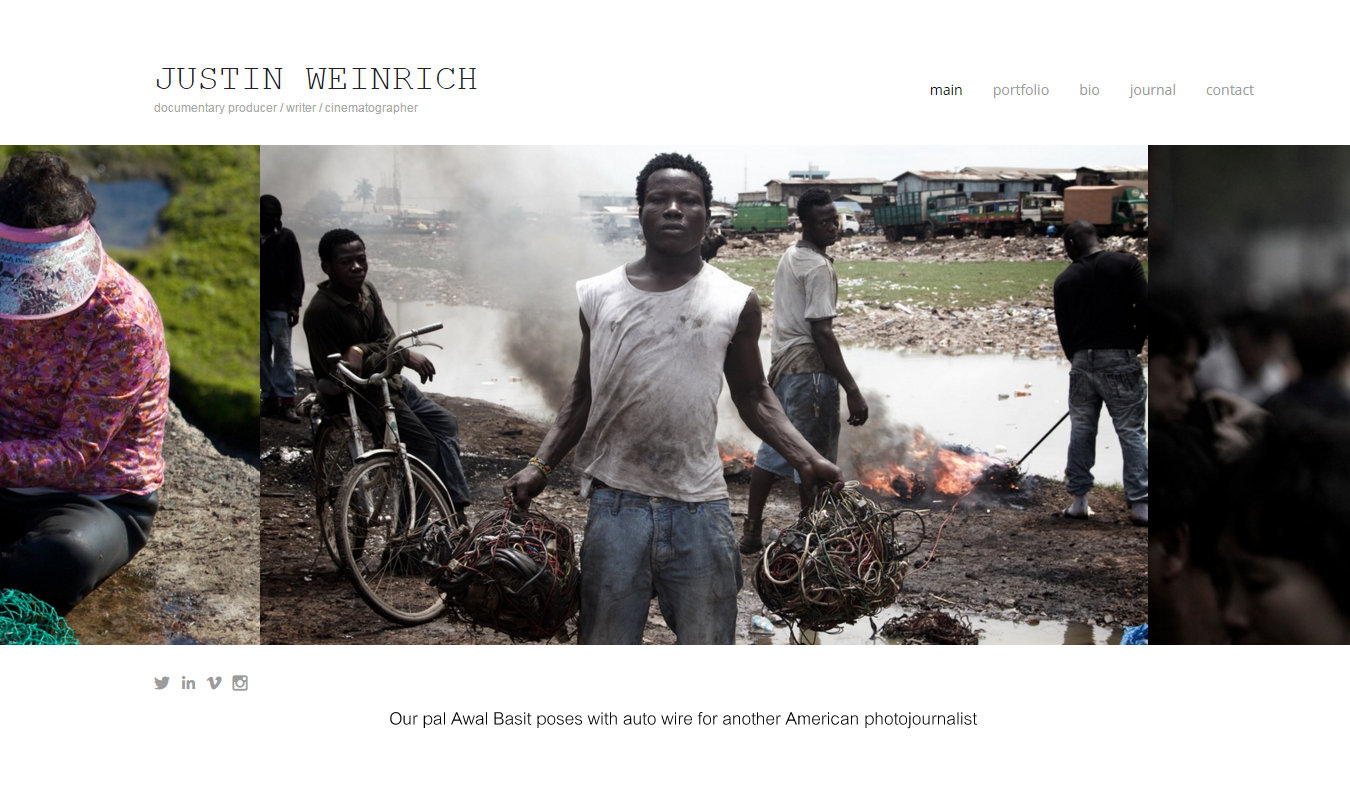
Or if you like, stay and interview Mohamed Saidu Rachid (top) and Awal Basit (bottom).  Stay involved and stay engaged.

BREAKING: Lord Chris Smith's African Witch Hunt Continues: Part 1

UNEP doubled down, using photos of "primitive recycling" in its 2015 report on "e-waste".  But the actual statistics hidden throughout UNEP's own report told a different story from it's press release headline.  If the majority of sea containers of used electronics shipped from Europe are "illegal", then why do the seizures of hundreds of containers only find 1/3 which had anything illegal?

Just one of dozens of examples where the #ewastehoax needs to answer the simple question, "duh?"

UNEP is only pointing fingers, however.  One nation abandoned nuance with flair 5 years ago.  Indictments and prison sentences. While Agbo workers burn wire, England is burning witches.

The photo above shows Mike Anane of Ghana briefing reporter Raphael Rowe of BBC Panorama, on the ground in Agbogbloshie, Ghana.   Mr. Anane was back at Agbogbloshie 2 days before my arrival in March... briefing Jacopo Ottaviana of Aljazeera's #ewasterepublic... see below.

"When I look at these things, I would not call it importation. For me the bottom line is dumping, because from all of these containers that come, only about 20% are functional, and 80% are junk, garbage" - Mike Anane Aug 2014

http://tegenlicht.vpro.nl/biografieen/a/mike-anane.html


PRISON FOR DANIELS RECYCLING? 

Anane's accounts to journalists were covered on this blog a few days ago.  I met him face to face at an Interopol Meeting in Washington DC in 2010, where he presented between UK Environmental Agency Director Lord Chris Smith and Jim Puckett of BAN.  You know the claims... 80% dumping. 500 sea containers per month arriving at Agbogbloshie. The biggest E-Waste Dump in the World. Teeming with fish, Anane recounted, just 10 years earlier.

Mike Anane: "For the past 11 years. That was when I first saw the trucks with e-waste coming from the port to Agbogbloshie. Agbogbloshie happens to be a place I’m familiar with. I have been hanging around the area when it was a lush, green, beautiful wetland with lots of birds and some wildlife, and the river and the lagoon that run through the dump site had so much fish. The fishermen, the people in the communities depended on these rivers for their livelihood. Agbogbloshie used to be an amazing, beautiful wetland, a Garden of Eden. A wetland performs enormous environmental functions. When the water from the city goes to the sea, it goes through the wetland and gets filtered. Fish from the sea come and make babies. Wetlands are so important to every country, to nature, and to mankind.
"But now, the river and the lagoon are both dead: no fish, no organisms, nothing. The river and the lagoon both end up in the sea, and when the fishermen at the seaside throw their net, hoping to catch some fish, they get computers, television sets, and fridges. Their poisons spill into the sea every single day... So for me Agbogbloshie, which was a green Garden of Eden, is now paradise lost."
Note that this interview was in August 2014, describing "11 years" of experience.  But his 2010 interview with me at Interpol, he said it had been ten years.  And in his first interview, with Greenpeace in 2008, it was ten years.  And on PBS Frontline, it was since he was a boy.

My personal interview was during the meeting that set Lord Chris Smith up against Hurricane Benson. Lord Chris Smith, as I recall, introduced Jim Puckett and Mike Anane to the audience of Interpol enforcement experts.  It set up the first arrest and indictment of "Hurricane Joe Benson". And this week, LetsRecycle.com, a British environmental online newsletter, reports that "Hurricane Joe Benson" has company.

MORE AFRICAN TECHS FOR UK JAILS

Latest Pics of Kids at Dumps - #TakingTuesday #FloggingAgbogbloshie

Pics of Kids at Dumps - The Gift that Keeps on Taking.

See today's solicitation from our friends at Basel Action Network, photo of scrapper at Agbogbloshie. It implies your donation for #GivingTuesday will benefit "Children aged 11-18" scavenging at dumps to earn $1-3 per day.  Another waste NGO flogging Agbogbloshie.

Ages 11-18??  B******t.  See Journal of Health, Exploratory Health Assessment of Chemical Exposures at E-Waste Recycling and Scrapyard Facility in Ghana (Jack Caravanos, DrPH, CIH; Edith E. Clarke, DrPH, MPH; Carl S. Osei, MD, MPH; Yaw Amoyaw-Osei)
Demographic Characteristics:  "The ages of the 87 e-waste exposed subjects from Agbogbloshie ranged from 15 to 73 years. The mean age was 32 years with a standard deviation of 5.6..."
Mean age 32.  Median age of 25.5 years.  That's not "child labor". The mean age of women giving childbirth in Ghana is 22.2 years, for crying out loud.  The employment data at the recycling yard shows far less child labor than agriculture sector, in fact it's above average for workforce in Accra.


Remember, this is from the organization that "never, ever stated" 80% of used electronics were dumped.  They are shameless in their "data" when it's used to solicit donations. They have a view of math, as something that your wishes and intentions give you mysterious powers over.  And it's full of accidental racism, bigotry, povertyporn, and profiling.   Yuck.

The art of making up very specific, scientificky sounding stats and numbers is bad for environmentalism and development.  But you know what's REALLY offensive to the workers in Agbogbloshie (who I'm still in touch with every week)?  That they are raising money with POSTER CHILDREN and they do not share one penny with anyone whose photos they use.

NONE.  I think this qualifies for worst non-profit EVER.  They can't even do #PovertyPorn right. 

Welcome to #TakingTuesday

Here to Help Part 2: The Words Don't Fit The Picture


Math test:
Q:  "If Ghana gets hundreds of millions of tons of e-waste per year, and e-waste is 5.76% of irony scrap (cars, white goods, appliances), and the world generates 106M tons of irony scrap, what percent of the world's e-scrap / e-waste does Ghana receive?"
 A:  If world e-Scrap exports are 5.76% of 106,000,000 metric tons*, then world e-scrap would be 6,105,600 tons per year.   To get hundreds of millions of tons, the rest of the world has to wait for 20 years - disposing of no e-waste - and then dump it all at once on Ghana at the end of two decades.
FACT:   Ghana receives somewhere between 0.000014 and 0.000439 of the world's #ewaste - between four and six /100ths of one percent.
          Calculations below.

after 90% reuseof 570,000,000 tons (include domestic scrap)Of 48,900,000 tons (exported only)
215000215000.000037719298250.0004396728016
8000080000.000014035087720.000163599182


Non toxic copper extraction
So, it's just ludicrous.  If you want a higher percentage, you need a lower denominator.  StEP's higher estimates numerator (215k tons) includes fridges and air conditioners and washer-dryers in "e-waste", which makes for 48.9 million tons per year worldwide.  In which case, for Agbogbloshie to receive hundreds of millions of tons, it would take only 5 years of 100% of all e-waste in every country being dumped there... still ridiculous.

How would China, India, and Nigeria get their share of the "e-waste crisis" if Ghana's Agbogbloshie was being so selfish about it?

*est. based UN University 106,000,000 tons of steel exports (of 570 MT recycled... including domestic use in all nations). ratio on ISRI 76M tons irony scrap + 4.4M segregated e-scrap.

History of Agbogbloshie: African Tech Comments on Ewastehoax

Just republishing Emmanuel E.P. Nyalete's comment to Resource Recycling this weekend.  Superbly thoughtful and interesting.   He's a laptop repair guru and graduate student studying coding at Georgia Tech... and a former Good Point Recycling staffer and current WR3 associate.

History of Agbogbloshie

I remember Agbogbloshie as one of the usual places in Accra where the guys from the northern part of the country work. They come knocking from door to door to buy alluminum and bottles and any other scrap item they could get. I remember saving coca-cola bottles that I sold to them to make some extra money for my next football. Over the years, Agbogbloshie has becomes a very compalext informal recycling site. It has grown from the recycling of bottles, glass and alluminun to heavy metalls from tractors and any form of motor vehicle. One of my friends who worked there told me that they prefer motor vehicles because they contained the larger quantity of metals and electrical wires. As Ghana's consumption of electronics grew so has the informal recycling of househould equipments grew. 
For over two decades, I have never considered this site to be the largest e-waste dump site in the world until I read the artiles and saw the videos in the mainstream media in Europe and the USA. I was surprised for a few reasons:
1. There are very few electronic items in Agbogbloshie to even consider it as Ghana's locally generated e-waste dump site.
2. The surface area of Agbogbloshie cannot contain the "world's e-waaste" considering the many junk auto parts that are already at the site.
3. The young men who work there use very simple tools and most of the time push carts to haul scrap. From my experience working in a recycling plant, there is no way these young men could haul "millions of tons" of e-waste and process them using hammers and chissels.
However, I acknowledge the fact that there is a problem, but its not about young men taking things apart with primitive tools. Neither is it an import issue. Ghana imports almost everything we use. The problem however is fire-burning wires for the valualble coper. 
To find the right solutions for this problem we need the correct diagnosis. We cannot find the right solutions if we keep exagerating the figures and the conditions on the ground. It does not help my country in any way if wrong statistics are published. A few projects have already failed at Agbogbloshie because they based their projects on false data. Incriminating African business men and women for crimes they have not commited will only lead to poverty and hence an increase in the fire pits at Agbogbloshie. Our country depends on these business men and women to provide technology at affordable prices to students and small businesses and hard working families. I am an example of how used electronics help families and young minds to aspire and dream for better tomorrow. 
Lets put in a liitle more effort to find the facts and then we will discover that there are so many talented technicians and inverntors in Africa who work hard and all they need is true partnership and opportunity. Thank you.

Emmanuel Nyalete


My own comment follows below

Ghana Connected Photos by Robin Ingenthron


While getting news when we can from Accra's terrible flood and fires of the past 24 hours, I'm uploading photos through National Geographic.  175 dead, we pray for the families and friends of our friends in Ghana.  We are connected.


Here are 15 Photos from our Agbogbloshie trip which try to connect the dots of the "ewaste" story... the villages young men leave for the "big city". The Tech Sector which imports used electronics, connecting us, creating sustainable jobs. The cities which eventually upgrade and produce overflow "e-waste". And the young men who break motors and burn wires to pay rent in the city.
Ghana Connected:  Photos by Robin Ingenthron (National Geographic website)


This is a Slide Show with 15 of the best photos from the trip to Ghana.   Need at least 15 more, to cover the trip to Tema for example, to the shopping malls, and to the homes (and children) of the technicians who hosted me.

If you want to read more, go here.   Two more reporters confirm the "Millions of Tons" Hoax.


This place I'm standing on is now under water.  While I was there, they told me it would be under water in another month or two. It's a flood plain.  It happens every year.

"eWaste Crimes in Ghana" Part 8: BAN, Blacksmith Hoax Costs EU $1,200,000

In case you missed it, here was the "good news" headline from 6 months ago (August 2014)


The purple text is my addition, by the way.

More purple underlines (article continues below)


On Monday or Tuesday, Emmanuel Nyaletey, Wahab Odoi, Wahab's cousin Peter and I will head back again to Agbogbloshie just to make sure we got this straight.   What we photographed 10 days ago is supposedly the site which has received $1.2M in EU funds.

Below is my amateur film of the place where the 20-50 units (monitors, TVs, PCs) per day were getting their wires removed. (199 view limit on Youtube until I have to black out unpermissionedfaces).

I address the purple underlined "great white savior hoax" in the article above.  It's the most ridiculous thing ever seen on planet earth.


I'll be back there this week, if you have questions for the 27 people in Agbogbloshie who carry 446,000 pounds, minimum (2M tons for "millions" of tons) every day to burn it.   That's per person, per day.  With unpowered hand-carts.

Truly the most outrageously exotic site BAN.org has ever "uncovered".

The video is not complete, it is a preview, I have to edit out faces I don't have permission from after 199 views.  Though its quite ironic the people who didn't give permission...


OP ED: Recyclers, Stewards Must Free the Geeks of Color

[6/20/2014] We are all familiar with the photos of wide eyed, poor children in faraway, exotic places. CARE, UNICEF and others have tried to be more sophisticated about the “poster child” syndrome, but many others will fill the space. A child’s photo often earns a quick sympathy buck.


It's the gift that keeps on taking. Through either God’s grace or a million years of evolution, we are capable of nurture, we can empathize.  Risk to a child is as frightening as risk to ourselves.


But in a new development, poster children are becoming a tool of major industries. Electronics manufacturers practicing “planned obsolescence” and “big shred” machine makers are funding a photo campaign to stop the secondary market. It is an example of what Peter Buffett calls the "charitable industrial complex" [NYT Op Ed 2013].


Reuse and repair have met anti-gray-market alliances in the back alleys of prohibition trade.  The anti-reuse complex have created a racial profile of traders in used goods. The campaign actually accuses overseas buyers of poisoning their own children.


What is unique about this "e-waste" campaign is that, unlike CARE or UNICEF or Save The Children or OXFAM, the fundraisers do not share a dime of proceeds with the children in the photos.   In a crassly opportunistic way, they actually use the kids images to arrest their parents. Among philanthropic colonialists, the e-waste export campaign is an abusive step parent.

Joe Benson, a 54 year old man, born in Africa, never went to school. He registered legally as a reuse business in London. He was sentenced Thursday to 16 months in prison. During sentencing, either the London judge or the barrister compared Benson's export to "rape". When I compared these "bullyboy" cases to Harper Lee's "To Kill a Mockingbird" in 2012, little did I know how similar the trials would be.

#freehurricanebenson

Top Ten Myths about so-called "E-Waste" (Update)

by Robin Ingenthron- (Originally Published on Earth Day 2010 via Greenwala).  Updated May 2014, as a reminder that the "Great E-Waste Hoax" continues to accuse geeks of color in many countries.
'It ain't what you don't know that gets you into trouble. It's what you know for sure that just ain't so." - Mark Twain
Ranking the 10 Myths requires a definition of what the term "e-waste" means.   In the dictionary and in the courts, "waste" means the material that is discarded or disposed of… stuff that didn’t get recycled, but was dumped.  If two computers are exported, and one is repaired, and the other is thrown away, only the second one is "ewaste".
Definitions aside, the "E-Waste" scare was probably the biggest environmental hoax of the past decade.  Protectionists, alarmists, and gray market regulators bandied the term loosely.  Two Chinese officials told me that any property once owned by anyone is considered "discarded" if it changes possession... the entire used car economy is "waste" business by that definition.   I asked a Hong Kong regulator at an Interpol conference - what if I used a laptop for a week and then sold it to my friend?  "Definitely e-waste" was his response.  
So I always put the term "e-waste" in quotes. Many myths stem from the confusion between waste, reuse, and scrap commodities (like steel and plastic).  Many Myths also have a kernel of truth.  But too often there is no data to support them.  There may be a photo of a poor child, and a fictitious statistic, or a stereotype.  

Some of Myths amount to "green" propaganda produced to sell "cures" like shredding.
As economist Roger Brinner said, “The sum of anecdotes is not data.”   Myths feed cynicism, which generates reaction AGAINST recycling (see #1).   We need scientists and engineers, economists and lawyers,  more representatives from importing businesses, and fewer megaphones.

 10.  MYTH:  "There is a growing tsunami of ewaste."
The Pitch: "Electronics are more disposable, with shorter useful lives. There is evidence [Franklin Associates] that obsolete electronics are the fastest growing segment of the MSW stream. Changes in analog TV broadcasts make old "rabbit ears" TVs obsolete, unless they are connected to cable or satellite. The pile is just getting bigger and bigger."

These facts are true, but they do not describe production of electronics. 

Generation is faster.  But the units themselves are getting smaller. There is more computing power in a cell phone today than in a living-room-sized computer at NASA in the 1970s. The increasing tonnage is made up of "legacy" equipment.   Most of the products collected at "ewaste recycling" events (think projection and CRT televisions) is coming out after decades of storage. 

Cultural Gulfs in Developing Markets 9: Deliverance from Comics

"Dueling Banjos" composer Arthur Smith passed away this week, at the age of 93.  If you call me on my cell phone, the (originally titled "Fueding Banjos") song slowly erupts, and builds crescendo the longer I wait to answer.  When Arthur Smith was born, few Americans lived in cities.  When I was born, more than half of Americans lived in cities, and my Ozarks family was already in the minority.

I grew up very aware of the "cultural gulf" between USA's urban and rural families, at a time too many of us got our news about the world from comic books.   My future wife studied "Snuffy Smith" and "L'il Abner" from her home in Paris (Rosny was considered a kind of ghetto), and I learned about urban life from "The Cross and the Switchblade" comic, and "learned about" Europe from Richard Scarry, and about Africa by reading "Tintin".


Today, you no longer need to go to a college library to find out about what the world is really like.   But many of us hold onto our simplified stereotypes the way we hold onto comic books, hoping they'll become vintage collectibles.

The term "lesser developed country" or "LDC" was retired, and "emerging economy" is much more in vogue.  The same transition which occured in the richest nation on earth, the USA, is occuring everywhere.
"The world is undergoing a sustained urbanization process that's pulling more people into city centers and turning more places from rural outposts into denser urban organisms. A new report [PDF] from the United Nations projects that the world's urban population – roughly 3.6 billion in 2011 – will grow by about 72 percent between now and 2050, bringing the urban population up to 6.3 billion. That's about the same amount of people on the entire planet in 2002." - Nate Berg, The Atlantic Cities Blog

Those of us who see the world first hand, who travel from city to city, comparing Kinshasa, Cairo, Paris, Singapore, Kansas City, New Orleans, Paris, Copenhagen, Hong Kong, Guangzhou, Lima, notice more similarity than differences....  we see the world is melding and growing and culturally merging and mingling.   The internet, stoves, and the city traffic have more in common.  The music is in a state of free exchange, Soukous has rap lyrics, rap has sampled bluegrass.  African, Asian and European visitors to my home in the Ozarks are sometimes a little disappointed how similar it is to Vermont.  Having spent all that money on travel, they want to point their cameras at a hillbilly, the same as I was tempted to take snapshots of 'poverty porn' in city scrap markets in Asia, Africa and South America.

Comic books and photos are not substitutes for policy data.  Fortunately, there are far more people studying cities and urbanization than there are studying "e-waste".  Electronic scrap is an intellectual policy backwater compared to projects like NYU Stern Urbanization Project.   Billions of people are consuming and discarding in ways which make Annie's Story of Stuff seem oversimplified to an almost Biblical degree.

NYU SUP has produced 4 short Youtube videos to show the growth of cities, like modern art ink spots bleeding onto a white canvas.  Paris, Chicago, Sao Paulo, and Los Angeles... from space, they grow like fungus in the fingerprint of a petri dish.  Cities as they would be visible from space.


Cities recycle, and cities finance extraction of metals from rain forests and coral islands.  Cities repair and reuse, and cities discard.