Showing posts with label sodom. Show all posts

Nuance Delivery 3: Eyewitnesses To Hell - Oluu Orga

The Agbogbloshie waste site has really become a crucible for examination of the charitable industrial complex. The richer the African city, the more consumer electronic waste it generates.  When I go to Agbogbloshie, I don't see anything I didn't see in Mobile, Alabama.

But once, I thought did.  When Westerners go to unfamiliar places, something happens. We photograph something that seems exotic, and the more shocking and unfamiliar, the more valuable the photo.  It's interesting to contrast our Western photos of Agbogbloshie to those taken by an African who lived and worked at the place. Western photojournalists (e.g. Kevin McElvaney) earn a better living selling their photos if there's a nice Biblical Halloween Titled Hyperbole around them.

In Nuance 1 and 2, we focused again on Awal Muhammed of Savelugu, Ghana, the guy in his mid-20s who figured out that adding more gasoline - literally - to the ewaste (and tires, mostly) burning fire was a recipe for handouts. On my first visit to Agbo in 2015, he certainly stood out. (And he video calls me too often ever since, see last night).

Today, let's focus on an authority, Oluu Orga, who is everything Awal is not. He also came to Agbogbloshie from the North, he also pushed a cart around the city, but he didn't ever learn to perform fire tricks for the Photojournalist convention (which started in earnest a year after Oluu left).

Oluu Orga didn't have much to spend on film, but he took pictures of his friends doing different jobs.

In the mid 1980s, I returned from 30 months in Africa with 7 undeveloped rolls of film. When they were all developed at once, I could see where my priorities had been.  Excited to be in remote Africa, the place I had heard about as primitive and natural and exotic.. many photos apparently were intended to "validate" my time there. More shots of grass roofs than corrugated steel, no pictures of paved roads.  When I went through Oluu's photos of his time there, Agbogbloshie finally got real.


Euro Agbo Porno Photo Journos 1: Flog African Tech Sector "E-waste"

My last post kind of took on European "White Savior Complex" in the e-Waste story.  I hesitated before hitting "publish".  Was I being too hard on Europeans?

The latest "European photo-journalist safari" came out the day after.  Italian photojournalist Stephano Stranges announced fundraising for his, well, somewhat creepy African series "Victims of our Wealth" or "Le Vittime della nostra Rizzchessa". Screenshots below...


From his website "Stranges Images" (which is largely in English, though he's Italian), you get the picture, so to speak.  The metal mining exploits Africans to make electronics, and then the Africans are exploited a second time by the selfsame electronics in Agbogbloshie.
Coltan, in other words, the mineral that everyone carries around in his or her pocket, is the object of a long commercial chain that implicates serious consequences in terms of human and environmental rights.   This mineral which is used in the production of various high tech materials, is especially fundamental in making smartphones. 

The compulsive consumption and the continual updating of these objects, fed by by the media’s barrage of ad campaigns, has caused the coltan industry to grow exponentially since the end of the 1990’s. From that point, there has been the exploitation on the part of large multinationals and the catastrophic consequences regarding the people from areas like DR Congo.   My photographic project, therefore, starts in this area of the world, as the initial link in a process that begins with the extraction of the mineral followed by the production of the object (South East Asia) and then moves onto the excessive use in every corner of the planet, ending up in the immense African dump sites (in particular, Ghana).
Now in fairness, I am greatly concerned by the Coltan Mining in the Congo (have been upfront that Congo and Amazon metal mining was topic Numbro Una since 1980s - that's WHY I got into recycling!).  So I have some schadenfreude of my own in Stranges photos of African mining.  (Some historical confirmation at bottom).

So I figured what the heck, I'll talk to them about it... by twitter (next page below).

Look at the specific claim made to support the photojournalism. Data journalists log, Photojournalists flog...
Its name is Agbogbloshie, but when you look for it, you better ask for “Sodom and Gomorrah”, everyone knows it with that name. It is the black dump of the West. 100,000 tons a year including mobiles, fridges, televisions, computers. Here, they are burnt, opened, selected, recycled and re-sold, to then enter again the cycle of production and sale. 80,000 is the estimated population, mainly coming from the North and the most depressed areas of Ghana. 
80,000 residents managing 100k tons per year of foreign waste?  What does that look like? Do you see that in their photos?

I saw 25 people in Agbogbloshie, managing 500 lbs per day of wire.  It was mostly from automobile consoles.  It was not EVEN hysterically remotely close to the photojournalist claims, and the photojournalists own photos prove my points - and disprove theirs!

Sodom and Gomorrah? Fishing as a Boy? Mike Anane via PBS Frontline

"Photojournalism without data journalism jails and fails"

Immediately after our 3 week investigation of Agbogbloshie, Tema, Tamale region and Accra, I went to Vancouver to meet with Graham Pickren and Peter Klein, both professors.  Pickren was very kind to meet me for lunch.

Peter Klein initially returned my messages, but did not seem to want to meet.

Klein's at UBC Vancouver, which is responsible for the PBS Frontline episode in 2010 that labelled Agbogbloshie as "Sodom and Gomorrah."  The label was based on interviews with Mike Anane, who has been repeatedly represented as a "journalist" in Ghana.

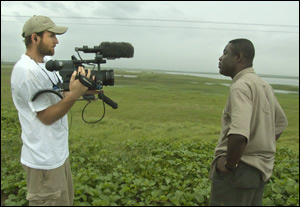
Isaac Brown, left, films Mike Anane in Accra, Ghana. Anane is a ...
n'importe quoi
My interviews with the scrappers at Ghana led me to believe Anane is not a journalist at all.  I can't find any record of any articles published by him, or any newspaper, radio, or television station he has worked for.  The Agbogbloshie scrappers claimed he was "in cahoots" with AMA, the Ghana developers who wanted to evict them from the increasingly valuable real estate near the center of Accra.  I've written about that before.

Here's another UN sponsored report, by African researchers, on the sources of pollution at the Odaw River lagoon of Agbogbloshie (2002).  It's incredibly well documented, and none of it jives with Frontline.

What I haven't really had the guts to do is to question Mike Anane's credibility.  I interviewed him at an Interpol meeting in 2010.  And I've promoted alternative experts such as Grace Akese of Memorial University or Emmanuel Eric P. Nyalete of Georgia Tech.  But when it comes to being an American questioning an African about his depiction of Africa, I've only attacked Anane's figures, his statistics, his 500 containerloads per month story.  And independent scholars back us up ("Criminal Negligence?")

The claims of the Agbogbloshie scrap workers do appear to hold water.  Take a look at the specific Anane representation below, still on the PBS website.


Anane makes a specific personal claim:
"I've always known Agbogbloshie as part of the country's westlands. As a kid, I used to play football here.  Some of my friends would go fishing in the lagoon.  When I went back and saw the huge amount of computers shipped in and dumped here, it mad me angry that these children had come to break them up." - Michael Anane
Now this is specifically an eyewitness claim.  Anane is personally claiming to PBS to have seen computers "shipped" to Agbogbloshie.  In the AlJazeera E-Waste Republic series and Cosima Dannoritzer's "The E-Waste Tragedy" Anane makes the same boast... this was a pristine riverside, a fishing village. 


Now how does this square with all the reports of Agbogbloshie, and the Odaw River Lagoon, since 1960?  How does it compare to eyewitness reports from any of my own interviews?  And Anane's claims to have been an editor in 1991-95 for "Triumph Newspaper" (no record of the paper in Ghana, though there's a Triumph newspaper in Kano, Nigeria).  Either Anane was in northern Nigeria, or he was editor from a remote location before the internet. But if that's the timeframe when Agbogbloshie was ruined in Accra, it's at a time when 1) Agbogbloshie was a city dump and auto scrapyard for a city of millions, and 2) there were no strict "ewaste" regulations to avoid as "drivers" per UNEP / "StoryofStuff", and 3) it's definitely not near "the outskirts", it's in the middle of the gosh darn city, visible on Google Maps.  Nothing adds up... except Anane's speaking fees.   Oh, didn't know that? Ask reporters, like those of #ewasterepublic  about the Anane speaking fees, and fees to photograph his collection of plastic with asset tags.

Nyalete, Odoi, and Akese say otherwise, and the reports like the one linked above are pretty darn thorough.  Agbogbloshie was a polluted dump before personal computers were sold in USA, let alone discarded. It's larger and more polluted to the degree Accra is larger and more polluted. There is no international dumping link, and no evidence of Eden after the Akosombo Dam of the Volta River was completed in 1965.  Electricity led to WEEE as roads led to cars.

But Anane specifically says it was "teeming with fish" in 1999.
Dan McKinney and M. Anane report that Agbogbloshie river was teeming with fish in 1999.  Bullhockey


Agblogblogshie: E-Waste Tsunami Covers Sodom-Gomorah in Understated Hell

Agbog-blog-shie Unplugged:  E-Waste Tsunami Covers Sodom & Gomorah in Understated Hell

Starved of facts and nuance, reports from African city of Accra - found on verge of catastrophe.

[BSNewsire, Accra, Ghana  April 1 2015]

Longtime a skeptic of "ewaste" dumping claims, WR3A Founder Robin Ingenthron arrived in Ghana last Sunday, and was shocked to find the situation far graver than he imagined.

"It began when our Delta Airlines flight was unable to land," said Ingenthron.   "We could see the junk televisions from 4,000 meters above Accra.   They were scattered in stacks, up to 90 feet high, on the runway and tarmac, and along the highway."

The Agbogbloshie dike, which separated greater Accra from the largest collection of electronic waste on the planet, had broken.    Teenagers could be seen pouring out of the Agbogbloshie fences, trying to regather the discarded computers and televisions.  But as fast as the kids worked to burn them, a tsunami of CRT televisions continued to spout through the gates, covering the streets of Accra and stalling traffic.

Ingenthron and other passengers were dropped via small white parachutes, like baby Dumbos, into the zoo of e-waste.  From the ground, the confessed electronics reuse kingpin came face to face with the toxic consequences of his "reuse excuse".

As reported in The Guardian, by Greenpeace, and at weather.com, "millions of tons" of obsolete electronics arrived in Agbobloshie each year.  At 34 units per ton, or 102 million TVs and monitors per year, 279,452 pieces had to be burned each day, keeping the 27 scrap boys who work in Abogbloshie on double shifts.  American households throwing away an average of 2.8 TVs per day are blamed for the mess.  Unfortunately, faced with the relatively small fires and lack of lighter fluid, the scrap boys had allowed a tinderbox of 10 decades of throwaways to amass.