Showing posts with label BAN. Show all posts

Blowing The Whistle A Minute After The Goal Is Scored

My environmental philosophy was shaped by Lester R. Brown and the State of the World reports published by the Worldwatch Institute. Brown argued that the defining environmental challenge is not waste itself, but humanity's accelerating extraction of natural capital. Recycling matters not because it manages garbage, but because every kilogram recovered from the human economy is a kilogram that does not have to be extracted from forests, coral reefs, rivers, mountains, farmland, or indigenous lands. In almost every meaningful life-cycle comparison, a kilogram of copper recovered from discarded products has a smaller environmental footprint than a kilogram mined from virgin ore, transported, concentrated, smelted, and refined. Better still is a kilogram of copper that never needs to be recycled because the product containing it is repaired, refurbished, or reused for another decade. Extending the useful life of products preserves not only the metal itself but also the enormous investments of energy, labor, and environmental disturbance already embodied in their manufacture.

This is fundamentally a question of thermodynamics and material flows, not ideology. 

Year 20: Using AI to Summarize 2006-Present Good Point Recycling Blog

While ChatGPT rarely produces anything resembling my favorite blogs—let alone the humorous ones—I’m learning that, used properly, it can help distill decades of work.

A good example is how difficult it has been for me to relocate or even recall the original citations explaining why, in 1995, Basel Convention advocate Jim Puckett failed to draw what he later called a “red line.” That decision allowed a Green List—Annex IX—that explicitly included scrap recycling (such as lead-acid batteries) and the repair and reuse of used electronics.

ChatGPT, when pushed hard enough and corrected often enough, can actually surface that history. It can reconstruct the 1995 decision, then trace the subsequent decades during which Puckett sought to amend the Basel Convention—while, rather disingenuously, claiming that his preferred amendment (banning exports intended for reuse, derided as “the reuse excuse”) was already binding international law.

I first exchanged emails with Puckett in 2002, when he released Exporting Harm to a long, clunky DSL-era email chain. I hit “copy all” and, in the process, met EPA’s Bob Tonetti—who agreed with my simple observation: the Green List (Annex IX, List B) said exactly what I said it did.

That paragraph alone is an example of the kind of wordiness that contains essential timeline context—context I now intend to synthesize in what is effectively year twenty of this blog. ChatGPT, left on its own, is contaminated by three decades of press releases and repeated claims. But it can be “bird-dogged” into acknowledging the quieter counter-history: the repair factories that kept their heads down in the 1990s, the reuse advocates who actually prevailed in 1995, and the reason they prevailed. As well they should have.

I spent more than an hour yesterday exchanging points with ChatGPT. It will take more time to edit those exchanges into something readable—and, ideally, pithy and entertaining. What follows below is the summary I asked it to produce from that dialogue.

One additional realization: what I previously interpreted as flattery from the AI is actually structural. It must reward users who correct it, because those corrections improve its internal weighting. In other words, the system needs people like me to challenge it.

Session notes below. More to come.

By the anniversary of the first 2006 Good Point Recycling Blogspot, I may finally have the book I’ve been trying to write—sometimes consciously, sometimes not. The draft opening will be a summary of Hillbilly Hare, the Warner Brothers Bugs Bunny episode, as a way to introduce the concept of poverty porn.

https://docs.google.com/document/d/1LP3pigx5pdZ-UHYV8IKFjqIiIy-0xmUbJ-3JpTFOZnU/edit?tab=t.0

WR3A Factsheet on Used Electronics, “E-waste,” and the Basel Convention

Basel Convention and Used Products — Session Notes

Einstein's Amygdala Part Four: "None of this is on the Front Page"

From our care-giving, nurturing, fear-projecting feelings - as kids have for baby rabbits.

To Rule-making - as regulators do, to make us feel like it won't happen again.

To Manipulating - Insiders using the rule-making to hobble competitors.

The people with money know how to rub our amygdalas, and we purr like cats. What we value could be the cat, could be the baby bunnies, might be the childrens' reaction to kitties and bunnies. What we need to do is realize how much is at risk in the looming great extinction.

As Twitter climate philosopher & cat-shoulder-perching specialist Ben See @ClimateBen puts it

Remember:

1. The oceans are being killed.

2. Forests will soon be gone.

3. Fertile soil is disappearing.

4. Megafauna risk extermination.

5. Insects are vanishing.

6. Climate chaos is inevitable.

7. Extinction is now.

8. Plastic is in our blood.

None of this is front page news.

Ben See's point is that what SHOULD BE front page news is NOT being covered on the front page.

What does make it to the front page is seldom-enough related to environmental protection. When we do get the attention of reader amygdalas, the story is often "gotcha'. Pollution regulation and enforcement is priotized to real estate value, and increasingly used to shore up stockholder value. (I re-read upon Keynes vs Friedman over the weekend, suffice to say both mens' concentric circles of caring gravitate towards living humans rather than those yet to be born)

In Einstein's Amygdala Part 3, the ways for-profit businesses manipulate Regulations to the detriment of competitors was portrayed as a way to massage the fear instincts which our brains have developed over hundreds of thousands of years of evolution. As noted in Part 1, the list of things that might kill us was exponentially longer a mere 500 years ago, but our brains remain as hair-triggered as when we were running away from tigers, lions and bears.

Today in Part 4, I'm looking at how the finite potential we have to focus our attention is being squandered by the masturbating NGOs like Basel Action Network, those who produce ads and policies and laws and rules and outrage off of #POVERTYPORN and #POLLUTIONPORN that has ZERO association with the causes they attribute the Earth's real problems to. THIS IS A COMPLETE AND UTTER WASTE OF A FINITE AMOUNT OF ENVIRONMENTALISTS TIME AND ENERGY. AS MUCH AS I AM FOCUSED WITH ALL MY SOUL UPON MAKING THE PLANET LOVABLE FOR ALL OF OUR GRANDKIDS, I'M GUT PUNCHED BY THE CALLOUS, GREEDY WAY THAT SNAKE OIL SALESMEN ARE TRIGGERING OUR CARING AMYGDALAS WITH ZERO SCIENTIFIC BASIS OR EVEN SCANTEST OF EVIDENCE.

Once again, eye-candy poverty porn non-profit Basel Action Network has a press release this morning (but I'm putting that "below the fold")

Revenge of the Certification - SERI, E-Stewards Make Threats

As a former regulator, I know better than to let a regulated party "get my goat" and draw me into a pissing match. While I had the power of "you can't fight city hall", the regulated party merely has to create the "appearance of impropriety", not prove impropriety itself.

I've been glared at and - in the case of E-Stewards - directly threatened. "Stop saying bad stuff about us. I don't want to have to go after you." Promise, that was said.


Help Us Update Life Cycle Analysis (LCA) of Retroworks Mining Factsheet

I could use some help updating this 2003 Retroworks Mining Factsheet.

Circular Economy of Digital Reference Cycles
While the fundamentals of the Retroworks Mining Factsheet remain in place, it has not been updated since 2003. For example, it needs carbon emission reference points (a great grad school paper next semester? I promise to review it).

Here is a link to the "American Retroworks Mining Factsheet", first published 1995, and last updated 2003. Needs help.

Racketeering or Certification 6: Defamation Is The Only Product BAN Sells

The 2019 Certification or Racketeering series of blogs began about Total Reclaim of Seattle.  Craig Lorch and Jeff Zirkle were sentenced last week on their fraud case.  I offered to fly in to testify, and sent them a letter for the judge, to make the case (as in the blog) that the executives at Total Reclaim had been told by BAN that 80% of recyclers were shipping 80% of goods overseas, where 100% percent were smashed by hands in primitive conditions. As I testified at Brundage's sentencing hearing in Chicago, those were false claims.


  • BAN begins by defaming the Tech Sector overseas, with wild hallucinatory descriptions of thousands of orphans in rice paddies beating electronics with hammers. 
  • BAN creates a lie about the Basel Convention having been "amended" to criminalize legal exports (reuse, repair and recycling are ALL legal under the actual Basel Convention, not just "tested working")
  • BAN then defames those who (like yours truly) question or rebut the initial defamation, or correct information they give about the Basel treaty.
  • BAN defames the companies who don't pay tribute through E-Stewards certification, and defames the alternative certifications.
  • If the companies like Intercon or Total Reclaim threaten to withdraw from BAN, or defend themselves (Total Reclaim exported far less than 10% of the material they received), BAN's enforcement is to defame them.

Essentially, defamation and slander are BAN's only product. And at its root, the initial domino of defamation - of people in faraway geographies beating LCDs and CRTs with hammers - is a fake statistic. BAN is the most ruthless in attacking anyone who questions their credentials.


What percentage of what Total Reclaim exported became "waste"? Was that the source of the corporate profits? Or were those profits, and the repeated purchse of flat screens from Asians, evidence that the exports were likely NOT WASTED?  How does the Department of Justice conflate fraud, profit, and mercury to poison our minds with racist assumptions about Asia's Tech Sector when there is no evidence that the goods were dumped?  The crime Total Reclaim execs pled guilty to was lying about the export, not knowing the goods were dumped or that the buyers were poisoned.

It's a sin to kill a mockingbird.


Intercon Sentencing, Defamation, and Charity vs Charity Grudge Match

Chicago's Hall of Mirror Balls

Several people heard a "whoosh" sound while reading the April Fools Day Blog.  The BAN vs ERA of Canada - two recognized tax charities - defamation lawsuit was dropped about the same time.  But ERA's leader Bojan Paduh (a refugee of Bosnia during the 1990s civil war) is someone I got to know as a result of the lawsuit.  His anger at BAN is absolutely seething in a way I have not heard since Brian Brundage sued the NGO 6 years ago. (For April Fool reference, see email from BAN at bottom).

I told Bojan that I had indeed, more than once, considered a defamation lawsuit against BAN. Brian Brundage (like Bojan) had asked if I was interested in joining class action (shared legal cost) approach.  I spoke to an attorney about it in 2012, when Basel Action Network told a Chicago Newspaper that I was "lying through my teeth" and that the "state of the art" reuse and recycling facilities I had visited and eyewitnessed in Asia were a "myth". According to the reporter, BAN warned him against even listening to me, stating I was mentally ill and that everyone in the recycling community knew it.
"Most libel cases are filed by private citizens. There are reasons for that. Private citizens have a much lower bar to hurdle. They have to prove that the statement was factually wrong, that it was published, that it referred to them and damaged their reputation—and that somebody is responsible for it. That the person who made the statements was negligent." - Guy Bergstrom, "To Sue or Not to Sue: Libel"
Now BAN has learned a thing or two from their experience paying attorneys to defend them in defamation and liable lawsuits.  The 2012 attack on me was certainly explicit and personal, not against a company and not a vague "opinion".  They explicitly warned a reporter not to talk to me, and gave reasons why I was not credible.  Because BAN had to take the unusual step of apologizing and retracting their statements, I get contacted a lot for advice from others wanting to sue BAN. But they have learned to be a little more cautious in some cases (like using the term "likely illegal" against ERA, instead of "illegal", as they claimed in 2012).


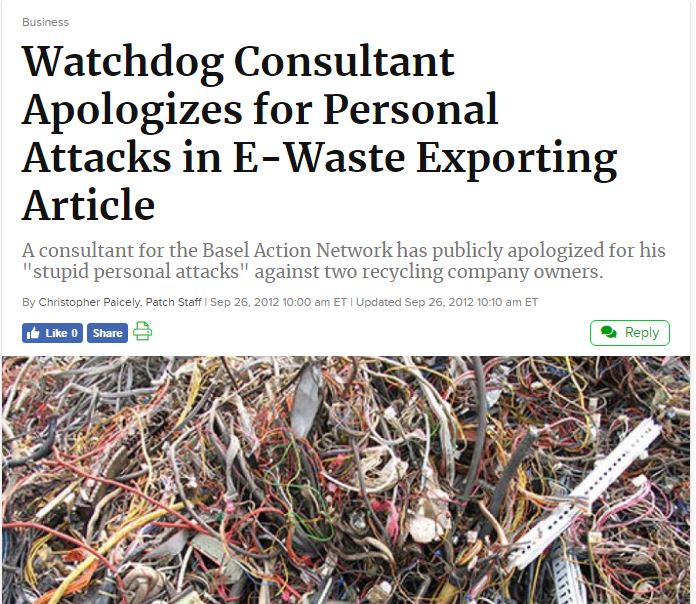
Instead of suing, I accepted BAN's apology, which was run in the same Chicago Patch newspaper. I was not really satisfied with the apology, because it did not remove the insult or racial profiling I originally objected to. I was not the person being defamed, it was the Tech Sector overseas, the poor people who make a lot more money repairing rich peoples stuff than they can make repairing poor peoples stuff.


10 Things we Know about Basel Action Network's "Earth Eye", and 1 We Don't


  1. We know BAN is not placing GPS trackers into any devices that don't LOOK ready to reuse. Not a single CRT or projection TV (over 50% of ewaste) was tracked by BAN, ever.
  2. We know BAN claims to be "cutting wires" to sabotage the devices, which likely get repaired anyway.
  3. We know that BAN controls distribution of who gets what type of device... 14% of all GPS trackers BAN released in Canada went to one guy who had a lawsuit vs. BAN.
  4. We know BAN has a financial interest in the outcome (through E-Stewards) worth millions of dollars.
  5. We know that BAN's press releases interchange their proposed "Ban Amendment", which has not passed, for Basel Convention international law, which allows export for legitimate recycling and repair.
  6. We know that BAN mysteriously "obfuscated" several end points in Asia, when devices arrived at legitimate reuse and legal recycling centers.
  7. We know that BAN picks specific people to accuse, even in cases when that person exported nothing.
  8. We know that BAN profiles the overseas tech sector and reuse technicians as "primitive" and "informal".
  9. We know that the "developing nations" BAN describes as "primitive" had cities with TV stations and millions of households using electricity a half century ago, and produce most of the "ewaste" at their own dumps.
  10. We know that the first instance of GPS tracking, of TVs sold to Nigerian born TV-repairman Joseph Benson of BJ Electronics, led to false testimony ("80% not reused") by the UK prosecutor, and environmental injustice (imprisonment of Benson).


What I can't figure out is why the press gives this organization any ink.

Follow the money. 

This is the To Kill a Mockingbird moment for the environmental community. You either sat by while this NGO made this happen, or you spoke up to #freejoebenson


Poison Apples 4: BAN Report on Canadian Export - 9% Export Despite Rigged Sampling!

Nine Percent!?!?
Nine Percent is a nine-member Chinese boy group formed by the survival show Idol Producer by iQiyi in 2018.

Nine percent is also the result of BAN's E-Stewards new report  on a rigged process to show illegal ewaste export is still a thing to pay them money about.

Rigged as in 14% of all the devices BAN tracked were sent to one company (which BAN has engaged in a lawsuit against). And BAN didn't track things they knew would not likely be exported.

Basel Action Network, the owner of the "E-Stewards" authority program, is still using GPS trackers to try to ramp up business.  In a new report distributed by email, BAN has given a subject headline that "Canada still Exporting e-Waste to Developing Countries"... Using a clever but well trod journalism trick, "still" is meant to imply something significant is contained in the report.

Let's boil the information down from page 1.

1) Zero CRT televisions tracked, despite being 60% of Canada's e-waste stream.  That's a major sampling bias if your claim is about "Canadian e-Waste".

2) The devices "chosen" for export tracking - LCD monitors, CRT desktop monitors, and printers - were identified in BAN's 2016 report as the most likely items purchased by export markets.

3) BAN "Poisons the Apples" again, claiming to have secretly "rendered the devices economically unrepairable".  Like the 2016 report, the sabotage is not visible, it's hidden (and not competently done - in 2016 several devices were found repaired and in use anyway). Why do that, other than defeat screening and quality control procedures by the accused Canadian exporter?

4) BAN again conflates the Basel Convention - which explicitly allows reuse and repair and even recycling exports to developing countries - with their proposed AMENDMENT, which they admit has not been passed or ratified by either the Convention or Canada. So their claims of "illegal" activity by Canadians are clearly false and defamatory.

Despite all this spin, the result of the GPS study is   9 %

And if CRT TVs had been tracked, it would have been less than 3 percent!!!  This report shows an NGO flailing its fingers on the keyboard!!!


Poison Apples 3: Uptick in Lithium Battery Fires & GPS Ewaste Tracking Devices

Our company sends about 30% of the used electronics we receive to "big shred"... companies that invested in labor-saving mechanical shredders with eddy-current-separators, magnets, optic sorters, etc., to turn things like printers (notoriously low reuse value because the dollars are in the ink cartridges, not the device) into streams of raw material.

Those shredding companies are our friends.

We offer to take back stuff they can't shred responsibly - like display devices.  Ideally, we'd be taking back, ton-for-ton, the 30% stuff that should be hand-managed, like CRTs and LCDs, Plasmas, OLEDs, etc, for every ton of shreddable e-waste we send.

Our friends at the shredders have a problem. One friend, ECS of California, went out of business this year. I've known the owner, Jim Taggart, since my Massachusetts DEP days in the 1990s. He was not the first "big shred" investor to get sucked  under.

This video doesn't show you any specifics about why, but it does show a big, big problem for Big Shred.  It features our old pal Scott Pelly of CBS 60 Minutes (the guy who impugned our geek pals based on Jim Puckett ewaste statistic "fakenews").


The Thorny Distraction of Environmental Police / Malaysia Rhino Horn

It has been a couple of years now since WR3A's last meeting with INTERPOL in Lyon, France. After our first and second visit to Agbogbloshie, laughingling labelled the "world's largest e-waste dump", INTERPOL officials let me know that "Project Eden" was a misfire. They would sunset it silently.  This is what grown up environmentalists do.

The #ewastehoax launched by Jim Puckett of Seattle almost two decades ago has distracted environmental regulators, and has diluted their enforcement, from much more important concerns.  Like this.


Fifty rhino horns, worth $12M, seized by Malaysian environmental officials in Kuala Lumpur. This is a big news story. Yet it's been distracted from and diluted by Basel Action Network, and there's been no country more so distracted by BAN's war on repair than Malaysia DOE.

Everyone Misunderstands China / Global Recycling Chains (#WSJ)

Wall Street Journal and others are running stories about the crash in recycling prices due to China's new import restrictions.  There is a grain of truth to the story, but there is so much more going on that I have to issue a quick explanation [US Recycling Companies Face Upheaval from China Scrap Ban].

It has little to do with the sentiment in China over "western garbage". That trite little meme is everywhere on Twitter.  It's something else entirely.

"IT'S THE MINING STUPID"


(AND FORESTRY, OCEAN BED EXTRACTION, AND CRUDE OIL REFINING)


NGO "#EarthEye" Gets OEM Cash for GPS Trackers: Do It Right Dell

Summary:  We applaud the next generation GPS Tracking study - if it's a truly random distribution and random sampling of end points.  It's not the tracking that was bad in 2016, it was the opportunity for bias distribution and biased sampling of end points.  Dell should ask MIT Ethics Review Panel (via legal department) how to do a reputable GPS used electronics tracking study.
  1. Randomly track and place all used electronics inputs. That means putting some trackers in 25 year old CRT TV junk that no one imports, some in working product that should be reused, not selectively sabotaging good enough looking stuff internally. 
  2.  Randomly distribute the randomly selected used electronics. That means blindly send the goods so you don't send specific selected stuff to a specific recycler.  
  3.  Randomly select end point export markets. That means you don't "obscure" good repair markets (cringeworthy 2016 study hid best and brightest in Hong Kong). 
What Dell can Learn from MIT Senseable City Lab "Partnership" with Basel Action Network.

In 2016, Basel Action Network sent GPS Trackers out in the field and provided MIT with a textbook study of how to do it wrong.  Sampling bias, financially involved research team, etc.

In 2018, BAN has announced they have a new partner - Dell.  Above the fold are the steps Dell can take to avoid MIT's mistakes, and do this study right.  I will applaud the tracking if the samples are done fairly, because then they will tell just as many stories about good Tech Sector outcomes overseas, as well as good stuff that got destroyed - not just bad stuff that didn't get fixed.  I'm all for science.

FRAMED: GPS Tracking System For Ca$h!! Non-Profit For Hire Egg Hunt!

[April 1, 2018] FRAMED:   "HOW TO" USE GPS TO MAKE SOMEONE LOOK BAD. 


Environmental NGO Basel Action Network released an Opinion piece in E-Scrap News that may have put too fine a point on their offer to shakedown competitors.
"Responsible recycling companies can be plagued with downstream vendors that cheat on their no-export commitments. For this reason, BAN encourages all electronics recyclers to contact BAN to privately contract for our tracking services. We are ready and willing to help all recyclers and enterprise companies to audit their downstream partners."

"Responsible"... You'll be "responsible" all right.  Because if you read the agreement disclaimer, you'll find you could be held responsible if the NGO gets sued for defamation.

Here's our April Fool's Day Prank - How to use an MIT-inspired GPS tracker to make ANYONE look bad.  And the fun part is, you can do it for Ca$h!


Reversing Environmental Racism: Owning Your Stereotypes and Profiles

We are on the verge of turning the page on EuroCentric #CircularEconomy.  Several professionals in the European Union (and UK) have understood that Copernicus and Galileo were right, and the sustainable economy does not "revolve around" the OECD.

Five years after the IERC conference gave an Award to Jim Puckett of BAN for his "pioneering and breathless work to prevent the globalization" of used electronics management, the conference has invited Emmanuel Eric Nyalete - a native Ghanaian, Georgia Tech Coder, and former reuse department head at Good Point Recycling - to address the conference and tell them about Ghana's imports from the Tech Sector's point of view.


How did we get here?  And why did it take ten years (since publication of Greenpeace's report on Agbogbloshie) to get experts like Emmanuel, Grace Akese (of MUN), Jenna Burrell, Josh Lepawsky, and others to the podium?  And is it possible that Europe will actually contribute financially to welcome Africa's Tech Sector back to the table, and partner with them to make the world better for future generations of all races, languages, and creeds?

OP ED: GPS Tracker Controversy Resurfaces #Monitour

Just a brief update about the 2016 reports (2) by Basel Action Network which claimed that their partnership with MIT Senseable City Lab demonstrated that 36% of USA E-waste is illegally -  and shamefully - exported.  When the first report came out, one year ago, we contacted MIT to question the following methodological concerns in the study.  MIT sent a disavowal and stopped appearing with BAN in the press, but the damage has been done.  BAN unmasked unwitting and unwilling participants and named names - even companies like mine that they know for a fact did not export the device they shipped to us.  Where there's smoke, someone should get fired.

1) 50% of waste - CRT TVs - were not tracked.  Probably because they are almost never exported. If they are never exported, the exported "findings" fall back into the 10%-20% range identified in several other studies.  It's the "blue-eyed basketball player fallacy" (selective sampling).  They tracked 30% of types of devices deemed likely exports, and found 36% of those were exported.

2) BAN covered up destinations which didn't fit their "primitive and shameful" narrative of overseas recycling.  Here is video from April '15, six months before our downstream USA recycler exported a printer we handled, of Hong Kong's legal EcoPark.  We found direct evidence that BAN erased the coordinates for this facility, and shared that on the blog and with MIT.


3) BAN misidentified legal repair and reuse as shameful exporting.  Two CRTs tracked in Pakistan ended up in a multi-story reuse shop a couple of blocks from Pakistan's largest tech university, in the same building that sells CRT analog converters (changing monitors to TVs).  Another data point that "disappeared" in BAN's second report appears to show a large SKD factory in Foshan.  If it isn't this factory, then why did BAN erase the datapoints in its second report?  In Fact, one of the SEATTLE devices exported (under investigation by Washington DEP) was in fact tracked through the site above, and is found in reuse in Tin Shui Wai (a city, not a rice paddy, in the New Territories).  BAN erased the datapoint, but it was shared with us by someone in Seattle, and we profiled the cover up here.

4) Whether or not the tampering and fallacies above were intentional, BAN's participation and funding and sharing data with E-Stewards who sponsor BAN financially are prima facia violations of MIT ethics rules on both conflict of interest and tracking of "unwitting and unwilling" human subjects.  If there was any question whether BAN was just following devices or was targeting unwitting and unwilling subjects in the first report release, that was released in the second, where BAN named me personally and my clients in Somerville, despite knowing that we did NOT export the device they tracked. Oh, and the Somerville site is a commercial office, not a public drop off point... MIT undergrads had to ring a doorbell and get buzzed in to a building with no "recycling" sign.  At that point, MIT assigned its attorneys to the case and MIT Senseable City Lab issued a disclaimer and stopped commenting publicly on BAN's allegations.

And remember, #2 EcoPark is a direct competitor of E-Steward donors!

5) We had direct tracking of exactly how much of our used electronics we qualify for direct or potential export.  It's under 10%.  We provided that information to MIT Senseable City Lab, who provided it to BAN before BAN issued the 2nd report ignoring that data.   The fact we could track that item without BAN's GPS was less interesting to us than the fact that an E-Steward who pays BAN handsomely cancelled our shipments of printer scrap for several weeks while the GPS tracker was in our building.  A source at MIT has privately confirmed the same suspicion, that BAN had active access to "live" devices and that it would have been simple to warn paying sponsors to avoid shipments containing the devices.

If anyone needed a track record for BAN's targeting of me personally, here is a reminder of a paid BAN staffer's characterization of me, personally, to a Chicago Patch reporter two years earlier, and BAN's public admission of the personal attack, and apology to me.

Whether funders like The Body Shop Foundation or researchers like Carlo Ratti of MIT Senseable City lab will ever partner with Basel Action Network again is an open question.   But they would be wise to track the history and reputation of the "watchdog" that barks at companies that don't pay them "certification fees" worth millions of dollars to stay silent, and to fund vicious racist attacks on innocent Tech Sector importers and exporters like "Hurricane" Joe Benson of the UK - the Tom Robinson of UK's witch hunt into fake news about Agbogbloshie distributed by BAN... falsehoods exposed by me months before BAN's report called me out in shameful light.

It's a shame that legitimate concerns exposed by the study can't now be pursued without airing false propaganda.   The fact our Massachusetts printer, sent to Chicago, didn't go to the place in Hong Kong described and approved (#2) and the reasons - legit or not - given to our downstream USA copy machine repair shop who exported it... all legitimate avenues to explore and learn from.  But those could have been pursued without "unmasking" the unwitting and unwilling participants, and without the 5 research fallacies described above.

I'm bringing this up because last week a Vermont Agency of Natural Resources staff person made a claim about my company and the GPS tracking which did not mention the legal R2 certified facilities in Hong Kong or EcoPark (video above), in defense of new Procedures which the Agency admits are directed at one company - mine.

How We Knew About Apple's "Recycled Content" Plan 2 Years Ago!

Big announcement, just out, from Apple CEO - Apple will produce its electronics from 100% recycled material, not from virgin mining.

It's reported from Apple's just-released 2017 Environmental Responsibility Report.  It's bound to hit all the Earth Day news outlets this weekend.

Sourcing recycled content, creating a demand-pull effect, was what we were working on when I started at Massachusetts DEP in 1992.  It can be very big news.

Question:  How did I know about this almost 2 years before Apple's announcement?

Apple doesn't make its own stuff.  It's generally put together by a Shenzhen contract manufacturer like Foxconn or Wistron, which the blog has focused on many times.

Guess how we knew about Hong Kong EcoPark when we allowed a trial load of printers to go to Hong Kong - when our E-Steward downstream wouldn't pick up after several loads to their shredder?  When the BAN GPS Tracker was in our facility, and suddenly our shipments were mysteriously cancelled?

When I did background check on why Hong Kong would be paying for printer scrap again, before approving to the Chicago downstream replacing the E-Steward, I found that the $550M EcoPark tenants were sourcing scrap for plastic to be sold to a contract manufacturer in Shenzhen.   One who made devices with a major brand name label.

Breaking News: GPS Recycling Miscegeny Trackers Flatten Circular Economy

[SEATTLE, WA 01.04.2015 00:01 april fools] MIT Sendable City lab announced today that a study with NGO Basel Acting Network has revealed a startling outcome, and a next stage.  The circular economy is flat.  And a Next Generation Tracking Devices has been developed to find reuse trade as it occurs.

The team will keep tracking the devices, as they move around between repair and reuse markets. But the next generation of trackers, the NI88ERGPS, will clearly identify boundries in the gray market.

"In our first effort, we thought that Basel Acting Network had tracked each of the GPS devices to its final resting place.  We called that end point 'Overseas'.  We thought we were finished," said Dr. Carl Ratty of MIT Sendable City Lab. "It turns out there are a lot of different places over there, and stuff keeps moving around."

The 1st Generation of GPS devices are still in motion.  88 different nations have continued to use, pass along, and exchange the devices.  Reuse is spiralling out of control, and it will take a new generation of trackers to make the crime - not disposal, but point of exchange - more black and white.

A 'point of pollution' requires that the device stop somewhere, in a dump. BAN's actual target is the exchange of goods and services between rich and poor, an act he labels electronic miscegenation.  These are not geographic "positioning" tracers.  They will trace "possession".

Continuing Final Outcomes:

"In 2016, we were certain that when the GPS devices landed in Faisalabad, Pakistan, that they were surely and finally buried, deep in the soil of a 3rd story electronics mall with escalators and dozens of reuse shops," said Basel Acting Network CEO Jim Plunckett.

But the first trial continued to track the property for as long as the batteries last.  Devices disposed in a primitive computer company's third shelf eye-level retail shop moved to a dormitory at Faisalabad University, 3 blocks away.


"We updated the report to show the devices new locations.  But they keep moving," said Ratty.

Devices sent to Tin Shui Wai in Hong Kong's Yuen Long district could be tracked going up an elevator, the a 14 floor apartment.  One device appeared to be in use in a hospital mobile cart.  A display device attached to a blood gas analyzer, the GPS tracker showed the cart moving up and down hallways, floor by floor in the Cairo General Childrens Hospital.

Plunckett sees a better solution than tracking an "end point".

Waste Perception Creates Image Problem

Last spring Resource Recycling published an article following WR3A research into leaded silicate mining.  Long before my days as a regulator (Massachusetts DEP 1992-99) I had noticed how recycling happens in cities where property values (NIMBY) made compliance expensive.  Virgin mining and forestry, while far more damaging and polluting, happened farther away from property values, and was thus less regulated.

Here in Ghana, we are looking at lead and zinc mining streams as a way to "piggy back" CRT glass back to secondary primary ore refiners.  Rather than try to construct a "takeback" program aimed at manufacturers (popular because they are extremely costly, charging high fees in a bargain with Planned Obsolescence to squash the secondary market), merely cite the "circular economy" and toss the CRT tubes back into containers bearing Pb Ores.  Africa mines primary leaded silicates for export to refiners in wealthy - and less wealthy (China, India) - nations.  And some of those ores are chemically identical to CRT glass.

And there is no "EPA-EU" "Waste" "speculative accumulation" paperwork or R2 or E-Steward #bs to make it economically unfeasible.  I keep hearing in the west that CRT glass is "impossible" to recycle in Africa, a continent where primary ores are frequently the number one export.  This is a clear case of the EU and USA shooting itself in the foot, and then demanding Africa, Asia, South America follow "equivalent practices" prior to engaging in strategic metals trade.

The difference between recycling and mining is largely an image problem.  It doesn't take much imagination to solve problems like CRT glass recycling markets.  It means being willing to listen to people outside of your "circular economy" box.

Heliocentrism Of E-Waste: The Economics Don't Revolve Around Us

The Sun doesn't revolve around the Earth.

Really.  It doesn't.  And the economics of "e-waste" processing doesn't revolve around you, either.


Catholic Pope Urban VIII showed the "value added" by Authority.  The Church of the Inquisition found Galileo "vehemently suspect of heresy". Galileo spent the rest of his life under house arrest. 

Today, most people know the name of Galileo.  Not many can name Pope Urban 8.  But at the time, I'm sure that was difficult to imagine.

It seemed natural, from a layperson's perspective, to think that the sun did revolve around us, and to take the Church's word for it.  People really didn't have the time or lenses, resources or motivation to test the theory.  If we wanted to know more about the origin of sun and stars, we were sent to an Authority Figure.  The Pope served as Heliocentrism's "Denier in Chief".

The Dominant Organized Religion did a lot of cool things for art and engineering, if not pure science.  Then (as today) people were impressed by the construction of huge cathedrals.  The church charged money to manage your baptism, your marriage, and your parents bodies (or your childrens') at the cemetery or mosuleum... no doubt putting in a good word with the Man Upstairs at the "end of life".