Showing posts with label Jim Puckett. Show all posts

Fishing for Swordfish at E-Waste World: The Negro Leagues of Electronics Recycling

The Curse of the Bambino and the Basel Convention

The Blessing of Big Papi: Why Basel Needs Jackie Robinson

What Jim Puckett Can Learn from the Red Sox
(Three alternate titles)

The 2026 E-Waste World Conference in Frankfurt, Germany, had free attendance. That was a major draw for members of the World Reuse, Repair and Recycling Association (WR3A), which had at least 4 attendees.  Of course, we originally had 3 attendees coming to rival E-Waste conference ICM in Valencia, Spain in January 2026.  I even bought my plane ticket to that much older conference, because it had initially accepted my proposal - Let Jim Puckett of Basel Action Network debate live on stage with two African Tech Sector geeks...

In this sports analogy blog, as we discuss Major League Baseball's integration of the "Negro League", and WSJ points out 25% of the USA FIFA Soccer Team are immigrants, we take a look at when the old oveweight player has to give up his seat on the team bench. Jim Puckett's opening statement, in his curious role as "Expert on E-Waste in Africa", was to state on the record that "First and foremost, Africa is the same as it was 20 years ago. Nothing has changed."

🤢🤐🙄

So, ICM initially invited Jim to speak alongside just one of those Geeks, Nana Yaw Konodu, a German who came from Ghana about 40 years ago, but who 5 years ago opened a remanufacturing factory in Accra, Ghana. (We introduced him to Recycling International editors at the E-Waste World Conference in 2025, and he made their list of Top 100 important recyclers that year). But Nana got disinvited on very short notice....

Why is Jim's opening statement so ... weird?  Twenty years ago, he and I were quoted in Charles Schmidt's NIH article on Africa's importation of used electronics, and I was already wrong (way behind) then - but was farther ahead than Jim was. Charles Schmidt needed to interview an African who is there right now, not parse between Jim who's 20 years behind, and me who's at least ten behind.

Here's the thing: For the Basel Convention to remain in force, OECD has to be kept in a separate league from Non-OECD.  About 35% of the World's industrial economies have to be kept separate from the other 65%.  It's about protecting the job of the overweight aging baseball or football player, already sitting on the bench. if Jackie Robinson, Bob Gibson, Willie Mays, and Lou Brock are allowed to play. It's white ownership of white teams arguing about how to integrate the two leagues.

So it was "Mysteriously" that Nana Yaw Konadu was "de-invited" to ICM conference at the last possible minute (I have preserved emails). Afterwards, Nana and I canceled our trips rather than pay a thousand plus Euros to sit in the audience and listen to "Expert" Jim Puckett tell us about Africa.  Afterwards, with a little maneuvering, E-Waste World Conference in Frankfurt made hay out of that, jumping on the invitation to invite Jim Puckett, Nana Yaw Konadu and Emmanuel Nyaletey (BridgeSolarPower.com, who helped WR3A with the 2015 tours of Agbogbloshie and the 2015 Clean Hands Teaser - Hurricane Benson interview minidocumentary).

Sorry for "weaving" here. But there's a point. Conferences deciding on speakers, League owners deciding on players, International Conventions deciding upon leagues... People are setting rules, and setting them out of sight of the players and the spectators enjoying the game. ICM, E-Waste World, SERI, E-Stewards, and Basel Convention are deciding who can speak against each other, who can play against each other, and who can trade between each other. But none of the "rules" are obvious to anyone outside of their smoke-filled rooms.

This morning's Wall Street Journal Opinion Page (my comment spun into this post) is titled "America's Immigrant Soccer Team", and centers on how much of its success owes to 25% of the roster being "birthright" citizens. It's about rules set for who can play on teams based on their "nationalities", and how nationality rules are being decided by courts or Executive Orders. Like ICM and E-Waste World choosing "African Expert" Speakers, or MLB deciding who can play in each league, a "conference of parties" at Basel Secretariat are defering to OECD how to divide economies, and entire conferences are planned based on those rather random decisions.

The comment section I waded into divides MAGA Trump Support commenters from Free Market business owners (who benefit from talent in any labor situation). And as my comment calls it, the line is over what should be "legal" immigration.  Calling balls and strikes, where is that line? And how does it compare to these lines we've drawn in the past?

  • Immigration and talent in sports.
  • Baseball integration and the Negro Leagues.
  • OECD/non-OECD segregation in the Basel Convention debate.
  • Electricity Usage Disproved Allegation of 80% Dumping

    Electricity usage in emerging markets has been closely monitored by international financial institutions such as the World Monetary Fund (WMF) and the International Monetary Fund (IMF) since the 1960s as part of their broader efforts to track economic development and growth indicators. Monitoring electricity consumption is crucial because it serves as a key proxy for industrial activity, economic progress, and overall living standards.

    1. Why Electricity Usage is Measured:

    • Economic Development Indicator:
      Electricity consumption is directly correlated with economic activities such as industrial production, transportation, and services. In emerging markets, growth in electricity demand often reflects rising industrialization and improvements in household income.

    • Energy Policy and Infrastructure Planning:
      Data collected helps policymakers and international organizations identify energy needs, infrastructure gaps, and potential areas for investment in energy production and distribution.

    • Sustainability and Climate Monitoring:
      Emerging markets are major contributors to global energy demand growth. Tracking their electricity consumption helps assess their carbon footprint and progress toward cleaner energy transitions.

    2. How Data is Collected and Reported:

    Both the WMF and IMF utilize various data sources and methodologies to measure electricity usage in emerging markets, including:

    • National Statistics Agencies: Governments provide data on power generation, distribution, and consumption by sector (residential, commercial, industrial).
    • Energy Ministries and Utilities: Reports from national and regional energy providers offer insights into grid expansion and rural electrification efforts.
    • Satellite Data: More recently, organizations have used satellite imagery to estimate electricity usage in regions where official data may be scarce or unreliable.
    • Surveys and Economic Models: IMF and WMF incorporate electricity consumption trends into their economic forecasts and structural adjustment programs.

    3. Trends and Findings Since 1960:

    • 1960s-1980s: Rapid industrialization in regions such as Southeast Asia and Latin America led to significant increases in electricity demand.
    • 1990s-2000s: Privatization and deregulation of power sectors in many emerging economies improved efficiency but also highlighted challenges in affordability and access.
    • 2010s-Present: Focus has shifted toward renewable energy integration and reducing dependence on fossil fuels, with emerging markets investing heavily in solar and wind energy.

    4. Challenges in Measuring Electricity Usage:

    • Data Reliability: Some emerging markets lack robust data collection systems, leading to discrepancies or gaps in reporting.
    • Unregistered Consumption: Informal settlements and unauthorized connections often go unmeasured.
    • Energy Theft and Losses: Technical and non-technical losses (such as power theft) distort actual consumption figures.

    5. Role of the IMF and WMF in Energy Policy:

    Both institutions provide policy recommendations, technical assistance, and funding to support sustainable energy development in emerging economies. Their reports often include projections of energy demand growth and suggest reforms to enhance energy access and efficiency.


    In conclusion, electricity usage in emerging markets has been systematically tracked by organizations like the WMF and IMF since the 1960s, providing valuable insights into economic development trends and infrastructure needs. This data helps shape energy policies and investments aimed at fostering sustainable growth in these regions.

    Two Types of Board Member


    We invited a respected colleague - who grew up in Cameroon (my Peace Corps home) and is now an experienced regulator and politician - to join our Fair Trade Recycling board of directors.

    His response resonates...

    "Robin, which kind of Board of Directors is this?"

    What do you mean?

    "Is it like the Board of Directors of General Motors, or IBM, where you pay me hundreds of thousands of dollars to attend a meeting which other people did all the work on...?"

    My face says of course, not.

    "Or is it the invitation to be on a Board I am supposed to feel good about and will therefore be expected to attend a lot of timely meetings without compensation?"

    ITAN: Intellectually Toxic Anecdotal Nonsense Problems

    There is a disturbing pattern, not just in the Environmental Movement, but probably across all social communication, propped up by ever weaker journalism editorial systems.


    Someone publishes an article, or a paper. Take the 2002 Basel Action Network's "Exporting Harm" paper on the river samples of Guiyu, China. 

    1. Basel Action Network publishes the paper with a photo of a child sitting on circuit board scrap (posed upon, film major Jim Puckett admitted to me personally, though Jim seems to forget everything he admits over the years).

    2. The White Paper makes an assertion that "80%" of used electronics and scrap is exported to places like Guiyu.

    3. The White Paper makes an assertion that "80%" (of the 80% above? unclear) is managed improperly in so-called "primitive" conditions.

    Google Warning - retroworks.blogspot.com losing 592+ Posts

    Well, it was a depressing email in my gmail box this morning.  Google will stop indexing a huge number of posts from this blogspot.

    I've always been aware of my mortality, and of the mortality of my ethical recycling messages. I have books on my shelf which are long, long out of print, which are both central to my morality and my thesis, and which I know are unlikely to ever be read again, much less appreciated by mentorees.

    But the first one I looked at in the Google Indexing purge kind of stung.

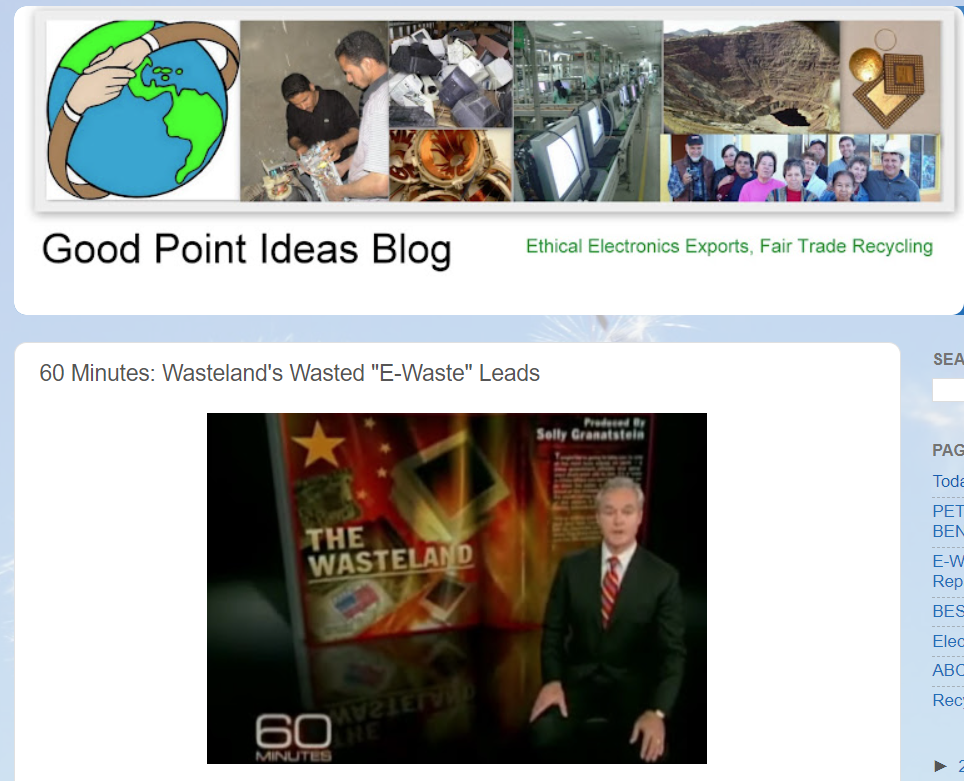
    It was from autumn 2009, when I had been a background check source for CBS Sixty Minutes producer Solly Granatstein, about Scott Pelley's notorious "wasted" minutes flying around with BAN.org's Jim Puckett, who was describing huge imports of CRT desktop monitors (purchased for $10 apiece, bearing only $2 of scrap copper) as being "primitively" mismanaged in Guiyu.

    http://retroworks.blogspot.com/2009/08/cbs-60-minutes-wasteland-unseen-footage.html

    Solly and Michelle Rey had stopped responding to my emails asking them to run a follow up or correction to the story, which had shown no evidence of CRTs processed in Guiyu, despite the claim "we followed the trail".


    So I checked that one, and because the film evidence of the factories that had actually purchased the monitors circled by helicopter were posted in picasaweb, a google product offered to bloggers like myself for photo uploads, and Google has since stopped supporting picasaweb, that the blog will no longer show up in searches.  So if you are a journalism student looking for CBS Wasteland's Polk Award on CRT disposal allegedly occuring in China in 2008, you won't find me.

    A lot of people I met - "Swordfish" - in my career met me through the circulation of that specific blog. Author Adam Minter for example asked what to look for when he visited Guiyu (the three-story integrated IC chip market - Guiyu was a reuse-of-CPU and chips market, not a CRT monitor refurbisher. And what is upstream of the river where BAN's "samples" showed poisons more associated with textile manufacturing than e-waste). Adam later visited CRT remanufacturing factories. He's a journalist with actual knowledge of recycling. But the blog that connected us is now gone unless Google accepts my correction (now linked to photos.google not picasaweb).

    But am I going to take the time to re-edit 520+ blogs? I had to find the one on CBS Wasted Leads via the Wayback Machine site to locate it and find the dated address to correct it on blogspot.

    Wikipedia Talk: Solly Granatstein CBS 60 Minutes Meta Response


    Thirteen years ago, this blog reported on CBS 60 Minutes sourcing of Jim Puckett for its George Polk awarded episode "The Wasteland".  

    I traded emails with producer Solly Granatstein during the original November 2008 broadcast.  I had been background sourced prior to the episode and did not know what CBS was going to say or claim. For that reason, the year before after the original broadcast, I only blogged about the actual buyers of the CRT monitors CBS aired claims were dumped for primitive recycling.  But after being ghosted by Granstein for months, I published the blog above directly taking them on.

    It is not too late to learn about the Charitable-Industrial Complex and Collateral Damage. 

    Now the CRT reuse business is long expired.  CRT glass is found in pending superfund sites in Phoenix AZ and Columbus OH, not in Guiyu China.  And it has been a decade since BAN's Jim Puckett tried to deny his role in the E-Waste Hoax - evidence enough that Granastein's source needed to be cross-interviewed.

    So I found a Wikipedia Bio on Solly Granatstein, and did not publicly alter it in any way, but left the comments below in the Editor Talk section.  It's a hail Mary pass.  Could Mr. Granatstein consider an Ira Glass turnaround (Mike Daisy episode) now that Spain has arrested 40+ African dyaspora workers in the Canary Islands, citing the false claims CBS first gave credence?

    Here's my Wikipedia Editor Talk post below.  I will post now but update links later

    Basel Action Network's Relentless Racism Against Africa's Tech Sector May Succeed

    For years, Basel Action Network has insisted on fake statistics about e-waste "loopholes" in the Basel Convention.  The original Basel Convention, in Annex IX, explicitly exempts reuse and repair of electronics from "waste" definitions (list B1110).

    BAN's Jim Puckett was a film major, and when he advised someone I was taking with me to see reuse factories in China, Jim told him to "take pictures of children on the scrap".  His other tactic was to make up statistics that were so alarming that they made people accept that it must be terrible. If 80% of X results in something bad, there must be something wrong with X.

    - homosexuality, atheism, swimming.... if 80% of it is bad, make it illegal?

    https://resource.co/article/basel-convention-require-informed-consent-e-waste-exports

    Depressingly, Ghana (which never signed or ratified the Bamako Convention, and consequently benefited by massive mass communications investments, leapfrogging Mali) has its name on a Ghana-Swiss proposal to finally change the Basel Convention to make import of used electronics de facto defined as "waste".  See my comments to Resource Magazine, (Amelia Kelly) which made the mistake of interviewing Basel Action Netwwork but not the Tech Sector importers who are capable of speaking on their own behalf.

    "There are 170,000+ mobile phone towers on the African continent today, thanks to the "critical mass of users" of flip phones which BAN tried to stop the export of a decade ago. The privileged wealthy white guy gets to define what is "waste", and the African tech sector experts who made the mobile phone tower investments possible are profiled as "Primitives" or at best "Informal Sector" (as if not knowing how smart they are is a reason to prosecute them). Free Hurricane Joe Benson." - Robin Ingenthron


     This guy loses his job, and the displays get ground up for raw materials... and doesn't get to reply to Jim Puckett's quote (below the fold)

    The Circular Economy of "e-waste" Parts: Opening Our Eyes to Value Added

    The European theory of the "circular economy" focuses on the final value of metals, minerals, and petrochemicals. Today I'll try to explain, as succinctly as possible, why this "Ptolemy" circle (stuff revolves around us) wasn't recognized in Emerging Markets.

    While researching the CRT Recycling Infrastructure for the Massachusetts DEP's first-in-the-nation statewide e-waste disposal program in 1999, I was told about Dr. Yuzo Takahashi (by Panasonic rep and Japan history buff David Thompson). Dr. Takahashi had published a brief book titled "A Network of Tinkerers: The Advent of the Radio and Television Receiver Industry in Japan."


    As a "cross culture" professional (hired by Peace Corps to train incoming Americans in 1986), I found Dr. Takahashi's brief history lesson to make complete sense. Japan's electronics economy - and its imitators to be in Taiwan, South Korea, Singapore, Malaysia, and eventually mainland China - was in one special way COMPLETELY different from USA and Europe. It was a cultural difference.

    ... and reading about how Asians traded parts and components (readily visible on Alibaba, Exporters.com, RecycleINME, and Recycle.net back in those days) are seen by Asians starts in the Japanese living room.

    When a society is building it's devices from components, the value added of the parts is far more important than the scrap value. Most USA and Europeans buy a pre-assembled electronic device sealed in a box and sold under warrantee. That blinded us to the parts and components trade, which is FAR more valuable than raw materials. Like aftermarket car parts, 20% of a scrap device is worth 80% of the money.

    Help Us Update Life Cycle Analysis (LCA) of Retroworks Mining Factsheet

    I could use some help updating this 2003 Retroworks Mining Factsheet.

    Circular Economy of Digital Reference Cycles
    While the fundamentals of the Retroworks Mining Factsheet remain in place, it has not been updated since 2003. For example, it needs carbon emission reference points (a great grad school paper next semester? I promise to review it).

    Here is a link to the "American Retroworks Mining Factsheet", first published 1995, and last updated 2003. Needs help.

    Certification and Racketeering 5: Analysis of Seven GPS Tracking Studies

    2018 GreenTrack Report found only 5% export, including export to OECD countries grntrac.com DWE
    In the next blogs of this series "Certification and Racketeering", we look at a chart comparing 6 actual and 1 hypothetical use of GPS Tracking Devices to follow largely unwitting and unwilling subjects.  We compare methods of placement, tracking, and financial involvement of lead investigators. From there, we will delve into whether the study acts as "Environmental Watchdog" or merely protects the claims of being an authority when those claims are threatened. If, for example, a GPS tracking study specifically seeks to discredit or scandalize someone who has a beef with the Investigator, does that influence the mechanics of the study?

    In the 7th hypothetical GPS Tracking study, I've deliberately created a clearcut "Racketeering" use (using the tracking study to offer a solution to a problem that would not otherwise exist without the financial interest of the investigator). The hypothetical would clearly be a matter for the American Civil Liberties Union, or EFF, or Interpol or Bob Mueller to decide. We then correlate the studies to see which ones have more in common with the Racketeering Hypothesis.  Then we look at quotes and behavior of the lead investigator.

    Certain MIT students, when they get older, may want to come forward and disclose specific methods used to drop specific devices at specific places. I can promise anonymity and cover your costs. I can also put you in touch with MIT's own attorney, who took over correspondence after MIT Senseable City Lab excused themselves from further collaboration with BAN.org

    Fair Trade Recycling Geek in Tamale, Ghana
    Later, we will visit ("Take Your Pic") the use of cringy photos to jolt emotions when the actual statistical findings are not doing the trick. The art of a deal "selling" an unnecessary service, deceitful or otherwise, involves provocative / race-baiting imagery.

    In the DWE tracking study, Dennis Ward    @dward_dennis gives us charts. In report by BAN, we have constant tear-jerking imagery evocative of our worst fears and perceptions of their so-called "Third World". But let's first focus on the methodology in 7 separate GPS Tracking Reports.

    GPS trackers show exchange of products between two consenting parties.  There is not a single case of direct dumping of used electronics at foreign landfills. Who are we guilty of doing business with? And what makes our partnership suspicious?


    Apology From Craig Lorch and Jeff Zirkle - Entrapped By BAN

    Last week, E-Scrap News and Recycling Today ran an Op-Ed Letter and story about the upcoming sentencing of two electronics recycling company owners from Seattle, Washington.

    Craig Lorch and Jeff Zirkle's letter starts with their background as young freon recovery do-gooders, who got into fluorescent lamp recycling, and then into "E-Waste", becoming the largest TV, computer, and electronics scrap recycling company in the NW USA.

    Open Letter: Learn from Total Reclaim’s mistakes


    Got a call from Craig a few days before the letter, and we had a pretty long talk about the situation. Had a shorter exchange with Jeff just afterwards. Around New Years, I had talked to Charles Brennick, another Seattle area electronics guy spiked by the GPS tracking scandal in Washington. And I've been in regular contact with Bojan Paduh, founder of Canada's ERA, who is in a defamation lawsuit against Basel Action Network for their report describing GPS device trackers they put into electronics dropped off at his site in Canada.  I was a paid expert witness for a fraud case on e-waste recycling in Chicago last summer.  So I have a lot of perspective to share.

    It is an ugly business to grandstand, or use a friend's painful prison sentence news story as a soapbox to pontificate on environmental policy.  But in some of these cases, I've been given a green light.

    Let's start by acknowledging that fraud is bad.

    Let's finish by talking about Total Reclaim's biggest mistake.


    Bombshell Interview with Jim Puckett of Basel Action Network - leaked!

    Let's start the 2019 Blog off with a BANG.

    I have gotten a copy of the ~10 minute interview Jim Puckett did with a documentary filmmaker from Spain, on the subject of Agbogbloshie, Ghana. At the end of the video, Jim evidently didn't like his answers, whips off the mic, and leaves, saying he refused to authorize the use of his video.

    He repeatedly used the term "biased questions". As is, is the percentage of bad material imported to Africa 15% or 80%? But my favorite "biased question" is...

    "Do you know the name Joe Benson?"

    No. That is a biased question....?

    ????

    Someone asks you the name (John Smith, Mary Johnson?) and if you don't know them, is it a "biased question"?

    Jim got his wish, and none of his interview made it to the documentary. But I have managed to get a very bad raw copy of it from an online upload site. The clips were uploaded in the USA (en route to Europe), and I have a copy of what the European documentary maker received (but did not use). If anyone is sued, I can testify that I obtained this directly from a third party cameraman hired from Florida, and not from the Europeans.

    I will try to get some of this video out this weekend.


    Rumors Update 3: Deauville, Normandy, Film Festival

    This is just a sneak peak. Leapfrogs #2 because it's so hot off the press...


    The collateral damage to geeks of color over the past 2 decades has left scores of witnesses.


    Rumors Updated Part 1: Status of the Joe "Hurricane" Benson E-Waste Witchhunt

    Finally getting ready to release some major developments in the case of Joseph "Hurricane" Benson, who was first interviewed for THIS BLOG back in 2013.  Unconfirmed rumors are that Benson was released some time ago, on a condition that he not speak to the press.

    Benson's Ewaste Export case was profiled a series of blogs, Titled BULLYBOYS.


    The term "BULLYBOYS" was Joe Benson's.  His friends, Jacques and Amadou, had contacted me through the blog. They arranged a meetings - before he was sentenced to 5 years in prison by the United Kingdom.

    Reversing Environmental Racism: Owning Your Stereotypes and Profiles

    We are on the verge of turning the page on EuroCentric #CircularEconomy.  Several professionals in the European Union (and UK) have understood that Copernicus and Galileo were right, and the sustainable economy does not "revolve around" the OECD.

    Five years after the IERC conference gave an Award to Jim Puckett of BAN for his "pioneering and breathless work to prevent the globalization" of used electronics management, the conference has invited Emmanuel Eric Nyalete - a native Ghanaian, Georgia Tech Coder, and former reuse department head at Good Point Recycling - to address the conference and tell them about Ghana's imports from the Tech Sector's point of view.


    How did we get here?  And why did it take ten years (since publication of Greenpeace's report on Agbogbloshie) to get experts like Emmanuel, Grace Akese (of MUN), Jenna Burrell, Josh Lepawsky, and others to the podium?  And is it possible that Europe will actually contribute financially to welcome Africa's Tech Sector back to the table, and partner with them to make the world better for future generations of all races, languages, and creeds?

    GPS LIE DETECTOR? Flagrant False Claim #Ewaste Watchdog (GPS Tracking Monitour interview)

    Wow, haven't followed up that much since the MIT SenseAble City Lab and BAN GPS tracking project was pulled to MIT legal office about a year ago.  Readers are aware that this blog tracked many of the devices into places that BAN didn't want to talk about - like a University reuse operation in Faisalabad, or modern 21st century EcoPark in Hong Kong (no longer obscured in Monitour).

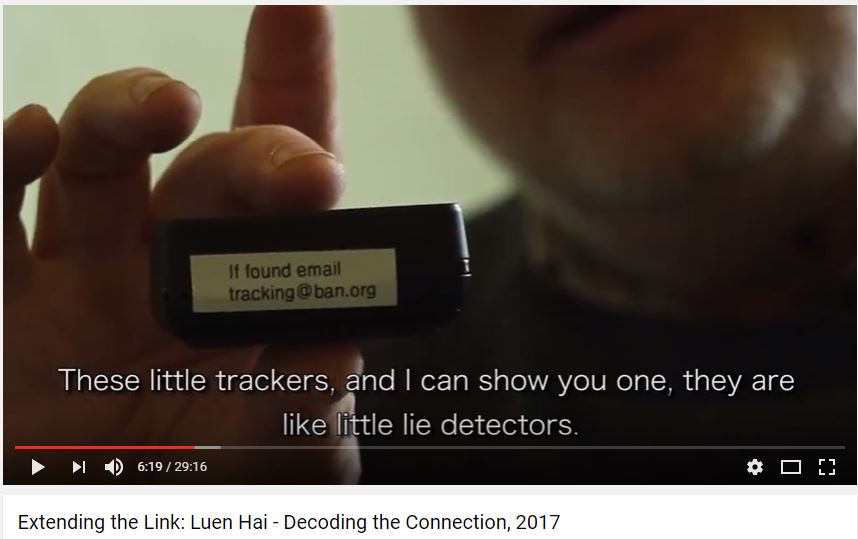
    Well I just ran across a little video produced in 2017 by Luen Hai - Decoding the Connection.  In it, at about minute 6, a Hong Kong reporter identifies Jim Puckett of Basel Action Network as an important expert in e-waste imports to Hong Kong.  Then Jim says on screen that 54% of the GPS trackers the organization placed in e-waste was shipped to Hong Kong.

    If you know about this study, you may think I made a typo. The numbers are so specifically wrong. But this is Jim's recorded voice, in his own words... screenshots with subtitles below.

    1. "These little trackers, and I can show you one, they are like little lie detectors"


    IRONY of IRONIES...  Listen to what Jim tells the filmmaker about the GPS "lie detector"...  Full video at bottom below.


    "Exaggerations Have Been Made" - NGO Exec Director

    He huffed and he puffed and he blew the Hoax down

    I'm really busy this month, in part due to the month away (Austria IERC conference, then 3 weeks in Ghana).  And I was in the Ozarks all last week for my father's DNR and funeral, simultaneously dealing with a tornado that wiped out water, electricity, internet, and my mom and dad's barn in Arkansas.  So... the blog's always poorly edited, but this month I've got really good excuses for it.

    Here's what sticks with me from the January IERC Austria conference.  I sat on a panel with Jim Puckett, the Executive Director of the E-Waste NGO Basel Action Network.  We were speaking to a crowd of about 100 European WEEE delegates.

    I opened by saying I used to be a teacher in Cameroon, Africa, from 1984-86.  I'd recently been to Agbogbloshie, and was going back again immediately after the conference.  I told the European audience that the junk they had seen photographed there was generated by African households and businesses, after decades of reuse.  Yes, it was originally imported used, but almost always repaired and used for 10-20 years before Africans discarded it.  I told them that 30 years ago my landlord had no running water but owned a (used) TV.  I told them that there wasn't any mystery around the baseline data - the World Bank clearly says that MOST households in cities like Accra had TV or computer 20 years ago, and the assumption that junk captured by photo-journalists was "dumped" in hundreds of sea containers by unscrupulous recyclers was categorically false;  I told them I had met Michael Anane, that he was not telling the truth about Agbogbloshie being a remote fishing village and he had certainly not been fishing and swimming there 20 years ago, that I was unable to find any newspaper that employed him, and that the people I asked in Agbogloshie said he worked for the AMA, the municipal land development group that forcibly evicted thousands of Old Fadama slum dwellers near the site, which they have a published plan to develop into shopping malls etc. The junk is collected in pushcarts from Accra city streets. I told them that the World Bank and IMF determined 15 years ago that used electronics in Africa were essential to creating the "critical mass of users" to fund TV stations and programming, cell phone towers, and internet cable.  I told them that Africa's Tech Sector found "Project Eden" to be scary, a threat to their livelihood, and cringe-worthy as a moniker.

    E-waste Ebola Connection?
    In conclusion, I counted backwards from 3, snapped my fingers, and  told them to forget all of the things Jim Puckett had told them for the past 15 years.

    Jim's response?

    "I will admit, exaggerations have been made."

    It strikes me, 6 weeks later, as an incredible use of passive voice.  Exaggerations "have been made" by someone.

    Exaggerations have been made, indeed.  Agbogbloshie photos have now disappeared from the CAER website, the conference speakers were now talking about keeping copper inside Europe's "circular economy", and Blacksmith Institute had changed its name.  That NGO allegedly told journalists 2 years ago that Agbogbloshie was the "most polluted place in the world" - something Blacksmith then denied but wouldn't issue any clarifying statement, despite our sending evidence they were cited by the journalists as the source of the claims about Agbo.  They did not tell me how much money they received to "transform" and "save" Agbogbloshie...

    How to Categorize Part 2: Derivatives of Martin Luther King Jr

    Yesteday's post wasn't well edited (I added some clarifiers this morning from my room in Salzburg, Austria).  But I was happy writing it, because I felt something was coming together somehow, it felt like something crystallized.  Sometimes those are the worst submissions, sometimes the best.  But in the spirit of Martin Luther King Jr.'s holiday in the USA, I hope that it channels Reverend King's letter written from Birgmingham prison, with pen and paper.  No backspaces, no click and delete.

    Someone I met and admire here in Europe stayed up with me last night (we arrived on the same flight), arguing and pontificating about Trump's election, e-Waste policy, economics, and family.  It was a broad enough discussion, lasted well past midnight.  He and I don't always agree, though he's reasonable enough that I hope he'll be able to look back and see the fallacies in the EU position in hindsight (or I will - I had to come back to my room and research some stuff when we left).

    The next day, it all seemed to fit in 140 characters.  Second, below the first 'pinned' tweet below.

    Criticism of method or regulation isn't "attacking" the regulator.  It is defending the innocent from unjust prosecution.  And a regulator or prosecutor who persists in using methods or enforcement proven to be constructed on false premises is liable for environmental malpractice.

    < That's boiled down to 140 characters at left.

    Shouldn't we try to get along?  Or is the false consensus built upon white privilege, and we need to represent the Geeks of Color, whose comments were ignored in PACE Initiative?

    The discussion came in response to Jim Puckett's constant claim that this is an "attack blog" and that I am "insulting" or "attacking" his poor non-profit organization.  This has been Jim's go-to response for several years now, since I wrote a guest editorial "We Shouldn't Have to Make That Choice" in Resource Recycling in 2009.  It was one of the first blogs turned editorial, and it was cited by Grahm Pickren in his 2014 thesis, Political Ecologies of Electronic Waste: Uncertainty and Legitimacy in the Governance of E-Waste Geographies.

    The editors of Resource Recycling liked it, thought it was nuanced.  But Jim Puckett, in emails to me personally and to the editors (demanding a right to response, which they gave him) called it an "attack" which he could not let stand.  In that email, he threatened to go after me personally, and my business and employees, if I did not refrain from criticizing his policy.

    Value Added By Reuse, Repair, Recycling and Mining

    Not much value added (wikipedia anti-art)
    My epiphany came sometime between my experience in Cameroon Peace Corps, my ~5 year term as a truck driver / consultant at Earthworm Recycling, and my MBA at Boston University.

    VALUE ADDED

    I realized that the recycling I was dedicated to was preserving value once added to rocks by mining and smelting them, value added to trees by cutting and cutting the bark off and bleaching them to fiber.  I realized that the Africans I met who were fixing stuff discarded by others were, with their intellects, capturing added value.  I realized my grandfather in the Ozarks was preserving otherwise depreciating added value by fixing expensive stuff like car engines rather than discarding them.   I realized the "Hillbilly Highway" between poor places and rich cities was a two-way street, with value of labor flowing out and value of devices flowing in.

    The dirtiest recycling is cleaner than the cleanest forestry/mining/extraction.
    The dirtiest repair is cleaner than the cleanest recycling.

    Geographical relocation of devices has to do with the value of the "value added".  In America, I could save $100 by keeping my smart phone or my CRT display just a year longer.  But at a certain point, $100 isn't worth the deferred satisfaction.  That economy is a privilege, which may be earned or may be inherited.

    Someone in a poor country may not have that privilege.

    The $100 I forgo is 5% of total annual household income for 3 billion people.

    Here is what a printer looks like going through a shredder.


    Now, the shredding pretty much ruins the plastic.  When the prices of metal is high, that's more than worth the cost of manual disassembly.  When the price of metals falls (as is the case the past 18 months), the value of the plastics becomes relatively important, and the price of labor to hand dismantle the devices becomes more salient.

    Liability takes away from added value.  So NGOs are funded by industries that provide less Value Added in order to impugn reuse or recycling industries which have an advantage in adding value.  Effectively, the value of your "stuff" depreciates faster when it crosses a national border.


    Intercon Solutions vs. Charity Conjecture Complex NGO

    Last week I had a brief telephone interview with Brian Brundage, CEO of Intercon Solutions.  Brian had texted me about his lawsuit vs. Basel Action Network, the NGO in Seattle which accused Intercon Solutions of illegally exporting toxic computer scrap to China.

    I've written about Intercon before.  I don't really claim to know the facts of the case.  But I do know very well the modus operendi of the NGO in Seattle.  From Oxford dictionary...

    con·jec·ture  ( kənˈjekCHər/) noun
    1. an opinion or conclusion formed on the basis of incomplete information. "conjectures about the newcomer were many and varied"
    synonyms:
    speculation, guesswork, surmise, fancy, presumption, assumption,theory, postulation, supposition;

    verb
    1. form an opinion or supposition about (something) on the basis of incomplete information. "he conjectured the existence of an otherwise unknown feature"
    synonyms:

    guess, speculate, surmise, infer, fancy, imagine, believe, think,suspect, presume, assume, hypothesize, suppose

    "I conjectured that the game was over"

    In several direct cases I am personally aware of, Jim Puckett of Basel Action Network defamed businesspeople on little evidence and lots of assumptions and a dollop of chutzpa.  PT Imtech in Semarang, Indonesia was one.  He was the primary source of the "80% of used electronics are junk" faux statistic, according to everyone from Terry Gross (Fresh Air) to Peter Essick (National Geographic) to the new generation of photojournalists (Benito, McElvaney, Hugo, etc.)

    The photos of Agbo don't generate money for orphans or recyclers.  They generate money for journos, NGOs, lawyers and defamation cases.


    At the EScrap Conference, held by Resource Recycling in Orlando for the last couple of years, Jim spoke to an audience that was shown direct evidence that Agbogbloshie never received a sea container of junk electronics.  Ever.  Not even accessible.  Two professional experts born and raised in Ghana (Grace Akese and Emmanuel Nyalete) were there with him in the audience, telling him that Agbogbloshie was a scrap automobile yard, and that the VCRs and computers delivered there are collected house to house in a metropolis of 4 million people who have had electricity for decades (Accra proper is about 2.5M, but the city has expanded. Agbogbloshie is a slum and market near the city center).

    Jim went on to speculate that while the sea containers arrive hours away, that the junk electronics were distributed to shops throughout the city, and then collected by pushcart.  Effectively, Jim was accusing people like Joe Benson, Africa's Tech Sector, of being incapable of sourcing 95% good computers, unable to repair them, but somehow stupidly were laundering "millions of tons" of junk electronics... for free.  No, not for free.  That they pay for these junk pieces, paying typically ten times more than the copper is worth when it reaches Agbogbloshie.

    Kevin McElvaney, the German photojournalist, was at the conference as a speaker and also in the audience.  The following day, McElvaney inserted himself to answer a question directed initially to Grace Akese, the Memorial University Ph.D. researcher from Ghana.  McElvaney basically gave Jim's version, that the junk is distributed through repair shops and secondary markets.  His evidence was not in any of the Secretariat of Basel Convention funded studies... it was based on what he knows... photography.