Showing posts with label copernicus. Show all posts

Do Packaging Bans Make Sense on an Island? It's the Metal Stupid

The past few years, the Recycling Community made a lot of progress on a couple of fronts. Mainly, the decade-long furvent conviction that "environmental justice" meant boycotts - and arrests - of geeks of color in Emerging Market Tech Sectors has been recognized as an #OwnGoal.  Last month's post of the Recycling Today podcast, and this month's recognition in Recycling International's Top 100, mostly paid tribute to a cold revenge against the 80% Waste Hoax.  He who shall not be named has disappeared from the Top 100 list.

This weekend I'll try to use a common challenge - recycling on an island - to explore how my recycling philosophy can bubble-sort ethical dilemmas using logic and statistical likely outcomes. I can already see some prospect for "long-form blogging". But it's the only December blog, and there are still people discovering the evolution of recycling ethics.

My takeaway: Ptolemy is the perspective of gravity around one's own ego.  Like "Spiritual Materialism", wanting to do the right thing is necessary - but by no means sufficient - to having the most sustainable impact. Too often we view our environmental efforts from within our own silo - or on our own island - relative to other humans acting for other various reasons.  In a karma-Judeo-Islam-Christian morality, God is going to grade on the curve. My moral licensing is measured by my effort to excercise on my care for the planet, etc. Better than nothing. A Ptolemy map of the cosmos is better than no record at all.  We'll test that out today.

Ethical Gravity 2: Producer Responsibility Demandside

In the 1970s Environmentalists all knew that the least sustainable human activity was mining and refining, extracting petroleum and mineral ores and trees from the forests, coral reefs, and mountains. Conservationist knew that to conserve endangered species, we had to conserve habitat. The human activity that digs deepest into the remotest habitats is raw material extraction.

Why are the natural resources in such remote places? Well... they aren't.

No matter how rich in copper ore Mount St. Elizabeth of Vermont might be, the pollution that would occur from the hard rock mining would be unacceptable to neighbors.  The population density in New England had led to more environmental regulation.

Property value is at risk when ore is blasted from veins of ore, smashed with 100 ton tractors, and leached with cyanide in the open air. You cannot obstruct the view of a Martha's vineyard cottage with an oil deck. However rich the vein of gold, you cannot open a Carlin Trend, or Witwatersrand Basin dredge in Central Park.  It is easier to make paper by cutting down 100 small pulp trees in northern Canada, to truck them 200 miles to a hydropulper, than to chop a single rich softwood from the Arnold Arboretum in Boston and pulp it at the James River Paper Mill in the same city.
"Recycling one ton of paper saves 17 trees."
Ok, granted, those are not majestic Sequoia trees. These are low income housing for owls. But the fact is that trees appreciate if they are left to grow longer, and the Forest Industry knows that pulp demand needs both recycled and virgin sources.

Indonesia forests being replaced for pulpwood or palm oil


Reversing Environmental Racism: Owning Your Stereotypes and Profiles

We are on the verge of turning the page on EuroCentric #CircularEconomy.  Several professionals in the European Union (and UK) have understood that Copernicus and Galileo were right, and the sustainable economy does not "revolve around" the OECD.

Five years after the IERC conference gave an Award to Jim Puckett of BAN for his "pioneering and breathless work to prevent the globalization" of used electronics management, the conference has invited Emmanuel Eric Nyalete - a native Ghanaian, Georgia Tech Coder, and former reuse department head at Good Point Recycling - to address the conference and tell them about Ghana's imports from the Tech Sector's point of view.


How did we get here?  And why did it take ten years (since publication of Greenpeace's report on Agbogbloshie) to get experts like Emmanuel, Grace Akese (of MUN), Jenna Burrell, Josh Lepawsky, and others to the podium?  And is it possible that Europe will actually contribute financially to welcome Africa's Tech Sector back to the table, and partner with them to make the world better for future generations of all races, languages, and creeds?

Heliocentrism Of E-Waste: The Economics Don't Revolve Around Us

The Sun doesn't revolve around the Earth.

Really.  It doesn't.  And the economics of "e-waste" processing doesn't revolve around you, either.


Catholic Pope Urban VIII showed the "value added" by Authority.  The Church of the Inquisition found Galileo "vehemently suspect of heresy". Galileo spent the rest of his life under house arrest. 

Today, most people know the name of Galileo.  Not many can name Pope Urban 8.  But at the time, I'm sure that was difficult to imagine.

It seemed natural, from a layperson's perspective, to think that the sun did revolve around us, and to take the Church's word for it.  People really didn't have the time or lenses, resources or motivation to test the theory.  If we wanted to know more about the origin of sun and stars, we were sent to an Authority Figure.  The Pope served as Heliocentrism's "Denier in Chief".

The Dominant Organized Religion did a lot of cool things for art and engineering, if not pure science.  Then (as today) people were impressed by the construction of huge cathedrals.  The church charged money to manage your baptism, your marriage, and your parents bodies (or your childrens') at the cemetery or mosuleum... no doubt putting in a good word with the Man Upstairs at the "end of life".

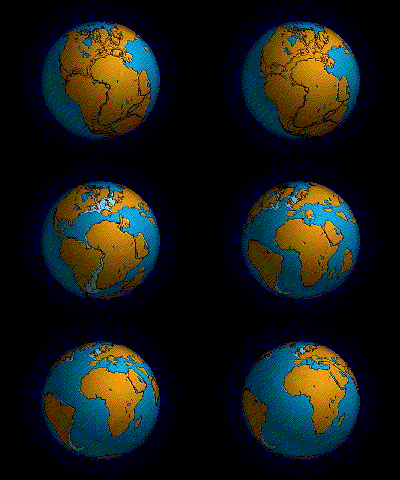
Alfred Lothar Wegener: Copernicus of Drift

Alfred Lothar Wegener

It's interesting that his idea about Continental Drift, proposed in a paper in 1912, was something he felt was not worthy of recognition because it was so patently obvious (and he credited several previous researchers for proposing it). On History Channel this AM, one geologist speculated about how many schoolchildren must have been shushed for proposing that the continents fit together like a puzzle piece. I remember vividly proposing it to my dad in Fresno, where I attended elementary school from 2nd-6th grade, and how he chuckled in an adult way and said it was a coincidence. I think my mother encouraged me more to question it, but the consensus was that it was a childish idea.

It's more interesting (in this blog) that Wegener was distainfully dismissed by geological experts for much of the past century, and he died vainly trying to find evidence to support the theory he labelled "continental drift". That geologists succumbed to "group think" and called him a doofas.


...(wikipedia)

During Wegener's lifetime, his theory of continental drift was severely attacked by leading geologists, who viewed him as an outsider meddling in their field.[12] His hypothesis received support from South African geologist Alexander Du Toit as well as from Arthur Holmes, but was not generally supported due to the lack of a known driving force and the absence of evidence beyond the coastline shapes and fossil records. The possibility of continental drift gradually became accepted by the late 1950s. By the 1960s, geological research conducted by Robert S. Dietz, Bruce Heezen, and Harry Hess, along with a revision of the theory including a mechanism by J. Tuzo Wilson, led to widespread acceptance of the theory among geologists.


It sounds now like Nicolaus Copernicus.

(wikipedia) Although Greek, Indian and Muslim savants had published heliocentric hypotheses centuries before Copernicus, his publication of a scientific theory of heliocentrism, demonstrating that the motions of celestial objects can be explained without putting the Earth at rest in the center of the universe, stimulated further scientific investigations and became a landmark in the history of modern science that is known as the Copernican Revolution.
... (merge with wikipedia on Galileo)
In 1633 Galileo Galilei was convicted of grave suspicion of heresy for "following the position of Copernicus, which is contrary to the true sense and authority of Holy Scripture,"[34] and was placed under house arrest for the rest of his life.

So the comparison here is the power of groupthink, the power of the catholic church, and the power of self interested parties to steer public perceptions of the truth... but also that truth eventually comes out.

I like OEMs and wish only that I owned more stock in them. When I describe their self-interests, I think of them protecting their shareholders. With that said, the combination of group-think, poster child politics by BAN.org, and the threat of wannabe counterfeiting white box generic re-manufacturers is worth trillions, and it is the single best explanation for A) China's import policies (shredded monitors allowed, working P4s not allowed), and B) the best and simplest explanation for consensus between certain OEMs and certain policy jaggers in the US and Europe.

If anyone reads this someday, I'd suggest it would be a great environmental studies thesis topic to see how the gravitational pull of OEM interests affects implementation of versions of environmental laws. For example, there is was a soda pop company in California when I was a kid which used deposit bottles. But CA became the one state which doesn't institute its bottle bill via units, but by pounds of broken glass. There must be some folks who were in the smoke filled rooms in the 70s who could explain to an interested student how the "breaking for reimbursement" became the norm. Maybe it's a good thing, maybe they were trying not to suck the reuse deposit bottles into the recycling system (which led to the exemption of deposit refill bottles from MA bottle redemption laws).

Maybe it was concern about bottles being refilled with someone elses product. Sound crazy? Consider:

Coca Cola spent a lot of money developing the hobbleskirt bottle, patented by Alexander Samuelson of the Ruth bottling company, when "white box" copycat cola companies began competing in generic bottles. That, and a lot of advertising and marketing, helped Coke survive to be the giant it is today. A true "bottleneck" to entry in the field, it allowed a trademark and a stewardship to be recognized which the marketplace accepted (along with Pepsi and RC Cola).

Coca Cola has a museum in Atlanta around the hobbleskirt bottle and considers it their most valuable innovation next to their "secret recipe".

Is treating CRTs - which have much greater added value as working units - like bottles to be broken merely a hiccup, an example of bad concensus, or something else?

My point as always is that we have a limited amount of environmental dollars in the total M1 which will be spent from our economy, and we have to spend them wisely to achieve the most environmental benefit. Billions are spent now collecting mercury lamps, and the mercury from those lamps is exported to alleuvial mining operations as bad as the worst Guiyu riverside. We need to spend every billion as if it really means something.

I question the millions being spent every month to break working monitors and TVs. I've done it for 10 years. And I'm beginning to spend my spare time reading about Wegener, Copernicus, and Galileo. Surely the majority of people who rejected their new theories were not their intellectual equals. But surely they had intellectual equals, in the church or the scientific community. What did they know? When did they know it?