Showing posts with label pollution. Show all posts

A Modest Hypothesis: Did Guiyu and Agbogbloshie Make the River Cleaner?


A professor visiting China emailed me this morning and jokingly asked what he should look for in Guiyu or Wuhan in his spare time.

Sometimes a pithy email response makes the best blog fodder. My response:

You don't need to really go to Guiyu or Agbogbloshie if you have Google maps. Just find press coverage of Basel Action Network or Blacksmith Institute's toxic River sample. Then identify the river and find a site a few kilometers upstream and then Google search for contaminated water samples upstream.  

Based on that evidence, Guiyu and Agbogbloshie are making the river cleaner (though of course that is because the samples upstream were taken years earlier when it was even worse).

Science!!!

I'm referring of course to the Guiyu river samples from the largest textile factory hub on earth, upstream from Guiyu, whose water samples are nearly identical to the Bangladesh Lourajong River samples downstream from the Bangladesh second-largest textile manufacturing hub on earth.  Surprise, Guiyu's samples look the same as the river samples of the textile effluent samples upstream from Guiyu.  

Fair Trade Recycling "EWaste Offset" Program: 8 Steps Forward, 3 Steps Back, 4 Marching in Place

We launched the FTR E-Waste Offset Program from Ghana, Africa, through this blog in 2017.  Time for an update on how the program evolved.


Briefly, here are highlights of our progress.

1) We initially had a firm quote from Camacho in Spain to take back full loads of CRT televisions, ones that had been imported in the 1970s, 1980s, and 1990s, at an extremely competitive cost... under $5k including shipping. This would have been very easy to finance with the discounts on sale of current reuse shipments.

2) Camacho needed a letter from the Ghana EPA allowing the "waste" TVs to be shipped to Spain... a demand from the Spain EPA. Turns out that was foreshadowing friction with Spain EPA that would lead to Camacho closing their purchase orders not only for Africa, but for USA as well.

3) WR3A hired an intern from Antioch University in NH, John Sumani of Wa, north Ghana. Sumani was getting his Ph.D and had previously worked at Ghana EPA. It took him about 3 months to get the requested letter (working with WebElement, a formal sector recycler in Ghana). But by the time they got the letter, Camacho's offer had vanished.

continued...

Ethical Gravity 2: Producer Responsibility Demandside

In the 1970s Environmentalists all knew that the least sustainable human activity was mining and refining, extracting petroleum and mineral ores and trees from the forests, coral reefs, and mountains. Conservationist knew that to conserve endangered species, we had to conserve habitat. The human activity that digs deepest into the remotest habitats is raw material extraction.

Why are the natural resources in such remote places? Well... they aren't.

No matter how rich in copper ore Mount St. Elizabeth of Vermont might be, the pollution that would occur from the hard rock mining would be unacceptable to neighbors.  The population density in New England had led to more environmental regulation.

Property value is at risk when ore is blasted from veins of ore, smashed with 100 ton tractors, and leached with cyanide in the open air. You cannot obstruct the view of a Martha's vineyard cottage with an oil deck. However rich the vein of gold, you cannot open a Carlin Trend, or Witwatersrand Basin dredge in Central Park.  It is easier to make paper by cutting down 100 small pulp trees in northern Canada, to truck them 200 miles to a hydropulper, than to chop a single rich softwood from the Arnold Arboretum in Boston and pulp it at the James River Paper Mill in the same city.
"Recycling one ton of paper saves 17 trees."
Ok, granted, those are not majestic Sequoia trees. These are low income housing for owls. But the fact is that trees appreciate if they are left to grow longer, and the Forest Industry knows that pulp demand needs both recycled and virgin sources.

Indonesia forests being replaced for pulpwood or palm oil


Garrison and Olymbec's CRT Glass Mess #2: Triple Jeopardy

Update on the progress of the CLRR lawsuit, where a 5-year landlord is suing people who shipped CRT tubes to the tenant in 2012 (there is a mess still there in 2019).

- The OEMs who backed CLRR are not named.
- The landlords who expanded CLRR 3-fold (3 warehouses) are suing recyclers who ceased shipments at first warehouse.
- Ohio EPA is pursuing tonnage, which means companies who abandoned CLRR before Ohio EPA greenlighted them are being sought for amends.

Weeks ago, we blogged about the Landlord's case against all recyclers, whom the landlord claims participated and profited from a "sham" recycler.  The landlord expects the judge to accept that anyone who shipped a tube there on Day 1 knew it was a sham, but the landlord did not, as they proceeded to extend leases and offer 2 additional buildings, years after some of us pulled the plug.

As an informal consultant to an OEM representative who vouched for CLRR, I have a treasure trove of information on the project between. 

My associates provided a viable downstream outlet for the CRT glass CLRR was able to process (at least, until the trommel broke in 2015), as an industrial mineral useful to primary and secondary metal smelters. In 2016, E-Scrap News published my article on the useful nature of CRT glass sized and graded with trommels. That was the backup plan for CLRR, not the $15M furnace.  When 2014 ended, CLRR had not shipped enough loads of processed furnace ready cullet, and the speculative accumulation had begun.

What could CLRR do, and when could they no longer do it?

Poison Apples Blog: 18 Questions for Research on GPS Tracking of E-Waste

Poison Apples Blog #1 - Labor Day Weekend 2018

It's September, the beginning of a new Academic Year.  Environmental studies and public policy and geography and business majors are arriving on campus, ready to launch hundreds of term papers, thesis, class essays, etc. on lots of topics.

Usually, there are dozens of students researching the topics of the Basel Convention, EPA policy, exports, and externalization of pollution.  And there are quite a few papers that will be written on racial profiling, and environmental justice.

So far, I haven't seen many papers on the thesis that Geeks of Color, the Tech Sector in emerging markets, is being improperly profiled as "primitive", "informal", and "illegal". But if I were to write such a paper, for an A+, I might begin with another paper that had been published that reached a conclusion in its title...

"How does e-waste travel across the world after disposal?" was a hot publication in 2016, and was covered on PBS national evening news broadcast before many of us had a chance to peer-review it. The title of the report asks a question... and has a cover photo at top which clearly shows the plastic casings of CRT televisions.  This raised a question to me... why was there not even a single CRT television tracked among the sample of 205 devices, which MIT's partner claims are a representative sample of "ewaste".

The 30% or so of "stuff" in e-waste collections that does indeed "travel across the world" is the only stuff they tracked. But the paper claims to answers the question "How" without asking the question, "Why"?  And the answer to why would come from the buyers, the black, brown, Asian, African, Latino and Islanders who are never offered a chance to show what they CAN do with your "elective upgraded" so-called "waste"...

Because the NGO knows this, they had to take an extra step. No one is selling spoiled apples in the marketplace, if they tracked the spoiled ones, it would show little export. But if they tracked the statistically good ones, they'd likely find their GPS in a reuse shop (in fact, they did despite efforts to sabotage).

The method, I call "poisoning the Apples"... And its time some people publish some term papers on the obvious errors in scientific method that should have been vetted before PBS was sent the paper.


E-Missionaries Saving African Recyclers: 9 Stages Of Eyes Adjusting to Dark

Senegal Computer Salesman - 2006
The 2006 picture of white computers shows a Tech Sector importer in his shop in Dakar, Senegal.  The Pentium 3s and 4s were likely 5 years old. They'd be 15 now. The picture itself is 11 years old. Someday, the computers will be Senegal's e-waste, if not already.

Until then, they brought the internet to people who could not afford to buy new.  And Souleymane, the geek in the white shirt, was one of the most interesting people I've met in a decade.  He stayed at my house.  We cooked and broke bread together. I accepted his money, and he accepted those computers from Vermont.

Most of us don't have a personal connection with Africans in photos of exported e-waste.  And most of the photos in the mainstream press do not have any specifics... names, age, date of import, chain of possession, etc.

Contrast the 2006 import shop with the 2016 photo.


Unfortunately, neither photo is typical in news reports on exports of used electronics to Africa.

What do the photos below say to you as an Electronics Recycler?  It depends at what Stage of the Recycling Export Experience you have achieved.  To end racism and environmental injustice, you must first remember a lesson from childhood. Let your eyes adjust to the dark, and it won't frighten you as much as it does at first.

Here are the 9 Stages of Export Denial and Acceptance.

Achtung Germany! Agbogbloshie (Ghana) Pollution is from AUTOMOBILE Waste Not E-Waste / WEEE

MISDIRECTED FOCUS

The 'Burning Environmental Issue' is Automobile Waste, not e-waste.

Clean up Africa's car pollution, worry about electronics later (when you understand it).

Hey, Listen..."Sending European used cell phones" to Africa is not the problem, and arresting African export-import traders won't clean the water or bring back "Eden".


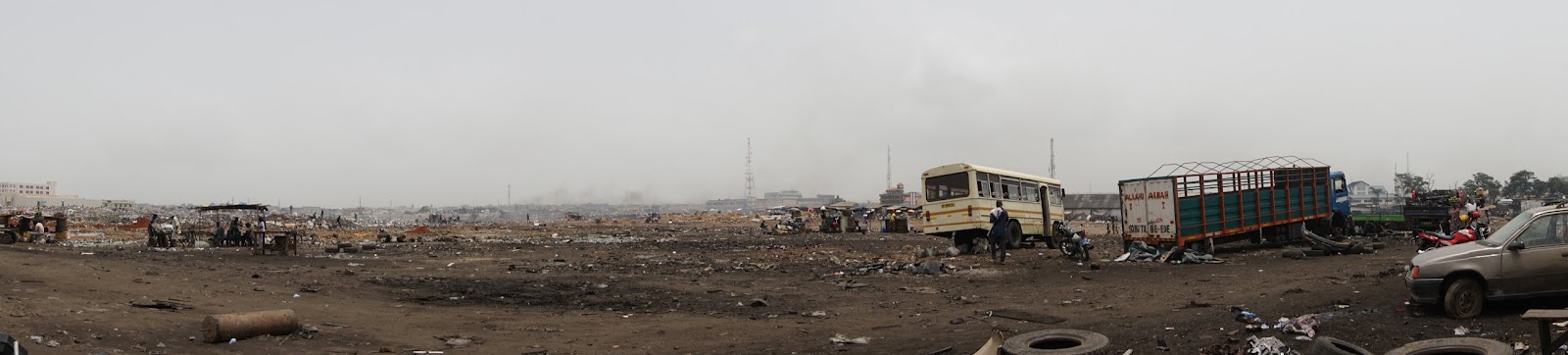
For two years, I've been making the point that Agbogbloshie is not the largest e-waste dump in the world, and that geeks of color are being racially profiled and arrested.  Those things are true.  But Accra is polluted, and the grants to date are misspent and misdirected.

Before Germany spends $15M - 25M on an e-waste recycling solution, they should look at the photos in the link more carefully.

It's a tire, and a ball of automobile wire, not a cell phone.

There is a serious pollution problem in Accra and other African cities. Its cause should be obvious as you wend your way from Accra's Kotoka International Airport to the hotel, the day before you spend another hour wending your way to Agbogbloshie's slum... or stuck bumper-to-bumber in Accra (or Lagos, or Nairobi) traffic.


Cars.
Autos.
Vehicle-Waste.

Follow the trail.

[photos taken at Agbogbloshie Scrap Yard by Robin Ingenthron for WR3A - except for the screenshots from MTV music videos of Placebo and Beyonce, and DW article]


Another Study Reveals Africa's Tech Sector knows its STUFF (#ewastehoax)

The new 2016 Report, published by United Nations University, is 39 pages.  What is remarkable about it is not only that it arrives at almost exactly the same "ewaste" percentages as documented by academics (like Josh Lepawsky of Memorial University, who was savagely mud-slung by a certain NGO director in Seattle last month).  The #ewastehoax around places like Agbogbloshie has been roundly covered by several academics, Basel Secreteriat (the ACTUAL international organization, not the USA charity using its name), and data journalists.

Again, disclaimer - poverty in Africa isn't fake. Toxics in Africa aren't fake.  What was faked was the narrative that EU and USA recycling programs dump waste and are responsible for the poverty or toxics.


What's remarkable about the UNU study is two things.  First, it uses completely different data sets from MIT, Memorial U, US ITC, and data journalism by #ewasterepublic Jacopo Ottaviana, etc... but arrives at the same conclusions.  For example, the chart below shows that less than 1% of Europe's used electronics are exported intact .
Very, very little of Europe's e-waste gets exported intact.  In fact, I interpret the data to say that Europe is being waaay too conservative - the percentages of working and non-obsolete goods is way higher than what is being sent overseas.

And very, very little of the junk in Africa's junkyards (like Agbogbloshie) came directly.  More than 95% of Africa's "ewaste" is its own, devices imported decades ago, used productively for years.
Some individual countries, they say, have higher or lower incidents of transboundary movement which is junk... but that begs the question... if it's an individual country like Burkina Faso, they are getting used electronics from wealthy cities like Accra.  As Lepawsky and Mather already documented, there are used goods traded WITHIN the global "south".

These screenshots shows exactly what I've been telling UNU and StEP since New Orleans in 2006.  The "Stuff" in the "Story of Stuff" gets used for YEARS and is EVENTUALLY discarded and recycled.   What's the first intact piece we photographed in Agbogbloshie?  It was a scrapper's VCR device that Adam Minter and Isaaco Chiaf and Jacopo Ottaviana (#ewasterepublic) stooped to photograph.  Africans imported millions and millions of used VHS players - IN THE 1980s and 1990s!  In Joe Benson's itemized packing lists, there isn't a single VHS player.  BECAUSE AFRICANS NOW WATCH DVD and STREAMING and soon, digital TV broadcasts.  The latter will generate exactly what it did in the USA - waste analog CRTs.  But those aren't being imported anymore to places like TEMA which have already switched to digital.

Golly gee, Colonialists, the evidence is that Africa's Tech Sector knows it's STUFF.

What Joseph Benson said on camera was the truth.  What Mike Anane said on camera was a lie.  Africa's Tech Sector needs reparations.

Accusations of Denial, Hoax, and Racism Haunt Agbogbloshie Ghana

2015-04-15 07.38.35.jpg
 
Yesterday I mentioned Mr. Jim Puckett's Op Editorial in Resource Recycling - Exporting Deception: The Disturbing Trend of Waste Trade Denial. I will have a chance to respond in Resource Recycling next week, in simpler terms than I traditionally write by blog.  The blog is directed at the best and brightest in our field.

The masthead photo of Agbogbloshie, by Amaia Benito, shows three young men, standing near the side of the Odaw River Lagoon, burning auto harness wire.  A 1990s CRT monitor case, used to carry the wire after burning, implies that there is e-waste, too.

No doubt.  When Wahab and Emmanuel and I interviewed the wire burners (27 at the site) last April, they estimated that 20-50 pieces of electronics arrived there each day.

That is in the largest slum of a city of more than 3 million people.
  • The hard working, poor men are not a hoax.
  • The "e-waste" is not a hoax.
  • The toxics are not a hoax.
  • The import of second-hand devices isn't a hoax.
These are specifically what Jim rebuts, and it appears he purposefully misses the point. I have never claimed the Odaw River is clean, or that we should ignore the environment in African cities, nor that Africans import second hand goods.
  • What is a hoax is that 400-600 sea containers full of western waste is dumped at the site each month
  • It is a hoax that the goods that Africans pay to import are quickly dumped 80-90% of the time.
  • It is a hoax that the Basel Convention has been amended and the trade in repair is illegal.  
  • It is a hoax that Agbogbloshie's a very large dump, much less one of the largest in the world for "ewaste".

And it's a hoax that "e-waste" ruined a pristine, lush, Odaw River. The exaggerations of Agbogbloshie trump the reality.  I objected to the exaggeration of African import crime in an interview with Jim Puckett in 2005, but no one had yet studied his claims of "75%-80% dumping" (and he had then as yet to later deny his claim).  Finding something I didn't say and responding to that, instead of what I did say, will fool some of the people, some of the time.

Extensive peer-reviewed studies and World Bank reports on teledensity in Africa can't simply be labelled "denial" and "associated" with tobacco and climate change skepticism.  And citing news sources that cited your own *claims* hardly matches wits with extensive research by Memorial U, ASU, MIT, and the UN.

In his editorial, Jim Puckett has repeatedly accused me of "ad hominem" attacks.  The claims he makes about Josh Lepawsky of Memorial University, Reed Miller of MIT, and researchers from US International Trade Commission aside... Jim would have a legitimate complaint if I have, as he implies in the article, called him a racist.

If Jim has really misunderstood me, my apologies and condolences.  But as likely he hasn't.


SMOKING GUN: Multiple Reports on Agbogbloshie, Ghana, source pollution!!


"Urban waste pollution in the Korle Lagoon, Accra, Ghana" ("Urban Waste") is an article that appeared in The Environmentalist in November, 2002.  It was written by Markku Kuitunen and Kwasi Owusu Boadi at the University of Finland, following announcement of a major grant (mostly OPEC) to dredge the river and abate annual flooding.

BANG BANG.  E-Waste Hoax is Dead.  (note that CAER has removed all the Agbogbloshie Boy photos from the website, and is now a "national security" focus for RERA... E-Wastegate Agenda Shift)


Anyone writing any report on E-Waste Crime in Agbogbloshie is incompetent if they don't do background research.  I don't have time to cite every one of these, but this one has a great bibliography, and is really a "smoking gun" for the Agbogbloshie "E-Waste Hoax", as well as a sobering account of past grants and efforts to "save Accra" from urban pollution.

The pollution and flooding is described as a problem since the early 1970s and 80s, and is attributed to "rapid urbanization" of Accra, Ghana's capital city.
"The Korle Lagoon in Accra, Ghana, has become one of the most polluted water bodies on earth. It is the principal outlet through which all major drainage channels in the city empty their wastes into the sea. Large amounts of untreated industrial waste emptied into surface drains has led to severe pollution in the lagoon and disrupted its natural ecology. The increased levels of industrial activity and consumption by the urban population lead to the generation of copious quantities of waste. Managing the volume of wastes poses a major challenge for the city authorities, particularly, ensuring that all the waste generated is collected for disposal. In Accra, the Waste Management Department is currently capable of collecting only 60 percent of the waste generated daily. The rest is dumped in open spaces, in surface drains, and into water bodies which end up in the Korle Lagoon. High eutrophication levels have developed in the shallow water body. The net effect is that, at the slightest downpour, the lagoon overflows its banks causing regular flooding in parts of the city.
"The Government of Ghana, having realized the adverse impacts of pollution in the lagoon on the physical and economic environment of Accra, with the support of donor agencies, is implementing measures to restore the lagoon to its natural ecology. Attempts are also being made to get the communities in the catchment area to become involved in managing their environment through environmental education and awareness programes."[sic]
The article stresses that problems cited in two previous studies (Biney, 1982 and Mensah, 1976) had continued to increase, and that by the time of the 1976 and 1982 studies, the lagoon was dead.  As Accra (and Lagos, Douala, Nairobi, Kinshasa, etc.) has grown, so has pollution from the waste generated by people who live there.
Before the onset of this severe pollution, and in the early 1950s, the lagoon supported a thriving fishery of both fin and shellfish, which served as a source of employment and income for some people in the nearby shantytown, which incidentally derives its name from the lagoon. However, due to the grossly polluted state of the waters, the lagoon has lost its fishery (Biney and Amuzu, 1995), and it is hard to believe that this black, nauseating muddy water could ever have supported any such life. The Korle Lagoon is the major basin into which the greater proportion of the flood waters of Accra flow before entering the sea (Biney and Amuzu, 1995). The lagoon receives water from a total catchment area of 400 km2.
It receives discharges from three main sources—the Odaw River and two major drains on its eastern and western sections (Fig. 3). These major drains are mostly uncovered and usually collect silt and debris which are transported into the lagoon (Mensah, 1976). Waste discharges, including industrial effluent, are the major sources of pollution. The wastes originate from residential, commercial and recreational areas, offices and institutions, such as hospitals and schools. They include food waste as well as paper, batteries, glass, plastics, textiles, excreta aerosol cans, and much more (Biney, 1982; Mensah, 1976).
So Mike Anane's descriptions of the "E-Waste Tragedy" starting with bad e-waste exports in Europe is late to the game.  Here are descriptions of the dumps upstream of the river, citing reports from Amuzu 1976, Laing 1994, etc.
"The water in the upper part of the lagoon is muddy, and the stench emanating from it is unbearable.  An abundance of saw mill dust from the timber market industrial area is disposed into this part of the lagoon.  Also, the Waste Department's dump which is covered with industrial sawdust, is gradually encroaching into the water body. Sediments in this part of the lagoon trap effluents from upstream.  These include industrial, domestic, and hospital wastes which have further deteriorated the water quality upstream. According to Liang (1994; 141), a survey of manufacturing industries in the Greater Accra Region showed that the metal industry creates 16 percent of the total industrial waste, garment and textiles - 30 percent, chemicals and cosmetics - 20%, electricals and electronics at 1 percent and mineral products at 0.7 percent.  Most of the untreated industrial waste waters are discharged into surface drains which flow into the Odaw River and Korle Lagoon.  Since the upstream part of the lagoon is the usual point of discharge, and the receptor of wastes, it is the most affected." 
So we knew in the 70s, 80s, and 90s that the lagoon was already polluted and dead, and that the source of the pollution was upstream of Agbogbloshie.  And the 2002 study estimates the contribution of electric and electronics as contributing 1%.  I'm not saying that Accra isn't polluted, and I'm not saying that pollution isn't tragic.  But accusing African Techs, Geeks and Nerds, or Dagbani scrappers, of making this mess amounts to not much less than criminal defamation.

Sample clip, 1994 Accra Waste
So certainly ownership of second hand electronics increased in Ghana homes, certainly teledensity increased, as did pollution, sewage, and people throwing batteries and car stuff in the gutters and river.  But arresting internet cafe owners, TV resellers, cell phone repairers, etc. seems like the most hideous, disgusting, moronic solution to the problem that anyone but a planned obsolescence industry could come up with.

And the Urban Waste Pollution articles bibliography, on page 309, involves numerous water studies of the Odaw River and Ghana pollution.  Not a single one of these, however, is cited in Greenpeace (Poisoning the Poor), Basel Action Network (Digital Dump), or Blacksmith Institute (aka Pure Earth) report with CUNY.

E-Waste Tragedy 8: Four Questions on Top 10 Pollution (Blacksmith Institute, Jack Caravanos)

The Tragedy of Agbogbloshie, the scrap neighborhood of Accra, Ghana, has been a "scene of the crime" which Joe Benson is in prison for.  Among the most credible sources for Benson's crime suspicions came a year ago this month, via Scientific American.  Ghana is not more polluted than any other emerging urban city.   So why, in 2014, is Ghana the  butt of the Scientific American headline?

"E-Waste Dump among Top 10 Most Polluted Sites

A list of the 10 most polluted places on Earth ranges from nuclear sites to e-waste dumps  

Dec 17, 2013 |By David Biello


Searching for #PovertyPorn
Is this the truth?  Is this metal scrapyard in Accra, Ghana, among, close to, remotely, being one of the ten most polluted sites on earth?   Scientific American is important and credible, as is the original source - Blacksmith Institute.

No.  Accra's scrapyard doesn't compare to Chernobyl or mining hotspots like Kabwe or OK Tedi.  It's not pretty, but it is pretty similar to dozens of other auto scrapyards in Guangzhou, Mumbai, Detroit, Jakarta, Rio, etc.

How did the headline above place Accra's automobile, white goods, and electronics scrapyard - and only their scrapyard - on a list with Chernobyl, Ukraine, Kabwe, Zambia, and other mining, smelting, nuclear and petroleum disasters?

In this blog, I'll show you where the research by Blacksmith Institute, behind this headline, was accurate and plentiful.   Unfortunately, one tragic citation led to false arrests, collateral damage, and potentially tarnished the brand of a really fine organization.  As Dr. Josh Lepawsky has described in "Mapping E-waste as a Controversy:  From Statements to Debates II", there has been a pollution of non-peer-reviewed "data" in the discussion of export policy.  It will lead to the end of "top ten" lists from Blacksmith Institute.  

Definition of PRIMUM NON NOCERE:  the first thing (is) to do no harm


Time's Up: E-Waste News Develops Faster than Blog


I have about 30 pages of blogs composed this summer, but the challenge is to update them as fast as the news changes.

Sometimes it's easier to point back at past predictions...
In the past year or so (not in order, and some still "breaking" news).


1.  BAN denies "80% waste" statistic (denies ever saying it).
2.  Peer reviewed studies from USITC, MIT, Memorial U, ASU, UNEP, etc. show 85-91% reuse.
3.  Benson is reportedly released early #freehurricanebenson
4.  Lord Chris Smith (UK Environmental Agency director) is replaced.
5.  Vermont ANR terminates contract with CRT-landfill operation early.
6.  Payment refused to local governments may be released.
7.  Interpol may have hit the "pause" button on Project Enigma / Eden (unconfirmed)
8.  A stampede of Europeans emerging from the trenches in Agbogbloshie to testify...

E-WASTE HOAX - NOT AS "BAN" ADVERTISED.

"Do not know what they are talking about.  Making it up as they go along."

The Guardian E-Waste Shoot: 3 Facts Behind "Poverty Porn"

It's the mining stupid.

The Guardian is actually a pretty excellent journal, compared to much of London's Yellow Press.  So when it "recycled" some photos of scrappers in Agbogbloshie this week, actually calling it "the largest e-waste dump in the world", it got a lot of 're-tweets'.

I called them out earlier, and a journalist at Fox News called to quote my reaction.  Read to the bottom of Jeremy Kaplan's piece on the "Ghana's E-waste Nightmare" to see "poverty porn" in a quotation in major news media, a possible first.

It's the mining stupid.


 Six pieces of WEE sited at African city dump!!    OOOGA BOOGA OOOGA BOOGA

Here are the facts:

1) None of the vintage electronics in those photos is typically purchased by African traders today.   Agbogbloshie is the "end of pipe" for Accra's piping hot interenet, which grew ten-fold in the past decade (see 2 blogs back).  (Eric Prempeh, Good Point's head tech, is over there now, measuring demand).

2) The article distracts from actual environmental nightmares, including those the Guardian has covered.
-  Tin mining on coral islands of Indonesia (The Guardian hits the spot)
-  Gold mining in Ghana (The Atlantic)
-  Kabwe, Zambia, lead mine, the MOST TOXIC PLACE ON EARTH...
-  Today on VOA, Gold Mining in Uganda

- We could go on and on here, OK Tedi Mine in Borneo, Zinc smelter spills in Guangdong, smelter spills in the Danube, lead mining in the Andes, 14 of the 15 largest Superfund sites in the USA, conflict metal mining for tantalum in Congo's river basin, zinc mines of Kunming....

It's the mining stupid.

3) Had the devices at Agbogbloshie, imported ten years ago, been shredded, African cities would still have e-waste at dumps.   Had the devices, imported for reuse ten years ago, been shredded, MORE MINING would have taken place, more carbon spilled, unless you want to assume Africans never got electronic media.

"Using a used CRT for 10 years is better than mining for a flat screen" 
- Captain Obvious.

Monkey Zoo Math: Reprint of Basel Action Network Fingerprints

In July of 2010, I wrote the post with the most reads to date.  Some have suggested that it was too long and buried the lead, but the people I met after writing it encouraged me to write more, and not to be afraid to write longer.

Below (more:) is the bottom third of the blog "Monkeys Running the Environmental Zoo".  The math has now been corroborated by USITC, by MIT, by World Bank, by the ASU Williams/Kahhat study, the Nigeria and Ghana E-Waste Assessment (studies of 279 actual containers, seized at ports in Lagos, based on reporter Cahal Milmo's and Greenpeace's "investigation" of naughty, naughty African television repairmen).

I will re-link all of those studies this week.   But as a reminder, Basel Action Network knew this in 2006, when they provided guidance to Kenyan researchers Kiaka and Kamande.
PRELIMINARY STUDY ON THE IMPORTED SECOND HAND COMPUTERS IN KENYA - THE CASE OF NAIROBI by Richard Kiaka and Rachel Kamande (2007) "with guidance from Puckett James, Basel Action Network"
The 2010 math has been completely borne out.  All you had to do was listen to the African, Latin American, and Taiwanese refurbishers, and take a pen and the back of an envelope.  It has always been obvious. Toxics are a problem, pollution is serious business... but Racial profiling doesn't look good dressed in green.   There are real victims of Environmental Malpractice, and the time has come to clean our "stewardship" programs of the vestiges of accidental racism and poverty porn.

Whose fingerprints are on the "e-waste" monitors at Agbogbloshie?   African cities.  The "80% export" figure was not just a mistake... it was mathematically impossible, and disproven by BAN's own 2007 study.  

From 2010 Blog:

Q:  How do bad monitors get overseas?