Showing posts with label toxics. Show all posts

SMOKING GUN: Multiple Reports on Agbogbloshie, Ghana, source pollution!!


"Urban waste pollution in the Korle Lagoon, Accra, Ghana" ("Urban Waste") is an article that appeared in The Environmentalist in November, 2002.  It was written by Markku Kuitunen and Kwasi Owusu Boadi at the University of Finland, following announcement of a major grant (mostly OPEC) to dredge the river and abate annual flooding.

BANG BANG.  E-Waste Hoax is Dead.  (note that CAER has removed all the Agbogbloshie Boy photos from the website, and is now a "national security" focus for RERA... E-Wastegate Agenda Shift)


Anyone writing any report on E-Waste Crime in Agbogbloshie is incompetent if they don't do background research.  I don't have time to cite every one of these, but this one has a great bibliography, and is really a "smoking gun" for the Agbogbloshie "E-Waste Hoax", as well as a sobering account of past grants and efforts to "save Accra" from urban pollution.

The pollution and flooding is described as a problem since the early 1970s and 80s, and is attributed to "rapid urbanization" of Accra, Ghana's capital city.
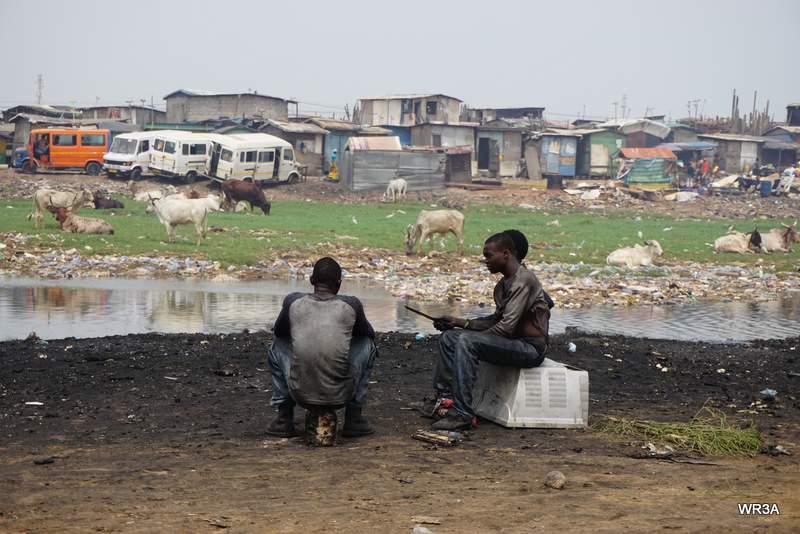
"The Korle Lagoon in Accra, Ghana, has become one of the most polluted water bodies on earth. It is the principal outlet through which all major drainage channels in the city empty their wastes into the sea. Large amounts of untreated industrial waste emptied into surface drains has led to severe pollution in the lagoon and disrupted its natural ecology. The increased levels of industrial activity and consumption by the urban population lead to the generation of copious quantities of waste. Managing the volume of wastes poses a major challenge for the city authorities, particularly, ensuring that all the waste generated is collected for disposal. In Accra, the Waste Management Department is currently capable of collecting only 60 percent of the waste generated daily. The rest is dumped in open spaces, in surface drains, and into water bodies which end up in the Korle Lagoon. High eutrophication levels have developed in the shallow water body. The net effect is that, at the slightest downpour, the lagoon overflows its banks causing regular flooding in parts of the city.
"The Government of Ghana, having realized the adverse impacts of pollution in the lagoon on the physical and economic environment of Accra, with the support of donor agencies, is implementing measures to restore the lagoon to its natural ecology. Attempts are also being made to get the communities in the catchment area to become involved in managing their environment through environmental education and awareness programes."[sic]
The article stresses that problems cited in two previous studies (Biney, 1982 and Mensah, 1976) had continued to increase, and that by the time of the 1976 and 1982 studies, the lagoon was dead.  As Accra (and Lagos, Douala, Nairobi, Kinshasa, etc.) has grown, so has pollution from the waste generated by people who live there.
Before the onset of this severe pollution, and in the early 1950s, the lagoon supported a thriving fishery of both fin and shellfish, which served as a source of employment and income for some people in the nearby shantytown, which incidentally derives its name from the lagoon. However, due to the grossly polluted state of the waters, the lagoon has lost its fishery (Biney and Amuzu, 1995), and it is hard to believe that this black, nauseating muddy water could ever have supported any such life. The Korle Lagoon is the major basin into which the greater proportion of the flood waters of Accra flow before entering the sea (Biney and Amuzu, 1995). The lagoon receives water from a total catchment area of 400 km2.
It receives discharges from three main sources—the Odaw River and two major drains on its eastern and western sections (Fig. 3). These major drains are mostly uncovered and usually collect silt and debris which are transported into the lagoon (Mensah, 1976). Waste discharges, including industrial effluent, are the major sources of pollution. The wastes originate from residential, commercial and recreational areas, offices and institutions, such as hospitals and schools. They include food waste as well as paper, batteries, glass, plastics, textiles, excreta aerosol cans, and much more (Biney, 1982; Mensah, 1976).
So Mike Anane's descriptions of the "E-Waste Tragedy" starting with bad e-waste exports in Europe is late to the game.  Here are descriptions of the dumps upstream of the river, citing reports from Amuzu 1976, Laing 1994, etc.
"The water in the upper part of the lagoon is muddy, and the stench emanating from it is unbearable.  An abundance of saw mill dust from the timber market industrial area is disposed into this part of the lagoon.  Also, the Waste Department's dump which is covered with industrial sawdust, is gradually encroaching into the water body. Sediments in this part of the lagoon trap effluents from upstream.  These include industrial, domestic, and hospital wastes which have further deteriorated the water quality upstream. According to Liang (1994; 141), a survey of manufacturing industries in the Greater Accra Region showed that the metal industry creates 16 percent of the total industrial waste, garment and textiles - 30 percent, chemicals and cosmetics - 20%, electricals and electronics at 1 percent and mineral products at 0.7 percent.  Most of the untreated industrial waste waters are discharged into surface drains which flow into the Odaw River and Korle Lagoon.  Since the upstream part of the lagoon is the usual point of discharge, and the receptor of wastes, it is the most affected." 
So we knew in the 70s, 80s, and 90s that the lagoon was already polluted and dead, and that the source of the pollution was upstream of Agbogbloshie.  And the 2002 study estimates the contribution of electric and electronics as contributing 1%.  I'm not saying that Accra isn't polluted, and I'm not saying that pollution isn't tragic.  But accusing African Techs, Geeks and Nerds, or Dagbani scrappers, of making this mess amounts to not much less than criminal defamation.

Sample clip, 1994 Accra Waste
So certainly ownership of second hand electronics increased in Ghana homes, certainly teledensity increased, as did pollution, sewage, and people throwing batteries and car stuff in the gutters and river.  But arresting internet cafe owners, TV resellers, cell phone repairers, etc. seems like the most hideous, disgusting, moronic solution to the problem that anyone but a planned obsolescence industry could come up with.

And the Urban Waste Pollution articles bibliography, on page 309, involves numerous water studies of the Odaw River and Ghana pollution.  Not a single one of these, however, is cited in Greenpeace (Poisoning the Poor), Basel Action Network (Digital Dump), or Blacksmith Institute (aka Pure Earth) report with CUNY.

#EWASTEGATE #COLLATERALDAMAGE #AGBOGBLOSHIE #WORLDREFUGEEDAY

"He that beats the drum for the mad man to dance is no better than the mad man himself." – African proverb

It began as a simple problem.  Ghana household teledensity (TV, internet, cell phone) is increasing like wildfire, two and three digit growth, year on year.  Ghana residents mostly afford this with used devices cherry picked from Western depots by African expats.  The most recent study (Secretariat Basel Convention) estimated that Ghana imported 215,000 Tons of second hand electronics goods (including refrigerators, microwaves, as well as PCs, TVs).  The study concluded that about 90% of these were reused or repaired.  21,500 tons not reused were added to the estimated 129,000 tons junked by Ghana residents after years of use.  The fallout rate for used electronics is actually less than new electronics, according to Ghana technicians, explaining consumer preferences.

However, well-intentioned NGOs like Blacksmith Institute, Greenpeace and BAN used the statistics above to imply that "western companies" dumping on Africa was the cause of the toxics problem.  Professional photographers (Fedele, Hugo, Bellini, McElvaney, etc.) used close-ups of scrap workers and odd Biblical references like "Hell" and "Sodom and Gomorrah" to scare people into a pledge campaign to boycott Africa technicians.

The "Sodom and Gomorrah" references to Agbogbloshie are a biblical reference, and the "E-Waste Hell" photos of Old Fadama are everywhere on Twitter, Facebook, in newspapers and magazines.  Fellow environmentalists discovered a white-guilt honeypot.   They found easy grant money, and crossover support from environmentalists and social activists on the "common ground" of not "polluting the poor".   But look what transpired...

1.  Create widespread citation of fake dumping statistic.

"Approximately 80% of electronic waste currently delivered to recyclers is actually exported to developing countries." 

"The dirty little secret is that when you take [your electronic waste] to a recycler, instead of throwing it in a trashcan, about 80 percent of that material, very quickly, finds itself on a container ship going to a country like China, Nigeria, India, Vietnam, Pakistan — where very dirty things happen to it," says Jim Puckett, the executive director of the Basel Action Network, which works to keep toxic waste out of the environment.

Makes it easy to imagine 50,000,000 tons going into a scrapyard - by hand pushcart - without a driveway.

2.  Take pics of Tire burning


Homer Simpson Voice:   OOOOOooooo!  Fire!


3.  Tell simple story about nameless faceless White Exporters


4. Ignore actual African Importers, Techs of Color 


5. Ignore true statistics (93% Reuse) when Techs ARE interviewed


5.  Hide when Collateral Damage is documented

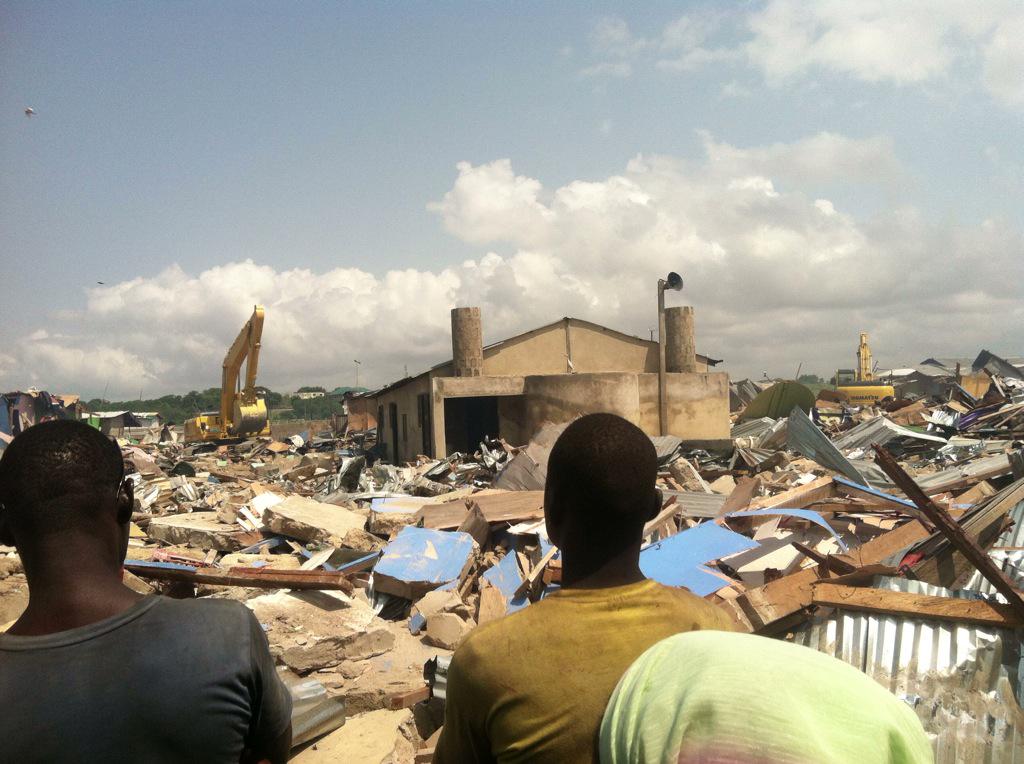
Photos of Agbogbloshie homes being destroyed June 2015


Twitter photo from Ab


the people look on helplessly as their homes are crashed in


Did enviros conspire with land grabbing developers to evict thousands of homes of scrapper families in Old Fadama / Agbogbloshie?  Of course not.

But we played into a propaganda war over the increasingly valuable property.  It would have been expensive for AMA and developers to buy it.   Easier to find a reason / excuse for teargas and military evactuation.

"They are unChristian outsiders, Dagomba tribe are settlers, Sodom and Gomorrah"

"They caused the flooding which killed 150 people in May"

"They import electronic waste from other countries and burn it, poisoning us"

I had no clue about the property issue when I went to Agbogbloshie.  I was surprised how close it was to the most expensive developments in all of Ghana.  When I saw less than 1,000 tons (not 215,000 tons, and certainly not "most" of the world's millions of tons of ewaste), all home scrap, I asked the scrappers why anyone would repeat this?  I thought maybe, for grant money.

The Dagbani speaking scrappers had another theory about the lie.

They said it was about their land.   People wanted it but did not want to pay for it.  And sure enough, soon after they were being blamed for importing waste, for causing floods, and for being un-Christian... the teargas and bulldozers came.   It looked pretty bad, and I had no idea this was going to happen so quickly.

I'm not very popular with some environmental groups right now.

But see, I'm doing us all a favor.

When someone in our "tribe" of do-gooder environmentalists attacks someone innocent, they draw negativity against our tribe that can affect many generations.  Standing up against "friendly fire" is not disloyal, is not profiteering, is not damaging.    I'm taking bullets for this but I really believe this is the right thing to be documenting, and am asking friends to retweet our messages of support for the "geeks of color".

#freejoebenson
#whitesaviorcomplex
#povertyporn
#accidentalracism
#unintendedconsequences
#geeksofcolor
#worldrefugeeday
#Agbogbloshie


wire recycler Awal. "They tell lies about us importing waste. All home scrap from Accra." Why? "Land"


There are truths about Agbogbloshie and there are lies. What's really scary is the number, volume, direction of lies.

For a well written history of the land dispute by Josh Lepawsky and Grace Akese of Memorial University (Geography), read this "Discard Studies" essay, just published.


50 million tons per year to this small scrapyard?  Let's see, that's 50,000 tons per day, at 25kg per TV/PC... Gee, Guardian, short on editors?  But hey, it's Africans, don't sweat the easy calculator stuff.

You reprinted two of three propaganda tropes about the minority Dagbani, a Muslim minority in Accra, saying they go by "Sodomites" and that they handle 5 million scrap televisions per DAY.  You just needed to say they were responsible for the flooding.  

Growth of Internet users in Nigeria (Quartz)

2015 WR3A Report on Agbogbloshie: 13 Recommendations

We are in the important but slow phase of re-editing the 2015 Agbogbloshie Report. It takes time to include citations, make charts, get peer review, and especially to accommodate assertions made in this month's release of the UNEP Report. Suggestions have been made that we better recognize the "accidental nature" of misdiagnoses by well meaning members of the charitable industrial complex. (References to "hoax" and "nutjob" may make future researchers less likely to cite the report).

Statistical meat and photo-potatoes are hot and ready to eat. Presentation of the meal is important, however. We need the plates and garnishes. In the meantime, here are thirteen e-waste recommendations on the menu.


13 Recommendations E-Waste / WEEE Enforcement


Recommendation 1:  UN and Interpol should immediately stop arrests and searches of used electronic product (televisions, computers, cell phones).   Inspectors who were trained with the assumption of 80% waste, using Guidelines developed using the same assumptions, are likely to unfairly harass and harm Africa’s Technical Sector and create unnecessary enforcement and prison expenses in the EU.

Cultural Gulf Travels: History Videos are about People

Saw this in the Atlantic Online, via Quartz (qa.com)


It shows how intelligent rural people are attracted to culture, or simply shows urbanization, depending on your take.  It's a little tough to distinguish the two.   But the printing press, during this time, was a city device, and until the internet, literacy was correlated with printing presses, and printing presses were in cities.

In my experience in "emerging markets", aka the "developing world", electricity and internet remain urban magnets.   As aspiring people move to Accra or Lagos (see "cultural gulfs in developing markets" series), they need "good enough" display devices to do things like access the internet and watch World Cup matches and local news broadcasts.

Yin, Yang, or Omm Part 2: White Man Ju-ju vs. 3-Point Shot

In Part I we took a close up of an actual problem - the past decade of managing Cathode Ray Tube televisions and monitors, after briefly introducing the concept that guilt and liability - positive ethical systems - can be twisted into bad law via fear, greed, and envy.  


What's the "green scare?"  
Same as the red scare.  Export Sympathizer is today's "Commie"

The Responsible Electronics Recycling Act (RERA), HR2791, was the focus.  The bill acknowledges overseas refurbishing and recycling operations if and only if the name-brand company (e.g. Dell of Texas) is shipping there (warranty repair, takeback).  That's "responsible".  The contract factories overseas are NOT owned by the name brand, there are no Dell employees at the computer display factory.  If Hurricane Fung, Hurricane Hamdy, Hurricane Benson, or Hurricane Chiu were OEM employees taking back used goods for repair and refurbishment, they'd be "Stewards".  Instead they are "primitive waste criminals".

The Guardian covered Dell for coming out against a geeks of color boycott, and I vigorously applaud Dell for that.   But RERA language creates a "members only" export system.

As the blog got longer, I've cut it into three or four parts.  Poor editing, or de Tocquevillian insight?  Mostly lack of time to edit, I'm running a business after all.  The digression into psychology and ethics is the readers choice, I figure.   Just don't hit the "print" key.

LIABILITY JUJU

Monkey Zoo Math: Reprint of Basel Action Network Fingerprints

In July of 2010, I wrote the post with the most reads to date.  Some have suggested that it was too long and buried the lead, but the people I met after writing it encouraged me to write more, and not to be afraid to write longer.

Below (more:) is the bottom third of the blog "Monkeys Running the Environmental Zoo".  The math has now been corroborated by USITC, by MIT, by World Bank, by the ASU Williams/Kahhat study, the Nigeria and Ghana E-Waste Assessment (studies of 279 actual containers, seized at ports in Lagos, based on reporter Cahal Milmo's and Greenpeace's "investigation" of naughty, naughty African television repairmen).

I will re-link all of those studies this week.   But as a reminder, Basel Action Network knew this in 2006, when they provided guidance to Kenyan researchers Kiaka and Kamande.
PRELIMINARY STUDY ON THE IMPORTED SECOND HAND COMPUTERS IN KENYA - THE CASE OF NAIROBI by Richard Kiaka and Rachel Kamande (2007) "with guidance from Puckett James, Basel Action Network"
The 2010 math has been completely borne out.  All you had to do was listen to the African, Latin American, and Taiwanese refurbishers, and take a pen and the back of an envelope.  It has always been obvious. Toxics are a problem, pollution is serious business... but Racial profiling doesn't look good dressed in green.   There are real victims of Environmental Malpractice, and the time has come to clean our "stewardship" programs of the vestiges of accidental racism and poverty porn.

Whose fingerprints are on the "e-waste" monitors at Agbogbloshie?   African cities.  The "80% export" figure was not just a mistake... it was mathematically impossible, and disproven by BAN's own 2007 study.  

From 2010 Blog:

Q:  How do bad monitors get overseas?