Showing posts with label toxic. Show all posts

Ethical Automobile Airbags - Sodium Azide. Carcinogen, Mutagen, Toxin saving lives at EOL

 Work up this morning wondering where automobile airbags wind up when used cars are sold for reuse in Africa. 

The automobile airbag, mandated after valiant effort to protect consumers by Ralph Nader's organization in the 1970s, is a wonderful invention.  Here's a video of one deploying.


Cool huh? But after your life is saved in the crash, what happens to the airbag? 

How it works (at least in older models of cars, most often exported to Africa) is that a highly toxic, known mutagen, suspected carcinogen, CDC advisory toxic chemical SODIUM AZIDE is triggered by an electrical charge.

Euro Agbo Porno Photo Journos 2: Dr. Jack Caravanos Back on Duty - Let's Flog The Mining

Since I've been quite the heckler of Blacksmith Institute / PureEarth for allowing themselves to be cited as a source of many, many incorrect and false reports on Agbogbloshie e-waste, it's refreshing to be able to give them a kudos.  I was just going after "data journalists log, photojournalists flog" on Africa in the previous blog.

Now what? I'm back so soon?

Blacksmith's main researcher on toxic sites across the globe is NYU's Dr. Jack Caravanos. Dr. Jack's research on soil and processes at Agbogbloshie was actually very good... too bad no one citing the report as saying things it doesn't say has ever read it.    The Guardian and other press who cited it as evidence that Agbogbloshie was some kind of significant world dumping ground would have done well to interview Jack rather than Mike Anane.  Jack's twitter account should be followed, because he's the first place I saw this story.

But here's where we are in total agreement - it's the mining.

And the Kabwe Lead Ore Mining in Zambia, to be more precise.


Jack Caravanos and Blacksmith Institute first put Kabwe lead ore mines on the map.  The worst recycling on earth is better for the environment than the very best mining.  And Kabwe, in Zambia, is one of the worst mines.

Compare the Guardian photojournalism of Kabwe to the Stephano Stranges photography of Agbogbloshie.  They meet in the middle, with StephanoStranges Coltan mine...  Is this where grisly photojournalism redeems itself?  Or is this where Robin tries to salvage relationships without being hypocritical?

I told the Guardian in 2014, "It's the Mining, Stupid".  Can we finally take on the toxic legacy of the General Mining Act of 1872, and the precedent it set for mining across the earth?

African "E-waste" Witch Hunt #3: BBC Whiffs at House of Commons "smoking gun"


BBC Panorama's episode "Track My Trash" has been given the dubious credit for a role in sentencing  Joe "Hurricane" Benson, Mark Daniels, and Ezenwa Ogbonnaya for alleged "ewaste" dumping in Africa.  Rowe seems pleased enough when we exchanged tweets.

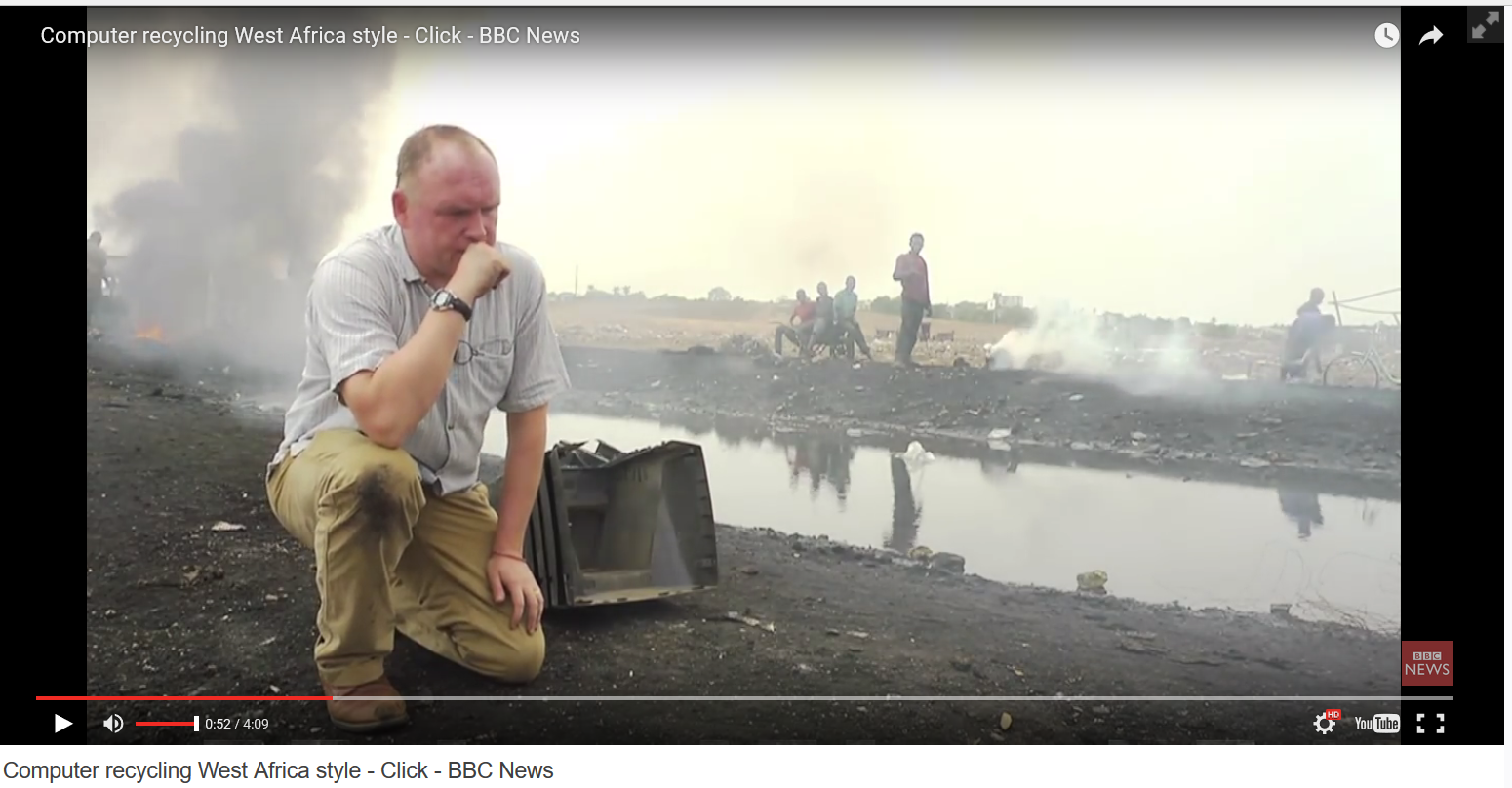
Another BBC reporter, David Reid, went back and gave some "fresh" reporting in 2014.  I'm being very, very sarcastic.  Reid flew into Accra airport, got himself a hotel room, and a 9 minute taxi ride later surrounded himself, cough coughing, with young men hitting metal with hammers and burning auto wire.  About 80 scrappers work at Agbogbloshie, mostly in car recycling, but Reid heads to the tire fires where 25 or so young men stand about burning about 200 kg per day of wire.

"Making a Living from Toxic Electronic Waste in Ghana"


Gotta love that title... journalists and photo journalists certainly are making a living off of the witch hunts of Agbogbloshie.

Reid stands at the same bank I stood at, where no cars or trucks have access - only wheelbarrows and pushcarts.  And then he goes to Tema Port an hours drive away and films Africa's Tech Sector workers, Africa's "Big Bang Theory" importers unloading a container (like the ones shipped by Daniels, Benson, Ogbayanna, etc.)... the goods being unloaded are clearly a decade newer than the stuff hammered in Agbogbloshie, but Reid can't see that.  He just sees black people.  He's not making the distinction between the African valedictorian Tech Sector Big Bang Theory superheroes and the toxic wire burning guys at Agbogbloshie.

He asks how much the technicians think will work, and the tech shrugs and says "99 percent".  Reid scoffs.  It's like he's talking to one of the illiterate drop outs at Agbogbloshie.  He snickers and asks "how big is the one percent?"

Because that's the story he came to tell, that the guys in Agbogbloshie are burning England's e-waste.  And he's standing right with an imported load which was paid for at several times the value of scrap, plus transport and customs fees and transport.  He is looking at a truck that is not driving to Agbogbloshie and could not drive inside if it did.  And he's mocking the black guy.

The narrative of Halloween language and images of scary black people is something BBC is obsessed with, despite the HOUSE OF COMMONS openly admitting that only 19% of containers have ANY illegal material in them at all, and that the UK's priortity is to keep "strategic" metals for Big Shred.

Oh, did you miss that?  Read more... lots of research has turned up during writing of our report on Agbogbloshie. 


Cultural Gulfs in Developing Markets 7: The Rusty Radiator Awards

Although I had a degree in International Relations, had spent a semester at the UN, and made a career in the science of development, I racially profiled someone in Singapore in 2005.    I know it now.   I deserve a rusty radiator for racism.

On my way back from Guangzhou, where I had gone for a second visit to see the second-hand shops of Foshan and the "Big Secret Factories" of CRT reuse, I stopped in Malaysia and Singapore for a couple of days.   Armed with my camera, I decided to hunt for some "exotic photos" to prove that I too, like Jim Puckett of BAN.org, had "been there".  Now, Interpol is trumpeting their act. with a project to describe their efforts to arrest "criminals" I refer to as the "geeks of color".

I understand where David Higgins' group at Interpol is coming from.  E-Waste is in the news, and we want to show our credibility, show we have been there, walked the streets, and have seen the problem.  We work for the (world) government, and are here to help. 

The shop below I presented in a Powerpoint slide at a NERC.org conference as an example (an olive branch to Puckett and Westervelt) of clearly bad imports.   I had stayed on the street, waiting for the man who owned this shop (Mr. Teck Recycle) to roll up the metal door.  He had a ladder on the inside, which he needed to physically climb up to the ceiling to start to descend items for resale on the street. 

I acted like I knew where this guy's material came from.   I didn't.

It seemed the guy had packed this 4M x 10M street shop "to the gills" with imports, and was never going to be able to reuse it all.  I represented this person as an example of "toxics along for the ride", of being an example of the primitive importer, and contrasted him with the SKD (semiknockdown or semi-knock-down) factories I wanted to "reform", in our view.

I confess that I assumed this was all recently imported material.  I had absolutely no evidence of that. We now know that the 6 billion people in the "non-OECD" generate far, far more used electronic scrap than the OECD does.

Lets teach them all the missionary position, put them in top hats, and certify them as non-primitives.

Was Mr. Teck Recycle importing at all?   Singapore, though not "OECD", was already as wealthy then as California.   It had become wealthy via the "Tinkerer's Blessing", the reuse and refurbishment trade, which evolved into contract assembly, then into ODM (Original Design and Manufacture).  Sure, some of this material may have been imported, but I had no idea how long before Mr. Teck Recycle got it.   What percentage came from residents of Singapore, which at that time had a higher percentage of engineering degrees, and higher percentage of online high speed bandwith, than the USA's Silicon Valley?   Why did I immediately assume the Singaporean shops were filled with USA "toxics along for the ride" (a phrase I pounded at the NERC audience?)

Sure, it was a sound theory.  Maybe some of this stuff did come "along for the ride".  But I had no proof, all I had was a need to position myself not-too-distantly from Basel Action Network's "80% Primitive Recycling" export statistic, which we now know is no more true than 80% of Los Angeles black teenagers are gang members and high school drop outs (BTW that's said tongue in cheek, it's obviously untrue, but the fact I have to apologize and point that out shows the root of whitey's problem).

Ghana TV repair 2014
Profiling.

The Guardian E-Waste Shoot: 3 Facts Behind "Poverty Porn"

It's the mining stupid.

The Guardian is actually a pretty excellent journal, compared to much of London's Yellow Press.  So when it "recycled" some photos of scrappers in Agbogbloshie this week, actually calling it "the largest e-waste dump in the world", it got a lot of 're-tweets'.

I called them out earlier, and a journalist at Fox News called to quote my reaction.  Read to the bottom of Jeremy Kaplan's piece on the "Ghana's E-waste Nightmare" to see "poverty porn" in a quotation in major news media, a possible first.

It's the mining stupid.


 Six pieces of WEE sited at African city dump!!    OOOGA BOOGA OOOGA BOOGA

Here are the facts:

1) None of the vintage electronics in those photos is typically purchased by African traders today.   Agbogbloshie is the "end of pipe" for Accra's piping hot interenet, which grew ten-fold in the past decade (see 2 blogs back).  (Eric Prempeh, Good Point's head tech, is over there now, measuring demand).

2) The article distracts from actual environmental nightmares, including those the Guardian has covered.
-  Tin mining on coral islands of Indonesia (The Guardian hits the spot)
-  Gold mining in Ghana (The Atlantic)
-  Kabwe, Zambia, lead mine, the MOST TOXIC PLACE ON EARTH...
-  Today on VOA, Gold Mining in Uganda

- We could go on and on here, OK Tedi Mine in Borneo, Zinc smelter spills in Guangdong, smelter spills in the Danube, lead mining in the Andes, 14 of the 15 largest Superfund sites in the USA, conflict metal mining for tantalum in Congo's river basin, zinc mines of Kunming....

It's the mining stupid.

3) Had the devices at Agbogbloshie, imported ten years ago, been shredded, African cities would still have e-waste at dumps.   Had the devices, imported for reuse ten years ago, been shredded, MORE MINING would have taken place, more carbon spilled, unless you want to assume Africans never got electronic media.

"Using a used CRT for 10 years is better than mining for a flat screen" 
- Captain Obvious.

Bullyboy III: Meet The Real Environmental Criminals

"The Perfect should not be the Enemy of the Good."   My first face-to-face with Donald Summers (the guy who told reporters I lie through my teeth), ended on that note, and Donald said it first.  We must prioritize our environmental issues, not based on the money and attention they bring our environmental organizations, but on the risk and harm.

When I met the head of Interpol's "Project Eden" in Lyon, France, last Monday, he had just returned from a trip to Sri Lanka, where 300 elephant tusks were seized.  Cees described his feelings, seeing the tusks there, and imagining the scale of the slaughter.

And toxic waste dumping in Africa is real, too.   Here is a 2006 story about a Dutch shipping company which dumped tons of highly toxic waste (from the cleaning of sea ship gasoline tanks) - the Transfigura Ivory Coast case was settled for $45M, thanks to a Dutch Court.  Amnesty Inernational and Greenpeace did important work.  The money is actually being distributed in Africa, not used to fund NGO offices in Seattle.  WR3A's attorney/stagaire, Fred Somda of Burkina Faso, was the first to make the point that planned obsolescence campaigns by OEMs should not distract from serious need for enforcement of the Basel Convention.

From Wikipedia 2013.07.28:

"The 2006 Côte d'Ivoire toxic waste dump was a health crisis in Côte d'Ivoire in which a ship registered in Panama, the Probo Koala, chartered by the Dutch-based oil and commodity shipping company Trafigura Beheer BV, offloaded toxic waste at the Ivorian port of Abidjan. The waste was then dumped by a local contractor at as many as 12 sites in and around the city of Abidjan in August 2006.
Ivory Coast kid poisoned by Trafigura - photo Al Jazeera
The gas caused by the release of these chemicals is blamed by the UN and the government of Côte d'Ivoire for the deaths of 17 and the injury of over 30,000 Ivorians, with injuries that ranged from mild headaches to severe burns of skin and lungs. Almost 100,000 Ivorians sought medical attention for the effects of these chemicals.[1]
The substance was claimed by Trafigura to have been "slops", or waste water from the washing of the Probo Koala's tanks. An inquiry in the Netherlands, in late 2006, revealed the substance was more than 500 tonnes of a mixture of fuel, caustic soda, and hydrogen sulfide for which Trafigura chose not to pay a €1,000 per cubic metre disposal charge at the port of Amsterdam. The Probo Koala was turned away by several countries before offloading the toxic waste at the Port of Abidjan.[2][3]

Fifteen people died, and thousands were treated.   We don't want to forget how important it is to truly enforce the Basel Convention, when someone is avoiding the true cost of disposing toxics by dumping it in sacks on African shores.  We do not want to label environmental watchdogs and enforcement agencies as "bullyboys".

At the Vermont Fair Trade Recycling Summit, Frederic Fahiri Somda made a clear case for the risk and danger of dumping toxic waste in Africa.  But he also said it's absurd to compare TV repair to Tranfsigura.

BAN Spins: How the Basel Action Network Saved Africa

This month, the UK is moving to change its laws to stop the export of used televisions.  You know, the used TVs which make up 70% of sales in African markets, which created about 7 million households with TV in Nigeria.  And the CRT computer monitors, which Africans used to set up the internet cafes which led to the Egyptian Spring.

In about 10 days, new regulations will come into force to explain the 2009 arrest of an African, Joe Benson, who sold the TVs before the laws were changed.  You could call it "tying up a loose end".

But there's another loose end to attend to.   Last month, Basel Action Network publicly disavowed the "80% Export" statistic in response to a Bloomberg editorial (Adam Minter).   Also, BAN Executive Director Jim Puckett applauded this UNEP study.


"The majority of refurbished products stem from imports via the ports of Lagos. The interim results from project component 2, the Nigerian e-Waste Country Assessment, show that 70% of all the imported used equipment is functional and is sold to consumers after testing. 70% of the non-functional share can be repaired within the major markets and is also sold to consumers. 9% of the total imports of used equipment is non-repairable and is directly passed on to collectors and recyclers."
- Final report of the UNEP SBC, E-waste Africa Project,  Lagos & Freiburg, June 2011 
Here's another quote from the Nigeria E-Waste Assessment Study:
"Refurbishing of EEE and the sales of used EEE is an important economic sector (e.g. Alaba market in Lagos). It is a well-organized and  a dynamic  sector that holds the potential for further industrial development. Indirectly, the sector has another important economic role, as it supplies low and middle income households with affordable ICT equipment and other EEE. In the view of the sector’s positive socio-economic performance, all policy measures aiming to improve e-waste management in Nigeria should refrain from undifferentiated banning of  second-hand imports and refurbishing activities and strive for a co-operative approach by including the market and sector associations."
Sounds a lot like "Fair Trade Recycling".  So how does BAN balance the UN Study, showing 91% reuse, recommending AGAINST laws like CAER's Green-Thompson bill, with its applause for the crackdown by Interpol and Europe on exporters like "Hurricane" Joseph Benson of BJ Electronics?

First, embrace the study.  Second, take credit.

Quotes from Jim Puckett:
"I am very satisfied with the quality of the UNEP studies. I know well the authors and have worked with them and discussed findings with them.   These studies were funded due to our film Digital Dump which was shown at the Basel meeting whereafter the EU donated 1 million Euros to assist Africa in solving the e-waste crisis.  
"Nigeria was faced with a very serious abusive importation scene when we first arrived in 2005.  They took the appropriate action and Nigeria is one of the great success stories of addressing the e-waste crisis.  In China it has worsened, in Nigeria, they have really exercised control over the egregious toxic e-waste trade impacting their environment.  "
This is Jim Puckett's spin on the UNEP study, which took 279 sea containers in Nigeria (104 of which came from Joseph Benson's adapted country, the United Kingdom).   The researchers pieced all the TVs out, and found 91% reuse rate.   He tries (in the second quote) to take credit for the turnaround.

In fact, BAN was very, very busy in 2009 and 2010, the period when the 91% reuse was documented in the UNEP study.

Here is a report from the University of Northhampton (UK) which uses BAN as a source, stating only 25% of what Nigerian techs imported could be fixed or reused - complete with photos by master photographer Jim Puckett himself.  What a terrific turnaround it is, from only 25% reuse to 91%.

So fast a "turnaround" that the innocence/improvement happened before the crime!

Here is the infamous 2009 Interpol report, which uses the same (or similar, they never seem to be exactly the same) statistics from BAN's "study" on the percentage of waste in African used electronics exports.  Did Puckett notify Interpol that it was actually much better in 2009?  No.  BAN issued a press release, referring to the Africans as "Organized Crime".  And the source of Interpol's data on the extent of the dumping - MSU - cites who else?  BAN, their report that 80% of exports of CRTs are for primitive recycling.

More from 2009 and 2010:  The smoking guns

E-Waste Export Hoax Coming "Home" to Roost

Recycling Today reports on the US International Trade Commission Study - the fifth, I think, to say that between 80% and 90% of used electronics purchased (with money) and shipped (with more money) by Africans, Asians, and Latin Americans were working or repairable.
"Exports accounted for $1 billion in sales of refurbished UEPs and $439 million in recycled material.  According to the study, despite longstanding anecdotal accounts to the contrary, 88 percent of all UEPs exported as repaired/refurbished are sent “tested and working.” Only a small share of U.S. exports, less than 1 percent (0.8 percent), is sent overseas for disposal."
Is it any surprise that BAN.org was this week turning its Watchdog Binoculars onto USA E-waste processors who are speculatively accumulating crushed CRTs?  The NYTimes article barely mentions exports, its focus is all the money that has been paid for DOMESTIC USA recycling which has led to nothing but big piles of toxic glass on the ground.

I was tsk-tskd as going too far when I wrote the article last year, E-Waste Recycling Hoax.   Pleas to #freeJosephBenson never got a retweet.  Everyone (especially CAER) kept to the hymn that 80-90% of USA's CRT televisions and monitors are not being processed, but dumped in China and Africa.  The 85%, or 88%, or 87%, or 90% studies (of what arriving overseas is good for reuse) got no ink.

But now NYTimes says that NGOs are protesting the massive piles of CRT glass from tubes collected in the USA's domestic recycling programs.

 What does this picture say?

It says the Africa export story was indeed a hoax.   But Watchdogs have turned the page, and are poaching game in the USA's home turf.

Well, it's not a complete hoax.  There was some truth to Basel Action Network's export story.  In my passion to defend the Hurricanes (Hamdy, Benson, and Chiu) I don't want to pretend there is not serious room for improvement in e-waste recycling overseas. There are indeed toxic repercussions of burning wires, or using aqua regia acid to get gold.  There were, indeed, toxics along for the ride.  The exporters had the control, and the power, and externalization did result.  The problem is, a boycott took the agents of conscience out of the trade, and gave those with less conscience even greater power to leverage the demand, and sell into it.

Externalization economics had affected some aspects of the trade in used electronics.  Exactly as externalization economics have resulted in mining raw materials in rain forests, just as it led to the "anti-gray-market" seizure of used goods, challenges to first use policy, delayed patent exhaustion, and other wars on the poor.  Tinkering, fixing, and refurbishment isn't perfect.  It can indeed be reformed and made more fair. But tinkering and repair are the go-to game for the poor.   Arresting Africans, seizing their purchases, and putting them in jail just doesn't deserve the air time that it competes for with ivory hunting, sex tourism, and child soldiering.  Arresting the victims isn't my idea of restitution.

BAN's Jim Pucket was this week back in the NY Times, his camera binoculars set on USA CRT processing companies.  Once his darlings, are the domestic CRT processors now the next scourge of e-waste? Will BAN feed on its own, for speculatively accumulating CRT glass he told them to take apart despite the orders from overseas factories that wanted to repair and reuse them?

Vermont Ilsley Public Library: Vermont Child E-Waste Tinkerers

Today (Friday March 15, 2013) is an "In-Service Day" in Addison County, and the Middlebury public schools are closed.   One of those days that's not a holiday for parents, and we schedule little things like tonsillectomy (my son, 8:00AM), or trips to the dentist (my 16 year old twins) if we are thinking far enough ahead.

If you are in Middlebury Vermont today, and you didn't plan that far ahead, here's another opportunity.  Good Point Recycling and the Ilsley Public Library are putting on a Special Event for Kids.  In the spirit of the "maker movement", "yankee ingenuity", and can-do tinkerer blessing, we will exploit ... 'err.. hold on, I'm getting an urgent call from our PR office.

Imagination Vacation:  Tinkering With Technology

Event:
Imagination Vacation: Tinkering with Technology
Start:
March 15, 2013 10:30 am
End:
March 15, 2013 12:00 pm
Category:
Updated:
March 1, 2013
Venue:
Community meeting room
Address:
Ilsley Public Library,Middlebury
maker
This hands-on workshop allows school-age children the freedom to explore the art and science of  ”how stuff works” in the spirit of the popular “maker movement.”  Library staff and re-use experts from Good Point Recycling will help you use hand tools to explore the mechanics of a variety of technologies from computers to telephones.  Bring your own hand tools, such as screwdrivers and pliers if you have them.  Adults and welcome too.

Term Paper IV: "E-waste" Export, Geog of Env Justice

PhotoSitting in the exhibit hall of CES, the Consumer Electronics Show, at the World Trade Center (an enlightened name for an exhibit hall)  in Las Vegas, Nevada.

In part I, I mapped the toxics in the USA, contrasting the tonnage of serious toxics (remote areas, primarily from raw material extraction) to the number of 100 data points close to urban areas.  I used this to support my thesis that environmental enforcement correlates positively with property value.

In Part II, I put the USA map into a generic Venn-like diagram (below), with the bluer areas representing land with high property value, and the green areas representing forests, tundra, moutains - land not valuable except to minimalist living or raw material exploit or agriculture.   The remote areas, where:

THIS HAPPENS (Mexico primary lead smelter 1999)
THIS HAPPENS (Peru primary ore smelter 2009)
And THIS HAPPENS (Zambia primary ore mining 2007)
And THIS HAPPENS (China primary copper, zinc, lead smelting 2000-1010)

In Part III, I made analogies over 130 years, how mercury mining and Indian wars and extinction of bison in the big green wild USA parallels the mercury mining, conflict metal wars, and extinction of gorillas in the wild jungles.  And the tinker Irish laborers in Boston who made paper mills survive by switching to recycled feedstock were looked down on 130 years ago, and suffered in the "great stink" of flushing toilets in Baltimore, much like repairpeople in Accra are looked down upon by recyclers while the goods they fix are labelled toxic, and while rich flood the markets with used devices...  Accra repairman lives in an Irish ghetto in a USA eastern city, and Congo mercury miner lives in the wild green lands of Wounded Knee.

In Part 4, I want to explore how the miracle of transportation allows trade between different zip codes in different countries.

Distracted from the Real Environmental Criminals

On my way to Retroworks de Mexico, I happened on a Discovery Channel show (#trivia - on the back of the middle seat on JetBlue, the only unoccupied seat on the plane, I was at window 20F, which doesn't have a working TV on JetBlue flight 179, flier beware.  But I could watch Discovery Channel on the middle seat).  Jungle Gold. its finally captured the ugliness which e-waste recycling debate distracts our environmental community away from.

In Ghana Africa, we see "the real criminals", or the bad environmental activity we export.   Bankrupt California boys, Catepillar tractors, Mercury, guns, and a toxic extraction process allowed by the mineral policies we exported, policies developed during the Apache Indian wars in the western USA... all in an easy to watch "Survivor-like" reality documentary.

At the end of the Jungle Gold episode (different from the one linked above, I couldn't find it), the two American lads  George Wright and Scott Lomu are deep in debt.  The last scene focuses on the worst environmental act performed in Ghana.  Gold mining, and the extraction of the gold from clay (not the same as panning for specks) with highly toxic liquid mercury.

The Americans don't do the dangerous part themselves, they let an African man use the mercury to soak up the gold into a ball, wrapped in a cloth, and burned off (mercury vaporizes) into the atmosphere.  One of the Americans actually talks about how difficult it is, watching his coworker posion himself, and says that someday he hopes to buy a centrifuge for the guy.  Right.

The mercury itself comes from America.    It is imported from Recycling Programs for mercury lamps in places like Vermont, where lamps are sent for retort and the mercury is exported to miners in Africa.  Recycled mercury is virtually the onlly source of mercury, it's almost impossible to find a mercury mine, because the environmental net on waste disposal is so efficient.

Export Bans and  Reducing Mercury Consumption in Artisanal and Small Scale Gold Mining

is a presentation by Kevin Telmer, University of Victoria
GEF/UNDP/UNIDO Global Mercury Project

An export ban that actually makes sense.  While we are at it, let's ban the export of dumbasses.

Marketing Confirmation Bias for E-Waste

Here's the simple thing about electronics recycling.  If you are an electronics recycler, which would you rather unload into your building today?

1)  Two trailers of gently used rich people stuff (high repair and reuse value)
2)  One trailer of gently used rich people stuff, and one trailer of obsolete "ewaste"
3)  Two trailers of obsolete "ewaste"?

Does the answer to this question depend on your race, your language, or your identity?  Or is it a universal obvious fact that we prefer items of more value?

No tech or geek I know cares about the "nationality" of a device.  A Chinese geek will prefer a P4 to a P2.  An African geek, working diligently on repairing a P3 for hours, will quickly abandon his invested time if a newer laptop is set on the desk.   Everyone prefers gently used rich people stuff.

If this is boring and obvious, then why is 100% of the dialog about banning poor people from importing rich peoples stuff?  Why are the African e-waste PACE project assuming "no imports"?

Dictators and Planned Obsolescence.

It's normal that BAN has a confirmation bias about the plight of poor kids who have toxics in their blood.  Even if the toxics from leaded gasoline or gold mining accounts for far more poisoning, any poisoning of any child seems unacceptable.  And if something is completely unacceptable, we will have a confirmation bias (ban exports) towards anything that appears to move the other direction.  They see the import glass as 20% empty.

But those of us who have lived in the developing world and have friends there see that geekdom is the opposite of the "resource curse", and that the jobs creasted overseas by the trailerloads of gently used rich people stuff are far better for Africans than other jobs available.  So our bias is that the import glass is 80% full.

I'm as guilty of confirmation bias as any human, I'm going to get a high from UNEP studies which confirm my 2005 hypothesis.   But I have no source of funding to promote my bias.

BAN got another rich company, Sims, to join their E-Steward campaign.   The origin is California, where counties were disqualifying Sims bids, and in particular, California Universities... which are the biggest source of trailerloads of gently used rich people tech there are.

Running rich people tech through a shredder means that the African and Asian and South American e-waste recyclers will get more trailers of obsolete junk, low profit material, as a percentage.  We have demonstrated in Retroworks de Mexico that they are able to do that work, that it's possible to do by hand.  But if they can do it for the domestic junk, why can't they do it for the 20% of bad stuff in the export trailer?  If they can buy tested working, and then properly recycle the unit 5 years later when it stops working, why can't they properly recycle it if they cannot repair it, and keep the money - the big money - they would make on it if they can?

Banning exports of used electronics is a marketing campaign which touches on the basest biases that Europeans and Americans have.   Finding a small piece of electronics, upgraded from a working unit or replaced from a unit sent for repair, is an obvious example of confirmation bias.  If you have set up an E-Stewards program based on no exports, or you've built a shredder to manage California material, or you are selling brand new product and don't want "market cannibalization" competition with your own used product, or you are a dictator who doesn't want tweets and youtube to be widely accessible, then you can all agree, can't you, that the tiny capacitor replaced by a geek of color makes the entire trailerload illegal waste?

And you can pool your resources to market over and over again, pictures of dirty, poor, sad children... whose parents will unload two trailerloads of material today at their African e-waste processing plant.

Press Sinks Ship Recycling

There are two ways to get metal.


Bangladeshi Workers Risk Lives Recycling Ships... thanks to Adam Minter for the nod.

One is to get it out of the ground.  Here is an example:  The OK Tedi Copper Mine on the island of Borneo.  Metal is found in many places, but it's impossible to gouge and dump cyanide tailings anywhere close to a populated area.  The USA has vast federal lands, remote from cities, so we can still mine red and hard rock metals (gold, copper, silver, etc.).  They generate 45% of all toxics generated by all USA industry... but it's not close to property values.   It's the same economic logic discussed in "environmental justice" blogs last weekend.

Australia has a lot of remote places, and is in the metal mining business, as is Canada and Mexico.  But when you try to do it in a place like Europe, there are risks of toxic spill disasters, like this one in Eastern Europe in 2010, or recently, in Liuzhou, China.  A city of 3.2 million, its drinking water system nuked by a cadmium spill into the Longjiang River, released by the Guangxi metal mining industry.

The press does occasionally cover these polluting practices, but only when an "abnormal" disaster strikes.  Bloomberg reports in 2010, China's Shenzhen Zhongjin Shuts Zinc, Lead Smelter After Toxic Leak Found.  Or here is another zinc smelting spill, of cadmium from metal mining, of the Yangtze River.
 In January 2012, Jonathan Watts wrote in The Guardian: Chinese emergency personnel are erecting barrages and pouring hundreds of tonnes of chloride into a river in southern China in a desperate effort to prevent a toxic spill from contaminating the supplies of a major city. The flow of cadmium - discharged into the Liu River earlier this month - has continued despite three previous containment operations, and now threatens the 3.2 million residents of Liuzhou city in Guangxi province. [Source: Jonathan Watts, The Guardian, January 30, 2012]
I've previously reported stories from the Danube, and from Guangzhou's massive zinc-lead smelter spill in 2006.  And don't forget about the conflict metal mining... today, this blog is sadly the top of the google ranking if you are looking for news about it.  I find that tragic.  I'm a nobody.  But the Guardian writes about stopping ship recycling, without asking, anywhere in the article, where the metal will be replaced from as the shipping industry increasingly sinks the ships rather than risk the wrath of environmentalists.

There are two ways to get metal.

Memorial Day: Fear and Greed Part 1

The more I try to crystallize the issue in this blog, the more it is about trade and exchange between rich and poor.  The exchange is a value, and the fear of exploitation is a value.  Some make their value in the margins of exchanges they make, others make their money through their authority over those transactions.

Whether we draw two big circles on a map and call them "OECD and non-OECD", or seven circles for continents, or 193 nations, or circles which show cities and peasants in those countries, or draw lines within a city between the high property values and the ghettos, it's ultimately about the transfer of wealth and value.   When a rich man employs a poor man, or a poor man buys something from a rich person, or a daughter marries across an economic line, opinions and suspicions sharpen.

Is trade between wealthy and poor exploitation, or opportunity?  Who is the authority or referee?

Jim Puckett says in his interviews in CBS 60 Minutes and Frontline that the deck is stacked against the poor in any exchange.  The economic have-nots will be abused and worse off due to the trade of second hand goods.  This line of thinking has some friendly listeners in the "environmental justice" arena, and the anti-globalization movement of Seattle.

I was a critic of how the USA's most toxic industry - hard rock non-ferrous mining - moved to rain forests where no one complains about the cyanide, mercury, and other toxic runoff.  Those concerns brought me into the recycling field, in fact.  And here I am in a battle of wits with a fellow environmentalist over how our raw material policy should play out worldwide.

My concerns about hard rock mining, however, were never pinned on a false hope of economic segregation.  Boycotting and segregating people we are uncomfortable or uncertain about has led to many "trail of tears", and many burned bridges.  Doing the right thing means doing something, but it isn't to throw a garbage can through the collective window of the recycling industry.  Fair trade makes more sense, and is not something Basel Action Network should try to make people afraid of.

Tech, Toxics, and Ju-Ju:  Leverage fear, create authority
In his editorial response to my first widely published column, "We Shouldn't Have to Make that Choice" (reprinted in E-Scrap in 2009), Jim Puckett said that he didn't think Fair Trade meant "poisoning people".   Toxics is a scare word.  Jim was clearly trying to make people afraid of the economic exchange.   He tells people that replacing or upgrading a part is hazardous, toxic, polluting.  He knows he's wrong, he just doesn't recognize why he's doing it. It is not, as he claimed, about a "loophole" of reuse.  If it's resolved, his authority diminishes, and he's not ready to retire.

Create concern, especially visceral concern (photos of children).  Promote yourself as an authority to reduce this concern. Sell certification.   Profit!

You do not create "environmental justice" by creating a vacuum or boycott of trade.  Justice is, by definition, a judgement call, a negotiation, and a settlement.   You do not stop exploitation by labeling people and segregating them.  

Trouble with Stewardship III


Regulatory Progress?  Or Regulatory Digression?

...And I'm here to help.
Were "E-Waste" Stewardship laws, as passed in over 20 states, an improvement over the Massachusetts Waste Ban approach?

The diversion rates don't say so. (Disclosure - the 1999 MA DEP regulation was my contribution - the first state with a CRT recycling law, always omitted from the list of states by NCER and other Stewardship advocates).  Did anyone actually follow to see whether the Massachusetts' treatment was bad for the patient?   Keep It Simple, Stewards?

If the movement for Product Stewardship is legit, and mature, it won't take these questions as an "attack".  It's important for technocrats to distinguish themselves from watchdogs.  They are not the same thing.

The new Stewardship laws are more complex, perhaps more sophisticated.   Regulators calculate what "shares" of electronics recycling responsibility to assign to different manufacturers.  They invent "diversion targets" that the manufacturers must either meet, or pay a penalty.

General Custer Reincarnate in Africa

You know who I'm talking about.  Enforcer of International Laws, in the form of unpassed amendments, the bringer of change in his vision.

The bringer of western ways.   Until the savages learn not to repair and recycle, because it just isn't safe.

The e-waste IT recycling should be done by whitie.

By the way, this internet thing is really cool.  Blackie should take some IMF or World Bank loans and leapfrog into the 21st century, and pay the interest in sweaty coltan mining jobs, to buy more new Stuff.

It's a whole package, it's all planned.  Obsolescence brings jobs to our factories, which we outsource to the people who are too primitive to fix or disassemble our stuff.

What he's destroying are the Geeks of Color, who are the best hope for places that otherwise offer kids employment in the sex trade, or who become thugs like KONY.

The image of the thugs like Kony is what gets the press, which further ingrains the image of an Africa too backward and too poor to fix a cell phone or CRT monitor.   Pounding and pounding the image of primitives into the press in Boston, just as period writers wrote of Custers heroic battles against the savage Apache.

The truth is now out there.   Ghana has 30,000 repair technicians, earning 10 times the average wage, creating places like MIST and intenet cafes like the ones in Cairo.

The threat to Custer yesterday would have been images of women and children laying on the "battlefield" outside their teepees and tents.  The threat today is an image of Chicas Bravas, an image of Geeks fixing, repairing, tinkering, debrouillards patching a new laptop out of two throwaways.

The threat to the ENGOs is that they will be caught having telephoned the EPA in the country of this (Indonesia) refurbishing factory, having told the competent environmental authority that it's a hazardous waste facility.  They are cutting down geeks at a rate that would make Custer proud.

Little Big Horn, Nairobi, Kenya...

10 Most Toxic African E-Waste Recycling Processes

UNEP Study:  The Dangerous 15%

"Risks and Opportunities of E-Waste"
("BAN-shes, cullet, aqua-regia... Oh My.")

Again, it's too bad that UNEP gave "Opportunity" second billing.  I suspect it keeps peace with the OEMs they are fawning over, papers over the embarrassing assumptions about "waste tourists" and "African criminals", and slowly re-acclimates us to the fact the glass is about 85% full.

There is indeed risk.  Not as much as mining, or dry cleaning, but the Center for Disease Control and OSHA do have rules.  Africa needs to gather the CDC and OSHA rules, as Retroworks de Mexico has done.  We all need to prioritize risks and benefits, and do so without hysterics.  Fair Trade Recycling doesn't want to be apologist for toxics.

So let's talk about the toxic risks.  What are the most dangerous recycling processes for e-waste in Africa, India, etc?  How do these compare with, say, dry cleaning, painting, or automobile repair?

At the Pan-African Congress WR3A is attending this month in Nairobi, the deal on the table is the same as Product Stewardship in California... stop import/exports in return for OEM money to recycle.

Africans would stop importing newer material, enforce "e-waste" planned obsolescence laws, and in return Europe will pay them top dollar for a cocktail recipe of sea container scrap... printed circuit boards, power supply, copper, and other scrap.   Something Europe would have paid for anyway, without any such anti-reuse compromise.

Let's look at the 9 or 10 very worst e-waste processes in Africa, and whether Africans can fix those themselves, on their own terms, before taking OEM devil deals.  Mining the metals like lead and coltan for the OEMs produces most of the harm in Africa.

Top 10 E-Waste Recycling Toxic Concerns for Africa:

EWaste Risk: What Africans Typically Know

More on the UNEP Report... Risk Risk Risk.

Risk and Opportunities of E-Waste:  Where are WEee in Africa?
"Where are WEEE in Africa? sheds light on current recycling practices and on socio-economic characteristics of the e-waste sector in West Africa. It also provides the quantitative data on the use, import and disposal of electronic and electrical equipment in the region."

The report is not about landfilling e-waste.  The thing getting buried is the LEAD, not the lead.
Journalistic leads emphasize grabbing the attention of the reader.[5]
In journalism, the failure to mention the most interesting or attention grabbing elements of a story in the first paragraph is sometimes called "burying the lead." [wikipedia 2012.2.21]
The most interesting thing in the studies is the description of the Opportunity for reuse and repair markets, and the opportunities in safe recycling. I wish the Report was a celebration of the Geeks of Color.  The report finds 30,000 electronics repair techs in Ghana alone.  The report says the Tech in Africa earns ten times more than the "scrap boy".  The Fixers should be the story.  The reuse of the imports generates over $100M dollars in nations that need it.  The CRT monitors  get reused, not burned, most of the time.  But (tsk, tsk, tsk) "Opportunity" gets second billing.

Ok, after reuse, ten years later, as Africans generate twice-reused electronics, is that the Risk?  No - the report STILL talks about OPPORTUNITY.   Within the junk, the opportunity of recycling the end of life product, is still an opportunity, the report says.  The report implies that the only problem is that Africans don't know how to do it safely.

The report should be written in this order:

1.  Most of the used electronics imported are reused and repaired.
2.  The reuse and repair create most of the jobs and value.
3.  Africans continue to use and repair the devices for years.
4.  Finally, of the remaining 15%, there is also jobs and value, but we have safety concerns

The fourth is definitely a concern to me, too.  But it's not instruction the Africans need.   It's not technology, either.  Hand disassembly works better than shredding.  The problem is that African have tough choices on where to spend their money, and will face real risks.   They may take the low hanging fruit, the cash crop copper and gold, and leave the difficult stuff for later.  There is also a danger that Africans will suffer toxic consequences if they in turn pass the buck to other Africans, to people who aren't equipt or incentivized to recycle professionally.  That's what happened in China.

How risky is that risk?  Tomorrow I'll go public about the Toxic Risk from recycling e-waste in Africa.

The main risk
 in this whole trade is the risk of being accused, in the west, of being an exporter.   Clients feel that it risks their reputation, recyclers fear they will get photographed with a container in their yards, like Intercon or CRTR.   OEMs are primarily concerned about the risk that White Box Computer factories will crop up, refilling their stupid $22 ink cartridges and reusing their RAM sticks.

My thesis is that The West is primarily concerned about itself, and masquerades that as a concern about African boys working instead of being in school.   Most of us are concerned first with our own liability, and at best the risk to our own consciences, when we believed that most of the e-waste in the dumps was fresh off the boat.   Let's be honest, readers in the west want to hear about OUR stuff, our role.  No one seems to be covering that the UNEP Report is ABOUT Africans and the best things Africans can be doing right now.   I say that the best thing for Africa is to increase their choices of people supplying to them (IE end E-Stewards and SB20 prohibition), and work on as new a used product as they can get their hands on, and then find someone to pay them for the printed circuit boards who will also take the CRT tubes.

One last word about something Africans generally know better than Europe and USA counterparts... RISK.  Africans I know have Risk in perspective.  They know:

1.  Just how soon we are all going to be dead.
2.  Just how long we are all going to stay dead.

There is a perspective and a beauty and a friendliness in Africa that comes from this knowledge of "end of life".  It can also, perhaps, explain the shrugging off of horrible violence.  It also may help explain the joy of religion there. But in general, Africans don't exaggerate their self importance, and their waste, when they are really truly finished with it, isn't tinged by the importance of the generator, quite so very much.  And it means that stalling the internet access for ten more years is not a good option.

I've introduced Recyclers who don't export to people from Africa who wanted to buy from them.   I know what I saw in their eyes.  They are afraid to be voted out of the good people club.

The single biggest risk of recycling e-waste, it appears, is the high correlation to narcissim, and taking yourself way too seriously.  I should know.


Cleaning Up #EWaste Madness Mess

STORY:  Africa turns imported electronics into hundreds of millions of dollars in jobs.


BLACK HISTORY MONTH.... The point has been made.   The anti-export, e-waste watchdog organizations were fueled by an intoxicating certainty that globalization was "externalization", and that world trade is inherently suspect.

They created a fake statistic, out of very thin air, that 80% of the "ewaste" in the USA is exported, and that 80% of the imports into places like Africa were junk.   The math failed on face value, but the images of "scrap boys" banging metals apart carried the day.   Splitting copper from steel in motors was mysteriously labelled "toxic".

Despite my best efforts, in posts like "E-Waste Madness 2010", "We Shouldn't Have to Make That Choice 2009",  and Motherboard in 2011, the "Ewaste police" gathered steam.  I took arguments I'd made in trade print in 2002 (Recycling Today, "Setting a Higher Standard") and used the pulp blogging to document the innocence of the Geeks of Color.  Sometimes I wrote with facts and statistics, sometimes with reason, sometimes with literary allusions aimed at the higher education field, sometimes in other languages.  Sometimes I really stuck my neck out and named influential people who should know better, like Donald Summers, Josh Mailman, Solly Granatstein, and Terri Gross.   Sometimes, I use video and tweets.  But perhaps the most important efforts have been to document the actual trade, and fight the fraudulent statistics with real numbers, examined by grad students and professors in several continents.

E-Scrap News is the first major newspaper to call a duck a duck.   The stats on imports into Africa were fake. Basel Secretariat believed them, and sent researchers, and found ... exactly what I've been describing, in posts like Monkeys Running the Environmental Zoo.   The UN found several hundred scrap boys in dumps.  But they also found, shocker of shockers, 30,000 repair and reuse techs, producing value and internet, the exact same way as Singapore, South Korea, and Benjamin Franklin got started.  Buying surplus media production (display units or printing presses), and making them "good enough" for the "good enough market", creating sustainable jobs with added value.  Had CBS 60 Minutes spent one more day in China, and followed the film I'd given them, they would have seen the same thing.

So now what?  Will the E-Waste Madness now end?

SCIENCE DAILY: Africa E-Waste Hoax Confirmed!!!

NEWS FLASH:  Most used computers and electronics found in Africa were purchased and imported at very great expense.   There is no incentive to pay for and ship junk.  The logic of anti-export organizations - that a few good ones at retail could explain their claim of 80% junk - may work mathematically, but makes no business sense.   Why would Africans buy the goods for $20, and pay $19 per unit just to ship each one, and then burn them for $3 worth of copper?  Today's Science Daily refers to UN Studies providing us with the truth about e-waste:

Domestic Consumption Main Contributor to Africa's Growing E-Waste Problem

ScienceDaily (Feb. 10, 2012) — In the five countries studied in the report "Where are WEEE in Africa?" (Benin, Côte d’Ivoire, Ghana, Liberia, and Nigeria), between 650,000 and 1,000,000 tons of domestic E-waste are generated each year, which need to be managed to protect human health and the environment in the region. The report sheds light on current recycling practices and on socio-economic characteristics of the E-waste sector in West Africa. It also provides the quantitative data on the use, import and disposal of electronic and electrical equipment (EEE) in the region. The report draws on the findings of national E-waste assessments carried out in the five countries from 2009 to 2011. 
The article takes its news from the report "Where are WEEE in Africa", published by the Basel Convention Secretariat.

FACT CHECK:  As fewer rich nations allow surplus e-waste exports to Africa, but demand remains, the quality goes down.   There are fewer suppliers to choose from.  PROHIBITION ECONOMY 101.  The lower the quality, the faster Africa's domestic recycling problem grows.  'War on reuse" makes it worse.

The Solution is obvious to the writers at Science Daily and the Basel Secretariat.   Allow import for reuse and repair, and have the companies exporting provide incentives and training to improve the recycling infrastructure.   In other words, Basel Secretariat and Science Daily just threw another big log on the Fair Trade Recycling bonfire.  Interestingly, the opinions in the Techie Listserve, Slashdot, overwhelmingly side with the obvious... reuse and repair are good, donating to good recycling beats banning bad recycling.

Multiple UN studies now confirm what we've been telling you from the field.  Most of the junk discarded by Africans was twice-reused for years, not hauled out of sea containers to avoid recycling fees in rich nations.   The used computer stores accept trade ins, but they make their money selling gently used equipment, like Goodwill or Salvation Army.   It's simple.  Poor techs, geeks of color, prefer to buy and work on rich people's surplus.  That's why they import.  Rich people discard after 3 years, and unless it's shredded, an African will try to buy it and use it for another ten years.  Goodwill, Salvation Army, and St. Vincent de Paul all know, you collect used goods in the rich neighborhoods like Wellesley, you may sell in Mattapan and Southie.

From the Basel Study:
The research revealed that there are some specific similarities between the refurbishing and recy-cling sectors in Nigeria and Ghana. In both countries, there is a well-organized repair and refur-bishing sector that is focused on used equipment either from imports or from domestic sources such as businesses and households. In both Accra (Ghana) and Lagos (Nigeria), this refurbishing sector generates income for more than 30,000 people...
 One major challenge for West African countries is to prevent the import of e-waste and near-end-of-life equipment without hampering the socio-economically valuable trade of used EEE of good quality. In addition, high volumes of domestically generated e-waste require well-functioning local take-back and recycling systems. Challenges include the establishment of appropriate collection strategies, ensuring that high volumes of valuable and nonvaluable waste fractions are collected equally and that those fractions reach appropriate treatment and disposal facilities. In addition, connecting informal collectors to a formal recycling structure is pivotal, along with appropriate capacity building and training. 
Locally adapted recycling technologies for West Africa should make use of the abundant labor force instead of deploying expensive shredding and sorting machinery. To ensure a maximum yield of valuable recycling fractions, West African recyclers should be encouraged to interlink with international recycling companies and networks to develop market outlets for their pre-processed e-waste fractions for a maximized return of value for secondary raw materials.  A sustainable e-waste management system would also need an adequate financing scheme, a level playing field and appropriate market incentives. It is thought that similar to policies in OECD countries, e-waste recycling systems in Africa could be developed in line with the principle of Extended Producer Re-sponsibility.

Is the system perfect?  No.  It needs reform.  What Africa needs is the same thing the USA and EU needed fifteen years ago - a cleaner recycling system for the stuff that eventually goes bad.  They DON'T need to be cut off the internet, or to be forced to spend half their annual salary on a brand new computer.  China has more scrap-economy demand, a different subject (see 2010 E-Waste Travels in Scrap Metal)