Showing posts with label BBC. Show all posts

Certification and Racketeering: Part 1 Ahmed Hussein Suale RIP

International Crime does take place.

"Racketeers offer a deceitful service to fix a problem that otherwise wouldn't exist."
Let that definition sink in.

"On 16 January, Ahmed Hussein-Suale, a Ghanaian investigative journalist who had collaborated with the BBC, was shot dead near his family home in Accra. Ghanaian police believe he was assassinated because of his work." - BBC

His work exposed bad calls from African referees, paid bribes to control the outcome of soccer matches. It's a textbook racketeering case, with a deceitful service (bad calls) sold to change the play that had occured on the field. People were convicted, resigned, or fired as the truth spread. And Africans who had watched the matches on TV and seen the bad calls with their own eyes, grew to esteem the Tiger Eye Team of Hussein-Suale and Anas Aremeya Anas.

Nuance Delivery 1: Awal is Sasha Rainbow's Tire Burning Boy

Another reminder from the Placebo "Life's What You Make It" controversy a year ago... Sasha Rainbow, who made the Placebo music video in Agbogbloshie, didn't ever - even once- respond to me or talk to me.  She said I was a liar.


Here (in Pidgin English) is an interview with Awal Muhammed of Savelugu (village north of Tamale).  Oh, he's also featured in BBC reporter Reggie Yates feature on Agbogbloshie.

Sasha's documentary is coming out soon, I've been told.  Good for her that she spent more time down there.  I've heard nice things about Sasha Rainbow from people I know in Accra. 

Reversing ER#3: J-School Background Checks on E-Waste - Benson Released, Rowe Fired?


Here's an interesting statistic on "e-waste" (like most, made up on the spot).  Four out of five journalists who contact me beforehand decide not to run the story on "e-waste" at all.

Reporters are initially attracted to the Basel Action Network's press release or photo opportunity (exotic brown child perched on familiar looking old electronics).  That BAN press release has, for 15 years, triggered interest in reporters and college researchers. An easy story to write, as BAN served "facts" up on a platter.

But Jim Puckett is no Upton Sinclair. He wrote about Agbogbloshie in chilling text - before admitting to me he had never been there at all. He had never even read a peer reviewed article.

The "ewastehoax" says junk in cities across the globe is the fault of "sham recyclers"... if only we use a USA recycling company that pays dividends to Jim Puckett, we will quickly clean these places up.

The Ewastehoax promises a moral lesson of "environmental injustice", and triggers three Steven Pinker-esque cognitive biases:

1. Nurture. We actually care about the poor child.
2. Greed. We suspect someone else's actions were driven by it.
3. Fear.  We are afraid of our own liability for our "stuff".

It's an easy recipe.  BAN isn't the only organization to use it. Annie Leonard, Blacksmith Institute, StEP, R2 (SERI), E-Stewards, CBS 60 Minutes, The Guardian, etc. all followed the trail on these instincts.

If you are a good photographer, that is all you need to put some guy like Joseph "Hurricane" Benson of BJ Electronics behind prison bars.  You can be the reporter that made him sell his house, that cost him his business and his retirement.


You are so cool.  You no doubt picked up all kinds of dates interested in your brave reporting.  Did you tell them about Joe Benson, the Nigerian TV repairman who shipped a TV with a GPS tracker to Ghana? Did you describe the satisfaction of Benson going to jail, like Raphael Rowe of BBC's Panorama did?

Oh, wait.  News flash.  Raphael Rowe got fired? (According to this article, "Pushed Out", but there's still some uncertainty as I research this, he's still on BBC 2 local).  And Interpol has pulled the plug on Project Eden.  All since Fair Trade Recycling's 2015 trip to Agbogbloshie, where we saw a city slum near a dump full of tires, cars, and junk appliances - all once owned by Africans, from a thriving city of millions of consumers.  Even the dozens (not thousands) of (adult) orphans there all carry cell phones, and can send photos of where they collected the scrap... at Accra homes and businesses, which had millions of TVs in the mid 1990s.


Benson may have the last laugh on Raphael Rowe. Though he has suffered, journalism students once attracted to "environmental justice" stories are increasingly documenting "environmental malpractice", "friendly fire", and "collateral damage" to Africa's Tech Sector.

Whether or not Raphael Rowe stays on at BBC, he's still know for having been racially profiled.  As will be Joseph "Hurricane" Benson.  As Rowe said in an interview "bitterness never leaves you".


BBC E-Waste Recycling Documentary on Agbogbloshie: Reggie Yates 2017

BBC Insider Series 2:1. Reggie Yates A Week in a Toxic Waste Dump 2017


If Agbogbloshie is the "largest e-waste dump in the world", or one of the largest, how can we explain the uncanny coincidence that everyone who visits there, even for an hour, meets the same people?

[Edit 9/28/17: While several other Reggie Yates BBC video docs remain on Youtube, this one has been pulled as of today]

DailyMortion has made the documentary accessible again here

The Insider S01E01 Reggie Yates A Week in a... by Eirador

Also on Reddit


Reggie Yates is a British journalist who is (like Vero, DK, Heather, etc) a second generation Ghanaian immigrant.  In this video documentary, he decides to live the life of three random wire burners from the Old Fadama slum.  The 53 minute documentary, like previous "Euro Agbo Journo" experiences last summer, revolves around the byline.  The journalist is the protagonist, and the background research  (into actual dumping claims) is practically nil (gleaned from Anane youtube appearances). I cringed at the opening montage of myths, assuming the hyperbole would once again propel the story.

But watch the video... there is progress...

Surprise!  He immediately hooks up with our pals Yahro, Razak, and Awal!  The same three musketeers who travelled with me (and PalmAndPlay, and Adam M) to stay with "Ghana Tech" and pal Wahab Odoi, a translator and importer from their Dagomba-speaking tribe around Tamale.  The ones who took us to meet their families, where we observed the tech sector, the charcoal stove fuel business, and copper jewelry craftsmen in the area. (See May press release on 'e-waste offset')


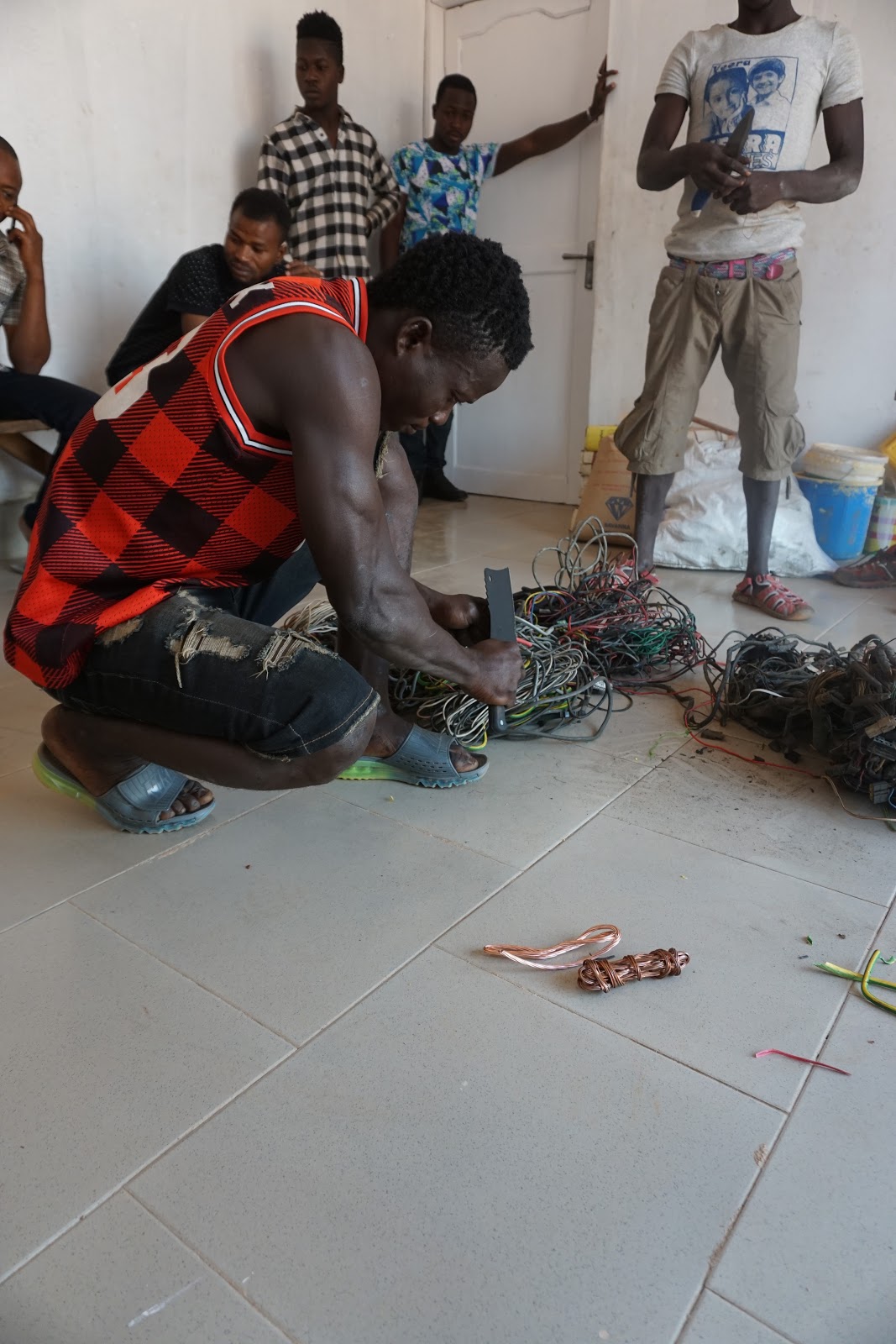
These shots are mine - taken when the guys stripped wire by hand to make "fair trade recycling bangles" like the one they give to the BBC reporter at the end of the documentary.


I've been to many slums before, and to this one several times over the years. I know Yahro, Awal, and Razak well.  I visited their families in Savelugu and Tamale, have pictures with their kids, and we chat a few times each month by Whatsapp. Reggie Yates' personal contact with them seems very genuine, if he perhaps misunderstands some of the Pidgin (for example Yahro doesn't say he hasn't seen his family for 4 years, in fact he was there with me in January and February 2017 - 4 Months).

You have to hand it to these Three Musketeers.  Awal has learned that photographers are attracted to flames, and by squeezing the most fuel into a tire, he can take control of every film crew.  Not that there is much competition... we only counted 25 people at the wire burning site on most days.  (Not thousands).

Our trip north to meet 3 muskateer fams
While it is irksome that BBC's Reggie Yates gets his information about Basel Convention and export from quite discredited claims from 5+ years ago, this is worth watching.  Not for "facts" about "e-waste exports" - Yates displays no evidence of reading research funded by Secretariat of Basel Convention, Interpol, MIT, Memorial University, and others who investigated - and dispelled with prejudice - the original Basel Action Network propaganda.

It's worth watching because, at least for 'e-waste', yes, this really is it. The 7 days Yates spends there pretty much capture the entire Agbo e-waste scene.  You can watch this whole thing and pretty much know everything.

Did you miss the 500 sea containers being unloaded?  Nope. There aren't any.  With time, I hope Yates will go see what 10 tons of e-waste actually looks like, at a facility like mine, and imagine seeing that arrive in an hour by wheelbarrow.

The only African Tech Sector representative appears in the video when Awal takes Yates to buy scrap from an imported goods shop.  The (unnamed) secondhand shopkeeper tells Reggie they are not importing "waste" or "scrap".  Study after study has proved the shopkeeper is, for the most part, correct.  Importers cannot afford to import junk, and they don't.  They fly and inspect goods, they will sample store returns to see if it's an easy repair.  The cost of shipping from the UK is about $5,000 and they certainly don't import VCRs (the junk Awal buys for scrap).  Reuse shops did import VCRs 10-30 years ago, used.  But today, Ghana residents bring them in for repair or exchange for something newer, a laptop or cell phone perhaps, leaving them at the secondhand shops.

Yates does find a UK store return at the shop and raises his eyebrows.  I've seen imported recalls, perhaps the one he saw in the shop.  But they are usually purchased and tested in the UK.  Yates doesn't plug it in, or find out how representative the sample is (this is photojournalism not data-journalism).  Certainly he can see that the shopkeeper isn't selling it for scrap, and that it's too expensive for Awal to buy for scrap, and stuff he sees at the junkyard is much older... nothing adds up.  Awal buys the scrap VCRs, not the store return. In any case, I challenge anyone to find enough "bad goods" in Accra shops to fill the Agbogbloshie they describe. Yates implies it's evidence of controversial import of bad goods. This "tidy little shop" isn't newsworthy... but Yates handling of Awal's negotiation gives us another glimpse of the reporter as protagonist.

The film does capture a lot of junk at the scrapyard. Junk cars, junk bikes, junk tires, junk coconut shells... Junk that comes from African Consumers, living African lives, in African cities.  The cell phone Razak points at Reggie will, in a few years, be scrapped for boards at the junkyard.

Reggie hasn't quite made the case that Agbogbloshie is anything but a city junkyard, similar to one in Essex or Dublin or Marseille, but with lower wages, more smoke, and lesser tools.  And I think if he sits and has a beer with me in a year or two, he'll agree the situation is kinda ordinary.

African consumers have been "consuming" electronics since at least the 1980s (when I lived in Cameroon for 30 months). A lot of "waste" is eventually generated in West Africa.  The more affluent the African city, the more e-waste.  If the export economy was really based on externalization and poverty, that wouldn't be the case.  Yates shows us the scrap exchanges up close, and we can see with our own eyes that it's being collected house-by-house, piece by piece, not dumped by container ships.

Yates shows how Awal buys the VCRs for a scrap metal price, and they wheel them to a consolidator, who pays Awal for footwork.

The journey of the scrap VCRs, by foot, is an example of where the documentary shines. The 3 musketeers do not remain "props", and are not nameless faceless viet cong in this BBC production.  Though he has no Dagbani translator, Reggie Yates deserves credit for listening, as best he can, to the individuals who make the fires. The guys told me this morning that Reggie was cool.

Here's a screenshot of Awal, in the documentary, who you will also recognize was the Blazing Tires "child" filmed by @itsSashaRainbow for the @officialPlacebo MTV video early this summer.


Even if it's not his intentional focus, Yates finds himself surrounded by a slum full of smart phones, FIFA jerseys, and rappers.  We can see with our own eyes that even the lowest scrapper has a TV set in his room.  Yates notes the traffic on a nearby highway.  He says he's been to Accra many times, and didn't know the slum was there.

World Bank data clearly demonstrates that Ghana is not a "primitive" place, and that the vast majority of Accra households owned at least one television in 2001.  World Cup and Africa Cup viewership is nearly universal. 20 TV channels are viewable in Accra, and there were 250 TV stations in Africa in 1977, for heavens sake.  The amount of junk at the Agbogbloshie scrapyard is if anything too light for a city of 3M residents... probably because Africans hang onto their electronics as long as they can.

Inline image 1


Of course, up close and personal is also the "byline trap". When a reporter's name or face features prominently in a story, it too often stops being journalism, and becomes a kind of talking-head on reality-tv. Yates remains seduced by his role in the lives of "the boys", and while he obviously means well, a great deal of footage is wasted on him demonstrating just that.  I learned after Peace Corps that having been to a brave and exotic place can help one seem interesting, help you pick up chicks, etc. Etc! Etc.

Like tire fires, journalism can be a testosterone high, or what I call a "graffiti economy" (time spent which is not really explained by monetary added value of the product).

Reggie Yates producers could have contacted some of the experienced reporters (Minter, Spaull) and researchers (Akese, Lepawsky, Miller) who have dispelled most of the hysteria about "hundreds of sea containers" being dumped and "pawed through" by "thousands of orphans" (I'm not exaggerating, the claims - with "millions of tons" - published in 2010-2014).  He should demand a follow up.  We can arrange for him to visit laptop repair shops and other importers, without whom Accra would never have had the "critical mass of users" to invest in cell phone towers, internet cable, etc.  I usually go to Agbogbloshie with savvy tech sector workers from Tamale, who translate the Dagbani language with Razak, Awal, Yahro, Muhammed etc.

We made the copper bangles (bracelets), and filmed the process, and I encourage the "boys" (I call them guys, musketeers, or men) to give them out to reporters if they have been honest and fair with them.  I take it from Reggie's parting gift that he passed that test.


Anyway I've been in touch with the guys and shared Yates photo - they remember him and seem to think well of him.  So I won't bash him, just gently chide BBC for re-publishing these outlandish crazy stories about hundreds of sea containerloads being dumped there.  And, yes, thank him for showing how little scrap is there, how many people (30 in e-waste, 250 in car scrap), how specialized a place it is, how little money is made in fire compared to hustle, how wheelbarrows (not sea containers) drive sales.  If you turn the sound off, you can learn a lot.

Agbogbloshie workers are a living, breathing part of the Circular Economy.  And that circle does not revolve around Europe.  While the used goods may disappear into reuse for decades, all the copper and circuitboards eventually get purchased and re-enter the world economy.  The TV on Joe Benson's sea container goes on a much deeper dive, has a much longer life, but the copper will emerge, bringing wealth to a place that added value. #freejoebenson

Euro Agbo Porno Journos need to meet one challenge.  In composing your "takeaway", please do not advocate for those who insist that arresting geeks and boycotting emerging markets does something compassionate. You can push the button on the shredder yourself, but you haven't done anything to improve anyone's lives.  You probably made them worse.

Instead of leaving UK citizens with a foolish notion that arresting #freejoebenson and boycotting #geeksofcolor and shredding, rather than exporting, used electronics will somehow benefit these young men, reporters could promote the clean copper recycling process.  You can buy the same bangles, made by the same men and women, and actually put some money on the table, and share the contacts Reggie Yates and others are making among your friends. The conditions of fair trade bangles include the safety measures (masks, gloves, doctors visits, etc) that Yates 'invents'.

With "fair trade rules", you only resell the copper rings, earrings, and bracelets that are collected without burning.  By doing that, you use the trade with Africa to actually make a difference in Awal, Razak, Yahro, Muhammed etc.s lives.

Reggie Yates was there in June (Ramadan), the anniversary of the AMA bulldozing and forced evictions (not mentioned), and 4 months after Awal posed with this copper bangle, filmed in a fair trade process, near the home of Kamaldeen - the laptop technician whose father is the metalsmith.  Kamaldeen is about the same age as the three musketeers, speaks the same local tongue, and grew up in the same places.  Kamaldeen did not drop out of school - he went on to college and got a degree in electrical and electronic engineering.  Today he fixes and resells laptops in a shop in the center of Tamale.  Reggie should meet him, too.

Reggie Yates gets a recycled copper Agbo bangle
One other theme I'm noticing is the territorialization of Agbogbloshie reporting as 'cultural appropriation'.  Increasingly, investigators (Agyepong, Yates, Vero) make their own bi-nationalism front-and-center of their reports.  It appears an evolutionary reaction to Hollywood's #whitesaviorcomplex. But it also forces the investigator to meet a broader range of African experts - scrap sector, tech sector, importers and regulators - to gain personal credentials.

If Reggie Yates and BBC want to go back and tell the other side of the Exotic Story of E-Waste in Africa, give me a call and I'll show you the intersection of Agbogbloshie and Chendiba Enterprises.  You will feel a little bit better about Europe and UK's roles in "exports".  I "f*king promise", Reggie.


see more by following #agbogbloshie on twitter


NGO Plants Needle in Haystack, Part 1: New Outrageous Claims in #EwasteGate

The news breaking today is that a Seattle NGO, Basel Action Network, is releasing a documentary with PBS about their "watchdog" effort to sabotage LCDs (making them non-repairable) and then track them overseas with GPS transponders.  The first company they have "outed" is Total Reclaim, an E-Steward certified company in their own home of Seattle Washington.

Article at E-Scrap News

Does this sound familiar?  You take electronics which someone wants to reuse, cut wires, and turn it in for reuse and repair.   Someone buys it for repair, and then you accuse them of having shipped it for "primitive" recycling.

#FREEJOEBENSON


BBC Reporter RAPHAEL ROWE cut a wire (thinking export for repair is illegal - should have read Basel Convention Annex IX, B1110 on export for repair of CRT monitors and TVs).

Context:  The Seattle Recycler received about 28.5M lbs of TVs, printers, computers, cell phones - as well as car seats, x-ray machines, and UPS.  The NGO doesn't say that the mass balance is off.  Of the 28.5M lbs, about 28M lbs of garbage-in came back out as baled steel, plastic, non-ferrous metal, and CRT cullet.  What the NGO's methodology is to find a device NOT in demand in the USA (CRTs in 2012 Benson case, smaller flat LCDs this year) but in high demand with overseas repair.  They take one that looks nice, open it and sabotage a wire, then place a tracking device.  When the Recycler has a staff person do sort-for-repair, the GPS is tracked, and the NGO implies that 28 million pounds are in question.

Had the NGO put its GPS tracking device in a random printer or CRT television or Pentium 2 computer, no one has ANYdoubt that Total Reclaim would have long recycled it.  This test is designed to disguise the GPS device in the biggest cherry, the patients who we believe could be saved from the recycling creamatorium.  Then, the NGO uses racist language to describe the "primitive" repair people who make a living by cherry picking luxury clients "waste" for the "good enough" market.

If BAN had put the tracker in a Pentium 2, a printer, a CRT television, virtually anything (aka random sample), they know perfectly well the Recycler would have scrapped it.  They chose the device they did because it has high demand and repair markets overseas, and they tracked it to a place a few miles from where the device was probably originally made... a place with more expertise in the device than anywhere in the world.

Remember, the reason NGO BAN told everyone to be very concerned about the export for repair market is that they told the press 80% was not repaired, but was dumped, in "Digital Dump" or "reuse excuse" language.  But it turned out they were making that up.  And their website still has the same garbage.

African "E-waste" Witch Hunt #3: BBC Whiffs at House of Commons "smoking gun"


BBC Panorama's episode "Track My Trash" has been given the dubious credit for a role in sentencing  Joe "Hurricane" Benson, Mark Daniels, and Ezenwa Ogbonnaya for alleged "ewaste" dumping in Africa.  Rowe seems pleased enough when we exchanged tweets.

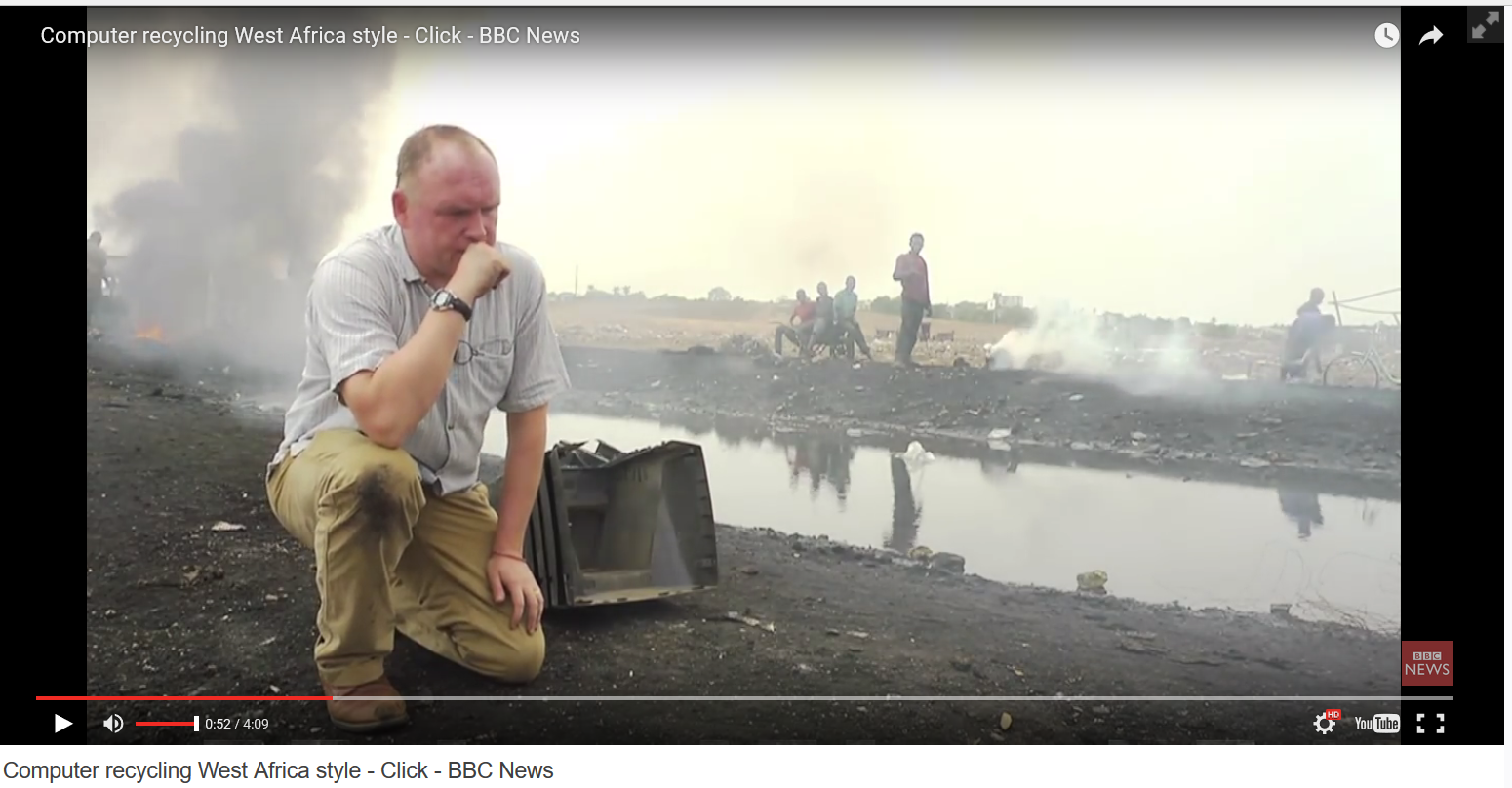
Another BBC reporter, David Reid, went back and gave some "fresh" reporting in 2014.  I'm being very, very sarcastic.  Reid flew into Accra airport, got himself a hotel room, and a 9 minute taxi ride later surrounded himself, cough coughing, with young men hitting metal with hammers and burning auto wire.  About 80 scrappers work at Agbogbloshie, mostly in car recycling, but Reid heads to the tire fires where 25 or so young men stand about burning about 200 kg per day of wire.

"Making a Living from Toxic Electronic Waste in Ghana"


Gotta love that title... journalists and photo journalists certainly are making a living off of the witch hunts of Agbogbloshie.

Reid stands at the same bank I stood at, where no cars or trucks have access - only wheelbarrows and pushcarts.  And then he goes to Tema Port an hours drive away and films Africa's Tech Sector workers, Africa's "Big Bang Theory" importers unloading a container (like the ones shipped by Daniels, Benson, Ogbayanna, etc.)... the goods being unloaded are clearly a decade newer than the stuff hammered in Agbogbloshie, but Reid can't see that.  He just sees black people.  He's not making the distinction between the African valedictorian Tech Sector Big Bang Theory superheroes and the toxic wire burning guys at Agbogbloshie.

He asks how much the technicians think will work, and the tech shrugs and says "99 percent".  Reid scoffs.  It's like he's talking to one of the illiterate drop outs at Agbogbloshie.  He snickers and asks "how big is the one percent?"

Because that's the story he came to tell, that the guys in Agbogbloshie are burning England's e-waste.  And he's standing right with an imported load which was paid for at several times the value of scrap, plus transport and customs fees and transport.  He is looking at a truck that is not driving to Agbogbloshie and could not drive inside if it did.  And he's mocking the black guy.

The narrative of Halloween language and images of scary black people is something BBC is obsessed with, despite the HOUSE OF COMMONS openly admitting that only 19% of containers have ANY illegal material in them at all, and that the UK's priortity is to keep "strategic" metals for Big Shred.

Oh, did you miss that?  Read more... lots of research has turned up during writing of our report on Agbogbloshie. 


Bullyboy III: Meet The Real Environmental Criminals

"The Perfect should not be the Enemy of the Good."   My first face-to-face with Donald Summers (the guy who told reporters I lie through my teeth), ended on that note, and Donald said it first.  We must prioritize our environmental issues, not based on the money and attention they bring our environmental organizations, but on the risk and harm.

When I met the head of Interpol's "Project Eden" in Lyon, France, last Monday, he had just returned from a trip to Sri Lanka, where 300 elephant tusks were seized.  Cees described his feelings, seeing the tusks there, and imagining the scale of the slaughter.

And toxic waste dumping in Africa is real, too.   Here is a 2006 story about a Dutch shipping company which dumped tons of highly toxic waste (from the cleaning of sea ship gasoline tanks) - the Transfigura Ivory Coast case was settled for $45M, thanks to a Dutch Court.  Amnesty Inernational and Greenpeace did important work.  The money is actually being distributed in Africa, not used to fund NGO offices in Seattle.  WR3A's attorney/stagaire, Fred Somda of Burkina Faso, was the first to make the point that planned obsolescence campaigns by OEMs should not distract from serious need for enforcement of the Basel Convention.

From Wikipedia 2013.07.28:

"The 2006 Côte d'Ivoire toxic waste dump was a health crisis in Côte d'Ivoire in which a ship registered in Panama, the Probo Koala, chartered by the Dutch-based oil and commodity shipping company Trafigura Beheer BV, offloaded toxic waste at the Ivorian port of Abidjan. The waste was then dumped by a local contractor at as many as 12 sites in and around the city of Abidjan in August 2006.
Ivory Coast kid poisoned by Trafigura - photo Al Jazeera
The gas caused by the release of these chemicals is blamed by the UN and the government of Côte d'Ivoire for the deaths of 17 and the injury of over 30,000 Ivorians, with injuries that ranged from mild headaches to severe burns of skin and lungs. Almost 100,000 Ivorians sought medical attention for the effects of these chemicals.[1]
The substance was claimed by Trafigura to have been "slops", or waste water from the washing of the Probo Koala's tanks. An inquiry in the Netherlands, in late 2006, revealed the substance was more than 500 tonnes of a mixture of fuel, caustic soda, and hydrogen sulfide for which Trafigura chose not to pay a €1,000 per cubic metre disposal charge at the port of Amsterdam. The Probo Koala was turned away by several countries before offloading the toxic waste at the Port of Abidjan.[2][3]

Fifteen people died, and thousands were treated.   We don't want to forget how important it is to truly enforce the Basel Convention, when someone is avoiding the true cost of disposing toxics by dumping it in sacks on African shores.  We do not want to label environmental watchdogs and enforcement agencies as "bullyboys".

At the Vermont Fair Trade Recycling Summit, Frederic Fahiri Somda made a clear case for the risk and danger of dumping toxic waste in Africa.  But he also said it's absurd to compare TV repair to Tranfsigura.

Earth Population to Exceed 7 Billion: Video


According to recent statistics, the human population of planet Earth will exceed 7,000,000,000 (seven billion) in another month to two months.   In perspective, there are now fewer Tigers in the wild than there are in zoos in the USA... around 5,000.   The line of extinction blurs with loss of habitat, replaced by of vibrancy of the DNA (preserved in umbilical stem cells)... 


The best video on the subject of population growth remains BBC's Hans Rosling's, 

200 Countries, 200 Years, 4 Minutes


The key to his video is that no country (USA) is declining.  Neighboring countries are catching up.  In terms of international comparison, there is less difference between poor and rich nations today than there was 75 years ago.  


The plan is that as the statistics on international well being level out, that the birth rate will level out, and that we may be approaching a "soft landing" as far as survival of humans and life on earth.  If we are going to survive this "soft landing", then we should start to protect the other species and planetary diversity.   Otherwise, we may survive Noah's flood, but we may have nothing but picture books of coral reefs and rain forests and savannahs to show our kids.


I for one think that internet access is important to the soft landing. The video shows that human progress helps humanity on the whole.  As the old threats to our lifespan decline, we invent new concerns about "toxics" and "vaccinations".  


The key measure is not population, but the net common sense of the population.