Showing posts with label geeks of color. Show all posts

Two Types of Board Member


We invited a respected colleague - who grew up in Cameroon (my Peace Corps home) and is now an experienced regulator and politician - to join our Fair Trade Recycling board of directors.

His response resonates...

"Robin, which kind of Board of Directors is this?"

What do you mean?

"Is it like the Board of Directors of General Motors, or IBM, where you pay me hundreds of thousands of dollars to attend a meeting which other people did all the work on...?"

My face says of course, not.

"Or is it the invitation to be on a Board I am supposed to feel good about and will therefore be expected to attend a lot of timely meetings without compensation?"

Defense of Importation of Used Electronics and the Geeks of Color


Tonight I asked AI to summarize the theme of my blog in two paragraphs.


Meanwhile I have had zero feedback or demand for my company's INDIUM bearing panels

Externalization Fallacy: Total Eclipse of the Truth 2002-2020

I recently met someone quite interested in Ethical E-Waste Blog who was 10 years old in 2002. 

Then I met someone who was 5 years old when CBS 60 Minutes broadcast "Wasteland" in 2008.

Both flattered me by saying this blog was "inspirational".  So I guess I gotta keep it up.

I also recently ran across a lot of film camera photos from my first visit to Guangzhou, China, in 2003. That was 21 years ago. It was a Shark Tank worthy experience.  Even if 5-6 blog visitors will find this to be a repeat, there are some new recruits whose minds have yet to be blown. And maybe some readers will be glad for the reminder.

Simon Lin. (Acer, Wistron)

Terry Gou. (Foxconn, Han Hoi Precision Inst.)

Rowell Yang. (Proview, "iPad")


These three men were the head of "contract manufacturing" when IBM, Dell, HP etc. declared that "display devices" were "commodities", not core manufacturing. Sony had, well, "colonized" Taiwan in the contract manufacturing of  CRT displays and now Guangdong Province had been "free=market" friendly thanks to Deng Xiaoping ... Who was famous for being patiently waiting for Mao to die while watching Taiwan and Hong Kong blow the gasket on free market manufacturing.

Used Ford Model As created the critical mass of users in the Ozarks and Appalachia who would vote to pave the roads.

Used VCRs and CRT televisions paved the roads for thousands of TV stations and satellites broadcasting to the "Global South".

Used CRT monitors paved the roads for internet cable investors.

Used Flip Phones paved the roads for 170,000 cell phone towers (2017 estimate) on the Africa continent.

Used Solar Voltaic Panels will pave the way for Africans to reduce diesel-electricity generation.

Despite the obvious facts about electricity access and consumption, the truth about the information and mass communications infrastructure, paved by progress from reuse and value-added repair, by the Tech Sector Auteurs, aka Geeks of Color like Simon Lin, Terry Gou, and Rowell Yang, the West (at least Europe and USA) press coverage of their bright past present and future has been eclipsed by an "externalization hypothesis" - that any capitalist trade between someone rich and someone poor is suspect. 

Imagine the Moon refusing to leave... a persistent, stubborn eclips of the truth...

Open Letter to WR3A / Fair Trade Recycling Interns 2007-2019

Hello summer 2019 team, and past WR3A interns

Thought you'd appreciate this coverage of Adam Minter's new book, Secondhand.  He has already been interviewed by NPR OnPoint and Marketplace, and will be on Fresh Air on Cyber Monday.  The concluding chapters of his book focus on our work, at Good Point, and in Ghana, on Fair Trade Recycling.

This has been a long and steady slog. Adam's research was enormously supported by interns from 2007 thru 2019.  Adam was inspired to write this book at the 2013 Middlebury College Fair Trade Recycling Summit, and the research by interns at Memorial University, Univesidad Pontifica Catholica (Peru), USC, MIT, Middlebury, U of Amsterdam, U de Paul Cezanne, Univ Monterrey de Guadalajara, developed a tome of documentation and research (much of which was consolidated in the excellent 2018 MIT Press publication Reassembling Rubbish by Dr. Josh Lepawsky).

On Adam Minter's second trip to Ghana, he followed up on the fate of the laptop "Junkyard Planet" was written on

Jaleel of Chendiba Enterprises identified a bad video chip, 

10 Years Of Good Point Recycling Blogs: What's Been Learned?

Ten years ago, most of the mainstream press in Europe and the USA had accepted the cartoon thesis that if electronic waste is expensive to recycle, that shipments of used electronics to Asia, Africa and South America were to avoid those expenses. At least, 80% of the time.

We took that on here, before anyone else would touch the controversy with a 10 meter pole. Here's a retrospective on what was, and still is, relevant in the Good Point Recycling Blog.

When poor people are paying for something (including transportation), it is not "because" the rich are willing to ship it.

We demonstrated that with the "Big Secret Factories" and 60 Wasted Minutes blogs. The sea containers of CRT monitors headed for Asia were never, ever full of large CRT televisions, even though large CRT TVs had more copper and costed more to recycle. In fact, the purchase orders did even accept Sony Trinitron 17" desktop monitors or screen-burned desktop CRTs or pre-VGA.  When someone is paying you $10 each for something specific, and refusing to accept other similar CRTs even if you pay them, it probably has nothing to do with (ahem) "rice paddies".

Brad Collis [CC BY 2.0]

NGO "#EarthEye" Gets OEM Cash for GPS Trackers: Do It Right Dell

Summary:  We applaud the next generation GPS Tracking study - if it's a truly random distribution and random sampling of end points.  It's not the tracking that was bad in 2016, it was the opportunity for bias distribution and biased sampling of end points.  Dell should ask MIT Ethics Review Panel (via legal department) how to do a reputable GPS used electronics tracking study.
  1. Randomly track and place all used electronics inputs. That means putting some trackers in 25 year old CRT TV junk that no one imports, some in working product that should be reused, not selectively sabotaging good enough looking stuff internally. 
  2.  Randomly distribute the randomly selected used electronics. That means blindly send the goods so you don't send specific selected stuff to a specific recycler.  
  3.  Randomly select end point export markets. That means you don't "obscure" good repair markets (cringeworthy 2016 study hid best and brightest in Hong Kong). 
What Dell can Learn from MIT Senseable City Lab "Partnership" with Basel Action Network.

In 2016, Basel Action Network sent GPS Trackers out in the field and provided MIT with a textbook study of how to do it wrong.  Sampling bias, financially involved research team, etc.

In 2018, BAN has announced they have a new partner - Dell.  Above the fold are the steps Dell can take to avoid MIT's mistakes, and do this study right.  I will applaud the tracking if the samples are done fairly, because then they will tell just as many stories about good Tech Sector outcomes overseas, as well as good stuff that got destroyed - not just bad stuff that didn't get fixed.  I'm all for science.

Electronics Recycling Conference 2017 Presents Jim Lynch Lifetime Achievement Award To

Scary Times in New Orleans...

What a great time I had last night, here in New Orleans, Louisiana.  I'm here to attend the 2017 ERC conference, run now by Sarah Cade of Chicago.  The annual international conference is a unique group of people, which took off from the launching pad of an organization, TechSoup, run by my pal Jim Lynch of San Francisco.  Jim's a legend, and each year this electronics reuse conference presents an achievement award in his name.

While the Bourbon Street Halloween Parade was truly a sight to behold, and Jazz Saxophonist Gary Brown was giving rare encores late into the night, the pinnacle of the evening, for me, came early.  At 6PM, I was presented a "Lifetime Achievement Award" for alleged contributions to the field of electronics repair and reuse. The honor was bestowed on me by Jim and Sarah, based on a vote of past Jim Lynch honorees, such as the distinguished Nancy Jo Craig of Baton Rouge, Charles Brennick of InterConnection in Seattle, Kyle Wiens (founder of IFIXIT!) and others.

Thanks.

Not cultural appopriation b/c photo snapped by Swiss woman? Oh and Halloween. That.

Jim Lynch himself introduced the award.  I was touched that he spoke about the several hour drive he and I shared together coming back from Retroworks de Mexico. He hit the sweet spots of my career, and my passion for defending reuse techs in emerging markets.


Circular Economy and African Shanzhai: Under the Bridge


Shanzhai, or Shan Zhai, or sanzai...

I dropped the word "shanzai" recently.  In my mind, it's something I blogged about not that long ago (2011) - a term I learned from meeting Dr. Josh Goldstein at USC via Adam Minter.  But I do admit to that habit of dropping a word or a phrase in places where no one knows what I'm talking about (unless they do).

Like a reference to "the Keystone Cops", the word "shanzhai" went "whoosh" over the heads of my listeners.  But in a reuse and recycling context, it's a profound concept.  It is like a master guitarist finding that a fan has learned to play his riffs even better than he can.  It's the concept of taking an iPhone 6 and repairing it with bells and whistles that make it, virtually, like an iPhone 9 (yet to be invented).

Today's blog has three goals - 1) remind readers of the importance of shanzhai, 2) show some really awesome examples of Africans turning broken LCD TVs into things of higher value, and 3) explore the "poor communicator" dynamic which so often dumbs down own discussions. When is it necessary to go back and remind a new reader what a word means?  Often today, journalists and bloggers "hotline" the word by html to a definition somewhere else online, similar to a footnote.


So here's the thing - Shanzai is being re-defined in relationship to "counterfeit" stuff. In the same way the charitable industrial complex defined African electronic recycling with "bad" images of Agbogbloshie, and defined Chinese technology reuse with cesspools and rice paddies, someone is out to bury the concept of refurbishment itself, and to make it seem shameful.

And they are going to use European and American implicit racism and assumptions about Africans and Chinese people to keep the competition away.  Like second string white baseball players, the American and European "big shred" recyclers are frightened of competition from Jackie Robinson.

To be fair, shanzai does also mean borrowed or knock-off, but in Chinese it has a much more respected context.  As I explained in the blog, Shanzhai is respected in China, in the way that John Frusciante, 47, (Red Hot Chili Peppers guitarist) respects Josh Klinghoffer, 37.  Klinghoffer copied Frusciante's guitar riffs and added a spice to them that put the Red Hot Chili Peppers on another level.

Here's what you will see in the blog below the "more" line:

1) Chili Peppers "under the bridge" video
2) An explanation of how I feel lonely explaining African exports (tied to lyrics)
3) A photo slide show demonstrating what Africans are doing with broken LCD TVs (like the ones Total Reclaim allowed to be exported to China)

And as usual, the conclusion

4) African geeks know more than we do, and the "circular economy" doesn't revolve around white people.

followed by

5) a blog-end of why it may be worth it to sometimes write a blog that's over most reader's level of expertise.

See if you can check the boxes


"Exaggerations Have Been Made" - NGO Exec Director

He huffed and he puffed and he blew the Hoax down

I'm really busy this month, in part due to the month away (Austria IERC conference, then 3 weeks in Ghana).  And I was in the Ozarks all last week for my father's DNR and funeral, simultaneously dealing with a tornado that wiped out water, electricity, internet, and my mom and dad's barn in Arkansas.  So... the blog's always poorly edited, but this month I've got really good excuses for it.

Here's what sticks with me from the January IERC Austria conference.  I sat on a panel with Jim Puckett, the Executive Director of the E-Waste NGO Basel Action Network.  We were speaking to a crowd of about 100 European WEEE delegates.

I opened by saying I used to be a teacher in Cameroon, Africa, from 1984-86.  I'd recently been to Agbogbloshie, and was going back again immediately after the conference.  I told the European audience that the junk they had seen photographed there was generated by African households and businesses, after decades of reuse.  Yes, it was originally imported used, but almost always repaired and used for 10-20 years before Africans discarded it.  I told them that 30 years ago my landlord had no running water but owned a (used) TV.  I told them that there wasn't any mystery around the baseline data - the World Bank clearly says that MOST households in cities like Accra had TV or computer 20 years ago, and the assumption that junk captured by photo-journalists was "dumped" in hundreds of sea containers by unscrupulous recyclers was categorically false;  I told them I had met Michael Anane, that he was not telling the truth about Agbogbloshie being a remote fishing village and he had certainly not been fishing and swimming there 20 years ago, that I was unable to find any newspaper that employed him, and that the people I asked in Agbogloshie said he worked for the AMA, the municipal land development group that forcibly evicted thousands of Old Fadama slum dwellers near the site, which they have a published plan to develop into shopping malls etc. The junk is collected in pushcarts from Accra city streets. I told them that the World Bank and IMF determined 15 years ago that used electronics in Africa were essential to creating the "critical mass of users" to fund TV stations and programming, cell phone towers, and internet cable.  I told them that Africa's Tech Sector found "Project Eden" to be scary, a threat to their livelihood, and cringe-worthy as a moniker.

E-waste Ebola Connection?
In conclusion, I counted backwards from 3, snapped my fingers, and  told them to forget all of the things Jim Puckett had told them for the past 15 years.

Jim's response?

"I will admit, exaggerations have been made."

It strikes me, 6 weeks later, as an incredible use of passive voice.  Exaggerations "have been made" by someone.

Exaggerations have been made, indeed.  Agbogbloshie photos have now disappeared from the CAER website, the conference speakers were now talking about keeping copper inside Europe's "circular economy", and Blacksmith Institute had changed its name.  That NGO allegedly told journalists 2 years ago that Agbogbloshie was the "most polluted place in the world" - something Blacksmith then denied but wouldn't issue any clarifying statement, despite our sending evidence they were cited by the journalists as the source of the claims about Agbo.  They did not tell me how much money they received to "transform" and "save" Agbogbloshie...

How to Categorize Part 2: Derivatives of Martin Luther King Jr

Yesteday's post wasn't well edited (I added some clarifiers this morning from my room in Salzburg, Austria).  But I was happy writing it, because I felt something was coming together somehow, it felt like something crystallized.  Sometimes those are the worst submissions, sometimes the best.  But in the spirit of Martin Luther King Jr.'s holiday in the USA, I hope that it channels Reverend King's letter written from Birgmingham prison, with pen and paper.  No backspaces, no click and delete.

Someone I met and admire here in Europe stayed up with me last night (we arrived on the same flight), arguing and pontificating about Trump's election, e-Waste policy, economics, and family.  It was a broad enough discussion, lasted well past midnight.  He and I don't always agree, though he's reasonable enough that I hope he'll be able to look back and see the fallacies in the EU position in hindsight (or I will - I had to come back to my room and research some stuff when we left).

The next day, it all seemed to fit in 140 characters.  Second, below the first 'pinned' tweet below.

Criticism of method or regulation isn't "attacking" the regulator.  It is defending the innocent from unjust prosecution.  And a regulator or prosecutor who persists in using methods or enforcement proven to be constructed on false premises is liable for environmental malpractice.

< That's boiled down to 140 characters at left.

Shouldn't we try to get along?  Or is the false consensus built upon white privilege, and we need to represent the Geeks of Color, whose comments were ignored in PACE Initiative?

The discussion came in response to Jim Puckett's constant claim that this is an "attack blog" and that I am "insulting" or "attacking" his poor non-profit organization.  This has been Jim's go-to response for several years now, since I wrote a guest editorial "We Shouldn't Have to Make That Choice" in Resource Recycling in 2009.  It was one of the first blogs turned editorial, and it was cited by Grahm Pickren in his 2014 thesis, Political Ecologies of Electronic Waste: Uncertainty and Legitimacy in the Governance of E-Waste Geographies.

The editors of Resource Recycling liked it, thought it was nuanced.  But Jim Puckett, in emails to me personally and to the editors (demanding a right to response, which they gave him) called it an "attack" which he could not let stand.  In that email, he threatened to go after me personally, and my business and employees, if I did not refrain from criticizing his policy.

Geography Baiting 1: MIT Senseable City Lab "MoniTour" Goes Offline

Has the correspondence from Unwitting, Unwilling Research Subjects finally got traction at MIT's Legal Office?  After 3 months of silent treatment, communications from MIT and BAN reignite the blog.

It is the end of summer vacation for Massachusetts Institute of Technology's Senseable City Lab. Professors have been on vacation, with little time to return calls or respond to our letters of May and June 2016.  But last week got a response back last week from MIT's Legal Department, saying that all future inquiries and correspondence should go through them.

This is one week after we cc'd MIT's Senseable City Lab Director, Carlo Ratti, in response to an email to Yours Truly from my an old pal, Jim Puckett, Executive Director of Basel Action Network.  BAN's parterner status with MIT is described in MIT's MoniTour website. You know, http://senseable.mit.edu/monitour


**** static ****

EDIT:  The website is restored now, and may have been unavailable only via my chrome browser which appears to be failing at several sites.  Speculation that MIT had taken the site down was wrong.

The site is 404, not available.  Could be a fluke, a temporary outage. But has been at least 3 days now. It might be premature to correlate MIT's shuffle with the written correspondence I've recently received from Basel Action Network and MIT's Legal Office.  But I predicted in my first response to the @KCTS PBS 9 airing of the "sting" on overseas electronics reuse, repair and recycling - MIT does not have a dog in this fight.  MIT has thousands of international students who know intimately the warts, beauty, sweat, and ingenuity across the oceans, and we predicted that MIT Ethics Committees would hold Carlo Ratti's Senseable City to a higher standard than to draw inferences on the "circular economy" based on BAN's notorious geography-baiting.

It's not exactly race baiting, since we don't know who in the USA owned or touched a device.  But BAN's descriptions of Hong Kong Province - which is wealthier per capita than the USA - with words like "primitive" and "rice paddy" should have been caught internally by MIT, without the help of a Vermont junk dealer's blog.

Someone commented that MIT might be engaged in a "cover up", but my friends in academia share my optimism.  The Massachusetts Institute of Technology's gravitas was clearly accepted as peer review and diligence by the reporters, and from MIT Senseable City Lab's response, it clearly was not merited or intended as such.

Google cache of the MIT-based webpage shows the original text which described the now AWOL web page as "A joint project between the Basel Action Network and the MIT Senseable City Lab".  And that's not BAN's claim, it's MIT Senseable City Lab indicating it's a "joint project" partner.  (copy and paste below, so you can recreate your own 404).

Monitour / MIT Senseable City Lab

senseable.mit.edu/monitour


Massachusetts Institute of Technology
A joint project between the Basel Action Network and the MIT Senseable City Lab ... this site in graphic form and will also be released in a series of reports by BAN. ... City Lab 2. a PDF copy of the publication is sent to senseable-press@mit.edu.
You've visited this page 2 times. Last visit: 8/27/16

Carlo Ratti's only direct response to my 14 pages of inquiries was 2 paragraphs. It could have been even shorter:  "It's BAN's project, not MIT's".  Or "People don't track People, GPS devices track people," or "GPS tags don't track people, they track peoples stuff".  "MIT just gave BAN the tools to track unwitting, unwilling participants, we didn't do it ourselves."

But Carlo Ratti spoke to PBS and clearly reviewed the pages on the now AWOL website stating that destinations, like Hong Kong, were "previously unknown".  The gist of my letter was:
"how did MIT determine my business transactions were 'previously unknown', unless it meant 'unknown to MIT and BAN', which isn't much of a defense of the ethical 'unwitting subject' test."
In fact, I'd been to Hong Kong (and Taiwan) one month before the PBS story aired.  Here's Video of Hong Kong from April 2016 below - with my 15 year old son, who I had taken to meet and have dinner with one of the best and brightest video display engineers I'd ever met (in Taipei).  Does the wifi-enabled, air-conditioned luxury ferris wheel ride among skyscrapers depict "typical Hong Kong"?  Of course not. Nor does +KCTS 9 film of a printer scrap yard in Yuen Long.  "Geographical Profiling" shortcut of the necessary effort to track each and every recyclable through each and every technician, and not to depict Asians as "primitives" with just obscured little points on a map.

You can't "obscure" destinations in Hong Kong on your website and then use photos of one location to "profile" anyone who does business with Hong Kong.  That's Geography-Baiting journalists and readers, appealing to their worst fears about recyclers and refurbishers in emerging markets.  You didn't show the Geeks of Color.

You can show Deliverance to depict America, but you've got to show Big Bang Theory, too.  Otherwise, it's propaganda, which BAN has been accused of for a long time, plenty long enough for MIT to vet them as a "joint partner" in describing emerging market "shantytowns" and "rice paddies" and "orphans" and "Sodom and Gomorrahs" and "E-Waste Hell" etc., etc., etc.

How does MIT's partner characterize the people who live and work in and built this location?

"Ewaste Crimes in Ghana": Intermission

End of Week 2 in Africa.

To catch everyone up, here are the cliff notes.

1) In 2002 three Americans were in Guangdong... Jim Puckett (BAN), Adam Minter (Shanghaiscrap.com), and yours truly.   We saw different things.   But the report with the least nuance (BAN's 80% dumping claim, claim that the water pollution was from e-Waste etc) got the biggest headline.  

Make the biggest claim, get the biggest coverage.

Where there's smoke, there's Tires.  Most of the visible smoke s from the tires.


2)  In fact Guiyu China was not receiving the CRT monitors, they were going to SKD semiknockdown factories for remanufacture, and the water pollution found in "Exporting Harm" was telltale from textile dying.    However, BAN ignored the nuance and created a Pledge of True Stewardship to raise more funds for their fledgling NGO.

An African Tech Reacts to "The E-Waste Tragedy"

EntertainmentEmmanuel E.P. Nyaletey is an electronics technician, currently on scholarship at Georgia Tech in Marrietta, where he's pursuing a degree in coding.    Emmanuel grew up a few blocks from the alleged largest "e-waste dump" of Agbogbloshie.    He went back to visit Agbogbloshie in March 2014.  Emmanual and I both attended the USA premier of Cosima Dannoritzer's documentary, The E-Waste Tragedy hosted by Jim Puckett of Basel Action Network... the inspiration of my past 6 blog posts.

Nyaletey has written an essay, reacting to the film, and it was posted on the ISRI.org blog last week.
It is worth a humble read.

Link:    My Reaction to the Film 'The E-Waste Tragedy' by Emmanuel Nyaletey.

The urbanization, electrification, and rapid development in African cities and other "emerging markets" is changing not just the landscape of Africa, but the foundations of the Guilt-AID industry.

 Since the BAN.org NGO publicly denied its previous claims that most of Africa's imports are "reuse excuse" junk, destined for "primitive recycling", the internet has begun to explode with exasperation, much of it (like Emmanuel's essay) written as eyewitness accounts.

William Buffett's essay, "The Charitable Industrial Complex", Cassandra Herrman's documentary #Framed, Heather Agyepong's "The Gaze on Agbogbloshie", and the "Rusty Radiator Awards" are well-heeled responses this blog has been inspired by over the past year.   What's harder to document are the less well produced, naturally exasperated reactions by ordinary businesspeople (like Joseph Benson) who trade "good enough" product to Africa's metropoleses (new articles in New Republic and the Guardian at bottom).

Check out the reaction to Bob Geldoff's "Band AID" on this UK talk show program.

Ghana Geek fixes Camera at Good Point Recycling
The lens is turning.  The photographers, and exotic gaze itself, is being examined by a new generation, born decades after "loving vs. virginia".  Touche pas a mon pote, biensur.

Top Ten Myths about so-called "E-Waste" (Update)

by Robin Ingenthron- (Originally Published on Earth Day 2010 via Greenwala).  Updated May 2014, as a reminder that the "Great E-Waste Hoax" continues to accuse geeks of color in many countries.
'It ain't what you don't know that gets you into trouble. It's what you know for sure that just ain't so." - Mark Twain
Ranking the 10 Myths requires a definition of what the term "e-waste" means.   In the dictionary and in the courts, "waste" means the material that is discarded or disposed of… stuff that didn’t get recycled, but was dumped.  If two computers are exported, and one is repaired, and the other is thrown away, only the second one is "ewaste".
Definitions aside, the "E-Waste" scare was probably the biggest environmental hoax of the past decade.  Protectionists, alarmists, and gray market regulators bandied the term loosely.  Two Chinese officials told me that any property once owned by anyone is considered "discarded" if it changes possession... the entire used car economy is "waste" business by that definition.   I asked a Hong Kong regulator at an Interpol conference - what if I used a laptop for a week and then sold it to my friend?  "Definitely e-waste" was his response.  
So I always put the term "e-waste" in quotes. Many myths stem from the confusion between waste, reuse, and scrap commodities (like steel and plastic).  Many Myths also have a kernel of truth.  But too often there is no data to support them.  There may be a photo of a poor child, and a fictitious statistic, or a stereotype.  

Some of Myths amount to "green" propaganda produced to sell "cures" like shredding.
As economist Roger Brinner said, “The sum of anecdotes is not data.”   Myths feed cynicism, which generates reaction AGAINST recycling (see #1).   We need scientists and engineers, economists and lawyers,  more representatives from importing businesses, and fewer megaphones.

 10.  MYTH:  "There is a growing tsunami of ewaste."
The Pitch: "Electronics are more disposable, with shorter useful lives. There is evidence [Franklin Associates] that obsolete electronics are the fastest growing segment of the MSW stream. Changes in analog TV broadcasts make old "rabbit ears" TVs obsolete, unless they are connected to cable or satellite. The pile is just getting bigger and bigger."

These facts are true, but they do not describe production of electronics. 

Generation is faster.  But the units themselves are getting smaller. There is more computing power in a cell phone today than in a living-room-sized computer at NASA in the 1970s. The increasing tonnage is made up of "legacy" equipment.   Most of the products collected at "ewaste recycling" events (think projection and CRT televisions) is coming out after decades of storage. 

Hobsons Choice For the "E-Waste" Market

Take it or leave it.

When an E-Steward company, or a state or enterprise influenced by its negative campaign, is approached by an Egyptian, Indonesian, or Nigerian who wants to set up the fastest growing cities in on the planet with affordable internet, they have one choice.

They can either replace the bad capacitors themselves, replace the hard drives themselves, buy new laptop batteries themselves... etc. etc.   Or they can destroy them.


The fastest growing, highest use, internet market in the world, is in the cities of emerging markets.  Cairo, Jakarta, Lagos... and dozens of others with billions of people clamoring to learn, to be entertained, informed, and connected to their family, friends, and associates.  They are starving for things like affordable display devices.

When a Nigerian, Egyptian, or Indonesian electronics repairperson (a terrific job choice in emerging markets) wants to buy a Dell, HP, or Samsung computer from the USA, they have once choice:  buy from someone willing to sell to them, or go without.

The Watchdog, the Gatekeeper, the certifier wants to change that choice.  The E-Steward Program charges YOU money to not attack you for selling junk.  This changes the choice for suppliers / sellers in the USA.  I used to decide based on the demand - what people wanted to buy.  Now that's changed by the requirement that I pre-repair it, and the risk that if I do sell it, I may be attacked.    The effect has been to constrain the supply - the buyers choice of goods.

The Watchdogs say this is to protect the buyers from getting "junk".   The test of whether something is junk?  In the marketplace, it's called "the marketplace"... what people are interested in buying.  The buyers, the Geeks of Color, the Technicians, the "Good Enough Market".   The Watchdog, having convinced everyone that 80% of these decisions are bad ones, intervenes, and places themselves between the buyer and the seller.   A referee can be good - if the ref understands scoring and other rules of the game.

Under E-Stewards, the ref has raised the stakes on any missed calls, and so they design a rule to be something much easier to measure than willingness to buy (repeatedly).  They can't be bothered by the background checks on buyers and fair contract language that Fair Trade Recycling pursues.   Keep it simple e-Stupid.  "Fully Functional", "Tested Working", "Plug and Play"...  E-Stewards and PACE gave up when we sent them 20 page purchase orders with quantities, tests, sizes, buyer qualification rules and other parameters.   Too long to read.   To difficult.  So they created "tested working" as a standard.  Sounds good.  The effect was to remove sellers unable to test and buyers who preferred buying newer goods for repair (rather than old ones "working").

1:  Take the highest demand in the world
2:   Restrict what they can buy
3.  Profit!!

They get applause from the Anti-Gray Market Alliance members who make brand new product, who restrict the right to repair and use patent trolls and copyright extension to squeeze the largest demand in the world into the tiny space of brand new product.  Profit.

Grouchy Marxist Defamation or Groucho Marx Defense?

Groucho Marx
“I have nothing but respect for you -- and not much of that.”
― Groucho Marx


My company, Good Point Recycling, used to charge residents $10-20 per TV, which most people were willing to pay every 10 years when they threw one away.  Here is a 2006 article (Burlington Free Press) praising us for the process and markets we used,..  


Interestingly, it's reposted on the wall of Basel Action Network.  It was posted in 2006', in happier days when BAN called me regularly to help them "certify" Pledge signers (like "Tom", in the article), before their consultants accused me of lying about the factories described in the article, which BAN chose to post on its website.


So, the article goes into detail about the distinction between "unknown" export markets and the use of legitimate export refurbishing factories.  BAN not only posted this article about the distinction, but BAN has also inserted language into their E-Stewards program describing "semiknockdown" factories, with instructions that any parts which may be electively upgraded or replaced must be removed in the USA before the CRT is exported.  

BAN also negotiated for the same terms in our "California Compromise" agreement, which fell flat in 2010.

Groucho Marx
“Are you going to believe me, or what you see with your own eyes?”
― Groucho Marx


To finesse the obvious differences between factories (like the one in Indonesia, at left) and the dirty recycling in Guiyu China, Jim Puckett, the Chief Executive at BAN, wrote in an Op-Ed piece that the disposal of parts replaced (common in an elective upgrade at the contract manufacturing factories) would be illegal, and speculated that the "discarded parts" would be "poisoning people", ergo "fair trade" was not possible.

In my emails to BAN over the years, I have offered to prove or certify that any electively replaced parts could be shipped for recycling to a place BAN approved, such as Japan or Belgium, which would solve that dilemma.

In responding for BAN, Jim said that he was aware of that option but that he did not want to promote it, because he distrusted and resisted globalization.  He said that no matter how hard we tried, that the nature of "exporting jobs" to poor countries meant exploitation.  In other words, whether or not I found a way that Basel Convention said was legal, that he objected based on his philosophy, that rich people who employ less rich people are exploiting them... something Karl Marx would say.

I told Jim that the "tested working" and "fully functional" and "accidental breakage" would require the same downstream diligence, that trading with poorer people, if inherently unfair, would extend to other trade, including sale of new devices, purchase of new devices, and certainly the mining of metals to make new devices.   Jim actually said he objected to those things too, but they were outside the scope of "waste" and therefore outside of his mission statement in Basle.   He didn't buy my suggestion that the big factories which certified the recycling of breakage, returns, and parts would be very valuable in the countries they were in. In fact, one WR3A member factory became a licensed take-back program for CRTs generated in that country.  If BAN killed them, and the majority of the e-waste disposed of in those countries originated there (See Williams/Kahhat study, referenced below), he'd be making e-waste worse...

So my point here is not to delve back into the specific arguments over the Basel Convention Annex IX, which explicitly says that export for repair is LEGAL... I'm just trying to demonstrate what Donald Summers, the BAN consultant, was referring to when he described "the genuine policy debate at issue" with personal attacks.  The general policy debate was about globalization and Marxist economics, not about whether contract manufacturing (e.g. Foxconn factories which make all IPhones and IPads) were mythical.

In the BAN web page articles above, on BAN's own website, BAN admits these factories are refurbishing.   And BAN negotiated terms for the semiknockdown factories with me, and BAN met some of the factory executives via Skype at E-Scrap 2010.   And BAN chose to support language allowing Manufacturers (OEMs) such as Dell, HP, IBM, Lenovo, Samsung, etc. to continue to use the factories (which take warranty returns, for example) in the language of HR2284, the Responsible Recycling Act.  The factories are NOT MYTHS.

So Basel Action Network obviously knows these factories exist, and is willing to let OEMs use them, and is willing to let E-Steward Recyclers use them if certain parts are removed (like bad capacitors). BAN says nothing if the devices these SKD factories buy are tested working (in which case the parts are removed anyway) and sold to a middleman (but not directly to the factory).  If this is obvious and proven and not disputed, why do so many people I meet think that the genuine policy debate between R2 Certification and E-Stewards standard is about POISONING CHILDREN??????

Or is it about rape, murder, and arson?  (See BAN's depiction of ASU Professor Eric Williams below)...


Groucho Marx
“Next time I see you, remind me not to talk to you.”
― Groucho Marx

2012: InterCon Takes On Basel Action Network

Word came in Friday's E-Scrap News that Intercon Solutions is suing Basel Action Network - for defamation.


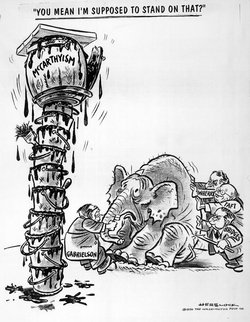
E-Stewards asked to Co-Defame (Herbert Block 1950)
BAN's "E-Steward" business model looks to many people like selling insurance against their own defamation campaign.  Whether Intercon Solutions wins, loses, or settles, we should note that they are not alone.  Unfortunately, most of the people being tarred as "primitives", "polluters", "criminals" and "exporters" don't have the wherewithal to sue Basel Action Network.


Eleven months ago, BAN's accusations vs. Intercon Solutions of Chicago Heights domineered the "e-scrap" and "e-waste" news.   My company had traded in a fair amount of "focus materials" with Intercon - CRT Tubes.   We knew that Intercon was passing the CRT Glass Test, which Basel Action Network agreed with us (in 2004) is the #1 indicator of bad behavior.  People called here to warn me that maybe the CRT tubes were going to China.  It was mathematically ridiculous.

Unfortunately, BAN seemed to have forgotten that lesson.   Rather than do Intercon the courtesy of saying that they passed 80/20 rules for focus material, BAN made it all about a single mysterious container which they photographed and tracked from the Intercon yard to a destination in Hong Kong.   BAN focused on whether a literally anecdotal percentage of Intercon's material was sold to - a person of color.  The story was not about what the material was - cell phones for repair?  laptop batteries?  LCDs? Nor about the capability of the person buying it.   It was about whether the containerload originated at Intercon, and what nationality the buyers were.  The only important thing was whether 1% of something was sold to a person in China.

E-Stork 4: It's the Journalism, Stupid.

From "precautionary principle", regulators defined export as an action with "suspected risk".  While a case can be made that the risk has been exaggerated, it's too bad that case is being made by me, a self-interested, partisan, biased exporter - one who has no editor and little time to proof-read (cutting too long posts into 4 parts didn't work in college very often, either).

I believe in dialectic, and the "marketplace of ideas", to bring the truth.  But I wish more professional writers would take interest in repair, reuse, knockoff, and tinkering - the true opposite of the "resource curse" in poorer but emerging markets.

The "suspected risk" comes from the same source that cleaned up the Blackstone River.  No, not the Saturday Evening Post.   But journalists.   Ethical journalism provides us a shortcut for proper due diligence, a reason to "suspect" risk.   Until or unless a river has been traced upstream to a repair and refurbishing factory, the journalist can "follow the money trail" and interview people telling both sides of the story.   They have the power to invoke or water down the "populist cognitive bias" against, say, interracial marriage.  Journalists may not be able to tell where our soul comes from, or where it burns when we die, but they have the power to interview people who CLAIM they know.

It's ok that we still believe in heaven and hell as a matter of faith.   As Chaucer said, a thousand times I've heard men tell of joy in heaven and pain in hell... but none of them has been to either place and lived to tell about it.   Faith and crusades are fine for spiritual upstreams and downstreams.   For rivers and environmental policy, we need science.  Journalists accepting statements like "80% of e-waste is exported", without a single fact or figure to go by in ten years, need to wake the heck up.