Showing posts with label fairtraderecycling. Show all posts

#OwnVoices 1: Ten Years of Video of Firsthand Accounts of Secondhand Trade


For over Ten Years, WR3A has been collecting video interviews, showing firsthand accounts by both the Second-hand tech sector and recycling (scrap) sector in places like Ghana, Senegal, China, Cameroon, Egypt, Peru, Mexico, Indonesia, etc etc.  There is a new hashtag for this. 

#OWNVOICES. It's  about marginalized people telling their own story, especially when it differs from - or opposes - "their" story as told by big money and charity industrial complex "saviors". 

It is Overdue.  Marginalized reuse techs - labelled "collateral damage" (2013) by Jim Puckett of BAN.org - have to to take the mic.


One huge takeaway from author Adam Minter's visit (his 3rd) to Middlebury last week was his ability to transition the story of Secondhand to "OWN VOICES". Google search top result for definition is a good start:


How To Pay For Africa E-Waste Cleanup?

15 years later, let's just ask what he imports
After 2 weeks back in Ghana, the #1 Finding of our research still stands.  E-Waste NGOs made up fictitious numbers about the percentage of imports to Africa that are "waste" and the percentage of waste in places like Agbogbloshie that come from faulty used good imports ("Exaggerations have been made" said Jim P. on our Salzburg panel).  Photojournalists flew to Accra (Agbogbloshie is about 20 minutes from the airport, 9 minutes from Accra's finest hotel), and took close-up photos of Africans in exotic poses.  And EU policymakers got project funding to "save" Africans from e-waste dumping.

Neither the NGOs, nor the journalists, nor the EU Policy funders checked out existing data on Accra stormwater runoff (the water quality at the Odaw Korle lagoon was hideous in the 1970s), the number of households with televisions in Accra 15 years ago, or the number of people employed in the scrap industry generally as compared to the number seen in Old Fadama slum of Accra. They didn't even find it on mapquest, which would show it's at the center of Accra, not a remote fishing village on the outskirts (as should have been suggested by the cab ride from the hotel). They would have found the phrase "Sodom and Gomorrah" appears in a 2002 AMA publication calling for razing the slum to build shopping malls and parking lots.

There was no basic secondary research.  No control group.  No null hypothesis.

Refining the Fair Trade Recycling Mission Statement


"Recycling needs to be materials science, not a belief system. Collecting during bad markets is smart, shows reliable long term supply grid."

Fair Trade Recycling is pro recycling.  But we are not exactly defined as part of "Zero Waste" movements.  We are somewhat resistant to "producer responsibility", at least as a solution for secondhand goods markets - planned obsolescence and right to repair are opposing forces (if producer implies mining and virgin material extraction, we are all ears). If any group has a close affinity to Fair Trade Recycling, it's probably USA's "Net Impact"... young professionals in the business sector who are agents of conscience, making the world better by participating in, rather than reacting to, global markets.  The worst recycling is better than the best mining.

At the same time, while we defend and participate in the overseas recycling and repair and reuse sector, we are confronted with the eventual waste and unplanned obsolescence of goods we once exported.  Our vision is to turn this into an opportunity, a circular economy, rather than reversing course on the international trade which is clearly benefiting standards of living and information and education in emerging markets.

Our primary incentive is to create a transitional economy for Africa's Tech Sector, the reuse and repair markets for used electronics, which we project will face increasing pressure from new affordable devices (seen in Asia in the past decade).  We believe the value of the sector is in the minds and education and ingenuity of the repair market 

The "Tinkerer's Blessing" is the working title of a book I'm writing about development and "savior complex" and "charitable industrial complex".  It's actually very optimistic, a defense of trade and free market activity in Africa, Asia and other emerging markets.  Terry Gou, Simon Lin, Steve Wozniak, etc. were tinkerers very much like the laptop and cell phone repair shop gurus from Tamale and Accra, we want to pitch them as a functional distribution and maintenance market for inevitable growth of solar power models in Africa.

Where will Africa's Wosniak emerge?  Who will monetize the "good enough market" in a way that is scaleable (like Foxconn and Wistron), creative like Apple, and sustainable as Microsoft?

It will probably be in the energy sector.  Which brings us back to Solar power.  Can SolarCity (Elon Musk's transformational solar panel financing scheme) scale solar power in a cash-based economy like urban Africa?  Or do we need other innovative financing models, like cell phone plans, to secure investments?

We will need people.  Africa's Geeks of Color.  Africa's repairers, tinkerers, fixers.  We need to stop arresting the people who buy and sell teledensity equipment in Cairo and Lagos and Accra and Nairobi, we need to silence the charitable industrial complex which defines its goodness in misleading photojournalism depicting Africa as a "victim".  We need to push out of the closet the NGOs who use pictures of African kids at dumps to raise money which is never, ever spent on Africans.

Photojournalism without data journalism jails and fails.  Our mission will outlive me, because it's rooted in the same scientific method and inspired conscience which has made the world's best practices.

- Robin Ingenthron 11/9/2015

Open WR3A Letter to CWIT / @Interpol on #Ewaste

DRAFT OPEN LETTER

Please send edits, suggestions, comments either by commenting under this draft or by email or tweet to yourname at wr3a.org.


Mr. Pascal LeRoy
Mr. David Higgins
Countering WEEE Illegal Trade (CWIT


Dear Sirs,

As you may know, WR3A (dba "Fair Trade Recycling") is an NGO business consortium which seeks to support businesspeople in emerging markets.  WR3A offers discounts on the cost of legitimate used electronic devices as an incentive to create takeback and proper recycling channels in those emerging markets.

We appreciate the advance copies of the CWIT literature [links below] which will guide the discussions in Lyon, France, next week.   While I will be in Lyon (previously scheduled) a few days later, I cannot afford to change my ticket.  Worse, the Association has just completed a major field work in Ghana and does not have the resources to bring representatives of Africa's Tech Sector to the meeting.   Therefore I have prepared this letter to convey our thoughts on this process.

The CWIT report contains a chart (from World Bank) showing electrification rates in several African countries.  We immediately noticed that the first statistic for Ghana was incorrect, perhaps because it is frequently updated.   Understandable, since the statistics on electricity and teledensity in Africa are changing at double and triple digits each year.

What we would like CWIT to learn from this is that import of used electric and electronic devices is not driven by European shredding costs.  It is actually driven by this rapidly changing statistic.

Stating the percentage of household electrification rates in Africa without stating the rate of growth can lead to wrong conclusions.   The relatively low percentage of homes with electricity (as compared to the EU) might imply, to some, that the sales of used electronic appliances are less likely to be "legitimate".

In fact, it is the rate of growth of electrification which predicts demand.

In the USA, for example, the poorest parts of the country were the last to get electricity.  When hydroelectric dams came to the Ozark Mountains, my family members drove to cities like Chicago or St. Louis to purchase used appliances.  Memphis, though closer, had a higher poverty rate, fewer used appliances, and more buyer competition.  If you are poor but making progress, your smartest move is to purchase used goods from wealthy geographies.

Similar modelling accounts for sales of automobiles in geographies which were rapidly paving roads (again, the Ozarks is a good example).   The last place to get paved roads had the highest rates of purchase of both new and used cars, and the ratio of used cars to new cars looked very similar to the rates of used vs. new sales of electronics in Africa.

The CWIT Interpol literature uses works like "illegitimate" and "informal" and "criminal" to describe well established supply and demand patterns.  Perhaps when Germany was reunited, the demand for used cars in East Germany and Poland was driven by a desire in Western Germany to avoid the cost of properly recycling autos...  But if Interpol had targeted auto mechanics in East Germany and Poland, it would have been a poor use of limited enforcement resources, discouraged agents of conscience, and thus attracted criminal enterprise to an otherwise mundane exchange of "good enough" products.

The growth of teledensity (internet, television, cell phone) in Africa is a marvelous story, and one written by canny Africans in the Tech Sector.   The best and brightest students are reading tech repair manuals, hacking phones, and finding the cheapest display devices (ones which last 20 years but are replaced in the West after 4 years are a ripe target).

Language with biblical and "halloween" references, and many photos describing "e-waste" businesses, tend to marginalize, exoticize, and otherize these technicians.  The UNEP's recent use of Agbogbloshie photos to describe Africa's Tech Sector was thoughtless and ill considered.  Similar propaganda was used to describe Simon Lin, Terry Gou, Lee Byung-chul, Chung Ju-jung, and others who repaired and tinkered their way into multibillion dollar economies which lifted the living standards of their compatriots in the most sustainable and environmentally sound manner available - through sustainable reuse, repair and refurbishment.   

If Africa is to meet its own potential, mining ores and shredding working devices is the least sustainable path.  But the demand will be met... there is no "Eden" to shepherd Africans to, and no "Sodom and Gomorrah" to take them away from.  It is fruitless and pointless to try to arrest all the geeks and nerds in Africa.  They are too many.  Crackdowns on internet cafe investors have already occurred in Africa, using "e-waste" as an excuse.   As we say in the Ozarks, "We don't have a dog in that fight."

Export for reuse and repair is explicitly legal in the Basel Convention, Annex IX.  The title of the UNEP Report contains a line about "inconsistencies", which describes well the challenges Interpol will face in enforcing EU interpretations which create new interpretations of the Convention, lined against the forces of supply and demand.   We would ask why, when rhino poaching and child labor and sex trafficking and arms trafficking and conflict metal mining are such a blight, Europe would want to add reuse and repair of electronics to the list that only criminals would succeed at.  Africans have real problems.  Reusing goods is not one of them.

Unintended consequences, collateral damage, friendly fire... These have been offered as excuses for false descriptions of statistics for ten years.  We are asking Interpol to suspend the enforcement of Project Eden until you have met the technicians who not only import used electronics, but have raised Africa's teledensity far beyond the wildest goals set by the most aggressive UN ICT or UNCTAD planners in the 1990s.   Decriminalizing things which should not be criminal is the most difficult, but wisest, challenge for regulators. 

Robin Ingenthron

DRAFT


Founder, WR3A
fairtraderecycling.org


Response to The Lancet: Electronic waste—time to take stock

Electronic waste—time to take stock

A member of WR3A based on Sao Paulo, Brazil, emailed me a copy of an article in the respected journal "The Lancet" yesterday.   It reminded me of the Charlie Schmidt article in Environmental Health Perspectives in 2006, when I was interviewed, and unfortunately, kept a hand tied behind my back.   Charlie erred on the side of "white guilt" and wrote an article that supported J. Puckett's of BAN.org now completely discredited allegation that African importers were "mostly" importing TVs to be burned for copper.   Puckett only recently admitted (in the comment section of an article by Bloomberg) that he had done no research while in Africa and made the "80%" statistic up.  He simply made it up.

Profiling kids at dumps
I now realize that once an allegation is printed in a respected journal, like EHSP or The Lancet, especially when accompanied by "poverty photos" of kids at dumps, that the "presumption of guilt" shifts, rather violently, against reuse FIXers techs geeks of color.  The white guilt ricochets around, and in the end, it's the African, like Hamdy of Egypt or Benson of Nigeria, who is accused, arrested, loses his business.

For that reason, my new policy is to never let a "reporter", like Dr. Jack Caravanos, off the hook as easily as Charles Schmidt.  I haven't met him yet, am certain he's a good guy, just like Therese Shyrane and David Higgins of Interpol, and UK enforcement leaders lik Graeme Vickery  (a supporter of Joe Benson's arrest).  All good people, armed with the statistics Basel Action Network hallucinated, who think that most African importers are guilty of #wastecrime.


OPEN LETTER TO THE LANCET AND JACK CARAVANOS

Dear Mr. Caravanos,

Are you the author of the piece in the Lancet?  http://www.thelancet.com/journals/lancet/article/PIIS0140-6736(13)61465-8/fulltext  First, I want to congratulate you on entering the discussion, and second, to introduce you to three professors who are working on a grant together to explore reform, rather than ban, of the trade.  Dr Lepawsky is from Memorial University, Dr. Goldstein from USC, and Dr. Kahhat teaches engineering at PCU Peru.

"Much e-waste (estimated to total 45·6 million tons in 2012) originates in developed countries. Treaties such as the 1989 Basel Conventionprohibit the export of defunct electronic equipment for disposal in developing countries. However, a loophole that allows the export of electronic equipment for re-use results in most of this retired equipment ending up in developing countries—a problem exacerbated by a lack of resources to test equipment for functionality. E-waste output from developing countries is also rising rapidly, and will soon overtake the developed world as the dominant source."

While there is definitely an element of truth here, and while the aspects of bored children burning things in landfills is completely unacceptable, I'd like to invite you to revisit the article from another point of view.   According to several studies, the import of used electronics cannot really be explained, economically, by any economics of "externalization".  Externalization of recycling costs definitely exists, but would not explain the sorting of loads sold.   From what I've personally observed, cities like Accra and Lagos have had television and electronics for several decades, and the way their own eventual discards are treated bears reform in the same way ours did two decades ago.

Nigeria, in 2007, had 6,900,000 households with television (World Bank).  And according to a 2012 storty, the UNEP, which intercepted and tested 279 sea containers imported by Nigerian techs, found 91% reuse in those containers - actually higher reuse rate than brand new product sold in Africa.  I'll share two quotes from the UNEP studied (funded in part by a grant from the Basel Secretariat).

"The majority of refurbished products stem from imports via the ports of Lagos. The interim results from project component 2, the Nigerian e-Waste Country Assessment, show that 70% of all the imported used equipment is functional and is sold to consumers after testing. 70% of the non-functional share can be repaired within the major markets and is also sold to consumers. 9% of the total imports of used equipment is non-repairable and is directly passed on to collectors and recyclers."
Final report of the UNEP SBC, E-waste Africa Project,  Lagos & Freiburg, June 2011 
Here's another quote from the Nigeria E-Waste Assessment Study:
"Refurbishing of EEE and the sales of used EEE is an important economic sector (e.g. Alaba market in Lagos). It is a well-organized and  a dynamic  sector that holds the potential for further industrial development. Indirectly, the sector has another important economic role, as it supplies low and middle income households with affordable ICT equipment and other EEE. In the view of the sector’s positive socio-economic performance, all policy measures aiming to improve e-waste management in Nigeria should refrain from undifferentiated banning of  second-hand imports and refurbishing activities and strive for a co-operative approach by including the market and sector associations."
If you simply mean that most of the used goods imported to Africa work or are repaired, but will eventually be discarded in a decade or two, I'd agree with that, since 70% of the sales documented (product in use) are used product.  I don't think that mining more lead, tin, copper etc. to make brand new product, however, would either eliminate the eventual dumping problem.  It would certainly elevate the exposure of Africans to lead and other pollution - hard rock metal mining is the primary source of toxics in both the USA and Africa.

The photo above, taken from a film by Greenpeace, shows a typical load of imports.  Frequently these are used CRTs taken out of hotels, upgraded for flat screens.  The Africans who purchase them are very picky, and you will not see a lot of variety of age or type of e-waste in these loads.

I'd invite you to visit my plant in Vermont, or to come down and meet with you at CUNY.  Our organization, Fair Trade Recycling (fairtraderecycling.org) is dedicated to improving quality of loads sold to repair and refurbishing markets.. The moral of your article seems to be that the "reuse" is some kind of a "loophole", and that people should be somehow ashamed if some of the goods sold or repaired in Accra or Lagos originated in New York.   I'm afraid that "boycott" attitude has not been very effective, driving entrepreneurs into back alleys to find the computers and televisison Africans need but cannot afford to buy new.

Robin Ingenthron


So that's my "open letter" to Jack Caravanos.  I hope I didn't burn any bridges.  I still correspond with Charles Schmidt, who unfortunately cannot get an editor interested in exhuming the bodies for DNA tests.

more->

European Study Proves Hand De-assembly Superior to Shredding

Thanks to our Fair Trade Recycling Intern Adelaide, who is in Middlebury, Vermont, working on her Masters in Waste Management from France.  Adelaide cites ten separate studies in her morning blog to make the point that taking a circuit board apart by hand - separating copper coils from aluminum heat sinks, steel from plastic -  is environmentally superior to shredding in a lifecycle analysis.

Figure 1. Environmental assessment of treatment of electronic waste, Gmünder (2007).

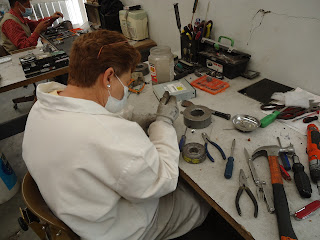
All Fair Trade Recycling wants to do is to make these hand-disassembly jobs (like our women in Mexico, below) de-criminalized.  Give them the proper tools and protection, stop open burning and other "ten worst practices".  There are no mercury switches, there is no "witches brew", hand disassembly is simply an alternative job to gang warefare in Mexico, pirate boating in Somalia, cocaine growing in Peru, sex work in Kenya, etc.

I've usually written about the Geeks of Color.  But the scrappers, too, have been denigrated and defamed in the American and European media.  There are bad practices by hand, and good ones.  Racial profiling is just not a very effective way of deciding, and the "safe" approach of shredding items before export is not a winning strategy for the environment.

Our company practices disassembly here in the USA.   But I'm opening hand disassembly factories in other countries.  They will recycle their own waste from inside their countries.  But if they can do that well, why not let them also take rich people stuff that can still be reused, which puts an even higher environmental outcome... one which is "off the chart".   Survival is the highest form of "end of life" when you're not dead yet.

Our Chicas Bravas in Mexico take a few extra steps and de-manufacture not just the PC, but the components like CDRom drives and floppy disk drives, hard drives, getting things like rare earth magnets and little gold things.  American companies which export intact power supplies, drives, and other "components" may ship them to a similar fate.  But they are all too afraid of the onus against export to visit and find out whether it looks like this or looks like a child sitting on a pile of circuits.

Most American recyclers don't know what this is on the left.  But they "recycle" them by the millions.  Reuse can get very small.