In Part A, I gave RecyHub the review they asked for, suggesting they are trying to place themselves in a halfway point between fallacy and fact. It's a slippery slope, being cozy with a fallacy.
 Why RecyHub thought we'd applaud the webpage? Probably because in Part B, they call for "improving the informal sector". Sounds a lot like what WR3A called "E-Waste Reform" eight years ago, when we too tried to compromise with the Ayatollah of E-Waste.
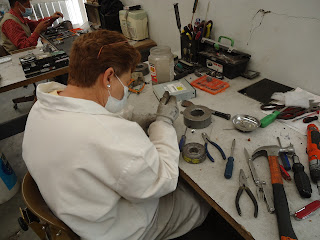
B) E-waste is a source of income and an incipient local industry. Metals and plastics can be scrapped out of old electronics and be sold in local markets for smelting and recycling, closing the materials loop. In Ghana families from the North send their kids to work in the dump because they value more the scarce but regular cash they get for the metals recovered than the irregular income from agriculture. For some Western countries it doesn’t make economic sense to manually remove the metals from e-waste, because it’s labour intensive, while for countries with lower wages it’s more suitable. In contrast, components like printed circuit boards can only be recycled in a handful of factories in the global North (and now in India too, by Attero) and therefore could be exported back, following a philosophy called “Best of Two Worlds” (PDF, 1Mb.). Improving the informal sector, including its workers’ health and safety conditions, could result in a local industry of e-waste recycling.What about the "worst of two worlds"? In part A, @RecyHub implies that the worst is when Europe fills boats with toxic waste electronics and dumps the waste on primitive beaches. I don't think that's the right diagnosis. How about an alternative diagnosis?
The worst of the West is its willingess to assume the worst of the blacks.
The "White Knights" of E-Waste reform accept a comic, rude, and insulting premise.
With less of "the right tools" we can stop shredding value to begin with. Below is my modest proposal, our proposed model at WR3A:
- Start with carefully assessing the situation. Start by asking questions, get a proper diagnosis.
- Sell Africans what they want to buy - working and repairable displays and computers. They prefer a 3 year old they can repair to a 6 year old "tested working". The point is, give African buyers exactly what they want. Ask them why they want things if you are confused, but don't be condescending.
- Once a price is agreed to (about $7,000 per container), offer the Africans a deal. Give them back $3,000 of the containerload if they take back used electronics from African cities each time they sell one. This creates a takeback infrastructure at the used retailers, just as used auto yards are connected to the auto scrap yards.
- With the other $4,000 buy tools, buy better used equipment, do something to incentivize the proper management of used electronics.
- Fly your Western staff to work in Africa (as Vermont does with its staff sent to Mexico), and fly African scrappers to cross train with your staff in Europe (as Vermont does with partners in Africa, Latin America, and Asia).
This takes the $7000 which is WASTED in EU WEEE shredders and uses it to finance the simple hand-disassembly which you've already recognized is a darn good job for many Africans. I don't label this as "inside the box" because the rest of the world doesn't live in the Basel Action Network's box. This is the same "secondary market" economy that automobiles, ink cartridges, ships and airplanes "waste" comes from. Waste is almost never generated from the first purchaser in the chain, unless a conscious decision is made to "obsolete" it. Wealthy people tend not to drive their new cars into the ground, or their cell phones or PCs.
WR3A's Model Improves not just the environment (reuse saves more carbon and toxics than recycling), but the entire Social Progress Index in Africa. Africa doesn't have to make a choice between barefoot-and-pregnant backwater and brand new product. They should be encouraged to tinker their way through the same way that Singapore, Taiwan, Japan and South Korea did, achieving economic growth by repair, recycling, knockoffs, counterfeiting, reverse engineering and contract assembly. Africa's got Terry Gous and Simon Lins and Rowell Yangs all over their cities. They are in their 20s and 30s now. Give them a chance.
 |
| The poor nations growth in internet outpaced the USA's by a factor of ten - using "discarded" CRTs |