Showing posts with label procurement. Show all posts

Procurement to the Rescue of the Right To Repair 2: Chess Game To Future-Proof


While I'm a big supporter of the Right To Repair legislation, a friend in an influential position at DEP (former hire, elevated to my former position) asked the Zoom group whether Right to Repair Legislation should be their top priority.

Fair Use Review

I'm always on my guard against "Group-Think".  Here were 15-20 proponents of reuse, actively engaged in DEFENSE of repair.  What did we all have in common, and how could common thought become a weakness?

In a tweet later, @WR3A (World Reuse, Repair and Recycling Association, my Twitter handle created 12 years ago) I used the words "my one qualm with #RightToRepair [as a movement] is that it is backward oriented. Trying to take back too many chess moves by planned obsolescence which were already played [successfully, by OEMs]... Each new device developed or sold is the next chess game. I recommend government procurement contracts as the opening move."


Ironically, the Right to Repair twitter advocate who responded (a friendly fire incident, if I offended) responded in a quote tweet... "Made the move to influence government buying at least 6 years ago. Have the conference badges to prove it. If only it were that easy. OEMs have made sure that the GSA won't even consider buying used equipment. If only it were that easy..." 

[as if I'd dispute it? I've got them going back to 1990]

My point about Procurement isn't about government buying used equipment. It is about strategically wording FTC-backed warranty language on things the government hasn't even purchased yet. Backward Oriented, Exhibit A?

Super Bowl of Reuse: Nabil Nasr, Adam Minter, Josh Lepawsky vs. PlannedObsoleteScience


Last weekend, we had a reflection on the previous decades of blogging, and our ability to declare successes and failures with the war against global reuse, as waged in the press.  There is a trifecta of 3 books - two of which the blog influenced, and one of which it was inspired by.

Three Most Important Re-Use Books of the Decade:

Reassembling Rubbish by Dr. Josh Lepawsky does an incredible job of surgically dismantling arguments widely cast by Basel Action Network and Greenpeace and other "do-gooders". He researched their IRS 990s, exposed the financial backing of Planned Obsolescence and Big Shred, and provides data to eyewitness the spray of filthy gossip about repairpeople in Asia, Africa and Latin America. While not an emotional read, that was not what we needed. If stoic in delivery, Lepawsky rubbed shoulders with #ownvoices. His team spent weeks living with emerging market recyclers and repairers, including several long visits to Las Chicas Bravas in Sonora Mexico (Retroworks de Mexico). Lepawsky re-thinks the incredible geographic scars of mining industry, comparing risks to the hand-wringing concerns over removing screws in slums like Agbogbloshie. It is incredibly well documented, footnoted, and sourced.

Secondhand by Adam Minter is about "Travels in the New Global Garage Sale". For a more visceral look at the "collateral damage"to the global good-enough markets, this is the best.  Adam turns the corner from being an extremely well-regarded trade journal writer, covering the scrap industry (first book, Junkyard Planet 2013), and dives into the mosh pit of reuse diaspora in Secondhand. Cleverly written, he first makes the used possessions personal - estate sale by estate sale, Goodwill by Goodwill, and his own grandmothers' basement chachkas. He then follows the billion dollar trade to the tech sector in India, China, Mexico, Benin and Ghana, and introduces us, face to face, with the talented and inspiring "others", letting the people in the USA, Europe and Japan hear the #OwnVoices of the racially profiled "primitives" we've been told are too ignorant and stupid to do more than burn the devices they carefully select, test, and purchase. He is a great listener.
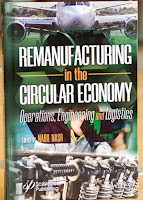
Remanufacturing In the Circular Economy is the newest release by Dr. Nabil Nasr of RIT in Golisano Institute for Sustainability (Rochester, NY).  Unlike Lepawsky and Minter's books, I cannot say I've yet read Nasr's Remanufacturing, but I'm ordering a copy now.  I have been a fan of Dr. Nasr for decades (though he probably barely knew me until the 2013 Fair Trade Recycling Summit in Middlebury). Some of the oldest Good Point Ideas blogs have hyperlinks to Dr. Nasr's stats on remanufacturing, the industrialized growth of scaleable repair (I remember having to learn "hyperlink" code, copy and pasting). As I applied principles in the 2007 Harvard Business Review article "The Battle for China's Good Enough Market" to explain what Asia's tech sector was really doing with the desktop SVGA CRT monitors that CBS 60 Minutes claimed were burned in acid in Guiyu, I could always find sanity in Dr. Nasr's data.  Like Lepawsky, Nasr provides Datajournalists a place to fact-check "80%" of the slop sprayed at us in alarmist NGO press releases.

The team provides Super Bowl stature in the defense of reuse. The table is set for Fareed Zakaria (CNN Global Public Square) to invite these 3 authors and deliver the dagger to racial profiling.  He may want to invite Dr. Grace Akese, who has just recently moved to take a position at Bayreuth University in Germany. Grace provided key insights to Reassembling Rubbish, in particular an "OwnVoices" fact check of characatured Agbogbloshie. Good luck, Grace, in turning Germany's (Kevin McElvaney's) "mirror on itself" back in the right direction. Emmanuel Nyaltey of Fair Trade Recycling would also be a good score. This morning I twitterwarned Fareed (a personal hero from "Foreign Affairs" editor days) that I'd be sending him snail mail to pitch the episode.

Letter to Vermont Legislators: Montpelier, we have a problem

3/26/2014 UPDATE:  For whatever reason ; )   since this was originally published, the Agency decided to issue the rebid.  I'd specifically asked the previous week.    The original post here has been re-edited to reflect the Agency's decision to rebid, though we noted the agency has inserted language to protect it from appeals.

There continues to be a lack of independent review of the Agency's bid process.  Hopefully they will have representation this time from the cities and towns and schools who actually receive the services.  When I was at Massachusetts DEP, the DPGS (procurement office) reviewed our bidding procedures, and appeals were considered part of the "checks and balances".  It remains to be seen how Vermont deals with the prospect of scandal.

After restating our request as a "FOIA", we got the state costs paid under the new contract for the first quarter.


Wait what?  Let's zoom in..


Cost per pound under the new state contract:  $0.42 (if you leave in the 10 days of the injunction, when Good Point charged 28 cents per pound).   Recall that ANR staff testified, under oath, in court, that the difference in cost was negligible, less than a penny per pound.

Attached is an open letter to the Vermont Legislators who are considering the 22 pages of red tape aimed a the Independent Plan, which would become statute (law) rather than a negotiated settlement once ratified.

Heroin Distribution and Procurement Corruption: The Vermont Experience

"Do you know the difference between education and experience? Education is when you read the fine print; experience is what you get when you don't."  Pete Seeger 1919-2014
This month, the Governor of Vermont, Peter Schumlin, made a very brave "State of the State" address, admitting Vermont has a problem - opiates, heroin and meth.

Admitting you have a problem is the first step in Vermont's program.    Thinking "it's a city problem" and we don't need treatment centers is a big mistake.

Another big mistake?  Unlike neighboring states, Vermont has no "procurement law".   It has a representative at BGS on National Association of State Purchasing Officials (NASPO.org).   But when Vermont's administration of it's "E-waste" contract was questioned - not just by the lower and more qualified (per ANR, not in dispute) bidder (me), but by the Solid Waste Districts (customers), and Superior Court Justice (in an injunction) Vermont ANR's response was to quash the FOIA request, and use a "calendar tactic" (redirecting the injunction to Environmental Court, adding a 7 month delay).  (For a reporters coverage of curious contract language written outside of the RFP for CWST, see this article in Vermont Digger, complete with changed signature dates.  Also see Vermont's refusal of the Freedom of Information Act Request at bottom of this blog).

If Vermont thinks it doesn't need a procurement law, like Massachusetts Chapter 30B, it's travelling down the same path as the heroin denial of the past decade.

Yeah, I love my job, and I'm proud of my work, but I'll have other opportunities if ANR's staff's stated objective - to replace Good Point Recycling - is carried out.  And yes, ANR's program manager actually SAID that prior to the RFP being issued (which by itself should have warned the state it needs procurement training).  David Mears, her boss, actually referred to "procurement laws" in defending the state's contracting with Casella (strategically hostile to the Manufacturer Independent Plan, to the point of possible anti-trust and flow control).

It's not a great position to be in, waiving a bloody shirt, crying over a lost bid and hostile regulators.   Why did I do it?  I did it in response to the letter below, from the wife of a subcontractor.  The real loser is the working class.


Good Morning Robin,
I am Harry XXXXs wife, remember he works [nonprofit subcontractor]? I have taken this way out step to contact you because for 5 years now I have constantly had this thought that will not leave me alone that Harry should be working for you. As you probably know Harry at home created a program that can wipe and refurbish up to 50 computers at a time. Harry is also a Linux person, that is recognized around the world and becoming more popular every year. He installs Linux on PC'S that have a tag that is destroyed so Microsoft does not recognize it.
My thought Robin, if you and Harry could see a future in working together, Harry could refurbish your product here at our home. He would still work for XXXX, but in my heart I feel your business would be the best for Harry's
future. Harry is responsible, honest and quiet unless you get him going, then he can tell jokes like no one else, a team player.
I had hopes that you would have had more to do with [our nonprofit] I felt it would have been a good thing. Maybe you could stop in the store on XXX St. in XXX, Vermont, and just look around. No one knows I am writing you, XXX loves what he does and I have felt with your business mind, could be a winning partnership.
Thank you for your consideration on this matter.
Helen XXXX
9 South XXXX St.
XXXXX, Vt. 05XXX

Vermont's Heart

The Governor of Vermont, Peter Schumlin, wants environmental jobs, and wants R2 certification, and wants to wear a white hat.   But he knows he has a problem at the Agency of Natural Resources.   The Agency is protecting itself by using the very line of appeals to clog an Environmental Court docket, essentially shielding itself from bid challenges.

Procurement 101: Vermont E-Cycles Lessons

As the recycling program manager at Massachusetts DEP in the 1990s, I oversaw something like 40 contracts per year (if you include 03 consultant hires).  We went through one of the biggest bid challenges, for the Springfield Materials Recovery Facility, which saved the state about $1 million dollars per year by switching from an incumbent vendor.

We knew that if the incumbent vendor lost, that they were certain to challenge the bid, so I had lots of time with attorneys at MA DEP making sure that each step of our bid evaluation was transparent, and run by NASPO.org standards (National Association of State Procurement Officers).  (Link to Massachusetts Chapter 30B Guidance on Procurement)

The incumbent Springfield MRF vendor did appeal, and they even won an injunction keeping us from awarding the contract to a new vendor.  Even though the state was losing roughly $500,000 during the six month injunction, however, we saw our jobs as making a smooth and continuous transition, and further, to show that Massachusetts DEP did not even want to suffer the APPEARANCE of impropriety.  By NASPO standards, the appearance of shady procurement is just as costly to society as impropriety itself.  Once an injunction is granted, the best thing is to sit down, in full transparency, and let the protester's case be heard.

So we patiently worked with the incumbent vendor, in as professional a manner as we could, until the court hearing.  The court found The Massachusetts DEP's contract procurement process was valid and dismissed the injunction.  But like an appealed referee's call in an NFL game, no one accused anyone of doing anything in bad faith.  And at this time, I'm not making any noise about bad faith in Vermont.

You will see in the news cycle a number of stories about the State of Vermont's E-Cycles ("e-waste") contract procurement, which my company, along with NRRA.net, administered for the past 27 months, with generally rave reviews.   The truth is that before the Vermont electronics recycling law had even passed, my company had already set up the infrastructure, and had a turnkey proposal in place in 2011.

This is not the time or the place to air our concerns about the new 2014 contract, or the merits of the two proposals the state decided between.  But this is a time to look at Vermont Procurement laws, and ask why "safety railings" are not in place to keep vendors and regulators from having it out in the press.  That's what NASPO standards were created to avoid.

"Does the injunction save the state money while providing the public assurance to a fair review of the process?"  If the answers to both questions is "yes", why fight the injunction?  Save tax money, hear the appeal out, and start the new contract when you've won.