Showing posts with label law. Show all posts

Pharmaceutical Recycling 2: Rich Liability vs. Poor World Shortages


George Washington Carver Is Not Liable For Peanut Butter Allergies (he didn't even invent it)

In Part 1, I introduced this topic after opening a piece of mail telling us that a $500-something dollar epipen we own had reached its expiration date.  It made me curious whether the "obsolescence" of the pharmaceuticals equated to actual risk, and made me think about the different financial implications for wealthy, poor, stockholders, etc. And how the psychology of "greed and fear" is used as a persuader to advance the interests of those parties.  From Part 1:
In the case of an epi-pen, "less effective" is certainly a concern if you can afford a new one.  But if my kid starts to suffer a life-threatening peanut allergy reaction, I'm not going to check the date on his epi-pen.

What about "elective upgrade"? Can I sell my expired epi-pen, and buy a new one to satisfy my risk averse kin?  That reduces MY liability (to my son), but is my liability somehow "externalized" to poor people?
Hint:  No

But let's see how the Policy On Pharma Storage or Disposal (not recycling) is covering the exits.

Letter to Vermont Legislators: Montpelier, we have a problem

3/26/2014 UPDATE:  For whatever reason ; )   since this was originally published, the Agency decided to issue the rebid.  I'd specifically asked the previous week.    The original post here has been re-edited to reflect the Agency's decision to rebid, though we noted the agency has inserted language to protect it from appeals.

There continues to be a lack of independent review of the Agency's bid process.  Hopefully they will have representation this time from the cities and towns and schools who actually receive the services.  When I was at Massachusetts DEP, the DPGS (procurement office) reviewed our bidding procedures, and appeals were considered part of the "checks and balances".  It remains to be seen how Vermont deals with the prospect of scandal.

After restating our request as a "FOIA", we got the state costs paid under the new contract for the first quarter.


Wait what?  Let's zoom in..


Cost per pound under the new state contract:  $0.42 (if you leave in the 10 days of the injunction, when Good Point charged 28 cents per pound).   Recall that ANR staff testified, under oath, in court, that the difference in cost was negligible, less than a penny per pound.

Attached is an open letter to the Vermont Legislators who are considering the 22 pages of red tape aimed a the Independent Plan, which would become statute (law) rather than a negotiated settlement once ratified.

SSFF: "NY e-Waste Law is a Disaster?"

Live Presentation by NYDEC
I'm 'live blogging' during a presentation by Mark M. of NYDEC here at the NY SW Federation conference (Sagamore).   Slide one:   NY legislation allows OEMs to claim tonnage from businesses with fewer than 50 employees, colleges, and schools.

Missing slide:  NYDEC does not release the numbers for obligations for the OEMs (as of May), and tells them there is no penalty for not meeting tonnage the first year.  If the manufacturer doesn't know how many tons they are obligated to collect, well, they will pay for the CHEAP tons (computers not curbside TVs).  Our expensive TV recycling is without a "sponsor".

Missing slide:  Outcome - My company drops its largest municipal contract.  After not getting paid for months, we can't expect the OEMs to pay us if they don't have their obligations released.  We should have dropped the TV tonnage months ago and concentrated only on business and college institutional tonnage.


Missing slide:  We were suckers to collect curbside TVs for as long as we did.

Bitter?  Moi?  I'm just reporting on the sour grape harvest from here on the front lines.  I'm sure they have plenty of reasons to call this NY Product stewardship law a success.   But there are signs that they don't know what they are doing, and are making it up as they go along.

PACE Yourself: Basel Logic of e-Waste Export


HP Blackbird 002 Crashes in the Dead of the Night.
An e-waste export crime in the making...

Basel Convention has a section on legal export which says that repairing electronics is not "Waste".  The ENGO Basel Action Network protested that from the beginning, but lost.  The ENGO now seeks to change this via a BAN "Amendment", calling the Convention as ratified as "an unfinished success story"...

In the meantime, while waiting for its amendment to be passed, BAN is fervently presenting the case that export for repair is indeed already waste.   While waiting to get its export-crime law passed, BAN is also trying to get "competent authorities" in importing countries to act as if repair is already illegal.

Blackbird crashing inthe dead of the night
The NGO has already been very successful when either A) the importing country manufactures new products and sees protectionism value in BAN's interpretation, or B) is a dictatorship trying to stop affordable internet.  89.7% of e-waste enforcement I've seen may be within one of these two categories [tic].  Now they are trying to get the interpretation enacted by USA Congress.   This is what HR 2284, the Green Thompson #Ewaste Bill, would do in the USA.

While waiting for export for repair to be made illegal, how is export for repair already in fact illegal?  BAN explains the logic, in their own words. From the BAN Library:


Why All Good Recyclers are Exporters.

There are many good recyclers, and we are all exporters. 
The purpose of certification is to "out" the liars, not to debate the outliers. 


During the past week (blogs below), I've written several essays concerning marketing themes which are "attacking the category".
Negative campaigning, also known more colloquially as "mudslinging", is trying to win an advantage by referring to negative aspects of an opponent or of a policy rather than emphasizing one's own positive attributes or preferred policies. In the broadest sense, the term covers any rhetoric in which one refers to one's opponent in an ad hominem manner. [ wikipedia 2012.02.08]
Negative imagery of competitors' export practices probably accounts for "80% of advertising" for ewaste recyclers (a statistic I just manufactured... see how easy it is for Americans to make things - up?)

Export policy is important, it does matter.  Below are five distinct export categories, and the niches they serve.   How we manage and certify the first four will help us all to control the 5th (see post "Ewaste Travel in Scrap Metal" 2010).   Mixing CRT glass and mercury bulbs into bales of scrap metal is one dumping problem, but ship captains stranded with cargo refused at port is another cause of the same "export for dumping" problem.   Basically, there are five ways for your "e-waste" to get from Here to There.

FIVE CATEGORIES OF E-WASTE EXPORTS

1.  Export No Intact Unit Category:   Some of us feel safer exporting raw materials only, and market the "no intact unit" standard as an option.  These companies attract business from OEMs concerned with reuse (market cannabalization), counterfeiting, or the "grey markets" somewhere in between.  It's a legitimate recycling category.  These companies represent an excellent choice, for example, for an OEM with faulty parts taken back under warranty that they don't want redistributed.  These recyclers export bales of steel, plastic, copper, aluminum, and circuit boards, sold openly on the commodities market.  (slideshow of China's metal recycling companies, which buy shredded material for hand sorting - The Atlantic Monthly 2008)

2.  Export of Tested Working Category:   Some of us sell to retail markets, such as schools or direct retail shops, which are not in the repair business and are willing to pay more for something "fully functional" and "tested working".  The recyclers who sell to the direct-reuse market tend to wipe hard drives, reinstall MAR licenses, and do other things to ensure their exports are what the buyer ordered.  (Slideshow of Egyptian repair / direct reuse markets, 2008)

3.  Export for Repair and Refurbishing Category:   Within the remote corners (83% of the world), there are mind-blowing repair and remanufacturing companies.  Some of these began as contract manufacturers (e.g. CRT factories) and performed warranty repairs as well as assembly.  Some have turned to full-fledge cores refurbishers, creating thousands of jobs in emerging markets, taking back things like old CRT tubes or smallish LCDs and recutting and re-vamping them.  They make things like monitor-television-DVD combos, which are sold in vast quantities to people earning $3,000 per year, who cannot afford to buy all 3 separately.  They tend to be very picky, but not about things like 120 volt power supplies... whether the power supply works or not, it's getting replaced for sale in a 220 volt country.  It's a very legitimate category.  The fact they buy non-working power supplies as well as working power supplies is evidence that they are the opposite of primitive.  Slides of the factories I've visited are available here.

Regulatory Nuts: To Approve Reuse of Waste

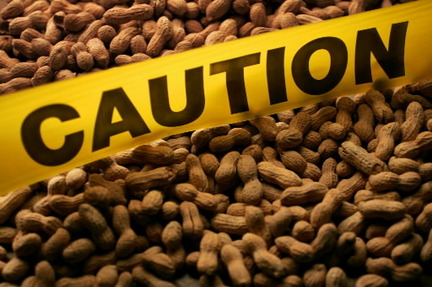
There are peanut allergies.  People can die if they eat a peanut by mistake. [Peanut Allergies Over-Reaction]

At the same time, there is a peanut shortage [Soaring Peanut Prices Hurt Food Banks]

Looks like a job for government regulators.  (I've been on both sides, with a decade as both a regulator and a decade as a private business and a decade in the non-profit / activist sector).

First, at the point the peanut is harvested, you put in rules against harvesting bad peanuts.  Ok, this really has nothing to do with deaths from peanut allergies, but you've been called and it doesn't sound unreasonable.

Peanut Stewardship:    Second, you institute a state procurement plan to pay for destruction of bad peanuts.  You've been told it's really expensive to remove bad peanuts.  So you tax peanut butter, peanut oil, the producers of new peanut snacks, to help pay for the inspection and removal of bad peanuts.

Now, since the peanut collectors are getting state funds (from peanut butter tax), it's reasonable to require more rules and regulations of these nut collectors.   In addition to the rules for what happens to bad peanuts removed through the subsidy program, you add a line about what may happen to the good peanuts.  Surely it's reasonable to track them.

The easiest way to regulate this is to declare all peanuts "bad" or "waste" or "p-waste", and then to set conditions under which they can be "de-wasted".

Local P-Waste Reuse:  You want to know how many peanuts are eaten locally.   Vermont is a small state with porous borders.  Since trucking is harder to track than you thought, you define "local" as the "United States of America".  If the peanuts are sold to Florida, California, Texas, Alaska or Hawaii, they must be tracked.  Define "local" as USA.

An anti-externalization/anti-globalization activist/watchdog suggests that sale of good peanuts could still be a loophole for export of bad peanuts to countries with little infrastructure to deal with them.  "Up to 80%" P-Waste exports result in crying children photos..  Regulators are paying so much for the bad peanut destruction, that would be a terrible loophole, a shame, if some bad peanuts were labelled good peanuts, and paid for by exporters instead of charged to the state subsidy... it would be a failure of the whole state subsidy program if bad peanuts got through.

Again, you don't actually have the authority to under RCRA Waste regulation to seize or regulate good peanuts.   So you define all peanuts as 'pwaste' even if they are not charged to the bad peanut removal program (because they were good peanuts).

Although they are not charged to your bad peanut removal program, the good peanuts must be tagged as "p-waste" at the point of collection.  They can be "un-wasted" if they qualify as good.  This is how you capture Reuse under RCRA, which has defined reuse not to be waste.

You institute a toe-tag label program.  Every single peanut collected in Vermont is labeled "p-waste", so that you maintain the authority in case a bad peanut is labelled a good peanut.  Do not tag bad walnuts, bad almonds, stones, dirt, roots, or  as waste, as these are not "covered nuts".  Not all waste is "p-waste", and not all "p-waste" is waste, and not all p-waste is covered by the subsidy...  clear enough.

Now, to define how good peanuts, not charged to the program, may be used.  Some good peanuts go into peanut butter, some go into peanut oil, some go into snacks.  You now ask the collectors to identify whether the peanuts are going into a snack, an oil, or a butter.  The collectors and farmers explain they don't know, they sell peanuts to a peanut buyer who grades and processes peanuts for sale.

To simplify, since the farmers are allowed to sell for "local" use, and most local reuse in Vermont is for snacks, you define local use to be snacks.  You then write a rule that the collectors can only sell peanuts to snacks, and that if sold as snacks, they cannot be charged to the bad peanut program.  But first they must be tagged as bad peanuts, so that snacks do not become a loophole for poisoning people.

This is not a game.  Remember, environmentalists have pictures of poor children.  People die.  The ebattled regulators have been accused by watchdogs of being pushed around by peanut collectors and processors, you need to demonstrate you can regulate this.  Be firm.

Now, peanuts sent for non-local reuse can be defined to be butters or oils.  You now need a plan from the peanut buyers, the ones who process peanuts for sale to oil, butter, and snack manufacturers. You don't want to complicate the paperwork you've created, so you ban the processors from selling for "local use" (forgetting you have defined the USA as "local", or perhaps not caring, or perhaps just living up to the laws you've written - its a thankless job).

If a peanut is sold as good to the "export" market for oils and butters, it must have been tagged a "waste" but must not have been charged to the "waste" program.  The professional peanut processors complain that selling perfectly good peanuts labelled as "waste" violates the health laws of the importing nation, which is trying to keep bad (waste) peanuts out of their products, and bans use of "waste" peanuts to make butters and oils.  Cleverly, you see this is an attempt to reopen the loophole, and must stand firm.

Now, the processor must define a plan for the export of "un-wasted" peanuts, regulated but not charged to the waste peanut program.  The plan needs to account for whether peanuts are sold for oil, waste, or snacks.  Is the shell removed?  Explain how the shell is left intact for the snack market, or removed for the butter market.  What?  Some snacks, such as candy bars, remove the shells?  Simple, just explain that in your plan so that sales can be approved.  Stop complaining.

Wait.  The bill you sent for waste peanut destruction shows that some peanuts have been removed.  While there was a plan and an understanding that peanuts would be removed for use, the missing peanuts must be labelled and tracked.  That is, in addition to not charging for them through the waste peanut program, and selling them only through a certified non-local (export) oil, butter, or snack program, you must INDIVIDUALLY account for the peanuts removed from individual bags of "p-waste".

All in all they're all just bricks in the wall
The processor tries to explain "triage".  The people like collectors or sorters are trained to remove bad peanuts.  They are not trained to know which peanuts are best sold for candy bars, peanut oil, or crunchy style or smooth peanut butter.  That happens at the buyers, or according to the purchase order QA/QC of the buyers.   Oil buyers have a different specification for "good" peanut than snack buyers.  In fact, a perfectly tested working peanut might not be right for the individual snack, oil, or butter factory.

The fact that a shell-on peanut is not accepted by the oil factory does not mean the shell-on peanut was "bad", but it will become "waste" if you send it to someone who doesn't or cannot shell peanuts.  This is the same fallacy of "tested working" and "fully functional" computers, they are not all acceptable at the best buyers.  Because your solution didn't work for them, that doesn't make them bad people!