Showing posts with label right to repair. Show all posts

Why RERA/SEERA is BAD Export Policy - baby projects thrown out with the bathwater

Much time away from the blog this spring... The RERA/SEERA (Responsible Electronics Recycling Act, rebranded as the Secure E-Waste Export and Recycling Act) made it's sneaky appearance in the House "America Competes Act" in February 2022. I've been writing letters, and editorials against Section 30612.

That's scary. Under the Texas (always Texas, since Green Thompson) amendment, and now 

S.1260 - United States Innovation and Competition Act of 2021.

But rather than blog about it again, I want to list the cool projects Good Point is working on that might be ruined by the anti-export law.

1. Reopen refurbishing factory in North Africa.


more

Right To Repair During Pandemic


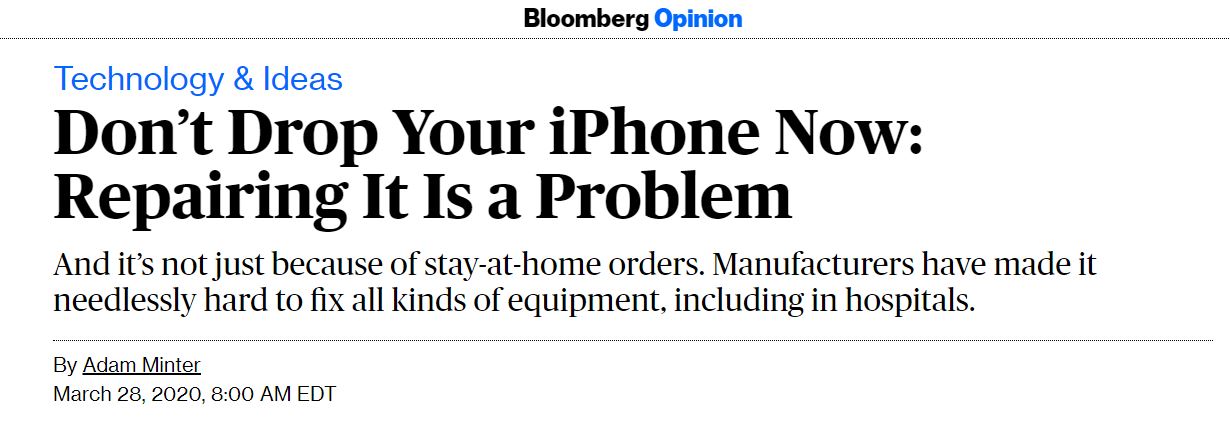
This morning brings an astute opinion page article by Adam Minter of Bloomberg, about how we are more vulnerable today to anti-reuse and anti-repair (planned obsolescence) strategies today than we were a couple of months ago. Apple has closed its "authorized" repair hubs, and the crackdown on trade in Asia during the pandemic has made replacement devices much more difficult and timely to order.

https://www.bloomberg.com/opinion/articles/2020-03-28/apple-s-rules-make-iphone-repairs-hard-to-get-amid-coronavirus?srnd=opinion

This excellently explained column may give Right To Repair legislation the push that it needs in Vermont. I will certainly be sending it to my legislators in Addison County.

Adam Minter is a swordfish - a reader who is interested in, understands, and re-conveys messages better and more broadly than you can. The meta-blogger should not be interested only in the number of readers (the most widely prescribed blogging strategy) or page rank, but in the ability to draw in a deeper intellectual with the capacity to make change. Of the three books of 1960 which influenced me deeply - To Kill A Mockingbird (Harper), Silent Spring (Carlson), and The Waste Makers (Packard) - the third is perhaps most under threat by big manufacturers. It is getting cut out of school books. More below on why that matters...

Swordfish-0046
Fishing for Swordfish
(This blog is both about a personal history on the subject of interest - right to repair - and also a commentary on "meta-blogging" which is a strategy of writing dense blogs that attract fewer - but more influential - followers)

Crass and Stupid Attack on Right to Repair: Jim Puckett


Just a reminder, Jim Puckett of Basel Action Network calls repair a "loophole" for waste exports.

He does not know anything about repair.

He knows FAR less than Joe Benson.

He wants white people to be in charge of what black people are allowed to buy.

Privilege.

Who was the liar - Joe Benson or Mike "Fishing as a Boy" Anane?


"Where is the proof? If you find a container where I load it, pay shipping duty, pass it through customs, and put it in a landfill, show me.  If you find I did that, put me in prison for 100 years. I will stay in prison for 100 years."


 "Ten years ago, this (Accra city dump since 1960s) was a beautiful paradise, where I was fishing and swimming as a boy".

Basel Action Network publishes and promotes lies aimed specifically and purposely at the repair sector, and gets big donations from manufacturers who oppose "market cannibalization" (sale of their own products in secondhand markets).

A year ago Jim Puckett re-promoted his filthy lies about Ghana's tech sector, in his self-penned false liar piece "A Place Called Away", where he unleashed INTERPOL upon Joseph "Hurricane" Benson, telling Europe that 80% of used electronics would not be repaired but burned by "thousands" of orphans.

It is a bigger lie than even Donald Trump can tell.  Why oh why does he get away with it?


First "Fan Mail" from Secondhand, Right To Repair in Connecticut

Got a letter from a resident in Connecticut this morning, who had just finished reading Adam Minter's new book "Secondhand".  I won't expect many of them, but figured I could be public in my response as to why Connecticut is the ONLY state in the Northeast we do NOT collect used electronics from.

The history has to do with the regulators who wanted to apply hazardous "Universal Waste Rule" regulations to used electronics, effectively classifying "Secondhand" as "Waste" under RCRA. A regulator once told me he believed he could legally take away my smart phone if it was "non-working".  

Here's the response to our fan in Connecticut...

Hi Chris, 
Thanks so much.  
Ironically, I was Division Director at Massachusetts DEP when Tom Metzner was writing the regs for your Connecticut. We split over the issues (exports, and what I felt was racially profiling the tech sector in emerging markets) that keep my company (established 2001 when I left MA DEP) from doing business in Connecticut (the only state we don't collect in). In Tom's defense, we were both being bombarded with propaganda from the hazardous waste and Big Shred sectors. I was just fortunate to have travelled to meet the people who were trying to buy stuff, and having surveyed 200+ TV and computer repair shops in New England (who explained a TV is a lot more hazardous plugged into a wall and broadcasting ads in your living room than it is in a landfill or recycling yard).
Yep, we accept 1) anything with a cord, and 2) cordless electronics.  
If you want to contribute further, or spread the word, visit WR3A.org or its new website fairtraderecycling.net, a non-profit that acts as an "anti-defamation league" for geeks of color. 
Robin

Help Us Define "Waste Colonialism": Talking Secondhand

Looking for University Research to Help Us Define "Waste Colonialism"...

Actively seeking university researchers interested in "waste colonialism", or the use of apparently environmentally minded rules to serve planned obsolescence and protectionism. #wastecolonialism #freejoebenson #fairtraderecycling
🤠
🧐

"Waste Colonialism" comes up in the final chapters of Adam Minter's new bestseller "Secondhand: Travels in the New Global Garage Sale".  Adam kicked off his book tour at the University of Vermont, in part to thank my company and our global partners for "dropping our drawers" and giving him access to secrets of the trade.

In fact, the next to last chapter is titled "A Rich Person's Broken Thing". That is drawn directly from conversations I had with my Ozarks grandparents, both on the farm as a child, and in long talks with them after I returned from the Peace Corps in Cameroon, Africa (June 1984-December 1986). Adam captured my grandpa Clarence Fisher's anecdotes about when automobiles first came to the Ozarks (his own father had a horse and wagon, and signed his name with an "X"). As many family members were leaving the Ozarks during the Great Depression (along the "Hillbilly Highway"), his older brother, he said, got into the used automobile business. He explained that no one they knew could afford a new car (and the unpaved roads would be heck on them anyway). Used cars were affordable... but his brother's method was to go to St. Louis, Memphis, or Chicago and listen for sounds a car was making when it had broken down or was about to. If you knew what went wrong with a car, what the sound that problem makes, and how to fix it, you could buy the "rich man's broken thing" for a lot less. They'd bring it down to Cedar Valley, fix the car, and flip it for the price of a working used car.

I explained to my grandparents how I'd seen Africans doing that exact same thing. And Adam not only put it in the book, but recounts the tale of Joseph "Hurricane" Benson of BJ Electronics in England, who was sentenced to prison for buying used hotel CRT TVs and selling them to Africa.

Adam shows the wisdom of the African traders, and accepted my challenge, which was to ask why do rich countries (and in particular white people, because Japan and South Korea don't do this) create "rules" by which Africans can buy secondhand equipment?  And when the UK House of Commons reported that the African exports needed to stop - not to "save" the Africans from pollution, but to retain "strategic minerals and metals" for European industry - why did no one from that House of Commons think it worthy to write the UK Barrister who was recommending Joe Benson be prosecuted?

Adam's answer is "waste colonialism". He doesn't use "racism" the way I have in the blog, but he certainly calls out the bigotry involved in confusing (sometimes deliberately) the secondhand (and "thirdhand") Tech Sector with the unschooled wire burners of the scrap sector.

As I said when apologized to 7 years ago, the apology from Basel Action Network should not be made to me, but to the Africans, Asians and LatinX whom the NGO has been racially profiling as "primitives".


Alexis de Tocqueville, Democracy in America v. Planned Obsolescence

Since I often have to hunt this down, here is copied the best Defense against accusations of "Planned Obsolescence". Alexis de Tocqueville's Democracy In America, Volume 2, Chapter 8.

Note that it has nothing at all to do with piracy, counterfeit, gray market.

When a company correctly estimates that too much 'value', too much repairability, is being given to the market, and 'downsizes quality', that may actually be good for the environment.

Alexis de Tocqueville, Democracy in America. English Edition. Vol. 2.  
"You cannot believe how many facts flow naturally from this philosophical theory that man is indefinitely perfectible,d and the prodigious influence [762] that it exercises on even those who, occupied only with acting and not with thinking, seem to conform their actions to it without knowing it. 


Right To Repair in Nashville: Red Light, Green Light, Purple Light

Here in Nashville for Electronics Reuse Conference.  Formerly the TechSoup conference, which had mostly NGOs engaged in the Digital Divide, the conference is now managed by a private Chicago company. I was proud to receive a "Jim Lynch Lifetime Achievement Award" last year, when the conference was in New Orleans. Jim Lynch himself nominated me - and said he had done so every year since the award was established in his name, a something that really touches me.

Jim and I shared a 5 hour drive from the Retroworks de Mexico plant in Fronteras, Sonora, a few years ago. We shared a rather romanticized concept of India in our youth.  I didn't go there to meditate, as Jim did for a year.  Perhaps because when I said I intended to, my chum Sri Chatrathi from Fayetteville High School remarked "Go smoke pot in your own country, we don't need any more white hippies in India."


This week, Nashville is about the Right to Repair. A lot has been happening, and more of us are realizing that a Right To Repair is simply an invitation to Manufacturers to restrain their own speed. Once the government has a chair at the table, look what happens.

Feds say Hacking DRM to fix your owned phone is LEGAL.

Consumer Reports Magazine covers this as well.

Poison Apples 2: Profiting from Ewaste Cures

Things that seemed very important to write about 6 years ago (about things like desktop CRT monitor remanufacturing in Asia, and California SB20) now seem less vital.  But while public discussion of the topics in this blog has quieted, and some wins (like Mr. "Fishing as a Boy" Anane being actively edited out of certain documentaries) institutionalized, individual cases of racial profiling of the emerging market's tech sector continue. I receive a lot of thank yous "under the table".

What I have learned over the 11 years of writing this blog is that being passionate about environmentalism is like being passionate about cures for human sickness and disease. It is a hot topic until the disease is cured, but that different populations struggle with different levels of risk.

And the importance of being green is not passeé.  The theme is to improve environmental health the way we improved human health. Sometimes, that means standing up to the liar wearing the doctor's white coat, promising to end suffering by selling a cure they've barely tested....


E-Waste Policy looks a great deal, through the lens of history, like 1960s infant formula sales.  My mom recently recalled that when she was breastfeeding me at the hospital in Harrison Arkansas in 1962, a nurse in the room asked her, "What are you trying to prove?"  Mom was only 19... but thank god she could see past the nurse's labcoat.