Showing posts with label Lepawsky. Show all posts

Certification and Racketeering: Part 2 The Guardian Deceit


Definition:   RACKETEERS OFFER A DECEITFUL SERVICE TO FIX A PROBLEM THAT OTHERWISE WOULDN'T EXIST.

"We don't want to have to go after you." - JP to yours truly during California Compromise negotiations in 2010.

"I'm not hiding anything, and don't think much of your threats" - My response.

Basel Action Network "goes after" people through the press. This week, The Guardian's environmental desk proves just how easy that is.  Sandra Laville's headline "UK worst offender in Europe for electronic waste exports - report" diligently puts out the hit, failing to interview a single African or Asian technician or importer.

Free Joe "Hurricane" Benson, much?


Mistaking Africa's Tech Sector (importers) for Africa's Scrap Sector (city wheelbarrow scrap collectors) is like mistaking a surgeon for a janitor because he's black.  The only proof BAN provides is a photo of a janitor.  

There are several other really really simple things to find on the internet which should have given The Guardian's editors pause. I'll tick them off briefly, but stick to the point. BAN has created a problem that wouldn't otherwise exist (false reporting, sabotaged equipment, fake statistics) for the purpose of generating millions of dollars from BAN E-Stewards. BAN not only threatens companies that don't pay them, but makes examples out of those of us who defend the Geeks of Color. It is the valedictorians in the Tech Sector who suffer the worst consequences of BAN's sabotage.

BAN doesn't just sabotage their equipment. It sabotages their reputation, and the reputation of anyone with the courage to trade with them, rather than boycott them. (In Part III, we'll look at who finances this sabotage).

Reversing Environmental Racism #2


This Good Point Ideas Blog has a dandelion in the background.  The wind is blowing the seeds. The image isn't random.

Some people consider the dandelion to be flower. Some consider it a salad green. But many consider it a weed.  Some of my earliest memories of "ethics" were my parents and great aunt's explanations of why I should be careful about blowing on mature dandelions, the "controversy" or "ethics" of spreading the seeds of a flower that will blow onto other peoples' lawns. My parents told me they don't mind dandelions on their own lawn, but others felt differently.  The issue, my dad said, was whose property the dandelion seeds landed upon.

On the first year anniversary of the passing of my dad, William J. Ingenthron, professor of Mass Communications and Journalism at the University of Arkansas (and Fresno State), I find myself reflecting on the dandelion discussion.  I was probably 3 and a half years old at the time, standing on the lawn at Auntie Maude's home in Columbia, Missouri, where my dad was to earn his J-School degree (I do have memories of 2 and a half as well, and possibly earlier).

"That is frowned upon here."

That "frowned upon" expression was expressed to me about 18 years later, when I had just thrown a lit firecracker out of a Carleton College dorm window.  And I did feel a little chagrin about that, though my friend and future Co-RA Peggy shrugged just afterwards, saying "I smile on it".  Using social consensus to define ethics is an interesting tool. Juries do it.  And consensus forms the crucible of the most important theme of this blog - Environmental Racism.  Accidental environmental injustice. Collateral damage. Friendly Fire...

It matters who we ask.  And after about 10 years, the chief "Authority" - Secretariat of the Basel Convention - has recognized that its first foray into screening used electronics sales had not asked enough people about the ethics and effects of used electronics exports. A little pat on the back here - I never attended a PACE meeting. But we were recognized for our contributions by SBC's Partnership for Action on Computing Equipment (PACE)...


The primary comment we submitted ten years ago was that Emerging Markets Technicians (not just regulators) had to be consulted in the drafting of the PACE Guidelines.  If OEMs (Planned Obsolescence), Secondary Smelters (Big Shred), and NGOs (White Saviors) were drafting the rules without consulting Africa, Asia and Latin America's Tech Sector, they were likely to do more harm than good.  As Emmanuel Nyaletey told the IERC conference in Salzburg, Austria, last month (my paraphrase) "writing rules for used electronics repair without consulting with African technicians is like writing a health manual without ever talking to a doctor."  The buyers know what they want, thank you.

Some consider used electronics to be a weed that must be kept on our own lawn.  Some consider them a flower.  And some consider them a source of income, a way to put food on the family table.

Here's an interview with a man, Olu Orga, who started in Agbogbloshie, and worked his way into Ghana's Tech Sector. If the Secretariat or the Basel Convention has something to thank American Retroworks Inc for, it's for keeping the doors and windows open during an echo-chamber of false claims and ewaste hyperbole.  As everyone sought to prove they weren't dumping on the poor, they became ashamed to admit friendships like this, if they were even brave enough to have them.

False Fears

Breaking News: As HK WEEETRF, So Follows Accra's "Ewaste" Moon Shot?

Another logical conclusion to all the research into NGO's proposed bans on E-Waste Exprot Trade.

"Hey, we can do it right.  We can repair and recycle better than you can"

As goes Hong Kong, so goes Agbogbloshie, Accra, Ghana.  A $30M State of the Art E-Scrap Recycling Plant is breaking ground in Ghana.   In January, I'll be there.
The Ministry of Environment, Science, Technology and Innovation in partnership with the Environmental Protection Agency are set to commission the construction of a recycling facility at Agbogbloshie in the Greater Accra Region. 
Estimated at $30 million for the first phase, the facility is expected to recycle all waste electrical and electronic equipment to final products in an environmentally sound manner, relieving the people of Accra and its environs, specifically Agbogbloshie community of toxic pollutants generated from the burning of e-waste. - See more at: http://citifmonline.com/2016/11/23/govt-to-construct-30m-e-waste-facility-at-agbogbloshie/#sthash.EpjnrmbK.dpuf
Once again, the solution to "sweatshops" is found to be "air conditioners".  Given the choice between moving business back to "Big Shred" in Europe and the USA, the Tech Sector in Emerging Markets says "Thanks but we like managing this, and by the way we're really, really good at it".


Finally the End of Ewastegate?

Jujitsu Lesson: Toxic Culture of Victim Identity

Over the decades, this poverty identity has grown from subconscious awareness to thematic.

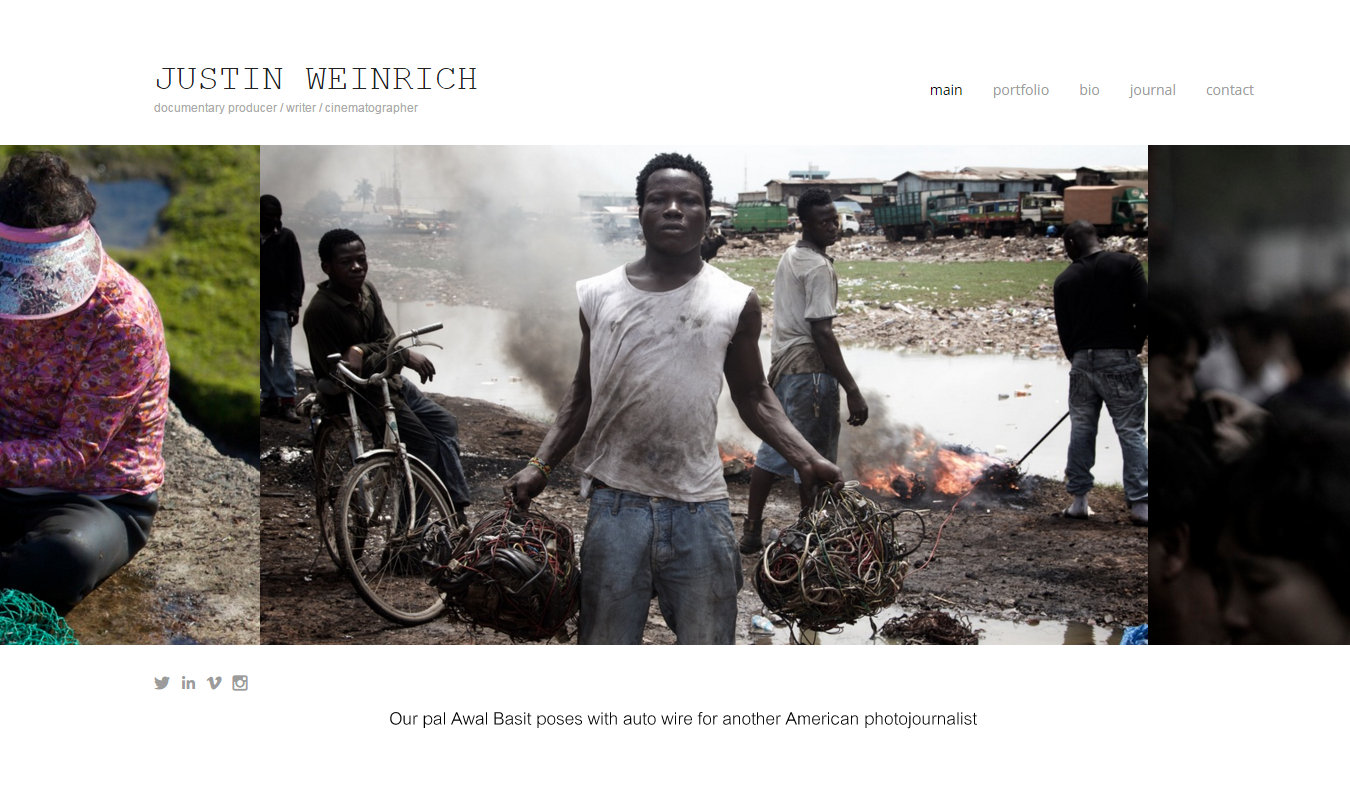
A few weeks ago, Awal Basit [E-waste Scrapper, Dying for Attention, 1/16], one of the leaders of the "Scrap Men" (rather than "scrap boys", cred to Lalouschek/Wondergem) was calling my cell phone a ridiculous number of times per day.  I try to keep relationships with people I spent weeks with in Ghana.  Drive by saviorism isn't sustainability.

The technicians - Kamaldeen, whose dad made me the fairtraderecycling,com bracelet, Elvis, Yussif, Kamal and his wife, etc [all from Chendiba Enterprises]- might call occasionally, and we chat by Facebook Messenger or WhatsApp at least a few times per week.


How's it going?  How's the family?  Hey, it's national service day.  yeah? what's that?  You know, it's good to stay acquainted.

Awal and the scrappers are the Ghanaians of the north who never went to school.  He struggles even with Pidgin English.  Awal's text messages, outside of a few platitudes, are a mystery.  He's from the other side of Tamale's tracks.

The young men burning wires in Agbogbloshie typically don't have the parenting or resources of Chendiba dudes.  Geeks of color are typically valedictorians. Awal and his crew are not just "out of Africa", they are out of an unpenned Soukous Hilife William Faulkner novel.  They all live in a poor country, they all come from the same tribe and language and region.  But the Chendiba Techs are using downloaded schematics to fix TV tunerboards. They feel somewhat awkward around the guys who took the bus to the big city and live in a lean-to on Agbogbloshie's skid row.

In the Simpsons, the Chendiba techs are Lisa, and Awal is ("ha-ha") Nelson.  Awal is on the streets and he has to show he's tough.  He calls me whenever he feels like, having evolved far afield of pleasantry and shyness.  When I get perturbed and stop taking his calls (usually when I've forgotten to turn on airplane mode and my phone goes off at 3AM with the whispering distinctive ring I've applied), he starts sending photos on whatsapp.  Photos of burning wire.

"Your guilt gives me leverage!"
As I said before, he wants attention.  He's alone.  He sees an opportunity but doesn't understand what to do with it  Like the proverbial dog who caught the bus, Awal has a personal relationship with someone he may imagine to be as rich as Donald.  And what got him that attention, and the interviews with Justin Weinrich and other photojournalists, is burning wires.

When someone begins to feel that their disadvantage is their attraction, it can become toxic in a whole new sense.  As in toxic employee, toxic manager.  I'm important because of my gripe.  My victimhood, my lack of privilege, is the only currency I have.  Your guilt gives me leverage.

Barenaked #PovertyPorn: Venn Diagram Shows Truth of Africa EWaste Market

Pal Adam in Malaysia forwarded this to me, suggesting it was good blog fodder.  And it is, except that it speaks for itself.

http://www.phnompenhpost.com/dirty-tourism-cambodia

Here is a story which cannot seem to "speak for itself" to many reporters I meet...

In 4 days I'll be leaving to meet three reporter/documentarians at Agbogbloshie, who are working on a very similar story in Ghana.  I've provided each with some of the same information.  I have shared hard data on the sources of these diagrams, but will still treat it as a "thesis" and look for evidence to confirm or deny the "E-Waste Hoax" from the heart of Agbogbloshie, Ghana.

Here's my thesis:

  1. Wealthy OECD nations use brand new computer displays, TVs and cars for about 4 years average (afterwards these go into the "secondary market").
  2. CRT displays and cars last an average 15-25 years (depending on hours of use / mileage)
  3. Rapidly urbanizing cities like Lagos and Accra have electricity, average per capita incomes of about $3000 per year, and access to television broadcast and internet (and highways).  The purchase price of the electronics is a very high percentage of wages, which supports a vibrant repair infrastructure.
  4. Repairpeople (like Joe Benson, Emmanuel Nyaletey, Wahab Odoi) can repair 15 year old electronics sourced in Ghana and Lagos, but make far more money repairing (or finding working) appliances that are 4-5 years old from wealthy nations.  
  5. As appliances from the 1990s and 2000s wear out in Ghana and Nigeria, most owners take them to be repaired, but are often convinced instead to buy a newer 5 year old model from London rather than repair their 20 year old appliance from London.
  6. The commerce funding the imports of 500+ imported containers per month is the reuse and resale market which sells affordable "good enough" technology for 25% the cost of brand new.

Explaining the circles... New product sales are estimated at 30% of total sales.  That's like Egypt in 2002, and it will change (today new product is a higher percentage of Egyptian markets).   Used electronics products are estimated at 70% of electronics sales.  A small portion of each may go "directly to Agbogbloshie", but it is far more likely (85%-93%) will be used for a decade or more.    Meanwhile, most of the "junk" at the African dump have nothing to do with electronics.


Even if no imports at all come to Accra, the amount of scrap and waste arriving at Agbogbloshie will continue to increase for the next 15 years, based on sales documented by World Bank in 2003.