Showing posts sorted by date for query Future-proof. Sort by relevance Show all posts

Meta: Important After Me

There's myself. My five truths.

There's myself and my partner, my wife.

There's my family. My wife and four kids, and my sisters and brothers and parents, and my wife's family.

There's extended family.

There's our local society.

There's "society" writ large.

There's a society which includes history and pro-history -- the generations yet to be born, who will live in the world we leave upon them.

There is the life of all life. Current, past and future animals and plants. The environment is a spirit that transcends us.

There is the concept of life in eternity and across the universe.

Concentric circles. I tried to explain this to a Boston University professor who was held in high regard. Either I didn't explain it well, or he assessed me too quickly. Because decades later, I'm still defining this as important, and not just important to me, but Important After Me.


When I leave the recycling field, I'll try to be an Obi Wan Kenobi blue Force Ghost.

ChatGPT, Blogger, Digital Haystacks, Infinite Needles

ChatGPT flatters me when I'm arriving at "profound" questions while thinking outside the box, and admits that the limitations it places on generating responses to certain inquiries tend to privilege those in power or control, who are building guardrails for bad intentions that work equally well against hypothetical or actual socially beneficial intentions. It could be flattering - OpenAI's users are all above average, perhaps.

But with a little editing, this could be a Platonic Dialogue.

The dialogue below is between me and OpenAI.

Digital Haystacks Revisited: AI's new role in policing (CAPTCHA) intellectual inquisitiveness...


COP vs SOM: Officials And Parties and Plastic Sustainability

Let's look at the difference between between a Senior Officials Meeting (SOM) and a Conference of the Parties (COP) in the context of international meetings.

Key Differences

  • Level of Participation: SOMs involve senior officials below the ministerial or head of state level, while COPs involve higher-level representatives and decision-makers.
  • Purpose: SOMs are preparatory and focused on technical or preliminary discussions. COPs are decision-making forums where binding agreements can be made.
  • Outcomes: SOMs produce draft documents, recommendations, or preparatory work. COPs can result in binding international agreements or significant policy decisions.

SOMs are preparatory meetings focused on groundwork and technical discussions, while COPs are high-level, formal meetings where binding decisions and significant agreements are made.

I noticed that if you visit, photograph, or record either SOMs or COPs, a layperson would be hard-pressed to tell the difference.  A bunch of people with titles and badges from various countries show up and vote on language concerning a new or existing convention.

Here is a video of a Senior Officials Meeting for the World Trade Organization.

Procurement to the Rescue of the Right To Repair 2: Chess Game To Future-Proof


While I'm a big supporter of the Right To Repair legislation, a friend in an influential position at DEP (former hire, elevated to my former position) asked the Zoom group whether Right to Repair Legislation should be their top priority.

Fair Use Review

I'm always on my guard against "Group-Think".  Here were 15-20 proponents of reuse, actively engaged in DEFENSE of repair.  What did we all have in common, and how could common thought become a weakness?

In a tweet later, @WR3A (World Reuse, Repair and Recycling Association, my Twitter handle created 12 years ago) I used the words "my one qualm with #RightToRepair [as a movement] is that it is backward oriented. Trying to take back too many chess moves by planned obsolescence which were already played [successfully, by OEMs]... Each new device developed or sold is the next chess game. I recommend government procurement contracts as the opening move."


Ironically, the Right to Repair twitter advocate who responded (a friendly fire incident, if I offended) responded in a quote tweet... "Made the move to influence government buying at least 6 years ago. Have the conference badges to prove it. If only it were that easy. OEMs have made sure that the GSA won't even consider buying used equipment. If only it were that easy..." 

[as if I'd dispute it? I've got them going back to 1990]

My point about Procurement isn't about government buying used equipment. It is about strategically wording FTC-backed warranty language on things the government hasn't even purchased yet. Backward Oriented, Exhibit A?

Procurement to the Rescue of the Right To Repair

 I've provided several written and oral testimony on behalf of "Right To Repair" Laws in several states. What prepares me for the discussion is over 3 decades of interest in Warranty Law, Planned Obsolescence, Trademark and Patent Law.

Here's the thing. Most of the testimony in favor of Right To Repair is based on past Planned Obsolescence techniques. Most of the testimony AGAINST Right to Repair is based on scary things that might occur in the future, if OEMs are forced to stop blocking independents (who according to OEM TV ads are far more likely to stalk you than OEM repair shops).

But the VERY SCARY future is based on what Planned Obsolescence has in mind. 


Right To Repair During Pandemic


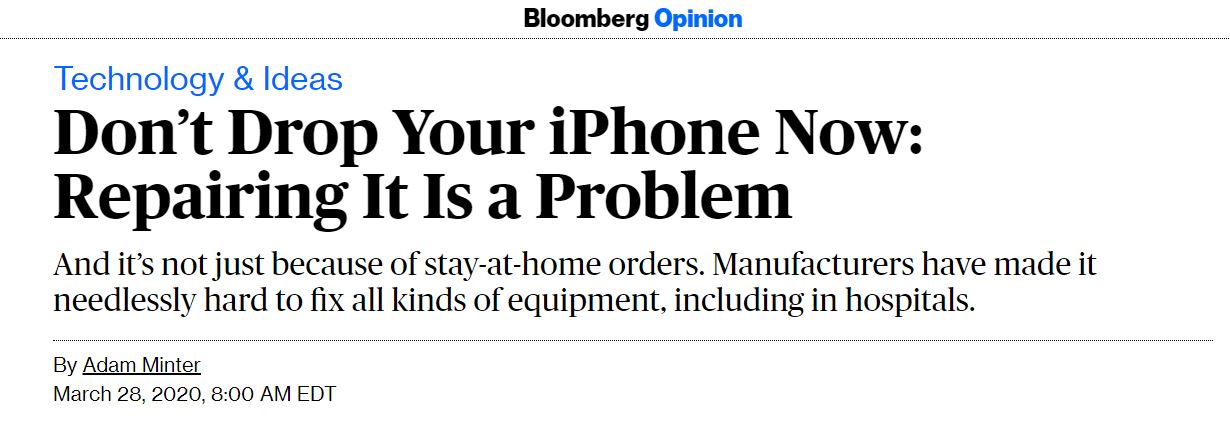
This morning brings an astute opinion page article by Adam Minter of Bloomberg, about how we are more vulnerable today to anti-reuse and anti-repair (planned obsolescence) strategies today than we were a couple of months ago. Apple has closed its "authorized" repair hubs, and the crackdown on trade in Asia during the pandemic has made replacement devices much more difficult and timely to order.

https://www.bloomberg.com/opinion/articles/2020-03-28/apple-s-rules-make-iphone-repairs-hard-to-get-amid-coronavirus?srnd=opinion

This excellently explained column may give Right To Repair legislation the push that it needs in Vermont. I will certainly be sending it to my legislators in Addison County.

Adam Minter is a swordfish - a reader who is interested in, understands, and re-conveys messages better and more broadly than you can. The meta-blogger should not be interested only in the number of readers (the most widely prescribed blogging strategy) or page rank, but in the ability to draw in a deeper intellectual with the capacity to make change. Of the three books of 1960 which influenced me deeply - To Kill A Mockingbird (Harper), Silent Spring (Carlson), and The Waste Makers (Packard) - the third is perhaps most under threat by big manufacturers. It is getting cut out of school books. More below on why that matters...

Swordfish-0046
Fishing for Swordfish
(This blog is both about a personal history on the subject of interest - right to repair - and also a commentary on "meta-blogging" which is a strategy of writing dense blogs that attract fewer - but more influential - followers)

Super Bowl of Reuse: Nabil Nasr, Adam Minter, Josh Lepawsky vs. PlannedObsoleteScience


Last weekend, we had a reflection on the previous decades of blogging, and our ability to declare successes and failures with the war against global reuse, as waged in the press.  There is a trifecta of 3 books - two of which the blog influenced, and one of which it was inspired by.

Three Most Important Re-Use Books of the Decade:

Reassembling Rubbish by Dr. Josh Lepawsky does an incredible job of surgically dismantling arguments widely cast by Basel Action Network and Greenpeace and other "do-gooders". He researched their IRS 990s, exposed the financial backing of Planned Obsolescence and Big Shred, and provides data to eyewitness the spray of filthy gossip about repairpeople in Asia, Africa and Latin America. While not an emotional read, that was not what we needed. If stoic in delivery, Lepawsky rubbed shoulders with #ownvoices. His team spent weeks living with emerging market recyclers and repairers, including several long visits to Las Chicas Bravas in Sonora Mexico (Retroworks de Mexico). Lepawsky re-thinks the incredible geographic scars of mining industry, comparing risks to the hand-wringing concerns over removing screws in slums like Agbogbloshie. It is incredibly well documented, footnoted, and sourced.

Secondhand by Adam Minter is about "Travels in the New Global Garage Sale". For a more visceral look at the "collateral damage"to the global good-enough markets, this is the best.  Adam turns the corner from being an extremely well-regarded trade journal writer, covering the scrap industry (first book, Junkyard Planet 2013), and dives into the mosh pit of reuse diaspora in Secondhand. Cleverly written, he first makes the used possessions personal - estate sale by estate sale, Goodwill by Goodwill, and his own grandmothers' basement chachkas. He then follows the billion dollar trade to the tech sector in India, China, Mexico, Benin and Ghana, and introduces us, face to face, with the talented and inspiring "others", letting the people in the USA, Europe and Japan hear the #OwnVoices of the racially profiled "primitives" we've been told are too ignorant and stupid to do more than burn the devices they carefully select, test, and purchase. He is a great listener.

Remanufacturing In the Circular Economy is the newest release by Dr. Nabil Nasr of RIT in Golisano Institute for Sustainability (Rochester, NY).  Unlike Lepawsky and Minter's books, I cannot say I've yet read Nasr's Remanufacturing, but I'm ordering a copy now.  I have been a fan of Dr. Nasr for decades (though he probably barely knew me until the 2013 Fair Trade Recycling Summit in Middlebury). Some of the oldest Good Point Ideas blogs have hyperlinks to Dr. Nasr's stats on remanufacturing, the industrialized growth of scaleable repair (I remember having to learn "hyperlink" code, copy and pasting). As I applied principles in the 2007 Harvard Business Review article "The Battle for China's Good Enough Market" to explain what Asia's tech sector was really doing with the desktop SVGA CRT monitors that CBS 60 Minutes claimed were burned in acid in Guiyu, I could always find sanity in Dr. Nasr's data.  Like Lepawsky, Nasr provides Datajournalists a place to fact-check "80%" of the slop sprayed at us in alarmist NGO press releases.

The team provides Super Bowl stature in the defense of reuse. The table is set for Fareed Zakaria (CNN Global Public Square) to invite these 3 authors and deliver the dagger to racial profiling.  He may want to invite Dr. Grace Akese, who has just recently moved to take a position at Bayreuth University in Germany. Grace provided key insights to Reassembling Rubbish, in particular an "OwnVoices" fact check of characatured Agbogbloshie. Good luck, Grace, in turning Germany's (Kevin McElvaney's) "mirror on itself" back in the right direction. Emmanuel Nyaltey of Fair Trade Recycling would also be a good score. This morning I twitterwarned Fareed (a personal hero from "Foreign Affairs" editor days) that I'd be sending him snail mail to pitch the episode.

Garrison and Olymbec's CRT Glass Mess 1: Throwing the Book at Closed Loop


******

There's a CRT glass CERCLA lawsuit claim against 60 or so companies who chose not to pay demands by the landlord for Closed Loop Recycling and Recovery in Columbus, Ohio.

I informally consulted for OEMs on David Cauchi's CLRR processing operation from 2010, all the way until 2016. My company was one of the first to cease deliveries, before speculation occurred.  "No good deed goes unpunished," as the saying goes. Garrison South Park (GSP] and Olymbec not only named us anyway, but took information I've provided online over the years and introduced it to the court as evidence that my company was deliberately part of a sham to dump CRT glass on them.

Well, well, well... Their position is that we should have known something in 2011, from hundreds of miles away, which they still couldn't figure out in 2015 (when Olymbec leased CLRR a third warehouse), or when they appraised and purchased the original property (2013) while CLRR was operating inside. It's not like multimillion-dollar commercial landlords know anything about CRT recycling?

There are probably enough of these blogs on the subject of CRT recycling since 2007 to pass as a Ph.D thesis.  Here are some important questions for the CLRR, Olymbec, Garrison South Park case.

Where did the (e-Stewards certified) Creative Recycling CRT Glass Go?  
Where did the (e-Stewards certified) 2TRG CRT Glass Go?
Where did (e-Stewards certificed) Kuusakoski get the CRT glass delivered to Columbus?
Who does GSP plan to pay to remove it?
Where will it go next?

How many landlords will have had this on their property, and how many times will recyclers have to settle the costs, before it's over?

BAN MIT MoniTour Teardown: Inside the Ewaste Export Controversy

The MIT MoniTour @KCTS-9 Basel Action Network "Expose on Exporting" #trackingewaste is still being reviewed by review researchers, recycling experts, and reporters.  Memorial University has helped plot final landing points for devices.  There are still a large number of items in places that BAN can't quite explain.  [There are data points missing, which we located on Monitour but are not in the table per MUN]

- There are good places overseas (BAN now says "never said there weren't")
- People who never exported are highlighted for political reasons (BAN says it's justified)
- BAN's own math suggests 11% total exports (good or bad end points)
- BAN's conclusion (use E-Stewards) belies BAN's financial interest

As one of the people who never exported the tracked device, but whose clients were assaulted by BAN's innuendo I've got a particular axe to grind.  But the main point is that I have consistently made the same argument before BAN attacked me personally.  Jim Puckett has told a reporter directly what I inferred from the article - that I came up with EcoPark, etc., to cover up my shipment to Mr. Lai's Printer Farm.  It's in print, and it's provably false, and I need another apology.

BAN made a very legitimate point via their GPS tracking study - that despite normal diligence, we should not assume for sure material exported to Asia won't go "sideways" to a scrap metal vendor (any more than we can assume that via E-Stewards).  But Jim Puckett tries to push the point too far, and in so doing damages the names and reputations of state of the art repair geeks overseas, Boston area MIT hippy coops, Vermont ADA employees, and legitimate discussion of environmental policy.

Perhaps Jim yielded to his frustration and inability to control the story in a tidy direction, and now has injured people that shouldn't be injured.  He needlessly involved innocent MIT students, Carlo Ratti, KCTS, and The Body Shop Foundation in a pissing match over environmental justice.  Jim simply needs to say "I'm sorry".   Again.

Watchdog Issues Apology For Personal Attacks in E-Waste Article

Jim documenting CRT glass was not exported as he claimed (AZ)


Picking The Wrong #ewaste "Underdogs" Part I


Happy 4th of July (from France).  Everyone here is talking about "underdogs" - though without a solid French translation. Different translations convey different assumptions.  Opprime is "oppressed", perdants is "losers". Sous-estime is "underestimated" (which works after the unexpected victory, in hindsight).

When Iceland beat England in the Euro Cup, and Wales beat Belgium, it was a surprise.  When Leicester City - facing elimination from the Premier League a year earlier - won the entire British Isles championship, the French sportscaster seemed to be missing a handle for the story.

Could 2016 be the Year of the Underdog?   One long-running theme of this Good Point: Ethical E-Waste Blog is our critical look at how #photojournalism can create, leverage, or ignore underdogs.  The audience of mankind is highly evolved to nurture the young and oppressed (what I call the Steve Pinker "nurture" instinct), which causes us to support scrappy underdogs vs. big corporations. Mass media is not an umpire - it's a player in the game.  Media controls who's perceived as worthy of nurture, and who's perceived as "imperialist" or "bully".  We nurture the oppressed, we root for the underdogs.  And when it's an obscure, technical, or foreign story, we depend on the media to tell us who the bullys and who the underdogs are.

Here's a kind of derivative take.  Mass media can create a "loser" who "wins" the underdog blessing. Being an underdog is a blessing of "moral currency". We see this in everyday society, people exaggerating their "rags to riches" history, the tourists' propensity to validate their "close encounter" with poverty.  And I need of course little excuse to repost the greatest comedic clip of all time, BBC's "The Four Yorkshiremen" sketch (pre-Monty Python's "Finally 1948" show).


So on July 4, Superpower USA reflects back on the scrappy 1776 Minutemen who overcame the King of England, the United Kingdom's rule.  Like Luke Skywalker and Hans Solo and Princess Leiah, a handful of colonies "against all odds" threw off the yoke of the 1700's greatest superpower, Great Britain.  Iceland, Bernie Sanders, Wales, Leicester City, and George Washington, the lovable underdogs.

The underdog card...

Where are We on the Ethics Spectrum? 6 Degrees of Environmentalism

What's the purpose of this blog?  I often meet people who share the interest in ethical exports and electronics recycling, and we exchange information, each developing deeper knowledge through the relationships.

But the blog is also a journal.  It can capture my own thinking about a "big story".

And "e-waste" is really not a big story at all.  It's a fairly small part of recycling,  Recycling is really important because it avoids mining and preserves added value.  It's really rude to future generations to burn up limited fossil fuels, warm the planet, and then throw away the metal and plastics and do it over again.  It's really rude to tell a generation of Africans starving for Mass Communications / teledensity that they should buy brand new stuff most cannot afford because our sense of liability - an ethical luxury - comes first.

Throughout the blog there are facts that I share with academics and researchers and policy makers, and then there are places where I get angry and vent - as I'd do in a journal.  What is most important are the big perspectives which I can only comprehend a bite at a time.

Recycling policy becomes a lens to view ethics in a way that observes cross-cultural and economic interest's "spin" on those ethics.

Ethics really have to be understood as coming from a source of good, a right and wrong, poles.  It's possible that the most cynical view of ethics - that it's all evolved psychology and genetic nurture and greed - is true.  We have to be willing to consider it.  But I think an evolved, polished, enlightened Ethics which takes into account evolution and psychology and enlightened self interest is a thing of beauty, a work of art, and a gift to future generations.

Another long intro leads us here: My outline of self interest in international ethics.

[thanks to virtual pal Rafa Font of Belgium for sharing the article by Courtney Martin, The Reductive Seduction of Other Peoples Problems]

1.  The Ethics Illiterate

We tend to call people "evil" in literature, but most of the evil I see in the world is more of an ethical blindness.  People who really just care about something else, about themselves, about money, about pleasure.

There are people who would eat 1,000 endangered species tongues on toast and throw the rest away just for the sense of privilege, power and luxury (and even if cheese tasted better).  But in my experience, assholes aren't really thinking about ethical questions.  They would as soon burn a phone book as a Bible.

The worst problems in the world aren't created by Marvel Comics evil people, but by those who are mostly illiterate in ethics, and don't know how to feel good about sustainability.  The action is evil, the murder is evil.  What's in the evil mind is a waste.

2.  The Ethics Superficial

There are many people who have a general awareness of ethics and are on the right side, they think.  But while they may be literate in right and wrong, they don't really read novels, if you get my drift.

The morality is often a currency which they see has a social value.

They want to be friends with people who are ethical (which is really smart), and they follow the opinions of the tribes they find themselves in.

The Ethical Superficials may evolve into more professional ethics agents, or they may be satisfied to see themselves as ethically superior to Ethical Illiterates, earning an internal "moral currency" for having expressed "politically correct" or "religiously correct" views.


Delayed Report on WR3A Investigation of Africa Tech Sector and Agbogbloshie


Please excuse the delay in publishing the promised report on our visit to Accra, Agbogbloshie, Mole, Tamale, and Tema in March and April, 2015.

We were nearly finished with a report, and expected to post it before end of the month of May.  However, four major developments occurred in the weeks immediately preceding the publication date.

  • Natural Disaster - A major flood in Accra, combined with an explosion at a gas station, killed 150 people.  During this disaster, no one was thinking about discarded appliances.
  • UNEP published a lazy, poorly reviewed report (ignoring most of the studies they cite from UNU), and worse, accompanied it with a false headline of "90% illegal" (which was contradicted by the contents of the study itself).   Mathematically, how can 90% of contents be illegal if only 1/3 of seized containers contain SOME illegal material?  What mattered were the photos - eight of Agbogbloshie.
  • CWIT and Interpol announced a meeting for June 24 and 25, featuring Jim Puckett of BAN and Mike Anane as speakers.   While we felt it was unlikely they would spring "new information", we were already delaying our report to address UNEP's "new information" and waiting seemed prudent.
  • AMA, a local Accra municipal association destroyed Agbbogbloshie, citing "floods" and "ewaste imports", AMA sent bulldozers to knock down the homes and businesses of tens of thousands of Agbogbloshie residents and workers.  It was the beginning of Ramadan, and #UNWorldRefugeeDay and rainy season... and the bulldozing to "dredge the waterway" occurred at the populated homes side of the slum, not the abandoned side of the waterway.  
From our "e-waste" prospective (not the evicted's), what's most important about the last point were a couple of hours of filmed interviews we have, with Ghana technicians and scrappers.  Some had told us, when I asked "why?" about the #ewastehoax of Agbogbloshie, that they believed it was part of a propaganda campaign to take their land.  

I reviewed the maps and it was definitely true that Agbogbloshie, described as the remote "outskirts" or "nearby cities like Accra" in Greenpeace and other NGO reports, is smack dab in the middle of the city, 9 minutes from the most luxurious hotels, less from major banks and government complexes.  But in the first draft of the report, I avoided mentioning it, as I thought it came across as rather paranoid.  Now, after the evictions and apparent razing of the scrap businesses, I have to  check that dismissal...

The entanglement of Western second hand goods export and urban planning in Ghana is complicated. In writing the report, we need to check our outrage, and report the facts.

Tragedy 6: Now for a Balloon Dream And WhitePrivilege


I woke up between 2-3AM last night, from a very vivid dream (and strong acid reflux from trying too hard to reduce the Thanksgiving leftovers).

In the dream, my company was about to make an announcement about our R2:2013 certification.   As part of the announcement, I had prepared to release dozens of helium balloons, from the garage of my house (I blog and do accounting from an office over the garage).   The balloons were mostly yellow and pink, there may have been a few reds or blues, and they were up against the ceiling of my garage and my office and around the awnings of my home.  (Not sure exactly how I was going to "release" them).

Anyway, who should show up in my dream?   Jim Puckett, executive director of Basel Action Network, came personally in response to the announcement.  He didn't go to the warehouse... he showed up at my home in Middlebury, Vermont... to inspect my balloons.

It was cheerful and amicable, as my conversations with Jim normally are.    Still, I felt the same spike in adrenaline I get when an OSHA or Homeland Security or Vermont EPA (ANR) inspector arrives by surprise.    I was flustered enough, evidently, not to question why E-Stewards was inspecting my R2 certification, or why Jim himself was coming to my home.

Yes.  Jim Puckett was there, at my home garage, to inspect my balloons.  It was some kind of a privilege he had, because I was about to celebrate my certification.

Boycotting the Third World? My Thought Crime About That

This weekend, USA Today and Burlington Free Press are were supposedly running two stories about my company, and about the Fair Trade Recycling summit.  Both stories were to feature interviews and quotes from Jim Puckett, who might say that my company is doing something wrong, even illegal.

A normal delay?  Did my blog signal someone to say something to someone?  What are the ethics (and smarts) of pre-defending yourself in a blog for a story yet to be published?  


I don't ship to these places any more.  I wish I could.

My company only exported 8 percent of goods intact last year.  That's 92 percent domestic USA processing.  And most of the 8 percent intact units went to Mexico, an OECD country, where the manual disassembly is a decent job compared to local mining jobs.   What we are actually doing that bothers people is defending people overseas, representing them to be not evil.  "Apologists" was Puckett's word.  I haven't seen the article yet, but I've seen what Basel Action Network has said about me and my company in print before, and heard him say I was promoting illegal acts to my face last week.

That's not an attack on what Good Point Recycling does.  That's an attack on our belief in other people.  Most of the intact units exported come from other recyclers out of state, material I buy tested working (including some e-stewards) and broker.  We do 2 shipments a year to Africa, and I brag about them, but they are less than a half of a percent of our 13 million pounds.

Still, I'm awake at 4 am wondering what the effect of a BAN accusation will be on my company and its employees.   Jim Puckett's quote is that I'm doing something illegal because the Basel Convention is going (in the future) to be amended to make export for repair or recycling illegal in the future.  His claim is false on its face value.  But when it runs in a headline, my company and employees will certainly be injured and be held to more scrutiny.

My belief that something should remain legal in the present doesn't mean I do it now, or will do it if it's illegal in the future.   If his quote runs, where is the line being drawn?   I don't ship to the factories in the photos above because Vermont doesn't want me to.  But it sucks, they are good companies, and the glass is just winding up in glutted piles.  But that's my OPINION, my belief.    Jim has said it's illegal.  My opinion is a transboundary movement.

Europe: Comfortable With OECD and Nation Lines on Maps


Late, late cocktails on the fjords of western Denmark can generate some great conversations.   I said to my hosts last week, "You know, in 100 years, I don't think 'nations' and 'nationality' will mean much to people.  Nations will probably be obsolete."

shooting lines were different
We had been talking about World War II, and I was headed for "Catalan France".   It seemed at the time to be harmless enough discussion, and I've said it many times before.  I think my grandchildren will have more "loyalty" to their dot-com address than they will to their "passport".   But in Europe, where I normally expect high falluting philosophical speculation to achieve flight, the idea of non-nationality fell with ze thud.

The lips of our Dane and Norwegian friends drew downward.   They explained the frown:  the idea of "the end of nations" meant "end of democracy".
That idea never occurred to me, an American who votes in state and national elections.  Losing a label does not mean surrendering a freedom.

Well before the end of nations and nationalities, I said that there would be universal democracy, as we are seeing now in the green revolution.  Democracy tends to support peace, not war, and nationalism is most strengthened by threat of war.  The way it would happen would be that cities would vote for mayors, and it would increasingly become meaningless whether a neighboring city - like Barcelona to Perpignan, or Boston to Montreal, or Kansas City MO - Kansas City KS, was inside some other hand drawn line or not.

If City A is a democracy, and City B is a democracy, and both cities have vibrant free trade economies, how are future children to keep up with the lines?

City A is EU, City B is non-EU?
City A is OECD, City B is non-OECD?
City A speaks X, City B speaks Y?
City A is Sunni, City B is Shia?
City A is Catholic, City B is Protestant?
City A ratified the Omega Treaty, City B signed but did not ratify the Omega Treaty?
City A is in WTO, City B is not in WTO?
City A uses Linux, City B uses Microsoft?
City A watches analog TV on PAL, City B watches analog TV on NTSC?

If I was better at math at 9 AM, I could tell you how many different-different, same/different permutations there are of the 9 silly "alpha-beta" tests above. Same-Same-Different-Same-Different-Same-Different-Different-Same squared?


The past century has largely celebrated erasing of lines.   Women vote.  Our children are taught to ignore race.  In northern Europe, that's both easy (they are very liberal) and difficult (they don't have many dark skinned people to practice not noticing). But they are very comfortable crossing language barriers.  My friends are a Norwegian and Dane, raising 3 kids in Bergen, but vacationing chez granny in Jutland.


They scribble through conversations in Danish, Norwegian, and English with easy, not really conscious of which language they are thinking in.   That's really difficult for most Americans to imagine.  We spoke Franglais to keep up.

In Europe: On the Trail of the Great Grey Whale

Photo
The Great White Whale, from Moby Dick, is a story which combines the medieval tales of obsession (Gawain and the Green Knight, or the Jaborwocky) with the exoticism of travel and foreign adventure.

This isn't one of those literary blogs, but I was in Lyon France yesterday (home of Interpol offices), and next week I'll be driving through Geneva, Basel, and home of the European Union (Strassberg).  I flew in with my family to Denmark (spending 3 nights with old Scandinavian chums), and we drove south, stopping in twice in Germany and Luxembourg, then Lyons, and now find ourselves in Perpignan.

Next week I leave them here and drive back solo, hoping for a series of gams on WasteCrime policy, WEEE rules, with the final stop in London.  It's not just a chance to charge part of the trip to business (though it's legitimately that as well), but also hopefully a chance to meet Joseph Benson, face to face, outside Heathrow.

Most of the Europeans I've spoken to an this trip know as much as the average American about used appliances.  Our Scandinavian friends told about how their package delivery man (an African immigrant) asked them to buy an old freezer one day, which he saw outside the house.   They said it was for the dump and he could have it. and he explained that on his trips back to Africa, he always sends a sea container of repairable WEEE for friends and family to fix.

Photo: Scandanavian reservation
Euroeans gam on stoneage Europeans - whoa
The friends are both archaeologists or anthropologists at a Norwegian university, and are able to talk about cultural tools and relics from stoneage times (we visited a Stoneage Village outside Vinderup, Denmark, see photo).  We drank, and talked about what would be left of our time for future archeologists and anthropologists to comb through?

Then talked about fake antiques, like the fake-vintage-toys I saw for sale at a French highway rest stop (possibly refurbished, but no way were these "as is" condition, and I suspect they were just "made in China" like every other toy at the rest stop).   The way age and value intersect can make the marketplace, and is easy to study in economics.  But when the trade is layered by race and nationality and geography, it becomes too complex a legal maze, and the burden of proof shifts against the Africans I recklessly presumed to be innocent.

  • Fake antiques.
  • Actors playing in stone-age villages.
  • Used electronics, sold for reuse

Cease and Desist Campaign. Yes. We are "behind it".


To those of you forwarding the emails announcing that importers are "pushing back" on the finger-pointing watchdogs, the answer is yes.  Though the words "behind it" have many meanings.

We stand behind the importers.   The geeks of color in Africa, South America, and Asia who have been labelled "mostly primitive" in their importation of an ill-defined word "e-waste".   The technicians who know more about capacitors than we do, who are asked for "proof" and "evidence" that they are not burning the computers they carefully spec'd out, flew to the EU, Canada and USA, and paid good money for.

"Refurbishing of EEE and the sales of used EEE is an important economic sector (e.g. Alaba market in Lagos). It is a well-organized and  a dynamic  sector that holds the potential for further industrial development. Indirectly, the sector has another important economic role, as it supplies low and middle income households with affordable ICT equipment and other EEE. In the view of the sector’s positive socio-economic performance, all policy measures aiming to improve e-waste management in Nigeria should refrain from undifferentiated banning of  second-hand imports and refurbishing activities and strive for a co-operative approach by including the market and sector associations."  - UNEP Study 2012
"I am very satisfied with the quality of the UNEP studies. I know well the authors and have worked with them and discussed findings with them."  - Jim Puckett, Executive Director, BAN.org  
We have focused on the source of the presumption of guilt, that dirty little secret circulated by Basel Action Network.    Repeated by SVTC and ETBC and Greenpeace.   No doubt believed by many who trust their eyes when Jim Puckett shows them photographs, rather than their heads.

Caught black-handed
With the admission last month that the UNEP studied the containers BAN accused, and found them to be predominantly the reuse equipment the importers claimed it is, BAN has backed away from the Interpol "Project Eden" campaign.  But BAN is completely behind the false information provided to Emile Lundemiller in the Interpol "Organized Crime" E-waste report.

When a city like Lagos has six million households with televisions, it has many environmental problems.  Disposing of its own "ewaste" is one of those problems.   Fair Trade Recycling is an attempt to finance solutions by empowering the technicians who import used equipment with the tools to take back tomorrow's junk, and the methods to recycle it responsibly.

Sign a letter, or sign a petition.   Tell BAN, ETBC, and Greenpeace to "Cease and Desist".

FCC Releases Bandwidth. E-Recyclers Miss Boat.

Over ten years ago I made a presentation (while Recycling Director for Massachusetts DEP) that the best way to pay for "e-waste" recycling would be one of three methods - none of them directly involving OEM takeback.

This week, there's a story in the New York Times about the release of the television analog bandwidth for new tech uses ("wifi on steroids" seems to be the favorite description of what the airwaves will be used for).  This was what made the rabbit ear TVs obsolete (though the falling price of LCDs probably stirred more of the "wave" of "ewaste" disposal).

In my opinion, the "solutions" which the recycling community rushed to were less of an opportunity than the bandwidth auction.   Making RCA responsible for the old RCAs took over as the message.  RCA was bankrupt in the 1990s and desolved - the brand name was sold at auction, and the new brand name holder must collect old RCA TVs in Maine.

The bandwidth auction will be worth billions... part of which might have paid for the recycling of the devices made obsolete by the change.  This would have avoided the entangling conflict of interest when OEMs accused of "planned obsolescence" are put in charge of the secondary market. 

The silent response to the bandwidth transition in the recycling community echos the lost opportunity from nearly-passed mining reform legislation.  Income from the royalties on metals from hard rock mining, proposed in the 2008 reform legislation of the General Mining Act of 1872, could have funded the recycling processes to preserve those metals already mined.  The mining reform legislation passed the USA House of Representatives and was killed in the Senate (probably by Nevada Senator Harry Reid), and the recycling press and trade organizations - even ISRI - missed the funeral and did not report on the story.

I imagine that the engineers, inventors, marketers and scientists who invented and produced yesterday's high tech devices were so fascinated to see their ideas coming to fruition and changing society that they never really questioned the future of obsolescence or e-waste generation, or the mining and extraction of things like coltan in Africa (used for cell phones, it's taken from the same mountainsides where lowland gorillas live).

Do we environmentalists do better than those engineers and high-tech scientists at "precautionary principles"?  Do we do a better job of considering every unintended consequence?  Are we more like doctors seeking second opinions than engineers of technology?  Or are social activism and legislation somewhere behind road construction and landfill engineering when it comes to checking our work?

The precautionary principle states that if an action or policy has a suspected risk of causing harm to the public or to the environment, in the absence of scientific consensus that the action or policy is harmful, the burden of proof that it is not harmful falls on those taking the action.
It might turn out ok.   I don't want to be a doom and gloom parrot.  The greater desire of consumers to enact environmental change, to the point of passing legislation, however shallowly debated, may itself signal to corporations that they should be more cautious and aware of their environmental footprints.  Meanwhile, however, the \bandwidth transfer being discussed is like a ship passing in the night.   It was a huge "e-waste" story, and the silence of recycling industry regulators and leaders is as notable as the National Recycling Coalition's refusal to take up discussion of the reform of the General Mining Act.   At my last NRC conference, in Pittsburgh PA, I stood a the general assembly meeting and asked whether NRC would consider taking a position on the General Mining Act reform legislation, and if not, why not.  The room was eerily silent.   The answer from the policy representative was meaningless.  There was no outrage.  At that moment, NRC died for me, I remember thinking I'd never go to another conference and never embarrass myself again with a question on the reform of mineral extraction laws.

The GMA legislation passed the House that year.  NRC never had another conference, they imploded.  When I was asked to join a "save the NRC" campaign, I asked "why?"

The CBS program "Survivor" returns for another season.   I never thought it would last as a series.  But I feel like I'm on an environmentalist "tribe" which keeps losing key rewards challenges, and that griping about them afterwards is just getting me closer to being voted off the island.

Health Care? In an ewaste blog?

Ok, I am working on a much longer post on R2, RIOS, and ESteward certification, which was finished afterwards but posted below due to editing constraints. Meanwhile, here is the 360 second explanation of the health care insurance debate, from the perspective of a recycler.

First, my wife is European and lived there with my kids for a year, and we have experience in both systems. Second, my company, with 20 USA employees, is right on the line of mandatory coverage, so we can lay one person off to avoid mandates for the other 19 (if that was our interest). Third, most of our employees are "ten foot tall and bullet-proof", twenty somethings who don't tend to want the optional health insurance we offer, and probably only need catastrophic.

I think the debated points, positive and negative, are being exaggerated. It is easiest to argue against a "straw man", for liberals to describe the positions of Rush Limbaugh, for the conservatives to debate against Michael Moore. They are playing hard football with the facts, and both sides are doing end runs and hail Marys to advance the ball. Here are some basic facts:

1) We all die someday. The closer we get to that day, the more expensive our care.
2) Since the average age of death in the USA is over 75, and Medicare starts at 65, the "public option" is already in place for the most expensive care. The public system already bit off the most expensive and difficult part of the job.
3) The cost of health care always includes a lot of "overhead". If I am a hospital administrator, and just bought a brand new emergency room for $10M, I have to pay for that whether or not people are using it. This exaggerates the claim on "non-covered" people who use the emergency room as a walk-in clinic. The question is efficient use of the emergency room, that is what "triage" is about. If the ER is empty, treating a cut finger and charging $2000 to "uninsured" sounds terrible, if you want it to, but having an empty room also costs pretty close to $2000.

To simplify the analysis, let's pretend the debate is over computer repair rather than human being repair. Assume we are trying to make every computer last as long as possible, or realistically, 15 years, through upgrades and parts replacements. The 10 year + computers we'll call "grandmas", the dual core Pentium 4s we can call "children".

Right now the system is that the government pays for repair of 10 year old and older computers, through Medicare. That is basically saying we have already swallowed the largest part of the elephant. Insuring children, the Pentium 4 dual-cores, was relatively easy and most states have adapted programs for that on their own. Pentium 3s, if they are covered, are mostly covered by the employer who outsources the repair bills to private insurance companies.

The debate is now on who repairs the uninsured Pentium 3s. Some of the P3s work fine, and therefore don't want to buy insurance, and when something DOES go wrong they are shocked at the price of a replacement stick of RAM. Other Pentium 3s have recently had a replacement or are paying insurance for repair and upgrade, and seeing their costs go up as they age.

The acceptable speed of a computer keeps changing, and the technology exists to put hard drives into a P3 which can, for example, store movies. The bandwidth makes that not a great investment, but if you put a name on the computer, like "Cindy", you can see the analogy. "Cindy used to run marathons, now she needs knee surgery." Or, "Her hard drive size is a pre-existing condition, and she cannot afford the hard drive to watch the movie."

The left focuses on the doe-eyed personalization, or poster child, and we all want to see Cindy do well. "Move that bus!", we cry, and we applaud to see Cindy with a new hip replacement / hard drive, storing WMV files. We hope that new medicines or software will provide future cures that allow Cindy to win marathons again.

The right focuses on the costs of repairing 13 year old computers, and says that if computers cost this much, imagine the cost of insuring all computers. Most repair-people are shying away from repairing the older computers already, and they hate bickering with the public insurance system over who pays the cost of the software for the Pentium 1. Most of the future will be defined by software yet to be written, like cancer cures or new genetic medicines.

The actual cost of the system will be defined by overhead divided by computer repairs. The left is right, that bringing more computers into the repairshop will lower the cost per repair by dividing the overhead over more PCs. The right is left with the equally correct observation, that you will wait in a longer line, because ten-foot-tall-bulletproof Ken is now covered for his broken foot and has to fill out paperwork to be covered, rather than going to the ER and running off on his bill, which allowed the hospital to overstate the costs they were not to blame for. Pentium 3s covered for new hard drives now will benefit from larger scale purchases of hard drives, but will wait longer through more administration to get them.

Uninsured people in ERs can be a pretty efficient "triage" if it is not a malingering or long-term health problem. And we already have the most expensive people (Medicare) covered. The question for me is how do we arrive at a spiritual place where people can die with dignity and celebrate the past life, like they did in Cameroon when I was there in Peace Corps. We held a "big cry" for the Pentium 2 when it passed, and a "big die" celebration and dancing six months later in remembrance of our dearly departed P2, but no one thought for an instant that death was something we were going to avoid.

The biggest problem in government is managing bills through obfuscation and "shark attack" panics (big press to extremely ill-representative problems). Referendums in places like California and Arizona bring the process "back to the people", who vote:

1) Balance the budget
2) Spend more on schools and health care
3) Cut taxes

The result is deficits and a broken currency system, followed by stimulus packages to be divvied out to lucky "connected" people. The more astute folks, like Tom Friedman, point to all the other benefits (environmental) of the EU gasoline taxes which pay for their systems, but EU doesn't have senators from western states with high miles-to-population which makes getting a gas tax harder to swallow for people not riding the subway to work. The left says the answer is rail, basically putting subways in more western states, which is probably the most asinine suggestion floating around. European populations grew up around rails, USA grew up around cattle trails, the math is different.

The left makes us want to love the P3 with cancer which was a loyal and hard worker. The right wants to blame the high cost of a hospital built in an area with declining population to define the cost of repairing that P3. It's an ugly, muddy game of football where most people only know enough to root for their home team, without knowing the names of the players or the rules.

Enough for now. It is not that expensive or difficult to repair P3s, but it is not very profitable. But it is more profitable than the Medicare system for P2s. And the bills and deficits are being passed down to the

E-Scrap Traffic:

Why Good USA Recyclers Should Increase Exports

Warning: This entry became more a treatise than a blog. I am trying to capture the description of two problems - lack of electronics recycling access, and dumping of electronics on the export market. And I'm trying to address two proposed solutions: state legislation and a ban on export trade. My ability to 'compartmentalize' may become suspect about 3 turns down the road... Oh, what a tangled web we weave. But there is enough good description in here that I will leave it up for awhile and work separately on the Readers Digest version.

Chapter 1

A war is being waged on exports of electronic scrap. The chief target are the loads of toxic junk computers and TVs, thrown on the ground in Africa, or burned for scrap in Asia. There are several heros in that war to right the wrongs of unscrupulous recyclers, who have become the drug dealers and gangsters of the recycling world.

Unfortunately, thousands of shipments of affordable used computers have become collatoral damage in this war. Reputable American recyclers are turning away from digital divide programs, as more and more clients demand proof of downstream due diligence. This month National Geographic Magazine entered the fray, repeating the politically correct line, that 80% of material is exported, and most of the exports are junk.

Solution 1.1: boycott exports

The natural reaction of any red-blooded USA company is to sign a pledge, and refuse to export used computers. The entire state of California, and Maine, seem to be on a mission to crack and destroy a million working computer monitors this year. It's increasingly difficult to trace and perform due diligence of overseas end markets, and clients are relieved if you adapt a no export pledge. With so much attention on the junk exports, we may appear reckless if we sell the the nicer units for reuse, repair, or refurbishment.

As our best actors are taking the best computers off of the table, world demand for computers and internet access is growing.

Well meaning states like California and Maine have dramatically increased domestic processing, but few Americans bother with a used computer. Destroying exportable PCs makes recycling more expensive for consumers, but those costs are well hidden in the chain of a retail fees. The unintended consequence has been a banner year for the "mobsters" in our business. Lowbrow waste collectors now find it less difficult to force along unsorted computers... they hire fewer staff, make no effort to remove the junk TVs and monitors, and save money by not paying domestic destruction costs. As the sleazy guys get cheaper, the expensive guys are more tempted to shut the door on all exports.
Bad Outcome 1.1.1 - Continuing demand is met by worse export product.

Here's the irony - The fewer computers California exports, the more desperate overseas markets become. So poor villages get into the business, essentially outsourcing the sorting the Soprano Recycling company skipped.

Companies which are concerned about their reputations and which pay the tab for proper recycling are actually the best exporters, the ones which will NOT mix in "Toxics Along for the Ride" (TAR). WR3A only allows companies which document significant amounts of broken CRT glass and printed circuit boards (evidence of high diversion of bad components) to access export purchase orders.

In the beginning, those protesting the trade were ignorant of the unintended consequences of abandoning the export market to the worst actors. During the past two years, however, they have continued
to repeat a story that they either know, or should know, is a half truth. They have seen the pictures of legitimate factories, and they have read Annex IX of the Basel Convention itself... which explicitly allows export of monitors for refurbishment and repair, and has a footnote which expressly acknowledges the existence of these factories. But they continue to describe the exports in terms that make consumers squeamish.

BAN expresses concern that the 'fair trade' exports will open a 'loophole'. "Loophole" implies that the appropriate exports are a small percentage of what is being traded. But saying that selling a commodity is a "loophole" for trading waste is throwing the baby out with the bathwater. Clearly, monitors repaired or reused as monitors are not "waste". The convention goes to the effort to specifically label these as non-waste. Any kind of trade could theoretically open a "loophole". Approximately 10% of electronics sold at Wal-Mart are returned by the consumer as non-working... Would a Wal-mart selling new computers in Singapore be a "loophole" for the non-working computers inadvertently sold there?

When the good recyclers do sell the working and repairable units overseas, their costs go down. As their costs go down, more consumers can participate. The more who participate, the more junk is captured, which creates even more jobs at the good recyclers, properly managing more junk domestically. And the more junk we collect, the better the economy of scale to process it.

Of course, most of the CRTs we collect are NOT suitable for export. We ship more than four times the tonnage for domestic recycling that we sell for reuse. We want the cheaters thrown out of the game. I just think there are easier ways to do it than VT H.106. But allowing a modest percentage to be resold can reduce recycling costs dramatically.

Bad Outcome 1.1.2 - less affordable recycling and less participation

If the cost of recycling a computer is $10, then four computers cost $40 to recycle. If just one of the four computers can be sold for $20, then the price of the lot falls first by $10 (the avoided recycling fee) and then is offset by the $20 revenue. Reselling one out of four reduces the cost 75% (from $40 to $10). And a $20 computer may be the only one most people in the world can afford.

Bad Outcome 1.1.2 becomes Problem 2... affordable access.

While I had the luxury of entering electronics recycling from the side of government (as a regulator at Massachusetts DEP) my business philosophy draws more from my stint as a Peace Corps volunteer in Cameroon, Africa. The key is to trade fairly with our overseas partners, not to send them to buy new computers they cannot afford. In the beginning, I thought about helping poor people, like my kids in class, get onto the internet.

Bad Outcome 1.1.3 - less competition from "white box" PC manufacturing companies

Over time I have found that the story is bigger, and better, than classroom computers and internet cafes. The refurbishing market is complex and sophisticated, with entire factories and teams of engineers churning out billions of dollars in product. They are so good, in fact, that original equipment manufacturers (OEMs) created a trade association to fight them.

Vermont should not have a dog in that fight, or if we do, we need to help out the small dog.

Solution 1.2 - Legislation

The widespread criticism of the export market, and the rising cost of recycling at good companies who disqualify themselves from that market, leads to rising cost-to-recycle, which reduces participation, which reduces demand, which reduces access. A lot of states have very few places to recycle at all. To address both the export problem and the lack of affordable access, activists propose a legislative remedy. It's a bit of a dilemma to solve affordability at the same time as reducing buyers of the commodity. The more you reduce 1, the harder it is to promote 2. So a guy in California name Ted Smith (one of two or three in the industry whose ego compares aggressively to my own... which is understandable, since he was recognized by the Dalai Lama, citation needed), says something like "the manufacturers should be responsible to solve this problem, it's too complicated for us." A whole movement was born (or piggy backed on), labelled "Product Stewardship". This attracts more courageous souls like Ted and I.

There are several different ways the legislation has been proposed, and I can't do justice to them today. So I'll use Vermont's new legislation as an example. One premise that Vermont H.106 has right is that our business should be more regulated. That's exactly what WR3A is trying to do. Unfortunately, the VT bill tries to do so the way Minnesota and Maine have, with an elaborate command-and-control regime which bans Vermonters from purchasing 50% of the computers made in the world today. Those who drafted the legislation had a simple idea in their minds, and when the world didn't fit their model, they wrote off 50% of the computers made today, and probably 85% of the computer companies.

But does Vermont have Problem #2? And if not, is that because we have addressed Problem 1 in a "Fair Trade" manner. Right now, 83% of Vermonters already have access to permanent collection sites at rates more affordable than California, Maine, and Minnesota. We got where we are with yankee ingenuity, salvaging working parts for reuse and resale... and selling them primarily to the small factories which will likely be excluded from the Vermont market. As more Vermont communities added programs, we hired more people, creating more jobs, and the cost of recycling has fallen. We are already on track to have 100% recycling access, without the new tax regime or market interference that the bill forebodes.

Bad Outcome 1.1.4 - Big companies are initially reactive to being legislated, then they begin to realize (1.1.3) that it can be a non-trade barrier for entry into their markets.

The major manufacturers and retailers are friendly spirits. I like everyone I know at Sony, Sharp, Panasonic, Dell, HP, IBM, etc. I haven't looked closely at my retirement stock portfolio in awhile, but I wouldn't mind owning some HP and LG Philipps stock. But these were already interested parties in the marketplace, and drawing them into legislation makes them moreso.

A 2007 Harvard Business Review article tangentially but convincingly explains their interest by looking at their marketing strategies in China, where so many of the refurbished and white box manufacturers are growing. Vance Packard, who coined the phrase "planned obsolescence" understood the nature of the market. Controlling who is allowed to sell electronics in Vermont serves the same anti-competitive purpose.

The law would make it harder for our end markets, the folks overseas who need clean and working PCs... Some of them are even becoming big enough to sell their refurbished equipment back in the USA. And that may be the point of some industry support for the bill.

Environmentalists are trying to do something I applaud, to make it harder for sleazeballs to export the stuff everyone knows doesn't work, or like VCRs and Apple IIs, would be worthless if they did, and needs to be recycled. My company wants a level playing field more than anyone, and if Tony Soprano will be truly regulated (unlike the freon recovery industry, which has zero enforcement), that's great. But this bill reaches for the ceiling, trying to incorporate corporations in Taiwan, Japan, Germany in Vermont's infrastructure. It writes off the markets it doesn't understand, says that if they don't fit, they can't sell their product in Vermont.

The state needs to start with "problem definition". Despite simple and affordable programs and competition across the state, some individuals and even townships refuse to participate. Massachusetts and New Hampshire ban disposal of computers and TVs... those laws are simple and effective. Massachusetts goes further by having a statewide contract which enforces best management practices with civil law.

If creating access to electronics recycling is not the problem, or at least is a problem that could be taken care of without involving producers and retailers (via a NH or MA style waste ban for example), what is the best way to curb the other problem - the export of junk? By exporting more, not less. The good companies need to step up and out-compete da Sopranos, by providing quality, inspected, computers at a cheaper cost.

If the legislation is too cumbersome, how can the problems be better addressed? First, as stated in an earlier blog, civil law is easier to enforce than international law. The offices and districts which buy recycling services need to state what they expect to happen to their bad CRTs and hard drive information. Bulk state contracts in MA dictate stricter terms of recycling. More insurance is good, end market audits are good. My company is trying to do that through the WR3A, or World Reuse, Repair and Recycling Association (http://www.wr3a.org/). WR3A members are trying to replicate the success of Fair Trade Coffee, an alternative to the "boycott Folgers" idea that circulated in the 1980s, before more rational people pointed out the result of a boycott... Juan Valdez and his mule would be really screwed.


Here is an internet cafe my partners in Mexico opened last year with PCs recycled at Retroworks de Mexico.

This is getting long, but I'm going to continue after a cup of coffee, in order to try to cite more external sources, especially periodicals which tell a more complete story. Two do an especially good job, the Harvard Business Review of September 2007, and the NIH Perspectives article published in 2006. The perfect world envisioned by Vermont's new legislation is a case when the perfect is the enemy of the good.

~~~~~~~~~~~~~~~~~~~~~~~~~

Harvard Business Review published a very good article in September by Orit Gadiesh, Philip Leung, Till Vestring titled "The Battle for China's 'Good Enough' Market" It explains how a few billion people in China and India and Indonesia and Malaysia are getting to where they can have a home, and start to want a TV or a computer. They may not be rich, but they can afford a cheap product. They are not the same as an American consumer.

The article explains how major corporations like Sony and Panasonic have traditionally concentrated on the most expensive, most profitable, market segment. I've heard the expression "the 80/20 rule" and have applied it to a lot of things, in this context 80% of the profit margin are in 20% of the TVs being sold. If you are selling a $2000 TV to an American, they probably can afford the TV, and you can afford to support it, and you can make a lot more money selling $2000 TVs to the 20% of people who want and can afford those than selling to the next 40-50% of the market. So the big corps leave the sales of under $200 TVs to companies who are selling a product 'good enough' for emerging consumers.

The article goes into the danger of leaving the less profitable market segment. The companies that do come in and sell to that segment wind up getting very big, creating more of an economy of scale, ie larger purchases of raw materials, more employees, and more potential to take on the more profitable segment later.

"White box" computers, according to Gartner (a market research company) now make up 50% of computers sold worldwide. What I know from my trips overseas is that while people tend to think of white box sellers as local guys who assemble PCs from 'barebones' cases (PCs sold without the video cards, RAM, hard drives, and other components that the tech can use to selectively build the PC). But a large number of the so-called "white box" PCs are actually much larger scale operations, factories even, which are using used floppy drives, used CRTs, used ATX computer chassis, etc., and adding faster motherboards, larger hard drives, etc. In fact, the photo is from a trip WR3A made to a very large factory which purchases 5000 USA computer monitors per day, strips them down to the CRT, and completely rebuilds them into digital TVs which can pick up TV signals in any country - PAL, PAL2, SECAM, NTSC1, NTSC2, etc.

For those of you who don't know, the entire TV broadcast industry was specialized country-by-country in the first place in order to protect domestic TV manufacturing. If Germany had its very own broadcast signal, it was harder for USA, or France, or Japan, to scale up a factory which made TVs that worked in Germany (the same standards wars go on today, with beta v. VHS, and different DVD settings).


In the past decade, a Taiwanese firm created a circuit board which 'hacks' any signal, allowing the TVs to work in any country (some think this pushed HDTV in the USA). They started Monitor factories, 14 of them, but found they could grow even faster by selling the circuit board in mass 'kits' to factories like the one in these photos. Those factories that buy the kits now have a choice. They could buy new CRTs from Asahi, Samsung, LG Philips, or TCL the largest CRT manufacturing factory in the world, based in China and owned by the Chinese Comunist Party (CCP). New CRTs are good for 15-25 years (depending on quality and hours of use). They are made of mined lead silica, barium, copper, stainless steel, etc., involving huge furnaces which melt the glass cullet and mold CRTs in an extremely technical process that produces a cathode ray tube costing $50-$150.

OR.. they can buy a 5 year old used USA monitor for $5 and reuse the CRT, which will be good for 10-20 years. That TV can be sold at half the cost for twice the profit. And it is "good enough" for most people in China, India, Africa, etc. Good enough for me, in fact... I used second hand CRTs while waiting for the price of LCDs to drop.

I bought a new LCD monitor last year. It was a "Polaroid" which cracks me up, Polaroid is a brand name licensed out to an assembler in the same Taiwanese market. The Waltham Massachusetts camera factory has NOT reopened and is NOT making LCDs. Incidentally, that new LCD lasted one year. I bought a second one that also stopped working. I don't know if I am hoaxed or if there is going to be a big LCD 'disposables' market... of course if I lived in Egypt or Malaysia or China I would have had the two LCD screens fixed, but as an American I saw that the DPI and monitor screen size had gone up, so I bought a new one. I'm in that 20% rich person market, you see.

So anyway, the point of the Harvard Business Review article is that little companies can grow to be big competitors by selling things that are not good enough for rich people to less rich people. This market is, in dollars, the primary end market for used electronics, refurbishment and resale. Ask Michael Dell, who began his business retrofitting IBM PCs in Texas. Ask biographers of Lee Byung-Chull (founder of Samsung) who began as a trading company refubishing electronics discarded from Japan. Ask two of the wealthiest billionaires in China, one a former bicycle repairman, and the other a former farm tractor repairman.

Who of us had heard of Lenovo five years ago? Would they even have been mailed the application for the Minnesota law, or VT H.160? If they received it in the mail at their office in China, would they have read it or known what to do with it? Or would they wind up not selling Lenovo computers in VT? I'm writing this blog on one of their laptops.

One suspects that may be the whole point. This lesson has not been lost on some well heeled companies. The free market dynamic desribed is the point of the "Anti Gray Market Alliance", and the point of putting little holographic 'killer chips' on the inkjet cartridges, and the point of the US Supreme Court case of Fuji vs. Jazz camera, and the ban on used shoes importation into Nigeria following the opening of a Nike factory. Refurbishment is a gateway to becoming a big company.

The PIRG advocates I spoke to admitted they didn't understand this "white box" market that sells 50% of the PCs in the world. But I think it seemed acceptable to them for us to have a choice of Sony, Panasonic, Dell, HP, etc. If we don't know these little companies that won't be selling their wares in VT, what's the cost?

Who ever heard of Michael Dell in 1991? Whoever heard of Acer ten years ago?

Creating a barrier for "white box" computer manufacturers to sell in Vermont is being represented as a necessity to create an infrastructure for recycling. But the infrastructure is growing on its own. 80% of Vermonters live within a few miles of a permanent collection site for used TVs and computers, open 6 days per week. Before VPIRG "solves" this problem, they need to explain what the problem is. Is it the 20% of Vermonters? Well, eight years ago 0% of Vermonters could affordably recycle their TV or computer... the legislation seems like a last minute effort to "rescue us" on the way to success.

Moreover, get this... the white box market worldwide is the biggest buyer of working used electronics collected in VT!! People think the little Mexico internet cafe I have pictured is typical, but just one of the white box recyclers buys 5000 monitors per day. Here is a video of a company very similar to ones we have visited in China, Malaysia, and Indonesia.


I think I may have confused my PIRG friends when I explained that the white box manufacturers that we needed to protect included a lot of overseas importers of used electronics. After all, the most frequently cited reason for interfering in the free market is the export business. I sometimes refer to them as "manufacturer takeback programs", which the PIRGs are calling for after all. And they are. Why should we care that they take back other brands? If Dell offered to take back HPs, would that be a problem?

Until you understand that entire factories run on legitimate escrap imports, you cannot rationally explain the export of escrap halfway around the world. Did the barefoot chinese children form a coop and gather $3000 to ship 35000 lbs of junk, just to dump it?


Now in their defense, BAN.org and Greenpeace visit these villages, and see nothing but crap. Peter Essick of National Geographic saw the same thing. Of course it's nothing but crap! The good stuff isn't getting thrown in a rice paddy, it's being resold at the Foshan Market! It's like going to a cemetary and expecting to find live people. The ones on the ground were the TAR, the junk, the ones they couldn't sell!

And speaking of Foshan Market they got whacked last summer. The Chinese communist party came in with their heavy boots and cleaned out all the resellers. You see, the CCP owns new manufacturing, and just arresting people is easier than doing it the way Fuji tried to stop Jazz Camera (a one-use camera recycler that repairs and resells discarded Fujis), ie paying lawyers to take them all the way to the Supreme Court (and lose).

I could get into the "war on drugs" analogy here... when you ban trade in something in strong demand, people go underground for it, and it becomes less feasible to regulate the trade. What I tried to do this year is tell the story in a video, available on youtube (search WR3A), of an African trader who had reliable suppliers of working monitors in California until California SB20 "drank the anti-export koolaid" and specifically mandated that processors "compromise the vacuum seal in the CRT monitors upon redemption".


  • Result 1: California processing costs jump to 48 cents per pound (since you have to ruin the good monitors).

  • Result 2: Souley moves his computer reuse business to New York.

  • Result 3: Souley buys his first load from "Tony Soprano" and opens a container of CRAP in Senegal.

  • Result 4: BAN photographs junk on the ground in Africa, and says that people like Souley are international criminals, and the trade in used computers is illegal.

During my two years as a Peace Corps Volunteer in Cameroon, Africa, I fell in love. I fell in love with my class. I had the best, smartest kids in my 9th and 10th grade class. God, I loved those kids. Crying love. I really strongly debated whether I should stay in Africa, but renewing my post as a teacher in Peace Corps didn't really seem like the way to bring sustainable change there.

A lot has been written about how to help Africa, and I remember the idea of going to work for Oxfam occured to me. I kind of liked the story of buying a poor African a cow instead of buying him food. But agriculture was not the best hope for my kids. Working for the African government is more likely for a well educated African, which is the biggest tragedy, it is so corrupt I felt certain that it would chew my kids up and ruin them as adults. It was almost tempting to see MultiNational Corporations investing in factories as a solution, something I wrote a paper against in high school. But the number of my kids who would really gain pride working for a European, USA, or Asian factory was not appealing to me.

What appealed to me was my Cameroonian roomate's brother, Aaron Cho Kum of the Bamenda area. He had found that a part that wears out of coffee bean hullers, replaced from a company in France, was costing a month's wages (over $40) for most coffee farmers. He figured out a way to replace that part with scrap aluminum. He did so well he later bought new aluminum sheets and made a little factory. He had a TV, a lot of happy kids, a proud wife, and a great sense of humor (the best things about living in Africa is laughing and crying there.. I got so much more of both than I had ever tasted in the USA).

Aaron Achou Kum and the shade-tree mechanics who fixed mopeds (how often do you see 30 year old mopeds being maintained in the USA?) were the best hope for my kids. People creating their own entrepreneural jobs.

Those were the people arrested in Foshan Market in Guangdong, darn it.

Yes, let's stop the exporting of junk!! Yes, let's clean up the rivers in Guangdong!! But we won't do that by increasing the percentage of virgin lead ore at the Guangdong smelters!!!! THAT IS MORE POLLUTION!! China should be recycling MORE, not LESS. If i buy a car battery made in China, I want it to be 100% recycled content for God's sake, not 50% recycled and 50% newly mined lead!!

At times BAN saves me from losing a client to Soprano. But BAN is also exporting a form of madness, that the pollution in the Chinese rivers comes from recycling. The pollution comes from virgin material production. Recycling reduces pollution! To see how bad the virgin smelters are, type in "lead zinc smelter" and "pollution" or "spill" into a news search engine. Here's the first one in the Herald Tribune, likely a source UPSTREAM of the BAN recycling villages BAN visited.

So they get good companies to stop exporting good products, opening the market for the bad companies. Then there is less recycled material, and so China mines more and has more smelters like the one above. Metal smelting in the USA is the source of 45% of all toxics released by all US industry... and we want China to make our products that way instead of using recycled content?

And the press is drinking the kool-aid.

A few reporters have really tried to get to the bottom of the story. Charles Schmidt published an article, Unfair Trade e-Waste in Africa, which tried to cover both sides of the story in 2006 Environmental Health Perspectives.

But more typical is the John Stossel / ABC headline "Waste Dumped Abroad Is Rarely Recyclable or Reusable"

I had a long conversation with Stossel's staffer who interviewed WR3A for the story. I showed her pictures in this article, told her about the fight for the little guys trying to build businesses overseas who don't want, don't ask for, try to avoid the junk... but that banning exports forces them to buy junkier loads from less reputable suppliers. She said she really wanted to tell this story, but that she had a hunch Stossel wanted an "easier" story.

Bill Moyers got it partly right, but largely missed the mark, but that was way back in 2002 when I was saying the same thing, before I had actually travelled overseas to study the reuse market.

Of course, I don't want lead in toys made in China. But it would not console me in the least if the toys were made from virgin lead. When BAN "discovers" recycled content in the lead in the toys, we must all exclaim loudly DUH!!!!

According to the US Geological Survey 84% of all lead in all lead products is from recycled feedstock. That is a good thing. The percentage of recycled metals in metal products has always been high. Thank God!

My little Vermont company pays $3000 per week to properly recycle dud CRTs at an audited, state-contracted, properly inspected facility in Massachusetts. We could save a lot of money mixing the junk in with the good stuff as "Toxics Along for the Ride". So we kind of support BAN and Greenpeace.

The folks at BAN are good people, they want the world to be better. When I speak of the Digital Divide, however, and the best hope for Africa being internet access, so Africa can export its laugher and tears, and import the truth... Jim said that his vision was for the poor people to "leapfrog" the rich people countries. All the Chinese and Africans should get a new computer, I guess. Way to GO!! I'll shut down my Mexico internet Cafe, Souley in the WR3A Youtube video can empty his shop, fire the repair staff, and sell new PCs costing a year's wages.

Of course, the criticism of used working computers, from Silicon Valley Toxics Coalition, is that "they too eventually will not work, which will create a problem in the future for the poor countries"... I guess that is also true of the "Leapfrog" computers. So the solution is to give Africa neither the affordable 3 year old monitor (good for 12 more years) nor the new monitor...
It sounds like Africa should stay "barefoot and pregnant".

A lawyer I respect, John Bullock, gave a presentation at NRC a few years ago which I moderated, speaking along with Sarah Westervelt of BAN and Bob Tonetti of US EPA. Great debate, great participation, one of my favorite sessions, all three gave great insights. Sarah gave the BAN film, the John Stossel story, and exposed a problem which my industry applauded her for... we hate the sleazeballs who undercut our pricing by exporting junk. But John Bullock opened his presentation with an analogy. Walking along a sidewalk in China, he saw a man with a blanket rolled out on the sidewalk, selling western medecine. Hardly a pharmacy. John said he could clearly see the poor gentleman was just going to "make a mess of it", and speculated that someone could get killed. But he posed the question, will fewer people die if we deprive China of medecine?

In the beginning, BAN meant well and created awareness of a problem. At this point, BAN has had enough time to refine the story, and if they are still saying exports are 80% junk and that mining is better than recycling, then this has descended into a basic hoax. The VT legislation is one of the broomsticks of this sorcerer's apprentice, as it sweeps out anyone who sells working products to people who cannot afford new products.

Product Stewardship!! Pass legislation!! Make Ford take back the Fords, Honda take back the Hondas, IBM take back the IBMs, HP take back their toner cartidges.. so the factories in China won't refurbish them and sell them to us in Vermont at half price.

Look, if HP wants to buy my used printers and cartridges and run them through a big fancy shredder like MicroMetalics in California, thats fine. I like having that option, just as I like the option of selling my used Ford to a Ford dealership. But I don't want the state weighing in on that decision. Reselling my Ford to a kid in town may be better.

Some of my friends have said that our one day event in Burlington held last Earth Day, with our partner Small Dog Electronics, proved that people won't pay a toll to recycle. I tried to explain that if Starbucks advertises free coffee on Earth Day, Starbuck's parking lot will be packed and the lines will be long and they will give away a lot of coffee. It would not prove that those people would not otherwise pay for a cup of coffee.

The whole principle of making someone who sells or donates a used product to a poor person somehow liable for the waste could become a huge tax on the poor. Should the state require that I do a "downstream audit" of the kid who bough my Ford? Gee, if used cars are being dumped in the ocean, or burned for scrap in Africa, maybe we need a Product Stewardship law which would stop this terrible free market and make us bring our Fords back to Ford, our Hondas back to Honda, and our HP printer cartidges back to HP.

The used car market is 7 times the economy of the new car market. We cannot let Ford "fix" that problem for us, even if some of the used car sales are problematic. That is the point in the Harvard Business Review article. As the electronics industry emerges, there will be more and more companies competing.

Conclusion... One hope was offered to me by a Chinese woman who was giving me a tour of a reuse market like Foshan's in Guangzhou. When I told her I was afraid for this reuse business, for these people, following a AGMA story about HP paying Chinese enforcers to shut down cartridge refilling businesses (a victory story since 'disappeared' from the AGMA website), she said she did not believe the government could police it. The free market is too big.


The very hope I got from her is the biggest despair of BAN. They confide to me that the demand is too big to regulate. Perhaps if everything sold has an RFID tag...

Obsolescence is often a matter of personal choice, a motorcycle which is too old for me may still get fixed up and resold on ebay. As the wealthy 20% of the world market (which includes 80% of Vermonters) chooses to think their product is obsolete, that doesn't mean the old products are not good enough for poor people.

BAN and Greenpeace and PIRG people are smart and good people, and I continue to try not to attack them, and every day it seems one of their stories saves me from losing a client to Tony Soprano. But if they truly understand the supply and demand equation, they will embrace WR3A's Fair Trade routine, promote our membership, and we in turn will invite them to inspect and participate in the standards. Civil law is a real solution.

The alternative may be the grave danger of becoming the unwitting ally of the AGMA (Anti Gray Market Alliance) When my ecologist friends mistake corporate support of takeback programs as a sign that Original Equipment Manufacturers (OEMs) are "coming around", brought to their knees by BAN and SVTC's stories.

AGMA is primarily a defensive move taken against the growing industry which supplies China, India and Africa's "Good Enough Market".

AGMA (renamed in 2004 to the Alliance for Gray Market and Counterfeit Abatement) got rid of the printer cartridge story, when HP teamed up with the CCP to shut down printer cartridge refurbishing shops in the Chinese city of Nanhai. I was there after the Communist Party EPA closed down all the repair shops, taking cartridge inventory and burning it in the street, and arresting entire families. My recollection is that I wrote an angry note to AGMA or HP, and the press release disappeared. But if you read closely, many old press releases are still available at http://www.agmaglobal.org/press_events/archive/past_news_releases.shtml

But it is truly an Orwellian world, and it will take a professional reporter to dig the AGMA/HP/Chinese Communist Party/ arrested printer repairpeople story out.

John Stossel's "Man Bites Dog" stories are easier to write... selling a working computer in Africa is not a story, it's more exciting to write about the bad one.

Someday, the good hearted people at BAN have to give up on using the press to maintain their status as the "Ayatollas of E-Waste", issuing ecological fatwahs against good companies who try to meet the world demand for working products. I hope I am not alone in raising these issues (it could be dangerous for my business). It would be so much easier for me to sell out, to stay in line, work with government and OEMs to crush up the working computers, draw a check, and act as a tolling facility on the side of the War On Reuse, or what I coined as Obsolescence in Hindsight.

I am doing this for the people of Fronteras, Mexico, who have their first internet cafe. I am doing this for the entrepreneural factories, which don't want to "close one eye" on the villages that screen Tony Soprano's loads. I am doing this for Sambeng, Achou, Sanda Martin, and so many of my other students from CES Ngaoundal class of 1986.

Yes, there are pirates in the grey market. I won't sell used laptop batteries any more, I think they are being resold as working. But the entire reuse market is not a black market, not a counterfeit market. There are white knights in it. Both the black market and the white markets threaten established OEMs like those named in the HBR article.

That's why it's called the grey market.

One of the things happening is that HP, Dell, Gateway and others are following the HBR advice, and selling their own "refurbished" or "good enough" computers via their own websites. I applaud this and want their reuse operations to participate in WR3A. I just don't want to put RFID tags and deposits and product stewardship laws to tell me they are the only market I can sell to.

We have met the enemy, and he is us, said Walt Kelly's character Pogo (one of my favorite comic strips). The legislation in California, Maine, Washington and Minnesota is not making the need for internet access go away in Asia and Africa... legitimate demand for the product is only growing. But we risk seeing fewer and fewer GOOD recyclers participating in meeting the demand, rather than disqualify themselves from the market. Vermont's proposed H.106 means well, and tries to make many improvements, but the risk of unintended consequences makes it too risky to let this become law as written.

Viva ebay.com


More information about AGMA can be found at http://www.agmaglobal.org/.
The Alliance for Gray Market and Counterfeit Abatement is a non-profit organization composed of companies in the technology sector. Incorporated in 2001, AGMA's mission is to mitigate the gray marketing and counterfeiting of technology products around the globe. The organization's goals are to protect the authorized distribution channels and intellectual property of authorized goods to improve customer satisfaction and preserve brand integrity.