Showing posts with label award. Show all posts

CRT Glass Recycling "Breakthrough" - Innovator Award Finalist


Great News!

After 5 years of trials at our sister company "Retroworks de Mexico" (see NPR Living on Earth, and MarketPlace), approval of the glass recycling system under EPA CRT Rule last year, and a $469,000 "Fair Trade Recycling" research grant with 3 universities to study the process, Good Point Recycling's CRT Glass management is in the news again.

This month we are being flown as a FINALIST to the National Recycling Innovators Forum in New Orleans, hosted by the national Resource Recycling Conference. This is a very prestigious national competition, which includes all types of recycling innovation (paper, glass, plastic, compost, you name it).  Our "Fundente Production Partnership" (FPP) proposal is recognized as a way for electronics recyclers across the nation to cooperatively share in this new market.  Basically, it supports the use of old TV CRT glass as leaded silicate to replace as a necessary ingredient in copper, zinc and gold smelting.  A single copper smelter we are working with in Mexico uses over 200 tons per day of leaded silicate "fundente" or fluxing agent, and copper smelters (like Phelps Dodge in Arizona) would also become end markets in replacing mined Angelsite, Feldspar, and other virgin leaded silicates for their smelting processes.

News about the Innovators Forum is here, the winning proposal submitted by Good Point Recycling of Middlebury, Vermont is described here (FPP).

 (Breakthrough, or "break, threw"?)

Basel Action Network Awarded Title, Cash, Prizes

soviet russia[Seattle, WA: April 1, 2012]  A hero's welcome was unveiled for an environmental watchdog group, to recap 10 years of efforts to reduce toxics, enforce international law, and close loopholes for dumping of used surplus electronics, or "e-waste".   The award recognized efforts of a USA NGO to represent unsuspecting victims in Africa, Asia, and Latin America. Basel Action Network, of Seattle Washington, dedicated its award to struggling Africans in emerging markets.  These small African businesspeople, who spend hundreds of millions of African dollars on used computers, find out many years later that the goods they imported and use are actually "e-waste".

The "Environmental Revolutionary Steward" award was presented by Iranian President, Mahmoud Ahmadinejad. Basel Action Network's leader James Puckett arrived by helicopter from his private first class Paul Gaughin Cruise Ship onto a red carpet at a military ceremony at CenturyLink Field.

Puckett approached the podium to a standing ovation by military rulers from a dozen nations.  He accepted the award as well as a check for 1% of the proceeds of customs fees seized for every container of used computers stopped at the ports in Tripoli, Alexandria, and other "developing world" ports.

Only Outlaws Will Export Computers
President Ahmadinejad held the E-Waste trophy high over his shoulders.  He called the BAN organization the "Real heroes" of the "Pledge of True Green Revolution", and the "Stewards of Stability".   This is the first time Ahmadinejad has used the term "green revolution", a term previously banned from use in Tehran.

Each of the generals and dignitaries joined Puckett to decry the pollution and toxic risks from the use of sites like Twitter, Facebook, Reddit, Google+, Orkut, Stumbledupon, etc.

"Ok, Revolution 2.0 is over.  Revolution 3.0 has now returned things 180 degrees, prior to all of this Kaleed Said nonesense," said Saadi Gaddafi Qaddafy Kwadafee, the billionaire football star and playboy son of deposed Colonel Omar Quadafi of Libya.

soviet russia
Prepared for used cell phone fixer lab raids
"We will not have our children exposed to computer viruses, or poisoned by toxic fumes from affordable computers," said Bashar al-Assad, leader of Syria.  "Used PCs pollute our young brains with pornographic images of democracy."

The "E-Steward Award" recognizes the efforts of European, American, South Korean, or Japanese recyclers who shred the highest percentage of used electronics, or close the doors of affordable "white box" refurbishing factories.

"Good enough technology is not good enough for Africa," said Husni Mubarek, via a Skype call covered on the stadium megastream.  A chant of "Good enough is not good enough" ensued from the green-uniformed military battalion at center stage.


"Appropriate technology is completely inappropriate," said deposed Tunisian president-for-second-life Zine al-Abadine Ben Ali.


60 Minutes: Wasteland's Wasted "E-Waste" Leads


I've previously written a nerdy piece on the 8 minute CBS 60 Minutes Documentary, "The Wasteland".   There are certain very good things about it, and WR3A members like that it raises the bar on bad "ewaste" recycling practices.


The intent of this post is to point out where CBS did well, but also focus on where they made a major, major blunder.  One they have yet to correct.  I have inserted the "ommissions" and my commentary in pink.


In the opening scenes they show computer collection at a one day event in Denver.  They show people waiting in line and making an effort to do the right thing.


Then, they interview the USA recycler, who actually invokes BAN images of the awful export market, to make people feel good about using his company's services.  This appears to be a gross lack of transparency... the guy is apparently pushing the recyclers overseas under the bus while he himself is shipping containers full of junk.  [update:  He was later convicted of fraud, not of dumping]


My role? CBS News representatives Michael Rey and Nichole Young spent about an hour trying to do due diligence before the story ran.  They didn't disclose what they had filmed in China, but they were calling to make sure they did not accuse a good operation of bad practices.  On the evening of the broadcast, I got to text with the producer, Solly Granatstein.  I had to say that it looked to me like they caught an actual bad guy, and Solly said back "thanks, you've made my day".  [*But I had always told them, the CRT market in China was for reuse and refurbishment - those were never sent to Guiyu, and they would not find many CRTs in Guiyu China.]


CBS showed images of the inside of this guy's containers. He would appear to fully flunk the "CRT Glass Test" (something BAN and I worked on together back in the good times). 

The junk CRT is the most expensive and, as 60 Minutes identifies, the most regulated and toxic component - and they are clearly visible on the back of the guy's container.  


So far, the documentary is doing great, exposing shortcuts and hypocrisy [and apperently, "toxics along for the ride"].


However, I had specifically gone over the economics of shipping junk with CBS News.  Admittedly, the math (like I tried to do in the "Zoo" blog) can make eyes glaze over, and it's hard to see eyes a-glazing on a telephone interview.  But I explained that normally,  there needs to be something good on the container.  It cannot be all "toxics along for the ride".  And I specifically described the SKD factories [and shared photos from "Big Secret Factories"] as being the thing China had which was way more sophisticated than anything in the USA (except for Video Display Corp.)  I have shown CBS images from WR3A visits to Contract Manufacturing facilities, including factories in Guangdong.


It's difficult to spot, but there are some intact white monitors visible in the back of the container.  Possibly, the dude is piggy-backing the bald scrap CRTs on a good CRT shipment.  Hopefully he wasn't paying for the waste with printed circuit boards, a little bit of which can pay for a lot of TAR.


National Resources Defense Council (NRDC)'s Allen Hershkowitz is interviewed about the toxics which are potentially on board in electronics [in Brackets, he will later go on - outrageously - to denounce one of the best refurbishing factories in the world, in Indonesia, as a "primitive, wire burning" operation].  I would try to agree with NRDC, though it's also important to discuss the full lifecycle - to balance the toxics employed in mining processes (cyanide and arsenic), in production processes, in recycling processes (aqua regia), and entombed in the "ewaste" product itself (cadmium in1960s CRTs, mercury in batteries).


Then it's off to Hong Kong.  What I find interesting is that CBS reporter Scott Pelley is standing in one of the most sophisticated, large, high-tech, wired, and wealthy cities in the world, but makes no transition from the high tech monorail ride to the plinky-sounding bikes in Guiyu.  Here is where something starts to smell.  CBS is just miles away from Foxconn, a factory campus with 279 thousand employees, which produces iPhones and laptops and virtually everything the story is about.  


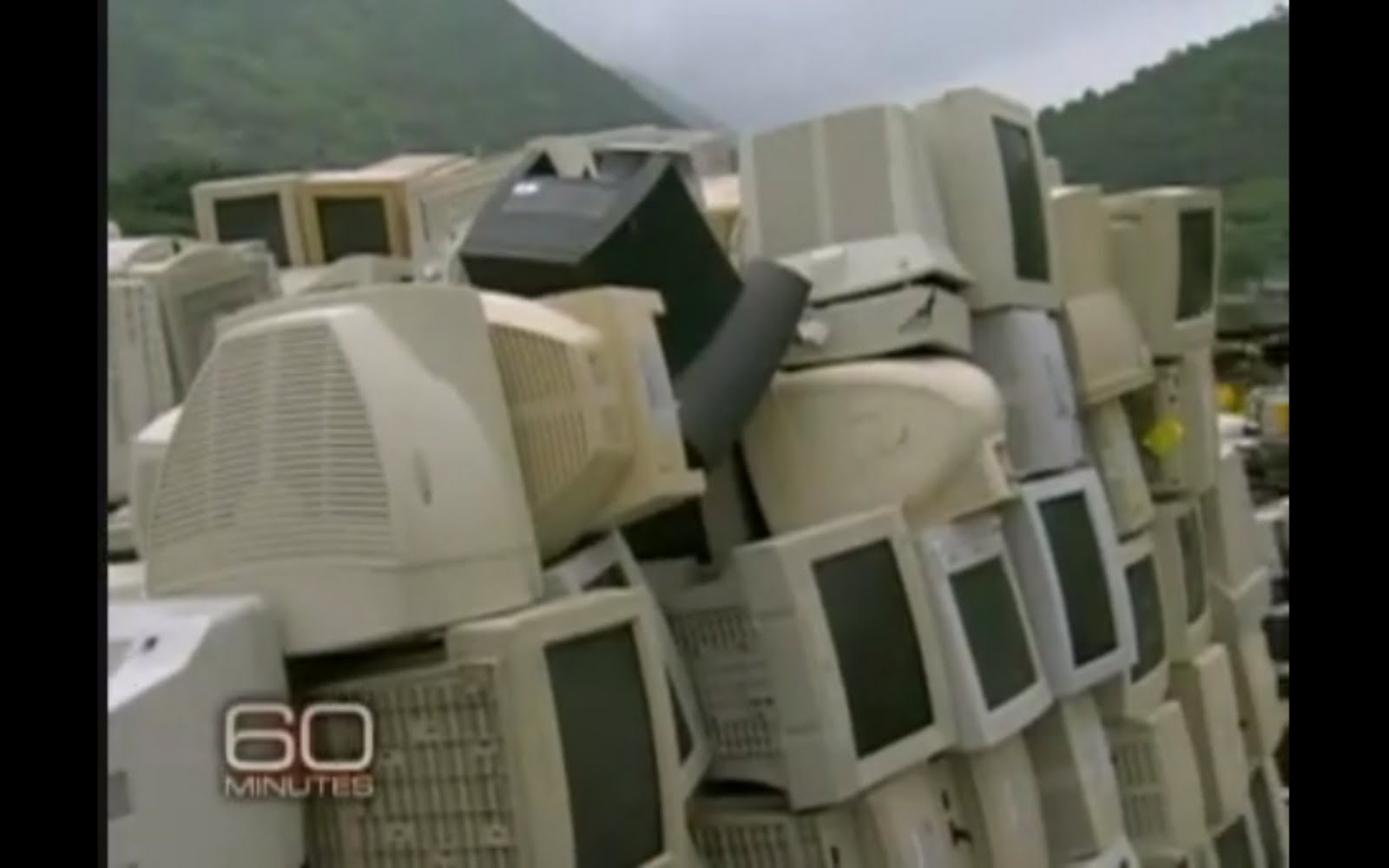
In Hong Kong, CBS's Pelley rides a helicopter with Jim Puckett of BAN, and they circle thousands of CRT computer monitors.  At this point, Jim Puckett knows, or should know,  that no CRTs go to Guiyu.  At this time, CBS has been informed about where these monitors go.


Do they not connect the dots?  Did BAN intentionally withhold information?


Hong Kong is actually a huge generator of CRT monitors in its own right, so whether these were even imported or not is a little questionable.  But Hong Kong has traditionally been a huge importer of CRT computer monitors, so that's not too important.


The question is, where are these monitors going?


It is NOT to GUIYU.  No dagnab way.


In an open letter to BAN, I have explicitly defended the "Big Secret Factories". Equating these with Guiyu is like equating Barack Obama or Colin Powell to a Chicago gang member. [Same race, different "profile".] They are much larger and more important than the little "wire burning" villages, create good jobs, and are actually better than any recycling operation which exists in the USA today.  Yes, they are owned by someone of a different nationality.  Get over it!!!  


Companies like Proview, BenQ, Foxconn, Wistron and Viewsonic were the manufacturers of CRT computer monitors, as contract assembly operations for IBM, HP, DELL, GATEWAY etc. throughout the 1990s.  I told CBS producers that I had personally visited huge CRT assembly plants in Guangdong province, and I used to ship there 5 years ago (that's how I got invited, I wanted to visit).   


THIS SLIDE SHOW SHOWS WHO BUYS THE MONITORS IN HONG KONG.  IT INCLUDES SLIDES FROM CHINA, INDONESIA, MALAYSIA AND THAILAND.  [It was shared with CBS 60 Minutes producers, and with Basel Action Network]


The old CRT monitor assembly factories survive today mainly by refurbishing older monitors.  I provided some of this film to CBS.  The original post, Big Secret Factories, appeared 18 months ago, and BAN has still not responded to the reminder letter posted last April.  These factories probably won't be doing CRT refurbishing many years longer, and are trying to get into LCDs contract manufacturing already, but there is lots of competition in northern China for that manufacturing base.  So for now, they do what they do well, but cheaply - they buy CRTs and rebuild them for resale into the "good enough" market.


The factories like those in these photos import tens of thousands of computer monitors per DAY and professionally refurbish them in the same factories that originally made the computer monitors for Dell, HP, IBM, Gateway, etc.


Returning to CBS 60 Minutes, Scott Pelley says, in the infamous quote, "We followed the trail..."


The trail of monitors in Hong Kong?  The trail of Executive Recycling's containers? The trail of WHAT? 

To Guiyu, a circuit board and wire burning village?   Gee, of the tens of thousands of monitors you circled in Hong Kong, about how many CRTs did you see in Guiyu, China?  Were they in that van up ahead (that's what's on screen when he says "followed the trail").


Here is where reporter Scott Pelley demonstrates he is on thin ice.  He picks up a plastic monitor stand, and says that obviously they are demanufacturing monitors here as well.  Jim Puckett is in the shot, but does not appear to correct him, or inform him about the CRT SKD factories we quarrel so vigorously over in the Basel Convention Annex IX  section B1110 debate.


Pelley's trip through Guiyu turns up a lot of sad and ugly stuff, and when I show the super sophisticated contract manufacturing factories, I have sometimes been accused of trying to "cover Guiyu up".  They are both there, just like you have all kinds of people doing all kinds of things in America.  I admit, I must be careful with whom I share a church pew.  So I'll be sure to show some of the ugly stuff here as well.


Melting solder off of boards to harvest (reuseable) chips and capacitors (these get shredded in the USA and go out with the fluff to a landfill... we need to invest in a compromise)... Not an acceptable electronics recycling practice.


Here, according to CBS, is a mideval process for precious metal recovery.   I presume it's aqua regia, which I've written about extensively.  WR3A has a zero tolerance for circuit board recycling in primitive operations.  


The Gold Test or Printed Circuit Board Test is a do not pass go, do not collect $200 issue for WR3A recycler memberships.  I've written about some of the things driving it - women's rights to own land.  I'll just leave here that it's not only polluting and dangerous and ugly, but its not even good recycling - they throw away a lot of the gold and silver and all of the precious rare earths like rhodium.  It's a disaster.  There were no PCs or computer circuit boards visible on the sea container from Colorado... but it would not take very many of them to pay for a lot of TAR, which is why WR3A agrees with BAN so very strongly on this practice.


The practice at left, harvesting capacitors and chips and ringy-dingies off of heated circuit boards, is again somewhat complex.  If you did a thorough lifecycle analysis, arguably fewer people are poisoned, and less poison is produced, by reusing electronics components in this method than shredding them in the USA and mining and refining and producing new ones from scratch.  And it's kind of sophisticated too, to see people trained to identify unique small parts for reuse. [New:  Independent reporter documents that pay in these jobs is good, typically higher than Ph.Ds earn. The job is to make it safe]


My position is that, seeing the children sorting them... it's heartbreaking. In the interests of transparency you have to be totally honest if this is what you are doing... and I'm not willing to defend it at this stage.  My company does not send boards to places like this (we use Colt or Sims, and send monitors for demanufacturing to audited markets as well).


Below is the photo that kind of says it all.
Scott Pelley stands in a garage sized tinker-toy operation, and describes it as the "tidy little facility", the example of high tech recycling which the Chinese officials "want us to see".   


Having been within a train stop of Shenzhen and Foxconn, which is already doing high end recycling for HP, he is either willing to stick a fabricated storyline to close the deal, or he may just be a dufus.  [In retrospect I regret saying this, it was an ad hominem attack expressed in frustration.  Many good people were misled by the Basel Action Network.  But, in my defense, I wrote this after trying to get responses for over a year, and AFTER one of the SKD factories was described as "primitive"].


Some of my friends vote for doofus, some offer pinhead, one says full-fledged retard. [Sorry, Scott et. al.  Just establishing that I've tried really hard to get you to back off of the Geeks of Color.] I think it is more of a used car salesman thing, based on his picking up the monitor base to cover his tracks on the "follow the trail" charade.  Sarah Westervelt of BAN told me that this segment of the "tidy facility" was said "tongue in cheek" and it was meant to show bad operations as well.  Watch the video.  Nothin' in Scott's cheek here.  This is the piece of film which tapes over half of the China story and all of the economics of the e-waste exporting story.  The Big Secret Factories remain a Big Secret, and Scott Pelley gets to claim he tried to cover both sides of the issue.  Maybe he's both a car salesman and a pinhead as well.   Sorry, I'm probably undermining my case here, but since 60 Minutes won't return any of my messages, I'm try chumming for the sharks at Fox News network.  Let him explain it to John Stossel or Geraldo or Bill O'Reilly.

What made the story worth Scott's willingness to "close one eye"?  My dad, Bill Ingenthron, is a retired journalism professor from the University of Arkansas, who got his degree from Columbia Missouri (top notch J school). He always said that the biggest risk to good journalism was the by-line, which despite the transparency it offers (reporters being accountable), is too tempting to journalists.  


If the reporter becomes "a part of the story", the facts and the ego become saturated and entwined.  Le Monde does not have bylines. 


CBS likes the story of its reporters risking their necks.


At the end, CBS's Scott Pelley nearly redeems himself, in a face to face with Jim Puckett.  


Scott Pelley explains that the Chinese he interviewed here did not want to lose their jobs, and that they need their jobs.  


Jim makes the remark I devoted a blog to in 2009, titled "We shouldn't have to make that Choice".  Jim says the Chinese should not have to choose between "poverty and pollution", in a double alliteration that Pelley provides as punctuation.

The jobs we are fighting over are not the jobs in Guiyu.  They are the jobs at the monitor manufacturing factories, which make "ewaste" recycling affordable for Americans, and make display devices affordable for the developing world, which is starving for internet and cannot afford a $100 LCD monitor.  

Did 60 Minutes have time to show the good side of the refurbishing business?   Did they have time to show the factories where the monitors really go?  60 Minutes had time to film the clownish "tidy" facility in that spot, and they had time to show TWICE the reporter's heroin - the cameraman being attacked for exposing a story.  As a result of this story, and as a result of BAN's silence, e-waste recycling is more exponsive in America, there is more mining done in Africa and Asia, and Egyptian medical schools cannot afford monitors for their students.

A crime has indeed been committed.  But in order to expose the environmental crime, CBS and BAN have allowed racial slander and stereotyping to stand, and it has been almost two years without a correction.  Did Pelley really care about the jobs and the poverty?

The danger of letting the reporter get "sexy", as Pelley does in the "take our cameras away" segment provided in two places in the documentary, is that they miss a small turn in the story and don't want to return and get it right at the risk of losing their Polk Award.


How do we steer this thing back to Fair Trade Recycling practices?  How can we get electronics to the people who can do it best, adding the highest value through reuse and repair, creating sustainable and green jobs in countries that need them?  How can we eliminate "toxics along for the ride", without throwing in the towel to mining extraction?   I don't want a bouquet of I-told-you-sos.  I want good people at NRDC and good people at BAN to sit down again with John Lingelbach of R2 and EPA, and the United Nations.  Get Tom Friedman, who would understand what I've been explaining in an instant... he's pals with Kennedy at NRDC.  Get Joshua Mailman, funder of BAN, and the OEMs together.  Asia has outgrown CRTs anyway, we can move the entire SKD factory to Mexico if BAN will support that.

[ed. For more details on the ignored market, see 2011 Motherboard.tv Article].


I have been making these entreaties since 2001.  I only get any attention by telling the truth publicly.  I can't seem to get financing to do Fair Trade Recycling the way I want to, despite support from EPA and Investors Circle and Forbes, NPR and PBS, and a come-here-gettaway tease from EPA Border2012.  I am trying to hold out for a financing partner who "gets it", who won't put a gag in and sign a no-export pledge, and who won't play the high profitability game of Toxics Along for the Ride.  [Patient Capital is hanging out with the Tooth Fairy and Santa Claus]


This is an appeal for help.  As John Adams sang in 1776, "Is anybody there?  Does anybody care?"  As John Adams sings, I've crossed the Rubicon.

Enhanced by Zemanta