Intellectual Pollution Problem Posed By ChatGPT, Bing

 Last December's experiments with ChatAI, the "artificial intelligence" program exemplified by https://chat.openai.com/chat

Two nights ago I had a nightmare where ChatAI became integrated with Computer Operating Systems like Windows, making it impossible to use the internet without utilizing the artificial intelligence. The "fake news" problem was then perpetuated by all of the opinionated blockheads posting angry and divisive comments on the internet having their opinions rhetorically and grammatically cleaned up and essentially, in the dream, it became impossible to distinguish between false and credible information. It was then weaponized in the dream to divide people and create culture wars.

This morning I woke up and again posed on Twitter the issue of "information pollution"

#ChatAI #BingAI They will be very human in this respect... They will be used to generate so much good looking disinformation that they will pollute their own data habitat. #Informationpollution is intellectual carbon to the global internet warming of human amygdalas.


So I posed this problem to chat.open.ai itself.  Read below if you are interested in the discussion.


Robin:  I am concerned that ChatGPT and other "artificial intelligence" will generate so much volume of content on the internet that it will essentiall "pollute" the internet. Humans currently use good grammar and language to vet information sources - if an uneducated person or child publishes an uneducated opinion, there is a "tell" or evidence to discount a potentially false claim. How can AI label its own posts to reduce the risk of "garbage in, garbage out" information being overly cleaned up and proliferating and contaminating ChatGPT's own sources of information?


ChatGPT Response:


Your concern about the potential for large volumes of AI-generated content to "pollute" the internet is understandable. However, it's worth noting that as an AI language model, I am programmed to generate content based on patterns and rules learned from a vast corpus of human-written text. While I am capable of generating text, I do not have the ability to independently create content, opinions, or beliefs like a human being would.

That being said, AI-generated text can sometimes be misused or misinterpreted, leading to the spread of misinformation or misleading content. To address this, there are several ways that AI-generated content can be labeled or flagged to help reduce the risk of "garbage in, garbage out" information proliferating and contaminating sources of information.

One approach is to include a disclaimer or label in the generated content to indicate that it was generated by an AI language model. This can help readers understand that the content they are reading was not written by a human and may not necessarily reflect the opinions or beliefs of a human writer.

Another approach is to incorporate fact-checking and verification tools into AI-generated content. These tools can help identify potential inaccuracies or misinformation in the text and flag them for review. Additionally, incorporating ethical considerations into the development and use of AI technology can help ensure that it is used in ways that benefit society and reduce harm.

Ultimately, the responsible use of AI-generated content will require a collaborative effort between technology developers, content creators, and readers to ensure that accurate and trustworthy information is shared on the internet.

This was a helpful and intelligent response. However, like my tweet comparing the potential for Artificial Intelligence programs to underestimate their ability to pollute the internet to humans late recognition of the Anthropocene (human consumption and pollution of the real world environment, mass extinction, etc), the pure speed at which ChatGPT generated this response - in seconds - shows that it isn't considering time any better than humans consider other people yet to be born.

The risk of "Intellectual Pollurion Problem" is like the risk of killing the rivers and oceans - considered "vast" in my childhood, cabable of absorbing human garbage.  There is no way the second idea - human editors - will be capable of vetting information pollution generated at this sheer potential volume and speed.  The first idea begs the question - isn't ChatAI capable of falsifying fact-checking and verification tools if asked - Vladimir Putin for example - to do so?

I followed up, continuing the conversation, and ChatGPT appears to concede that I've brought up a good point.


Robin: The oceans were vast enough to absorb human pollution without risk to other species or the global environment prior to the industrial revolution's spread to every continent. Your response that there is a "vast corpus of human-written text" seems to make the same assumption. My question is whether ChatGPT et. al. underestimate the "industrialization" of computer generated and published text so fast and in such high and uncontrolled volumes that the human-generated text (good and bad) is flooded by contradictory and blurred reasoning generated like an oil gusher by Artificial Intelligence. Will humans use ChatGPT to pollute our own internet as we did the ocean with garbage and skies with carbon?


ChatGPT


Thank you for clarifying your concern. You are correct that the amount of computer-generated content is increasing rapidly, and there is a risk that it could flood the internet and potentially lead to the spread of misinformation or other forms of content that are harmful or misleading.

It is true that AI language models like myself have the potential to generate vast amounts of text at an unprecedented rate, and there is a risk that this could contribute to information overload or overwhelm human efforts to filter or verify information. However, it is worth noting that AI language models like myself are designed to generate content based on patterns and rules learned from existing human-written text. Therefore, the quality of the content that I generate is directly influenced by the quality of the text that I have been trained on.

To address concerns about the potential for AI-generated content to contribute to pollution or misinformation on the internet, it is important to focus on responsible development and use of AI technology. This includes incorporating ethical considerations into the development and deployment of AI systems, as well as promoting transparency and accountability in AI-generated content.

Ultimately, the responsible use of AI technology will require a collaborative effort between technology developers, content creators, and users to ensure that AI-generated content is used in ways that benefit society and do not contribute to the pollution or degradation of online information.

Part 3: Why You Can Be For African Development, Or Against Secondhand Imports, But NOT BOTH


The most important thing in the history of this blog is boring.  Secondary research. Data journalism.

The most important "unique" insights I've been credited with were available to everyone, in plain sight.

- World Bank and IMF Data on electricity demand.
- Digitimes data on display device manufacturing in the 2000s
- @GrahamMytton's 1983 "Mass Communcation in Africa"

Electricity demand (IMF, World Bank) correlates strongly with device ownership and use.
Device ownership and use does NOT correlate as strongly with device production and sales (Digitimes).
Historical device ownership correlates strongly with secondhand device sales.

"But I've seen the photos!" #povertyporn is easier to witness than #datajournalism. That's the problem.

Wikipedia Talk: Solly Granatstein CBS 60 Minutes Meta Response


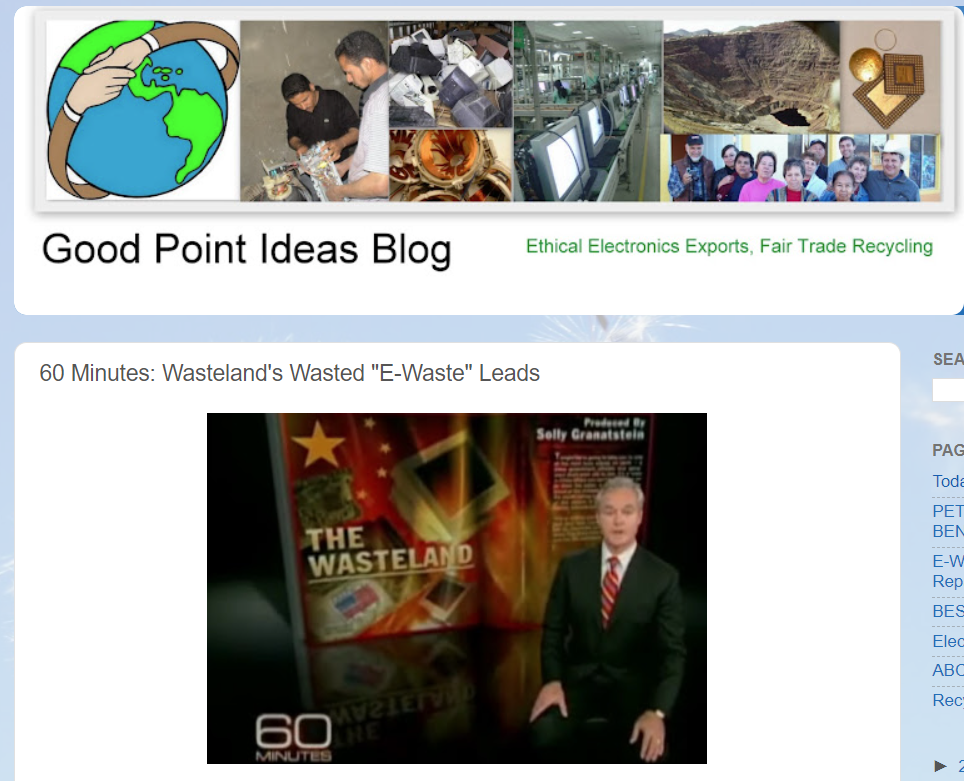
Thirteen years ago, this blog reported on CBS 60 Minutes sourcing of Jim Puckett for its George Polk awarded episode "The Wasteland".  

I traded emails with producer Solly Granatstein during the original November 2008 broadcast.  I had been background sourced prior to the episode and did not know what CBS was going to say or claim. For that reason, the year before after the original broadcast, I only blogged about the actual buyers of the CRT monitors CBS aired claims were dumped for primitive recycling.  But after being ghosted by Granstein for months, I published the blog above directly taking them on.

It is not too late to learn about the Charitable-Industrial Complex and Collateral Damage. 

Now the CRT reuse business is long expired.  CRT glass is found in pending superfund sites in Phoenix AZ and Columbus OH, not in Guiyu China.  And it has been a decade since BAN's Jim Puckett tried to deny his role in the E-Waste Hoax - evidence enough that Granastein's source needed to be cross-interviewed.

So I found a Wikipedia Bio on Solly Granatstein, and did not publicly alter it in any way, but left the comments below in the Editor Talk section.  It's a hail Mary pass.  Could Mr. Granatstein consider an Ira Glass turnaround (Mike Daisy episode) now that Spain has arrested 40+ African dyaspora workers in the Canary Islands, citing the false claims CBS first gave credence?

Here's my Wikipedia Editor Talk post below.  I will post now but update links later

Part 2: Why You Can Be For African Development, Or Against Secondhand Imports, But NOT BOTH

Almost anything mined can and should be reused before that material is mined again.
Razak Muhammed of Savelugu, Ghana, takes my photo 2015


In 2013, Statistica reports one hundred and seventy thousand mobile phone towers were operating in Africa.

With 170,000 cell phone towers, Africa leapfrogged the telephone poles and landlines in a decade. Who made that possible? Africa's Tech Sector. 

The cost of a new cell phone tower is between $100k ($110k in South America) and $250k (in the USA, where siting and zoning and labor costs are higher). So let's assume the lower range, $100k... times 170,000 African mobile phone towers...

$17 billion dollars worth of mobile phone towers were invested in (many of them "secondhand") on the African continent between 1995 and 2012.   What does World Bank say about new cell phones sold to Africans in that period?

Twenty three years ago, a World Bank report said that secondhand equipment was necessary to establish a "critical mass of users" to make telecommunications infrastructure investable. So let's look closely at those mobile phone towers.

The 2010 Tufts University report by Jenny C. Aker and Isaac M. Mbiti was published the same year that "Project Eden" was launched by Interpol, based on the statistic published repeatedly by Basel Action Network - that 80% of the used mobile phones imported by Africans were recycled in "primitive" conditions in "remote fishing villages" like Agbogbloshie.


Mobile phone subscriptions in sub-Saharan Africa increased 49% annually between 2002 and 2007... and in 2011, the Council On Foreign Relations credited the explosion in mass communications to the affordability of used mobile phones.

Part 1: Why You Can Be For African Development, Or Against Secondhand Imports, But NOT BOTH

Almost anything mined can and should be reused before that material is mined again. Almost anything mined can and should be reused before that material is mined again. Almost anything mined can and should be reused before that material is mined again.


Ask them.

The photo above was taken this week in a city in Spain.  It shows three carters.  Carter is a legal term (see New York City statute) for the job of pushing a cart through the street to look for items discarded by businesses and residents that can be economically salvaged and should be reused, repaired, or recycled.

This photo is interesting because it humanizes the carters.  I tweeted a photo last week of a carter showing up to scavenge a waste container ten minutes after a previous carter had already sorted through it. In the photo above, two carters have idled their own carts to help a third repair the broken wheel on his own cart - which contained a computer and microwave ("e-waste").

It's also interesting because it's an opportunity to follow the cart, and see that 80% of it is sold locally to European formal sector scrap yards, by the African immigrants. The only things they keep to ship home are working and repairable devices... to countrymen who develop Africa, not dump on it.