Showing posts with label kids. Show all posts

"Dead Reckoning": Cross Cultural Risk Part III

Cross Cultural Risk Comparison, Assessment:  Part III "Dead Reckoning"

"Let's take working PC displays away from African hospitals, grind them to dust, and apply it as wind cover in USA cities." - USA E-Waste Policy Expert

Part 1 went to the philosophical morality of risk, as defined by our ability to care about wider and wider circles, in geography and in time, etc.  From selfishly caring about oneself, to caring what one's mother thinks, to caring about decades later, and about people on other continents, and on to the spiritual and supernatural...  The highest risk, for environmentalists, is extinction. Things people do here on in a lifetime on earth that leave a mark, until the next supernova.  We need to value genomes, genes, more than we value carbon, and more than we value individual human lives.

Shark attack child
Part 2 zoomed inward.  Individual human lives, individual acts, small risks.  Thanksgivings past and present.   The blog analyzed the risks of "wasting food", and liabilities for serving "risky" food, from the perspective of my own geography (Ozarks) separated by generations and time.  The perception of risk relates to actual risk.  What is risky in a rich nation - serving blinky food - is risky not to do in a poor nation.

In the third and final part, we turn to risks of leaded glass and childbirth.

Lead is dangerous.  Banning leaded gasoline was the best environmental law the USA ever passed.  Childbirth is also dangerous.  The number one cause of death in Africa is from blood loss during childbirth.

But is the risk of a pound of lead in a working computer monitor at a hospital in Africa the same as a pound of lead ground up in a USA landfill?  The perception of risk, by a USA or EU regulator vs. by a young African mother, is altered through the cross-cultural lens.

Over the holiday I skimmed an article in a journal called Risk Analysis: Vol. 24, No. 3, 2004  "Dead Reckoning: Demographic Determinants of the Accuracy of Mortality Risk Perceptions" (Jahn Karl Hakes1 and W. Kip Viscusi).  From the Conclusion
"One theory for the high degree of observed risk aversion in public policy decisions is based upon public overestimation of small risks and underestimation of large risks, as argued in Viscusi.(20) According to this theory, the public’s difficulty in distinguishing between differing magnitudes of risks leads to similar amounts of spending for reducing each risk. As a result, the resulting regulatory costs per statistical life saved are much higher for low probability risks, whereas the greatest gains in lifesaving will be from reducing very large risks.
"Improved policy treatment of risks, assisted particularly by improved communication of risks, holds the potential to increase the cost effectiveness of public policy."
The paper tries to correlate opinions of risk to actual risks, and how the outliers lead to inefficient regulation and public policy.  This is really germane to the Good Point Ideas Blog  (see "Cognitive Risk: E-Waste Cell Phone Cancer").  How do Africans, North Americans, Asians, Europeans, Oceanians, and South Americans weigh the risk of "e-waste"?   If we broaden the geography of the risks being debated, and the cultural geography beyond USA, does "improved communication of risks" remain associated with "educational attainment"?  Or can the well-educated get something wrong?  We all have our ju-jus, our gri-gris.

"Dead Reckoning": Cross Cultural Risk Part I


3 holiday blogs on Cross Cultural Risk Comparison, Assessment.  


File:Rubberbandball.jpgRisk Comparison and Assessment.  Sometimes society gets it right.  Sometimes, though, we miscalculate risk, and misdiagnose.  Environmental regulations are the response to environmental risks, which may or may not be a direct risk to human health.  If our subjective responses to direct risk to our own lives vary, by demographic, how good is our derivative judgement of the more indirect risk to the environment?  And to the indirect risk to an environment physically distant?

Our opinions on world risk are like an army of rubber bands.  When enough of them are used together, they can create energy, a movement, or an obstacle.

"Risk" generates aversion, and aversion is energy to be harvested, either by capitalists, or by command-and-control economies.  Risk aversion, and the externalized risk aversion (which arises genetically from the impulse to nurture), are winds we can direct towards or away from our windmills and sails by conjure.   The force which conjures these winds is journalism, or wiki-editing, or other social media.

Now that I've lost nearly everybody (a Thanksgiving long-bomb hail Mary blog tradition), let's use e-waste policy, again, as a lens to measure how media plays on society's cognitive risk (personal threat avoidance, or nurture to protect "others", or true ecosystem challenges) to stir policies worth billions of dollars.


In our families, our religions, our work, and our lives we must weigh different derivatives of risk and benefit.  But our actions and decisions and votes seem like rubberbands.  They are capable of holding small things together, or inflicting a snap of pain.  But the rubber band cannot hold back a landslide.  We direct the energy and elasticity we have to the things we can cognitively manage.   That image is a way of introducing my theory of how we care about the pictures of little kids in Africa and Asia.


Presentation at MIT: Sustainability and Tinkerer Blessings

The theme of my presentation at Mass Institute of Technology (MIT) University this afternoon.

It's a class on international development strategy.

It took me back to high school.

This slide explains how I turned from philosophy to scrap recycling.


Recycling goes beyond human health, it conserves energy and resources for future generations.   The opponents of recycling have trouble coping just with the fact that kids they photographed 12 years ago are now adults working in smartphone factories in China, and understanding that Africans began throwing used televisions away 30 years ago.  This is ultimately about whether we are intelligent enough, and care enough, to do things today which affect the generations yet to be born.

Environmental Justice in a Pixelized City Slum


Fences around slums, to keep out the rich? 

   Last weekend, "Useless Lists of Jobs", was about pixelized slums, a bookend to the "Rich City, Poor City" UN Pixelizes World blog from last January.  Each describes just how much wealth is in cities inside "poor" countries.   Following our Fair Trade Recycling trips to Africa and South America, I'm thinking about specific encounters with relative poverty and relative wealth.

IFIXIT and TechTravels have made also made pilgrimages to "recycling slums".  We all have great photos, but need better research and statistics (like this from World Bank) about the jobs that are realistically available in this neighborhood of Lima.  The photo of the multi-colored walls on the Useless Lists of Jobs post is a little too pretty... when you see the slum from the air, colored only by the brown dust on the roofs, it's a little more textured.

View of neighborhood from the sky... less colorful..  No yards, pools or streets.
Not all of Lima is like this.  But a lot people live here
   
Environmental Justice via Ban on Trade?   Environmentalists have made a very strong case that exports of computers for recycling should be taken "off the table", made illegal, either through an amendment to the Basel Convention.  Recycling jobs, they argue, are so intensely hazardous that even export for repair (clearly asset, not waste management) should be illegal.   If the factory that made your monitor replaces a bulging capacitor, they say, it's a slippery slope to recycling harm...  So they would have us build a wall around the slums, to keep rich peoples' used equipment out.

These restrictions may keep rich people from Europe and America out.  But cities like Lima, Rio, Kuala Lumpur, Shanghai and Guangzhou are also places of tremendous wealth. Outside the OECD, and in Lima itself, people are on high speed internet, replacing CRTs and LCDs with bigger and better gear.

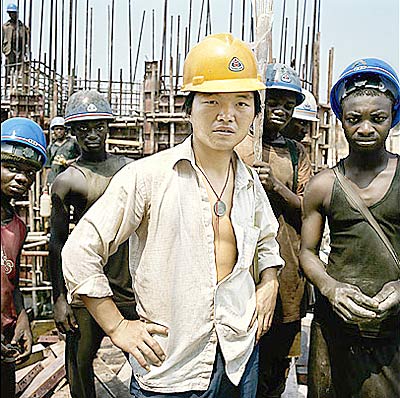
How China Kicked Our Asses in Africa

Photo and post inspired from London School of Economics Africa Blog, 
Africa and China: How it all began


What I'm doing with Fair Trade Recycling is perfect.  It's appropriate technology, it gives Africans affordable internet, and the repair jobs which pay too little to do in the USA create 10 times the per hour wages for Africa.  It's the "tinkerer blessing", the opposite of the Resource Curse.

Thanks for the Business, Uncle Sam
It seeds and creates and pays for an appropriate technology recycling system.  While only 15% of imports of used equipment are bad (Wal-Mart returns are 11%), paying for the proper disassembly and recycling of incidental breakage, elective upgraded parts, etc. creates a recycling infrastructure.

In Retroworks de Mexico, that creates a "computers for clunkers" trade in program where the ones they refurbish for resale can be exchanged for the domestic-generated e-waste.  That's the system already in Africa, people trade in the ten year old ones for more recently imported and upgraded, which is the link between the importers and Agbogbloshie.  BAN and Greenpeace and Interpol would have known this if they'd given Souleymane, Wahab, Hamdy, Somda or Miguel the courtesy of a discussion rather than just profile them as "waste tourists".

USA would be smart to be selling the repair and working display devices etc. to Africa.  We create more income and more jobs through reuse.  We cannot afford to have an idiotic 48 cent per pound California-destroy-all SB20 system.

USA has former Peace Corps volunteers like me, African immigrants like Wahab and Souleymane, and a history as a melting pot which our biggest competitors - China, Japan and South Korea - didn't have.