Debate, Dialectic, Diablog: IPhone #ewaste Graphic Misleads

Diablogs and Wiki-Greeks
A couple of weeks ago, I was sent a new set of graphics, in the spirit of "Story of Stuff", by umm... students? activists? artists?... seeking to raise awareness about the IPhone.   A woman named J.Rhee sent me an advance copy and asked for my comments.   I sent her some, in the spirit of cooperation, but did not hear back.  

Elizabeth Chamberlin of IFIXIT (soon to take away the crown for the "Best Scrap Blogger in the World"*) has written about the Apple-criticism piece, and does a good job of examining the case against Apple without taking it hook, line and sinker.

The Anti-IPhone-graphic-activists display a lot of talent, sincere passion, and make some very valid points.  They asked my opinion rather nicely, and I'm always looking for mature, grown-up conversations with environmentalists.  But I'm disappointed not to have heard back from the authors of the piece.  Below is a snippet of the dialogue, followed by my response and comments.

Hi Robin,Thanks for getting back to me. The graphic I was referring to lives here: http://www.mbaonline.com/cost-of-iphone/  Let me know what you think. I’d love to get your thoughts, and feel free to use it as you’d like!Thanks again, Jen
Hi Jen,

I really like the lifecycle focus on mining, coltan, etc.   I lived in Africa and was in Rwanda, Burundi and DR Congo for awhile.   The natural resources harvesting business has been a curse. The Worlds Most Polluted Places (TIME) are metal mines, not recycling yards.

With that said, I think your graphic is pretty unfair to Terry Gou and Foxconn (Han Hoi Precision)...  The Taiwanese "Geeks of Color" like Gou and Simon Lin (Wistron) and Rowell Yang (Proview) have been "racially profiled" by the left in the USA, I think.  All three of those guys began as a "tinkerer" importing and repairing used electronics, then became a contract manufacturer (like Foxconn is for ... um... everyone not just Apple).  They have done a pretty good job of learning 100 years of industrial revolution lessons in a decade.

Foxconn is owned by the Taiwanese, managed by Hong Kong, employs labor from Cantonese Guangdong, and is regulated by Mandarin Beijing.   It's pretty remarkable.  The suicide rate is below that of similar scale operations (yes including the USA), when you have 1.1 million employees living in campuses the size of cities, you see rapes, robberies, and suicides at the same rate as you'd see in Detroit. 

Finally, the piece about Guiyu is completely inaccurate.   There are no Iphones in Guiyu.  Guiyu is almost all scrap generated in China.  Shenzhen, Guanzhou and Hong Kong have basically grown into one metropolis which has the population of JAPAN, and Guiyu is the scrapyard.

If you want to know what happens to Iphones which wind up in China, check out this blog.  http://techtravels.wordpress.com/shenzhen-phone-recycling-1/  Visit all 4 pages on the cell phone recycling in China.

I'm a socially conscious environmentalist.  In my opinion, we don't do ourselves any favors with racist depictions of the Geeks of Color.  It is a major embarrassment to the environmental community to have launched this "green scare" campaign against geeks and techs overseas.  I urge you to imagine how you would feel if you were Mowgli... when sex worker, coltan mining, child soldiering is 30% of your job market, and you learn to fix a cell phone, creating affordable connections for people in your emerging market,  or putting CRTs into internet cafes that become the center of Revolution 2.0, when you are recycling rather than mining, and green Americans portray you as some kind of a primitive, polluting, sorry, toxic victim.

Again, bravo on the first half of your piece.  But if I post it on the blog as is, I'm going to make some of the points I made above.  If you are interested in really conveying the truth, I'll spend as much time with you as you want.
If you want to see the piece we are both commenting on, find it via Elizabeth's blog... I don't really want to raise its pagerank if they are sending it out "looking for comments" but don't respond to the comments.  An MBA is supposed to be a masters degree program, and work is supposed to be subject to peer review, response and debate...

Leven, Rachel's Postcard from India

Interesting people I'm meeting here at ISRI.   I feel I'm falling behind on reporting all the good reports coming out on the repair, recycling and refurbishing trade.

Rachel Leven, a Fulbright Scholar who has just returned to Duke, gave a very good presentation based on her article in Foreign Affairs magazine (a Postcard version of her letter from Delhi).  Here is a teaser.  It would be terrific if some India scholars could use the report, and others like it, to get the Indian customs agents to stop serving the behest of manufacturers and planned obsolescence.   Repair and refubishing and the "informal" sector are not perfect, but the UNEP and Basel Secretariat reports on the actual 85% reuse of imports to Ghana and Nigeria should cause India to reconsider whether the recycling trade should really be kept untouchable, or whether Singapore's ingenious harnessing of the repair and reuse resources in the 1980s and 1990s represents a better model than the prohibitions on that trade.

Letter From Delhi

The Economics of Trash

The streets of India's major cities look dirty, piles of waste rot in the corners of buildings, and plastic bottles crunch underfoot. But the grit hides an informal waste collection system so effective that, despite an increase in the sale of disposable, non-organic consumer goods in India in recent years, the trash that ends up in the hands of municipal garbage facilities is over 50 percent organic -- that is, mostly food waste. In 2009, food scraps made up only 21 percent of non-recycled waste in the United States. India's ubiquitous trash-pickers may seem to some an unfortunate byproduct of Western-style consumption, but where others see garbage many Indians see opportunity. In an informal glass market in Bangalore, I was offered three rupees for a green glass bottle. By selling three bottles, I could have earned enough for a local bus ride.

Editor Wanted: Because Less Is More

Las Vegas, 4/18/2012.   Weather will finally hit the 80s today - it has been hotter at home in Vermont so far this week than here in Nevada.  Groups and small talk.  Tweet talks.

Had a long after-dinner discussion with someone whom I deeply respect in our little computer refurbishing community last night.  I know something in the blog wasn't resonating with him, thought we'd have a drink and he'd give me some guidance.   He's 11 years older than me, started out as a hippy scavenging from his job on a garbage truck, amazed by what people throw away.

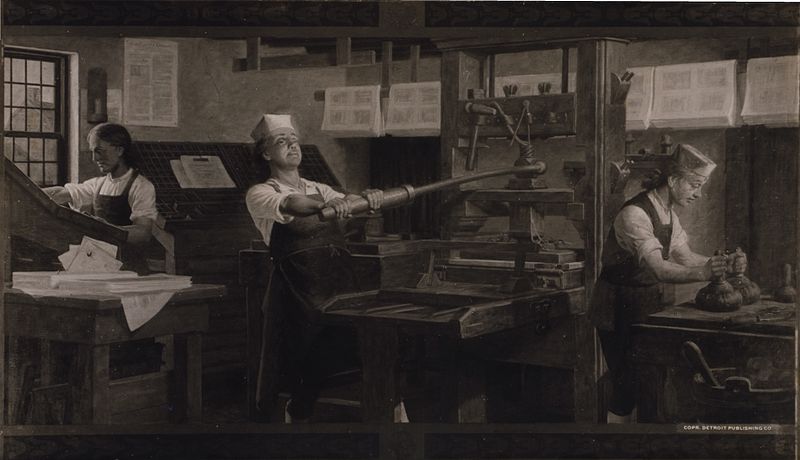
File:Franklin the printer.jpg
Benjamin Franklin at work on a printing press. Repro of a Charles Mills painting
While he said he could respect the long-bomb "Foreign Affairs" posts, that he simply didn't have time for them, and said more importantly that my denser posts, digressions, and obscure historical parallels were losing people he hoped would be my allies.  He says that groups in the refurbishing community, in particular, could become a groundswell of support for the "geeks of color", the counter- obsolescence planning, and other crusades I'm engaging.

Sounds like a case for less is more.

Now, this blog began (if you go back to the first years posts) as a journal I was convinced that no one at all was reading.   I was shocked by the first comment ever posted... "Not quite no one."

Well, my secret desire is that I'm going to have time one day to tear all 2000 pages (including a number of as-yet unpublished posts that I wasn't happy with) down into 249 pages that say something that hasn't been said in a way that more people would listen to.  I don't happen to care whether that's during my lifetime.  I'm acutely, or rather chronicaly aware I could die next year.

My evening mentor said that's fine, but he'd like to see me pay $14 per hour to some college student or professor just to edit each post as it comes out.  After listening to him, it seems ironically more arrogant not to pursue the idea.

European Study Proves Hand De-assembly Superior to Shredding

Thanks to our Fair Trade Recycling Intern Adelaide, who is in Middlebury, Vermont, working on her Masters in Waste Management from France.  Adelaide cites ten separate studies in her morning blog to make the point that taking a circuit board apart by hand - separating copper coils from aluminum heat sinks, steel from plastic -  is environmentally superior to shredding in a lifecycle analysis.

Figure 1. Environmental assessment of treatment of electronic waste, Gmünder (2007).

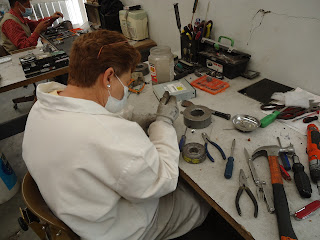
All Fair Trade Recycling wants to do is to make these hand-disassembly jobs (like our women in Mexico, below) de-criminalized.  Give them the proper tools and protection, stop open burning and other "ten worst practices".  There are no mercury switches, there is no "witches brew", hand disassembly is simply an alternative job to gang warefare in Mexico, pirate boating in Somalia, cocaine growing in Peru, sex work in Kenya, etc.

I've usually written about the Geeks of Color.  But the scrappers, too, have been denigrated and defamed in the American and European media.  There are bad practices by hand, and good ones.  Racial profiling is just not a very effective way of deciding, and the "safe" approach of shredding items before export is not a winning strategy for the environment.

Our company practices disassembly here in the USA.   But I'm opening hand disassembly factories in other countries.  They will recycle their own waste from inside their countries.  But if they can do that well, why not let them also take rich people stuff that can still be reused, which puts an even higher environmental outcome... one which is "off the chart".   Survival is the highest form of "end of life" when you're not dead yet.

Our Chicas Bravas in Mexico take a few extra steps and de-manufacture not just the PC, but the components like CDRom drives and floppy disk drives, hard drives, getting things like rare earth magnets and little gold things.  American companies which export intact power supplies, drives, and other "components" may ship them to a similar fate.  But they are all too afraid of the onus against export to visit and find out whether it looks like this or looks like a child sitting on a pile of circuits.

Most American recyclers don't know what this is on the left.  But they "recycle" them by the millions.  Reuse can get very small.

Environmental Justice in a Pixelized City Slum


Fences around slums, to keep out the rich? 

   Last weekend, "Useless Lists of Jobs", was about pixelized slums, a bookend to the "Rich City, Poor City" UN Pixelizes World blog from last January.  Each describes just how much wealth is in cities inside "poor" countries.   Following our Fair Trade Recycling trips to Africa and South America, I'm thinking about specific encounters with relative poverty and relative wealth.

IFIXIT and TechTravels have made also made pilgrimages to "recycling slums".  We all have great photos, but need better research and statistics (like this from World Bank) about the jobs that are realistically available in this neighborhood of Lima.  The photo of the multi-colored walls on the Useless Lists of Jobs post is a little too pretty... when you see the slum from the air, colored only by the brown dust on the roofs, it's a little more textured.

View of neighborhood from the sky... less colorful..  No yards, pools or streets.
Not all of Lima is like this.  But a lot people live here
   
Environmental Justice via Ban on Trade?   Environmentalists have made a very strong case that exports of computers for recycling should be taken "off the table", made illegal, either through an amendment to the Basel Convention.  Recycling jobs, they argue, are so intensely hazardous that even export for repair (clearly asset, not waste management) should be illegal.   If the factory that made your monitor replaces a bulging capacitor, they say, it's a slippery slope to recycling harm...  So they would have us build a wall around the slums, to keep rich peoples' used equipment out.

These restrictions may keep rich people from Europe and America out.  But cities like Lima, Rio, Kuala Lumpur, Shanghai and Guangzhou are also places of tremendous wealth. Outside the OECD, and in Lima itself, people are on high speed internet, replacing CRTs and LCDs with bigger and better gear.