Showing posts with label malpractice. Show all posts

Extended Producer Responsibility. Part 1: Define the Problem / Benign Neglect?


2009 The Watchmen

Adrian Veidt:
It doesn't take a genius to see that the world has problems.
Edward Blake:
No, but it takes a room full of morons to think they're small enough for you to handle.

"It doesn't take a genius to see the world has problems."

"It takes a roomful of morons to think they're small enough for you to handle."

So let's discuss EPR, or "Extended Producer Responsibility".  It's the most talked about recycling topic, other than "Plastic", at almost every recycling conference.

This blog is deliberately agnostic about EPR. Here is my critique.

1. Define the problem to be solved. Then don't neglect it.

The first ever bottle bill, in Vermont in the late 1950s, was passed at a time when "disposable" beverages was new. Most soda and beer at the time was sold in refillable bottles. Vermonters collecting litter saw that the new one-use containers constituted most of the litter, and the problem was "non-deposit container litter".

In the 1980s, when bottle deposit laws were proposed in several other states (including Massachusetts, which my division administered at DEP), there was a huge shift to single-use containers, and both rewarding refillables and recycling single use were part of the plan. The advocates conceded on putting the deposit only on carbonated beverages because bottled water wasn't common and the Cranberry Juice lobby in Massachusetts argued that (highly sugared) fruit juice was healthy. 

Einstein's Amygdala Part One: The Baby Rabbit Rescue

January 2022, first blog of the new year. And I can tell this is going to be a multi-parter.

One day in Fayetteville, Arkansas, when I was a teenager in the 1970s, my adored and adorable white mutt persian cat - Samantha - came to the door with a baby cottontail rabbit. As I recall, she was clutching the baby rabbit by the scruff of its neck, as Samantha did with countless litters of her own kittens over the years. But I knew she was a hunter, she'd likely eat the baby bunny, and I reacted quickly to save it.

Samantha gave up the baby rabbit to me with what seemed a minor fuss as compared to times I'd tried to get back a prized bird or mouse. I rushed to show the baby rabbit to my little brother and sister, who cooed and said how cute it was, and I started to tell them about a wild cottontail my great aunt and my mom and I raised successfully when I was 3 years old, and the memories of...

... Wham. Samantha was back, with a second baby cottontail rabbit. We were so occupied with the first, stupidly in hindsight. Bunnies are born in litters of five or six. The eyes were not quite open, so this was a nest of bunnies, and Samantha hadn't fought to keep the first, either because she was on a fire-fighter rescue mission to save all the other bunnies, or she knew there was plenty of lamb hasenpfeffer where that came from.

So I gave the first and second baby rabbits to my siblings, and followed Samantha this time, out into the side yard of our brown split level home on the corner, down the hill toward the small park across the street. Samantha went on with her mission, and this time I was tracking her. She entered some leafy ivy covered portion of the yard, and quickly emerged with Peter Rabbit #3. I grabbed both the cat (now growling) and kitten still in her mouth and carried them both back to the front door, where our mom was now preparing a box for the involuntary kitten-bunnies. We got the third baby rabbit out of Samantha's mouth, and then shut the cat in the lower floor of the house to keep her from returning, whether as Terminator 1 or Terminator 2 - this fluffy white Schwartzenegger was in the penalty box.

But how long, realistically, could we expect to keep our "free range" cat, who'd been free to live her life indoors or out for 15 years? Some moral blue district suburban PETA subscriber today would tell me to keep all cats indoors, and never remove their claws, accept the collateral damage to the wallpaper and furniture. And today no doubt the population of humans is doubled, and the standard of living of humans now supports far more cats and far larger home spaces. But this was Arkansas in the 1970s, and I came from a family of Ozark farm dwellers. Rabbits have as many litters as they do each year because they have evolved to be food. If not for the owls, bobcats, foxes, falcons, coyotes and wolves, rabbits would suffer a mass overpopulatoin, disease and starvation. Hundreds of thousands of years of evolution left us with rabbits facing far fewer pumas and grey wolves, and if some farmers grandkids cats caught and ate a few, it was merciful violent mitigation of the dearth of carnivores humans had created over just the past few centuries. 

My 1978 Pentax K1000 pointed at my sister stirs amygdala counter-threat

My 1978 Pentax K1000 pointed at my sister stirs amygdala counter-threat

Poison Apples Blog: 18 Questions for Research on GPS Tracking of E-Waste

Poison Apples Blog #1 - Labor Day Weekend 2018

It's September, the beginning of a new Academic Year.  Environmental studies and public policy and geography and business majors are arriving on campus, ready to launch hundreds of term papers, thesis, class essays, etc. on lots of topics.

Usually, there are dozens of students researching the topics of the Basel Convention, EPA policy, exports, and externalization of pollution.  And there are quite a few papers that will be written on racial profiling, and environmental justice.

So far, I haven't seen many papers on the thesis that Geeks of Color, the Tech Sector in emerging markets, is being improperly profiled as "primitive", "informal", and "illegal". But if I were to write such a paper, for an A+, I might begin with another paper that had been published that reached a conclusion in its title...

"How does e-waste travel across the world after disposal?" was a hot publication in 2016, and was covered on PBS national evening news broadcast before many of us had a chance to peer-review it. The title of the report asks a question... and has a cover photo at top which clearly shows the plastic casings of CRT televisions.  This raised a question to me... why was there not even a single CRT television tracked among the sample of 205 devices, which MIT's partner claims are a representative sample of "ewaste".

The 30% or so of "stuff" in e-waste collections that does indeed "travel across the world" is the only stuff they tracked. But the paper claims to answers the question "How" without asking the question, "Why"?  And the answer to why would come from the buyers, the black, brown, Asian, African, Latino and Islanders who are never offered a chance to show what they CAN do with your "elective upgraded" so-called "waste"...

Because the NGO knows this, they had to take an extra step. No one is selling spoiled apples in the marketplace, if they tracked the spoiled ones, it would show little export. But if they tracked the statistically good ones, they'd likely find their GPS in a reuse shop (in fact, they did despite efforts to sabotage).

The method, I call "poisoning the Apples"... And its time some people publish some term papers on the obvious errors in scientific method that should have been vetted before PBS was sent the paper.


2010 Flashback to Europe's Decade of Racial Profiling E-Waste

Back in November 2010, I used a cover photo on a blog to convey how Europe was relying on photojournalism to set waste policy. WRONG, WRONG, WRONG was one of my most visited blogs that year - the year Interpol launched "Project Eden", an approach to Africa and Asian geeks that was as cringeworthy as the Eurotrash Art.


Fair Trade Recycling [WR3A] Launches "E-Waste Offset" Initiative In Africa


[Middlebury, Vermont May 22, 2017]  Fair Trade Recycling has launched a strategic partnership in West Africa to create capacity for proper recycling of junk "e-waste" devices without impugning, racially profiling, or interfering with the imports of Africa's talented "Tech Sector".

The initiative is based on "carbon offset" models, and is derived from conclusions Fair Trade Recycling representatives arrived at during research in Ghana from 2015 to the present.

Under the new program, African Tech Sector buyers will be rewarded with lower prices for used computers and tech sector equipment they import when they "offset" or "exchange" the tonnage for a similar quantity of obsolete or irreparable electronics taken back from African cities.  The model is patterned after "carbon offset" or carbon exchange models and the recycling training program for the women's collective "Retroworks de Mexico".

For every 50 containerloads of used electronics imported by Ghana's Tech Sector, the reuse shops will take back 10 containerloads of junk TVs and computers which were imported to Ghana two or three decades ago.  And the Tech Sector will pay for proper tools, training and methods - all funded by the profitable and appropriate reuse of newer second-hand products.

The "Agenda Shift" has already resulted in calls from major manufacturers interested in promoting takeback in Africa as a solution to junk buildup.

How To Pay For Africa E-Waste Cleanup?

15 years later, let's just ask what he imports
After 2 weeks back in Ghana, the #1 Finding of our research still stands.  E-Waste NGOs made up fictitious numbers about the percentage of imports to Africa that are "waste" and the percentage of waste in places like Agbogbloshie that come from faulty used good imports ("Exaggerations have been made" said Jim P. on our Salzburg panel).  Photojournalists flew to Accra (Agbogbloshie is about 20 minutes from the airport, 9 minutes from Accra's finest hotel), and took close-up photos of Africans in exotic poses.  And EU policymakers got project funding to "save" Africans from e-waste dumping.

Neither the NGOs, nor the journalists, nor the EU Policy funders checked out existing data on Accra stormwater runoff (the water quality at the Odaw Korle lagoon was hideous in the 1970s), the number of households with televisions in Accra 15 years ago, or the number of people employed in the scrap industry generally as compared to the number seen in Old Fadama slum of Accra. They didn't even find it on mapquest, which would show it's at the center of Accra, not a remote fishing village on the outskirts (as should have been suggested by the cab ride from the hotel). They would have found the phrase "Sodom and Gomorrah" appears in a 2002 AMA publication calling for razing the slum to build shopping malls and parking lots.

There was no basic secondary research.  No control group.  No null hypothesis.

Hoaxes Harm. Agbogbloshie Land Grab Reportedly Underway

#WORLDREFUGEEDAY June 20, 2015

IMG-20150620-WA0005Look, it's hard for a westerner to establish a credible campaign about urban land reform in Africa.   The use of land in central Accra, 9 minutes from the city's most prestigious hotels and government buildings, has been a powderkeg for some time.

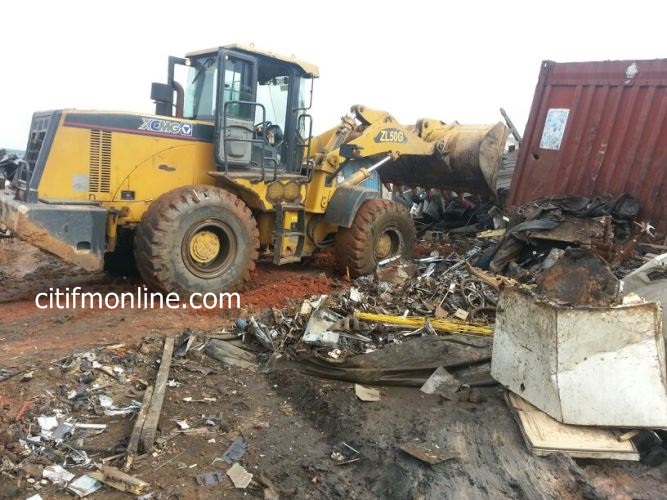
But Interpol and CWIT and UNEP's role in the "Agbogbloshie Sodom and Gomorrah" hyperbole should be investigated.   Posing as concerned about the Dagbani speakers who were Accra's Recycling Caste, they set up this cruel display of heartless eviction-by-bulldozer, which started yesterday.

Agbobloshie Demolishing Underway (citifmonline.com) has photos

Best way to get the news at this point is on Twitter.   @RecyHub, @AdamMinter, @Rubbishmaker, @Heatha_a, @RestartProject, @AfricanSolarLLP, @Kwiens, have been there and know what they are talking about, and new voices, like Abhassan Ibn Abdalla are reporting from the scene.
  1. Forced eviction is not a method of slum redevelopment. Demolishing homes and livelihoods is not good governance.
 2 hours ago2 hours ago2 hours agoAgbogbloshie children centre which was sheltering displaced people is being demolished now
  1. agreed. My sense is 'we' flatter ourselves to think our names relevant to those doing the clearing or those being cleared.
The imprisonment of Joe Benson in the UK for "wastecrime" (secondhand computer sales in Africa) was just a part of the story of #ewastegate. The Blacksmith Institute, GAHP, and Green Cross meant well but the use of the $1.2M was tone deaf to the underlying issues. Kevin McElvaney and other photojournalists have reaped their share of "sponsorship". But the worst part is putting Basel Action and Mike Anane on an expense paid promotional tour that makes destruction of recycling yards and arrests of Tech Sector workers pass as "environmental justice" or "remediation".
It just hurts to have a campaign of connected Accra developers take advantage of an environmental story completely misunderstood by Western NGOs, and label Dagbani neighborhood "Sodom and Gomorrah", as if recycling Accra's scrap was doing something wrong. I don't know if it's as bad as Egypts "cleaning of the Zabaleen" (something I was incensed about a decade ago, now forgotten), or China's flattening of "informal recycling" sites during it's rapid urban development phase. As Josh Lepawsky says, we flatter ourselves to think the Accra AMA powers that be will listen to our Western tweets. But the news editors who printed the "Agbogbloshie E-Waste Tragedy" Propaganda need their clocks cleaned. This cannot keep happening to recyclers and refurbishers.

IMG-20150620-WA0010
This was not really about recycling. This was about forced relocation.
The story is still developing, and the flooding of the area was real, and the photos on twitter don't really show the extent of the evictions. Reportedly classrooms and homes have been demolished, but the story still needs a chance to develop.

Blacksmith Institute Ghana Project: Environmental Injustice or Economics?

Blacksmith Institute's "top ten list" of "most toxic places" put Agbogbloshie, Ghana at the top. (Later it was clarified that it was at the top of the alphabetical list because it began with A).  The Blacksmith press release is now 16 months past.  While I've tried to call Blacksmith out in debate, both with personal calls and emails and with a little blog chiding of Dr. Jack Caravanos' use of disavowed BAN export statistics (bad data), my friends have warned me to be careful.  Blacksmith Institute isn't a Greenpeace or a Basel Action Network.   They'd be a powerful adversary.

Androcles pulling a thorn from the lion's paw
My response has pretty much been that scientific and academic approaches applaud "peer review", it's part of the Scientific Process.  If I've been wrong all this time, I believe in Socratic method, and like Plato said, would be as happy to have a wrong idea removed from my mind as I would to have a thorn removed from my skin.   If I'm making a mistake, I want the mistake to be corrected.

I trust Blacksmith would see it the same way, if they take the time.


This morning I got an email from Rafa at @RecyHub, cc'ing a subset of interested parties like Josh Lepawsky following #Ewastegate, with a link to a public update on the cleaning up of Agbogbloshie project.


It's about AMP Project, the MIT-CoLab style "appropriate technology" approach to wire burning in the Accra city dump, which has provided the update below.
More on the Blacksmith Institute, what do you think?
http://www.pureearth.org/wp-content/uploads/2014/01/Ghana-Pilot-PCR-2015.pdf
Link to the project completion report for phase 1 of the pilot project. 
I was trying to figure out who to cc in my response, and decided to post it for the world below.

Eco-Fundamentalists 1: Joseph Benson, Tom Robinson, Willie Horton

If you are old enough to be surprised that Nigeria is #8 in the world in people connected to the Internet, then you are old enough to know who Tom Robinson was (the accused in To Kill a Mockingbird, by Harper Lee) and old enough to know who Willie Horton was (scary escaped inmate in anti- Democratic ads run in the south in 1988 elections).

New FBI Director James Comey gave a very honest and provoking speech last week about "racism".  Better than any of my rants.   Two basic points stick out.


  1. The Police, historically, enforce the status quo.   That includes Jim Crow laws.   Cops were on the bad side of the firehose in civil rights marches.   That history brings with it some baggage which has to be addressed in the open.
  2. University research of human  psychology indicates that everyone has a certain distrust of the unfamiliar, probably through evolution.   Almost everyone, of all colors, has some subconscious racial distrust.   

What is unique about "e-waste" and the jailing of #FreeHurricaneBenson is that environmental police are reacting to the same kind of panicked finger-pointing described in To Kill a Mockingbird.
Eco Fundamentalists - the proponents of radical fundamentalist Basel Convention Amendment interpretations (that anything with a circuit board is "waste", even if the circuit board is being reused or repaired or electively upgraded) so believe in themselves, that their leader actually says "Joe Benson is collateral damage".  

Sure, and Tom Robinson was "collateral damage" in the war on rape.   Rape's such a horrible crime, that a "Willie Horton" description of Robinson is accepted for the protection of society.

Yin, Yang, Omm Part 1: Responsible Electronics Recycling Act (HR2791)

#FreeJoePenna Blog (one of 8 composed on a France beach vacation 2014)

WR3A became the anti-BAN.  But we have both been part of a Charitable Industrial Complex.

It's like a tug of war over dusty, desolated, impoverished Darfur, a guerrilla morality of ethical posturing.   A war between rich over who gets the rights to the poor's images. 

Poverty and inequality, or the perception of it, is power.  Ask Marxists about how to harvest envy.  The bigger the problem is perceived, the more you can justify meddling and redirecting the marketplace to "fix" the problem.  (appropriate illusion and background music by Brazilian MysteryGuitarMan Joe Penna, below)


There is no denying that there are problems and inequalities in the system.  But whether or not the poor are hurt more by the free market than by BAN.org's efforts to "fix" it, we are contesting a moral high ground which itself has an economic value.  In this series (Yin Yang Omm) I'm attempting to write about how the economically disadvantaged either benefit from the dispute, or from its resolution, or whether they have any interest in it at all, and who-the-heck-are-we in that equation.

In several previous blogs, like Environmental Malpractice, readers get a closer view of what it's like inside the planned obsolescence shredding industrial complex, and how it is driven by white man juju - liability.  The fetishes placed on the secondary market by people "responsible" for the continued life of products they've let go of force many to shorten the lives of the product.  Recycling laws have made it almost impossible to export working assets.  It is taking billions of dollars of USA assets which are wanted by less affluent but rapidly emerging markets, and turning them into toxic piles, and puts people supplying countrymen who cannot afford new product into jail cells.

Reactions to perception of inequality or injustice can drive societies to do irrational things, to burn witches at stakes, ban books, and shred new cars.   Envy can drive liability lawsuits, jealousy can sway jurors... (so Mazda said to heck with it).  That's right, liability for product has created a system which actually shreds new cars rather than punt them into poor countries, and the same system is increasingly positioning itself to shred refurbishing markets.

Through a proposed new law on exports to secondary markets, BAN and CAER essentially propose a paradigm where the emerging markets cheap labor is available to only to corporations, but are blocked from buying their own supply of work.  RERA would allow these people to do warranty repair, and to assemble and disassemble brand name goods, but not to purchase non-working products for reuse, repair or recycling.

The Responsible Electronics Recycling Act (HR2791)   

The Bill is supported by some people I really like. Niel Peters-Michaud, for example, has enlisted himself and his company both with E-Stewards, BAN and CAER, and has also been to Africa and testifies that limits on trade to that continent will produce better results.
"Do we really believe that the dream of someone in a developing world is to process our toxic e-scrap?  I think they would prefer to dream of driving a well equipped Audi." - Niel Peters-Michaud
Before going deeper into the psychology of two white CEOs from liberal northern states arguments over the welfare of Africans, let's look at what a state (California) with a system similar to RERA's has created.  Hint:  no new Audis have been distributed to any African nations.

OP ED: Recyclers, Stewards Must Free the Geeks of Color

[6/20/2014] We are all familiar with the photos of wide eyed, poor children in faraway, exotic places. CARE, UNICEF and others have tried to be more sophisticated about the “poster child” syndrome, but many others will fill the space. A child’s photo often earns a quick sympathy buck.


It's the gift that keeps on taking. Through either God’s grace or a million years of evolution, we are capable of nurture, we can empathize.  Risk to a child is as frightening as risk to ourselves.


But in a new development, poster children are becoming a tool of major industries. Electronics manufacturers practicing “planned obsolescence” and “big shred” machine makers are funding a photo campaign to stop the secondary market. It is an example of what Peter Buffett calls the "charitable industrial complex" [NYT Op Ed 2013].


Reuse and repair have met anti-gray-market alliances in the back alleys of prohibition trade.  The anti-reuse complex have created a racial profile of traders in used goods. The campaign actually accuses overseas buyers of poisoning their own children.


What is unique about this "e-waste" campaign is that, unlike CARE or UNICEF or Save The Children or OXFAM, the fundraisers do not share a dime of proceeds with the children in the photos.   In a crassly opportunistic way, they actually use the kids images to arrest their parents. Among philanthropic colonialists, the e-waste export campaign is an abusive step parent.

Joe Benson, a 54 year old man, born in Africa, never went to school. He registered legally as a reuse business in London. He was sentenced Thursday to 16 months in prison. During sentencing, either the London judge or the barrister compared Benson's export to "rape". When I compared these "bullyboy" cases to Harper Lee's "To Kill a Mockingbird" in 2012, little did I know how similar the trials would be.

#freehurricanebenson

Breaking News! UK Sentences Nigerian-born Exporter to Prison!

After a cacophony of alarm bells in 2006, 2007, 2008, and 2009, Basel Action Network and Greenpeace have finally achieved what they wanted.

A TV repair man is going to jail for buying something reuseable which someone else wanted, who could not otherwise afford new.

Hoax 1, Africa 0
There has been one environmental activist who has been trying to keep "illegal exports of e-waste" in the news.  They earn money by certifying Recyclers don't illegally export.  But they've rarely been able to show enforcement, and bemoan our inattention to "ewaste exports".

Yesterday they got their Big News.  OMG.  An African is finally going to UK jail for "e-waste" wastecrime.

Joseph "Joe" Benson (black) of BJ Electronics was accused by Cahal Milmo (white) of #wastecrime. Lord Chris Smith, the UK's Environmental Director, vowed to stop England's illegal dumping on the shores of Nigeria and Ghana.  And they put a TV repairman, with about 90% working product, in prison to make him an example to others willing to trade or donate used goods to Africa.

After 4 years and untold dollars, Joseph Benson said uncle.  He will start a sentence of 16 months.

Who is "Joe Benson"?  In February, this blog was the main source of information about the trial and appeals of "Hurricane" Joseph Benson of BK Electronics.   Benson, a Nigerian-born television repairman, was profiled by UK journalist Cahal Milmo as an "e-waste exporter".  In a sting set up by Greenpeace, covered The Independent's Cahal Milmo, BBC, and The Guardian newspaper, Benson's crew reportedly accepted a sabotaged CRT television in 2010.

Just learned that Benson sentence was reduced from 24 to 16 months in prison today.

So who pointed the finger at Joe Benson?   It started in 2005, with the publication by Basel Action Network of its paper, "The Digital Dump:  Exporting Reuse and Abuse to Africa".   BBC covered the paper in 2006.
In customs documents, the computers are described as being "shipped for re-use."
But Jim Puckett of environmental NGO the Basel Action Network says that in practice, dubious exporters exploit the re-use category to increases their profits and offload their environmental responsibilities. 
"Unscrupulous exporters from the North are intentionally mixing bad with good so that they are able to avoid disposal costs," he says. 
"Usually when you bring a computer to a recycler, you pay a fee. But brokers will take this fee, and instead of recycling will mix in some good equipment and trade it... exporters say it is working equipment to help the poor to bridge the digital divide, but what we've observed is not bridging the digital divide but the creation of a digital dump." 
In fact, it is several dumps, spread around the city. Lagos has no computer recycling facilities itself, and so the waste computers build up in huge piles.
On these dumps children scavenge for the contents - they can earn around US $2 a day by collecting components - but are also putting their health seriously at risk.

Top Ten Myths about so-called "E-Waste" (Update)

by Robin Ingenthron- (Originally Published on Earth Day 2010 via Greenwala).  Updated May 2014, as a reminder that the "Great E-Waste Hoax" continues to accuse geeks of color in many countries.
'It ain't what you don't know that gets you into trouble. It's what you know for sure that just ain't so." - Mark Twain
Ranking the 10 Myths requires a definition of what the term "e-waste" means.   In the dictionary and in the courts, "waste" means the material that is discarded or disposed of… stuff that didn’t get recycled, but was dumped.  If two computers are exported, and one is repaired, and the other is thrown away, only the second one is "ewaste".
Definitions aside, the "E-Waste" scare was probably the biggest environmental hoax of the past decade.  Protectionists, alarmists, and gray market regulators bandied the term loosely.  Two Chinese officials told me that any property once owned by anyone is considered "discarded" if it changes possession... the entire used car economy is "waste" business by that definition.   I asked a Hong Kong regulator at an Interpol conference - what if I used a laptop for a week and then sold it to my friend?  "Definitely e-waste" was his response.  
So I always put the term "e-waste" in quotes. Many myths stem from the confusion between waste, reuse, and scrap commodities (like steel and plastic).  Many Myths also have a kernel of truth.  But too often there is no data to support them.  There may be a photo of a poor child, and a fictitious statistic, or a stereotype.  

Some of Myths amount to "green" propaganda produced to sell "cures" like shredding.
As economist Roger Brinner said, “The sum of anecdotes is not data.”   Myths feed cynicism, which generates reaction AGAINST recycling (see #1).   We need scientists and engineers, economists and lawyers,  more representatives from importing businesses, and fewer megaphones.

 10.  MYTH:  "There is a growing tsunami of ewaste."
The Pitch: "Electronics are more disposable, with shorter useful lives. There is evidence [Franklin Associates] that obsolete electronics are the fastest growing segment of the MSW stream. Changes in analog TV broadcasts make old "rabbit ears" TVs obsolete, unless they are connected to cable or satellite. The pile is just getting bigger and bigger."

These facts are true, but they do not describe production of electronics. 

Generation is faster.  But the units themselves are getting smaller. There is more computing power in a cell phone today than in a living-room-sized computer at NASA in the 1970s. The increasing tonnage is made up of "legacy" equipment.   Most of the products collected at "ewaste recycling" events (think projection and CRT televisions) is coming out after decades of storage. 

EU E-Waste Policy: Disarming Friendly Fire & Environmental Malpractice (Part B)

In Part A, I gave RecyHub the review they asked for, suggesting they are trying to place themselves in a halfway point between fallacy and fact.   It's a slippery slope, being cozy with a fallacy.

Why RecyHub thought we'd applaud the webpage?  Probably because in Part B, they call for "improving the informal sector".  Sounds a lot like what WR3A called "E-Waste Reform" eight years ago, when we too tried to compromise with the Ayatollah of E-Waste.
B) E-waste is a source of income and an incipient local industry. Metals and plastics can be scrapped out of old electronics and be sold in local markets for smelting and recycling, closing the materials loop. In Ghana families from the North send their kids to work in the dump because they value more the scarce but regular cash they get for the metals recovered than the irregular income from agriculture. For some Western countries it doesn’t make economic sense to manually remove the metals from e-waste, because it’s labour intensive, while for countries with lower wages it’s more suitable. In contrast, components like printed circuit boards can only be recycled in a handful of factories in the global North (and now in India too, by Attero) and therefore could be exported back, following a philosophy called “Best of Two Worlds” (PDF, 1Mb.). Improving the informal sector, including its workers’ health and safety conditions, could result in a local industry of e-waste recycling.
What about the "worst of two worlds"?   In part A, @RecyHub implies that the worst is when Europe fills boats with toxic waste electronics and dumps the waste on primitive beaches.   I don't think that's the right diagnosis.   How about an alternative diagnosis?

The worst of the West is its willingess to assume the worst of the blacks.

The "White Knights" of E-Waste reform accept a comic, rude, and insulting premise.

With less of "the right tools" we can stop shredding value to begin with.  Below is my modest proposal, our proposed model at WR3A:
  1. Start with carefully assessing the situation.   Start by asking questions, get a proper diagnosis.
  2. Sell Africans what they want to buy - working and repairable displays and computers.  They prefer a 3 year old they can repair to a 6 year old "tested working".   The point is, give African buyers exactly what they want. Ask them why they want things if you are confused, but don't be condescending.
  3. Once a price is agreed to (about $7,000 per container), offer the Africans a deal.   Give them back $3,000 of the containerload if they take back used electronics from African cities each time they sell one.  This creates a takeback infrastructure at the used retailers, just as used auto yards are connected to the auto scrap yards.
  4. With the other $4,000 buy tools, buy better used equipment, do something to incentivize the proper management of used electronics.
  5. Fly your Western staff to work in Africa (as Vermont does with its staff sent to Mexico), and fly African scrappers to cross train with your staff in Europe (as Vermont does with partners in Africa, Latin America, and Asia).
This does not presume a "best" or "worst", or even the geography of "two worlds".

This takes the $7000 which is WASTED in EU WEEE shredders and uses it to finance the simple hand-disassembly which you've already recognized is a darn good job for many Africans.  I don't label this as "inside the box" because the rest of the world doesn't live in the Basel Action Network's box.  This is the same "secondary market" economy that automobiles, ink cartridges, ships and airplanes "waste" comes from.  Waste is almost never generated from the first purchaser in the chain, unless a conscious decision is made to "obsolete" it.  Wealthy people tend not to drive their new cars into the ground, or their cell phones or PCs.

WR3A's Model Improves not just the environment (reuse saves more carbon and toxics than recycling), but the entire Social Progress Index in Africa.  Africa doesn't have to make a choice between barefoot-and-pregnant backwater and brand new product.  They should be encouraged to tinker their way through the same way that Singapore, Taiwan, Japan and South Korea did, achieving economic growth by repair, recycling, knockoffs, counterfeiting, reverse engineering and contract assembly.   Africa's got Terry Gous and Simon Lins and Rowell Yangs all over their cities.  They are in their 20s and 30s now.  Give them a chance.


The poor nations growth in internet outpaced the USA's by a factor of ten - using "discarded" CRTs

Monkey Zoo Math: Reprint of Basel Action Network Fingerprints

In July of 2010, I wrote the post with the most reads to date.  Some have suggested that it was too long and buried the lead, but the people I met after writing it encouraged me to write more, and not to be afraid to write longer.

Below (more:) is the bottom third of the blog "Monkeys Running the Environmental Zoo".  The math has now been corroborated by USITC, by MIT, by World Bank, by the ASU Williams/Kahhat study, the Nigeria and Ghana E-Waste Assessment (studies of 279 actual containers, seized at ports in Lagos, based on reporter Cahal Milmo's and Greenpeace's "investigation" of naughty, naughty African television repairmen).

I will re-link all of those studies this week.   But as a reminder, Basel Action Network knew this in 2006, when they provided guidance to Kenyan researchers Kiaka and Kamande.
PRELIMINARY STUDY ON THE IMPORTED SECOND HAND COMPUTERS IN KENYA - THE CASE OF NAIROBI by Richard Kiaka and Rachel Kamande (2007) "with guidance from Puckett James, Basel Action Network"
The 2010 math has been completely borne out.  All you had to do was listen to the African, Latin American, and Taiwanese refurbishers, and take a pen and the back of an envelope.  It has always been obvious. Toxics are a problem, pollution is serious business... but Racial profiling doesn't look good dressed in green.   There are real victims of Environmental Malpractice, and the time has come to clean our "stewardship" programs of the vestiges of accidental racism and poverty porn.

Whose fingerprints are on the "e-waste" monitors at Agbogbloshie?   African cities.  The "80% export" figure was not just a mistake... it was mathematically impossible, and disproven by BAN's own 2007 study.  

From 2010 Blog:

Q:  How do bad monitors get overseas?