Showing posts with label dumping. Show all posts

New Rule: Person with most knowledge of a device...

From waste colonialism to environmentalism 3.0
New rule: Person with the most knowledge about repair of, and demand for, the device gets to define if it is waste to her/him. Basel definition of waste originally recognized this, but rich countries exploited power to define it.

This is "systematic". The privileged folks with the most knowledge of the Basel Convention SYSTEM are able to knock out competitors in reuse, repair and re-manufacturing. Planned Obsolescence and Big Shred financial interests amplify boneheaded false statistics based NGOs, in a #CharitableIndustrialComplex.

Revenge of the Certification - SERI, E-Stewards Make Threats

As a former regulator, I know better than to let a regulated party "get my goat" and draw me into a pissing match. While I had the power of "you can't fight city hall", the regulated party merely has to create the "appearance of impropriety", not prove impropriety itself.

I've been glared at and - in the case of E-Stewards - directly threatened. "Stop saying bad stuff about us. I don't want to have to go after you." Promise, that was said.


Africa is not a Leak in Your #CircularEconomy


The Twittersphere continues to post drama documentaries about Agbogbloshie, illegal dumping, largest e-waste dump on earth, etc.  Just 12 months ago, another European documentary was produced which tries to out-do the outlandish racial profiling that already put Joseph "Hurricane" Benson in prison.  It now has over 1M views.

But there's no title.  No filmmaker.  Narrarator is unnamed. There are no credits. No funding source. No one to ask questions of.  It's an anonymous hit job on Africa's Tech Sector, doing the business of Planned Obsolescence, Big Shred, and Charity Industrial Complex.

Joseph Benson of BJ Electronics, Olu Orga, and the Tech Sector in Ghana still face a European lynch mob... but now the journalists may as well be wearing hoods.  Learning from the retorts to #SashaRainbow and #BaselActionNetwork, the propaganda now seeps through social media without anyone to confront or trace it back to.


Certification and Racketeering 5: Analysis of Seven GPS Tracking Studies

2018 GreenTrack Report found only 5% export, including export to OECD countries grntrac.com DWE
In the next blogs of this series "Certification and Racketeering", we look at a chart comparing 6 actual and 1 hypothetical use of GPS Tracking Devices to follow largely unwitting and unwilling subjects.  We compare methods of placement, tracking, and financial involvement of lead investigators. From there, we will delve into whether the study acts as "Environmental Watchdog" or merely protects the claims of being an authority when those claims are threatened. If, for example, a GPS tracking study specifically seeks to discredit or scandalize someone who has a beef with the Investigator, does that influence the mechanics of the study?

In the 7th hypothetical GPS Tracking study, I've deliberately created a clearcut "Racketeering" use (using the tracking study to offer a solution to a problem that would not otherwise exist without the financial interest of the investigator). The hypothetical would clearly be a matter for the American Civil Liberties Union, or EFF, or Interpol or Bob Mueller to decide. We then correlate the studies to see which ones have more in common with the Racketeering Hypothesis.  Then we look at quotes and behavior of the lead investigator.

Certain MIT students, when they get older, may want to come forward and disclose specific methods used to drop specific devices at specific places. I can promise anonymity and cover your costs. I can also put you in touch with MIT's own attorney, who took over correspondence after MIT Senseable City Lab excused themselves from further collaboration with BAN.org

Fair Trade Recycling Geek in Tamale, Ghana
Later, we will visit ("Take Your Pic") the use of cringy photos to jolt emotions when the actual statistical findings are not doing the trick. The art of a deal "selling" an unnecessary service, deceitful or otherwise, involves provocative / race-baiting imagery.

In the DWE tracking study, Dennis Ward    @dward_dennis gives us charts. In report by BAN, we have constant tear-jerking imagery evocative of our worst fears and perceptions of their so-called "Third World". But let's first focus on the methodology in 7 separate GPS Tracking Reports.

GPS trackers show exchange of products between two consenting parties.  There is not a single case of direct dumping of used electronics at foreign landfills. Who are we guilty of doing business with? And what makes our partnership suspicious?


10 Years Of Good Point Recycling Blogs: What's Been Learned?

Ten years ago, most of the mainstream press in Europe and the USA had accepted the cartoon thesis that if electronic waste is expensive to recycle, that shipments of used electronics to Asia, Africa and South America were to avoid those expenses. At least, 80% of the time.

We took that on here, before anyone else would touch the controversy with a 10 meter pole. Here's a retrospective on what was, and still is, relevant in the Good Point Recycling Blog.

When poor people are paying for something (including transportation), it is not "because" the rich are willing to ship it.

We demonstrated that with the "Big Secret Factories" and 60 Wasted Minutes blogs. The sea containers of CRT monitors headed for Asia were never, ever full of large CRT televisions, even though large CRT TVs had more copper and costed more to recycle. In fact, the purchase orders did even accept Sony Trinitron 17" desktop monitors or screen-burned desktop CRTs or pre-VGA.  When someone is paying you $10 each for something specific, and refusing to accept other similar CRTs even if you pay them, it probably has nothing to do with (ahem) "rice paddies".

Brad Collis [CC BY 2.0]

Cross Cultural Training in Ewaste #2: IRS FORM 13909

Two NGOs take opposing positions on trade w/ "Third world" aka "emerging markets". What's Tech? What's Scrap? Who decides? Which is a "watchdog"? Which is registered as a "charity"? Who beats up other non-profits?


Ten years ago, the mission of WR3A.org dba Fair Trade Recycling was to vet exporters. And by that we meant to identify USA companies it was safe to export FROM, and not foreign companies it was safe to export TO.

To me, it's an amazingly simple explanation, but it takes weeks sometimes to get it through to journalists and documentary makers.

If you begin with the assumption that the Tech Sector in an emerging market enlists the very best and brightest, the valedictorians, and assume they are flying to purchase something from the Scrap Sector in the wealthy nation - as I did - then the purpose of a civil contract between the two parties is to increase efficient and fair trade.

Earlier this decade [post WR3A California Compromise] we realized that before we could broker loads, we had to first serve the Tech Sector by advocating on their behalf against a very strongly funded defamation campaign. To complicate matters, that campaign was being promoted by "the Left", people who were quite self-certain that they didn't have a single racist idea in their minds.  People who championed "environmental justice" were in fact committing "environmental malpractice", but that was a hard message to deliver.


If I can't fundraise to pay the WR3A credit card bills, maybe we can do the next best thing and "level the playing field". Basel Action Network is registered as a 501-c(3) charity - an organization that attests it does not advocate for legislation, does not perform work to benefit any private business or organization, and provides charitable services.  If reporters are looking for a story, we got another one for you....


Everyone Misunderstands China / Global Recycling Chains (#WSJ)

Wall Street Journal and others are running stories about the crash in recycling prices due to China's new import restrictions.  There is a grain of truth to the story, but there is so much more going on that I have to issue a quick explanation [US Recycling Companies Face Upheaval from China Scrap Ban].

It has little to do with the sentiment in China over "western garbage". That trite little meme is everywhere on Twitter.  It's something else entirely.

"IT'S THE MINING STUPID"


(AND FORESTRY, OCEAN BED EXTRACTION, AND CRUDE OIL REFINING)


UNU Gets Closer To Ewaste Truth (B-): But it is LEGAL not ILLEGAL

I T    I S   L E G A L

See video of African Reuse

The "fine print" behind in the UNEP / UNU headline.  75% of the imported used electronics work, and are preferred by African consumers because they perform better than affordable new ones. Of the 25% that require repair, Nigeria's Tech Sector is the best on earth at repairing them. 

First the Good News about United Nations University's "Person in the Port Project" (2018).  "Assessing Import of Used Electrical and Electronic Equipment Into Nigeria"...

  1. The 2018 PiP report avoids the pitfall of poverty porn  photos (its 2015 report was cringeworthy)
  2. The report correctly describes the use of otherwise "unused space" in automobiles (West Africa's #1 used goods import) to move laptops, computers, and other household electronics (and clothes, and jacuzzis, etc).
  3. They involved 2 African authors, Olusegun Odeyingbo (UNU), and Dr. Innocent Nnorom, BCCC Africa (along with Dr. Olmar Desozer of UNU - ViE SCYCLE)
For a really excellent description of what "drives" the export trade, see section 5.8.1 Economic Relevance of UEEE Trade, Refurbishment and Recycling (complete quote at bottom, in blue).
"The high skill level of Nigeria’s refurbishing sector, with the ability to fix many technical defects in UEEE at reasonable service cost, also motivates importers to import both functioning and non-functioning electronic equipment to Nigeria." 
Well done.

The problem is in the press release, and the headline.  They claim something that is rational and environmentally sound is nevertheless illegal.  And the press release (apparently written by a freaked out white Starbucks barista) calls for law enforcement... without quoting or interviewing the black people who loaded and unloaded the containers.

Africans are in control of this whole trade.  This report does a lot to document that, reversing the narrative that unethical OECD sham recyclers are responsible.

So it doesn't get an "F".  It correctly describes the loading and unloading, and the financial transactions.  Better dressed, better facts, and with credible African co-authors.  But where is the crime?  Where is the waste dumping?

Recalling Booker T. Washington - the report reads like a compromise.  It describes the good outcomes in Africa, but still extends a sturdy olive branch to the WEEE policy hawks who constantly impugn trade with geeks of color in rapidly emerging markets like Nigeria.  A sturdy branch for the European E-Wastes lynch mob, who continue hunting down African technicians.

BBC E-Waste Recycling Documentary on Agbogbloshie: Reggie Yates 2017

BBC Insider Series 2:1. Reggie Yates A Week in a Toxic Waste Dump 2017


If Agbogbloshie is the "largest e-waste dump in the world", or one of the largest, how can we explain the uncanny coincidence that everyone who visits there, even for an hour, meets the same people?

[Edit 9/28/17: While several other Reggie Yates BBC video docs remain on Youtube, this one has been pulled as of today]

DailyMortion has made the documentary accessible again here

The Insider S01E01 Reggie Yates A Week in a... by Eirador

Also on Reddit


Reggie Yates is a British journalist who is (like Vero, DK, Heather, etc) a second generation Ghanaian immigrant.  In this video documentary, he decides to live the life of three random wire burners from the Old Fadama slum.  The 53 minute documentary, like previous "Euro Agbo Journo" experiences last summer, revolves around the byline.  The journalist is the protagonist, and the background research  (into actual dumping claims) is practically nil (gleaned from Anane youtube appearances). I cringed at the opening montage of myths, assuming the hyperbole would once again propel the story.

But watch the video... there is progress...

Surprise!  He immediately hooks up with our pals Yahro, Razak, and Awal!  The same three musketeers who travelled with me (and PalmAndPlay, and Adam M) to stay with "Ghana Tech" and pal Wahab Odoi, a translator and importer from their Dagomba-speaking tribe around Tamale.  The ones who took us to meet their families, where we observed the tech sector, the charcoal stove fuel business, and copper jewelry craftsmen in the area. (See May press release on 'e-waste offset')


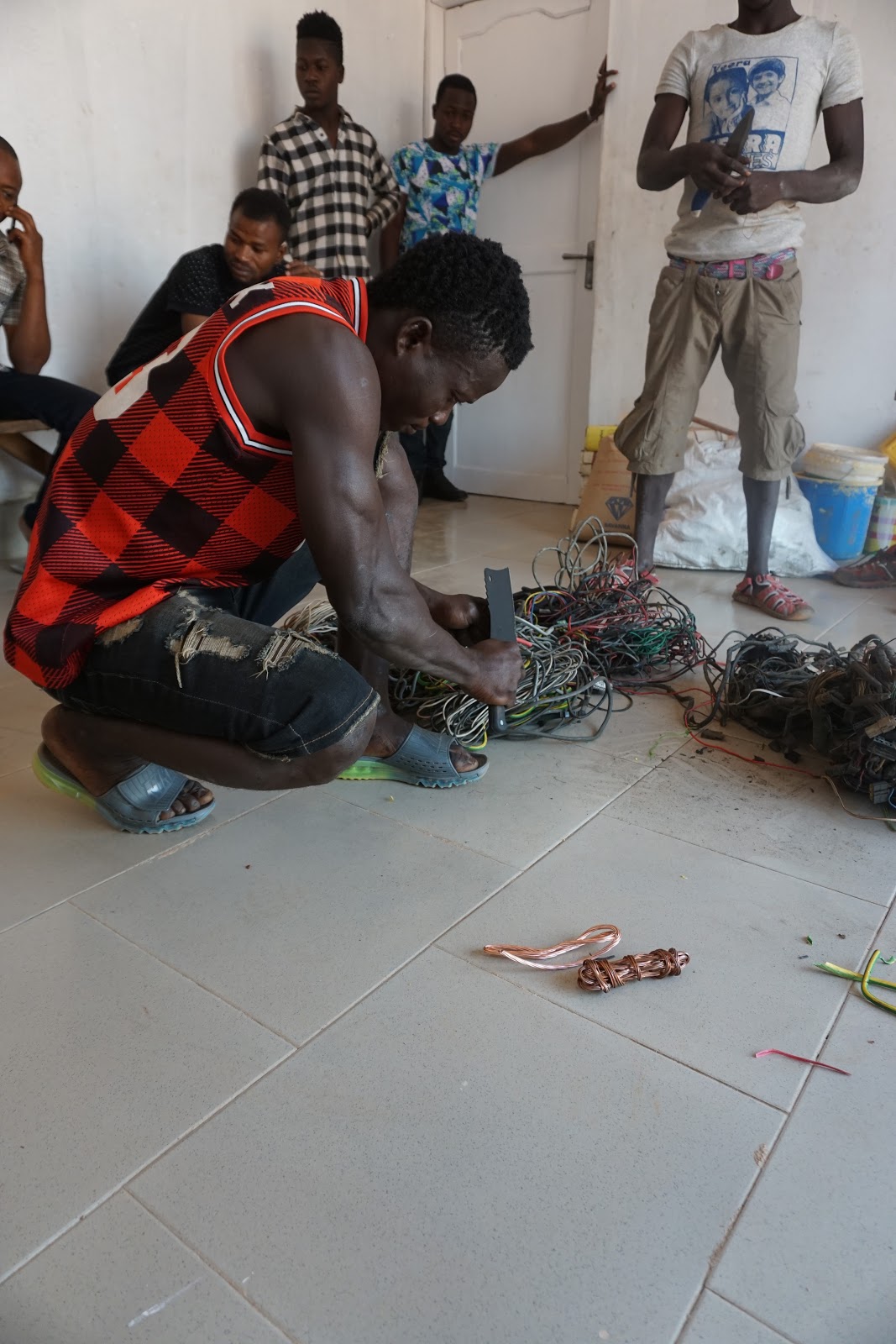
These shots are mine - taken when the guys stripped wire by hand to make "fair trade recycling bangles" like the one they give to the BBC reporter at the end of the documentary.


I've been to many slums before, and to this one several times over the years. I know Yahro, Awal, and Razak well.  I visited their families in Savelugu and Tamale, have pictures with their kids, and we chat a few times each month by Whatsapp. Reggie Yates' personal contact with them seems very genuine, if he perhaps misunderstands some of the Pidgin (for example Yahro doesn't say he hasn't seen his family for 4 years, in fact he was there with me in January and February 2017 - 4 Months).

You have to hand it to these Three Musketeers.  Awal has learned that photographers are attracted to flames, and by squeezing the most fuel into a tire, he can take control of every film crew.  Not that there is much competition... we only counted 25 people at the wire burning site on most days.  (Not thousands).

Our trip north to meet 3 muskateer fams
While it is irksome that BBC's Reggie Yates gets his information about Basel Convention and export from quite discredited claims from 5+ years ago, this is worth watching.  Not for "facts" about "e-waste exports" - Yates displays no evidence of reading research funded by Secretariat of Basel Convention, Interpol, MIT, Memorial University, and others who investigated - and dispelled with prejudice - the original Basel Action Network propaganda.

It's worth watching because, at least for 'e-waste', yes, this really is it. The 7 days Yates spends there pretty much capture the entire Agbo e-waste scene.  You can watch this whole thing and pretty much know everything.

Did you miss the 500 sea containers being unloaded?  Nope. There aren't any.  With time, I hope Yates will go see what 10 tons of e-waste actually looks like, at a facility like mine, and imagine seeing that arrive in an hour by wheelbarrow.

The only African Tech Sector representative appears in the video when Awal takes Yates to buy scrap from an imported goods shop.  The (unnamed) secondhand shopkeeper tells Reggie they are not importing "waste" or "scrap".  Study after study has proved the shopkeeper is, for the most part, correct.  Importers cannot afford to import junk, and they don't.  They fly and inspect goods, they will sample store returns to see if it's an easy repair.  The cost of shipping from the UK is about $5,000 and they certainly don't import VCRs (the junk Awal buys for scrap).  Reuse shops did import VCRs 10-30 years ago, used.  But today, Ghana residents bring them in for repair or exchange for something newer, a laptop or cell phone perhaps, leaving them at the secondhand shops.

Yates does find a UK store return at the shop and raises his eyebrows.  I've seen imported recalls, perhaps the one he saw in the shop.  But they are usually purchased and tested in the UK.  Yates doesn't plug it in, or find out how representative the sample is (this is photojournalism not data-journalism).  Certainly he can see that the shopkeeper isn't selling it for scrap, and that it's too expensive for Awal to buy for scrap, and stuff he sees at the junkyard is much older... nothing adds up.  Awal buys the scrap VCRs, not the store return. In any case, I challenge anyone to find enough "bad goods" in Accra shops to fill the Agbogbloshie they describe. Yates implies it's evidence of controversial import of bad goods. This "tidy little shop" isn't newsworthy... but Yates handling of Awal's negotiation gives us another glimpse of the reporter as protagonist.

The film does capture a lot of junk at the scrapyard. Junk cars, junk bikes, junk tires, junk coconut shells... Junk that comes from African Consumers, living African lives, in African cities.  The cell phone Razak points at Reggie will, in a few years, be scrapped for boards at the junkyard.

Reggie hasn't quite made the case that Agbogbloshie is anything but a city junkyard, similar to one in Essex or Dublin or Marseille, but with lower wages, more smoke, and lesser tools.  And I think if he sits and has a beer with me in a year or two, he'll agree the situation is kinda ordinary.

African consumers have been "consuming" electronics since at least the 1980s (when I lived in Cameroon for 30 months). A lot of "waste" is eventually generated in West Africa.  The more affluent the African city, the more e-waste.  If the export economy was really based on externalization and poverty, that wouldn't be the case.  Yates shows us the scrap exchanges up close, and we can see with our own eyes that it's being collected house-by-house, piece by piece, not dumped by container ships.

Yates shows how Awal buys the VCRs for a scrap metal price, and they wheel them to a consolidator, who pays Awal for footwork.

The journey of the scrap VCRs, by foot, is an example of where the documentary shines. The 3 musketeers do not remain "props", and are not nameless faceless viet cong in this BBC production.  Though he has no Dagbani translator, Reggie Yates deserves credit for listening, as best he can, to the individuals who make the fires. The guys told me this morning that Reggie was cool.

Here's a screenshot of Awal, in the documentary, who you will also recognize was the Blazing Tires "child" filmed by @itsSashaRainbow for the @officialPlacebo MTV video early this summer.


Even if it's not his intentional focus, Yates finds himself surrounded by a slum full of smart phones, FIFA jerseys, and rappers.  We can see with our own eyes that even the lowest scrapper has a TV set in his room.  Yates notes the traffic on a nearby highway.  He says he's been to Accra many times, and didn't know the slum was there.

World Bank data clearly demonstrates that Ghana is not a "primitive" place, and that the vast majority of Accra households owned at least one television in 2001.  World Cup and Africa Cup viewership is nearly universal. 20 TV channels are viewable in Accra, and there were 250 TV stations in Africa in 1977, for heavens sake.  The amount of junk at the Agbogbloshie scrapyard is if anything too light for a city of 3M residents... probably because Africans hang onto their electronics as long as they can.

Inline image 1


Of course, up close and personal is also the "byline trap". When a reporter's name or face features prominently in a story, it too often stops being journalism, and becomes a kind of talking-head on reality-tv. Yates remains seduced by his role in the lives of "the boys", and while he obviously means well, a great deal of footage is wasted on him demonstrating just that.  I learned after Peace Corps that having been to a brave and exotic place can help one seem interesting, help you pick up chicks, etc. Etc! Etc.

Like tire fires, journalism can be a testosterone high, or what I call a "graffiti economy" (time spent which is not really explained by monetary added value of the product).

Reggie Yates producers could have contacted some of the experienced reporters (Minter, Spaull) and researchers (Akese, Lepawsky, Miller) who have dispelled most of the hysteria about "hundreds of sea containers" being dumped and "pawed through" by "thousands of orphans" (I'm not exaggerating, the claims - with "millions of tons" - published in 2010-2014).  He should demand a follow up.  We can arrange for him to visit laptop repair shops and other importers, without whom Accra would never have had the "critical mass of users" to invest in cell phone towers, internet cable, etc.  I usually go to Agbogbloshie with savvy tech sector workers from Tamale, who translate the Dagbani language with Razak, Awal, Yahro, Muhammed etc.

We made the copper bangles (bracelets), and filmed the process, and I encourage the "boys" (I call them guys, musketeers, or men) to give them out to reporters if they have been honest and fair with them.  I take it from Reggie's parting gift that he passed that test.


Anyway I've been in touch with the guys and shared Yates photo - they remember him and seem to think well of him.  So I won't bash him, just gently chide BBC for re-publishing these outlandish crazy stories about hundreds of sea containerloads being dumped there.  And, yes, thank him for showing how little scrap is there, how many people (30 in e-waste, 250 in car scrap), how specialized a place it is, how little money is made in fire compared to hustle, how wheelbarrows (not sea containers) drive sales.  If you turn the sound off, you can learn a lot.

Agbogbloshie workers are a living, breathing part of the Circular Economy.  And that circle does not revolve around Europe.  While the used goods may disappear into reuse for decades, all the copper and circuitboards eventually get purchased and re-enter the world economy.  The TV on Joe Benson's sea container goes on a much deeper dive, has a much longer life, but the copper will emerge, bringing wealth to a place that added value. #freejoebenson

Euro Agbo Porno Journos need to meet one challenge.  In composing your "takeaway", please do not advocate for those who insist that arresting geeks and boycotting emerging markets does something compassionate. You can push the button on the shredder yourself, but you haven't done anything to improve anyone's lives.  You probably made them worse.

Instead of leaving UK citizens with a foolish notion that arresting #freejoebenson and boycotting #geeksofcolor and shredding, rather than exporting, used electronics will somehow benefit these young men, reporters could promote the clean copper recycling process.  You can buy the same bangles, made by the same men and women, and actually put some money on the table, and share the contacts Reggie Yates and others are making among your friends. The conditions of fair trade bangles include the safety measures (masks, gloves, doctors visits, etc) that Yates 'invents'.

With "fair trade rules", you only resell the copper rings, earrings, and bracelets that are collected without burning.  By doing that, you use the trade with Africa to actually make a difference in Awal, Razak, Yahro, Muhammed etc.s lives.

Reggie Yates was there in June (Ramadan), the anniversary of the AMA bulldozing and forced evictions (not mentioned), and 4 months after Awal posed with this copper bangle, filmed in a fair trade process, near the home of Kamaldeen - the laptop technician whose father is the metalsmith.  Kamaldeen is about the same age as the three musketeers, speaks the same local tongue, and grew up in the same places.  Kamaldeen did not drop out of school - he went on to college and got a degree in electrical and electronic engineering.  Today he fixes and resells laptops in a shop in the center of Tamale.  Reggie should meet him, too.

Reggie Yates gets a recycled copper Agbo bangle
One other theme I'm noticing is the territorialization of Agbogbloshie reporting as 'cultural appropriation'.  Increasingly, investigators (Agyepong, Yates, Vero) make their own bi-nationalism front-and-center of their reports.  It appears an evolutionary reaction to Hollywood's #whitesaviorcomplex. But it also forces the investigator to meet a broader range of African experts - scrap sector, tech sector, importers and regulators - to gain personal credentials.

If Reggie Yates and BBC want to go back and tell the other side of the Exotic Story of E-Waste in Africa, give me a call and I'll show you the intersection of Agbogbloshie and Chendiba Enterprises.  You will feel a little bit better about Europe and UK's roles in "exports".  I "f*king promise", Reggie.


see more by following #agbogbloshie on twitter


Geography Baiting 6: Granular Images of Recycling in Asia

My response to BAN's report "Scam Recycling" is not a criticism of tracking technology as a methodology.  And I'm not a critic of MIT or the Basel Convention.


Basel Action Network, using funding from The Body Shop Foundation, successfully added a lot of granularity to the discussion about exports of used electronics internationally.  The Data is interesting.   A peer review process, using scientific method, could have produced a great report, and could have protected the privacy of unwitting and unwilling test subjects in all the countries involved.  And to the degree that data is released rather than "obscured", it can be assessed by professionals like myself, and academics, and policy can evolve.

And that's happening. Josh Lepawsky of MUN's Geography department has repopulated many of the data points that were obscured on BAN/Monitour (though not all - Foshan is missing, as is EcoPark).

Is BAN playing games with the data?  If so, MIT Ethics office should recognize that its students (remember we have the names of the ones who placed a device in Somerville) are pawns.

I'm a critic of one thing.  Environmental Malpractice.  For a decade, this blog has attempted to offer an "anti-defamation" defense vs. Basel Action Network's game of tokenism, profiling, geography-baiting, race-baiting, and slander.  The people I'm most concerned about today are the Chinese printer technicians who make repair and reuse of laser printers as commonplace in China as automobile repair in the USA.  Or, put another way, as common as repair of laser printers was in the USA in 1995.  Because of the history economy printer cartridges - which cost as much as ball point pens to make, but sell for over $20 - printers are a specialty business which has been under attack since I first visited China's Nanhai/Foshan district in 2002, the year BAN visited Guiyu and Adam Minter arrived in Shanghai.

It's extremely difficult for Fair Trade Recycling to defend a printer economy which is kept in the "informal" sector by forces which defy Americans understanding of reuse economies.  Fifteen years ago, I assumed that anyone paying double the price of scrap for laser printers, but who refuses to buy inkjet printers, knew what they were doing, and had to be in the reuse parts business.  When I visited those markets, I was uneasy. They were very small, dirty shops.  Sometimes the work was outdoors. But you saw clearly that the sandaled brown and yellow people were sorting the printers by size and brand.  I found out that the reuse markets for certain LaserJet 4s had more to do with industrial machine repair (using the same memory cards) than it had to do with Laser printing.  And I found out about EFF.org, and Arizona Cartridge Manufacturers, and Jazz Camera.


I also found out that these markets are virtually untraceable and impossibly unaccountable. If I met a printer scrap buyer in person, and managed to communicate in Chinese, I learned that from his perspective scrap was "liquid". If he found the same printer I sold him closer to him, he felt he'd fulfilled his obligations and what happened to my physical printer was irrelevant.  From his perspective, it was as if I was trying to track the serial numbers on a hundred dollar bill I'd used to transfer money by Paypal.

5 Bells: Blogger Declares "E-Waste Hoax is Dead"

Shaba Kahamba, the Artist formerly known as Prince, and the E-Waste Hoax are dead.*

The second of the list, Prince, the incredibly famous purple dancer, was found passed out in an elevator, and declared dead at age 57.  Shaba Kahamba, the Congolese Soukous bassist legend, died peacefully in retirement in the Netherlands on Tuesday... in somewhat undeserved obscurity.   And the E-Waste Hoax will be remembered only by its silence.  There is no "correction" forthcoming from BBC, Economist, NYT, NPR, etc.  But I predict no further national or international coverage of any "e-Waste" emergency this Earth Day, one year after the news "jumped the shark" in declaring a small scrap metal pile in Western Africa to be the largest E-Waste Dump on Earth.

After a decade of NGO hype, what makes me think that "ewastegate" is over?  And not with a clang, but a whimper?

There may be some residual stories about "e-waste exports" cropping about here and there, but mostly they are coming from rank amateurs like Kevin McElvaney, people in their 20s with a camera. But the source of the hoax statistics is running out of funding, and not a decade too soon.

*homage to "the Oxford Comma"... Shaba K and TAFKAP are two different people.

Another Study Reveals Africa's Tech Sector knows its STUFF (#ewastehoax)

The new 2016 Report, published by United Nations University, is 39 pages.  What is remarkable about it is not only that it arrives at almost exactly the same "ewaste" percentages as documented by academics (like Josh Lepawsky of Memorial University, who was savagely mud-slung by a certain NGO director in Seattle last month).  The #ewastehoax around places like Agbogbloshie has been roundly covered by several academics, Basel Secreteriat (the ACTUAL international organization, not the USA charity using its name), and data journalists.

Again, disclaimer - poverty in Africa isn't fake. Toxics in Africa aren't fake.  What was faked was the narrative that EU and USA recycling programs dump waste and are responsible for the poverty or toxics.


What's remarkable about the UNU study is two things.  First, it uses completely different data sets from MIT, Memorial U, US ITC, and data journalism by #ewasterepublic Jacopo Ottaviana, etc... but arrives at the same conclusions.  For example, the chart below shows that less than 1% of Europe's used electronics are exported intact .
Very, very little of Europe's e-waste gets exported intact.  In fact, I interpret the data to say that Europe is being waaay too conservative - the percentages of working and non-obsolete goods is way higher than what is being sent overseas.

And very, very little of the junk in Africa's junkyards (like Agbogbloshie) came directly.  More than 95% of Africa's "ewaste" is its own, devices imported decades ago, used productively for years.
Some individual countries, they say, have higher or lower incidents of transboundary movement which is junk... but that begs the question... if it's an individual country like Burkina Faso, they are getting used electronics from wealthy cities like Accra.  As Lepawsky and Mather already documented, there are used goods traded WITHIN the global "south".

These screenshots shows exactly what I've been telling UNU and StEP since New Orleans in 2006.  The "Stuff" in the "Story of Stuff" gets used for YEARS and is EVENTUALLY discarded and recycled.   What's the first intact piece we photographed in Agbogbloshie?  It was a scrapper's VCR device that Adam Minter and Isaaco Chiaf and Jacopo Ottaviana (#ewasterepublic) stooped to photograph.  Africans imported millions and millions of used VHS players - IN THE 1980s and 1990s!  In Joe Benson's itemized packing lists, there isn't a single VHS player.  BECAUSE AFRICANS NOW WATCH DVD and STREAMING and soon, digital TV broadcasts.  The latter will generate exactly what it did in the USA - waste analog CRTs.  But those aren't being imported anymore to places like TEMA which have already switched to digital.

Golly gee, Colonialists, the evidence is that Africa's Tech Sector knows it's STUFF.

What Joseph Benson said on camera was the truth.  What Mike Anane said on camera was a lie.  Africa's Tech Sector needs reparations.

Agenda Shift 2: Agbogbloshie Ghana explained in 11 Minutes / McElvaney Akese Osseo-Asare

This 11 minute video of the exchange between 3 experts in e-waste of Agbogbloshie seems to get into the weeds at some points, but has everything you really need to know on the subject.  Wait for the end, when Ph.D student Grace Akese of Memorial University responds to the German photographer Kevin McElvaney's description of the "mysterious" free market fraud which (he alleges) dumps hundreds of thousands of tons (or millions, perhaps) of obsolete non-working electronic waste on the poor of Africa.

DK Osseo-Asare (an American who has lived in Ghana for 11 years) responds to McElvaney first, explaining that his allegation they goods don't work and aren't repaired is a bit ignorant.  The used products are more likely to work than brand new product sold in Africa.

Then Grace Akese of Kumasi, Ghana, who has researched the flow of goods throughout their 20 year lifecycle, has a chance to answer the question.  Her command of every study and fact about "e-waste" export to Ghana emerges patiently and slowly.  Then she schools McElvaney in a "drop-the-mic" conclusion.


91 percent of the used electronics Africa imports are reused for years.  Asset tags add value in Africa's secondary market.  An African consumer would no more scrape one off than you'd remove Jennifer Lopez's nametag from a shirt at the thrift shop, or scrape off a brand logo.

Delayed Report on WR3A Investigation of Africa Tech Sector and Agbogbloshie


Please excuse the delay in publishing the promised report on our visit to Accra, Agbogbloshie, Mole, Tamale, and Tema in March and April, 2015.

We were nearly finished with a report, and expected to post it before end of the month of May.  However, four major developments occurred in the weeks immediately preceding the publication date.

  • Natural Disaster - A major flood in Accra, combined with an explosion at a gas station, killed 150 people.  During this disaster, no one was thinking about discarded appliances.
  • UNEP published a lazy, poorly reviewed report (ignoring most of the studies they cite from UNU), and worse, accompanied it with a false headline of "90% illegal" (which was contradicted by the contents of the study itself).   Mathematically, how can 90% of contents be illegal if only 1/3 of seized containers contain SOME illegal material?  What mattered were the photos - eight of Agbogbloshie.
  • CWIT and Interpol announced a meeting for June 24 and 25, featuring Jim Puckett of BAN and Mike Anane as speakers.   While we felt it was unlikely they would spring "new information", we were already delaying our report to address UNEP's "new information" and waiting seemed prudent.
  • AMA, a local Accra municipal association destroyed Agbbogbloshie, citing "floods" and "ewaste imports", AMA sent bulldozers to knock down the homes and businesses of tens of thousands of Agbogbloshie residents and workers.  It was the beginning of Ramadan, and #UNWorldRefugeeDay and rainy season... and the bulldozing to "dredge the waterway" occurred at the populated homes side of the slum, not the abandoned side of the waterway.  
From our "e-waste" prospective (not the evicted's), what's most important about the last point were a couple of hours of filmed interviews we have, with Ghana technicians and scrappers.  Some had told us, when I asked "why?" about the #ewastehoax of Agbogbloshie, that they believed it was part of a propaganda campaign to take their land.  

I reviewed the maps and it was definitely true that Agbogbloshie, described as the remote "outskirts" or "nearby cities like Accra" in Greenpeace and other NGO reports, is smack dab in the middle of the city, 9 minutes from the most luxurious hotels, less from major banks and government complexes.  But in the first draft of the report, I avoided mentioning it, as I thought it came across as rather paranoid.  Now, after the evictions and apparent razing of the scrap businesses, I have to  check that dismissal...

The entanglement of Western second hand goods export and urban planning in Ghana is complicated. In writing the report, we need to check our outrage, and report the facts.

4 Great Articles on #Agbogbloshie Ghana: Not an e-waste dump, perhaps?


Once again, here are 4 links to articles by 3rd parties who have recognized that hoaxes harm, that Africa's Tech Sector / ICT workers have been impugned, and Africa's recycling workers in Agbogblohsie have been blamed for importing devices which they collected on street corners in Africa's urban centers.  Imported once, second hand, but used for 5-15 years, is not "dumping".

http://therestartproject.org/repair-elsewhere/representations-of-e-waste-matter/

http://discardstudies.com/2015/06/24/criminal-negligence/

http://shanghaiscrap.com/2015/06/anatomy-of-a-myth-the-worlds-biggest-e-waste-dump-isnt/

http://www.wired.com/2015/06/infamous-e-waste-slum-needed-us-got-razed-instead/


And it certainly did not make a lick of sense to bulldoze homes, mosques, and schoolrooms of the Agbobgloshie recycling (and onion farming, and litter collection, and water carrying) community.  The predominantly Dagbani were set up like a bowling pin, knocked down, got to wearing thin.

No white money-hatted cartoon characters have been found or sent to prison in the past ten years, since BAN's "Digital Dump" morphed into Frontline / UBC Vancouver's "millions of tons", which morphed into Greenpeace in 2008 labeling Old Fadama, aka Agbogbloshie, as "Sodom and Gomorrah" and "the largest e-waste dump in the world".  The story just got bigger and bigger, despite our constant cries, and the increasing number of scientific studies that found no evidence at all of "dumping".  None.

The people being arrested, the owners of the seized goods, are Africa's Geeks of Color.   They are bringing affordable electronic communications to inner city Africans, in the face of a European campaign called "Project Eden", the chalkboard-clawing title of Interpol's #greatwhitesavior campaign, and UNEP's Willie Horton poster boy TV repairman, #FreeHurricaneBenson.

We know what happened in Old Fadama because geeks and nerds like Alhassan Ibn Abdalla tweeted and filmed the destruction on #WorldRefugeeDay... because he lives in the real world, not in a TinTin comic, nor in jungles of "Eden".  Geeks are tweeting news that winds up in the articles above on laptops and cell phones imported and repaired by Africa's Tech Sector.  I'm blogging passionately because I KNOW these people, they lived in my HOUSE in Vermont.  They are the best and brightest, and FairTradeRecycling has become like a modern day "underground railroad" for geeksofcolor threatened primarily by environmentalist propaganda.  It's crazy.  It's religious colonization all over again.   Environmentalists are "here to help" by putting black people safely in chains, protecting all of London from scary African tinkerers and nerds.  It's a nutty combination of Roots, Big Bang Theory, and The Shining.  "Heeere's TinTin!"

movie animated GIF
Here to help
As I originally wrote in my best blog, "Why We Should Export...", republished in Motherboard in 2011, recycling was good, reuse and repair was good.  African and Asian and South American geeks of color were good, creating the most progress the World Bank had ever reported in internet ICT and teledensity access, in the most sustainable and affordable way possible.  With used CRT displays that lasted another 10-15 years, Accra residents were watching the World Cup, watching Colin Powell make the case for the Iraq invasion, watching ads about clean water, and checking their emails... or watching 1970s movies, for common cultural references like "The Shining" (about another mentally disturbed one-note author, played by Jack Nicholson).

Let's environmentalists retrace our steps.  How did we get from speculative concern over "donated" equipment (in fact purchased and inspected by Africans), worth only 20% in scrap of the cost of transport, to demolishing homes on UN #WorldRefugeeDay, under a colonialist Biblical banner #SodomandGomorrah and #Eden?

Sure, I keep writing about the same thing.  But can anyone find a WORSE case of #Charitableindustrialcomplex, #colleteraldamage, #parasitesofthepoor, #saviorcomplex, #unintendedconsequences than BAN and Greenpeace and Blacksmith Institute and UNEP's #Ewastegate?  So horrifically stunning in its reality, putting Africans in European chains for fixing cell phones and TVs?  It is an environmentalist horror show.

Finally an end to dumping of 15 year old city buses on Africa's Eden
"First we caught him listening to Soukous and Highlife.  It was a gateway drug for apologists"

Recommendations to CWIT, INTERPOL on WEEE EWaste Project

delivered by Twitter, Linkedin, and Blogspot


June 25, 2015

David Higgins
Pascal LeRoy


Dear Pascal and David,

Thank you for Pascal's response to our initial draft of comments for the CWIT meeting in Lyon in June.   In addition to presenting more factual numbers, it is important that the CWIT group focus on percentages, not tons.

Ghana's secondhand imports, estimated at 215,000 tons, includes approximately 21,000 tons not reused. That's a real problem, but smaller than the generation of once-reused, now discarded electronics (and cars, and other machines) as cities like Accra modernize.  The generation predicted by World Bank and other sources will require in-country solutions, much greater than "informal" scrapyards (like Agbogbloshie) can offer. 


The ratio of fallout from secondhand electronics imports is similar to clothing, new electronics, automobiles, cell phones, broadcasting equipment.  No import container is perfect.  Shipping damage, human error, demand forecast changes, electrostatic discharge, and other fallout cannot be termed "illegal waste transport" without impacting all development. Criminal enforcement should be directed at goods (such as ivory) which is 100% illegal.

We recommend Interpol and CWIT start discussing acceptable "de minimus" quantities, and whether the testing Guidelines (used in prosecutions) is a good predictor of percentages.  And please, incorporate discussions with Africa's Tech Sector.  They are the ones who send contacts to Europe to source proper reuse equipment, they are the ones who pay for the equipment, they are the ones who have created double and triple-digit teledensity growth for Africans this decade.  Their supply to the "good enough" market creates the critical mass of users which makes paving roads, laying internet cable, erecting cell phone towers, etc., economically feasible.


We can introduce you to several speakers, or university research departments, who know these technicians, who would have been a valuable addition to your list of experts.  Here are some articles written by westerners who accepted this invitation, and met with these champions of the Emerging Market.  Fair Trade Recycling (tm) goal is to engage these technicians in managing the takeback of used electronics, and pay for their proper recycling by donating MORE used equipment at lower prices, rather than by driving up price and lowering demand in the current "Prohibition" enforcement model.


I will be arriving in Lyon (previously scheduled business) on July 1, if anyone from Interpol is interested in meeting to discuss a more progressive agenda to the media-driven "export crisis". In the meantime, here are some articles we recommend for distribution to your guests and attendees.


Sincerely,

- Robin Ingenthron, WR3A.org 


PS.  The illegal goods reported in Ghana were refrigerators which work, and which are eligible for a subsidized program to replace them with energy efficient models.   Stating that 1/3 of inspections found illegal goods should differentiate between the energy efficiency ban (not widely understood by importers) and illegal dumping.

Q: Are Millions of Tons of Western "e-Waste" Dumped in Agbogblshie, Ghana?


No.


There is more and more "e-waste" in Africa.  But the West (Europe and USA) are exporting fewer and fewer containers of used electronics.   The implication is obvious... used electronics DID work for 5-15 years after they were imported - Africans are finally replacing TVs and computers they imported more than a decade ago.

There is no big story here, other than the fake news was faked and Joe Benson is in jail because of it.

More African city households have had multiple televisions since the 1990s.  But the "sources" for the foreign dumping claim have all dried up.

John Henry:  "Where did that @#$% statistic go?"
Containers of used equipment being imported into Ghana's port (Tema, not Accra) are not going directly to the Agbogbloshie scrap yard. That can be disproved from any editor's desktop, or by looking carefully at photos purporting to show it.

And there is no evidence of widespread violations of international law.  15% waste is the margin of accidental breakage, electrostatic discharge, human error, etc., and it's as likely (or more likely) to come from brand new product lots as from used.

The discussion is not about what happens to used electronic scrap.  This is about is how to feel about people, and how those feelings promote a political agenda with multiple stakeholders, winners and losers.

How to feel about poor people, how to feel about non-profits, how to feel about ourselves when we consume more goods, how to feel about ourselves as do-gooders and non-profit founders..?  That's far more interesting than which type of video display (used CRT or new LCD) an African with $3,000 annual income should invest in.

[Addendum 6/23/2015 - After forced evictions begin, Discard Studies essay by J. Lepawsky and G. Akese explains history and land politics]

2015 WR3A Report on Agbogbloshie: 13 Recommendations

We are in the important but slow phase of re-editing the 2015 Agbogbloshie Report. It takes time to include citations, make charts, get peer review, and especially to accommodate assertions made in this month's release of the UNEP Report. Suggestions have been made that we better recognize the "accidental nature" of misdiagnoses by well meaning members of the charitable industrial complex. (References to "hoax" and "nutjob" may make future researchers less likely to cite the report).

Statistical meat and photo-potatoes are hot and ready to eat. Presentation of the meal is important, however. We need the plates and garnishes. In the meantime, here are thirteen e-waste recommendations on the menu.


13 Recommendations E-Waste / WEEE Enforcement


Recommendation 1:  UN and Interpol should immediately stop arrests and searches of used electronic product (televisions, computers, cell phones).   Inspectors who were trained with the assumption of 80% waste, using Guidelines developed using the same assumptions, are likely to unfairly harass and harm Africa’s Technical Sector and create unnecessary enforcement and prison expenses in the EU.

Evolution of RERA #eWaste Legislation: Spinning H.R. 2791 Obsolescence

Lobbying for the RERA Bill, to bring EU style enforcement to bear on secondary market electronics, keeps shifting parameters.   Here's a blow by blow on why exports of used electronics should (or shouldn't) be banned.   The justifications for both RERA and Interpol enforcement seem to go "obsolete" every 18-24 months... Moore's Law for accusations?  

Summary: H.R.2791 — 113th Congress (2013-2014)

(Note, the dialogue is equally effective in summarizing INTERPOL's Project Eden enforcement)

"The legislation is necessary because 80% of USA e-scrap is exported and dumped.  It was necessary to arrest Joe Benson and more like him.".

- No, actually USITC and MIT show conclusively that most is not exported (otherwise why would we have all those CRT glass piles?)

"We meant, The legislation is necessary because of what IS exported, 75% is simply dumped and recycled in primitive conditions.   It was necessary to arrest Joe Benson and more like him."

- No, actually 85%-93% is reused, not dumped, according to multiple peer reviewed UN studies.

"Ahem.  Thanks to the attention we brought, and arrest of Joe Benson, the situation is greatly improved.  Legislation is needed to continue this improvement."

- No, the studies were on the containers seized during his arrest.  It was literally the accused containers that were found to be 85%-93% reused.  He didn't do what you said.

"While the 80% dumping was exaggerated, 9-15% dumping is still completely unacceptable.  Legislation is needed so Africa will leapfrog into new product..."

- No.  Actually, brand new product imported to Africa was found to fail more often than the used equipment, either due to lightweighting (less durable, cheaper components susceptible to Africa's electric grid fluctuations), or shipment of "new" ESD damaged warranty returns to Africa.

PRESS RELEASE: Agbogbloshie e-Waste Investigators Claim "Export Hoax"


Hoax: Investigators call out Agbogbloshie "E-Waste Tragedy"

Three weeks of research at Ghana "e-waste dump" and review of UN Studies and World Bank data confirm waste in pictures was not "dumped" by Western recyclers.

As Americans and Europeans once again are confronted by photos of old white monitors and CRT televisions in a dumpsite in Accra, Ghana, recent investigation confirms suspicion that the story repeated by news sources is a hoax.  Three reports on Agbogbloshie, Ghana, and "ewaste" appeared last week:
"'Developed countries export millions of tonnes of electronic waste annually into developing countries such as Ghana,' the group based in the country claims on its website."  - Daily Mail
“People just load up containers to places like Ghana with enough working stuff to satisfy the importers and and then the rest is junk, and that junk gets smashed,” Puckett says. -
"Agbogbloshie, reportedly the world’s largest e-waste dumping site... is now a field home to thousands of tons of the world’s electronics." - Washington Post
Recycling experts have long noted that the number of pieces of junk electronics visible in photos (e.g. Wired News link) do not appear to support the claims made in the articles. Several major media have reported that "millions of tons" of used western electronics are dumped in Agbogbloshie, Ghana, and that "80 percent" of used goods imported are actually not reused.  The Guardian claims it is "the world's largest e-waste site".  But the landscape (behind posed scrap workers) is relatively barren.

A three week investigation involving data journalists, trade news reporters, Ghana customs officials, local Dagbani speakers, and African electronics technicians found that Agbogbloshie only managed between 20 to 50 used electronic pieces per day - a nearly infinitesimal amount as compared to "millions of tons per year" claimed in mainstream press articles on the site. Most scrap workers at the site is concentrated on junk automobile recycling, and most of the wires being burned were from automobile harness wire.  The electronic or "e-waste" material being recycled was collected locally, and manually, by push cart, from neighborhoods and businesses in Accra.

Is the "world's largest e-waste site" a hoax?

The researchers reviewed 2 United Nations reports from 2011 and 2012, which assessed hundreds of sea containers of electronics, to compare against the claims by NGO's.  The UN reports contradict the claim that most of the goods imported are dumped in Agbolgbloshie rather than reused and repaired by Ghana technicians.  World Bank metadata also supported the claims of the scrap workers that the scrapped appliances shown in films were owned by Africans and had been in use for many years.  Africa has over 600 television broadcast stations.

Investigators stressed that concerns over health and pollution were genuine, and expressed particular concern over workers who eat lunch or drink water with hands contaminated by leaded soil. "We do not condone the conditions at Agbogbloshie. We only note that ending imports and arresting repairpeople will do nothing to address the problem," said Robin Ingenthron of WR3A, who organized the investigation.  Copper wire burning by teenagers is not unique to Africa, however.  Reports of copper wire burning in Europe and California emphasize the same "primitive recycling" practices occur in many cities, and are associated with unemployment and high copper prices.

Analysis of the claims by anti-trade NGOs showed their versions of the story to be mathematically and economically impossible. NGO press releases which simultaneously claim "millions of tons" are imported in 500 sea containers per month would indicate a sea container with well over 800,000 pounds per truckload.... the maximum one holds is 42,000 lbs. The cost of shipping used computers from the USA is approximately $10,000 - $14 per television. That is seven times more than the scrap value.  While many of the alarming press releases contain data which are prima facia contradiction of the claims, an emphasis on "child workers" and exotic photography still deliver a powerful message of guilt and liability in the western press.

WR3A spokesperson Robin Ingenthron offered the reporters direct access to African technicians.   The technicians participated in the investigation, and strongly cautioned editors and readers from accepting claims which do NOT interview the Africans who paid for, owned, and generated the "waste" in the photos.  WR3A also provided several studies which provide actual vetted data on e-waste exports rather than rely on emotional or racially charged photos.  Despite many headlines which empasize "child workers" employed in recycling, fewer than 1 percent of the workers in Agbogbloshie appeared to be under 18 years old.  One young man, Rachid, was shown his own photo in a Washington Post story, which indicated he was "between 12 and 18 years old".   Rachid is 22, and married, with a child.

"Africa has plenty of real problems," said Wahab Odoi, a technician and translator. "We don't need NGOs to make up pretend problems for us." Wahab Odoi suggested that donors find other causes to donate to and other environmental crimes to investigate, such as illegal ivory poaching.

A report on the trip and findings will be published soon.

http://tinyurl.com/hoaxAgbo