Showing posts with label Africa. Show all posts

Should we switch to Substack?

There are still important things that we, in the actual trade in electronics reuse and recycling, can share. But if Google is de-platforming its own blogspot platform, I have to consider moving this entire discussion to Substack.

The risk is that we lose the 30-55 average blogspot views (way down from 2015) and have an unviewed substack. Substack is not showing up in my page 1 Google searches, there's probably a riff (maybe Google is "protecting" blogspot while another wing of the office is killing it?)

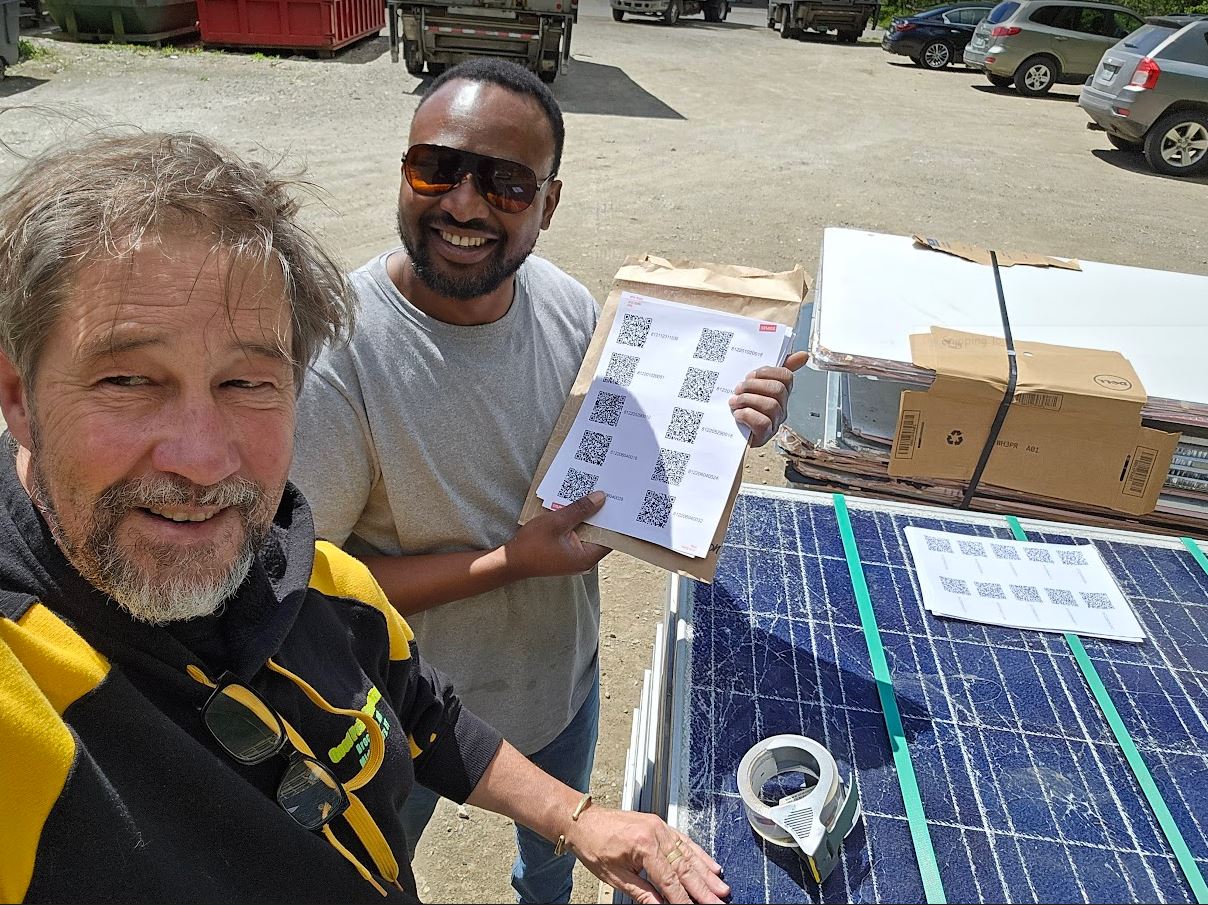
And here is your reward for reading this.


Reused solar panels will be tagged with these Avery Labelled stickers, with OBADA.io blockchain tracked QR codes, which Africans can scan with their mobile phones to upload photos - which have GPS location - proving it is NOT IN AGBOGBLOSHIE.

more

Externalization Fallacy: Total Eclipse of the Truth 2002-2020

I recently met someone quite interested in Ethical E-Waste Blog who was 10 years old in 2002. 

Then I met someone who was 5 years old when CBS 60 Minutes broadcast "Wasteland" in 2008.

Both flattered me by saying this blog was "inspirational".  So I guess I gotta keep it up.

I also recently ran across a lot of film camera photos from my first visit to Guangzhou, China, in 2003. That was 21 years ago. It was a Shark Tank worthy experience.  Even if 5-6 blog visitors will find this to be a repeat, there are some new recruits whose minds have yet to be blown. And maybe some readers will be glad for the reminder.

Simon Lin. (Acer, Wistron)

Terry Gou. (Foxconn, Han Hoi Precision Inst.)

Rowell Yang. (Proview, "iPad")


These three men were the head of "contract manufacturing" when IBM, Dell, HP etc. declared that "display devices" were "commodities", not core manufacturing. Sony had, well, "colonized" Taiwan in the contract manufacturing of  CRT displays and now Guangdong Province had been "free=market" friendly thanks to Deng Xiaoping ... Who was famous for being patiently waiting for Mao to die while watching Taiwan and Hong Kong blow the gasket on free market manufacturing.

Used Ford Model As created the critical mass of users in the Ozarks and Appalachia who would vote to pave the roads.

Used VCRs and CRT televisions paved the roads for thousands of TV stations and satellites broadcasting to the "Global South".

Used CRT monitors paved the roads for internet cable investors.

Used Flip Phones paved the roads for 170,000 cell phone towers (2017 estimate) on the Africa continent.

Used Solar Voltaic Panels will pave the way for Africans to reduce diesel-electricity generation.

Despite the obvious facts about electricity access and consumption, the truth about the information and mass communications infrastructure, paved by progress from reuse and value-added repair, by the Tech Sector Auteurs, aka Geeks of Color like Simon Lin, Terry Gou, and Rowell Yang, the West (at least Europe and USA) press coverage of their bright past present and future has been eclipsed by an "externalization hypothesis" - that any capitalist trade between someone rich and someone poor is suspect. 

Imagine the Moon refusing to leave... a persistent, stubborn eclips of the truth...

Electricity Stupid.

For 25 years, since I left MA DEP to start my own used electronics repair, export, and recycling company, there has been a blind spot in the entire environmental movement.

It has not been about waste.

It has not been about externalization.

It has been about electricity.

The growth in access to and consumption of electricity worldwide has been extremely well documented by GapMinder (Hans Rosling), the international monetary fund, carbon monitoring / clean energy, big petroleum, the airlines, USA AID, the State Department, and every industry that manufactures anything that consumes electricity. 


The screenshot above, from the World Bank Data page, is remarkable for two reasons. 

The Noble Informal

Today's blog is just a placeholder for another I've been working on for a few days. 

The topic is my invitation to present to a group of African Environmentalists on the Topic of E-Waste Management in Africa. 

Youth in E-Waste and Greentech Summit

The paper introducing the conference quotes Global Transboundary E-Waste Flows Monitor as follows:

"According to the Global Transboundary E-waste Flows Monitor 2022, Africa generates over 2.3 million metric tons of e-waste annually, with only 1.2% of this waste being collected and recycled in an environmentally sound manner in an ecologically sound manner. The informal waste management sector handles a substantial amount of e-waste, collecting and recycling the majority through unsafe treatment methods. These practices harm the environment and pose severe health risks to women, children, workers, and fenceline communities. The informal e-waste sector's low-value recovery methods perpetuate poverty and hinder sustainable development."

I have been invited by Agabas Ayudor of Appcyclers, who spent a week at Good Point in Vermont last month learning about how hand disassembly leads to more reuse and repair than grinding and shredding.


If I'm able to present, my title will be The Noble Informal, and will focus on Retroworks de Mexico, which opened in 2007, and which for 13 years operated an e-waste demanufacturing facility in Sonora which was banned from the Tucson Arizona contract it was awarded based on the exact same made-up narrative. The Arizona companies who impugned Las Chicas Bravas as "Primitives" wound up creating the largest hazardous CRT waste pile in America - possibly the largest on earth.  The women who ran Retroworks de Mexico in fact recycled the only CRT glass from Arizona that came from that pile.

Africans presenting the dystopian rumors about Africa Tech Sector to young Africans is something that should keep European tax payers up at night.  This is 2022, not 2012, when the lid came off of Basel Action Network's 80% false claims, and the re-arrest of Joseph "Hurricane" Benson in the UK was issued based upon that false, faked, statistic.

I don't want to be pidgeonholed into writing about the same thing, but WHO IN ACADEMIA IS HOLDING GLOBAL TRANSBOUNDARY E-WASTE FLOWS MONITOR accountable for this propaganda?  


The Torching Critical Mass of Used Solar Voltaic Panels at Africa Barber Shops

Accra, Ghana:  Every barber in the city knows the other barbers in the city.

Every person in the city knows a barber in the city.


The leasing of used solar panels, imported from Vermont, can light a torch - so to past-speak - on rapid adaptation of solar panel electricity in Africa.  And Africa is obviously the fastest growing population on the grandest continent. Unless our plan is for Africans to live without electricity and not cook their food, they will continue to buy expensively off of a limited electric grid, and buy illegally deforested charcoal to cook their meals.

Jim and Daniel Puckett, just come here right now and attack this export of used solar panels for good and proper use. That's your thing...Get it over with.

The electric grid in Africa was meticulously studied before I lived in Africa as a Peace Corps Volunteer+-3

See these African Tech Geniuses getting free secondhand panels and measure the gallons / liters of diesel they save every day, every single day, from the ubiquitous diesel powered electric generators which are feeding demand since IMF and World Bank ran out of rivers to Akosomba Dam Hydroelectric fund.

WSJ Documentary On Wagner Group: Mining the Absence of Environmental Leadership

WSJ Documentary On Wagner Group: Mining the Absence of Environmental Leadership

The new 2023 Wall Street Journal Documentary on Russia's Wagner Group - Shadow Men: Inside Wagner, Russia's Secret War Company - deserves a Pulitzer Prize.  I try to embed it below, but follow the link above if that does not work.

It's a story linking the exploitation of extracted natural resources to war crimes. First in Syria - which offered Wagner Group 25% of the money at oil fields they protected - to become a "lilly pad" expansion to Libya, Central African Republic, and other weak states.  The gold mine they took over in Central African Republic is now a major source of funding for Wagner Group and Russia's war on Ukraine.

What I will add here for commentary is that the colonial forced extraction of virgin raw materials, in unregulated and poverty stricken lands, demands we re-read Heart of Darkness. But my liberal and environmentalist colleagues largely draw the absolutely wrong lesson from that. The mostly well intentioned left tries, through Basel Convention Amendments and R2 and E-Steward Certifications - to label suspect, racially profile, and boycott trade in everything that is NOT virgin material extraction.

The "cultural lobotomy" of denying Africa's Tech Sector to come test and buy used equipment comes out of a fear of exploitation. We want to keep our consciences shiny, and good enough on you for that. But watch the documentary below. Wagner understands what immense power a hundred dollar bill has to an African or a Russian prisoner.  They pay people to be brutal, they recruit sharp-elbowed youth, and they succeed in taking over governments precisely because people in those places are so inexpensive.


Why environmentalists what to deny those people good jobs in repair and recycling is not so much unfathomable as it is a symptom of tragic misunderstanding. Hanlon's Razor. I get frustrated at groups like Basel Action Network and SERI at times, but don't want to overstep and mistake ignorance or stupidity for malelovence. But when we don't allow the Youth in Emerging Markets to create valuable recycling and repair jobs - like our litter collection offset project underway in Cameroon - it just leaves a vacuum which allows exploitation of  hopelessness by filthy new Belgian Leopolds (the king who did not annex Congo, but made the Congolese people his personal property) like Yevgeny Prigozhin become the de facto job market for high school graduates.   

Boycotting or shaming trade as "exploitation" is, de facto, removing your privileged ass from environmental leadership. Contract managers, certification bodies, regulators, and activists who would prevent me from employing geeks of color in these same emerging markets are helping to supply the labor Wagner relies on to brutalize freedom seekers. 

Watch.

<iframe allowfullscreen="true" webkitallowfullscreen="true" mozallowfullscreen="true" frameborder="0" scrolling="no" width="512" height="288" src="https://video-api.wsj.com/api-video/player/v3/iframe.html?guid=29735C37-0B4E-4E70-8E8C-C46FB711370C"></iframe>

The Battle for Reuse "Good Enough" Market: Solar Panel's "Primitive" Recyclers

There is a nascent discussion at SERI R2, 
at EPA, and E-Stewards 
about what the "maximum life" of solar panels are. 

I've had several discussions with experts like Cascadeem.com's Curt Spivey, Veolia's Paul Conca, and solar panel manufacturing experts on what "specification" a panel must meet before a buyer is allowed to be "legitimate". 


Curt and Paul are smart, but they are nervous about their own "accountability" - that they may be held to if they sell their clients' electively upgraded panels overseas.  Other recyclers are taking a strong a priori stand against export of solar panels for reuse.  Note that these are potential sellers of used equipment, discussing which buyers are "legitimate" or "primitive". 

It's a continuation of privilege. No one seems to worry about the mining of raw materials in developing countries, despite the fact that the cleanest virgin material mining is worse than the worst possible recycling. But are the others good enough people to get their electricity from a reused solar panel? If in doubt...

The video above is a 42 year old solar panel sent to Good Point Recycling for end of life recycling. It's widespread "truth" that panels function for 30 years. But that "30 year estimated life" statistic was put in print before any panel was more than 10 years... it was (like "80% of ewaste" stats) made up by someone with zero knowledge of the future life of the panel... ostensibly I'm told it had something to do with a procurement specification or waranty request.  But "30 years" is hocus pocus, not reality.

Don't Let #CircularEconomy Mean #PropertyColonialism

 The previous blog opened with a some photojournalism chestnuts from a decade ago - when Greenpeace slipped reporters a mickey, and showed journalists a sea container full of identical CRT TVs from a hotel upgrade shipped to Tema, Ghana - and then a 70 year old black and white Magnavox kitchen table TV housing in Agbogbloshie. What should have been proof that Agbogbloshie was an #ewastehoax was passed around as evidence of #environmentalinjustice.

There IS environmental injustice on display - it's when Western NGOs conflate the recent importer, the valedictorians in the Tech Sector, the "Geeks of Color", with wire-burning "primitive" recyclers from the slums who eventually gather used imports after DECADES of reuse in the #goodenoughmarket.

This week, we see evidence of the same tactic, via another NGO.  "How Romania Turned Into an Illegal Dumping Ground for EU Waste".

Check out these photos from the article, which claims that "rusting" metal farm equipment is "burned" in Romania landfils. Shocking, but not in the way the writer intended.


The claim that the "rusty" meatals are "burned in landfills" after being purchased in Western Europe is bigoted, stupid, and every bit as stupid as the 2010 claims that Joe Benson was importing the 1970 kitchen Magnaox watched by Prince Nico Mbarga.

The Privilege of Recycling Righteousness

 Waste Hierarchy vs. Litter.  Keep Atlantic Beautiful.

There is a privileged disconnect between weathy nations' obsession with recycling rate of plastic, when the emergency is ocean-bound litter in emerging markets. I don't care if it's recycled, I want to see litter collected before monsoons send it to sea.

Visit WasteAid.org 
Over the past two decades, I've been delighted to see hunger decline globally, disease vaccination rates gain, mass communications tech spread across the poorest nations, and, quite significantly, the income per capita in so-called "third world" nations triple. Most scholars now refer to developing countries as "Emerging Markets" based on double-digit annual per income growth and spending.

Still, they have a ways to go. And environmentally speaking, many African, Asian and South American Communities are at the awkward stage of environmental regulation the USA saw in the 1950s and 1960s, when cars were dumped in American Rivers, and bottle bills were driven by LITTER, not by a heartfelt need to recycle.


There is a reverse normal curve when it comes to recycling and growth of income. Very poor nations recycle the most, because the value of the material is a high wage, they cannot afford to throw it away. In places like Kumasi, Ghana, the metals from cars are segregated into far more categories than an American recycler would ever bother to. 

But when the income of a nation doubles or triples, from very poor to modestly lower class, you start to see disposables being consumed - bottled water in Africa (or plastic bagged) - but not collected. The awkward period when - like my grandparents farm in the 1960s - garbage is being produced by higher and higher levels of packaging, but at best being burned in barrels, and at worst, dumped on roadsides.

And that's what is going on in Emerging Cities, many of which are on the coast, or along one of 7 rivers that dump into the 5 oceans.

The COVID-19 Bottom Line: Some Societies Can Afford To Insure The Elderly. Some Can't.

This will be brief, and I don't want to "bury the story" yesterday about concrete things recyclers in wealthy societies can do to preserve their businesses.

Bloomberg columnist Adam Minter just published a big truth. In some of the 7 billion people world, there is enough stimulus to finance "flattening the curve". In other places, there is not.


Fair Trade Recycling "EWaste Offset" Program: 8 Steps Forward, 3 Steps Back, 4 Marching in Place

We launched the FTR E-Waste Offset Program from Ghana, Africa, through this blog in 2017.  Time for an update on how the program evolved.


Briefly, here are highlights of our progress.

1) We initially had a firm quote from Camacho in Spain to take back full loads of CRT televisions, ones that had been imported in the 1970s, 1980s, and 1990s, at an extremely competitive cost... under $5k including shipping. This would have been very easy to finance with the discounts on sale of current reuse shipments.

2) Camacho needed a letter from the Ghana EPA allowing the "waste" TVs to be shipped to Spain... a demand from the Spain EPA. Turns out that was foreshadowing friction with Spain EPA that would lead to Camacho closing their purchase orders not only for Africa, but for USA as well.

3) WR3A hired an intern from Antioch University in NH, John Sumani of Wa, north Ghana. Sumani was getting his Ph.D and had previously worked at Ghana EPA. It took him about 3 months to get the requested letter (working with WebElement, a formal sector recycler in Ghana). But by the time they got the letter, Camacho's offer had vanished.

continued...

The 1960s Wasn't Eden: How "Gotcha" Journalists Mean Well But Twist Facts on Secondhand Clothing

How "Gotcha" Journalists Mean Well But Twist Facts

As the kid of a Journalism / Mass Communications professor ("Dr. I"), I'm very fond of reporters and journalists. I bemoaned the mistake the print media made in the 1990s by resisting online sales. Yes, ebay was a threat to the classified ads, which were about 1/3 of revenue (subscriptions and ads were 2/3). As advertising dollars then also migrated to the internet, and free content eroded subscriptions, it's amazing that good reporters like Barbara Davies at DailyMail are able to make a living.

But you can't run a paper based on a 1960s strategy.

So, if something rather ordinary and gradual, but important, has been happening for decades, how does a good journalist juice up the content? Add a little spice - or sugar - to a story?

Bigass Font!

The fast fashion trash mountain: Shocking report reveals today's cheap clothes are so badly made they often can't be resold — and end up rotting into a toxic soup in Africa


If my dad were to edit the headline, confident in his classified ads and advertising revenue, and not afraid of losing subscribers to the 1960s "Yellow Press", he might have written something more educational, less twisty.

"Report reveals today's cheap clothes end up in Africa."

This would ease up a bit on the "gotcha", because Africans today are a LOT more affluent than they were in the 1960s. They buy a lot of new clothes, made by increasingly efficient Asian clothing manufacturers. As Hans Rosling/Gapminder noted a decade ago the screaming poverty of the 1960s is long gone, and good damn riddance.

How Agbogbloshie Should Have Been Presented (Katie Jane Fernelius)

Once you get the sensationalist headline out of the way, this week's article in The Nation provides stunning contrast with the reporting that began 5 years ago about the so-called "Largest E-Waste Dump On Earth".


"The Global Garbage Economy Begins (And Ends) In This Senegalese Dump"
https://www.thenation.com/article/garbage-china-senegal-economy/

The tamer subtitle, "How Dakar’s trash depot became a battleground for Chinese industry, the World Bank, and Senegalese organized labor" reflects a deeper assessment by New Orleans based writer Katie Jane Fernelius

I'll kick off the New Year by posting a few excerpts. But it's better to read the whole article, as it contrasts incredibly sharply with the lazy photojournalism which depicted African scrappers as helpless primitive victims. Fernelius obviously listens, and either wasn't being fed any Mike "Fishing As A Boy" Anane nonsense, or took the time to research and collect the type of data that would prevent the kind of journalism malpractice applauded a decade ago.

Interview with Ghana TV Repair Veteran, and Black Elk Speaks by John G. Neihardt

A Great Gift - The Ability to Interview Elders

Why do some of us become very attached to our grandparents, and others of us secretly dread the holiday base-touch?  Why do some of us spend thousands of dollars per year flying back and forth to visit elderly relatives, and others don't bother to make a ten minute drive, more than once a year?

The gift of boredom.  It's something perhaps lost on the current generation of non-fisher, non-hunter (I'm neither, either), non baseball-watcher generation.  The ever-ready internet is at our fingertips. The cell phone has balmed our boredom so thickly that even minutes lead to fidgets.

Will this reduce book reading?  Great books have made me better than who I am. Could I have finished reading them if I'd had internet in the 1960s, 1970s, or 1980s?  I appreciate many people who know history and still read books (many far more often than I do). But in wondering at my own weakness for distraction, I fear that great books will not die in fire... but in ice.

Master Baba of Tamale Ghana, retired Tech Sector, on the history of West Africa Television


Help Us Define "Waste Colonialism": Talking Secondhand

Looking for University Research to Help Us Define "Waste Colonialism"...

Actively seeking university researchers interested in "waste colonialism", or the use of apparently environmentally minded rules to serve planned obsolescence and protectionism. #wastecolonialism #freejoebenson #fairtraderecycling
🤠
🧐

"Waste Colonialism" comes up in the final chapters of Adam Minter's new bestseller "Secondhand: Travels in the New Global Garage Sale".  Adam kicked off his book tour at the University of Vermont, in part to thank my company and our global partners for "dropping our drawers" and giving him access to secrets of the trade.

In fact, the next to last chapter is titled "A Rich Person's Broken Thing". That is drawn directly from conversations I had with my Ozarks grandparents, both on the farm as a child, and in long talks with them after I returned from the Peace Corps in Cameroon, Africa (June 1984-December 1986). Adam captured my grandpa Clarence Fisher's anecdotes about when automobiles first came to the Ozarks (his own father had a horse and wagon, and signed his name with an "X"). As many family members were leaving the Ozarks during the Great Depression (along the "Hillbilly Highway"), his older brother, he said, got into the used automobile business. He explained that no one they knew could afford a new car (and the unpaved roads would be heck on them anyway). Used cars were affordable... but his brother's method was to go to St. Louis, Memphis, or Chicago and listen for sounds a car was making when it had broken down or was about to. If you knew what went wrong with a car, what the sound that problem makes, and how to fix it, you could buy the "rich man's broken thing" for a lot less. They'd bring it down to Cedar Valley, fix the car, and flip it for the price of a working used car.

I explained to my grandparents how I'd seen Africans doing that exact same thing. And Adam not only put it in the book, but recounts the tale of Joseph "Hurricane" Benson of BJ Electronics in England, who was sentenced to prison for buying used hotel CRT TVs and selling them to Africa.

Adam shows the wisdom of the African traders, and accepted my challenge, which was to ask why do rich countries (and in particular white people, because Japan and South Korea don't do this) create "rules" by which Africans can buy secondhand equipment?  And when the UK House of Commons reported that the African exports needed to stop - not to "save" the Africans from pollution, but to retain "strategic minerals and metals" for European industry - why did no one from that House of Commons think it worthy to write the UK Barrister who was recommending Joe Benson be prosecuted?

Adam's answer is "waste colonialism". He doesn't use "racism" the way I have in the blog, but he certainly calls out the bigotry involved in confusing (sometimes deliberately) the secondhand (and "thirdhand") Tech Sector with the unschooled wire burners of the scrap sector.

As I said when apologized to 7 years ago, the apology from Basel Action Network should not be made to me, but to the Africans, Asians and LatinX whom the NGO has been racially profiling as "primitives".


Why No Place's Industrialization Looks Like Any Other Place


Corporate conquests, raw materials, industrialization and economic development... I'm beginning to think that African classrooms should be receiving USA 1970s high school history textbooks.

Histories differ, context differs, trade relationships differ, languages differ, currency differs.  The development of Western Guangdong Province looks nothing like the development of coastal Shenzhen. The WSJ reported last week that Viet Nam would not instantly replace China as an outsource.  In Harvard Business Review this month, author Ndubuisi Ekekwe of the African Institution of Technology and Fasmicro Group published an essay with the headline "Why Africa's Industrialization Won't Look Like China's".

It's not a bad short essay, but it could have been even shorter. If the western edge of one Chinese Province looks nothing like the eastern edge, why on earth would we expect a whole continent to develop by the pattern of eastern Shenzhen?

Racketeering and Certification 4: "Framing" the Export Market

In the first blog in this series on Racketeering and Certification, we looked at actual problems in Africa (assassination of a journalist who reported on Racketeering). We then looked at the monetization of a so-called "charity" which claims to similarly expose problems -- for cash.  Pay for #EarthEye / "EarthEye"  and they will track your competitors, Pay for E-Steward Certification and get advance information about the same trackers. We looked at the charity's practice of sabotaging used devices (creating a problem) in order to gin up sales from paying clients (including commission-based profits, normally disqualifying for 501-c(3) "charities").

In part 4, let's look closer how this tracking works.  Do Basel Action Network's services cross the line from "watchdog" and become simple extortion, or racketeering? Is the problem they purport to solve one of their own making?

Jim Puckett "Frames" Africa

If a single computer monitor from this African Tech Sector shop went to Agbogbloshie days after Jim Puckett photographed it, we will bet it is the very one that Jim sabotaged. How more cringy can this "charity" get while "framing" the story?


* Sneak Peak * Fair Trade Recycling Documentary Transcript

Fair Trade Recycling is finally working on our own short documentary. The only purpose of giving this advance narration (we have the film already) is to solicit donations or in-kind services for editing.

Contact me if you want to help.

Deauville Prizewinning Documentary to Air at Conference

This is a trailer for a 50 Minute Documentary called "Blame Game" produced by Sideways team in Spain this year.

The producer and filmmaker interviewed Joseph "Hurricane" Benson after he received a 5 year sentence for allegedly shipping TVs - which he bought, and could recycle for free in the UK - to Ghana, during "Project Eden".


Clean Hands Teaser from Clean_Hands on Vimeo.

If anyone wants to interview the filmmakers, I can get you in touch.

Cross Cultural Training in Ewaste #2: IRS FORM 13909

Two NGOs take opposing positions on trade w/ "Third world" aka "emerging markets". What's Tech? What's Scrap? Who decides? Which is a "watchdog"? Which is registered as a "charity"? Who beats up other non-profits?


Ten years ago, the mission of WR3A.org dba Fair Trade Recycling was to vet exporters. And by that we meant to identify USA companies it was safe to export FROM, and not foreign companies it was safe to export TO.

To me, it's an amazingly simple explanation, but it takes weeks sometimes to get it through to journalists and documentary makers.

If you begin with the assumption that the Tech Sector in an emerging market enlists the very best and brightest, the valedictorians, and assume they are flying to purchase something from the Scrap Sector in the wealthy nation - as I did - then the purpose of a civil contract between the two parties is to increase efficient and fair trade.

Earlier this decade [post WR3A California Compromise] we realized that before we could broker loads, we had to first serve the Tech Sector by advocating on their behalf against a very strongly funded defamation campaign. To complicate matters, that campaign was being promoted by "the Left", people who were quite self-certain that they didn't have a single racist idea in their minds.  People who championed "environmental justice" were in fact committing "environmental malpractice", but that was a hard message to deliver.


If I can't fundraise to pay the WR3A credit card bills, maybe we can do the next best thing and "level the playing field". Basel Action Network is registered as a 501-c(3) charity - an organization that attests it does not advocate for legislation, does not perform work to benefit any private business or organization, and provides charitable services.  If reporters are looking for a story, we got another one for you....