Showing posts with label MIT. Show all posts

Racketeering and Certification 4: "Framing" the Export Market

In the first blog in this series on Racketeering and Certification, we looked at actual problems in Africa (assassination of a journalist who reported on Racketeering). We then looked at the monetization of a so-called "charity" which claims to similarly expose problems -- for cash.  Pay for #EarthEye / "EarthEye"  and they will track your competitors, Pay for E-Steward Certification and get advance information about the same trackers. We looked at the charity's practice of sabotaging used devices (creating a problem) in order to gin up sales from paying clients (including commission-based profits, normally disqualifying for 501-c(3) "charities").

In part 4, let's look closer how this tracking works.  Do Basel Action Network's services cross the line from "watchdog" and become simple extortion, or racketeering? Is the problem they purport to solve one of their own making?

Jim Puckett "Frames" Africa

If a single computer monitor from this African Tech Sector shop went to Agbogbloshie days after Jim Puckett photographed it, we will bet it is the very one that Jim sabotaged. How more cringy can this "charity" get while "framing" the story?


Poison Apples Blog: 18 Questions for Research on GPS Tracking of E-Waste

Poison Apples Blog #1 - Labor Day Weekend 2018

It's September, the beginning of a new Academic Year.  Environmental studies and public policy and geography and business majors are arriving on campus, ready to launch hundreds of term papers, thesis, class essays, etc. on lots of topics.

Usually, there are dozens of students researching the topics of the Basel Convention, EPA policy, exports, and externalization of pollution.  And there are quite a few papers that will be written on racial profiling, and environmental justice.

So far, I haven't seen many papers on the thesis that Geeks of Color, the Tech Sector in emerging markets, is being improperly profiled as "primitive", "informal", and "illegal". But if I were to write such a paper, for an A+, I might begin with another paper that had been published that reached a conclusion in its title...

"How does e-waste travel across the world after disposal?" was a hot publication in 2016, and was covered on PBS national evening news broadcast before many of us had a chance to peer-review it. The title of the report asks a question... and has a cover photo at top which clearly shows the plastic casings of CRT televisions.  This raised a question to me... why was there not even a single CRT television tracked among the sample of 205 devices, which MIT's partner claims are a representative sample of "ewaste".

The 30% or so of "stuff" in e-waste collections that does indeed "travel across the world" is the only stuff they tracked. But the paper claims to answers the question "How" without asking the question, "Why"?  And the answer to why would come from the buyers, the black, brown, Asian, African, Latino and Islanders who are never offered a chance to show what they CAN do with your "elective upgraded" so-called "waste"...

Because the NGO knows this, they had to take an extra step. No one is selling spoiled apples in the marketplace, if they tracked the spoiled ones, it would show little export. But if they tracked the statistically good ones, they'd likely find their GPS in a reuse shop (in fact, they did despite efforts to sabotage).

The method, I call "poisoning the Apples"... And its time some people publish some term papers on the obvious errors in scientific method that should have been vetted before PBS was sent the paper.


NGO "#EarthEye" Gets OEM Cash for GPS Trackers: Do It Right Dell

Summary:  We applaud the next generation GPS Tracking study - if it's a truly random distribution and random sampling of end points.  It's not the tracking that was bad in 2016, it was the opportunity for bias distribution and biased sampling of end points.  Dell should ask MIT Ethics Review Panel (via legal department) how to do a reputable GPS used electronics tracking study.
  1. Randomly track and place all used electronics inputs. That means putting some trackers in 25 year old CRT TV junk that no one imports, some in working product that should be reused, not selectively sabotaging good enough looking stuff internally. 
  2.  Randomly distribute the randomly selected used electronics. That means blindly send the goods so you don't send specific selected stuff to a specific recycler.  
  3.  Randomly select end point export markets. That means you don't "obscure" good repair markets (cringeworthy 2016 study hid best and brightest in Hong Kong). 
What Dell can Learn from MIT Senseable City Lab "Partnership" with Basel Action Network.

In 2016, Basel Action Network sent GPS Trackers out in the field and provided MIT with a textbook study of how to do it wrong.  Sampling bias, financially involved research team, etc.

In 2018, BAN has announced they have a new partner - Dell.  Above the fold are the steps Dell can take to avoid MIT's mistakes, and do this study right.  I will applaud the tracking if the samples are done fairly, because then they will tell just as many stories about good Tech Sector outcomes overseas, as well as good stuff that got destroyed - not just bad stuff that didn't get fixed.  I'm all for science.

CryptoCurrencyBall: Tinkerer's Blessing Moneyball Takes on E-Waste

The previous post basically took MIT SustainAble City Labs and E-Stewards to task for the ill-conceived GPS tracking study that succeeded, mostly, in elevating negative stereotypes about both scrappers and tech sector workers in emerging markets. 

Basel Action Network is trying to monetize tracking of unwitting, unwilling subjects.  I just hope MIT will eventually do the right thing and apologize for its role in using undergraduate students to place tracked devices, disguised as repairable (and in some cases WERE repaired), and associating legitimate overseas technicians with "rice paddies" and "shantytowns".

Now for the positive, forward looking alternative, the Fair Trade Recycling vision.
"Your goal shouldn't be to buy players. Your goal should be to buy wins... I believe there is a championship team that we can afford, because everyone else undervalues them." Peter Brand, Moneyball
We are working to fly 2 of the brightest LED/LCD/Plasma display techincians I have met in Ghana over the past 4 years to Middlebury, Vermont, to train and interract with Good Point Recycling staff. We sent 2 student interns to work with one of those technicians under the Fair Trade Recycling "e-Waste Ambassadors" program last summer (Middlebury College and U of Florida).

We are going to be card counters at the blackjack table...

And here is a paid Fair Trade Recycling Internship post to bring us there (please repost).

I call it CryptoCurrencyBall...

FRAMED: GPS Tracking System For Ca$h!! Non-Profit For Hire Egg Hunt!

[April 1, 2018] FRAMED:   "HOW TO" USE GPS TO MAKE SOMEONE LOOK BAD. 


Environmental NGO Basel Action Network released an Opinion piece in E-Scrap News that may have put too fine a point on their offer to shakedown competitors.
"Responsible recycling companies can be plagued with downstream vendors that cheat on their no-export commitments. For this reason, BAN encourages all electronics recyclers to contact BAN to privately contract for our tracking services. We are ready and willing to help all recyclers and enterprise companies to audit their downstream partners."

"Responsible"... You'll be "responsible" all right.  Because if you read the agreement disclaimer, you'll find you could be held responsible if the NGO gets sued for defamation.

Here's our April Fool's Day Prank - How to use an MIT-inspired GPS tracker to make ANYONE look bad.  And the fun part is, you can do it for Ca$h!


Reversing Environmental Racism #2


This Good Point Ideas Blog has a dandelion in the background.  The wind is blowing the seeds. The image isn't random.

Some people consider the dandelion to be flower. Some consider it a salad green. But many consider it a weed.  Some of my earliest memories of "ethics" were my parents and great aunt's explanations of why I should be careful about blowing on mature dandelions, the "controversy" or "ethics" of spreading the seeds of a flower that will blow onto other peoples' lawns. My parents told me they don't mind dandelions on their own lawn, but others felt differently.  The issue, my dad said, was whose property the dandelion seeds landed upon.

On the first year anniversary of the passing of my dad, William J. Ingenthron, professor of Mass Communications and Journalism at the University of Arkansas (and Fresno State), I find myself reflecting on the dandelion discussion.  I was probably 3 and a half years old at the time, standing on the lawn at Auntie Maude's home in Columbia, Missouri, where my dad was to earn his J-School degree (I do have memories of 2 and a half as well, and possibly earlier).

"That is frowned upon here."

That "frowned upon" expression was expressed to me about 18 years later, when I had just thrown a lit firecracker out of a Carleton College dorm window.  And I did feel a little chagrin about that, though my friend and future Co-RA Peggy shrugged just afterwards, saying "I smile on it".  Using social consensus to define ethics is an interesting tool. Juries do it.  And consensus forms the crucible of the most important theme of this blog - Environmental Racism.  Accidental environmental injustice. Collateral damage. Friendly Fire...

It matters who we ask.  And after about 10 years, the chief "Authority" - Secretariat of the Basel Convention - has recognized that its first foray into screening used electronics sales had not asked enough people about the ethics and effects of used electronics exports. A little pat on the back here - I never attended a PACE meeting. But we were recognized for our contributions by SBC's Partnership for Action on Computing Equipment (PACE)...


The primary comment we submitted ten years ago was that Emerging Markets Technicians (not just regulators) had to be consulted in the drafting of the PACE Guidelines.  If OEMs (Planned Obsolescence), Secondary Smelters (Big Shred), and NGOs (White Saviors) were drafting the rules without consulting Africa, Asia and Latin America's Tech Sector, they were likely to do more harm than good.  As Emmanuel Nyaletey told the IERC conference in Salzburg, Austria, last month (my paraphrase) "writing rules for used electronics repair without consulting with African technicians is like writing a health manual without ever talking to a doctor."  The buyers know what they want, thank you.

Some consider used electronics to be a weed that must be kept on our own lawn.  Some consider them a flower.  And some consider them a source of income, a way to put food on the family table.

Here's an interview with a man, Olu Orga, who started in Agbogbloshie, and worked his way into Ghana's Tech Sector. If the Secretariat or the Basel Convention has something to thank American Retroworks Inc for, it's for keeping the doors and windows open during an echo-chamber of false claims and ewaste hyperbole.  As everyone sought to prove they weren't dumping on the poor, they became ashamed to admit friendships like this, if they were even brave enough to have them.

False Fears

GPS LIE DETECTOR? Flagrant False Claim #Ewaste Watchdog (GPS Tracking Monitour interview)

Wow, haven't followed up that much since the MIT SenseAble City Lab and BAN GPS tracking project was pulled to MIT legal office about a year ago.  Readers are aware that this blog tracked many of the devices into places that BAN didn't want to talk about - like a University reuse operation in Faisalabad, or modern 21st century EcoPark in Hong Kong (no longer obscured in Monitour).

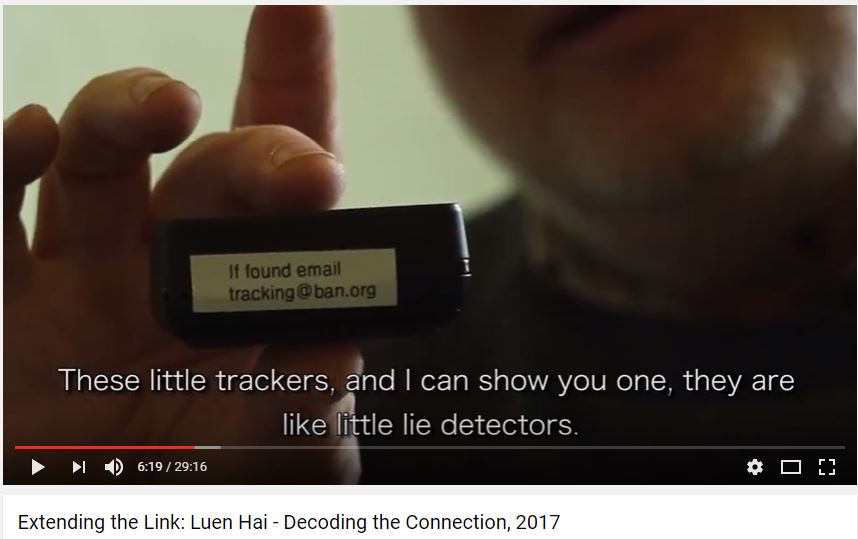
Well I just ran across a little video produced in 2017 by Luen Hai - Decoding the Connection.  In it, at about minute 6, a Hong Kong reporter identifies Jim Puckett of Basel Action Network as an important expert in e-waste imports to Hong Kong.  Then Jim says on screen that 54% of the GPS trackers the organization placed in e-waste was shipped to Hong Kong.

If you know about this study, you may think I made a typo. The numbers are so specifically wrong. But this is Jim's recorded voice, in his own words... screenshots with subtitles below.

1. "These little trackers, and I can show you one, they are like little lie detectors"


IRONY of IRONIES...  Listen to what Jim tells the filmmaker about the GPS "lie detector"...  Full video at bottom below.


How We Knew About Apple's "Recycled Content" Plan 2 Years Ago!

Big announcement, just out, from Apple CEO - Apple will produce its electronics from 100% recycled material, not from virgin mining.

It's reported from Apple's just-released 2017 Environmental Responsibility Report.  It's bound to hit all the Earth Day news outlets this weekend.

Sourcing recycled content, creating a demand-pull effect, was what we were working on when I started at Massachusetts DEP in 1992.  It can be very big news.

Question:  How did I know about this almost 2 years before Apple's announcement?

Apple doesn't make its own stuff.  It's generally put together by a Shenzhen contract manufacturer like Foxconn or Wistron, which the blog has focused on many times.

Guess how we knew about Hong Kong EcoPark when we allowed a trial load of printers to go to Hong Kong - when our E-Steward downstream wouldn't pick up after several loads to their shredder?  When the BAN GPS Tracker was in our facility, and suddenly our shipments were mysteriously cancelled?

When I did background check on why Hong Kong would be paying for printer scrap again, before approving to the Chicago downstream replacing the E-Steward, I found that the $550M EcoPark tenants were sourcing scrap for plastic to be sold to a contract manufacturer in Shenzhen.   One who made devices with a major brand name label.

2002 Article In Recycling Today Foreshadows WR3A, IFixIT, E-Stewards

While looking to upload some papers in Academia.edu, I ran across an article published by Recycling Today magazine in 2002 - by yours truly.  "Setting a Higher Standard" explained that boycotting the export market would be a "war on drugs" approach, forcing legit oversees reuse and recycling operations to meet demand via "back alleys".

Here are 3 conclusions about e-waste export policy at the end of the article (edited by Brian Taylor).

Looks sound.

1) Send Quality.  Meet the customers and find out what they want.  Just export that.  Don't throw a piece of junk on the container that you don't know what to do with.  This would become the foundation of WR3A.org and Fair Trade Recycling.

2) Support Reuse and Repair.  This forshadowed Ifixit.org, was influenced by repairfaq.org's Silicon Sam.  I'd used Sam's repair instructions while reviewing Chinese purchase orders, and found the Chinese buyers were giving instructions that would eliminate non-repairable units.  This led to the realization that China was not buying ANY CRT Televisions, only specific 15" and 17" CRTs, which meant the trade was not driven by cost externalization.  California SB20 went off a cliff that year.

3) Support Reputable USA companies.  This forshadowed R2 and E-Stewards.

Basel Action Network attacked me for writing the article, personally, and that is how I met Jim Puckett.  He blasted a response to the article via "Microsoft Outlook" and cc'd dozens of people whom I'd never met, but with whom I'd become acquainted over the years.

The article was sent to some folks at US EPA, who later hired me as a consultant for the 2006 Federal Register CRT Rule, which funded my second trip to Asia - this time bringing Craig Lorch of Total Reclaim and Lin King of UC Davis, to visit some of the "Big Secret Factories" that BAN was racially profiling as "primitive rice paddies".  (If you are researching MIT Senseable City Lab and BAN's Monitour project, there's a chestnut about this at the bottom of this blog).


Breaking News: GPS Recycling Miscegeny Trackers Flatten Circular Economy

[SEATTLE, WA 01.04.2015 00:01 april fools] MIT Sendable City lab announced today that a study with NGO Basel Acting Network has revealed a startling outcome, and a next stage.  The circular economy is flat.  And a Next Generation Tracking Devices has been developed to find reuse trade as it occurs.

The team will keep tracking the devices, as they move around between repair and reuse markets. But the next generation of trackers, the NI88ERGPS, will clearly identify boundries in the gray market.

"In our first effort, we thought that Basel Acting Network had tracked each of the GPS devices to its final resting place.  We called that end point 'Overseas'.  We thought we were finished," said Dr. Carl Ratty of MIT Sendable City Lab. "It turns out there are a lot of different places over there, and stuff keeps moving around."

The 1st Generation of GPS devices are still in motion.  88 different nations have continued to use, pass along, and exchange the devices.  Reuse is spiralling out of control, and it will take a new generation of trackers to make the crime - not disposal, but point of exchange - more black and white.

A 'point of pollution' requires that the device stop somewhere, in a dump. BAN's actual target is the exchange of goods and services between rich and poor, an act he labels electronic miscegenation.  These are not geographic "positioning" tracers.  They will trace "possession".

Continuing Final Outcomes:

"In 2016, we were certain that when the GPS devices landed in Faisalabad, Pakistan, that they were surely and finally buried, deep in the soil of a 3rd story electronics mall with escalators and dozens of reuse shops," said Basel Acting Network CEO Jim Plunckett.

But the first trial continued to track the property for as long as the batteries last.  Devices disposed in a primitive computer company's third shelf eye-level retail shop moved to a dormitory at Faisalabad University, 3 blocks away.


"We updated the report to show the devices new locations.  But they keep moving," said Ratty.

Devices sent to Tin Shui Wai in Hong Kong's Yuen Long district could be tracked going up an elevator, the a 14 floor apartment.  One device appeared to be in use in a hospital mobile cart.  A display device attached to a blood gas analyzer, the GPS tracker showed the cart moving up and down hallways, floor by floor in the Cairo General Childrens Hospital.

Plunckett sees a better solution than tracking an "end point".

Our Political New Year's Resolution: Ebony and Ivory

It's 6AM and I'm packing the car for another annual cross country road trip from (red state) Arkansas to (blue state) Vermont.  I was hired as a cross cultural trainer for new US Peace Corps volunteers arriving in Cameroon in 1987, and sometimes feel I never stopped.

Can't resist posting my note to the AirBNB host where we stayed in lovely Leslie, Arkansas.  She was the child of a hippie who grew up in the Ozarks and now lives in Seattle.

Finding yourself in liberal Seattle must be like me finding myself in Vermont. Generally I'm very relieved to be away from "ignorant and proud of it" politics here in the southern midwest. But also I find myself very aware of my coastal liberal friends and our own confirmation bias and "profiling" of conservatives, and attributing to 'denial' what may be legitimate skepticism over 'solutions'. Consider yourself a Peace Corps volunteer from a red state.

ebony and ivory stripes (wikipedia chain gang)
Confirmation bias. Profiling.  I'm not immune to it.  None of us can be. But when you walk a mile in another man's shoes - as I've done for a long time with the WEEE export entrepreneurs in emerging markets - you can sit on their jury.  The blindness of NGOs to the studies that show nuance is nothing new.  It's Captain Ahab.  It's Scarlet Letter.  It's Sir Gawain and the Green Knight.  It's in To Kill a Mockingbird.  It's Huckleberry Finn's crime.  These great works are all about people who start a mission based on justice (like environmental justice) and consider themselves jurists and agents of conscience, but are deafened by their own conclusions.

We need to keep it simple. If I'm skeptical of your trade ban on used electronics as a "solution" (to what? poverty?) that does not make me a "denier". Let's find something else to agree on, a simple message that might appeal to rural and urban and OECD and non-OECD.


Breaking News: As HK WEEETRF, So Follows Accra's "Ewaste" Moon Shot?

Another logical conclusion to all the research into NGO's proposed bans on E-Waste Exprot Trade.

"Hey, we can do it right.  We can repair and recycle better than you can"

As goes Hong Kong, so goes Agbogbloshie, Accra, Ghana.  A $30M State of the Art E-Scrap Recycling Plant is breaking ground in Ghana.   In January, I'll be there.
The Ministry of Environment, Science, Technology and Innovation in partnership with the Environmental Protection Agency are set to commission the construction of a recycling facility at Agbogbloshie in the Greater Accra Region. 
Estimated at $30 million for the first phase, the facility is expected to recycle all waste electrical and electronic equipment to final products in an environmentally sound manner, relieving the people of Accra and its environs, specifically Agbogbloshie community of toxic pollutants generated from the burning of e-waste. - See more at: http://citifmonline.com/2016/11/23/govt-to-construct-30m-e-waste-facility-at-agbogbloshie/#sthash.EpjnrmbK.dpuf
Once again, the solution to "sweatshops" is found to be "air conditioners".  Given the choice between moving business back to "Big Shred" in Europe and the USA, the Tech Sector in Emerging Markets says "Thanks but we like managing this, and by the way we're really, really good at it".


Finally the End of Ewastegate?

2016 - Particularly Hoppy Bourne Brew of Ewaste Blogs

This year, the average readership per blog has doubled.  That's no doubt thanks to the interest in #ewaste generated by the Basel Action Networks claims, and academic links to MIT Senseable City Lab.  I thought perhaps the links to Hong Kong (specific geographies, like Tin Shui Wai) may have had something to do with the readership, but actually the hits were greater in the Pakistan Faisalabad blog (which tracked the 3 CRT monitors that BAN said were exported, 2 of which wound up at a TV remanufacturing operation a few blocks from a major urban university - a far more interesting story than the dystopia described by BAN).


Or is it something else entirely that attracts readers?  Jim Puckett, the speakers on TED about #ewaste, EU policy makers, publish-or-perish researchers, the regulators, and myself, are all looking for the right background for the movie we are making in our heads, about ourselves, and our role in discarded items generated by consumers.  We all perceive ourselves in a defensive position.  EU folks I interviewed seem absolutely dumbfounded that the African Tech Sector I work with saw them in a completely "offensive" light.

Pictures of kids at dumps, and Halloween ghoulish rice-paddy language, make our jobs - and our blogs - seem more exciting, more worthy of a Moby Soundtrack (bottom).  Activists perceive ourselves as heroes, academics as judges or historians, and commercial interests are in some ways the most honest - getting food on the table for families by providing what the marketplace asks for.

Collateral Damage 1: Data Journalism vs. Ewaste Politics of Personal Destruction

The best advice has proven out. Don't do what I did.  If the press isn't covering BAN's story, don't cause them to cover it by over-reacting to it.  Yesterday WasteDive called in reaction to the blog on the curious denial of a claim never made.

But I've long been in the business of "glasnost", and in the end I believe that serious researchers will learn more by the methods used by the "watchdog" than if I hold back.  This is the long game.  I'm betting that friends 10 years from now will appreciate honesty and integrity, even if the safer choice is to hide in the crowd.  And let me take personal credit for BAN's announcement that future tracking will be a) voluntary (e-Stewards), b) anonymously reported (no more singling out Robin), and c) won't send live lithium batteries that burst into flames at shredding companies.

I've already taken credit for BAN admitting state of the art [SoTA] facilities exist in Hong Kong. State of the Art modern facilities which, I pointed out, was insulted by describing New Territories as "rice paddies".  In our private May 10 letter to MIT, we described the $550M investments in EcoPark as examples of modern and legal importing facilities.  Important to remember:  at that time we were demanding data that was being OBSCURED in Hong Kong.  We did not export to Hong Kong, period.  We did not claim WE had any connection to company in Hong Kong.  We were saying that the profiling of Hong Kong recycling was biased.  And it was.

My private May 2016 letter to MIT demanded our data (on the printer seen going from Boston to Vermont to Chicago to Hong Kong).  MIT SCL's Carlo Ratti denied having the data (see below).  We later learned MIT undergrads at Senseable City had rung the doorbell to deposit the tracked, sabotaged printer to our greater Boston client offices.  It was not a public drop off point.

Jim Puckett solves these mysteries in an email of August 16, and the text of the Scam report (left).  We requested an Ethics review at MIT, but have only heard back from their attorney so far (who seems like a nice person, see next blog on "Collateral Damage").


Here it gets a bit messy.

Now, completely separate from our investigation of BAN and MIT deployment data on the sabotaged printer ("our data" on "my tracked printer"), as a blogger I was provided data from a different Seattle non-profit - one quite similar to the one in Boston above.  That Seattle non-profit had been given the prescise, unobscured data through enforcement actions that were then underway by Washington State environmental regulators.

So we were now tracking two different devices to Hong Kong, one deployed on the East Coast (Printer to Chicago) and one no the West Coast (LCD from WA to California).

Unlike normal peer reviewed research, no one was making this easy. MIT answered back "As BAN is in sole possession of the information and data that you request, we suggest that you contact BAN for the information."   Hmm.  I read that to mean it's a one-way street, because we did NOT contact BAN for the information, but Ratti sent our 14 page letter and 2 page cover letter to Jim Puckett (according to Puckett).  So in the blog we wrote about the data we did have - the Seattle LCD travelling through EcoPark to Tin Shui Wai.

How did we think BAN would react to disclosures of modern high-tech recycling in China?  Been there.  Read the quote below, and ask what you'd expect BAN to "obscure" in the Monitour website designed by MIT SCL.


Remember 2012?  BAN specifically attacked me, ad hominem, to a Chicago Patch report for promoting "the myth that there are all these wonderful high-tech facilities in China."

This quote from BAN not only attacked "the myth of wonderful high-tech facilities" for recycling in Asia, it attacked me personally, "adding more harsh comments about Ingenthron's character".

If you follow, we requested the data that would have saved us a lot of time and shown the printer showed up in Mr. Lai's Printer Farm.  But between May and August, while we were refused that data,  some other data fell in our lap.   We were given coordinates of the Seattle LCD, and sent a letter to MIT about the coordinates about a wonderful high-tech facilities in Hong Kong, objecting to those facilities never being contacted by PBS @KCTS-9 etc.

It's a small world.   One company I've mentioned in the blog as an example of R2 and ISO certified state of the art recycler in New Territories in HK has requested we keep their name out of the discussion.  On reflection, I agree that BAN's naming the company as a blameless party - but implying claims I did not make about it - is unfortunate, and am rewriting past blogs to remove unwanted references.  Though there is a WSJ article about them from January 2015, when their press releases I used to have links to went out.

We tracked the data we had - the LCD from Seattle (repeat - not the printer from Boston) on its journey, via the coordinates no longer obscured in Hong Kong.   Compare the two screen shots from Monitour and Google Maps of the site in Yuen Long (New Territories HK) below.... Pillar Point, home of EcoPark, Yuen Long, New Territories, Hong Kong.

So BAN is putting two and two together and getting three.  Seattle's LCD goes through EcoPark and apparently gets reused.  Chicago's printer doesn't, is diverted to a scrapyard, and winds up at the "printer farm".  Vermont never exported anything.  But had we been given an LCD and shipped it to Seattle rather than shipped a printer to Chicago, it might have been different.  We'd still have nothing to do with the outcome, and the question becomes how did BAN decide to profile yours truly (and my client) for 2 pages when we did neither?  The point is what is BAN hiding in the obscured data, and what is MIT's role beyond having undergraduates "deploy" devices at unwitting, unwilling, private drop off points?

Geography Baiting 3: Retribution Strikes Press Release from BAN

While we wait patiently for answers from MIT about the ethics questions we have on Senseable City's "joint project" with Basel Action Network, BAN strikes.
"40% of  e-Waste given to Recyclers gets Shipped Illegally to Polluting Operations Overseas" - Jim Puckett, Basel Action Network
Since we have sent multiple letters to MIT and emails to BAN, offering to meet to show our processes and all downstream information, we know that BAN is conscious of the false and derogatory information embedded in this statement, explained below.  The question is, do they do it purposefully to cause harm?

1.  It is NOT 40% of e-Waste given to Recyclers.

BAN never tracked 65% of the weight (CRT and projection TVs that practically never get exported).  They sample tracked 3 types of device (printers, CRT monitors, LCDs) and found - of those - that about 36% were exported.   36% of 35% is not 40%.

2.  Most of the 40% tracked was NOT shipped illegally.

We showed here on the blog devices tracked to reuse and refurbishing operations.  Also, Hong Kong doesn't consider printers hazardous waste and BAN attacks them for classifying them as non-hazardous waste even as BAN calls them "clearly" hazardous waste in their report.

3. Most Overseas Operations are NOT Polluting.

The one BAN focuses all their attention on - Mr. Lai's Printer Farm - is visually concerning, and it was NOT identified as a destination on our downstream tracking.  So kudos on that.  But to say it is representative of the 40% of 35% is racist and insulting.  Other devices went to places overseas anyone should be PROUD to work with.

But the point of BAN's report is clear.  They do not go after companies that pack and export.  They do not track most of the destinations.  They track my company in several pages.  It's because I spoke out about them.  I believe that is the message here, to make other recyclers afraid to speak up on behalf of the geeks of color, to intimidate those of us who object to racial profiling, who do NOT pay them tribute money via E-Stewards (using an E-Steward company shows prominently on the press release, though the GPS tracking didn't show that to be determinate).

My company baled 95% of the printers we received for shredding - some by E-Stewards, all by R2 certified companies.  Of the FIVE (5%)* our crew found potentially reuse and repairable, we either tested them ourselves or more likely sent them to another R2 company which listed reuse as a potential outcome (not 100% shredder).   It was one of those 5% nice-looking ones that we sent to a USA company, which had listed certified Hong Kong destinations as their partners.  And, notably, one of those BAN and MIT chose to send to us.

When BAN and MIT hide the data we requested since last May, it just makes it hard for us to respond.  BAN plays the Bilbo Baggins Riddle "What (data) have I got in my pocket?"   We did find some of the tracked devices DID go to the Hong Kong EcoPark. If ours did not - and I accept that now - we have to find out who misdirected it (the USA company or the Hong Kong certified company).  Even if it was legal, it may not be acceptable.

For all we know, the device WOULD have been reused and repaired if not but FOR BAN's Sabotage.  I don't open all the halloween candy I buy to make sure no one sabotaged it.  Until now, I doubt anyone has opened a repairable printer and cut up the guts to make it unrepairable.  There's a word for that, but it's not a polite one.

The point is that BAN is a bully and directs its Reports and Press Releases not to enlighten, but to casuse people to fear them, and to pay them tribute.  It is because I read the Report, studied it, tracked devices to different places, made 14 pages of comment and critique, that my company is profiled in the report.  What I want to know is why people at MIT would not see this for what it is.

We did not, NOT export the device.  We send printers we have DETERMINED to be unusable to a shredder, and that is MOST of the printers.  If BAN intended to show we export, they'd choose a printer that sells for ten times scrap value on ebay and Amazon, and they'd make it unrepairable with internal damage.  We did not export even THAT (Jim stated we "exported to Chicago" in his email).  This is a spray-paint job by BAN.  And while our Chicago partner has offered to just let me "push him under the bus" (and claim it wasn't us), I prefer to out this Senator Joe McCarthy.

At long last, NGO, have you no sense of decency?  Have you no shame?

* (Ed correction -. first edition of blog mistakenly reported on 95% not repairable by omitting the word "not". Only 5% of printers at my company have been set aside for potential reuse in 5 years)

Press Release Below.

Secret Tracking Project Finds that Your Old Electronic Waste Gets Exported to Developing Countries
40% of  e-Waste given to Recyclers gets Shipped Illegally to Polluting Operations Overseas
September 15, 2016. Seattle, WA. Utilizing high-tech methods to track high-tech wastes, the environmental watchdog, Basel Action Network (BAN) as part of their e-Trash Transparency Project, funded by the Body Shop Foundation, planted GPS trackers into 205 old printers and monitors and then delivered them to charities and recyclers. The new report, entitled Scam Recycling: e-Dumping on Asia by US Recyclers, revealed that of those that were handed over to American electronics recyclers, 40 percent did not get recycled in the US as expected by customers, but were instead exported to highly-polluting and unsafe operations in developing countries -- mostly in Asia.  

"The American public continues to be scammed by unethical companies greenwashing themselves as 'recyclers'," said BAN Executive Director Jim Puckett.
"The toxic chemicals released by the crude breakdown of our old electronics in the junkyards in Hong Kong not only harms workers and communities abroad, but comes back to hurt us as well. We are the only developed country in the world that ignores this problem. It's time to stop say 'enough is enough'."
Among the findings of the report, BAN found that:
  • 40% of the 152 deliveries to US electronics recyclers went offshore -- mostly to China
  • 96% of the exports are likely to be illegal under international or US law 
  • 93% of the US e-waste exports moved to developing countries
  • 75 companies were involved in a chain of transactions that led to export of e-waste.*
  • Many recyclers involved in export made website claims of never exporting
  • "R2" Certified Recyclers exported at greater than average rates, e-Stewards
    Certified Recyclers at less than average
  • Hong Kong electronics junkyards expose workers and the environment to dangerous toxins such as mercury. 
The exported tracked devices, travelled to Hong Kong (37), Mainland China (11), Taiwan (5), Pakistan (4), Mexico (3), Thailand (2), Canada (2), and one each in United Arab Emirates, Togo, Kenya, Cambodia, and the Dominican Republic. MIT's Sensable City Labs worked in partnership with BAN to produce an interactive online map
 to show the pathways of all of the 205 trackers.
Most of BAN's trackers had found their way via ship and truck to 48 different sites in a semi-rural part of Hong Kong known as New Territories. BAN travelled there and visited the precise locations where the trackers ended up. They found massive volumes of LCD monitors, printers and other electronics being smashed each day and broken apart by hand in hidden junkyards, allowing the release of printer toners, and mercury phosphors easily inhaled by workers both unprotected from, and unaware of, the hazards.  
BAN also looked at the electronics certification programs designed to improve ensure recycling management. The "R2" certification program created as a result of an EPA convened multi-stakeholder process has about 5 times more certified recyclers than the e-Stewards program (a more rigorous standard), but it was found that "R2" members had a higher rate of being associated with export than even uncertified recyclers. Recyclers certified to the e-Stewards Standard had the lowest export rate. The e-Stewards Standard was created by the Basel Action Network together with industry leaders. It is designed to be fully consistent with international law and is the only e-recycling program that utilizes tracker technology to verify conformity with the standard.
The BAN report calls for the following key recommendations:
  • All consumers and businesses concerned about preventing pollution of the global environment should make exclusive use of e-Stewards Certified Recyclers
    .
     
  • President Obama should sign an executive order to prevent US government e-waste from being exported overseas.  All others can sign petition for this
    .
     
  • Manufacturers, governments and recyclers should commit to full transparency of where they send all of their hazardous electronic waste.
Hong Kong government should ban all imports of hazardous e-waste and close the informal New Territories junkyards.

Download the report here:

For more information:

Jim Puckett, Executive Director, Basel Action Network


Geography Baiting 1: MIT Senseable City Lab "MoniTour" Goes Offline

Has the correspondence from Unwitting, Unwilling Research Subjects finally got traction at MIT's Legal Office?  After 3 months of silent treatment, communications from MIT and BAN reignite the blog.

It is the end of summer vacation for Massachusetts Institute of Technology's Senseable City Lab. Professors have been on vacation, with little time to return calls or respond to our letters of May and June 2016.  But last week got a response back last week from MIT's Legal Department, saying that all future inquiries and correspondence should go through them.

This is one week after we cc'd MIT's Senseable City Lab Director, Carlo Ratti, in response to an email to Yours Truly from my an old pal, Jim Puckett, Executive Director of Basel Action Network.  BAN's parterner status with MIT is described in MIT's MoniTour website. You know, http://senseable.mit.edu/monitour


**** static ****

EDIT:  The website is restored now, and may have been unavailable only via my chrome browser which appears to be failing at several sites.  Speculation that MIT had taken the site down was wrong.

The site is 404, not available.  Could be a fluke, a temporary outage. But has been at least 3 days now. It might be premature to correlate MIT's shuffle with the written correspondence I've recently received from Basel Action Network and MIT's Legal Office.  But I predicted in my first response to the @KCTS PBS 9 airing of the "sting" on overseas electronics reuse, repair and recycling - MIT does not have a dog in this fight.  MIT has thousands of international students who know intimately the warts, beauty, sweat, and ingenuity across the oceans, and we predicted that MIT Ethics Committees would hold Carlo Ratti's Senseable City to a higher standard than to draw inferences on the "circular economy" based on BAN's notorious geography-baiting.

It's not exactly race baiting, since we don't know who in the USA owned or touched a device.  But BAN's descriptions of Hong Kong Province - which is wealthier per capita than the USA - with words like "primitive" and "rice paddy" should have been caught internally by MIT, without the help of a Vermont junk dealer's blog.

Someone commented that MIT might be engaged in a "cover up", but my friends in academia share my optimism.  The Massachusetts Institute of Technology's gravitas was clearly accepted as peer review and diligence by the reporters, and from MIT Senseable City Lab's response, it clearly was not merited or intended as such.

Google cache of the MIT-based webpage shows the original text which described the now AWOL web page as "A joint project between the Basel Action Network and the MIT Senseable City Lab".  And that's not BAN's claim, it's MIT Senseable City Lab indicating it's a "joint project" partner.  (copy and paste below, so you can recreate your own 404).

Monitour / MIT Senseable City Lab

senseable.mit.edu/monitour


Massachusetts Institute of Technology
A joint project between the Basel Action Network and the MIT Senseable City Lab ... this site in graphic form and will also be released in a series of reports by BAN. ... City Lab 2. a PDF copy of the publication is sent to senseable-press@mit.edu.
You've visited this page 2 times. Last visit: 8/27/16

Carlo Ratti's only direct response to my 14 pages of inquiries was 2 paragraphs. It could have been even shorter:  "It's BAN's project, not MIT's".  Or "People don't track People, GPS devices track people," or "GPS tags don't track people, they track peoples stuff".  "MIT just gave BAN the tools to track unwitting, unwilling participants, we didn't do it ourselves."

But Carlo Ratti spoke to PBS and clearly reviewed the pages on the now AWOL website stating that destinations, like Hong Kong, were "previously unknown".  The gist of my letter was:
"how did MIT determine my business transactions were 'previously unknown', unless it meant 'unknown to MIT and BAN', which isn't much of a defense of the ethical 'unwitting subject' test."
In fact, I'd been to Hong Kong (and Taiwan) one month before the PBS story aired.  Here's Video of Hong Kong from April 2016 below - with my 15 year old son, who I had taken to meet and have dinner with one of the best and brightest video display engineers I'd ever met (in Taipei).  Does the wifi-enabled, air-conditioned luxury ferris wheel ride among skyscrapers depict "typical Hong Kong"?  Of course not. Nor does +KCTS 9 film of a printer scrap yard in Yuen Long.  "Geographical Profiling" shortcut of the necessary effort to track each and every recyclable through each and every technician, and not to depict Asians as "primitives" with just obscured little points on a map.

You can't "obscure" destinations in Hong Kong on your website and then use photos of one location to "profile" anyone who does business with Hong Kong.  That's Geography-Baiting journalists and readers, appealing to their worst fears about recyclers and refurbishers in emerging markets.  You didn't show the Geeks of Color.

You can show Deliverance to depict America, but you've got to show Big Bang Theory, too.  Otherwise, it's propaganda, which BAN has been accused of for a long time, plenty long enough for MIT to vet them as a "joint partner" in describing emerging market "shantytowns" and "rice paddies" and "orphans" and "Sodom and Gomorrahs" and "E-Waste Hell" etc., etc., etc.

How does MIT's partner characterize the people who live and work in and built this location?

Right Wrong 2: African Ambiance at MIT Senseable City Lab

I'm looking for time to edit down the long post I've written for "what the NGO's and MIT got right, what the NGO's and MIT got wrong" piece.  That's a problem for me, finding time to edit stuff.

The 14 months that have now passed since March-April trip to Ghana in 2015 have been in large part the editing or digesting of the experience there.  I'm still re-editing things I wrote at the time, I'm still reviewing interviews we filmed.  And new information keeps coming, even as the situation is evolving.

Wahab - our business partner in Ghana - has been back and forth four times to see his cousin Kamal, CEO of Chendiba Enterprises.  And I continue to take calls every week from young men I met there.   Kamaldeen has now finally graduated the engineering school program (he had been working at Chendiba Enterprises to help pay for his studies).  And Awal, the "lead guy" of the wire burning men at Agbogbloshie, still calls several times a week.  When Wahab's here, it's easier, because my pidgin English is really rusty.  Wahab and I help ground each other's wires;  my compassion for Awal keeps Wahab from spanking his ass for calling and shilling, and Wahab's grown up expectations of the men (and Awal is definitely a man, not a "child labor orphan") who will twist a guilty knife is welcome intervention in the role-play.  I've had good and bad experiences intervening in Africa, and having time and partners from the area give needed perspective.

What I need to say about Jim Puckett, Kevin McElvaney, and the MIT team, PBS and @Earthfixmedia is important, but I do owe it to them to take the time to edit.  They deserve the same compassion and patience we show Awal and the company at Agbogbloshie.  And this extends of course to Dr. Jack Caravanos and PureEarth, and the StEP team, and everyone in the business of "saving Africa".  I need to edit, and to demonstrate the dignity these researchers and journalists deserve.

It takes time.  Primum non nocere. Don't rush to judgement. Listen to your human subjects.  Basics.


#Ewastetracking Project by MIT and NGO Discovers Analog Television (exists) in Pakistan


According to the opening page of Massachusetts Institute of Technologies Senseability City Lab's expose on second hand electronics, transboundary movement demonstrates likely environmental harm.

A joint project between the Basel Action Network (BAN) and the MIT Senseable City Lab has led to the discovery of previously unknown international electronic waste routes departing from the United States.
Printer, and LCD and CRT monitors were embedded with GPS trackers capable of remotely reporting their location from overseas locations. These trackers were then delivered to recyclers and charities around the country. 65 of the first 200 trackers deilvered as part of the Monitour/e-Trash Transparency Project went offshore, mostly to Asia. 
On-the-ground investigations in Asia by BAN produced a clearer picture of these trade routes. Results of this study can be found here on this site in graphic form and will also be released in a series of reports by BAN. These can be found at: www.ban.org/trash-transparency. 
While legitimate e-waste recycling helps reduce landfill contamination and raw material extraction, the export of hazardous electronic waste is most often illegal trade under the Basel Convention and moreover, the management of toxic electronic waste in the informal sector damages human health and the environment. 
The Monitour/e-Trash Transparency Project demonstrates how relatively new technology can generate unique data needed by civil society, law enforcement and enterprises to better track what until now have been hidden flows. Since the time of our experiment, the UN Organization on Drugs and Crime has confirmed that the Mong Cai border is a primary corridor for e-waste flowing from the US and EU into China, part of an estimated US $3.75 billion market for illegal e-waste. 
Learn more about e-waste tracking here: Video.

"On the ground investigations in Asia by BAN produced a clearer picture of these trade routes."  Really, MIT?  Just how clear?  Analog or high definition?  Seriously, this is from Media Lab of all places?

As I showed last week, the screen shots of the MIT's tracking project are difficult to see at proper resolution; you can't zoom in.  Instead, you must copy the longitude and latitude and paste it into google maps, or rely on whoever is writing written descriptions of the sites on MIT's website.

Then you find places like the Hafeez Computer Center in Faisalabad, Pakistan.  It's near the center of a dense city, blocks away from one of Pakistan's largest universities.  It is a long way from the port.  Screenshot below.


We are writing to MIT to offer to assist them in interpreting several tracking devices locations.  In particular, I'm focusing on CRT devices, which are governed by USA EPA law.  That law does not ban export for reuse, or even export for recycling, but requires that export to be declared and investigated by EPA prior to export.

The reason for EPA's restrictions stem largely from the Basel Action Network (MIT's "joint partner") declarations in 2002 and 2005 that the "vast majority" of CRTs are not recycled, but are dumped overseas to avoid high USA recycling costs. Overseas, BAN announced, the CRTs were most likely going to be beaten by children with hammers to remove "valuable copper".  It is certainly true that CRTs are the most expensive type of electronic waste to recycle, and it's true that any which are diverted for continued use represent an avoided fee.  It's also true that working display devices have been in high demand for reuse and repair markets.  Billions of people owe their "teledensity" (mass media, internet, etc.) to used and rebuilt CRTs sourced from wealthy nations.

Time's Up: E-Waste News Develops Faster than Blog


I have about 30 pages of blogs composed this summer, but the challenge is to update them as fast as the news changes.

Sometimes it's easier to point back at past predictions...
In the past year or so (not in order, and some still "breaking" news).


1.  BAN denies "80% waste" statistic (denies ever saying it).
2.  Peer reviewed studies from USITC, MIT, Memorial U, ASU, UNEP, etc. show 85-91% reuse.
3.  Benson is reportedly released early #freehurricanebenson
4.  Lord Chris Smith (UK Environmental Agency director) is replaced.
5.  Vermont ANR terminates contract with CRT-landfill operation early.
6.  Payment refused to local governments may be released.
7.  Interpol may have hit the "pause" button on Project Enigma / Eden (unconfirmed)
8.  A stampede of Europeans emerging from the trenches in Agbogbloshie to testify...

E-WASTE HOAX - NOT AS "BAN" ADVERTISED.

"Do not know what they are talking about.  Making it up as they go along."