Showing posts with label blog. Show all posts

18 Years. Might as well be Me.

For me, the origin of this blog is a kind of central - well, some would say conceit - but sense of purpose that I trace back to late adolescence. At my 40th Reunion at Carleton College a week ago, I wandered the grounds, dared to speak deeply with old friends and mere former acquaintances.  Food service (SAGA), student governance, the college recycling program, Peace Corps interviews, dancing and romance... all in the orbit of my ego.


The origin of that Ego was a very religious or spiritual seeking period, contemplating becoming a Buddhist Monk, during high school.  My pal Jenny at our Carleton College 40th reunion last weekend noted that I had arrived at Carleton my Freshman year engaged to be married (to a different Jennifer), and how did that line up with the monastery mode I contemplated?  I said my guess was that a guy considering becoming a monk was attractive.  Jenny said she could definitely see that point.  And it was textbook Spiritual Materialism (Trungpa ref).  The adolescent was more likely to get laid by acting righteous.

This cuts two ways today.  On the one hand, even if I'm not particularly religious now, and more certain of uncertainty than of faith, I do advise young people that a 3-4 year period of spiritual exploration - even if Materialistic - will compound over your life. Like a launch pad. That period of striving to meditate and pray did, I believe, give me confidence the rest of my life to act as an Agent of Conscience - which was my stated goal at high school graduation. The root of the word "sin" is missing the mark, failing to hit the target you are aiming for. We all miss a mark, but the harder we try to hit it the less the arrow goes astray.

Another Carleton alum friend at dinner was speaking to me about my time as Carleton Student Association (CSA) President, when I was vehemently making noise about a 16% tuition increase.  I told him that the Administration told me there were two traditions to uphold... that Carleton was rare in giving the student association a vote on the budget.  And that in the history of the college, the Trustees had always been given a unanimous vote by Administration, Professors, and the Student Body Association.  I told my dinner companion that I said it was damn time to break that tradition if they were using students as a straw for federal Pell money (formerly grants, then converted to loans). I don't know if that vote against the tuition increase was the reason Carleton waitlisted my kids, but as I said to Admissions Officer Thibadeau, it was certainly their loss.  The point however being that my pal at dinner said that at the time, he thought I was making noise and posturing.  But he said in retrospect, I was absolutely right, and the colleges needed to be aware of the growing college debt they were introducing to a generation or two of students.

Einstein's Amygdala Part Two: Creating Popular Regulations

So all of the wild baby rabbits lasted 5 days, seemingly content to feed on pieces of bread soaked in milk and eggs.  Then they got sluggish. Then they suddenly seemed wide awake and active, and we kids were elated. This is what some animals do just before they die. We buried the baby cottontail rabbits in the woods. My mom, raised on a farm, said it was par for the course.

So from a child's perspective, our amygdalas had been yanked around, rewarded and punished, over 5 days falling in love with wild baby rabbits that your mom says probably won't survive the initial cat bite.

Deceased. late, extinguished, Monty Python "no more" baby rabbits is a headline we don't like, so it's easy to write a story... to imagine a reporter covers our dead bunnies, and the press demands a solution.

So what lessons would we expect innocent, naive, emotional children to learn? If they were in charge of regulating cats and rabbits, what rules might the children create which an experienced, educated, creative, thoughtful, highly intelligent person would not? Even though the Einstein does have an amygdala, we imagine that the higher power of intelligence would design a better rule - or not try to design one - rather than let emotional bunny-centric kids rule the roost.

Or what if the Rabbits were Super Intelligent, and could Propose Their Own Rules?

Bugs Bunny Square Dance from Loony Toons "Hillbilly Hare" (set in my home state of Arkansas)

Super Bowl of Reuse: Nabil Nasr, Adam Minter, Josh Lepawsky vs. PlannedObsoleteScience


Last weekend, we had a reflection on the previous decades of blogging, and our ability to declare successes and failures with the war against global reuse, as waged in the press.  There is a trifecta of 3 books - two of which the blog influenced, and one of which it was inspired by.

Three Most Important Re-Use Books of the Decade:

Reassembling Rubbish by Dr. Josh Lepawsky does an incredible job of surgically dismantling arguments widely cast by Basel Action Network and Greenpeace and other "do-gooders". He researched their IRS 990s, exposed the financial backing of Planned Obsolescence and Big Shred, and provides data to eyewitness the spray of filthy gossip about repairpeople in Asia, Africa and Latin America. While not an emotional read, that was not what we needed. If stoic in delivery, Lepawsky rubbed shoulders with #ownvoices. His team spent weeks living with emerging market recyclers and repairers, including several long visits to Las Chicas Bravas in Sonora Mexico (Retroworks de Mexico). Lepawsky re-thinks the incredible geographic scars of mining industry, comparing risks to the hand-wringing concerns over removing screws in slums like Agbogbloshie. It is incredibly well documented, footnoted, and sourced.

Secondhand by Adam Minter is about "Travels in the New Global Garage Sale". For a more visceral look at the "collateral damage"to the global good-enough markets, this is the best.  Adam turns the corner from being an extremely well-regarded trade journal writer, covering the scrap industry (first book, Junkyard Planet 2013), and dives into the mosh pit of reuse diaspora in Secondhand. Cleverly written, he first makes the used possessions personal - estate sale by estate sale, Goodwill by Goodwill, and his own grandmothers' basement chachkas. He then follows the billion dollar trade to the tech sector in India, China, Mexico, Benin and Ghana, and introduces us, face to face, with the talented and inspiring "others", letting the people in the USA, Europe and Japan hear the #OwnVoices of the racially profiled "primitives" we've been told are too ignorant and stupid to do more than burn the devices they carefully select, test, and purchase. He is a great listener.

Remanufacturing In the Circular Economy is the newest release by Dr. Nabil Nasr of RIT in Golisano Institute for Sustainability (Rochester, NY).  Unlike Lepawsky and Minter's books, I cannot say I've yet read Nasr's Remanufacturing, but I'm ordering a copy now.  I have been a fan of Dr. Nasr for decades (though he probably barely knew me until the 2013 Fair Trade Recycling Summit in Middlebury). Some of the oldest Good Point Ideas blogs have hyperlinks to Dr. Nasr's stats on remanufacturing, the industrialized growth of scaleable repair (I remember having to learn "hyperlink" code, copy and pasting). As I applied principles in the 2007 Harvard Business Review article "The Battle for China's Good Enough Market" to explain what Asia's tech sector was really doing with the desktop SVGA CRT monitors that CBS 60 Minutes claimed were burned in acid in Guiyu, I could always find sanity in Dr. Nasr's data.  Like Lepawsky, Nasr provides Datajournalists a place to fact-check "80%" of the slop sprayed at us in alarmist NGO press releases.

The team provides Super Bowl stature in the defense of reuse. The table is set for Fareed Zakaria (CNN Global Public Square) to invite these 3 authors and deliver the dagger to racial profiling.  He may want to invite Dr. Grace Akese, who has just recently moved to take a position at Bayreuth University in Germany. Grace provided key insights to Reassembling Rubbish, in particular an "OwnVoices" fact check of characatured Agbogbloshie. Good luck, Grace, in turning Germany's (Kevin McElvaney's) "mirror on itself" back in the right direction. Emmanuel Nyaltey of Fair Trade Recycling would also be a good score. This morning I twitterwarned Fareed (a personal hero from "Foreign Affairs" editor days) that I'd be sending him snail mail to pitch the episode.

2010 Flashback to Europe's Decade of Racial Profiling E-Waste

Back in November 2010, I used a cover photo on a blog to convey how Europe was relying on photojournalism to set waste policy. WRONG, WRONG, WRONG was one of my most visited blogs that year - the year Interpol launched "Project Eden", an approach to Africa and Asian geeks that was as cringeworthy as the Eurotrash Art.


Reversing Environmental Racism #2


This Good Point Ideas Blog has a dandelion in the background.  The wind is blowing the seeds. The image isn't random.

Some people consider the dandelion to be flower. Some consider it a salad green. But many consider it a weed.  Some of my earliest memories of "ethics" were my parents and great aunt's explanations of why I should be careful about blowing on mature dandelions, the "controversy" or "ethics" of spreading the seeds of a flower that will blow onto other peoples' lawns. My parents told me they don't mind dandelions on their own lawn, but others felt differently.  The issue, my dad said, was whose property the dandelion seeds landed upon.

On the first year anniversary of the passing of my dad, William J. Ingenthron, professor of Mass Communications and Journalism at the University of Arkansas (and Fresno State), I find myself reflecting on the dandelion discussion.  I was probably 3 and a half years old at the time, standing on the lawn at Auntie Maude's home in Columbia, Missouri, where my dad was to earn his J-School degree (I do have memories of 2 and a half as well, and possibly earlier).

"That is frowned upon here."

That "frowned upon" expression was expressed to me about 18 years later, when I had just thrown a lit firecracker out of a Carleton College dorm window.  And I did feel a little chagrin about that, though my friend and future Co-RA Peggy shrugged just afterwards, saying "I smile on it".  Using social consensus to define ethics is an interesting tool. Juries do it.  And consensus forms the crucible of the most important theme of this blog - Environmental Racism.  Accidental environmental injustice. Collateral damage. Friendly Fire...

It matters who we ask.  And after about 10 years, the chief "Authority" - Secretariat of the Basel Convention - has recognized that its first foray into screening used electronics sales had not asked enough people about the ethics and effects of used electronics exports. A little pat on the back here - I never attended a PACE meeting. But we were recognized for our contributions by SBC's Partnership for Action on Computing Equipment (PACE)...


The primary comment we submitted ten years ago was that Emerging Markets Technicians (not just regulators) had to be consulted in the drafting of the PACE Guidelines.  If OEMs (Planned Obsolescence), Secondary Smelters (Big Shred), and NGOs (White Saviors) were drafting the rules without consulting Africa, Asia and Latin America's Tech Sector, they were likely to do more harm than good.  As Emmanuel Nyaletey told the IERC conference in Salzburg, Austria, last month (my paraphrase) "writing rules for used electronics repair without consulting with African technicians is like writing a health manual without ever talking to a doctor."  The buyers know what they want, thank you.

Some consider used electronics to be a weed that must be kept on our own lawn.  Some consider them a flower.  And some consider them a source of income, a way to put food on the family table.

Here's an interview with a man, Olu Orga, who started in Agbogbloshie, and worked his way into Ghana's Tech Sector. If the Secretariat or the Basel Convention has something to thank American Retroworks Inc for, it's for keeping the doors and windows open during an echo-chamber of false claims and ewaste hyperbole.  As everyone sought to prove they weren't dumping on the poor, they became ashamed to admit friendships like this, if they were even brave enough to have them.

False Fears

Letter to Scott Adams Dilbert Blog


Last summer, a friend from Rhode Island asked if I'd read Scott (Dilbert artist) Adams blog predicting since 2015 that the most probable outcome of the 2016 election would be the election of Donald Trump.  Adams is intelligent, his reasoning is thought-provocative, and I've continued to read the blog, and many of its comments and tweets, for several months.

I've read reviews of the blog by commentators who "binge read" the blog.  Since I've been reading pretty steadily, and trading comments, I thought I'd break from e-waste policy to discuss the weaponization of psychology, persuasion, and hypnosis.  Because I don't think cramming his blog is the best way to absorb his thoughts on how to be, or not be, successful in persuasion.

Here is one example of Scott Adams blog, from January, titled "The Persuasion Filter and Immigration" which typically makes the case that none of us are "rational", that evolution has bred us to be "wet robots" responding to greed and fear through psychology.
"I’ve mentioned in this blog a few times that persuasion works even when the subject of the persuasion recognizes all the techniques as they happen. This is a perfect case. The left has been watching Trump make big offers and dial them back for the past year. And yet they still think this time it will be different. The Persuasion Filter says that 70-year old Trump will act the same way today as he has for the past several decades: Big first offer, then negotiate."
"But what about Trump’s critics on the far right who want more extreme immigration? Trump needs to negotiate with them too. And he is. He did that by showing them that his temporary offer was so extreme that people took to the streets. The system (America) is actively trying to eject Trump like some sort of cancer cell. And the worse it gets, with protests and whatnot, the more leverage Trump has to tell his far right supporters that he has gone as far as the country will let him go. He needed that. The protests are working in his favor. He couldn’t negotiate with the extreme right without them." 
As a business person, I found this very intelligent, and as a big supporter of immigration and globalization, I was frustrated as heck that the Left fell for Trump's January head-fake.   Trump had (in order to fulfill his 'campaign promise') appear to do something about "Muslim Ban" and artfully selected the exact same countries which President Obama had already issued an order to increase "vetting" of.  The left came out and protested, giving Trump the appearance of having done something dramatic.  Scott Adams was correct, this was artful on Trump's part.

Here's another one, which I think defends him well from accusations that his prediction was Pro-Trump persuasion or bias.  While he was certainly correct that Trump was being under-estimated, and using strong persuasion skills, he safely recused himself through this non-endorsement.
"My personal bias is that I don’t think any 70ish-year old person (Clinton or Trump) should be president. You wouldn’t hire a 70-year old into any other type of job that requires high energy, mental flexibility, and a possible eight-years of service. Why would we do it for the most important job in the land? And keep in mind that we haven’t seen detailed medical records from either oldster."Objectively speaking, we are likely to have incompetent leadership – because of age alone – no matter whether Clinton or Trump wins. That should scare you."-Scott Adams Blog, "Trump Prediction Update", August 10, 2016
And today, he said he was "Tracking His Persuasion".  It looks like he's using dollars to track it, because it's also pushing his books (as he has a software app, WhenHub, which I like in principle).

My challenge in the letter at the bottom of this blog is to convince Scott Adams that environmental science should be given the same respect - and no more - as the study of human health and western medicine.  There will be many, many false leads, correlations, conclusions, along the way.  But we are all more likely to live longer today (as noted by famous statistician Hans Rosling) because over time, the base of knowledge evolves, and the fittest policies survive.  We could be on the wrong track, Trump could be on the right one.  But Scott can't prove that "faith based medicine" would have created the vaccinations we live with today, and should beware of attracting the equivalent of anti-vax followers based on his ability to beat up straw men as political opponents.


Soup Kitchen Essays - Summer Hiatus Blog

Normally one announces a summer hiatus at the beginning of summer, rather than in retrospect.  It was not really my intention to post less frequently, as my passion for the added value (environmental, social, and economical) of reuse, repair and recycling does not fade.  But I suppose I've had a growing awareness that a book on a hero cannot last forever, and my hero - the prototypical Geek of Color - would not ultimately be served in a soup-kitchen of essays.

I've still been writing, but the "draft" folder is burgeoning as I try to reflect more and more on what I'm writing which itself adds value, which is itself new, which is evolutionary.

The "e-waste" recycling industry is constantly evolving.  When I started my business, after leaving the regulatory field 15 years ago, the USA was "The Saudi Arabia of Reuse". Americans had evolved to a period where the US Department of Labor forecasts for TV and electronics repair jobs showed an unprecedented shrinkage.   Employment estimates of TV repairpeople were 100,000 in 1990, and they had fallen to 20,000.

So too, my blogging must evolve.  (listen to cover of Steve Earle's "Hillbilly Highway" below).


Motherload Blog Alert: Foreshadowing Karma

My next posting is nearly finished, and it's another college-thesis styled attempt to tie together several themes of this Good Point Recycling blog.

- Accidental Racism, Environmental Malpractice, Environmental Injustice
- Cognitive bias, psychological basis for the mis-prescriptions of justice and intolerance
- Facts, statistics, and environmental best practices
- Geographical and social development forces, from urbanization to 'state-hate'

I'm a little bit afraid to hit the "publish" button, I want to reread it again over the next two days.  But as a preview, here are two links, one to a CNN interview of Harvard bio-psychologist Steven Pinker, and the other to an amazing Singapore-based undergraduate's philosophical blog (pen name Laicite).

In the treatise, I confess to waging war on too many battlefronts, and the psychological toll it takes on our loyal clients, staff and supporters of Good Point Recycling.   I read an essay by Alexis de Tocqueville on the weekend, and will use the specifics of the Vermont "state-hate" phenomena to shed light on broader truths for the environmental movement.

The blog begins in Singapore, takes a random wander through Vermont "e-waste", touches Lord Chris Smith (UK Env Minister) and Interpol, and ends in Africa.  Environmentalists and bible belters, regulators and entrepreneurs, can all be excellent people, and still wind up wringing collateral damage out of distrust and shame.   The way out is an exercise in leadership, requiring both humility and certain direction.  We evolve to accept differences, to defuse state-hate, and wind up with fusions and Gangstagrass.  

If you don't want to read Steve Pinker, de Tocqueville, or Laicite, I'll assign the pilot episode of My Name Is Earl., something of a transition from the recent "cultural gulf" theme, a very humorous USA television program I just discovered a couple of months ago.

Facebook

Interlude: Geography, DNA, and Functionality


Loving v. Virginia
We have so many unpublished blogs at Good Point Ideas Blog that I'm thinking of publishing in a parallel universe.

The Demanufacturing Chapter was well received, and I'm working on trucking, tech and sorting and admin.

Here's a quick fact, however.  I have successfully transplanted techs from other countries.  I have transplanted Peru techs to the USA, and I've transplanted Malaysia techs to Egypt, and I've transplanted USA techs to Mexico.  And you know what?

It's just like organ transplants.  DNA (race) does not matter.  Borders do not matter.  All that matters is functionality.  If you need a kidney, it doesn't matter if you find the donor ugly, and the citizenship papers don't matter to the doctor.

The circuitry repair works exactly the same.

Sincerest Form of Blog Hijack? Damageethical Zelig (Poonam Verma)

Sincerest Form of Blog Hijack?  Damageethical Zelig (Not_by Poonam Verma)
Mirror Effect Photo Screenshot
Well... my search box widget in Blogspot keeps breaking down (known issue at google forums) and I have been using Google Search to find references to old blogs.

How's this for a doppleganger?   Damageethical Blog, "by Poonam Verma".  He may be from India, or from Sri Lanka, I see 22 pages accessed from Sri Lanka this morning.

It's registered as retroworksa.blogspot.com (notice the letter "a" affixed to retroworks).  And it's a complete reposting of my work in this blog.

Except every post has a crap link advertisement in front.  I haven't found any malware.

Not that Indian
So... since I'm a mission oriented dude, do I see this as "getting the word out?"   Or should I be outraged at the paid ads for water removal, sewage, etc. he's selling?  It's like running into a cyber-Leonard Zelig from India.

"The question of whether Zelig was a psychotic or merely extremely neurotic was a question that was endlessly discussed among his doctors. ... his feelings were really not all that different from the normal, what one would call the well-adjusted, normal person, only carried to an extreme degree, to an extreme extent. I myself felt that one could really think of him as the ultimate conformist." - character Bruno Bettelheim, Zelig (1983, Woody Allen film)

The ultimate conformist copies a blogger who has been labelled, by many in the "E-Waste" industry, as a non-conformist. It's copycatting of a defender of tinkerers, knock-offs, shanzai, good-enough markets...  He's probably making a lot more money on the blog than I am.

Monkeys Running the Environmental Zoo Redux Nigeria

In July 2010, I was here in the same beach house (Barcares, France), reading author Bill Bryson's "Short History of Nearly Everything", and I attempted to explain exports of used electronics to Africa the way Bill Bryson might explain it.

It has been the highest ranked, highest read blog.

Many such blogs relied on photos or topical references, and the "Monkeys" blog is not really any exception. The photo of the baby monkey was forwarded back to me by Jeff Hunts of California Recycles (the example makes short shrift of CASB20).

But for me it is the financial analysis in the example at the end of the blog which makes it high ranking.  It uses sample loading of sample purchase orders to predict - 85% reuse.

This was a year after the Ramzy Kahhat and Eric Williams paper (Peru 87% reuse).

It was a year before the UNEP found 91% reuse of electronics imported to Nigeria.

It was three years after BAN's own researcher in Kenya estimated 90% reuse.

And it shows NORMAL TRADE.  Californians return brand new product at 11.9%.  Worldwide, new product failure for circuit boards is 8-33% (ESD).  If we were reporting on a trade which didn't have photos of Pieter Hugo nymphs burning smoky junk attached to it, it would be boring, too boring even for this blog.

Oh, right.  People are going to jail.  Over this.

A week from today, if all goes well, I will be meeting (outside of Heathrow Airport) the man Joseph Benson who was labelled a "kingpin" in the "illegal" trade of used electronics to a country - Nigeria.  Nigeria had 6.9M households with television, a 70% of all sales as "secondary market", and a sampling showing 91% reuse of used electronics imports.

I'm told Benson doesn't like meeting face to face with white male environmentalists.

Who can blame him?

Read the 2010 blog if you haven't yet.  I want to keep it as the #1 read blog.


Debate, Dialectic, Diablog: IPhone #ewaste Graphic Misleads

Diablogs and Wiki-Greeks
A couple of weeks ago, I was sent a new set of graphics, in the spirit of "Story of Stuff", by umm... students? activists? artists?... seeking to raise awareness about the IPhone.   A woman named J.Rhee sent me an advance copy and asked for my comments.   I sent her some, in the spirit of cooperation, but did not hear back.  

Elizabeth Chamberlin of IFIXIT (soon to take away the crown for the "Best Scrap Blogger in the World"*) has written about the Apple-criticism piece, and does a good job of examining the case against Apple without taking it hook, line and sinker.

The Anti-IPhone-graphic-activists display a lot of talent, sincere passion, and make some very valid points.  They asked my opinion rather nicely, and I'm always looking for mature, grown-up conversations with environmentalists.  But I'm disappointed not to have heard back from the authors of the piece.  Below is a snippet of the dialogue, followed by my response and comments.

Hi Robin,Thanks for getting back to me. The graphic I was referring to lives here: http://www.mbaonline.com/cost-of-iphone/  Let me know what you think. I’d love to get your thoughts, and feel free to use it as you’d like!Thanks again, Jen
Hi Jen,

I really like the lifecycle focus on mining, coltan, etc.   I lived in Africa and was in Rwanda, Burundi and DR Congo for awhile.   The natural resources harvesting business has been a curse. The Worlds Most Polluted Places (TIME) are metal mines, not recycling yards.

With that said, I think your graphic is pretty unfair to Terry Gou and Foxconn (Han Hoi Precision)...  The Taiwanese "Geeks of Color" like Gou and Simon Lin (Wistron) and Rowell Yang (Proview) have been "racially profiled" by the left in the USA, I think.  All three of those guys began as a "tinkerer" importing and repairing used electronics, then became a contract manufacturer (like Foxconn is for ... um... everyone not just Apple).  They have done a pretty good job of learning 100 years of industrial revolution lessons in a decade.

Foxconn is owned by the Taiwanese, managed by Hong Kong, employs labor from Cantonese Guangdong, and is regulated by Mandarin Beijing.   It's pretty remarkable.  The suicide rate is below that of similar scale operations (yes including the USA), when you have 1.1 million employees living in campuses the size of cities, you see rapes, robberies, and suicides at the same rate as you'd see in Detroit. 

Finally, the piece about Guiyu is completely inaccurate.   There are no Iphones in Guiyu.  Guiyu is almost all scrap generated in China.  Shenzhen, Guanzhou and Hong Kong have basically grown into one metropolis which has the population of JAPAN, and Guiyu is the scrapyard.

If you want to know what happens to Iphones which wind up in China, check out this blog.  http://techtravels.wordpress.com/shenzhen-phone-recycling-1/  Visit all 4 pages on the cell phone recycling in China.

I'm a socially conscious environmentalist.  In my opinion, we don't do ourselves any favors with racist depictions of the Geeks of Color.  It is a major embarrassment to the environmental community to have launched this "green scare" campaign against geeks and techs overseas.  I urge you to imagine how you would feel if you were Mowgli... when sex worker, coltan mining, child soldiering is 30% of your job market, and you learn to fix a cell phone, creating affordable connections for people in your emerging market,  or putting CRTs into internet cafes that become the center of Revolution 2.0, when you are recycling rather than mining, and green Americans portray you as some kind of a primitive, polluting, sorry, toxic victim.

Again, bravo on the first half of your piece.  But if I post it on the blog as is, I'm going to make some of the points I made above.  If you are interested in really conveying the truth, I'll spend as much time with you as you want.
If you want to see the piece we are both commenting on, find it via Elizabeth's blog... I don't really want to raise its pagerank if they are sending it out "looking for comments" but don't respond to the comments.  An MBA is supposed to be a masters degree program, and work is supposed to be subject to peer review, response and debate...

Editor Wanted: Because Less Is More

Las Vegas, 4/18/2012.   Weather will finally hit the 80s today - it has been hotter at home in Vermont so far this week than here in Nevada.  Groups and small talk.  Tweet talks.

Had a long after-dinner discussion with someone whom I deeply respect in our little computer refurbishing community last night.  I know something in the blog wasn't resonating with him, thought we'd have a drink and he'd give me some guidance.   He's 11 years older than me, started out as a hippy scavenging from his job on a garbage truck, amazed by what people throw away.

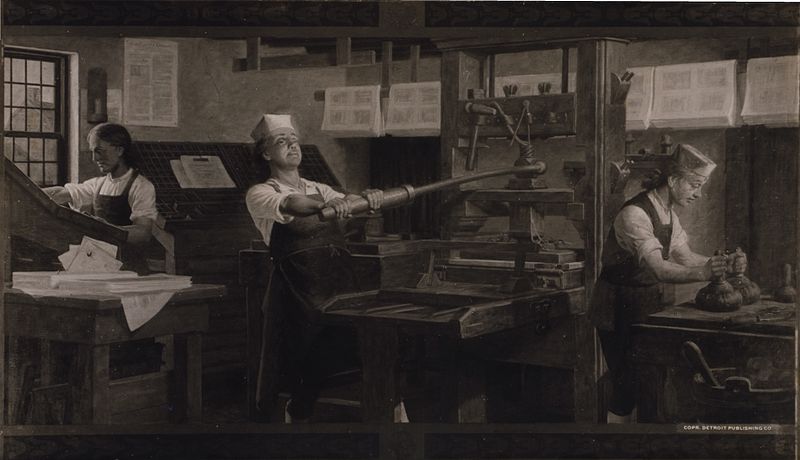
File:Franklin the printer.jpg
Benjamin Franklin at work on a printing press. Repro of a Charles Mills painting
While he said he could respect the long-bomb "Foreign Affairs" posts, that he simply didn't have time for them, and said more importantly that my denser posts, digressions, and obscure historical parallels were losing people he hoped would be my allies.  He says that groups in the refurbishing community, in particular, could become a groundswell of support for the "geeks of color", the counter- obsolescence planning, and other crusades I'm engaging.

Sounds like a case for less is more.

Now, this blog began (if you go back to the first years posts) as a journal I was convinced that no one at all was reading.   I was shocked by the first comment ever posted... "Not quite no one."

Well, my secret desire is that I'm going to have time one day to tear all 2000 pages (including a number of as-yet unpublished posts that I wasn't happy with) down into 249 pages that say something that hasn't been said in a way that more people would listen to.  I don't happen to care whether that's during my lifetime.  I'm acutely, or rather chronicaly aware I could die next year.

My evening mentor said that's fine, but he'd like to see me pay $14 per hour to some college student or professor just to edit each post as it comes out.  After listening to him, it seems ironically more arrogant not to pursue the idea.

Pulp Blogging about Recycling: 16 Short Paragraphs

Pulp Non-Fiction.   My career, developing recycling infrastructure.  Markets, participation, and logistics make recycling more economical. People who want to recycle, and mills which can use waste materials as resources, working together.  You know, the alternative to cutting down rain forests.

Who is really poisoning and destroying his brothers?
The success of recycling, in many ways, is no more important than the establishment of an infrastructure for laundromats.   There weren't washing machines all over the country one hundred years ago.  Now there are.  They have created countless spare hours for poor women to use in more productive careers, education, etc.  Like internet cafes in Africa, they bring tech access to the masses.  But what could be more boring?


Part of the challenge for recycling culture is to accept our success and become boring.  We were part of an environmental sustainability movement.  In many ways, we were the most important part, as recycling saves carbon, energy, forests, and species, and creates wealth where there is poverty.

The temptation over the past ten years has been for recycling people like myself to try to find a new controversy, a new battle, a new war.  We are like retired colonels who miss the days of bravery and grandness. The temptation to set off on a new crusade is understandable.

For me, the pursuit of recycling infrastructure has become about erasing national boundaries in order to make the solid waste hierarchy more efficient.   We reduce mining by extending the lives of products already mined, for example.  In doing so, we bring internet cafes to dark places.  Others stay in the USA, and see "overseas" as a new adversary.

Undisciplined blogging on "e-waste" arts

James Joyce chose his path.

Maybe he was only discovered by a future group of readers.

Maybe he wrote for them and didn't care about his hit counts in the meantime.

You don't want to aggravate and alienate a current reader (though artists have done so).

But if they were attracted to you originally for being what you are being, maybe trying to be someone else to keep them isn't the right response.

I can't personally respond to comments from the future, though.  And I thrive on dialectic.  So I have to get my dialectic dialogue fix from the people spitting on my tinkerer friends.

My belief is that I cannot possibly write anything to change the hearts and minds of the planned obsolescence and shredding industrial complex.  They are money making tiger robots, burning bright.

But if I manage to penetrate a spouse or son or respected elder, someone with a soul and a personal connection to the people pulling the trigger of friendly fire, that I may, as one person, have an effect.


I'm taking my family to meet these men and women in South America next month.  They previously met geeks, tinkerers, techs, and good-enough debrillards in Egypt and Mexico.  My 3 kids don't have a hint in their minds that Africans or Asians or Latinos are lesser intellects.  They've seen engineering techs best me in trade and haggling, fixing things I couldn't, winning like friends across a tennis court.

That's finally it.  The Watchdogs kids will get images of primitives.  My kids have images of equals.  Stuff that in your turkey.

FIFTH Film of E-Waste Samaritans This Week

Thanks to Waste and Recycling News for adding a 5th film to the list of "E-Waste Samaritans" this week.   The teaser video on Vimeo for the documentary "Zabaleen" rounds out a busy week for investigation of the crime of the decade - Recycling While Brown.  In Zabaleen, director Justin Kramer digs into the social, political and economic divide inside Egypt's own have-and-have-not society.

WRN Editor John Campanelli not only found this Fifth video of the week on Recycling Samaritans, but also by pens a very accessible Editorial, Film reveals the story of Egyptian trash collectors.  Campanelli interviews the director of the documentary, Justin Kramer, by telephone to make sure that his own "aha" moment he obviously experiences is clear to all readers.  (Disclosure:  WRN  also reprinted my modest proposal post on "A-Waste" this week, so far the highest hit count of the weekly publication.)


Campanelli keeps it simple and not political.  Appreciate garbage people and recyclers.  They could be heroes.  While the editorial maintains WRN as an apolitical, unbiased interviewer, Campanelli gets makes the Brown Recyclers' story to be an environmentalists story, an underdog's story, a refreshing change from the "primitive toxic" story.
""The general view is that these people are what they handle," said Kramer. "Most people, especially younger people, look at them as just disgusting. They don´t see the good that they are doing."
The good is an astonishing diversion rate. The Zabaleen are able to recycle or reuse 80% of what they collect. The organic waste becomes feed for their livestock. The paper, plastic and metal go to recyclers.
"The sustainability of these people is completely off the charts," said Kramer. "They don´t waste anything."
The citizens of Cairo didn´t realize the service these people provided until 2009, when, in the wake of a swine flu scare, the government ordered the slaughter of all the Zabaleen´s pigs – hundreds of thousands of animals.

Time Out: Big Picture Environmentalism

I'm on my way to vacation, followed by a trip to our fair trade recycling plant in Sonora, Mexico, then a presentation at the CES in Las Vegas.    I'll probably write more than ever on the road.  But even my haiku is too long.

If there were an Abstract for prospective readers of this blog, it might be:
The author [Robin Ingenthron] is a former environmental regulator with a degree in international relations, and experience in "third world" and "second world" development programs.  Using MBA skills and a business as a background, he writes about how environmentalism can make more efficient choices, trimming policies which do not benefit the earth ecology, with particular emphasis on environmental protocals which have been "hijacked" or influenced by greed.   

Dia-blogging with BAN's Jim Puckett

To his credit, Jim Puckett responded to my comment (posted yesterday in my own blog, but also appearing today as a comment below his own blog post on Ghana).

Sorry Glinda, you're busted
Jim makes his usual response, that a "mobile phone guidance document" trumps Annex IX.  It puts everyone to sleep and obfuscates a very simple and practical legal fact:  Basel Convention says that Parties can consider CRT display device repair to be a commodity and not a waste.  It says that in black and white, and flow charts about cell phones simply distract and confuse.

The mobile phone guidance document, which was published several years after the Basel Convention was passed, says that if a technician buys a fully functional unit but electively decides to upgrade a part and make it last longer or work better, that the part that was removed was a transported waste, making that smart technician illegal to work with.  It's a white man's burden thing, not IFIXIT neutral.

This was the case BAN tried to make to the Secretariat about CRTs a decade ago.  Now they are making a similar case again in the still-live-document PACE guidance on computers... if something might get replaced in order to upgrade, it must be removed prior to export.
 
But this is where BAN gets conflicted between its role as an advocate to change (amend) the Basel Convention and its role as a supporter of the Convention as it is currently written.   I've accused BAN of becoming so blinded by that dual role that they have made ad hominem attacks on geeks of color, allowed journalists to believe and report that SKD factories buying CRT and LCD monitors for refurbishment are explained with a trip to Guiyu, which was never a CRT monitor refurbishing center nor even a CRT scrap endpoint.
All electronics importers are same

BAN lumps Glindas, the good witches with bad Witches of the East and West.  The average journalist, like Dorothy, does not realize Glinda is a witch at all.   Exporters are not all bad, and we need good exporters to make the world better.  Shredding fails.   A "Steward" with no reuse is a prohibitionist, who will call for more and more Elliot Ness enforcement rather than admit that Prohibition doesn't work.

BAN Launches Blog

Imitation, the most sincere form of flattery!

Basel Action Network announced hours ago that they have kicked off their own "e-Waste blog".  I'm happy to link to it, and hope it will help their blog rise in the google and bing rankings.  In the linked post, they are of course trying to paint over the data now coming out of Ghana, using weasel words to obfuscate the major study showing 85% of Ghana used electronics imports are legit...  No new info here, just trying to drown out news of the actual data with noisy angst.  Pay no attention to the data behind the curtain.

Still, BAN's welcome in the blogosphere. I'm completely supportive of debate, dialogue, dialectic, and reasoning.  I've never censored BAN's commentary on this blog, and why I invite them to comment here.

Anyway, fun is fun.  Below is my inaugural comment on BAN's blog, just left.  It's waiting moderation.  I hope they allow it!  It's about Functionality and the Annex IX of the Basel Convention, which says that export for repair and refurbishment is legal (and doesn't say "tested working" anywhere).

R2 Responsible Recycler Certification Vs. E-Stewards Certification: Synopsis

What is the difference between Responsible Recycler (R2) and E-Steward Certification?


There are already several posts this year about the technical aspects of the Basel Convention, EPA Export Rules, and differences in perspectives on "fully functional", "tested working", and "elective upgrade" of used computers and components.  A list with links follows below/bottom.


I've been involved with "legalese" since my days as a regulator.  When is a product "discarded"?  What is "original intended use"?  Does Basel Convention Annex IX allow an overseas buyer to "electively upgrade" (replace and improve parts) and refurbish?  What is "major reassembly"?


Dialogue with the groups opposed to international trade was rational and factual during the R2 Stakeholder meetings, and so continued when BAN.org organized a competing "E-Stewards" Certification program.  However, when BAN's marketing of that campaign, and of their views about the contract manufacturing or SKD facilities, turned negative, I became negative as well.  I hoped R2 Solutions and ISRI would continue the level headed dialogue with the protest organizations, and from time to time I could use the blog to express the opinions of "geeks of color", which was increasingly disgusted with the way Watchdog groups equated their elective upgrades with "primitive wire burning".


The central difference between E-Stewards and R2 comes down to this:  In non-OECD nations (China, Singapore, Taiwan, Malaysia, etc.), can a material be legally recycled if no toxic constituents are released per Annex III? Who answers that question? The ayatollah of e-waste, or the competent authority (EPA)?    
For example, can a computer refurbisher in Singapore send upgraded circuit boards to Japan for refining, or send them to the same circuit board refiner in Singapore that off-spec newly manufactured product and warranty return product is sent? If so, the professional warranty-return, manufacturer takeback factory, in an ISO14001 factory, could keep its jobs, buy tested working product, and electively decide to replace working but worn parts, replace 110 volt boards for use in 220v countries, degauss cathode ray tubes for changes in hemispheric magnetic conditions, remove analogue boards and replace them with digital tuners, etc.


- R2 says yes but demands 3rd party certification that the non-reuse constituents were in fact legally recycled in a manner which did not result in release of Annex III constituents.

- E-Stewards says that even if the part is properly recycled, and no toxic is released, that the part must have been removed prior to shipment.