Showing posts with label Apple. Show all posts

Right To Repair During Pandemic


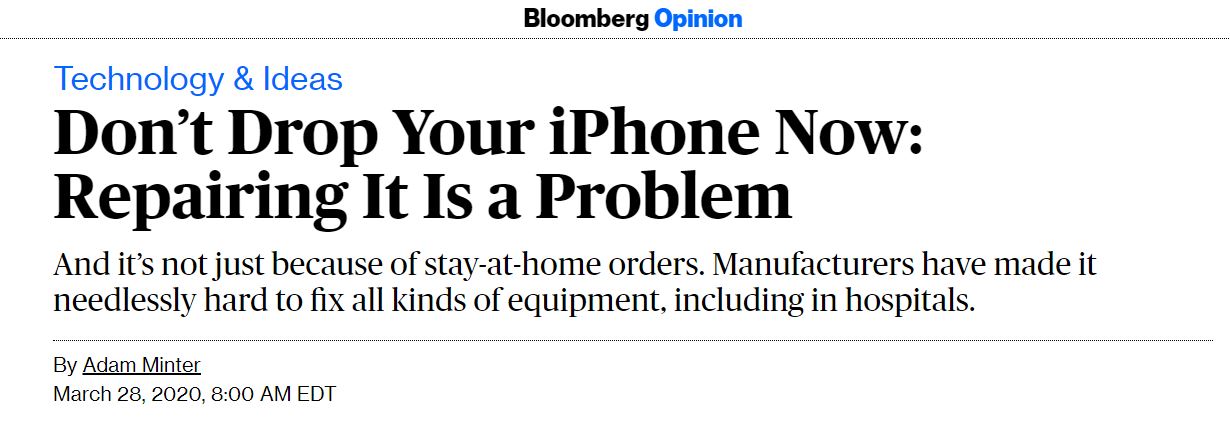
This morning brings an astute opinion page article by Adam Minter of Bloomberg, about how we are more vulnerable today to anti-reuse and anti-repair (planned obsolescence) strategies today than we were a couple of months ago. Apple has closed its "authorized" repair hubs, and the crackdown on trade in Asia during the pandemic has made replacement devices much more difficult and timely to order.

https://www.bloomberg.com/opinion/articles/2020-03-28/apple-s-rules-make-iphone-repairs-hard-to-get-amid-coronavirus?srnd=opinion

This excellently explained column may give Right To Repair legislation the push that it needs in Vermont. I will certainly be sending it to my legislators in Addison County.

Adam Minter is a swordfish - a reader who is interested in, understands, and re-conveys messages better and more broadly than you can. The meta-blogger should not be interested only in the number of readers (the most widely prescribed blogging strategy) or page rank, but in the ability to draw in a deeper intellectual with the capacity to make change. Of the three books of 1960 which influenced me deeply - To Kill A Mockingbird (Harper), Silent Spring (Carlson), and The Waste Makers (Packard) - the third is perhaps most under threat by big manufacturers. It is getting cut out of school books. More below on why that matters...

Swordfish-0046
Fishing for Swordfish
(This blog is both about a personal history on the subject of interest - right to repair - and also a commentary on "meta-blogging" which is a strategy of writing dense blogs that attract fewer - but more influential - followers)

How We Knew About Apple's "Recycled Content" Plan 2 Years Ago!

Big announcement, just out, from Apple CEO - Apple will produce its electronics from 100% recycled material, not from virgin mining.

It's reported from Apple's just-released 2017 Environmental Responsibility Report.  It's bound to hit all the Earth Day news outlets this weekend.

Sourcing recycled content, creating a demand-pull effect, was what we were working on when I started at Massachusetts DEP in 1992.  It can be very big news.

Question:  How did I know about this almost 2 years before Apple's announcement?

Apple doesn't make its own stuff.  It's generally put together by a Shenzhen contract manufacturer like Foxconn or Wistron, which the blog has focused on many times.

Guess how we knew about Hong Kong EcoPark when we allowed a trial load of printers to go to Hong Kong - when our E-Steward downstream wouldn't pick up after several loads to their shredder?  When the BAN GPS Tracker was in our facility, and suddenly our shipments were mysteriously cancelled?

When I did background check on why Hong Kong would be paying for printer scrap again, before approving to the Chicago downstream replacing the E-Steward, I found that the $550M EcoPark tenants were sourcing scrap for plastic to be sold to a contract manufacturer in Shenzhen.   One who made devices with a major brand name label.

JTouch: Long Live the Hardware Kings

Americans (and everyone else) loves the touchpad screens on HTC Evo, IPhone, Samsung Galaxy, etc. i-Everyone is aware of i-something and e-waste.  What does J Stand For?

No, Steve Jobs didn't e-invent the i-touchscreen.  Apple saw the beauty of the nice, tight little Asian displays, and quickly worked to design an operating system to implement them.  But now Google Android and Microsoft have caught up, and I don't know how long it will take for someone in Asia to start making software.

JTOUCH... Only 2,400 employees.  CEO Yeh Yu Chou, his phone number is still listed on the web.
J Touch Corporation is principally engaged in the manufacture and distribution of touch panels. The Company's major products include resistive touch panels, capacitive touch panels and traditional touch panels. The Company's products are applied in the manufacture of smart phones, personal digital assistants (PDAs), portable navigation devices (PNDs), commercial point of sale (POS) tools and business applications, among others. During the year ended December 31, 2011, the Company obtained approximately 99.68% of its total revenue from touch panels. The Company distributes its products primarily in Asian markets. - Reuters
Find the Taiwanese Executive.  I see Japan, I see South Korea, I see China... Working together to produce films and cultural cooperatation.  Because these guys don't want a stupid war in Asia, not over Sino/Japanese islands or the Taiwan straight or Korean "unification".  They even avoid patent wars, at least better than Americans do.


They are not "outsourced".  They ARE the Source.   Let's hope they make enough money to buy beef and cars made in America, because the genie ain't going back in the 1955 Display Device catalogue.

Now you can find $40 pads in Shenzhen (see "Death of Hardware").   I researched this, because the "death of hardware" headline looked to me like another case where we think that because "Polaroid Died" and "Eastman Kodak Died", that the headline is that "Cameras Died".

Hardware isn't dead.   JTouch is a company you never heard of, and they are making a billion dollars a quarter.  And they can produce the hardware cheaply enough now to sell it to people earning $6,000 per year.  That's a lot of people, a big market, a market bigger than a USA patent lawsuit can leverage.

In fact, the entire story of screen display technology "outsourcing", by Apple, or by whomever, as told by Romney and Obama, is a completely hysterical fiction.  IBM stopped making CRT monitors in NY in the early 1990s.  And that, my friends, was because Asia already owned the CRT business by then.

"Hardware is Dead"?   The king is dead, long live the king.  Incredibly good, profoundly useful, and shockingly cheap gadgets are going to change our industry.  They won't stop.  The question is whether the idea to make them non-repairable is ingrained in the industry now, and whether they will become like light bulbs, produced too cheaply to fix first, then re-designed to fail faster... or whether, mercifully, buyers in the $6000 income bracket won't put up with that.  In the USA, display panels are already becoming the new ink cartridge, and we barely finished breakfast.  But in Guangzhou, you can buy printed reverse-engineering books which tell you how to repair (or remanufacture, or counterfeit) every electronic device on the market, and if one gets a reputation for being "all glue and no screw," they may find USA and Europe to be their only market.

JTouch to increase revenues in 4Q12 from tablet product orders
Siu Han, Taipei; Alex Wolfgram, DIGITIMES [Thursday 4 October 2012]
Taiwan-based touch panel maker JTouch is expected to see fourth-quarter 2012 revenues hit the highest quarterly level of the year due to increased orders for touch screen panels used in tablets, according to industry sources.
The company is seeing increased orders mainly from international companies such as Samsung Electronics for its 10.1-inch tablets and is increasing its overall proportion of production of touch screen products used in small- to medium-size devices, added the sources.
JTouch has also been improving its production capacity throughout 2012 and is increasing the number of customers from China, added the sources.
JTouch's revenues for the third quarter are estimated at NT$1.4 billion (US$47.7 million), up 40%...
See Digitimes for more

Revolution Number Nine: Apple, Google, Taiwan, Korea...

From Digitimes:

4Q12 trends in the Greater China touch panel industry

In the global touch panel market, handset applications will account for the highest proportion of shipments at 76.2% in 2012. In second-half 2012, the main change in the handset touch screen market is the release of Apple's iPhone 5 that uses in-cell touch screen technology. The supply chain for Apple's panels will be shifted from Taiwan-based panel makers to Japan and Korea- based ones, which will cause shipments for panels used in handsets to decrease for Taiwan-based panel makers from 41.3% in first-quarter 2012 to 26.9% in fourth-quarter 2012.
Global touch panel shipments by application, 2010-2012 (k units)
Additionally, China-based panel makers will benefit from low-priced handsets in China. Due to such handsets having strict cost requirements, they will be beneficial for China-based touch screen makers. This will allow the makers' shipments of touch panels used in handsets to increase from 32.7% in first-quarter 2012 to 39.4% in fourth-quarter 2012.
This is about the split between Taiwan Display Engineers and the "old rivalry" between South Korea and Japan.  Apple will probably try to keep developing more expensive touch displays with some micro-improvement.  They will try to use Apple software to make sure people use it.  It was the Apple way of the 1990s, to shun "cheap" PC-clone manufacturers which manufacture for the "Good Enough Market".

China (over) Produces $45 Tablets - Commodity Deflation!!

File:Carbonfilament.jpg
Looks like a job for Light Bulb Repair-Man
Last weekend I wrote about Apple founder Steve Wozniak's take on the "Samsung vs. Apple" patent battle.  Yesterday we looked at the billionaire Asian Titans, Lees, Lins, Lis and Gous, who took reuse and spun good enough gray market and refurb items into the dominant modern industry of our times.

Are display devices becoming like light bulbs?

Today, I ran across an article by Jay Goldberg in VentureBeat about his latest trip to Shenzshen, China.


Android tablets are selling in Shenzhen at $45 each, brand new.

"Hardware is dead".
This was a 7-inch tablet, Wi-Fi only with all the attributes of a good tablet. Capacitive touchscreen. Snappy processor. Front facing camera. 4GB of internal memory and an expandable memory slot.
I later found out that these devices are now all over the supply chain in Shenzhen. At volume, say 20,000 units, you can get them for $35 apiece. My device ran full Android 4.0 Ice Cream Sandwich and had access to the full Google API, including Gmail, Maps, YouTube and Google Play (not quite sure how that works either).
Once my heart started beating again, the first thing I thought was, “I thought the screen alone would cost more than $45.” My next thought was, “This is really bad news for anyone who makes computing hardware.”
The title is misleading. The hardware isn't dead.  In the industry, it's called "commoditization", where yesterday's unique must-have hardware becomes mass produced, and competition renders it the price of an ear of corn.  Apples may truly become apples.   Even as Apple and Samsung fight over the patent on the tablet and touch phone, the fact that the critical component - the small touch screen - was not owned / invented by either, has taken over reality.

This is not a small deflation.

Yes, it is still aggravating that OEMs seem to manufacture devices NOT to be upgradeable or repairable.  But if they are producing them at 10 percent the cost of a year ago, that may undermine the tinkerer blessing.

Just When I was Starting to Hate Apple

 'Photographer Credit: Nichollas Harrison' - thanks


File:Steve Wozniak, 1983.jpg
I am not a Troll
Steve Wozinak Speaks to Bloomberg about Smart Phone Patent Wars.
“I hate it,” Wozniak said when asked about the patent fights between Apple and Samsung. “I don’t think the decision of California will hold. And I don’t agree with it -- very small things I don’t really call that innovative.
“I wish everybody would just agree to exchange all the patents and everybody can build the best forms they want to use everybody’s technologies.”
Steve Wozniak, the engineer-geek who co-created Apple Computer with Steve Jobs, was ever the good cop.   Yes, Jobs was a visionary, yes he was an orphan, yes he climbed up from the bottom, and yes he got blindsided by IBM when richie rich kid Bill Gates' Parents (who were on IBM's Board of Directors) got Gates a personal meeting to pitch Windows... Perhaps those tender moments influenced Jobs, perhaps he grew up tough.

But Steve Jobs also sued 14 year old bloggers, parked in handicapped spots, and (my beef) took credit infamously and greedily for other peoples ideas.  See Wired News articles... (but beware of flame-baiting your blog)...

My position in this industry was built by reading Digitimes, a Taipei-based tech journal which I started subscribing to about 10 years ago.  It was mainly about displays, displays, displays then.  I was able to predict and ride the sales of CRTs when the demand curve was outpacing the LCD supply curve, due to increasing demand projected in emerging markets, I was able to find Taiwanese-owned contract manufacturers, and I became who I am by riding Taiwanese coat-tails.  And here's the truth - Windows and IBM released their hardware, the PC clones, rather than open-source their software (as Google has now done) and the deal worked.  The Asian Tigers engineered and tinkered and produced PC Clones into a massive industry.  And the biggest thing you wanted to clone, 50% of the cost of a computer, was the CRT monitor.

Apple had to outsource their displays, they had nowhere near the market share to produce their own, not even close, in the 1990s.  And they outsourced them to Japan (Sony Trinitron), and did not develop the ties with Proview, BenQ, Wistron and Foxconn which others in the industry developed.  Apple tried to keep control, when Windows and IBM were PC-cloning, and tries to keep control as Google is Androiding.  But eventually, they had to come work to discover the IPhone prototype.

The Taiwanese became to display devices what Japan had become to automobiles.  In fact, it drove Beijing nuts that Taiwan was becoming outsource-in-chief to Japanese manufacturing, drove the Communist Party so nuts that they tried to corner the entire CRT manufacturing market, buying out all the furnaces and dumping subsidies into the manufacture... in 1999.   (Newbies).

What I do at the Beach: Masters in Capitalism

This doesn't really fit in a blog.   And like many of my college papers, it was written at one sitting (I used a typewriter with white out and being able to re-write a paragraph was rare). Sometimes I do this and park it for months, and eventually publish a "robin masterpiece" like Monkeys Running the Environmental Zoo.  Sometimes I do it in one sitting at a place like Motherboard.TV and an editor there helps me to produce "Why We Should Export Our Electronic 'Waste' To China and Africa.", which becomes subject of a documentary on European cable news.

I haven't reread this at all, so buyer beware.  Here's my attempt at relational relativity applied to Marxism and development economics.   It was too windy at the beach. (pun intended).

Cleaning Up in Capitalism:  Relative Aspirational Pyramids
by Robin Ingenthron, July 21 2012.  Written in Le Barcares, France.


In journalism, they say you need to know your audience.  I'm obviously not a journalist, and don't think I'm competing in "free content" for the news writing community.  But I think there are a lot of works I admire where the author (e.g. de Tocqueville) probably didn't exactly "know his (future) audience".


I'm also re-reading Herman Hesse's Siddhartha.  In chapter one, he's an arrogantly admirable son of a brahmin (SOB).
The word Siddhartha is made up of two words in the Sanskrit language, siddha (achieved) + artha (meaning or wealth), which together means "he who has found meaning (of existence)" or "he who has attained his goals".[3] 

Growth of cities in developing world

This is a fascinating little tool, showing overlays of the the growth charts of the largest cities in the world.

590 Cities Charted:  Impure Blog

As Yadji explained in his video, people are leaving the backwaters of the developing world and heading to the city.   I've been writing a lot this year on the "pixelization" of wealth distribution, and how clumsy the "rich vs. poor" country debate has become.

The changing world means that companies like Sony, RIM (Blackberry), HP/Compaq, and Dell are receding, just as RCA, Magnavox, and Polaroid disappeared over the past decades.   But when I read that the "electronics industry" is in decline, I laugh.   That's like saying "basketball is in decline" because Larry Bird or Michael Jordan are unable to compete on the court. 


Debate, Dialectic, Diablog: IPhone #ewaste Graphic Misleads

Diablogs and Wiki-Greeks
A couple of weeks ago, I was sent a new set of graphics, in the spirit of "Story of Stuff", by umm... students? activists? artists?... seeking to raise awareness about the IPhone.   A woman named J.Rhee sent me an advance copy and asked for my comments.   I sent her some, in the spirit of cooperation, but did not hear back.  

Elizabeth Chamberlin of IFIXIT (soon to take away the crown for the "Best Scrap Blogger in the World"*) has written about the Apple-criticism piece, and does a good job of examining the case against Apple without taking it hook, line and sinker.

The Anti-IPhone-graphic-activists display a lot of talent, sincere passion, and make some very valid points.  They asked my opinion rather nicely, and I'm always looking for mature, grown-up conversations with environmentalists.  But I'm disappointed not to have heard back from the authors of the piece.  Below is a snippet of the dialogue, followed by my response and comments.

Hi Robin,Thanks for getting back to me. The graphic I was referring to lives here: http://www.mbaonline.com/cost-of-iphone/  Let me know what you think. I’d love to get your thoughts, and feel free to use it as you’d like!Thanks again, Jen
Hi Jen,

I really like the lifecycle focus on mining, coltan, etc.   I lived in Africa and was in Rwanda, Burundi and DR Congo for awhile.   The natural resources harvesting business has been a curse. The Worlds Most Polluted Places (TIME) are metal mines, not recycling yards.

With that said, I think your graphic is pretty unfair to Terry Gou and Foxconn (Han Hoi Precision)...  The Taiwanese "Geeks of Color" like Gou and Simon Lin (Wistron) and Rowell Yang (Proview) have been "racially profiled" by the left in the USA, I think.  All three of those guys began as a "tinkerer" importing and repairing used electronics, then became a contract manufacturer (like Foxconn is for ... um... everyone not just Apple).  They have done a pretty good job of learning 100 years of industrial revolution lessons in a decade.

Foxconn is owned by the Taiwanese, managed by Hong Kong, employs labor from Cantonese Guangdong, and is regulated by Mandarin Beijing.   It's pretty remarkable.  The suicide rate is below that of similar scale operations (yes including the USA), when you have 1.1 million employees living in campuses the size of cities, you see rapes, robberies, and suicides at the same rate as you'd see in Detroit. 

Finally, the piece about Guiyu is completely inaccurate.   There are no Iphones in Guiyu.  Guiyu is almost all scrap generated in China.  Shenzhen, Guanzhou and Hong Kong have basically grown into one metropolis which has the population of JAPAN, and Guiyu is the scrapyard.

If you want to know what happens to Iphones which wind up in China, check out this blog.  http://techtravels.wordpress.com/shenzhen-phone-recycling-1/  Visit all 4 pages on the cell phone recycling in China.

I'm a socially conscious environmentalist.  In my opinion, we don't do ourselves any favors with racist depictions of the Geeks of Color.  It is a major embarrassment to the environmental community to have launched this "green scare" campaign against geeks and techs overseas.  I urge you to imagine how you would feel if you were Mowgli... when sex worker, coltan mining, child soldiering is 30% of your job market, and you learn to fix a cell phone, creating affordable connections for people in your emerging market,  or putting CRTs into internet cafes that become the center of Revolution 2.0, when you are recycling rather than mining, and green Americans portray you as some kind of a primitive, polluting, sorry, toxic victim.

Again, bravo on the first half of your piece.  But if I post it on the blog as is, I'm going to make some of the points I made above.  If you are interested in really conveying the truth, I'll spend as much time with you as you want.
If you want to see the piece we are both commenting on, find it via Elizabeth's blog... I don't really want to raise its pagerank if they are sending it out "looking for comments" but don't respond to the comments.  An MBA is supposed to be a masters degree program, and work is supposed to be subject to peer review, response and debate...

Confessions: Foxconn Hoax by APM Mike Daisey


Fake Foxconn story on This American Life

While I don't want to exaggerate Foxconn as a wonderful place to work, I said from the beginning that it was nowhere nearly as bad as places like mines and textile factories in China, and the story by Mike Daisey didn't strike me as unbiased reporting.  I wrote two posts about how Foxconn is foremost a cooperative effort between Cantonese, Hong Kong, Taiwanese, and Mandarin Chinese, which is kind of a coup by itself, and I provided film from Financial Times.

But it's worse than I thought.  Not Foxconn - Mike Daisey is worse than I thought.

This afternoon's press release from American Public Media:


During fact checking before the broadcast of Daisey's story, This American Life staffers asked Daisey for this interpreter's contact information. Daisey told them her real name was Anna, not Cathy as he says in his monologue, and he said that the cell phone number he had for her didn't work any more. He said he had no way to reach her.


"At that point, we should've killed the story," says Ira Glass, Executive Producer and Host of This 
American Life. "But other things Daisey told us about Apple's operations in China checked out, and we saw no reason to doubt him. We didn't think that he was lying to us and to audiences about the details of his story. That was a mistake."


So when Mike Daisey says this,
...and all these people have been exposed [to N-hexane]...Their hands shake uncontrollably. Most of them...can't even pick up a glass.
What he meant was... well Marketplace asks Daisey in this interview which sheds new "dark" on his tale... [marketplace.org] :
Rob Schmitz: Cathy says you did not talk to workers who were poisoned with hexane.
Mike Daisey: That’s correct.
RS: So you lied about that? That wasn’t what you saw?
MD: I wouldn’t express it that way.
RS: How would you express it?
MD: I would say that I wanted to tell a story that captured the totality of my trip.
Ira Glass: Did you meet workers like that? Or did you just read about the issue?
MD: I met workers in, um, Hong Kong, going to Apple protests who had not been poisoned by hexane but had known people who had been, and it was a constant conversation among those workers.
IG: So you didn’t meet an actual worker who’d been poisoned by hexane.
MD: That’s correct.
Now maybe people will remember the great "E-Waste Hoax" of Africa, and ask themselves, when does passion do more harm than good?


Enhanced by Zemanta

ODM - Opportunity is in the Wind


First, here is a May 2010 film from Financial Times, which was done during the wave of 10 suicides at Foxconn (Han Hoi) in Shenzhen (click "MORE")


IPAD: I Want My, I Want My QWERTY

Money for Nothing Keyboard
The Day After Black Saturday:  Family discussing whether they want an IPad.  Or similar tablet, Galaxy, HTC, etc.

Millions of obsolete and junk products arrive here at our "e-waste" morgue, so opinion may pass as insight.

The laptop is a display device combined with a very flat computer (motherboard-powersupply-drive-etc).  They fold together with a keyboard input device sandwiched in between.  Three old technologies designed to fit snuggly.  In my warehouse we are surrounded by Input (keyboards, cameras and microphones) Output (display devices, speakers and printers), and the storage and processing (hard drives, processors) which bent time and distance to connect us to each other at exponential speed and convenience.

A smartphone eliminates the keyboard, in favor of a combination of software and touchscreen replacements... that is speed and convenience because of its portability (cell phone tower).   We generally don't use the smartphone to compose reports, blogs, or letters once we are at home or in the office.

Nevertheless, there have been enormous gains in touchscreen technology and software, as well as in voice recognition.  The smartphone market has unleashed a lot of software codewriting energy.

I want my, I want my, I want my QWERTY....

Where Apple really takes advantage is the opportunity to sell software or apps in this rapidly developing no-keyboard touchscreen market.   Two decades of Microsoft commanding the ALT-DEL keyboard market left other software makers too far behind to leapfrog Microsoft.  The growth of that market, and the level playing field, gives Apple a big reason to bring the touch display into the home and office.

Buying a PC, you were buying a software support environment based on a keyboard input device.  Apple had successes (notably with Adobe), but if you bought a PC you were buying a much larger stable of software code  With the Pad (touch pad) technology, Microsoft does not have a big bench.  The rules are being changed for input devices, and keyboard is no longer king.

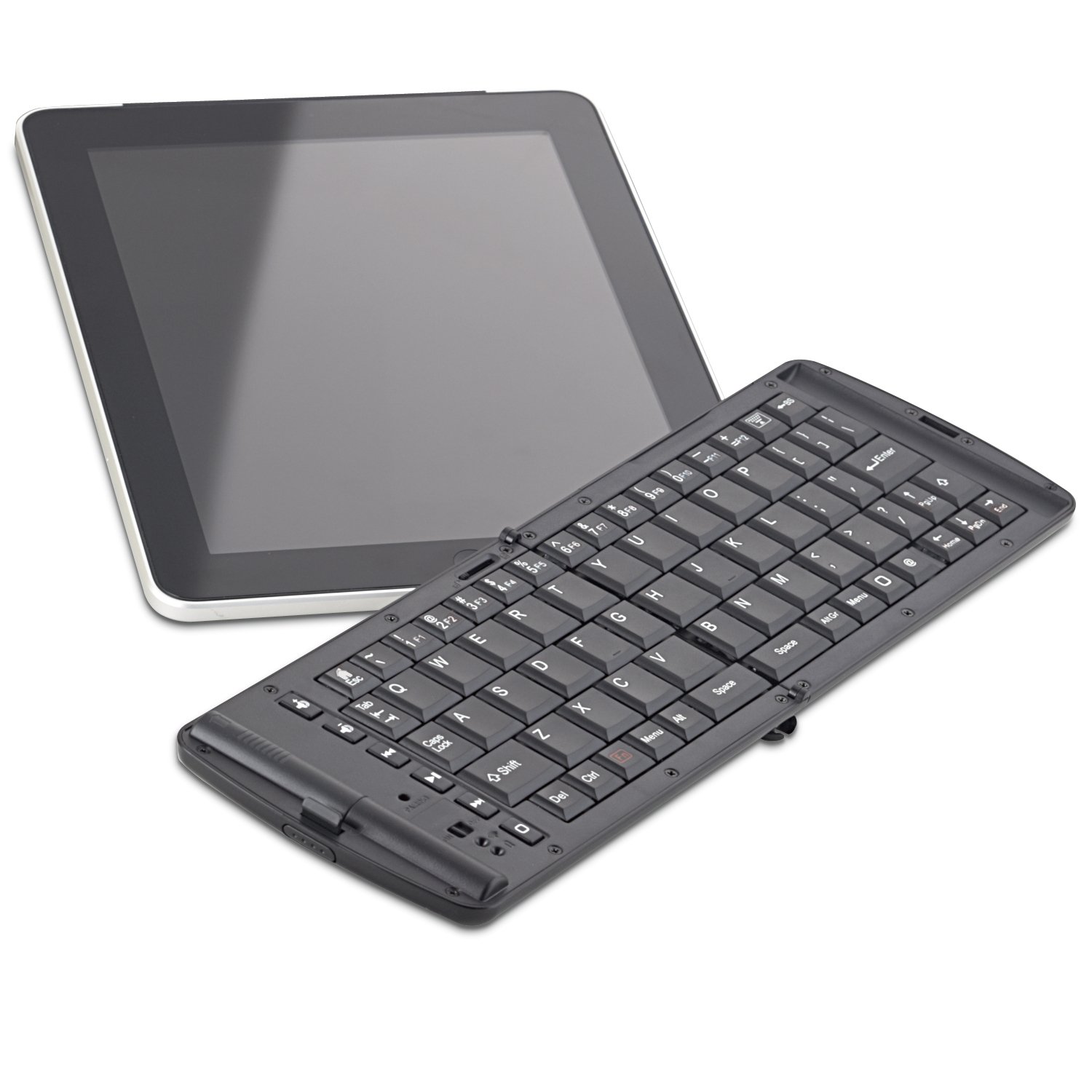
So the question I ask my family is, how much do you hate your keyboard?   Enough to spend $1000 to get rid of it?  And will you buy a peripheral for $58.99 to replace it?

I want my, I want my, I want my QWERTY....

For me, so far, touch screen software - while it has made great gains - is still a limitation I put up with as a compromise... driving, cell phone towers, and battery life make it an advantage to laptops.   

When I see people buy keyboard-attachments for their IPads, I really think they should take another look at the sub-$500 laptop and netbook markets.

The big change however will be how non-English software takes advantage of the curve in the software road for Input Devices.   When I see Guangdong Geeks bent over the QWERTY device (infamously designed to slow input so mechanical typewriter keys don't jam), I wonder...


  • Are Chinese programmers enslaved by left-to-right keyboards reprogrammed for modern Chinese?  (Chinese and Arabs write right-to-left)

  • Or do they mainly sit passively and read from the display device, and not input (compose) as frequently?

  • Or are they going to use the leveling of the playing field for new touchscreen software applications to do, as Apple hopes to do, and leapfrog Microsoft?

  • Or... is this IPad tablet an I-fad, because really we will miss and should like our keyboards?  We keep them despite the QWERTY origins because they fit the speed at which we think most productively?
There are signs that my younger generations think more quickly than I remember thinking.   Younger staff, my kids, they are very fast conclusion-formers... They TXT LOL.  Hemingway, Dickens and Twain they are not (though all those writers thrived by incorporating less formal speech into their characters).

For the near term, Adobe, Google and Sun Java have as much of a level playing field to enjoy from keyboard-free input devices as does Apple or China.  Palm might have, but the sale to ink-cartridge-maker HP was hitching to a pretty old racehorse.

So for the IPad... I'm making room for them in the warehouse.  Personally, I always try to buy things I can repair or have a reasonable warranty (or sell-for-repair market, as my HTC Evo proved to have), and which have a reasonably mature software market.  We still have a very large Toshiba CRT Television (HD) in my living room, one discarded from an audio-visual company which paid top dollar for it, as part of a conference-call room.  A pre-skype conference call room.

I want my, I want my, I want my QWERTY....

And as anyone reading this knows, my input devices are as important to me as my display devices.  Touchscreen inputs, to me, are like sign language.  I respect it, and thank God for Helen Keller.  But I don't see it as a primary vehicle to compose a work of literature.

I'm not photogenic enough to rely on video, and the bandwidth constraints of video broadcast in emerging markets are unfriendly.  Video is like a subway, it can get you to lots of places with lots of people.  But typing is like walking, I'm not giving it up for the subway.

(Someone soon will release the first ever Text TXT novel, and it will be crap... Opera via telegraph)

I want my, I want my, I want my QWERTY....