Showing posts with label hong kong. Show all posts

5. How Too Quietly Big EWaste Lies Buried: Top Five E-Waste Lies Mapped

Let's ReMap the Five Biggest E-Waste Lies (before the April Fool's Blog traditionally comes out).  In Part Five, let's look at five geographic places the bodies of the truth were buried underneath a pile of false narratives and bogus "E-waste Export" claims. If you are doing a thesis or term paper on electronics recycling this semester, take the blue pill and see how normal ordinary places were sensationalized with poverty narratives despite prima facia evidence that the story was bogus.

We can forgive reporters and news producers like Solly Granatstein (CBS 60 Minutes) at the proximate time that they report. We can roll our eyes at well-meaning do-gooders who react to false claims with alarm, out of a sense of liability. 

But I question why so few reporters do as Ira Glass did following his sharing of Mike Daisy's Foxconn exaggerations and lies. This American Life is alone in re-tracing its steps, and learning that activists and environmentalists are not immune from biased reporting, sensationalism, and creating bricks that build the House of Big Lies.

The Big Lies are about PLACES visible on Google Earth. Please, I need some unprejudiced university student help to link and map these, and I can provide the photos.

1.Guiyu.

2. Foshan

3. Basel

4. Accra

5. Hong Kong

Punjab / Faisalabad is the Sixth Man... Penang, Malaysia gets honorary mention.


GPS LIE DETECTOR? Flagrant False Claim #Ewaste Watchdog (GPS Tracking Monitour interview)

Wow, haven't followed up that much since the MIT SenseAble City Lab and BAN GPS tracking project was pulled to MIT legal office about a year ago.  Readers are aware that this blog tracked many of the devices into places that BAN didn't want to talk about - like a University reuse operation in Faisalabad, or modern 21st century EcoPark in Hong Kong (no longer obscured in Monitour).

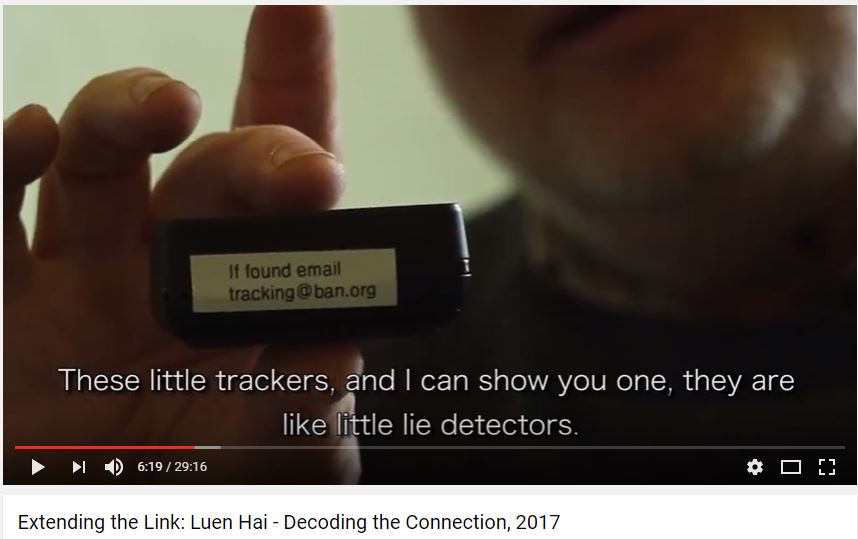
Well I just ran across a little video produced in 2017 by Luen Hai - Decoding the Connection.  In it, at about minute 6, a Hong Kong reporter identifies Jim Puckett of Basel Action Network as an important expert in e-waste imports to Hong Kong.  Then Jim says on screen that 54% of the GPS trackers the organization placed in e-waste was shipped to Hong Kong.

If you know about this study, you may think I made a typo. The numbers are so specifically wrong. But this is Jim's recorded voice, in his own words... screenshots with subtitles below.

1. "These little trackers, and I can show you one, they are like little lie detectors"


IRONY of IRONIES...  Listen to what Jim tells the filmmaker about the GPS "lie detector"...  Full video at bottom below.


How We Knew About Apple's "Recycled Content" Plan 2 Years Ago!

Big announcement, just out, from Apple CEO - Apple will produce its electronics from 100% recycled material, not from virgin mining.

It's reported from Apple's just-released 2017 Environmental Responsibility Report.  It's bound to hit all the Earth Day news outlets this weekend.

Sourcing recycled content, creating a demand-pull effect, was what we were working on when I started at Massachusetts DEP in 1992.  It can be very big news.

Question:  How did I know about this almost 2 years before Apple's announcement?

Apple doesn't make its own stuff.  It's generally put together by a Shenzhen contract manufacturer like Foxconn or Wistron, which the blog has focused on many times.

Guess how we knew about Hong Kong EcoPark when we allowed a trial load of printers to go to Hong Kong - when our E-Steward downstream wouldn't pick up after several loads to their shredder?  When the BAN GPS Tracker was in our facility, and suddenly our shipments were mysteriously cancelled?

When I did background check on why Hong Kong would be paying for printer scrap again, before approving to the Chicago downstream replacing the E-Steward, I found that the $550M EcoPark tenants were sourcing scrap for plastic to be sold to a contract manufacturer in Shenzhen.   One who made devices with a major brand name label.

MIT Ethics Inquiry? Senseable City Lab and BAN GPS Tracking Update

As we near the end of 2016, and I review the engagement of the published blogs this year, it appears I need to update readers on the apparent stonewalling of our requests for information and review of MIT Senseable City Labs "collaboration" with Basel Action Network's GPS tracking of used electronics.

I slowed down on the reporting in part because I had to engage with actual attorneys... MIT's, one of the "collateral damage" processors at Hong Kong's Eco Park, and my own.  Obviously Hong Kong Environmental Department attorneys must be involved in responding to BAN's accusations (in China Daily) that their legal opinion - that printer scrap is not hazardous waste and not illegal to import - was against international law (according to USA-based BAN.org). Also a few of the companies mentioned in the report as being in the "chain of export" cautioned me about the "Streisand Effect".  If reporters were by and large (other than PBS and Time) ignoring BAN's study, why risk elevating it?

Well enough time has gone by for an update.


  1. MIT did not confirm or deny that a copy of my letter was given to its Ethics Review Committee.  They sent it instead to Basel Action Network, the organization we thought entangled MIT in the ethical research questions to begin with (and who I did not address in the letter for that reason).
  2. Evidence has come to light that BAN had the ability to control the outcome in real time.  This risk was not addressed by Carlo Ratti's team.  BAN admits they knew where the devices were at intermediaries DURING the study.
  3. My company shipped printer scrap to another shredder, on several occasions, which pays BAN e-Steward royalties.  We shipped printer scrap to that company immediately before the load (also to the Chicago area) the month before the tracking device came to Good Point, and a month after the device was shipped to the company that exported it.
  4. DURING THE MONTH IN BETWEEN the company which pays BAN royalties stopped accepting our material!  We had actual cancellations of deliveries of printer scrap while the tracking device was at our property!

At the very least, this seems a strong reason not to publish the names of unwitting and unwilling test subjects involved in the chain.  While we don't know about this particular case, we do know some in the chain were more "witting" than others.  I revealed last summer that at least some E-Steward companies knew the trackers were in the field, and at least some were involved in selecting which devices to track.

This does not prove that BAN colluded with or warned their sponsor company that we had a device on our property, or that the information resulted in the delivery being cancelled until the device was off our property.  That information is "continuously unknown".

It does show the need for MIT's existing rules on testing of unwitting subjects, and rules on conflict of interest.  And there can be no bigger example of a conflict of interest than between Basel Action Network and Fair Trade Recycling.

BAN MIT MoniTour Teardown: Inside the Ewaste Export Controversy

The MIT MoniTour @KCTS-9 Basel Action Network "Expose on Exporting" #trackingewaste is still being reviewed by review researchers, recycling experts, and reporters.  Memorial University has helped plot final landing points for devices.  There are still a large number of items in places that BAN can't quite explain.  [There are data points missing, which we located on Monitour but are not in the table per MUN]

- There are good places overseas (BAN now says "never said there weren't")
- People who never exported are highlighted for political reasons (BAN says it's justified)
- BAN's own math suggests 11% total exports (good or bad end points)
- BAN's conclusion (use E-Stewards) belies BAN's financial interest

As one of the people who never exported the tracked device, but whose clients were assaulted by BAN's innuendo I've got a particular axe to grind.  But the main point is that I have consistently made the same argument before BAN attacked me personally.  Jim Puckett has told a reporter directly what I inferred from the article - that I came up with EcoPark, etc., to cover up my shipment to Mr. Lai's Printer Farm.  It's in print, and it's provably false, and I need another apology.

BAN made a very legitimate point via their GPS tracking study - that despite normal diligence, we should not assume for sure material exported to Asia won't go "sideways" to a scrap metal vendor (any more than we can assume that via E-Stewards).  But Jim Puckett tries to push the point too far, and in so doing damages the names and reputations of state of the art repair geeks overseas, Boston area MIT hippy coops, Vermont ADA employees, and legitimate discussion of environmental policy.

Perhaps Jim yielded to his frustration and inability to control the story in a tidy direction, and now has injured people that shouldn't be injured.  He needlessly involved innocent MIT students, Carlo Ratti, KCTS, and The Body Shop Foundation in a pissing match over environmental justice.  Jim simply needs to say "I'm sorry".   Again.

Watchdog Issues Apology For Personal Attacks in E-Waste Article

Jim documenting CRT glass was not exported as he claimed (AZ)


Geography Baiting 6: Granular Images of Recycling in Asia

My response to BAN's report "Scam Recycling" is not a criticism of tracking technology as a methodology.  And I'm not a critic of MIT or the Basel Convention.


Basel Action Network, using funding from The Body Shop Foundation, successfully added a lot of granularity to the discussion about exports of used electronics internationally.  The Data is interesting.   A peer review process, using scientific method, could have produced a great report, and could have protected the privacy of unwitting and unwilling test subjects in all the countries involved.  And to the degree that data is released rather than "obscured", it can be assessed by professionals like myself, and academics, and policy can evolve.

And that's happening. Josh Lepawsky of MUN's Geography department has repopulated many of the data points that were obscured on BAN/Monitour (though not all - Foshan is missing, as is EcoPark).

Is BAN playing games with the data?  If so, MIT Ethics office should recognize that its students (remember we have the names of the ones who placed a device in Somerville) are pawns.

I'm a critic of one thing.  Environmental Malpractice.  For a decade, this blog has attempted to offer an "anti-defamation" defense vs. Basel Action Network's game of tokenism, profiling, geography-baiting, race-baiting, and slander.  The people I'm most concerned about today are the Chinese printer technicians who make repair and reuse of laser printers as commonplace in China as automobile repair in the USA.  Or, put another way, as common as repair of laser printers was in the USA in 1995.  Because of the history economy printer cartridges - which cost as much as ball point pens to make, but sell for over $20 - printers are a specialty business which has been under attack since I first visited China's Nanhai/Foshan district in 2002, the year BAN visited Guiyu and Adam Minter arrived in Shanghai.

It's extremely difficult for Fair Trade Recycling to defend a printer economy which is kept in the "informal" sector by forces which defy Americans understanding of reuse economies.  Fifteen years ago, I assumed that anyone paying double the price of scrap for laser printers, but who refuses to buy inkjet printers, knew what they were doing, and had to be in the reuse parts business.  When I visited those markets, I was uneasy. They were very small, dirty shops.  Sometimes the work was outdoors. But you saw clearly that the sandaled brown and yellow people were sorting the printers by size and brand.  I found out that the reuse markets for certain LaserJet 4s had more to do with industrial machine repair (using the same memory cards) than it had to do with Laser printing.  And I found out about EFF.org, and Arizona Cartridge Manufacturers, and Jazz Camera.


I also found out that these markets are virtually untraceable and impossibly unaccountable. If I met a printer scrap buyer in person, and managed to communicate in Chinese, I learned that from his perspective scrap was "liquid". If he found the same printer I sold him closer to him, he felt he'd fulfilled his obligations and what happened to my physical printer was irrelevant.  From his perspective, it was as if I was trying to track the serial numbers on a hundred dollar bill I'd used to transfer money by Paypal.

Geography Baiting 5: How Can You Say No?

You are approached by an R2 Certified Chicago Recycler, who has decades of experience in copy machine refurbishing.  You have seen and photographed copy machine refurbishing, overseas, yourself.

The Chicago company has news about a state-of-the-art recycling facility in Hong Kong.  Hong Kong is wealthier, per capita, than the USA.  You know it's near the center of printer parts repurposing, and demand for recycled plastic - the plastic that you know is being lost in big shredding operation.

You check the downstream.  Hong Kong Environmental Department considers printers non-hazardous waste.  The facility identified in Hong Kong is also R2 certified.  You request verification of where the focus materials (circuit boards) go, and track them to Dowa and Umicore...

"You should have refused to ship there".

Really?  Why exactly, given the information above, should we have said "no"?


Deflection Option:  You can say you sent it to Chicago, not overseas.  But the fact is that you knew it could have gone overseas.  You just don't believe what BAN tells us about "primitives" in Hong Kong.

If you were to say no based on the Hong Kong facility, advertised as being state of the art, able to make the highest and best end use of the printers, how would you justify boycotting them?  How can you say no?  On what basis?

I could think of only one reason.  Bigotry. Racial profiling of Hong Kong as a place with "hundreds of junkyards" and "rice paddies".   Fear of the other.

Geography Baiting 4: BAN Investigates Un-American Recycling Activities

Well, this guy must not be a credible source...

"Just a few days after arrival, the printer left Vermont and travelled to the Chicago area and then onwards to the port of Long Beach, California. It next pinged off of the coast of mainland China before arriving at the port of Hong Kong. Two days later it was in Mr. Lai’s Farm. " - Jim Puckett

He's talking about ME.

Sounds very "Un-American".  Sounds like Evidence that we are exporting 40% of our waste, according to BAN.  Or worse, sounds like companies that PAY the NGO tribute money are a "safe" solution to the Un-American problem, we must be shipping more than 40% just to buck up the average.

Caution:  Wet Taint

Sounds like.  This NGO makes a lot of noise, but the report they issued says in one place that 50%-80% of devices are exported, in another place over 80% are exported, and in the press release says 40% are exported.  In Geography Baiting #3 we showed what the actual MIT data say, and when corrected for the sampling error (not GPS tracking the 60-80% of e-waste that's almost never exported), what they actually have is data that is pretty close to the 7%-15% range of other vetted studies.

But this is about sound.  Jim doesn't want people to listen to me, he wants to discredit the blog.  So he's got a GPS on a device purchased by an R2 Company in Hong Kong, traces it to an R2 Company we sold it to in greater Chicago, and traced that back to us, who was downstream for our client in greater Boston - the one with no public drop off point - who someone told MIT undergrads to deposit the normally reuseable laser printer they were told to sabotage inside.

They did probably expose something we didn't know - that the buyer of our buyer in Hong Kong is using Hong Kong EPD's non-chemical non-hazardous waste classification of printers to outsource those devices on the cheap.  That's information, and we began acting on it last May.


But the "Geography Baiting" is making all Asian recyclers - all "Un-American" recyclers, seem primitive.  Telling readers that what happened to Robin could happen to you.  If a device might be reused, might be repaired, but someday eventually gets disposed, it will impugn you for doing business with someone who does business with someone who does business with someone overseas in the first place.  That is why they name the client in greater Boston, who is 4 transactions away.  

We do allow some printers to be exported.  Not very many.  Less than 6% of the printers that arrive at Good Point Recycling are intended or approved for reuse, and it was one of those BAN tracked to the R2 buyer whose R2 buyer sold it to someone at MLPF. 

Our problem at Good Point is that we believe in, and want to support rather than boycott, the best practices and state-of-art recycling in emerging markets.  We now know that the downstream 2nd tier audit didn't tell us everything, but we'd have no more info about that than if we had used an E-Stewards company, and BAN/MIT have not demonstrated that E-Stewards is superior to R2 in their study.  (But look at how my pal Craig Lorch is portrayed in an inset, compared to me).

Geography Baiting 3: Retribution Strikes Press Release from BAN

While we wait patiently for answers from MIT about the ethics questions we have on Senseable City's "joint project" with Basel Action Network, BAN strikes.
"40% of  e-Waste given to Recyclers gets Shipped Illegally to Polluting Operations Overseas" - Jim Puckett, Basel Action Network
Since we have sent multiple letters to MIT and emails to BAN, offering to meet to show our processes and all downstream information, we know that BAN is conscious of the false and derogatory information embedded in this statement, explained below.  The question is, do they do it purposefully to cause harm?

1.  It is NOT 40% of e-Waste given to Recyclers.

BAN never tracked 65% of the weight (CRT and projection TVs that practically never get exported).  They sample tracked 3 types of device (printers, CRT monitors, LCDs) and found - of those - that about 36% were exported.   36% of 35% is not 40%.

2.  Most of the 40% tracked was NOT shipped illegally.

We showed here on the blog devices tracked to reuse and refurbishing operations.  Also, Hong Kong doesn't consider printers hazardous waste and BAN attacks them for classifying them as non-hazardous waste even as BAN calls them "clearly" hazardous waste in their report.

3. Most Overseas Operations are NOT Polluting.

The one BAN focuses all their attention on - Mr. Lai's Printer Farm - is visually concerning, and it was NOT identified as a destination on our downstream tracking.  So kudos on that.  But to say it is representative of the 40% of 35% is racist and insulting.  Other devices went to places overseas anyone should be PROUD to work with.

But the point of BAN's report is clear.  They do not go after companies that pack and export.  They do not track most of the destinations.  They track my company in several pages.  It's because I spoke out about them.  I believe that is the message here, to make other recyclers afraid to speak up on behalf of the geeks of color, to intimidate those of us who object to racial profiling, who do NOT pay them tribute money via E-Stewards (using an E-Steward company shows prominently on the press release, though the GPS tracking didn't show that to be determinate).

My company baled 95% of the printers we received for shredding - some by E-Stewards, all by R2 certified companies.  Of the FIVE (5%)* our crew found potentially reuse and repairable, we either tested them ourselves or more likely sent them to another R2 company which listed reuse as a potential outcome (not 100% shredder).   It was one of those 5% nice-looking ones that we sent to a USA company, which had listed certified Hong Kong destinations as their partners.  And, notably, one of those BAN and MIT chose to send to us.

When BAN and MIT hide the data we requested since last May, it just makes it hard for us to respond.  BAN plays the Bilbo Baggins Riddle "What (data) have I got in my pocket?"   We did find some of the tracked devices DID go to the Hong Kong EcoPark. If ours did not - and I accept that now - we have to find out who misdirected it (the USA company or the Hong Kong certified company).  Even if it was legal, it may not be acceptable.

For all we know, the device WOULD have been reused and repaired if not but FOR BAN's Sabotage.  I don't open all the halloween candy I buy to make sure no one sabotaged it.  Until now, I doubt anyone has opened a repairable printer and cut up the guts to make it unrepairable.  There's a word for that, but it's not a polite one.

The point is that BAN is a bully and directs its Reports and Press Releases not to enlighten, but to casuse people to fear them, and to pay them tribute.  It is because I read the Report, studied it, tracked devices to different places, made 14 pages of comment and critique, that my company is profiled in the report.  What I want to know is why people at MIT would not see this for what it is.

We did not, NOT export the device.  We send printers we have DETERMINED to be unusable to a shredder, and that is MOST of the printers.  If BAN intended to show we export, they'd choose a printer that sells for ten times scrap value on ebay and Amazon, and they'd make it unrepairable with internal damage.  We did not export even THAT (Jim stated we "exported to Chicago" in his email).  This is a spray-paint job by BAN.  And while our Chicago partner has offered to just let me "push him under the bus" (and claim it wasn't us), I prefer to out this Senator Joe McCarthy.

At long last, NGO, have you no sense of decency?  Have you no shame?

(Ed correction -. first edition of blog mistakenly reported on 95% not repairable by omitting the word "not". Only 5% of printers at my company have been set aside for potential reuse in 5 years)

Press Release Below.

Secret Tracking Project Finds that Your Old Electronic Waste Gets Exported to Developing Countries
40% of  e-Waste given to Recyclers gets Shipped Illegally to Polluting Operations Overseas
September 15, 2016. Seattle, WA. Utilizing high-tech methods to track high-tech wastes, the environmental watchdog, Basel Action Network (BAN) as part of their e-Trash Transparency Project, funded by the Body Shop Foundation, planted GPS trackers into 205 old printers and monitors and then delivered them to charities and recyclers. The new report, entitled Scam Recycling: e-Dumping on Asia by US Recyclers, revealed that of those that were handed over to American electronics recyclers, 40 percent did not get recycled in the US as expected by customers, but were instead exported to highly-polluting and unsafe operations in developing countries -- mostly in Asia.  

"The American public continues to be scammed by unethical companies greenwashing themselves as 'recyclers'," said BAN Executive Director Jim Puckett.
"The toxic chemicals released by the crude breakdown of our old electronics in the junkyards in Hong Kong not only harms workers and communities abroad, but comes back to hurt us as well. We are the only developed country in the world that ignores this problem. It's time to stop say 'enough is enough'."
Among the findings of the report, BAN found that:
  • 40% of the 152 deliveries to US electronics recyclers went offshore -- mostly to China
  • 96% of the exports are likely to be illegal under international or US law 
  • 93% of the US e-waste exports moved to developing countries
  • 75 companies were involved in a chain of transactions that led to export of e-waste.*
  • Many recyclers involved in export made website claims of never exporting
  • "R2" Certified Recyclers exported at greater than average rates, e-Stewards
    Certified Recyclers at less than average
  • Hong Kong electronics junkyards expose workers and the environment to dangerous toxins such as mercury. 
The exported tracked devices, travelled to Hong Kong (37), Mainland China (11), Taiwan (5), Pakistan (4), Mexico (3), Thailand (2), Canada (2), and one each in United Arab Emirates, Togo, Kenya, Cambodia, and the Dominican Republic. MIT's Sensable City Labs worked in partnership with BAN to produce an interactive online map
 to show the pathways of all of the 205 trackers.
Most of BAN's trackers had found their way via ship and truck to 48 different sites in a semi-rural part of Hong Kong known as New Territories. BAN travelled there and visited the precise locations where the trackers ended up. They found massive volumes of LCD monitors, printers and other electronics being smashed each day and broken apart by hand in hidden junkyards, allowing the release of printer toners, and mercury phosphors easily inhaled by workers both unprotected from, and unaware of, the hazards.  
BAN also looked at the electronics certification programs designed to improve ensure recycling management. The "R2" certification program created as a result of an EPA convened multi-stakeholder process has about 5 times more certified recyclers than the e-Stewards program (a more rigorous standard), but it was found that "R2" members had a higher rate of being associated with export than even uncertified recyclers. Recyclers certified to the e-Stewards Standard had the lowest export rate. The e-Stewards Standard was created by the Basel Action Network together with industry leaders. It is designed to be fully consistent with international law and is the only e-recycling program that utilizes tracker technology to verify conformity with the standard.
The BAN report calls for the following key recommendations:
  • All consumers and businesses concerned about preventing pollution of the global environment should make exclusive use of e-Stewards Certified Recyclers
    .
     
  • President Obama should sign an executive order to prevent US government e-waste from being exported overseas.  All others can sign petition for this
    .
     
  • Manufacturers, governments and recyclers should commit to full transparency of where they send all of their hazardous electronic waste.
Hong Kong government should ban all imports of hazardous e-waste and close the informal New Territories junkyards.

Download the report here:

For more information:

Jim Puckett, Executive Director, Basel Action Network


Real Time reporting on BAN Report - Dell Reconnect Fallacy

Click BELOW for Real Time Analysis Blog on Controversial NGO + MIT Allegations #trackingewaste.

- NGO False Claims Act Rebuttal
- Methodology / Fallacy in Sampling Data
- False Claims vs. Goodwill Industries, Dell ReConnect
EStewards Accusations vs. Total Reclaim / Seattle
- Alternative Explanations for "conclusions" reached by NGO
- Research leads, links to vetted data.

Unlike normal blogs, this one is being updated with information about the "scandal" of alleged e-waste exports to Hong Kong and other countries, made to support NGO's claim that it's paid e-Stewards certification, or national legislation, would cure environmental problems overseas without resulting in collateral damage (impugning reuse and refurbishment operations, boycotting geeks of color, sacrificing tradeable commodities covered under WTO "cores" law, racial profiling of recycling operations, false attribution of Basel Convention standards Annex IX B1110, fallacy in sampling data, sampling bias, etc.).  The chief counterpoints to this blog (the story we are debating) can be found at the links below.

http://kcts9.org/programs/circuit

BAN Web page (just going online) http://www.ban.org/trash-transparency

MIT SenseAble City http://senseable.mit.edu/monitour

Like every one of these blogs, the views here are only my own and do not represent my company, any research or journalists I cooperate with, or the not-for-profit Fair Trade Recycling group (WR3A). The views are put forth in belief in debate, rebuttal, and defense of a trade which has received exaggerated and hyperbolized accusations, often against Emerging Market Tech Sector businesses who have little ability to respond to "profiles" created in the Western Press.

For ten years the Blog has told everyone that the NGO was making up the "80% Export" e-scrap myth out of whole cloth, and knew it was misleading reputable journalists in an "e-waste hoax" campaign that benefited the NGO financially.   For ten years we have documented that the NGO uses photos of poor people, implying it benefits them, but never spending a single penny to assist or aid them in any way.  For ten years this blog has alerted Interpol, EPA, trade associations, university researchers, interns, legislators and journalists of misleading and incomplete information being generated about the import and export of second-hand and secondary market commodities.

I do not know how long I will update this piece on the NGO's accusations against Goodwill Industries and certified and non-certified electronics recycling companies, and the overseas markets they may or may not trade with.  My passion for this is driven by victims in developing and emerging markets who are a) recycling material their own country traded in to them in upgrade, b) refurbishing newer second hand equipment imported from the USA and other "rich" nations, and c) general disgust as an environmentalist that organizations seeking to benefit from "strategic metals retention" or "planned obsolescence" or "protecting shredding investments" may be funding a propaganda campaign against the people I called (over ten years ago) "Geeks of Color".

MORE
MORE
MORE

NGO Needle In Haystack Part 2: Methodology is "Base Rate Fallacy" Bingo

Part 2 in response to the Basel Action Network and E-Stewards public disparagement of Hong Kong LCD display refurbishing market.


This is being edited now that the PBS Report is available on live internet. Additions will be highlighted in Yellow, deletions in Gray.  


FAIR USE - Response to Criticism
We do not know exactly what Total Reclaim sent to Hong Kong, or the condition that it was in.  But it sure wasn't a console TV, a microwave, a copy machine, CRT monitor, or printer.

The methodology used by the NGO behind the story appears intended to prop up misinformation about refurbish and repair markets overseas.  The NGOs know that if they put a tracking device in a CRT television, it will wind up domestically recycled.  But by planting it in a smaller device with high repair potential and high reuse demand, they have once again ensured "collateral damage" - this time to their own Top Shelf E-Steward.

It is not an accident that the #trackingewaste demonstration caught one of the best-in-class Recyclers. And it's no mystery what would likely find its way back to the cradle of LCD manufacturing, warranty takeback, refurbishing and repair.  The highest percentage of display device engineers on the planet live in a triangle between Taiwan, Hong Kong, and Kunming, China, and if you know what someone will buy from that area, and what someone would track if they wanted to land there, you can guarantee a BINGO.  The game is rigged to obscure 2 key facts:

- Total Reclaim exported almost nothing, as a percentage of Seattle e-Waste.
- Hong Kong imports next to nothing, as a percentage of intact Seattle e-Waste

Here are 373 Companies which sell PARTS and COMPONENTS of digital displays in the area.

Rank The Environmental Atrocity: Is Fraud Visible from Outer Space?

Multiple Choice:  If you could correct one thing, to protect the planet, sustainability, endangered species, and the planet, what would you choose?
  • Hard rock metal mining?
  • Diverting Interpol enforcement from Ivory poaching, to arrest African internet cafe investors?
Critics accuse Freeport-McMoRan not only of underpaying workers but also of destroying the environment in remote Papua and of decades of complicity in human rights abuses by the Indonesian military. Here, an aerial photograph of the Grasberg mining complex.

To the degree the last one belongs on the list, it's because of fraud.   The first fraud was BAN and SVTC telling California that the CRT monitors being shipped in 2002 were destined for dumps. They were being purchased by SKD factories.

The second fraud was, again, BAN and SVTC telling California that diverting those CRTs to "recycling" companies represented international law or environmental progress.

The third fraud was allegedly committed by the cathode ray tube recycling company ("Dow Management" in Yuma) which evidently took money for the tubes, stuck them in a warehouse, and ran.


Our war should be on fraud.

First do no harm.  Be true to thine own self.  Truth is not conservative or liberal, blue or red or green, truth is transparent, and only environmental and recycling systems based on truth will be sustainable.

(By the way, I had access to other 'close up' photos with children in them, but believe it contributes to poster child exhaustion, we all need to de-escalate the emotional button-pushing)

Vermont Ilsley Public Library: Vermont Child E-Waste Tinkerers

Today (Friday March 15, 2013) is an "In-Service Day" in Addison County, and the Middlebury public schools are closed.   One of those days that's not a holiday for parents, and we schedule little things like tonsillectomy (my son, 8:00AM), or trips to the dentist (my 16 year old twins) if we are thinking far enough ahead.

If you are in Middlebury Vermont today, and you didn't plan that far ahead, here's another opportunity.  Good Point Recycling and the Ilsley Public Library are putting on a Special Event for Kids.  In the spirit of the "maker movement", "yankee ingenuity", and can-do tinkerer blessing, we will exploit ... 'err.. hold on, I'm getting an urgent call from our PR office.

Imagination Vacation:  Tinkering With Technology

Event:
Imagination Vacation: Tinkering with Technology
Start:
March 15, 2013 10:30 am
End:
March 15, 2013 12:00 pm
Category:
Updated:
March 1, 2013
Venue:
Community meeting room
Address:
Ilsley Public Library,Middlebury
maker
This hands-on workshop allows school-age children the freedom to explore the art and science of  ”how stuff works” in the spirit of the popular “maker movement.”  Library staff and re-use experts from Good Point Recycling will help you use hand tools to explore the mechanics of a variety of technologies from computers to telephones.  Bring your own hand tools, such as screwdrivers and pliers if you have them.  Adults and welcome too.

War of Images: 3 Views of Hong Kong Waste, Recycling

World electronics recycling policy has been boiled down to characterization of trade between "wealthy" OECD nations and "poor" non-OECD nations.

Photos, film, and images describe people living in a geography which is too distant for the viewers to visit.

Below the photos and the break are two videos, two stories of what scrap exported to Hong Kong are all about.   One is the description from BAN.  The other is the biography of an American scrap recycling trader, describing what life is like in Hong Kong.

First, photos of SWANA style landfills in the "new territories".

IGS Photo Competition


Videos below