Showing posts with label WEEE. Show all posts

“The Circular Economy Doesn’t Revolve Around Us”

Testimony Submitted July 4, 2019


via Fair Trade Recycling (WR3A.org)

The environmental WEEE policies supported by the UK mean well. They mean fabulously well. When I met Lord Chris Smith at a public meeting to launch INTERPOL’s “Project Eden”, I could see the passion towards ending what was thought to be the scourge of the planet - E-Waste exports.


The UK had made the export (except for “fully functional”) used electronics a crime.  African, Asian and Latin American tech sector importers were labelled “waste tourists”. The House of Commons reported in 2012 that the exported secondhand computers represented a “strategic mineral” interest, and that whether or not they were reused (the HOC report did, to its credit, cast doubt on the “80% waste” statistic proclaimed by Lord Chris Smith), that the UK’s industrial sector needed the metals to remain in the UK’s “circular economy”.


Breaking: Raid on Thailand's Largest Used Flat Monitor Reuse/Recycling Operation

Hopefully non-Facebook viewers can see the CarmaFi LIVE from Bright TV in Thailand, I am looking for other hosts (Youtube).


This is fascinating because it's very rare to have 60 minutes of live video of an Asian E-waste recycling and refurbishing facility.  I was aware that Thailand has become the largest buyer of desktop LCDs, and as my company expands its own USA flat TV recycling operation, I confess I was worried this would be our competition.

https://www.facebook.com/BrightTV20/videos/2143410722606242/

Wow. I see things that look really bad. I see things that look really good.  I see modern air separation equipment, and I see Asian women sorting things on the table, and men sorting things on the floor. Lots of green circuit boards. I don't see any smoke or acid (promised by BAN).  I see aluminum heat sinks being sorted for reuse. I see downdraft tables where chips are being pulled and sorted from circuit boards for reuse.  I see 50 tubs with 50 different grades of copper.

The dreaded aluminum heat sink sorting table

Basel Action Network has pronounced judgement, of course. And I have to reserve judgement - even BAN isn't wrong all of the time. But they (BAN) sure do make it hard to see people for what they can do, positively, when they introduce them as "primitives" and "polluters".  I am just watching this video for the first time, and hope to learn what these processes are.  My hunch is that it is environmentally safer than mining, refining, and new manufacturing.  But that could be my own bias.

Bias is not all bad. My pre-disposition is largely framed by my knowledge of the complete history of electronic displays, from blinking-lights to tab cards to VGA, SVGA, digital, etc. I learned most of this from a guy who arrived as a child in Tawain during Mao's takeover of PRC, who wore rice sacks as clothes, but went to engineering school in Taipei... where he developed the first-ever display of Chinese characters on a CRT electron gun screen.

Rumors Updated Part 1: Status of the Joe "Hurricane" Benson E-Waste Witchhunt

Finally getting ready to release some major developments in the case of Joseph "Hurricane" Benson, who was first interviewed for THIS BLOG back in 2013.  Unconfirmed rumors are that Benson was released some time ago, on a condition that he not speak to the press.

Benson's Ewaste Export case was profiled a series of blogs, Titled BULLYBOYS.


The term "BULLYBOYS" was Joe Benson's.  His friends, Jacques and Amadou, had contacted me through the blog. They arranged a meetings - before he was sentenced to 5 years in prison by the United Kingdom.

Defending the 20 Percent: LET'S INTEGRATE RECYCLING


American Retroworks Inc. is a USA corporation based in Middlebury, Vermont. Established as a consulting company in 2001, ARI developed one of the first electronics take back and recycling ventures in the USA (Good Point Recycling), which now employs 30 staff. ARI has recycled, or diverted for reuse, over 20M kilos of “e-waste” over the decade plus we have collected in New England.  We create blue collar jobs in Addison County, we train our staff to meet new opportunities, and almost all of the $40M we have brought into the county came not just from out of state, but from big manufacturing companies - OEMs, steel and copper smelters, plastics molders - in other countries.

This blog is about the 20%.  Of people, partners, and product. 

2002 Article In Recycling Today Foreshadows WR3A, IFixIT, E-Stewards

While looking to upload some papers in Academia.edu, I ran across an article published by Recycling Today magazine in 2002 - by yours truly.  "Setting a Higher Standard" explained that boycotting the export market would be a "war on drugs" approach, forcing legit oversees reuse and recycling operations to meet demand via "back alleys".

Here are 3 conclusions about e-waste export policy at the end of the article (edited by Brian Taylor).

Looks sound.

1) Send Quality.  Meet the customers and find out what they want.  Just export that.  Don't throw a piece of junk on the container that you don't know what to do with.  This would become the foundation of WR3A.org and Fair Trade Recycling.

2) Support Reuse and Repair.  This forshadowed Ifixit.org, was influenced by repairfaq.org's Silicon Sam.  I'd used Sam's repair instructions while reviewing Chinese purchase orders, and found the Chinese buyers were giving instructions that would eliminate non-repairable units.  This led to the realization that China was not buying ANY CRT Televisions, only specific 15" and 17" CRTs, which meant the trade was not driven by cost externalization.  California SB20 went off a cliff that year.

3) Support Reputable USA companies.  This forshadowed R2 and E-Stewards.

Basel Action Network attacked me for writing the article, personally, and that is how I met Jim Puckett.  He blasted a response to the article via "Microsoft Outlook" and cc'd dozens of people whom I'd never met, but with whom I'd become acquainted over the years.

The article was sent to some folks at US EPA, who later hired me as a consultant for the 2006 Federal Register CRT Rule, which funded my second trip to Asia - this time bringing Craig Lorch of Total Reclaim and Lin King of UC Davis, to visit some of the "Big Secret Factories" that BAN was racially profiling as "primitive rice paddies".  (If you are researching MIT Senseable City Lab and BAN's Monitour project, there's a chestnut about this at the bottom of this blog).


How To Pay For Africa E-Waste Cleanup? Part II

So we've established that so far, "saving Africa from e-waste" has made a handsome profit for EU Policy makers, NGOs, Big Shred, and lazy photojournalists and prosecutors. 

We've established that like USA in the 1990s, Africans have a growing volume of junk televisions and computers.  Imported in the 1980s, 1990s, and 2000s, the CRT televisions alone represent a modern "urban mining" project.

The kids at left - ALL of their grandparents had a TV when their parents were born.  This is not a "recent import" or "Basel Convention" disorder.

Here's the problem - Africa's Tech Sector, the repair and upgrade professionals, used to be able to sell third hand televisions and computers, collected from African consumers who traded them in or abandoned a repair after 'elective upgrade'.  They are increasingly finding it hard to resell 20, 30 and 40 year old "third hand" electronics.

Correctly diagnosing the problem is the first step to treatment.  Paying for the solution is the second step.

How to pay for the safe and effective recycling of used electronics abandoned at African repair shops - not by Europeans or Americans, but by African consumers who, eventually, decide not to pay for the repair of a 45 year old television set?

First, stop wasting money on environmental malpractice.


How To Categorize People Properly: Beware Those Who Accept 80%ism

Do's and Don'ts for categorizing people.

80/20 Rule is useful enough... which is why we must be careful with it as is.  Exaggerating that "80%" of someone or something is bad is over the top, the worst insult.

We all need to make simplifications, rules, and shortcuts to efficiently survive.  The most famous and useful generalization is the "80 / 20 Rule", aka the Pareto Principle, which says that 80% of the value is in 20% of the transactions or stuff.  It's a risk management principle as well - 80% of the danger is in 20% of something.  I applaud this principle, and use it all the time in business, especially in training new staff.  What we teach people the first month on the job is the 20% of things they need to know to get 80% of the work right.  The learning curve is eventually going to kick in if training is regular and consistent.

But the 80-20 rule has a downside, too.  Donald Trump is on his way to being infamous based to his brute appeals to this kind of generality.

We can all imagine how we'd feel if the generality was actually reversed... there is nothing that feels more racist and insulting than to have your own demographic group called 80% stereotype.   Consider these horrible insults...

80% of men are rapists
80% of women are incompetent
80% of German citizens are Nazi apologists
80% of white Americans are racists
80% of black Americans are drug dealers

Most readers would agree that the statements above are difficult to even read.  They are simplifications that appeal - in the worst and falsest way - to the human instinct to generalize.  I'd call it hate-speech.  When I even use these as examples in conversation, I can see my friends blood pressure rising.

Now imagine I make it about how professionals do their work.  It's not racist, but a class of people nonetheless.

80% of doctors mistreat their patients.  
80% of carpenters build homes that fall down.
80% of environmentalists perpetuate hoaxes.
80% of soldiers shoot innocent civilians.
80% of police falsely accuse innocent suspects.

Ok, it no longer counts as "hate speech" if it's about a profession rather than a culture or race or demographic, right?


"80% of used computer importers dump junk to pollute their countries."

Imagine how Jaleel, 34, above, feels about that?  Jaleel is a guy who worked very hard in school, excelled beyond expectations for people from his village.  He was a great saver, a marshmallow experiment prodigy (see Standford Marshmallow experiment below for the "type" of person he is).

Or Jaleel's young son?


Or Jaleel's boss, Kamel?


Or his co-workers?


Or his father?


Or the people he buys stuff from, every day, in the market?  See, just how the "white lie" pervaded Europe, it is pervading Africa in the opposite direction.   The Africans all know the 80% lie.  Just the same as you'd know it if something extreme like that was said about you.


The number of educated European policy students and professors and German photo-journalists may well be impressed.  If your audience is the Privileged, you have safely made their discard decisions easier to navigate, and they will applaud you.

But the collateral damage to your organization from the people who know people who could not possibly have afforded internet, television, cell phone, or other teledensity measure if-not-but-for Jaleel and his world, is enormous insult.  They have never actually lived in a world where they are a "minority", and they really don't have first hand experience with Racism against Minorities, which is the subject or most writings on the R-word.

But it looks like a duck, and walks like a duck.

 It's 80=percent=ism.

I'm defining as "80%ism" the reverse of the Pareto 80/20 rule.  It is the description of 80% of something in the worst possible way, knowing that human nature may confuse it with the 80% of the perceived risk that comes from 20% of the population.  My hunch is that the 80/20 rule is used subconsciously by so many people that we perceive its 80% bad as a hyperbolic insult, and at the same time fear that people will "compromise" emotionally and consider 20% of us to be bad as a "likelihood".


So how do we harness the awesome power of the Pareto Principle, to simplify and economize the way we treat people, without triggering fear of generalizations and false identifiers?  Like a gun, most of us want the simplification method to be in the hands of authorities who protect us.  But we don't want it to be a short-cut or label for whole groups of geographies and demographics and religions and sexual orientations, etc.  To some, "politically correctness" verges on "disarming the police".  But none of us like it when it happens to us.  As comedian Chris Rock said, if a guy goes ballistic and kills his co-workers, it's probably a white guy.  But that's actually what occurred in San Bernadino, CA, and because it WASN'T a white guy, candidate Trump used the occasion to invoke the infamous "Muslim Ban".  That's how sharp the 80-20 simplification knife cuts.  Today it's pointed at a threat, and you feel a little safer that if only 20% of the people cut really were a threat (and 80% were innocent), that it's not your problem.  But when you are the subject of the "great rounding of numbers", nothing feels more threatening.

So I'm out of time, but here are two very famous psychological studies from the 1960s and 1970s which can help you to properly generalize people... and not by race or culture.  Not at all.  But these are really the things that you should be concerned by.

Stanford Marshmallow Experiment - This study looked at kids who were tested as follows.  They had to sit still at a table, hungry, and look at a sweet (marshmallow) for an hour or 30 minutes or something.  They were told that if they waited the whole time and didn't eat it, they would get two marshmallows (double ROI return on investment).  If they ate it, they would not.  The Stanford researchers kept track of the students, and found that those who had NOT waited for the second marshmallows performed poorly (economically) the rest of their lives.  Whether that's because they lacked discipline, lost accrued interest, or otherwise succumbed to instant gratification, is speculation.  Perhaps (I have pointed out) they lived in a culture where the Authority Figure (the one who made the "deal" over the marshmallows) is less likely to be truthful.

If so, then the Authoritarian Regimes the Global South is notorious for (to generalize) have a long term effect on the citizenry and the economics.  Accrued interest, Einstein supposedly noted, is the most powerful force in the known universe... nothing naturally observed grows at that rate since the Big Bang.

Milgram Experiment - this infamous experiment tested unwitting participants willingness to inflict pain on a third party if told to do so by an authority.  Just to simplify, about one third of people will refuse to do harm to the third party on moral grounds, about one third will inflict the pain or harm on the third party if told to do so by an authority.  And one third in the middle has to somehow be convinced, or it depends, or it's a little unknown.

What Nazis did was scare the hell out of that middle group by not threatening them directly, but by selecting a minority - should be kept at 5% or under - and applying the 80% Racist Stereotype against them.  Kill them.  Show absolute authoritarian power.  The "follows authority" group will do so, the wishy-washy middle just want to make sure they are not IN that minority.

This is how we should catergorize other humans.

By what they do when told something by an authority.

And who is willing to tell the most vulgar, exaggerated lie -  not that 20% of some people are unsafe to deal with, but that EIGHTY percent are unsafe.  That's the hypnotic power of evil, taking the naturally assumed, frequently good-enough 80/20 rule, and reversing it so that privileged white people in Europe actually feel really good about putting TV repairman Joe Benson in prison for fixing TVs.  They actually are hypnotized or persuaded that by doing so, they are agents of conscience, doing something good for the environmnet, saving the poor.

The problem is the false authority.

For Jaleel's network of humans, it's the Ayatollah of E-Waste.  He doesn't know it, but he threatens them with poverty and all the death, destruction, lack of education, etc. that goes with it.  And the most dangerous authorities are not evil people, they actually believe their simplism.  They know perhaps it's only 20%, not 80%, of exporters are violators, but they write laws focused on their own fame, and the number of people who believe they saved Africans, rather that dropped bombs on them.

Sorry, "collateral damage" is not an excuse for reversing the 80-20 rule to create a stereotype that makes bomb-dropping more acceptable to the privileged third of people following your authority.  You lied.  You damaged people.  And there is no way to cover this up, hundreds of students are doing forensics on it.  You


Heliocentrism Of E-Waste: The Economics Don't Revolve Around Us

The Sun doesn't revolve around the Earth.

Really.  It doesn't.  And the economics of "e-waste" processing doesn't revolve around you, either.


Catholic Pope Urban VIII showed the "value added" by Authority.  The Church of the Inquisition found Galileo "vehemently suspect of heresy". Galileo spent the rest of his life under house arrest. 

Today, most people know the name of Galileo.  Not many can name Pope Urban 8.  But at the time, I'm sure that was difficult to imagine.

It seemed natural, from a layperson's perspective, to think that the sun did revolve around us, and to take the Church's word for it.  People really didn't have the time or lenses, resources or motivation to test the theory.  If we wanted to know more about the origin of sun and stars, we were sent to an Authority Figure.  The Pope served as Heliocentrism's "Denier in Chief".

The Dominant Organized Religion did a lot of cool things for art and engineering, if not pure science.  Then (as today) people were impressed by the construction of huge cathedrals.  The church charged money to manage your baptism, your marriage, and your parents bodies (or your childrens') at the cemetery or mosuleum... no doubt putting in a good word with the Man Upstairs at the "end of life".

2017 Theme: Questions From Grad and Undergrad Students

Here's an idea for 2017.  Through the FairTradeRecycling.org web address, we receive research questions and internship applications from undergraduate and grad students around the globe.  This year, I'm going to publish some of those questions, with my answers (or external experts) in the blog. I'll be the Dear Abby or Miss Manners of E-Waste.

If you have a research question about recycling or waste or export for repair, send it here.


It reminds me of my Carleton College (MN) internship at the United Nations in Geneva in 1983.  I was a long-haired activist and agent of conscience who was promoting the 1970s "Nestle Boycott" over infant formula sales [NYT 1981].  I'd circulated a petition at the college to keep Nestle brand candy bars out of Carleton vending machines, etc.  In Geneva, I had the chance to meet with the head of INFORM the Boycott NGO, with the US representative of the WHO, and the Vice President of Nestle, Geoffrey Foochs.  A lot of what I learned that summer put a permanent spin on my career.  A lot of that summer appears in this blog.

The misuse and aggressive marketing of infant formula was indeed a horrible period.  I won't go into the pictures of malnourished babies, contaminated water, "samples" which lasted long enough for a mother's breasts to dry out (leaving her bound to the bottle)... this was clearly a heroic battle in the early 1970s.  But in 1983, there was as clearly an "industry" around the "boycott" and the main product being traded was ego gratification among long haired liberal arts students.

A year later I was teaching in Adamawa Province in Cameroon and I brought in Nestle powdered milk for a lesson.  I'd drawn a nice cartoon of a mother breast feeding and asked the class which was better.

A slight majority raised their hands and said the powdered milk was better.  All boys.

Then something rare occurred - the few young women in the class were adamant.  Standing.  Raising their voices and pointing their fingers menacingly at the ceiling, as if testifying before God.

No, they cried.  Breast is best!  All of the girls knew better, and were - uncharacteristically - LOUD about it!

For Our New German Blog Readers: See You in Salzburg


The number of blog visits is up in 2016, compared to 2015.  Hopefully that is a sign that I've been engaged more relevant topics. Views from Europe, India and Africa grew in number and duration.

"Why We Should Ship Our Electronic 'Waste' To China and Africa" ran in Motherboard Vice five years ago.  Klaus N. read it in Germany and decided to do a piece on it for 3Sat (German language equivalent of PBS, I'm told, which broadcasts in several countries).  That led to a pretty steady dozen or so readers in West Europe.  This year, the number is close to 100.

Some of the attention is probably "reflected from the mud".  Kevin McElvaney published the arm-flailing Mike Anane's absurd claims about Agbogbloshie ("the biggest e-waste dump on earth") Sodom and Gomorrah? Fishing as a Boy?..."), which led to interviews in all kinds of German news, and led to a flurry of follow up visits to Ghana by other aspiring documentarians.  A textbook case of photojournalism running off the reservation without a hint of datajournalism to support it.  The posts here which provide links to World Bank and other data seem attractive to the photographically inspired.

In any case, Fair Trade Recycling is now a curiosity, if not a known quantity, in Europe.   I'm preparing my presentation for ICM, 16th International Electronics Recycling Congress IERC 2017 in Salzburg, Austria, where I will sit side by side with Jim Puckett of Basel Action Network on a panel in front of hundreds of European regulators and researchers.

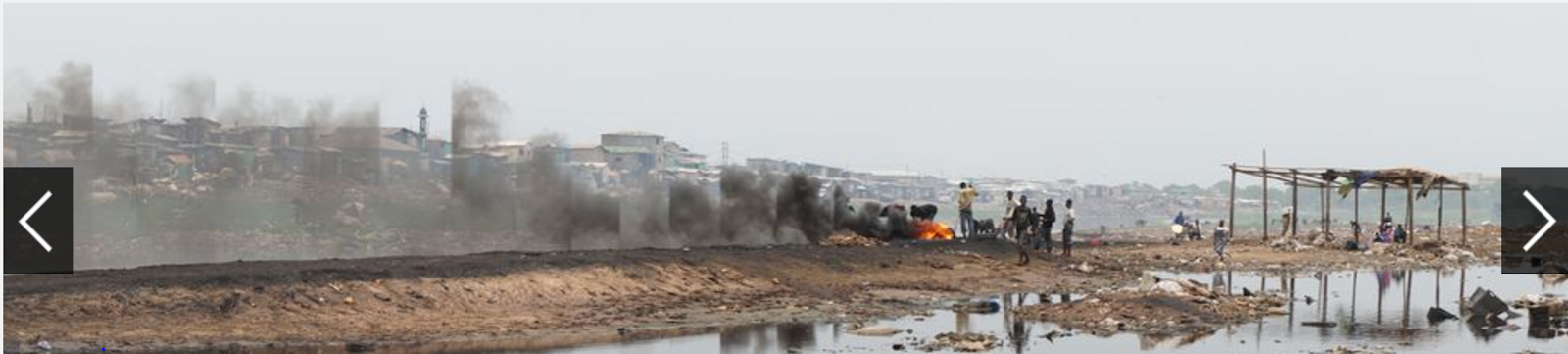
Landscape shot of the small small site at Agbogbloshie where close ups of kids perched on monitor casings takes place
I offered to do a presentation on how incredibly small and insignificant our topic is.  How bland, how navel gazing our concerns are from the perspective of the slum dwellers we wring hands and handkerchiefs about.  The background of the landscape photo I took shows the Old Fadama slum in central Accra.  The dump is across the lagoon.  And the most photographed, if not the largest, ewaste dump on earth is there in the center, on this side of the lagoon.

No kidding, folks. This is it for wire burning. I got photos of photographers on that tiny, barren spot, posing young slum ruffians on top of some of the few dozen devices found scattered on the lagoon bank.   See the "close up" of the same site at bottom... same tent in the background.

Above is another (landscape) view of this exact site and the 25 people burning wires there. Note tent behind girl

Collateral Damage 2: Emerging Markets "Informal" Sector Takes sCrap from Shiny Consciences

Collateral Damage 2. Small scale (Informal) repair and recycling of home generated scrap

Several NGOs made "informal sector" a bad word.  Search "e-waste" and "informal" online, and you find that it's a polite word for a lot of pictures of brown people earning a living the way white boy scouts earn medals - by protecting the environment, adding value, and supporting a circular economy.

Infamous example?  How about the COVER photo from the 2015 UNEP Report.  What exactly do you see here?  A lot of people have been hypnotized to see something nefarious going on.  

This is what I saw happening when I visited Chinese buyers more than a decade ago.  It was informal. But it was also sustainable.  The environmental harm of producing chips from mining, refining, smelting, and manufacturing created small integrated circuits worth more than the gold they held in them.  If it was about the gold, the refiners in Japan and Belgium would have no competition here.  What I saw the Asians doing was memorizing each chip and sorting them, painstakingly, according to their reuse value.  


.

If my children were born in a poor rice paddy village, and they learned to do this, creating thousands of dollars in secondary market value, I'd be proud.  It would remind me of how my Ozark family went from subsistence farming, no running water, no electricity and no paved roads, to OECD status in two generations.  And no thank you, it wasn't from big city charities.

Fixers do "git er done" in every culture, and often become the founders of the world's most successful enterprises.  They see stuff for what it can do, not for what it cannot do.  They find treasure where others saw trash.

The "informal" market in Asia, Africa and South America isn't perfect, but if you want proof of racism look at the cover photo of the UNEP article and ask how something which reduces carbon, creates wealth, and is a less toxic process than European refining gets elevated to poster child.

Another Study Reveals Africa's Tech Sector knows its STUFF (#ewastehoax)

The new 2016 Report, published by United Nations University, is 39 pages.  What is remarkable about it is not only that it arrives at almost exactly the same "ewaste" percentages as documented by academics (like Josh Lepawsky of Memorial University, who was savagely mud-slung by a certain NGO director in Seattle last month).  The #ewastehoax around places like Agbogbloshie has been roundly covered by several academics, Basel Secreteriat (the ACTUAL international organization, not the USA charity using its name), and data journalists.

Again, disclaimer - poverty in Africa isn't fake. Toxics in Africa aren't fake.  What was faked was the narrative that EU and USA recycling programs dump waste and are responsible for the poverty or toxics.


What's remarkable about the UNU study is two things.  First, it uses completely different data sets from MIT, Memorial U, US ITC, and data journalism by #ewasterepublic Jacopo Ottaviana, etc... but arrives at the same conclusions.  For example, the chart below shows that less than 1% of Europe's used electronics are exported intact .
Very, very little of Europe's e-waste gets exported intact.  In fact, I interpret the data to say that Europe is being waaay too conservative - the percentages of working and non-obsolete goods is way higher than what is being sent overseas.

And very, very little of the junk in Africa's junkyards (like Agbogbloshie) came directly.  More than 95% of Africa's "ewaste" is its own, devices imported decades ago, used productively for years.
Some individual countries, they say, have higher or lower incidents of transboundary movement which is junk... but that begs the question... if it's an individual country like Burkina Faso, they are getting used electronics from wealthy cities like Accra.  As Lepawsky and Mather already documented, there are used goods traded WITHIN the global "south".

These screenshots shows exactly what I've been telling UNU and StEP since New Orleans in 2006.  The "Stuff" in the "Story of Stuff" gets used for YEARS and is EVENTUALLY discarded and recycled.   What's the first intact piece we photographed in Agbogbloshie?  It was a scrapper's VCR device that Adam Minter and Isaaco Chiaf and Jacopo Ottaviana (#ewasterepublic) stooped to photograph.  Africans imported millions and millions of used VHS players - IN THE 1980s and 1990s!  In Joe Benson's itemized packing lists, there isn't a single VHS player.  BECAUSE AFRICANS NOW WATCH DVD and STREAMING and soon, digital TV broadcasts.  The latter will generate exactly what it did in the USA - waste analog CRTs.  But those aren't being imported anymore to places like TEMA which have already switched to digital.

Golly gee, Colonialists, the evidence is that Africa's Tech Sector knows it's STUFF.

What Joseph Benson said on camera was the truth.  What Mike Anane said on camera was a lie.  Africa's Tech Sector needs reparations.

African "E-waste" Witch Hunt Continues: Part 2


I have the account of Mark Daniels.  I have the account of Joe Benson.  I'm looking for Ezenwa Ogbonnaya and M2 Ventures Limited ...  That will make 3 UK electronics recycling companies who were tried in the press.

Daniels Recycling prosecuted for African WEEE export


In Part 1, as well as the "Sodom and Gomorrah" blog, we traced the outrage and arrests back to two men, Jim Puckett and Mike Anane.

  • That Agbogbloshie was a very large e-waste dump... perhaps "biggest in the world"
  • That the Odaw River was a pristine, green African "Eden" just a decade ago, "teeming with fish"
  • That the lead in the soil at the dump does not come from automobiles, but from dumped electronics
  • That 80% of the electronics shipped to Ghana are "junk" and the other 20% "fail after between 2 and 6 months"
  • That most of the work done at Agbogbloshie is by children, orphans, under age 18
  • That the majority of workers at AGbogbloshie die of cancer in 2 years.


Well, well, well... this is the information that was recited by Anane and Puckett at an Interpol meeting I attended at EPA offices in Arlington VA in March 2010.   Puckett and Anane were introduced by the UK's Environmental Agency head, Lord Chris Smith.   

These horrible "e-waste facts" were also recited to Raphael Rowe of BBC in "Panorama".

If half of the "e-waste facts" were half true, it would indeed be understandable that the Environmental Agency prosecuted Joe Benson, Mark Daniels, and Ezenwa Ogbonnaya for dumping - or rather selling - used electronics to Africa's Tech Sector.

But the accusers, the prosecutors, never met anyone in Africa's Tech Sector, did they?

Summary Quote from Africa EWaste Report at Agbogbloshie: #freejoebenson

The report from Fair Trade Recycling's visit to Agbogbloshie, Ghana, is nearing completion (60 pages).  Final draft abstract below.


"There is no evidence that Europe’s WEEE testing measures reduce the spoilage or benefit Africa, or that they are based on knowledge of supply and demand in the African market. Evidence supported some Africans’ speculations that those profiling Agbogbloshie as a significant story (reporters, policy makers, anti-gray-market manufacturers, shredding companies, metals recyclers, environmentalists, photojournalists) personally benefit from false or exaggerated portrayals. The report recommends incorporating Africa’s Tech Sector in managing Africa’s growing scrap generation, rather than impugning it.  The burden of proof on allegations of shipping junk should be born by the accusers who benefit from the reduction in trade."

By taking extra months to finish the report, I could find more secondary resources outside the "waste" world -  e.g. Odaw River sample data from the 1980s, rate of TV imports in the 80s and 90s, urban development reports, World Bank Data, etc.

This will be the worst single embarrassment to our environmentalist community if we don't get out in front of it, apologize for our implicit racism in profiling Africa's Tech Sector, and call off the dogs.  I'm serious, people.  I don't want this to come out in Rush radio.   We need to deal with this and stop this McCarthy tactics by certain ENGOs.  We were not immune from implicit racial profiling, and we need to show the guts to admit it and get in front of this story now.

FREE JOE "HURRICANE" BENSON.  Sign the petition to the top right of this blog.

Before you assume an old computer that you expected at your waste shredder was purchased and shippped by Africans as junk, look in this pile. Until we count them here, the "export percentage numbers" are just speculation.

Embedded image permalink

Breakup of Europe's E-Waste Armada? EU WEEE Agenda Shift

Accusations of Denial, Hoax, and Racism Haunt Agbogbloshie Ghana

Our expectations couldn't be very high.  But whether because of our pressure, or despite it, Europe has blinked.  Bullied for years by Basel Action Network to implement the "Ban Amendment", Europe had shown a pattern of stimulus-response which I had failed to note ten years ago.  So WR3A got less diplomatic in our language, to match the "ghoulish witchy skeleton toxic" language of Basel Action Network and Greenpeace.  Where they claimed "Stewardship" we called out "Africa Boycott".  Where the NGO's called out "waste tourists" we gave voice to "geeks of color".

"Most of the illegal e-waste trade is taking place next door rather than far away in Africa," said Jaco Huisman of the United Nations University, scientific coordinator of the project that included police agency INTERPOL and other partners.
Come again?

That's right.  Europe finally got a clue this summer.  It took awhile, but the Dennis Moore analogy holds.  This redistribution of environmental costs was trickier than thought.

Amazing grace.

European Environmental Advocates really must be "word war weary" at this stage.  Poor Pascal LeRoy and David Higgins couldn't help but bristle at being named personally in blogs to account for the environmental malpractice of the WEEE Guidelines, as implemented.  Basel Action Network is known for developing "tests" which appear to allow trade - like allowing laptops with batteries that show 80% of original charge - a charge gone on many laptops after a few weeks.  Or like allowing SKD factories to buy "fully functional" CRTs with parts removed.  The proof in the pudding was that exactly 0% of their E-Stewards would export a CRT monitor, they were all pounded into toxic rubble following the breakdown of the California Compromise.  But the point of sharing these technical anecdotes is to show the level of obfuscation faced by UNU, UNEP, PACE, StEP and other Euro Acronym Agencies in the Puckett Armada.

They believed the lead ship knew where it was going.  But after 10 years, short of supplies and weary of the "collateral damage" of Africa's Tech Sector, Europe today has blinked.

Amazing grace, how sweet the sound.


(Soweto South Africa choir)

Recommendations to CWIT, INTERPOL on WEEE EWaste Project

delivered by Twitter, Linkedin, and Blogspot


June 25, 2015

David Higgins
Pascal LeRoy


Dear Pascal and David,

Thank you for Pascal's response to our initial draft of comments for the CWIT meeting in Lyon in June.   In addition to presenting more factual numbers, it is important that the CWIT group focus on percentages, not tons.

Ghana's secondhand imports, estimated at 215,000 tons, includes approximately 21,000 tons not reused. That's a real problem, but smaller than the generation of once-reused, now discarded electronics (and cars, and other machines) as cities like Accra modernize.  The generation predicted by World Bank and other sources will require in-country solutions, much greater than "informal" scrapyards (like Agbogbloshie) can offer. 


The ratio of fallout from secondhand electronics imports is similar to clothing, new electronics, automobiles, cell phones, broadcasting equipment.  No import container is perfect.  Shipping damage, human error, demand forecast changes, electrostatic discharge, and other fallout cannot be termed "illegal waste transport" without impacting all development. Criminal enforcement should be directed at goods (such as ivory) which is 100% illegal.

We recommend Interpol and CWIT start discussing acceptable "de minimus" quantities, and whether the testing Guidelines (used in prosecutions) is a good predictor of percentages.  And please, incorporate discussions with Africa's Tech Sector.  They are the ones who send contacts to Europe to source proper reuse equipment, they are the ones who pay for the equipment, they are the ones who have created double and triple-digit teledensity growth for Africans this decade.  Their supply to the "good enough" market creates the critical mass of users which makes paving roads, laying internet cable, erecting cell phone towers, etc., economically feasible.


We can introduce you to several speakers, or university research departments, who know these technicians, who would have been a valuable addition to your list of experts.  Here are some articles written by westerners who accepted this invitation, and met with these champions of the Emerging Market.  Fair Trade Recycling (tm) goal is to engage these technicians in managing the takeback of used electronics, and pay for their proper recycling by donating MORE used equipment at lower prices, rather than by driving up price and lowering demand in the current "Prohibition" enforcement model.


I will be arriving in Lyon (previously scheduled business) on July 1, if anyone from Interpol is interested in meeting to discuss a more progressive agenda to the media-driven "export crisis". In the meantime, here are some articles we recommend for distribution to your guests and attendees.


Sincerely,

- Robin Ingenthron, WR3A.org 


PS.  The illegal goods reported in Ghana were refrigerators which work, and which are eligible for a subsidized program to replace them with energy efficient models.   Stating that 1/3 of inspections found illegal goods should differentiate between the energy efficiency ban (not widely understood by importers) and illegal dumping.

6 Observations: UNEP Report Earns "F" on #E-waste


Illegally Traded and Dumped E-Waste Worth up to $19 Billion Annually Poses Risks to Health, Deprives Countries of Resources says UN Report


"a rapid response assessment"


“Inconsistency in Cross-Border Regulations Challenge to Effective Control of Illegal Waste Trafficking”.  This is the sub-headline of the United Nations Environmental Programme’s May 12, 2016, press release.  The headline of the report states the trade is worth $19 billion, poses risks to health, and deprives countries (European countries) of resources.  

Say this slowly. Inconsistency in regulations... between countries... is a challenge to arresting people... for illegal activity... because it's not illegal.... in the other country? And therefore (by not making second hand goods illegal), the second country is "depriving (Europe) of resources?"

Four "e-waste experts" are on the team of 16 authors. I've highlighted their names at the bottom.

We counted 43 photos in the report, eight of which are taken at Accra scrapyard Agbogbloshie.

And the adjectives..."primitive", "informal", "deplorable"...

These are the insults slung at the geeks of color, the workers in Africa's tech sector and manual disassembly operations. Perhaps, the authors "assessed" and "responded" too "rapidly". My own report has been slowed down, in contrast. I planned 10 pages, but was dealt with two curve balls on my return to the USA. First, Interpol announced a big EWaste (CWIT) meeting in Lyon, France - where I already have a ticket (was going to be there anyway). The CWIT features another 2010 performance by Jim Puckett and Mike Anane.

How about this for a response? READ YOUR OWN DARN REPORT NUMBERS!!!

Doubt I have ever seen such an incompetently written press release. To rebut the UNEP's headline, look at the report's own figures. It appears the authors were so excited by the prospect of more funding that they looked only at the black children posed on obscure lonely pieces of Ghana generated e-waste (imported 20 years earlier, now discarded), and didn't study the numbers in the report itself. THE REPORT DISPROVES ITS OWN HEADLINE. If that's not a key indicator of Racial Profiling, I'm not sure what's a better one.

The UNEP Report announced that ten European Countries in 2012 (year of the E-Waste Country Assessments in Nigeria and Ghana, finding 85%-91% reuse) shipped 2,929 tonnes of "e-waste" (or reuse, the report doesn't specify) to five countries - 4 in West Africa plus Pakistan. Ghana is profiled as the biggest target, and eight photos of Agbogbloshie illustrate the case.

Spoiler - our analysis was that Agbogbloshie manages (outside of cars and white goods) about 910,000 POUNDS (not tons) of electronics scrap, delivered by hand cart from street collectors in Accra. This week Scrap Magazine (p.78) publishes an article by Adam Minter (Junkyard Planet author), who we met in Agbogbloshie. The cover page photo shows how most of the material is delivered.

See below left. By hand cart. Pickup trucks on occasion. Zero sea containers. But access roads into Agbogbloshie and outgoing wire, plastic, and circuit board (bottleneck) weights support the estimates of the workers there. Agbogbloshie manages between 20-50 pieces (TVs, VCRs, computers) per day. The pieces on the ground in the UNEP (Kevin McElvaney) photos look like they've been there a long time. And they have been.

About 910,000 pounds per year. Disassembled by hand, delivered by hand cart.


Now look at the UNEP Report figures, configured below.

Convert 2,929 million tonnes (metric) to pounds (x 2200) = 6,443,800,000 lbs. Six billion per year, from ten countries - not including the USA or Asia - of "e-waste". Divide 910k by 6,443,800k.
One of the five largest destinations handles about one fiftieth of one percent. 

Two conclusions are possible... if one assumes 100% of the material at Agbogbloshie is imported from Europe, and none of it was used for decades in Accra (which had tens of thousands of households with TV in the 1990s), then:
  1. Although Agbogbloshie is on the top 5 destinations list, it manages only about 2 percent of ONE percent (0.0002) of Europe's "ewaste".
  2. UNEP and Interpol are using Secondary Market (non-scrap, reuse) numbers in their "e-waste dumping" statistic.
Of course, if at least half of Agbogbloshie's volume was domestically generated, and the imports are one percent of one percent, the UNEP Report (shockingly) tries to explain that...

If the latter, the $19B suddenly becomes confusing if not meaningless. Africans buying used laptops on ebay is certainly legal... and Ebay has annouonced a $195 billion dollar market selling to emerging markets. Who knows what percentage of $195b is used electronics. But if it's 10%, then UNEP's $19B number looks low.

Below is an analysis of the UNEP Report which I've had to cut from my report (in order to respect my page limit).  It begins with UNEP making the massive case for millions of tons, then shows how Interpol's seizures only implicate 2-3 times the 9-15% waste estimate of the E-Waste Assessment studies.   Interpol accuses one third of the shipments of containing some waste.

It covers 6 observations about the report, Debate Team style.

OBSERVATION NUMBER ONE: One Third does not equal 90%
The report's own numbers disprove the 90% allegation.
"There were also checks in Ghana, Guinea, and Nigeria in Africa, a region considered to be a destination for this waste. Almost one-third of the checks resulted in the discovery of illegal electronic waste.”*
We found most of these to be electric, not electronic waste.  White goods being reused, illegal due to Ghana appliance refund-takeback program - which targeted WORKING fridges (because they were older and used more of Ghana's scarce electricity).  In any case this "discovery" is legally an allegation at this point.  And most importantly, how the heck do they explain the "90%" illegal headline if 2/3 of the cases against suspect containers are dismissed??? Finally, if you "discovered" some in 1/3 of the containers, how much of those containers was allegedly illegal?  If 50% of "almost one third"... we have verification of the Ghana E-Waste Assessment Study (15%), don't we?
One third contained "illegal" imported EEE. Not WEEE (unless W stands for "Working")
Our interviews with custom officials in Tema indicate that seizure of working but eligible-for-rebate refrigerators were the only items declared illegal at the Tema port courtyard.


OBSERVATION NUMBER TWO:  Prima Facia Evidence of Legal Incompetence.
The report's claimed 'cause' of illegal transport is disagreement over illegality.
“Identifying and classifying electronic and electrical equipment as waste may be challenging. One could argue that used or discarded equipment could still be of value to others and therefore should not be considered waste. However, the life span of second-hand goods is very short, and within a couple of years it becomes discarded waste. " 
Nuff said.  They are frustrated that it's legal. See #1 above. Also, brand new devices fail the same test (more often, according to African technicians).  Is this what "Project Eden" means, reversing Africa's teledensity? And on what is the objective evidence of "a couple of years"?  BAN claimed they were discarded "within days". BAN made up the 80% figure. What does UNEP ("90%", "couple of years") have in common with BAN? Fundraising is easier when numbers are more salacious.

OBSERVATION NUMBER THREE:  Theory of "Drivers" is Disproven by Evidence
The report's theory of causes of trade is disproved by the report.
“The main drivers of the trade in hazardous waste appear to be the high costs of proper treatment and the opportunities for illegal actors to operate in a market with relatively low risks and high financial benefit. In addition, low shipping costs and demand for certain types of used goods and constituents in some countries can be a driver for the illegal export of waste to developing countries (Bisschop 2012)." 
Ahh.  Appear to be... to you?  But the 5 countries shown on the chart have the highest shipping costs on the planet.  The low shipping cost (cited) was for China.  USA-Ghana is about $7,000 or $14 per CRT.  And the scrap value for the CRT is only $2, so the "demand for certain types of used goods" (and not others) is explained only by reuse.  "Appear to be" is in the eye of the group seeking funding for more studies... it appears to ME to be racial profiling.

OBSERVATION NUMBER FOUR: Evidence of Value is NOT Evidence of Waste.
Payment for goods shown in report is not evidence of "waste" or "illegality".
"The owner/producer of the waste can pay a waste broker to take the waste off his hands for further recycling. Waste brokers maximize their profit through getting paid first by the player disposing of the waste and second by the player who buys it as a reusable commodity. "
First, no one pays the "waste brokers" who ship to Africa (if they do, it probably really IS waste, like Trafigura, and UNEP should focus and enforce there!). Second, if it only works because it's a "reusable commodity"... See #1, and subtitle. Frustrating that you cannot enforce against the "wastecrime" because of that stubborn "reuse innocence" thing.

OBSERVATION NUMBER FIVE: Only Conviction Doesn't Fit Theory
Conviction example (Benson) undermines case, demonstrates Observations 1-4
"Investigators found the defendant had been collecting e-waste from a number of council-run sites in the London area and taking it to his licensed waste premises. Instead of processing the e-waste properly, he sold and loaded four containers of items – including cathode ray TVs and fridge freezers with ozone depleting substances– to brokers and shipping firms who then exported the waste to West Africa. He loaded items at the front of the containers that appeared to have been tested properly for functionality and even put “testing labels” on them."
We have 100+ pages of documented evidence in the case, none shows freon appliances in Benson's containers and he denies being in that business and there are none in the photos.  His company license was a REUSE license, not a "waste processing license".  But that's all secondary evidence, the point here is that it doesn't fit any of the theories presented in this UNEP report.  Shipping costs were high, cost for Benson to return items (which he documented doing, after failed testing) was $0 at the council-run sites.  And repair is legal, a "cut cord" (cited as evidence of not being tested) is a simple repair, a most obvious "for repair" case under Annex IX Basel Convention.  Benson would lose money on the bad ones, which he could recycle in the UK for free.


OBSERVATION NUMBER SIX: No habeus corpus.
See math. If Ghana is at top of 5 country list, and Agbogbloshie is the largest site in Ghana, hand carts and tire fires cannot possibly manage millions or hundreds of thousands or tens of thousands - or even 1% - of tons claimed in the report.

Larger diagram below
Number Five is Fair Trade Recycling's "Hurricane Benson".   Their star example, Joe Benson of BJ Electronics, as being the kingpin, the example of the bad dealer, and proudly trumpets his 16 month prison sentence... 

But all the math in their own report indicates there is no Benson material dumped at Agbogbloshie.  Tying black Benson, a TV repairman, to black Rachid, Awal, and Razak (my new chums in Agbogbloshie) is racial profiling - you may as well tie him to Kofi Anan or Nelson Mandela or Hurricane Carter or Joe Johnson (the boxer).

Joe Benson may not be perfect, I've met him only after his indictment, and have never traded with him.  But I have seen the "evidence" against him, and it's based on the same bad math as riddles this UNEP Report, making Joe Benson the most important example of legal abuse.  

  • Only reuse explains African incentives.
  • Only reuse explains African growth in teledensity.
  • Only reuse explains the $19B dollars cited.
  • Only reuse explains the costs paid to load, ship, and unload the electronics.

The authors of these reports have jobs to "solve" #ewaste, and the conclusions between the lines of their reports are that they need more resources, to arrest more #freejoebensons.  This is #whitesaviorcomplex at best, and #parasitesofthepoor or #charityindustrialcomplex at its worst.

So we meet, head to head.  Sixteen paid UNEP experts, armed with professional photography, vs. one lonely blogger.  

ENVIRONMENTAL MALPRACTICE AND FALSE PROSECUTION.
INJUSTICE AND RACISM AND PROTECTIONISM OF EU SHREDDING INTERESTS.
THIS IS A SCANDAL.  THIS IS #EWASTEGATE.

Academic peer review is occurring (Josh Goldstein and Josh Lepawsky are separately reviewing the UNEP Report), reporters like Adam Minter are taking the time to examine the case, Africans like Wahab Odoi Muhammed and Emmanuel Nyaletey are coming forward, and other photojournalists, less driven by "poverty porn" (like Heather Agyepong) are finding out about the Ewaste Hoax on their own.

Below is the rough analysis of the UNEP Report cut from my own Agbobloshie Report, which has larger paragraphs for better context of the quotes above (I have footnotes as well).  But it's almost 9 AM and I have a recycling factory to run... a plant which manually disassembles most of the electronics, because no one would want them or would want to pay to ship them to Africa.  Everyone in our business knows that.  Everyone in EScrap knows this is a hoax, that there are no Africans buying thousands of containers of packed junk.

Africa's best and brightest, the Tech Sector which brought double-digit and triple-digit teledensity growth to the "dark continent", year upon year.   The Tinkerer's Blessing is the opposite of the curse of natural resources.  We have met the enemy, and he is us.