Showing posts with label journalism. Show all posts

NYT "Recycling Lead for U.S. Car Batteries Is Poisoning People" Stretches the Truth Farther than it Should

From New York Times reporters By Peter S. GoodmanWill Fitzgibbon and Samuel Granados

Following the tradition of Upton Sinclair's 1906 classic gotcha expose "The Jungle", Goodman, Fitzgibbon, and Granados have found a very legitimate way to make environmentalists feel bad about recycled content in auto batteries.

Recycling Lead for U.S. Car Batteries Is Poisoning People

It's much easier for reporters to visit lead recycling operations than it is to visit the only alternative to recycled content lead batteries - which is lead batteries made from mining lead ore and smelting it in a huge primary lead smelter.  The lead in an old car battery is 100% lead. The lead in virgin lead-zinc ore mined from mountains ranges from less than one percent to eight percent lead content.

Consequently (math!) primary lead smelters are about 25% larger / more active than secondary, or recycled, lead smelters. But the production of lead from virgin mining operations - like Perkoa in Burkina Faso, Africa - is really hard to get to, hard to photograph, and stays quiet, not claiming any environmental advantage. 


So if the story was about nutrition, Goodman, Fizgibbon and Granados would be reporting on urban food coops,  not on cannabilism, because it's going to grab the attention of NYTimes readers. That's very typical of journalism, and it has a value in forcing improvement at recycling facilities and urban food cooperatives. We appreciate criticism and the opportunity to improve.

But when not a word or sentence anywhere about the difference between mining and recycling lead acid batteries. Therefore, it is criminally negligent in context.

FACT:  United States Geological Survey (USGS) estimates 73% of USA auto batteries are recycled content rather than mined content.

Recycling: In 2019, about 1.2 million tons of secondary lead was produced, an amount equivalent to 73% of apparent domestic consumption. Nearly all secondary lead was recovered from old scrap, mostly lead-acid batteries. Import Sources (2015–18): Refined metal: Canada, 44%; Mexico, 18%; Republic of Korea, 17%; India, 5%; and other, 16%.

https://pubs.usgs.gov/periodicals/mcs2020/mcs2020-lead.pdf

That's a lot of content right there in that paragraph.  It leaves a lot of mental gymnastics to do to tie automobile scrap generated in Africa, removed in African scrap markets, smelted in African secondary smelters, and sold on the London Metals Exchange as metal, to responsibility to USA car manufacturers.  #DataJournalism called, they want their focus back.

A Modest Hypothesis: Did Guiyu and Agbogbloshie Make the River Cleaner?


A professor visiting China emailed me this morning and jokingly asked what he should look for in Guiyu or Wuhan in his spare time.

Sometimes a pithy email response makes the best blog fodder. My response:

You don't need to really go to Guiyu or Agbogbloshie if you have Google maps. Just find press coverage of Basel Action Network or Blacksmith Institute's toxic River sample. Then identify the river and find a site a few kilometers upstream and then Google search for contaminated water samples upstream.  

Based on that evidence, Guiyu and Agbogbloshie are making the river cleaner (though of course that is because the samples upstream were taken years earlier when it was even worse).

Science!!!

I'm referring of course to the Guiyu river samples from the largest textile factory hub on earth, upstream from Guiyu, whose water samples are nearly identical to the Bangladesh Lourajong River samples downstream from the Bangladesh second-largest textile manufacturing hub on earth.  Surprise, Guiyu's samples look the same as the river samples of the textile effluent samples upstream from Guiyu.  

Third Dimensional Silo Environmentalism

Photo of plastic recycling in Tamale Ghana

Plastic is the villain of the mainstream environmental coverage these days. 

To be sure, there are lots of undesirable and unsustainable things about plastic.  But I'm concerned that the attacks are coming out of environmental silos. In the same way I was labelled an "apologist" of used electronics purchases by emerging markets 15 years ago, I've been called an "iconoclast" for even questioning sanctions on plastic packaging, such as the Vermont ban on plastic straws and single use bags. 

Our seeding of the plastic litter offset in Cameroun should demonstrate we are serious about the threat of ocean plastic. But it also shows we are looking for ways to defend the packaging from unfair threats and scapegoatism, without sliding into denial.

https://www.oregon.gov/deq/FilterDocs/MaterialAttributes.pdf

If you never read another one of my blogs, read the Oregon Packaging Paper from 2018. Then visit US Geological Survey USGS.gov every time a recycling story hits the press.

Reporters like Adam Minter, Oliver Wallis-Franklin, and  Laura SullivanEmily KwongRebecca Ramirez (of NPR "The Myth of Plastic Recycling") should start with the link above.  It's not all about recycling.

For decades I've described the perfect packaging from a waste silo perspective - organic, reusable, natural and compostable, native American / First Nation adapted... Baby seal pelt bags.


Life Cycle Analysis should keep score of the environmental harm implicated in microplastics, ocean litter, recyclability and recycled content. In all of these, plastic fares poorly. But the camera lenses always focus on the fingerprint, the downstream, the gotcha. It's called fetishism, and it is blind to the role of the total path of consumption

Plastics Recycling's Burdensome New "Narrative"

A friend from Carleton College, physican, philosopher, professor and author Peter Ubel, nominated me on Facebook to comment on a new Frontline and NPR series:


The headline implies that plastic never would be recycled.  I've seen some other reporting to this effect, harkening back to the Penn and Teller video "Recycling is Bull***t".

How about:

"Some in Big Oil Misled the Public Into Believing More Plastic Would Be Recycled Than Could Be"

The thing is, plastics recycling is not all that complicated to explain, compared to say health care policy. 


"Part of the problem with mixed plastics recycling is insufficient participation. Manufacturers cannot meet % recycled content goals if consumers don't participate. "Another is over-participation. When in doubt, leave it out. Over-eager recyclers contaminate feedstock with mayo. "

Not really that political.

Certification and Racketeering: Part 1 Ahmed Hussein Suale RIP

International Crime does take place.

"Racketeers offer a deceitful service to fix a problem that otherwise wouldn't exist."
Let that definition sink in.

"On 16 January, Ahmed Hussein-Suale, a Ghanaian investigative journalist who had collaborated with the BBC, was shot dead near his family home in Accra. Ghanaian police believe he was assassinated because of his work." - BBC

His work exposed bad calls from African referees, paid bribes to control the outcome of soccer matches. It's a textbook racketeering case, with a deceitful service (bad calls) sold to change the play that had occured on the field. People were convicted, resigned, or fired as the truth spread. And Africans who had watched the matches on TV and seen the bad calls with their own eyes, grew to esteem the Tiger Eye Team of Hussein-Suale and Anas Aremeya Anas.

Cross Cultural Training in Ewaste #2: IRS FORM 13909

Two NGOs take opposing positions on trade w/ "Third world" aka "emerging markets". What's Tech? What's Scrap? Who decides? Which is a "watchdog"? Which is registered as a "charity"? Who beats up other non-profits?


Ten years ago, the mission of WR3A.org dba Fair Trade Recycling was to vet exporters. And by that we meant to identify USA companies it was safe to export FROM, and not foreign companies it was safe to export TO.

To me, it's an amazingly simple explanation, but it takes weeks sometimes to get it through to journalists and documentary makers.

If you begin with the assumption that the Tech Sector in an emerging market enlists the very best and brightest, the valedictorians, and assume they are flying to purchase something from the Scrap Sector in the wealthy nation - as I did - then the purpose of a civil contract between the two parties is to increase efficient and fair trade.

Earlier this decade [post WR3A California Compromise] we realized that before we could broker loads, we had to first serve the Tech Sector by advocating on their behalf against a very strongly funded defamation campaign. To complicate matters, that campaign was being promoted by "the Left", people who were quite self-certain that they didn't have a single racist idea in their minds.  People who championed "environmental justice" were in fact committing "environmental malpractice", but that was a hard message to deliver.


If I can't fundraise to pay the WR3A credit card bills, maybe we can do the next best thing and "level the playing field". Basel Action Network is registered as a 501-c(3) charity - an organization that attests it does not advocate for legislation, does not perform work to benefit any private business or organization, and provides charitable services.  If reporters are looking for a story, we got another one for you....


Cross Cultural Training Program for Ewaste Shockumentary Makers 1

This week I spent another several hours in a pre-interview for a German documentary crew from ZDF. They had seen Blame Game or seen the blog, and said that they were reaching out to see if we can get them interviews with Africans in the Tech Sector --- "At Agbogbloshie".

spend more time at the beach guys
They are attending something called the Digital Conference Republica [technovagh blog by
Joseph-Albert Kuuire], a German conference established 2013 on the subject using online information to solve global problems, to be held in Accra for the first time.

Obviously these dudes mean well. But finding a repair tech "At Agbogbloshie" is a bit like finding a mechanic at your local scrap metal yard. They are associating the original stubborn idea that imports arrive directly at Agbogbloshie (thanks to Jim Puckett and Mike Anane) with the message that Africans import what they can repair.

So in my next blog, I'm going to share some of the training and background information which we tried to impart to Alexander Glodsinksi of SDF, in a crash course via Whatsapp, with Emmanuel Nyalete, Evans Quaye, Wahab Odoi, and Olu Orga.  After the "text training", Evans suggested we put it up on a website devoted to Africa's Tech Sector. Let's start here.


Reversing ER#3: J-School Background Checks on E-Waste - Benson Released, Rowe Fired?


Here's an interesting statistic on "e-waste" (like most, made up on the spot).  Four out of five journalists who contact me beforehand decide not to run the story on "e-waste" at all.

Reporters are initially attracted to the Basel Action Network's press release or photo opportunity (exotic brown child perched on familiar looking old electronics).  That BAN press release has, for 15 years, triggered interest in reporters and college researchers. An easy story to write, as BAN served "facts" up on a platter.

But Jim Puckett is no Upton Sinclair. He wrote about Agbogbloshie in chilling text - before admitting to me he had never been there at all. He had never even read a peer reviewed article.

The "ewastehoax" says junk in cities across the globe is the fault of "sham recyclers"... if only we use a USA recycling company that pays dividends to Jim Puckett, we will quickly clean these places up.

The Ewastehoax promises a moral lesson of "environmental injustice", and triggers three Steven Pinker-esque cognitive biases:

1. Nurture. We actually care about the poor child.
2. Greed. We suspect someone else's actions were driven by it.
3. Fear.  We are afraid of our own liability for our "stuff".

It's an easy recipe.  BAN isn't the only organization to use it. Annie Leonard, Blacksmith Institute, StEP, R2 (SERI), E-Stewards, CBS 60 Minutes, The Guardian, etc. all followed the trail on these instincts.

If you are a good photographer, that is all you need to put some guy like Joseph "Hurricane" Benson of BJ Electronics behind prison bars.  You can be the reporter that made him sell his house, that cost him his business and his retirement.


You are so cool.  You no doubt picked up all kinds of dates interested in your brave reporting.  Did you tell them about Joe Benson, the Nigerian TV repairman who shipped a TV with a GPS tracker to Ghana? Did you describe the satisfaction of Benson going to jail, like Raphael Rowe of BBC's Panorama did?

Oh, wait.  News flash.  Raphael Rowe got fired? (According to this article, "Pushed Out", but there's still some uncertainty as I research this, he's still on BBC 2 local).  And Interpol has pulled the plug on Project Eden.  All since Fair Trade Recycling's 2015 trip to Agbogbloshie, where we saw a city slum near a dump full of tires, cars, and junk appliances - all once owned by Africans, from a thriving city of millions of consumers.  Even the dozens (not thousands) of (adult) orphans there all carry cell phones, and can send photos of where they collected the scrap... at Accra homes and businesses, which had millions of TVs in the mid 1990s.


Benson may have the last laugh on Raphael Rowe. Though he has suffered, journalism students once attracted to "environmental justice" stories are increasingly documenting "environmental malpractice", "friendly fire", and "collateral damage" to Africa's Tech Sector.

Whether or not Raphael Rowe stays on at BBC, he's still know for having been racially profiled.  As will be Joseph "Hurricane" Benson.  As Rowe said in an interview "bitterness never leaves you".


Euro Agbo Photo Journos Redux 1: The Butterfly and the Whale (enacted by 2 roosters)

With the help of Ghana Tech Wahab Odoi, and the miracles of the internet, I have managed to put together a lot of the pieces behind the strange alt-coinish entry by the  band Placebo.  Their MTV video's use of Agbogbloshie as a backdrop for "Life is What You Make It" debuted during the middle of this blog's series on Euro Agbo Porno Photo Journos.

As far as making friends with people you run into in strange places - well, chalk this chicken fight up to unfortunate timing.

I was in the middle of a "photo journo flog" series.  And Sasha Rainbow was thrilled with what seems her studio's most prestigious work to date. And the band and Placebo fans were unprepared to play a part in an environmental lesson plan.  What does work for photography often does not work as journalism?... um no it's about the music dude.

Artists look for simplicity - a simple, powerful photo can tell a thousand words. But those words may be false, and quite easily proffer mere racial profiling.  I brought their video into the "Free Joe Hurricane Benson" debate, and they seem angry and perturbed.  Easier to describe me as a trollish brute than to entertain the possibility that their depiction of poverty was bleeding with collateral damage, and wrapped in #ewaste activist folly.

How did we meet in this place?  All of us? How does Awal, Yahroo or Razak wind up with a Whatsapp treasuretrove of white contacts from UK, USA, Spain, etc?  Since just the last month, I've been sent photos and been handed by phone to speak directly to five "freelance documentary makers".  It's a land rush... but they don't know what kind.

Q-Methodology And Fair Trade Recycling Negotiation - The News


Many readers already know about the E-waste research project, funded by a $469k grant secured by Dr. Josh Lepawsky at Memorial University, Newfoundland.  The project involves research in five countries - Mexico, Peru, Bangladesh, and China. I'm kind of doing Ghana on my own, as is Grace Akese of Memorial U, so I include it even though it's not part of the research funding.

We introduced Lepawsky to Josh Goldstein, a Ph.D. in Chinese History at USC, and Dr. Ramzy Kahhat of Pontifica Universidad Catholica Peru (PUCP).  Lepawsky and some grad students recently completed their first "assessment", based on indept interviews of workers at Retroworks de Mexico in Sonora.


Sodom and Gomorrah? Fishing as a Boy? Mike Anane via PBS Frontline

"Photojournalism without data journalism jails and fails"

Immediately after our 3 week investigation of Agbogbloshie, Tema, Tamale region and Accra, I went to Vancouver to meet with Graham Pickren and Peter Klein, both professors.  Pickren was very kind to meet me for lunch.

Peter Klein initially returned my messages, but did not seem to want to meet.

Klein's at UBC Vancouver, which is responsible for the PBS Frontline episode in 2010 that labelled Agbogbloshie as "Sodom and Gomorrah."  The label was based on interviews with Mike Anane, who has been repeatedly represented as a "journalist" in Ghana.

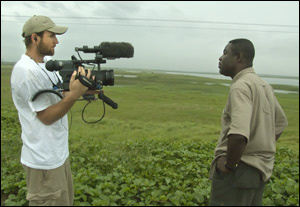
Isaac Brown, left, films Mike Anane in Accra, Ghana. Anane is a ...
n'importe quoi
My interviews with the scrappers at Ghana led me to believe Anane is not a journalist at all.  I can't find any record of any articles published by him, or any newspaper, radio, or television station he has worked for.  The Agbogbloshie scrappers claimed he was "in cahoots" with AMA, the Ghana developers who wanted to evict them from the increasingly valuable real estate near the center of Accra.  I've written about that before.

Here's another UN sponsored report, by African researchers, on the sources of pollution at the Odaw River lagoon of Agbogbloshie (2002).  It's incredibly well documented, and none of it jives with Frontline.

What I haven't really had the guts to do is to question Mike Anane's credibility.  I interviewed him at an Interpol meeting in 2010.  And I've promoted alternative experts such as Grace Akese of Memorial University or Emmanuel Eric P. Nyalete of Georgia Tech.  But when it comes to being an American questioning an African about his depiction of Africa, I've only attacked Anane's figures, his statistics, his 500 containerloads per month story.  And independent scholars back us up ("Criminal Negligence?")

The claims of the Agbogbloshie scrap workers do appear to hold water.  Take a look at the specific Anane representation below, still on the PBS website.


Anane makes a specific personal claim:
"I've always known Agbogbloshie as part of the country's westlands. As a kid, I used to play football here.  Some of my friends would go fishing in the lagoon.  When I went back and saw the huge amount of computers shipped in and dumped here, it mad me angry that these children had come to break them up." - Michael Anane
Now this is specifically an eyewitness claim.  Anane is personally claiming to PBS to have seen computers "shipped" to Agbogbloshie.  In the AlJazeera E-Waste Republic series and Cosima Dannoritzer's "The E-Waste Tragedy" Anane makes the same boast... this was a pristine riverside, a fishing village. 


Now how does this square with all the reports of Agbogbloshie, and the Odaw River Lagoon, since 1960?  How does it compare to eyewitness reports from any of my own interviews?  And Anane's claims to have been an editor in 1991-95 for "Triumph Newspaper" (no record of the paper in Ghana, though there's a Triumph newspaper in Kano, Nigeria).  Either Anane was in northern Nigeria, or he was editor from a remote location before the internet. But if that's the timeframe when Agbogbloshie was ruined in Accra, it's at a time when 1) Agbogbloshie was a city dump and auto scrapyard for a city of millions, and 2) there were no strict "ewaste" regulations to avoid as "drivers" per UNEP / "StoryofStuff", and 3) it's definitely not near "the outskirts", it's in the middle of the gosh darn city, visible on Google Maps.  Nothing adds up... except Anane's speaking fees.   Oh, didn't know that? Ask reporters, like those of #ewasterepublic  about the Anane speaking fees, and fees to photograph his collection of plastic with asset tags.

Nyalete, Odoi, and Akese say otherwise, and the reports like the one linked above are pretty darn thorough.  Agbogbloshie was a polluted dump before personal computers were sold in USA, let alone discarded. It's larger and more polluted to the degree Accra is larger and more polluted. There is no international dumping link, and no evidence of Eden after the Akosombo Dam of the Volta River was completed in 1965.  Electricity led to WEEE as roads led to cars.

But Anane specifically says it was "teeming with fish" in 1999.
Dan McKinney and M. Anane report that Agbogbloshie river was teeming with fish in 1999.  Bullhockey


Reporting Neither Policy

Why there should be no "recycling policy" and no "mining policy".   

There should only be a "raw material policy".  

In a recent Slashdot.org essay, commenters bemoan the fact that national dialogue is increasingly polarized, and "lacks nuance".   I contributed the following in response to the essay, "Edward Snowden and the Death of Nuance" by Dennis Fisher.  (Snowden and NSA debate is to Slashdot what Michael Jackson was to National Enquirer, or Michael Jordan was to Sports Illustrated).
"I'm from 3 generations of journalists, and part of the problem is that news outlets need to a) attract readers (make it interesting and simple), and b) are trying to cover stories that are frankly out of the reporters depth and comfort zone. Reporters want to cover both sides of an issue, and the easiest way to do that is to find two sources who disagree strongly... Opposite + Opposite = "fair and balanced". When "long form journalism" is proposed as an antidote, we still suffer from weak audience attention spans and excuses for writing prose that lacks punch, or remains lazy-sourced.
"This, in turn, rewards "experts" who take a polarized view. If your expertise provides nuance, you have to compete for the reporter's attention. So much easier for reporters to submit black-and-white points of view. Often reporters tell me they are afraid NOT to interview loud and ignorant people out of fear of "not having covered their side".
"In my particular field (electronics scrap policy) I've tried to interest reporters in identifying victims of policies which lack nuance - a "derivative" of the story which fits the black-and-white reporting model. The "victimhood" of un-nuanced policy can sometimes trigger "blame" and "innocent or guilty" coverage paradigm. I realize too that it's not the reporters fault that readers/audience response to nuanced articles is "Whoosh". "Whoosh" doesn't sell papers and tv ads. I fear this is causing erosion of even stronger news sources (The Economist, WSJ, NYT, etc)."   Read the 180 comments
After I hit submit, I was bugged by my reference to "Electronic Scrap Policy".  It has become an "export vs. non-export" policy, largely, or a manual disassembly vs. shredder debate, or a repair vs. obsolescence debate.    Victimhood triggers the "nurture and underdog" responses among readers and reporters alike, and to make any of these points of view "newsworthy", we are all scavenging for victims.

"Dead Reckoning": Cross Cultural Risk Part III

Cross Cultural Risk Comparison, Assessment:  Part III "Dead Reckoning"

"Let's take working PC displays away from African hospitals, grind them to dust, and apply it as wind cover in USA cities." - USA E-Waste Policy Expert

Part 1 went to the philosophical morality of risk, as defined by our ability to care about wider and wider circles, in geography and in time, etc.  From selfishly caring about oneself, to caring what one's mother thinks, to caring about decades later, and about people on other continents, and on to the spiritual and supernatural...  The highest risk, for environmentalists, is extinction. Things people do here on in a lifetime on earth that leave a mark, until the next supernova.  We need to value genomes, genes, more than we value carbon, and more than we value individual human lives.

Shark attack child
Part 2 zoomed inward.  Individual human lives, individual acts, small risks.  Thanksgivings past and present.   The blog analyzed the risks of "wasting food", and liabilities for serving "risky" food, from the perspective of my own geography (Ozarks) separated by generations and time.  The perception of risk relates to actual risk.  What is risky in a rich nation - serving blinky food - is risky not to do in a poor nation.

In the third and final part, we turn to risks of leaded glass and childbirth.

Lead is dangerous.  Banning leaded gasoline was the best environmental law the USA ever passed.  Childbirth is also dangerous.  The number one cause of death in Africa is from blood loss during childbirth.

But is the risk of a pound of lead in a working computer monitor at a hospital in Africa the same as a pound of lead ground up in a USA landfill?  The perception of risk, by a USA or EU regulator vs. by a young African mother, is altered through the cross-cultural lens.

Over the holiday I skimmed an article in a journal called Risk Analysis: Vol. 24, No. 3, 2004  "Dead Reckoning: Demographic Determinants of the Accuracy of Mortality Risk Perceptions" (Jahn Karl Hakes1 and W. Kip Viscusi).  From the Conclusion
"One theory for the high degree of observed risk aversion in public policy decisions is based upon public overestimation of small risks and underestimation of large risks, as argued in Viscusi.(20) According to this theory, the public’s difficulty in distinguishing between differing magnitudes of risks leads to similar amounts of spending for reducing each risk. As a result, the resulting regulatory costs per statistical life saved are much higher for low probability risks, whereas the greatest gains in lifesaving will be from reducing very large risks.
"Improved policy treatment of risks, assisted particularly by improved communication of risks, holds the potential to increase the cost effectiveness of public policy."
The paper tries to correlate opinions of risk to actual risks, and how the outliers lead to inefficient regulation and public policy.  This is really germane to the Good Point Ideas Blog  (see "Cognitive Risk: E-Waste Cell Phone Cancer").  How do Africans, North Americans, Asians, Europeans, Oceanians, and South Americans weigh the risk of "e-waste"?   If we broaden the geography of the risks being debated, and the cultural geography beyond USA, does "improved communication of risks" remain associated with "educational attainment"?  Or can the well-educated get something wrong?  We all have our ju-jus, our gri-gris.

"Dead Reckoning": Cross Cultural Risk Part I


3 holiday blogs on Cross Cultural Risk Comparison, Assessment.  


File:Rubberbandball.jpgRisk Comparison and Assessment.  Sometimes society gets it right.  Sometimes, though, we miscalculate risk, and misdiagnose.  Environmental regulations are the response to environmental risks, which may or may not be a direct risk to human health.  If our subjective responses to direct risk to our own lives vary, by demographic, how good is our derivative judgement of the more indirect risk to the environment?  And to the indirect risk to an environment physically distant?

Our opinions on world risk are like an army of rubber bands.  When enough of them are used together, they can create energy, a movement, or an obstacle.

"Risk" generates aversion, and aversion is energy to be harvested, either by capitalists, or by command-and-control economies.  Risk aversion, and the externalized risk aversion (which arises genetically from the impulse to nurture), are winds we can direct towards or away from our windmills and sails by conjure.   The force which conjures these winds is journalism, or wiki-editing, or other social media.

Now that I've lost nearly everybody (a Thanksgiving long-bomb hail Mary blog tradition), let's use e-waste policy, again, as a lens to measure how media plays on society's cognitive risk (personal threat avoidance, or nurture to protect "others", or true ecosystem challenges) to stir policies worth billions of dollars.


In our families, our religions, our work, and our lives we must weigh different derivatives of risk and benefit.  But our actions and decisions and votes seem like rubberbands.  They are capable of holding small things together, or inflicting a snap of pain.  But the rubber band cannot hold back a landslide.  We direct the energy and elasticity we have to the things we can cognitively manage.   That image is a way of introducing my theory of how we care about the pictures of little kids in Africa and Asia.


Environmental Injustice and Work By Hand

The theme of the blog has been a defense of work done by hand.  Solving the E-Waste Problem [StEP], six years after we met at E-Scrap, has started a Best of Two Worlds campaign to champion the advantages of hand-disassembly of e-scrap.  They don't go far enough, in my opinion, towards defending trade between rich and poor (the poor prefer to hand-disassemble and repair rich people's stuff).  But it's progress.

In every developing city, there are people who have jobs that are "beneath" rich people.  [Useless Lists of Jobs Beneath Wealthy People is one of the top ranked posts of 2012].

If you take a camera very close to any job of any hard working poor person, you may frighten someone.   The butcher shops are "nasty".   Working in an auto garage exposes one to carcinigens and mutigens. Bleaches at the laundry and in mop buckets.   Repetitive tasks, risking motion injury, at assembly plants.  Mining.  Petrochemical factories.  Forestry. Smelters.   Working in 105 degree heat, smelling lignin, at a recycled toilet paper factory in Massachusetts may only look good to a migrant worker.

This technique of bringing a camera very close to one of the workers that picks our organic cotton "by hand", and making us feel guilty for using, owning, accessing things, is cheaply reproduced by even worthless idiot "non-governemental organizations".   It's like camera proliferation, arming idiots with the ability to combine poverty+unfamiliar-race+trade to impugn... anything.   Anything good or bad.  Even recycling.

Daisey Chain, Foxconn, and Export Policy


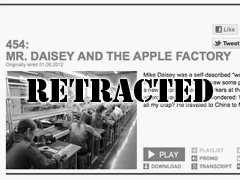
I want to strongly recommend listening to the podcast (or at least reading the PDF) from the retractions in This American Life.

Ira Glass of This American Life has done a good job of trying to undo the ficticious Mike Daisey reporting about Foxconn.  In this episode, they try to correct the mistakes without excusing past abuses, or defusing legitimate concerns over fair trade with the workers who make Apple and other products.

The moral, to me, is that if an accident happens at a different factory in China (not Foxconn), 1000 miles to the west, two years ago, that it's not ok to say that you eyewitnessed the same accident happened at Foxconn's factory in Shenzhen.  This undermines the good factory, by making them the same as the bad factory.  The fact that both factories have brown people in them does not really excuse the shortcut.  The lesson is that if you are a journalist, and you give someone a soap box, you have to act swiftly to prevent a daisy-chain of bad journalism from taking route.

This is what CBS 60 Minutes allowed to happen, relying on Basel Action Network's Jim Puckett, in reporting that CRT monitors were scrapped in Guiyu, China, and not at the refurbishing factories I showed them pictures of.  They set into motion a chain of daisey-claims, infecting PBS Frontline, and Terry Gross' Fresh Air program, with fake statistics about e-waste exports.