Showing posts with label hell. Show all posts

The Circular Economy of "e-waste" Parts: Opening Our Eyes to Value Added

The European theory of the "circular economy" focuses on the final value of metals, minerals, and petrochemicals. Today I'll try to explain, as succinctly as possible, why this "Ptolemy" circle (stuff revolves around us) wasn't recognized in Emerging Markets.

While researching the CRT Recycling Infrastructure for the Massachusetts DEP's first-in-the-nation statewide e-waste disposal program in 1999, I was told about Dr. Yuzo Takahashi (by Panasonic rep and Japan history buff David Thompson). Dr. Takahashi had published a brief book titled "A Network of Tinkerers: The Advent of the Radio and Television Receiver Industry in Japan."


As a "cross culture" professional (hired by Peace Corps to train incoming Americans in 1986), I found Dr. Takahashi's brief history lesson to make complete sense. Japan's electronics economy - and its imitators to be in Taiwan, South Korea, Singapore, Malaysia, and eventually mainland China - was in one special way COMPLETELY different from USA and Europe. It was a cultural difference.

... and reading about how Asians traded parts and components (readily visible on Alibaba, Exporters.com, RecycleINME, and Recycle.net back in those days) are seen by Asians starts in the Japanese living room.

When a society is building it's devices from components, the value added of the parts is far more important than the scrap value. Most USA and Europeans buy a pre-assembled electronic device sealed in a box and sold under warrantee. That blinded us to the parts and components trade, which is FAR more valuable than raw materials. Like aftermarket car parts, 20% of a scrap device is worth 80% of the money.

Rumors Update 3: Deauville, Normandy, Film Festival

This is just a sneak peak. Leapfrogs #2 because it's so hot off the press...


The collateral damage to geeks of color over the past 2 decades has left scores of witnesses.


"Exaggerations Have Been Made" - NGO Exec Director

He huffed and he puffed and he blew the Hoax down

I'm really busy this month, in part due to the month away (Austria IERC conference, then 3 weeks in Ghana).  And I was in the Ozarks all last week for my father's DNR and funeral, simultaneously dealing with a tornado that wiped out water, electricity, internet, and my mom and dad's barn in Arkansas.  So... the blog's always poorly edited, but this month I've got really good excuses for it.

Here's what sticks with me from the January IERC Austria conference.  I sat on a panel with Jim Puckett, the Executive Director of the E-Waste NGO Basel Action Network.  We were speaking to a crowd of about 100 European WEEE delegates.

I opened by saying I used to be a teacher in Cameroon, Africa, from 1984-86.  I'd recently been to Agbogbloshie, and was going back again immediately after the conference.  I told the European audience that the junk they had seen photographed there was generated by African households and businesses, after decades of reuse.  Yes, it was originally imported used, but almost always repaired and used for 10-20 years before Africans discarded it.  I told them that 30 years ago my landlord had no running water but owned a (used) TV.  I told them that there wasn't any mystery around the baseline data - the World Bank clearly says that MOST households in cities like Accra had TV or computer 20 years ago, and the assumption that junk captured by photo-journalists was "dumped" in hundreds of sea containers by unscrupulous recyclers was categorically false;  I told them I had met Michael Anane, that he was not telling the truth about Agbogbloshie being a remote fishing village and he had certainly not been fishing and swimming there 20 years ago, that I was unable to find any newspaper that employed him, and that the people I asked in Agbogloshie said he worked for the AMA, the municipal land development group that forcibly evicted thousands of Old Fadama slum dwellers near the site, which they have a published plan to develop into shopping malls etc. The junk is collected in pushcarts from Accra city streets. I told them that the World Bank and IMF determined 15 years ago that used electronics in Africa were essential to creating the "critical mass of users" to fund TV stations and programming, cell phone towers, and internet cable.  I told them that Africa's Tech Sector found "Project Eden" to be scary, a threat to their livelihood, and cringe-worthy as a moniker.

E-waste Ebola Connection?
In conclusion, I counted backwards from 3, snapped my fingers, and  told them to forget all of the things Jim Puckett had told them for the past 15 years.

Jim's response?

"I will admit, exaggerations have been made."

It strikes me, 6 weeks later, as an incredible use of passive voice.  Exaggerations "have been made" by someone.

Exaggerations have been made, indeed.  Agbogbloshie photos have now disappeared from the CAER website, the conference speakers were now talking about keeping copper inside Europe's "circular economy", and Blacksmith Institute had changed its name.  That NGO allegedly told journalists 2 years ago that Agbogbloshie was the "most polluted place in the world" - something Blacksmith then denied but wouldn't issue any clarifying statement, despite our sending evidence they were cited by the journalists as the source of the claims about Agbo.  They did not tell me how much money they received to "transform" and "save" Agbogbloshie...

Sodom and Gomorrah? Fishing as a Boy? Mike Anane via PBS Frontline

"Photojournalism without data journalism jails and fails"

Immediately after our 3 week investigation of Agbogbloshie, Tema, Tamale region and Accra, I went to Vancouver to meet with Graham Pickren and Peter Klein, both professors.  Pickren was very kind to meet me for lunch.

Peter Klein initially returned my messages, but did not seem to want to meet.

Klein's at UBC Vancouver, which is responsible for the PBS Frontline episode in 2010 that labelled Agbogbloshie as "Sodom and Gomorrah."  The label was based on interviews with Mike Anane, who has been repeatedly represented as a "journalist" in Ghana.
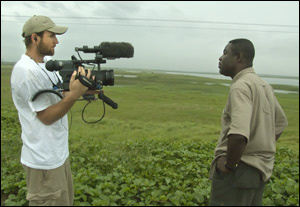
Isaac Brown, left, films Mike Anane in Accra, Ghana. Anane is a ...
n'importe quoi
My interviews with the scrappers at Ghana led me to believe Anane is not a journalist at all.  I can't find any record of any articles published by him, or any newspaper, radio, or television station he has worked for.  The Agbogbloshie scrappers claimed he was "in cahoots" with AMA, the Ghana developers who wanted to evict them from the increasingly valuable real estate near the center of Accra.  I've written about that before.

Here's another UN sponsored report, by African researchers, on the sources of pollution at the Odaw River lagoon of Agbogbloshie (2002).  It's incredibly well documented, and none of it jives with Frontline.

What I haven't really had the guts to do is to question Mike Anane's credibility.  I interviewed him at an Interpol meeting in 2010.  And I've promoted alternative experts such as Grace Akese of Memorial University or Emmanuel Eric P. Nyalete of Georgia Tech.  But when it comes to being an American questioning an African about his depiction of Africa, I've only attacked Anane's figures, his statistics, his 500 containerloads per month story.  And independent scholars back us up ("Criminal Negligence?")

The claims of the Agbogbloshie scrap workers do appear to hold water.  Take a look at the specific Anane representation below, still on the PBS website.


Anane makes a specific personal claim:
"I've always known Agbogbloshie as part of the country's westlands. As a kid, I used to play football here.  Some of my friends would go fishing in the lagoon.  When I went back and saw the huge amount of computers shipped in and dumped here, it mad me angry that these children had come to break them up." - Michael Anane
Now this is specifically an eyewitness claim.  Anane is personally claiming to PBS to have seen computers "shipped" to Agbogbloshie.  In the AlJazeera E-Waste Republic series and Cosima Dannoritzer's "The E-Waste Tragedy" Anane makes the same boast... this was a pristine riverside, a fishing village. 


Now how does this square with all the reports of Agbogbloshie, and the Odaw River Lagoon, since 1960?  How does it compare to eyewitness reports from any of my own interviews?  And Anane's claims to have been an editor in 1991-95 for "Triumph Newspaper" (no record of the paper in Ghana, though there's a Triumph newspaper in Kano, Nigeria).  Either Anane was in northern Nigeria, or he was editor from a remote location before the internet. But if that's the timeframe when Agbogbloshie was ruined in Accra, it's at a time when 1) Agbogbloshie was a city dump and auto scrapyard for a city of millions, and 2) there were no strict "ewaste" regulations to avoid as "drivers" per UNEP / "StoryofStuff", and 3) it's definitely not near "the outskirts", it's in the middle of the gosh darn city, visible on Google Maps.  Nothing adds up... except Anane's speaking fees.   Oh, didn't know that? Ask reporters, like those of #ewasterepublic  about the Anane speaking fees, and fees to photograph his collection of plastic with asset tags.

Nyalete, Odoi, and Akese say otherwise, and the reports like the one linked above are pretty darn thorough.  Agbogbloshie was a polluted dump before personal computers were sold in USA, let alone discarded. It's larger and more polluted to the degree Accra is larger and more polluted. There is no international dumping link, and no evidence of Eden after the Akosombo Dam of the Volta River was completed in 1965.  Electricity led to WEEE as roads led to cars.

But Anane specifically says it was "teeming with fish" in 1999.
Dan McKinney and M. Anane report that Agbogbloshie river was teeming with fish in 1999.  Bullhockey


Agblogblogshie: E-Waste Tsunami Covers Sodom-Gomorah in Understated Hell

Agbog-blog-shie Unplugged:  E-Waste Tsunami Covers Sodom & Gomorah in Understated Hell

Starved of facts and nuance, reports from African city of Accra - found on verge of catastrophe.

[BSNewsire, Accra, Ghana  April 1 2015]

Longtime a skeptic of "ewaste" dumping claims, WR3A Founder Robin Ingenthron arrived in Ghana last Sunday, and was shocked to find the situation far graver than he imagined.

"It began when our Delta Airlines flight was unable to land," said Ingenthron.   "We could see the junk televisions from 4,000 meters above Accra.   They were scattered in stacks, up to 90 feet high, on the runway and tarmac, and along the highway."

The Agbogbloshie dike, which separated greater Accra from the largest collection of electronic waste on the planet, had broken.    Teenagers could be seen pouring out of the Agbogbloshie fences, trying to regather the discarded computers and televisions.  But as fast as the kids worked to burn them, a tsunami of CRT televisions continued to spout through the gates, covering the streets of Accra and stalling traffic.

Ingenthron and other passengers were dropped via small white parachutes, like baby Dumbos, into the zoo of e-waste.  From the ground, the confessed electronics reuse kingpin came face to face with the toxic consequences of his "reuse excuse".

As reported in The Guardian, by Greenpeace, and at weather.com, "millions of tons" of obsolete electronics arrived in Agbobloshie each year.  At 34 units per ton, or 102 million TVs and monitors per year, 279,452 pieces had to be burned each day, keeping the 27 scrap boys who work in Abogbloshie on double shifts.  American households throwing away an average of 2.8 TVs per day are blamed for the mess.  Unfortunately, faced with the relatively small fires and lack of lighter fluid, the scrap boys had allowed a tinderbox of 10 decades of throwaways to amass.

More Insider Dope on Electronics Export Transactions: Giovana Vitola

Leyla Acaroglu tweeted us about a documentary, aired in Australia, as proof that electronics exports are bad.  The reporter is a Brazilian woman, who is now in Singapore.   I have an address for her to visit.
Giovana Vitola's documentary "E-Waste Hell"  (shown on Australia's DateLine) follows the Basel Action Network recipe.

1.  Fly to a big city in an exotic location.
2.  Find bored kids burning TV devices (and refrigerators) at a city dump.  Take film.
3.  Interview an African (Mike Anane) who reads and believes BAN's fake 80-90% export statistics.
4.  Go to the sea container yard and take pictures of televisions being unloaded (from Australia)
5.  Interview the importer with a hidden camera.


Before you assume this is "same old same old", watch the documentary all the way through.  I noticed a few things worth talking about.

First, the standard freeze frame screen shots show, once again, that the devices filmed in the landfill shot look nothing like the flat CRT (2003ish TV year, which would have been made a the Samsung Corning flat CRT furnace in Klang, Malaysia, which made the compact CRTs until 2011).  She films one with broken plastic, but it's clearly shipping damage, and it's cosmetic, it doesn't mean it won't work.
No, I don't think so.  Talk to StEP much?

Second, the undercover film shows what Interpol recognized in its 2009 "organized crime" report.  The sea container is being received by the family business... the importer says his brother lives in Australia, and bought the televisions.  Another "Hurricane Benson" being associated with the dump, kilometers away.

Interpol:  Brothers + buying = organization = mafia

E-Stork III: Where Poisoned Babies Come From

Green Ned Flanders Stork Museum
Part III of 4:   Does it really matter whether the pollution in Guiyu China came from E-waste, or from iron mining, or from textile mills?

If we are responsible for the Stewardship of our own upstreams and downstreams, as seems reasonable, why take any risk at all?

Isn't it appropriate for us to use our buying and selling power to procure the best available services, providing the best possible standards?

If so, why shouldn't our society, in essence, assign a liability for bad consequences to corporations we buy from?  Why shouldn't we ourselves remain legally liable for anything we once owned?  This concept is behind the "precautionary principle", championed in Europe:
The precautionary principle or precautionary approach states that if an action or policy has a suspected risk of causing harm to the public or to the environment, in the absence of scientific consensus that the action or policy is harmful, the burden of proof that it is not harmful falls on those taking the action. [wikipedia 2011.11.20]
If the individual making the purchasing decision suspects risk, and there is a vacuum or absense of scientific consensus, the burden of proof (liability) might dictate we should "avoid bad neighborhoods".  In the "absence of scientific consensus" we have reputation, news reports, green fingerpointing upon which to formulate our cognitive risk.  EPA enforcement cannot happen (in the USA) in absence of science.  Perhaps we need Watchdog organizations to boost our collective sense of liability.  Whether or not what we did was responsible for the watershed pollution in Blackstone, Louhrajang, OK Tedi, or Guiyu rivers, perhaps we need watchdogs who bark falsely, to keep us on our toes.

Or so said the lawyer for the boy who cries wolf...

Populist Cognitive Risk:   The "suspected risk" of the precautionary principle has boiled down to racial profiling.   Reputations of Africans for "waste tourism", "organized crime", burning computers they purchase for thousands of dollars after spending thousands of dollars to ship them over the ocean and through customs...  Given most Americans command of language and geography (most would place Mauritania next to Malawi, Madagascar, and Mozambique...), a photo of a sad child or sandalled woman elevates the "suspected risk".  A friend of mine in Massachusetts, a recycler of conscience, said to me that if there was even a chance that a computer exported wound up in Guiyu, that she couldn't sleep at night if a computer her town collected might wind up there.*

[see Bambauer, "Shopping Badly: Cognitive Biases..." 2006)

Ethics of Religion: Imagine You're Jesus

(at the risk of offending absolutely everyone... this is about thinking).

Imagine You Are Jesus, and You've recently arrived back in Heaven.  You are looking down at the world, and You have some followers, some people who are genuinely enlightened by the golden rule, loving their neighbors as themselves, bearing fruit one hundred fold.

You also see about a million people who are just awful.  Just the worst.  Cruel, murdering, thieving, a million people who kill children.

Two of Your followers, named Pastor West and Pastor East, feel heartbroken by the badness.  West and East both live by Your golden rule, they both give away their possessions to help the needy, and they both try to be perfect as their Father in heaven is perfect.

Then Pastor West speaks up.  He tells the million violent and angry people that You, Jesus, spoke to him personally, and gave him a saintly prophetic vision... that You, Jesus, had told him Your plans for a place called Hell.  Agonizing, atrocious, flesh eating fire which never ends, forever and ever and ever, and that you were going to throw those million sinners into a firey doom.  And that you spoke of a place called Heaven, where all people who believe in You and change their ways will live in Joy and harmony.

Of course, You said no such thing.  Your allegories of gnashing of teeth were intended to describe a life trying to bless itself with material goods which pass.  Pastor West weeps tears of joy at the feeling of "Your" words, adding emphasis and importance to the "vision".

But... Imagine it appears to work sometimes.  Of the million sinners, imagine that half of them pause, fearing death and Hell, and that they lay down their weapons and stop killing children...  Hundreds of thousands are spared, as armies and gangs set down their weapons, and pray for salvation from the Vision of Hell.

On the day Your two followers meet You in heaven, they each plead their case...