Showing posts with label environment. Show all posts

UNITAR Global E-Waste "Monitor" 2024: Better, but still kinda cringy?

I have yet to read more than the Executive Summary and Table of Contents of the new UNEP Global E-Waste Monitor report, but I can already see that it's being mis-reported.  The "hook" is an emergency, that only 22.3% of e-waste is "documented", and the rest (the Executive Summary implies), is presumed to be "improperly" managed or "lost" to the so-called "informal sector".

Readers may remember this blog previously defined "informal sector" as "a white person didn't enter it into a spreadsheet"... in response to the "Criminal Negligence" 2015 Report.

UNITAR (another UN agency) describes the reports findings as follows:

"Meanwhile, less than one quarter (22.3%) of the year’s e-waste mass was documented as having been properly collected and recycled in 2022, leaving US $62 billion worth of recoverable natural resources unaccounted for and increasing pollution risks to communities worldwide. "

The "five fold growth" in "e-waste" is describing worldwide generation, not just wealthy countries.  This raises questions about the measurement of "undocumented" used electronics... but lets list a few obvious premises.

1.  The size of electronics PER CAPITA is declining due to the miniaturization effect.  In 1992 it peaked because we needed a desk phone, an answering machine, a fax machine, a camera, a radio, etc.... all of which now fit inside the smart phone in my front pocket.  

2. The export market, which the previous 2015 UNEP Report described as "primitive", is mostly for reuse.  So if there was less e-waste generated in the past compared to the future, that can only be explained by the continuous reuse of past devices which continue to be reused and maintained in places like Ghana, Nigeria, Angola, etc.  

3. The UNEP reports conflate the end of first consumer use with "waste generated", as if reuse and repair, if not "documented", is in the "ewaste" volume assesssed.  That would mean that if a white person owns a TV for ten years, and it's purchased and reused by an African for another 40 years, that the "waste" is counted twice - the first time it was "generated" and the actual "end of life" of the TV.

Photo of TV Repairman Ibrahim Alhassan in Savelugu, Ghana, who we introduced to author Adam Minter, who wrote about Ibrahim in the seminal reuse non-fiction book "Secondhand: Travels in the New Global Garage Sale".  Ibrahim was repairing a 1970 Japanese CRT television, or rather improving it by addint a remote control function absent in the original knob-tuned TV.  This TV certainly would have been destroyed by "Big Shred" in Europe decades ago... but hard to describe the African's continuous use and extended life as "primitive"... unless you are a wee bit racially-profilly.


Thought Protein: The Empty Calories of Smug Policies

Committed Environmentalists generally prefer as friends the people who care deeply about extinction, sustainability, and the environment, strongly over those that don't care.

If you are truly passionate, however, you must also strive to think critically and deeper than slogans and groupthink.

If thinking critically is equated to 'criticism', social popularity takes a hit.

I often hear the argument that a popular message is important to momentum, which is valuable to policy change. However, if popularity is measured with a small smug group and not broad swath of humanity, it quickly sours into useless moral licensing and posed indignation.

The worst possible outcome is a poorly tested 'cure' which has negative environmental outcomes, increases costs on others, and which dissuades a democracy from making other regulations and changes. Many voters have a justifiable resistance to entrusting Authority To The Smug.

Alexis de Tocqueville, Democracy in America v. Planned Obsolescence

Since I often have to hunt this down, here is copied the best Defense against accusations of "Planned Obsolescence". Alexis de Tocqueville's Democracy In America, Volume 2, Chapter 8.

Note that it has nothing at all to do with piracy, counterfeit, gray market.

When a company correctly estimates that too much 'value', too much repairability, is being given to the market, and 'downsizes quality', that may actually be good for the environment.

Alexis de Tocqueville, Democracy in America. English Edition. Vol. 2.  
"You cannot believe how many facts flow naturally from this philosophical theory that man is indefinitely perfectible,d and the prodigious influence [762] that it exercises on even those who, occupied only with acting and not with thinking, seem to conform their actions to it without knowing it. 


For Thankgiving 2018: Yes, You Are Probably Better Off Than Your Parents*


On social media, I sometimes try to "referee the internet".  That's what I call engaging in political debate or argument. I like dialectic. Constructive argument is better than smile-and-wave, or sweep-under-the-rug, etc. If you have the right touch, the friendship survives.

One of the arguments that is ongoing is over the pessimism vs. optimism for globalisation.

Other species, and the environment, I'm tragically not optimistic about.  My optimism about human lives is actually, in part, to get us to focus on worrying about things that really matter.  Also, I think that unnecessary panic and pessimism, whether to Trump or Bernie, distracts us from making investments that might really matter.

So here goes. When we look at an optimistic video, like GapMinder (Hans Rosling), about more girls going to school, fewer diseases, less poverty, the statistics and facts are clear.  Here is an interesting graphic - The World Poverty Clock.

57,913 people escaped poverty today (income levels increased)
11,508 people fell into poverty (especially in places like Venezuela, Nigeria, Syria and Yemen)

World Poverty Clock Screenshot

The graphic shows red (newly poor) and black (newly rich) stick figures, and shows countries in red or black according to how their own population is faring.  I have some funnier videos at bottom.

Here's the argument people most often push back. Many people believe that the current generation of AMERICANS or EUROPEANS is less likely to be better off than their parents generation.

But there are two ways to pose the question. Are we living better than a previous generation? And if so, how did we afford it?

The Spiraling Economy: Double Regulations of A Circular Economy

Here is the recycler's recurring nightmare...
"We'd love to keep using 1,000 tons per day of your recycled material instead of mining and extracting it from forests and mountains. But EPA says we'd need a Waste Facility Perimit in addition to our clean air and water permits.  If we mine from the mountain, we just need 2 permits, not 3"
No good deed goes unpunished. Regulators of city waste insist on tracking processed recyclables in the industrial mineral market, even when they compete as "furnace ready" feedstocks with materials mined from mountainsides.


The best hard rock mining is worse than the worst recycling. And this week, the Wall Street Journal's reporters Mackenzie Knowles-Coursin and Joe Parkinson show us what some of the worst (gold) mining looks like.

Grasping At Straws: The Net Liability of Extraction

Let's assume that people without a sense of environmental conscience don't spend time on this blog. Longtime readers know that I'm in recycling because of "religious" or "philosophical" experiences I had in the 1970s. In distilling the ethos of hippies and hillbillies (elderly god-fearing folks I also admire), I might have coined a term "Agent of Conscience".


Time to "recalculate the route" of environmental strategy. We know that we need people who care, and we know that it needs to be science based. We hope to develop cures for planet health the way western medicine cured smallpox and polio. And borrowing from the March of Dimes polio strategy, we aren't above using poster children if the timing is right.

First, we need a personal end point or destination, a true north. At least, that's where I started. Without history and accountability and scientific method, Environmentalists will be left Grasping for Straws.  In the big math, the net cost of extraction vs. reuse/repair/recycling, finding novel things to make people to feel guilty about isn't going to get us to our sustainable destination.

Grasping at Straws.... 

Why we need to press pause on the plastic straw ban | The Big Issue

Euro Agbo Porno Photo Journos 3: Credits Making Poverty Porn Placebo in Agbogbloshie!

Video Produced by Sasha Rainbow for RiseRecords and Placebo creates more "Collateral Damage".  

"Life is what you make it" music video, filmed at Accra city dump, uses gasoline fueled fire, children, and recycling images.

Well, well, well... it has been a busy week for Agbogbloshie.  We are looking for a release document for one of the "three musketeers" (Awal, Razak, Yahroo), who featured prominently in a new music video released for Placebo by Rise Records.  Not trying to scare them away, but to get them into their role in the dialogue.  They probably meant well, and are "collateral damage" from BAN propaganda... which they append at the video's final seconds, as if spreading fear for Africans victimization is compensation enough for a day of scrap circus performances.

First, some actual journalism happened the same afternoon as the video was released, and from the same state (Oregon).  Resource Recycling magazine had a thoughtful cover article on our Fair Trade Recycling "carbon offset model" waste trading with Ghana.

Same day, Rise Records (Beaverton, OR) released a film by director "Sasha Rainbow".   The music video for glam-punk-rock rerelease UK group Placebo advertises albums and t-Shirts.  The Song is "Life's What You Make It".

The film opens with the line "dedicated to the workers of Agbogbloshie".  Well, that's nice.  What's fascinating is that Sasha Rainbow uses only a handful of the people there, and the most prominently featured is Awal Muhammed of Savelugu (north of Tamale), who I spent several weeks with in January and February.

Here's Awal in the music video.  I am struggling to know how to feel about this.  His name, at a minimum, should be in the credits.  He's not a "nameless faceless worker of Agbogbloshie".


Here's Awal wearing my company T-Shirt (with Yahroo)


So I was kind of mock-exploiting these "most photographed dudes in Africa".  But I don't know if I paid them as much as Placebo or Sasha Rainbow paid them - or far more.  And I very much want to find out.  Because if Sasha Rainbow and Rise Records did compensate these workers, they should proudly name them (like a check would require) and say so in the credits.  Because Bellini, McElvaney, and other Euro Agbo Porno Photo Journos did not.  None of us assumes the scrappers are given more than a thank you, and if that's the case here, the Glam Rockers need to find out, and correct that.  If I see these people in a video that's making money, I want to read that the dudes were paid a fair crew wage.  The ironically titled video "Still Not Sponsored" is perhaps the grossest, most disturbing example, with smarmy ridiculing voice over by Mike Anane, a guy these scrappers detest.

Editors Note: Status of WR3A Good Point Blog

Blog Status December 6, 2016.

Wahab, left, points to photo in Washington Post of Idrissa, who was struck and killed by a truck in 2013 or 14
Catching up on editing 4 blog articles (from "Collateral Damage" series) and one magazine article, and preparing for my presentation at ICM in Salzburg, Austria.  Also getting all my vaccinations for the re-visit to Ghana.   I'm double checking things from the draft Fair Trade Recycling report (2015 visit).

1- Does something bad happen  at Agbogbloshie?  Bad for health, for the environment, etc.?

2- If something bad happens, is it related to unfair export and import trade?

3- If something bad happens, due to unfair trade, is it illegal or a "loophole"?

4- If something bad happens, due to unfair trade, and it is illegal, should Joe "Hurricane" Benson and other Tech Sector African businesspeople pay fines or go to prison for it?

The answer to the first question is yes and no.  Or rather, some bad things happen, and some good things (better than if the goods were in the USA or EU) happen.  The worst thing is probably the men who burn wire and then use their bare hands to scrape metal out of the dirt and ashes.  The earth there will be contaminated by lead.  Some of the lead is from automobiles, some from leaded casings in older electric wire (not computers).  If they aren't washing their hands really well, they are likely to suffer consequences.

The good thing is that the goods are used for far longer than westerners use the goods.  Even after westerners have finihsed using the electronics, Africans will tend to reuse them twice as long as that. And hand disassembly is better for the environment than shredding.  And the cost of achieving internet, phone, TV, radio and other teledensity measures, per African is a TINY FRACTION of the upstream environmental cost per capita done by Western countries.  And most of THAT damage, from mining, occurs in places like Africa.

2 - No.  The junk in Agbogbloshie is far more likely to be collected from African city residents and businesses after 10-20 years of use than it is to be imported. The people saying that it came from sea containers being dumped to avoid recycling costs are making it up at best, and in some cases lying.

3. Not under Basel Convention Annex IX.  But - in reaction (over-reaction) to lies about #2, some EU countries have passed stricter laws.  It's like if you thought bananas were poison, and passed a law against selling bananas... yeah, banana sellers would be criminals.  But seriously.

4. No. This was a witch hunt.

Charm Offensive

Being charming and being offensive at the same time is tricky.   It's also fascinating, an entire Hollywood genre.

Anti-slavery advocate John Brown may be my hero... he created a space for Abraham Lincoln and Frederick Douglas to work inside.   But if you don't have a popularity guru, and aren't part of a Lincoln-F.Douglas team, it does help to build up chits, credits, and bitcoins of goodwill.  Count your cultural ammo before you embark on something really worth being contrary over.  It's not a secret, but it has to be a habit, like a banker saving interest, or a cowboy counting his bullets.

Sometimes we discover an injustice in our group, and we have to buy or earn attention to it, until we recruit our Great Communicator like Abe Lincoln, Mark Twain, or Frederic Douglas.

Until then, how do we promote justice while remaining acceptably affable?   How do we communicate the need for change to people who aren't really in the business and whose attention we are borrowing?  It's kind of like selling Civil Rights Movements at a Little Rock Garden Club meeting, or Women's Suffrage to a Chicago Country Club, in 1925.

Take note of what you are spending with this Charm Econ earnings report by Sebastian Drake.

13 Characteristics of Likeable People by Sebastian Drake
1. Smiling - 
2. Eye contact – 
3. Touch – 
4. Not talking about yourself – 
5. Not talking too much - 
6. Empathy – 
7. Not trying to impress – 
8. Showing praise and appreciation – 
9. Never criticizing, ever, for any reason –

10. Not trying to fix other peoples’ problems
 – 
11. Eliminate negativity - 
12. Never complain –

13. Never impose weakness on others
 –

Maybe we can assign earnings per day to each habit and treat it like a checklist.  Follow these steps, and be less unpopular.  But when is Charm over-rated?

INK: History of Patent Wars


How BAN.org shows "Egypt"
Ok, this headline is a teaser for a book I would like to write.   If I were to be suddenly unemployed, rather than the CEO of a fast going (doubling in size every 3 years) environmental company, I'd have no problem occupying my time.   In the past quarter, I've written more and more and posted less and less because it's hard to make brief points that don't water down the body of work.

Here's the problem:

1.   Most CRTs are Waste
2.   Most CRTs are Exported
3.   Therefore, most waste CRTs are exported.

This sounds reasonable, whether you garnish it with poverty porn (pictures of kids with burning trash) or not.

Shanghai Scrap Pictures: 10,000 Scrap TVs in a day

That's a day in the life of reporter Adam Minter (who has recently finished his upcoming book, Wasted, at Bloomsberg Press).  The photo below is from one inland city.

Adam verified with me (prior to his post) that this is not a certain inland city I know of (which does import CRTs, via inland routes from Viet Nam).  No, these are Chinese brand, Chinese generated televisions from Chinese homes.  Which isn't at all surprising when you have been to cities - cities in Asia, South America, and Africa - which are full of millions and millions and millions of people generating their own "e-waste".

Some of you may remember one of my more shocking discoveries from my trip to South America last spring.  The old reuse market which used to buy USA used TVs was still selling used TVs - marks from China.  By commingling their own used ("waste") televisions in a container, China made the new good-enough LCDs they manufacture affordable in smaller, less-than-load samples.  It had nothing to do with China exploiting Peru environmental standards.

I'll stop and let you cruise over to Shanghai Scrap to read Adam's post.  His conclusion was that the process he witnessed did a darn fine job of recycling the televisions.   China has developed a way to manage it's own e-scrap.  That's what we need everywhere that imports, exports, or grows their own electronics.   A ban on trade just doesn't make any sense at all.


Memorial Day: Fear and Greed, Part 2

EPA tried to simplify things a few decades ago with a "Solid Waste Hierarchy".  The first was "recycle, then incinerate, then landfill".   That drew an environmentalist backlash, and the "new hierarchy" in 1990 Earth Day was "Reduce, Reuse, Recycle".  Neither hierarchy anticipated the international trade issues and controversies.

Reuse and repair beats recycling.  Ghettos and barrios are the best places for that work... Just as auto and engine repair is no longer done in Manhattan.  But that collides with a social fairness "tab" we have open, and in the late 1990s "Environmental Justice" became EPA's forray into social issues.


Definitions from wikipedia 2012.05.27
The United States Environmental Protection Agency defines EJ as follows:
Environmental Justice is the fair treatment and meaningful involvement of all people regardless of race, color, national origin, or income with respect to the development, implementation, and enforcement of environmental laws, regulations, and policies. EPA has this goal for all communities and persons across this Nation [sic]. It will be achieved when everyone enjoys the same degree of protection from environmental and health hazards and equal access to the decision-making process to have a healthy environment in which to live, learn, and work.[5]
In other words, this environmental outcome concerned the human perception of environmental risk... people who were poor had the same vote on EPA attention as the rich people.  A clean and safe environment was seen as a human right, a protection of people.

The attention of government regulatory staff was to be divided equally, to protect us all.  This shifted the radius or loci of EPA from protecting high property values to protecting humans equally.

In this paradigm, the value of protecting the environment is utilitarian.  How many people are in contact with the environment being protected?

This is not a song for the woods, or rain forests.  It's only the giving that makes you what you are.

European Study Proves Hand De-assembly Superior to Shredding

Thanks to our Fair Trade Recycling Intern Adelaide, who is in Middlebury, Vermont, working on her Masters in Waste Management from France.  Adelaide cites ten separate studies in her morning blog to make the point that taking a circuit board apart by hand - separating copper coils from aluminum heat sinks, steel from plastic -  is environmentally superior to shredding in a lifecycle analysis.

Figure 1. Environmental assessment of treatment of electronic waste, Gmünder (2007).

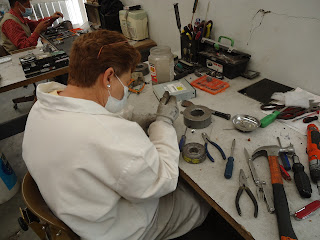
All Fair Trade Recycling wants to do is to make these hand-disassembly jobs (like our women in Mexico, below) de-criminalized.  Give them the proper tools and protection, stop open burning and other "ten worst practices".  There are no mercury switches, there is no "witches brew", hand disassembly is simply an alternative job to gang warefare in Mexico, pirate boating in Somalia, cocaine growing in Peru, sex work in Kenya, etc.

I've usually written about the Geeks of Color.  But the scrappers, too, have been denigrated and defamed in the American and European media.  There are bad practices by hand, and good ones.  Racial profiling is just not a very effective way of deciding, and the "safe" approach of shredding items before export is not a winning strategy for the environment.

Our company practices disassembly here in the USA.   But I'm opening hand disassembly factories in other countries.  They will recycle their own waste from inside their countries.  But if they can do that well, why not let them also take rich people stuff that can still be reused, which puts an even higher environmental outcome... one which is "off the chart".   Survival is the highest form of "end of life" when you're not dead yet.

Our Chicas Bravas in Mexico take a few extra steps and de-manufacture not just the PC, but the components like CDRom drives and floppy disk drives, hard drives, getting things like rare earth magnets and little gold things.  American companies which export intact power supplies, drives, and other "components" may ship them to a similar fate.  But they are all too afraid of the onus against export to visit and find out whether it looks like this or looks like a child sitting on a pile of circuits.

Most American recyclers don't know what this is on the left.  But they "recycle" them by the millions.  Reuse can get very small.

10 Year Green Entrepreneur: Good Point Recycling Decade

My January 2002 Purchase (home equity loan)
In January 2002, I drove this rusty blue used Penske truck through the snow, across Applachia, from Memphis to Middlebury.  I always remember seeing myself in the mirror the morning after I signed the papers, a chill feeling of ice water in my abdomen.


On the road that night, I had hours to think about what I'd just done with my home equity, my wife and two young twins in the small car trained in my headlights ahead of me.


1.  We have good ideas.
2.  We do them.
3.  We tell the truth every day.

Among Green Entrepreneurs, "good ideas" are plentiful.  Successful, sustainable, self-sufficient environmental programs are one in a dozen.  Recycling passes the tests so well, it has become taken for granted, like laundromats and gas stations.   Few remember the challenges of setting up the recycling infrastructure, the net to capture subsidized extraction and keep it in the loop of consumption.  I've tried doing this as a protester in my twenties, as a regulator in my 30s.   For the past ten years, I've been putting my own silver, sweat, blood and tears into this, and its time to assess.  I was not by myself on the front lines, in the foxhole, but I was in a place somewhat unique among advocates, lobbyists, regulators, policymakers, and corporations.

3 Recycling Films: "Where" is E-waste Exploitation?

TV at dump in Ghana.  Imported.. but when?
I'm postponing a post I'm writing about my ten year anniversary at Good Point (in January 2002 I bought my first asset, a used truck), to say a bit more about the Scrap Boys Ghana Agbogbloshie film reposted yesterday.


Dr. Josh Lepawsky of Memorial University in Newfoundland sent me this link to film of recycling in Detroit.  It appears in NY Times as a short, "Dismantling Detroit", and the young men interviewed serve as kind of a comparison to the "Scrap Boys" in Agbogbloshie.


Josh and his grad student Chris McNabb came down to visit our "fair trade recycling" pilot recycling plant in Mexico two weeks ago (Third Video:  PBS on Las Chicas Bravas at Retroworks de Mexico).  Josh has written about the theory he's studying, The Pollution Haven Hypothesis, which is that avoided disposal costs explain geographic displacement of PCs. 


The cost of disposing the junk (or surplus) product here in the OECD represents a value that could partially offset the cost of geographic displacement.  The environmental and social benefit of OECD's higher standards may be assumed lost, or be a cost to the recipient.   But what was good about the item, which caused African entrepreneurs to pay for its relocation?  Is this also about externalizing value, or only costs?


  • What's the cost (or value) of properly recycling it in the new location?
  • What's the retained value after pollution haven is debited... i.e. what is the raw material and reuse haven value?
The "value" of a labor hour in Ghana - about $1.68 - alone creates an economic disincentive to do the work for USA minimum wage.  But accounting for all the "unfair" and "pollution haven" values, are we left with a symptom or a cause?  What is the value added?  Where's the baby, and who is holding the bathwater?

Below I make my case for the "Reuse Haven" hypothesis.   Both depressing films focus on symptoms.   If we stop world trade, will we make the symptoms go away?  What other effects would that cause?  Can the third film - on Retroworks de Mexico - offer a compromise?

IFIXIT, ISRI: Waste Recycling Sanity

Pelts:  Non toxic, recyclable, organic, and not "waste"
Two important efforts are underway to defend sustainable consumption, vis a vis the Solid Waste Hierarchy.
  1. Reduce 
  2. Reuse 
  3. Recycle

Today's heroes are IFIXIT.com and ISRI.org.  The first is a reuse via repair organization, the second is a recycling association.  Both get it.  The worst recycling is better than the best mining.

This is environmentalism 101, going back to the first Earth Day (1970), and it is central to the definition of "waste".  Waste is defined as discarded by a consumer, ie post consumption.

Simply, the hierarchy is based on the central, undisputed fact, that mining-consumption-disposal is non-sustainable and carbon-belching.

However much a recycled paper mill might be improved, it is never worse for the environment than sending trucks up mountains to cut down trees and bleach them into pulp.   However cranky a scrap metal or junk dealer may seem, he never does as much harm to the environment or rain forest as the most polished metal mining company.   No matter how many photos you take of a barefoot child, repairing a cell phone beats the hell out of making a brand new one.

IFIXIT is picking up where WR3A left off.  I'm exhausted, happy to pass the ball.  We were trying to document reuse and refurbishment in developing nations via cheap cameras, with film uploaded to www.viddler.com (search term WR3A).   IFIXIT is going to do what we couldn't, which is to get professional filmmakers to study the reuse market overseas, and give voice to the parents of the shoeless children obnoxiously photographed, like harp seals, by watchdogs who give nary a penny to improve the kids lives.  Like a Greenpeace ship that burns harp seals as fuel, the watchdogs have done immeasurable harm to sustainability, democracy, environment, and law.  IFIXIT has heard the debate between us, and is sending journalists to see for themselves whether the Good picked the fight with the Perfect.  IFIXIT is the voice of sanity.

ISRI, meanwhile, is defending Recycling on the Waste Definition Front.   ISRI has the history and legal skill to counter-define the mission creep of EPA into raw material Commerce.  ISRI. Defending. Basic. Recycling. Good!   The war against the hierarchy is the definition of "waste".   If "hazardous waste" regulations apply to recycling, but do not apply to mining, then the perfect is the enemy of the good.  The mission creep is based on well-meaning "environmental justice" advocates, who respond to the momentum caused by real estate interest and property values.  I don't care if your recycling process saves baby seals, I don't want it in my neighborhood... AKA NIMBY, or "Not In My Backyard".  This was the conservative-anti-recycling barrier of the 1970s.  It led to a compromise of recycling going into less affluent real estate.  That seemed unfair to poor urban people.  The compromise - kill baby seals, who are in proximity to neither the wealthy nor the urban depressed sites.   The total pollution or hazard is divisible by property definitions.  Use waste law to kick the mining back into the rain forest.   ISRI is the voice of sanity.  From their recent call:


Regarding Proposed Definition of Solid Waste
Using its authority under federal hazardous waste laws, EPA has proposed to start regulating recyclers of scrap metal, shredded computer boards, and possibly other similar non hazardous materials. This proposal, if it becomes final, is likely to have very serious impacts on our industry, and on recycling generally. It will not only increase costs considerably, but it will also make people think that recycling scrap metal is the same as disposing of hazardous waste. ISRI needs your help to convince EPA that this is the wrong thing to do. Attachment A contains suggested questions and comments for you to send to EPA as a comment to this proposal by OCTOBER 20. Please do not simply copy these comments and send them in. To be most effective, please read them and, if you can, tailor them to your operations. You can fax, email or upload your comments directly to EPA at the following addresses:
The information in this message is intended to help you write a comment letter and talk about this issue with your suppliers and customers. Please encourage your suppliers and consumers to send similar comments to the EPA as your suppliers and consumers may be adversely affected if the materials you handle are suddenly deemed to be wastes or hazardous wastes.


I will try to spend more than the 30 minutes I spent on this blog and follow up on both the ISRI and the IFIXIT efforts.  The point is, it's not just me.   After 5 years of playing nice with the Watchdogs, esp. Basel Action Network, I believe they have become corrupted, much like a church, by a combination of their holiness and blindness to the interests of shredding and planned obsolescence.  They have in the end increased carbon emissions, lost working devices needed by democracy movements, and wasted rare earth metals, and their response is "we are a small non-profit and we mean well".  ISRI and I are branded "business", and many people in environmental justice, journalism, and jurisprudence are leaning towards stopping trade.  "Trade is bad" trumps free and fair trade and alter-globalization.

By taking my gloves off, I have not strenthened myself or my own organization.   But I believe we have empowered organizations like TechSoup, IFixit, and World Computer Exchange to go about their business. If Malcom X is not getting locked up, Martin is emboldened.

Earth Population to Exceed 7 Billion: Video


According to recent statistics, the human population of planet Earth will exceed 7,000,000,000 (seven billion) in another month to two months.   In perspective, there are now fewer Tigers in the wild than there are in zoos in the USA... around 5,000.   The line of extinction blurs with loss of habitat, replaced by of vibrancy of the DNA (preserved in umbilical stem cells)... 


The best video on the subject of population growth remains BBC's Hans Rosling's, 

200 Countries, 200 Years, 4 Minutes


The key to his video is that no country (USA) is declining.  Neighboring countries are catching up.  In terms of international comparison, there is less difference between poor and rich nations today than there was 75 years ago.  


The plan is that as the statistics on international well being level out, that the birth rate will level out, and that we may be approaching a "soft landing" as far as survival of humans and life on earth.  If we are going to survive this "soft landing", then we should start to protect the other species and planetary diversity.   Otherwise, we may survive Noah's flood, but we may have nothing but picture books of coral reefs and rain forests and savannahs to show our kids.


I for one think that internet access is important to the soft landing. The video shows that human progress helps humanity on the whole.  As the old threats to our lifespan decline, we invent new concerns about "toxics" and "vaccinations".  


The key measure is not population, but the net common sense of the population.

Ethics of Religion: Imagine You're Jesus

(at the risk of offending absolutely everyone... this is about thinking).

Imagine You Are Jesus, and You've recently arrived back in Heaven.  You are looking down at the world, and You have some followers, some people who are genuinely enlightened by the golden rule, loving their neighbors as themselves, bearing fruit one hundred fold.

You also see about a million people who are just awful.  Just the worst.  Cruel, murdering, thieving, a million people who kill children.

Two of Your followers, named Pastor West and Pastor East, feel heartbroken by the badness.  West and East both live by Your golden rule, they both give away their possessions to help the needy, and they both try to be perfect as their Father in heaven is perfect.

Then Pastor West speaks up.  He tells the million violent and angry people that You, Jesus, spoke to him personally, and gave him a saintly prophetic vision... that You, Jesus, had told him Your plans for a place called Hell.  Agonizing, atrocious, flesh eating fire which never ends, forever and ever and ever, and that you were going to throw those million sinners into a firey doom.  And that you spoke of a place called Heaven, where all people who believe in You and change their ways will live in Joy and harmony.

Of course, You said no such thing.  Your allegories of gnashing of teeth were intended to describe a life trying to bless itself with material goods which pass.  Pastor West weeps tears of joy at the feeling of "Your" words, adding emphasis and importance to the "vision".

But... Imagine it appears to work sometimes.  Of the million sinners, imagine that half of them pause, fearing death and Hell, and that they lay down their weapons and stop killing children...  Hundreds of thousands are spared, as armies and gangs set down their weapons, and pray for salvation from the Vision of Hell.

On the day Your two followers meet You in heaven, they each plead their case...