Showing posts with label lifecycle. Show all posts

Unobtainium Critique of Renewable Energy by Black Hooded Mark Mills

"Life Impact of Renewables" by Manhattan Institute's Mark Mills is still being widely shared in the MAGA universe. It was forwarded to me a month ago It might be a good thought experiment to question what is the half-life of a half-truth in half of a polarized society? But let's stick to math and science.

Does X - any object or technology - have environmental cost inputs? Certainly. A gold ring or smartphone has more costly inputs than a plastic ring or a corded dial up phone. Solar panels and wind turbines are not immune.  Everything has a break-even point to pay off the cost of the inputs. It's a time and math equation.


https://youtu.be/JNRNK3ULLK8

https://youtu.be/JNRNK3ULLK8


ARS TECHNICA's Science author John Timmer already rebutted this insidious critique of investment in renewable energy in 2021.  So if you watch the cringy attack by Mark Mills on renewable energy investments, read Ars Technica next. But I have a few things to add third.

Reality of Recycling Vs. Mining: By Satellite

Welcome to Mexico.
Here is the view of our "e-waste" facility in Sonora, Mexico (Retroworks de Mexico).


And here, above, a few dozen kilometers away, is the Copper Mine.


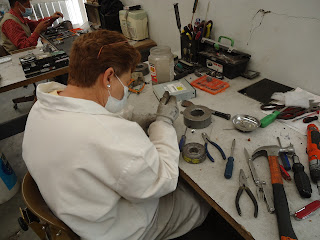
OK... LOoK!  This is a woman, Lidia, working at the Recycling operation.

Recycling isn't perfect.  But compare the press over "recycling" toxics in Africa to the coverage of Africa's actual most toxic sites - the mines that the virgin ore for lead, copper, gold, silver - and the mercury, cadmium, and other chemicals that spew out.

The planned obsolescence and mining industry has developed a terminator-spy, an anti-recycling, anti-reuse organization raising environmentalist donations to fight the only alternatives to mining, refining, and disposing... recycling by hand.

European Study Proves Hand De-assembly Superior to Shredding

Thanks to our Fair Trade Recycling Intern Adelaide, who is in Middlebury, Vermont, working on her Masters in Waste Management from France.  Adelaide cites ten separate studies in her morning blog to make the point that taking a circuit board apart by hand - separating copper coils from aluminum heat sinks, steel from plastic -  is environmentally superior to shredding in a lifecycle analysis.

Figure 1. Environmental assessment of treatment of electronic waste, Gmünder (2007).

All Fair Trade Recycling wants to do is to make these hand-disassembly jobs (like our women in Mexico, below) de-criminalized.  Give them the proper tools and protection, stop open burning and other "ten worst practices".  There are no mercury switches, there is no "witches brew", hand disassembly is simply an alternative job to gang warefare in Mexico, pirate boating in Somalia, cocaine growing in Peru, sex work in Kenya, etc.

I've usually written about the Geeks of Color.  But the scrappers, too, have been denigrated and defamed in the American and European media.  There are bad practices by hand, and good ones.  Racial profiling is just not a very effective way of deciding, and the "safe" approach of shredding items before export is not a winning strategy for the environment.

Our company practices disassembly here in the USA.   But I'm opening hand disassembly factories in other countries.  They will recycle their own waste from inside their countries.  But if they can do that well, why not let them also take rich people stuff that can still be reused, which puts an even higher environmental outcome... one which is "off the chart".   Survival is the highest form of "end of life" when you're not dead yet.

Our Chicas Bravas in Mexico take a few extra steps and de-manufacture not just the PC, but the components like CDRom drives and floppy disk drives, hard drives, getting things like rare earth magnets and little gold things.  American companies which export intact power supplies, drives, and other "components" may ship them to a similar fate.  But they are all too afraid of the onus against export to visit and find out whether it looks like this or looks like a child sitting on a pile of circuits.

Most American recyclers don't know what this is on the left.  But they "recycle" them by the millions.  Reuse can get very small.

Why All Good Recyclers are Exporters.

There are many good recyclers, and we are all exporters. 
The purpose of certification is to "out" the liars, not to debate the outliers. 


During the past week (blogs below), I've written several essays concerning marketing themes which are "attacking the category".
Negative campaigning, also known more colloquially as "mudslinging", is trying to win an advantage by referring to negative aspects of an opponent or of a policy rather than emphasizing one's own positive attributes or preferred policies. In the broadest sense, the term covers any rhetoric in which one refers to one's opponent in an ad hominem manner. [ wikipedia 2012.02.08]
Negative imagery of competitors' export practices probably accounts for "80% of advertising" for ewaste recyclers (a statistic I just manufactured... see how easy it is for Americans to make things - up?)

Export policy is important, it does matter.  Below are five distinct export categories, and the niches they serve.   How we manage and certify the first four will help us all to control the 5th (see post "Ewaste Travel in Scrap Metal" 2010).   Mixing CRT glass and mercury bulbs into bales of scrap metal is one dumping problem, but ship captains stranded with cargo refused at port is another cause of the same "export for dumping" problem.   Basically, there are five ways for your "e-waste" to get from Here to There.

FIVE CATEGORIES OF E-WASTE EXPORTS

1.  Export No Intact Unit Category:   Some of us feel safer exporting raw materials only, and market the "no intact unit" standard as an option.  These companies attract business from OEMs concerned with reuse (market cannabalization), counterfeiting, or the "grey markets" somewhere in between.  It's a legitimate recycling category.  These companies represent an excellent choice, for example, for an OEM with faulty parts taken back under warranty that they don't want redistributed.  These recyclers export bales of steel, plastic, copper, aluminum, and circuit boards, sold openly on the commodities market.  (slideshow of China's metal recycling companies, which buy shredded material for hand sorting - The Atlantic Monthly 2008)

2.  Export of Tested Working Category:   Some of us sell to retail markets, such as schools or direct retail shops, which are not in the repair business and are willing to pay more for something "fully functional" and "tested working".  The recyclers who sell to the direct-reuse market tend to wipe hard drives, reinstall MAR licenses, and do other things to ensure their exports are what the buyer ordered.  (Slideshow of Egyptian repair / direct reuse markets, 2008)

3.  Export for Repair and Refurbishing Category:   Within the remote corners (83% of the world), there are mind-blowing repair and remanufacturing companies.  Some of these began as contract manufacturers (e.g. CRT factories) and performed warranty repairs as well as assembly.  Some have turned to full-fledge cores refurbishers, creating thousands of jobs in emerging markets, taking back things like old CRT tubes or smallish LCDs and recutting and re-vamping them.  They make things like monitor-television-DVD combos, which are sold in vast quantities to people earning $3,000 per year, who cannot afford to buy all 3 separately.  They tend to be very picky, but not about things like 120 volt power supplies... whether the power supply works or not, it's getting replaced for sale in a 220 volt country.  It's a very legitimate category.  The fact they buy non-working power supplies as well as working power supplies is evidence that they are the opposite of primitive.  Slides of the factories I've visited are available here.