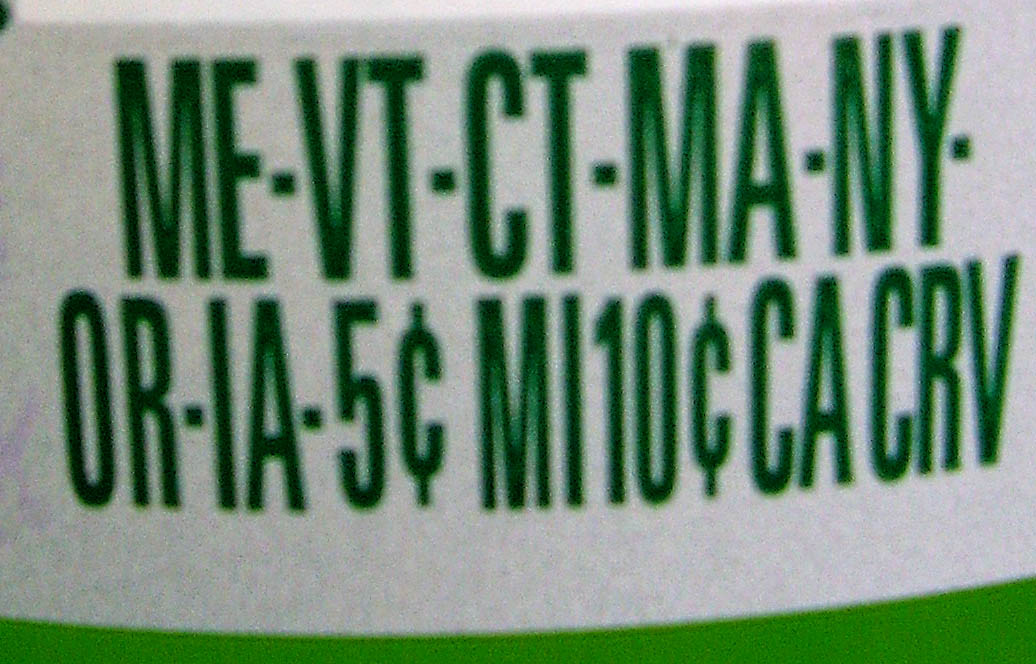
Showing posts with label bottle bill. Show all posts

Turning Extraction Subsidies (EG GMA 1872) into Recovery Deposits

For more than 150 years, the General Mining Act of 1872 has allowed mining companies to extract valuable minerals—including gold, copper, and lithium—from public lands without paying fair-market royalties to the American public. Economists and conservation organizations often describe this as a hidden subsidy: an opportunity cost where billions of dollars that could have been collected from extractive industries instead go uncharged. If even a fraction of those unrealized royalties were captured today, they could serve as a dedicated revenue stream to address the environmental externalities of modern consumption—particularly the challenge of managing end-of-life electronics, solar panels, batteries, and other high-value waste streams.

Above, the AI feed. Below, the AI response.

Extended Producer Responsibility. Part 1: Define the Problem / Benign Neglect?


2009 The Watchmen

Adrian Veidt:
It doesn't take a genius to see that the world has problems.
Edward Blake:
No, but it takes a room full of morons to think they're small enough for you to handle.

"It doesn't take a genius to see the world has problems."

"It takes a roomful of morons to think they're small enough for you to handle."

So let's discuss EPR, or "Extended Producer Responsibility".  It's the most talked about recycling topic, other than "Plastic", at almost every recycling conference.

This blog is deliberately agnostic about EPR. Here is my critique.

1. Define the problem to be solved. Then don't neglect it.

The first ever bottle bill, in Vermont in the late 1950s, was passed at a time when "disposable" beverages was new. Most soda and beer at the time was sold in refillable bottles. Vermonters collecting litter saw that the new one-use containers constituted most of the litter, and the problem was "non-deposit container litter".

In the 1980s, when bottle deposit laws were proposed in several other states (including Massachusetts, which my division administered at DEP), there was a huge shift to single-use containers, and both rewarding refillables and recycling single use were part of the plan. The advocates conceded on putting the deposit only on carbonated beverages because bottled water wasn't common and the Cranberry Juice lobby in Massachusetts argued that (highly sugared) fruit juice was healthy. 

Plastics Recycling's Burdensome New "Narrative"

A friend from Carleton College, physican, philosopher, professor and author Peter Ubel, nominated me on Facebook to comment on a new Frontline and NPR series:


The headline implies that plastic never would be recycled.  I've seen some other reporting to this effect, harkening back to the Penn and Teller video "Recycling is Bull***t".

How about:

"Some in Big Oil Misled the Public Into Believing More Plastic Would Be Recycled Than Could Be"

The thing is, plastics recycling is not all that complicated to explain, compared to say health care policy. 


"Part of the problem with mixed plastics recycling is insufficient participation. Manufacturers cannot meet % recycled content goals if consumers don't participate. "Another is over-participation. When in doubt, leave it out. Over-eager recyclers contaminate feedstock with mayo. "

Not really that political.

Value Added By Recycling Industries in Massachusetts (1992, Robin Ingenthron) - What John Tierney Failed to Learn about Garbage

Value Added By Recycling Industries in Massachusetts (1992, Robin Ingenthron)

This is kind of a hoot.  Dr. Josh Lepawsky found a paper I wrote my first months in the job at MA DEP, 30 years old, 25 years ago. It got Boston Globe front page coverage because of ricochet.   A loud PIRG vs. Plastic Packaging Industry referendum fight had thrust "recycling" into a spotlight, and the value of "recycling" rather than the packaging policy itself, was occupying the center stage.  Critics of the referendum were attacking state recycling policy, and proponents of the packaging laws were wrapping themselves in recycling like it was mom, apple pie, and the American flag.

To defend recycling as a policy, I tried to explain that there aren't "good markets" and "bad markets".  There are "buyers markets" and "sellers markets", and from an economic perspective, the paper mills, glass furnaces, metal refiners, etc. were adding more value than "waste diversion" from landfills.  So I got some secondary data on the recycled paper mills etc. that I'd supplied as a recycling collector, added up their employees, and explained the multiipliers.

The paper doesn't do so explicitly, but buried in it was my first realization that paper mills might be worse "neighbors", environmentally (odor, water effluent) than an incinerator or landfill, but they created so many jobs that the neighborhoods surrounding those mills were advocates.  Environmental enforcement was linked, geographically, to real estate value.  Likewise, those same jobs, which would disappear in Massachusetts if the tissue paper had to be made from trees, were far more important economically than the value of a ton of paper at a recycling center.

I was initially accused of writing the paper to influence the referendum (and threatened, professionally). I responded that the paper mill employees and those like me who'd been driving paper recycling trucks were kind of bemused... I might next leak the number of laundromats in MA and see if that got in the Globe.  And four years later, this paper was called upon to rebut John Tierney's "Recycling is Garbage" rant, which in part arose out of the very anti-recycling statements being made during the Packaging Referendum Wars (which employed many Bottle Bill Battle generals... history for another blog).

Anyway I long ago lost track of the paper, Josh found it at the MA State House library.


Massachusetts Bottle Bill - Redemption Centers

A brief history of how government programs to collect deposit containers failed to keep up with the times, and what it means for e-waste and health care.


See Boston Globe on Struggling Redemption Centers...

I don't understand how people failed to grasp this when I was at Massachusetts DEP, and still don't seem to grasp it.

The bottle bill was an anti-litter campaign before it was a recycling campaign.  It somewhat arbitrarily went after "carbonated" beverages and not juice, and failed to anticipate bottled water.

Most of the bottles and cans returned for deposit are single-serve.  Most of those are consumed away from home, at the office or in the car.

Most of those are collected by janitors, custodians, and pickers, and brought to redemption centers (not to retail stores).   The redemption centers, in 1996, were 2% of the locations but handled 40+%  of the total volume.  They haven't had a handling fee increase since the 1980s and some of the distributors stopped collecting from them, making them drive out of state to deliver the containers for no additional fee.

Janitors and park-pickers need the redemption centers.  No one wants people with 600 cans and bottles inside the retail supermarkets.  And curbside programs don't do office buildings and parks (though that could change with my Tomra recommendation below).

So here are some recommendations....  15 years later