Showing posts with label sb20. Show all posts

"E-Waste Crimes in Ghana" 9 - Great White Savior Gam

We revisited Agbogbloshie in urban Accra yesterday.   Having 9 days in Tamale, learning the Dagbani context, was important.  It honed and shaped our thinking.  Wahab and his 2 cousin/friends could focus their Dagbani translation on our questions, rather than siphon off the translation for American and Italian reporters.  As importantly, we had 9 days to think about the questions we didn't think to ask on the first day.


Since it was Agbogbloshie, of course there was yet another documentary being filmed that day... Justin from New York said he's a masters degree film student.   That's basically all he'd tell us.

This time we got to the wire-burning "hot spot" via the long and windy route.   We saw much, much more of the scrap metal site and trash dump.  It is indeed impressive in the context of a city of 1 million residents.  Of course, this city has closer to 5 million.   Recyclers will get my point... there has to be a lot of stuff still out in the city somewhere, waiting for a decision maker to let it be recycled.

money shot
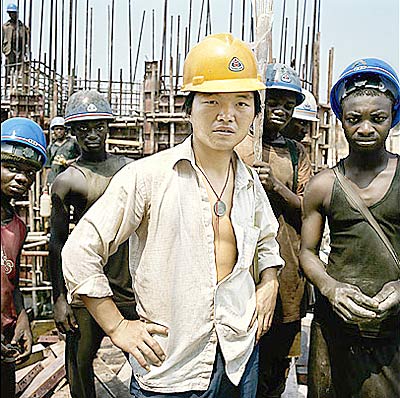
The white photojournalist had Awal (Howell) set up along the canal, sitting on a TV housing, with his back to the tire fires east of him.  We took a vantage point under the sun canopy where the scrap burners and hanger-abouters rest and have lunch.

Agbogbloshie as a scrapyard has little to do with wire burning, and the wire burning has much more to do with automobile wire than with "e-waste".  But those wire fires, while a very small part of the equation, attract thrill seekers - unemployed teenagers and #greatwhitesaviors like me and "Justin".  

The site, seen from above, is mostly scrap automobiles, motorcycles, and bus recycling,.  It's not the largest electronics dump in the world, not even in the top 100.  Given the number of African households who have had electroncs for decades, there should be much more e-scrap.  "E-waste" is a very small part of the scrap, apparently because Africans are still holding onto it, "speculating" that used electronics they don't use now will be sellable to someone.  Today's Agbogbloshie is probably the tip of an iceberg as decades of reuse and repair will eventually cascade from a next generation of smart phone users.

Environmental Malpractice Part 4: Poverty Porn

Born in:   Mexico, Mexico, USA, Palestine, USA, Taiwan, USA, Malaysia


So at our meeting in Vegas, Jim Puckett made the case that the world will be better if we all obey "international law", and that defamation of technicians, and closure of sustainable repair and reuse factories, is acceptable "collateral damage".  Jim presents himself, again and again, as an authority on Basel Convention.

The use of international treaties to simultaneously protect the 6 billion people in "non-OECD" nations from ... bubble, bubble, toil and trouble...  and the same time generate millions of well-intentioned dollars for a Seattle non-profit... This is not BAN.org's invention.  Poverty Porn has been around for decades.

Since my days studying international development at Carleton College, and as both a volunteer and employee (cross-culture trainer) for Peace Corps Africa, we've been aware of the "poster child" syndrome.  Here's a recent editorial on "Poverty Porn" by Nathaniel Whittemore at Co.Exist  (and here's a film from an admittedly donation-based organization in Africa, MamaHope.org, which does at least give hope for a different message).


The Hollywood and not-for-profit-Guilt-Industrial-Complex are really nice people to hang around with, as Jim and Mike both were in Vegas.  They are nicer people than I am.   Calling them accidental racists or ayatollahs of #ewaste was a decent into frustration.    If we are to turn them around, we need to first get their attention (which I've done) but then to find an alternative to the touchy word "racism".

Morality, Favors, and Contracts

I believe in practicing "thought experiments", like Einstein did with physics, about ethics and morality.   It's something we did in a meaningful freshman philosophy seminar at Carleton College (where I intended to be a philo major... but that's another story).


This week I had a frustrating conversation with a teenager in our family.   He asked me for a favor dropping him off somewhere by car.  It reminded me I needed someone to go to our Fair Trade Recycling Intern Adelaide's apartment to bring my bicycle back home, and I proposed an exchange - I drop him off at practice, and he brings my bike back from her apartment.

Parents of teenagers know the slippery slope of negotiations.  Below is a lesson in how to negotiate, which can be applied to contracts, etc.

  1. Even though no one knows I do it, even though it's not appreciated, I silently do this favor.  It is not even "for God" (though that's a legitimate inspiration).  I'm just wired to do this favor for someone who will owe me nothing, not even realize I did it.  My left hand knoweth not what the right hand giveth.
  2. Even though you appear to have nothing, and are unlikely to ever be in a position to help me back, I do this favor, and you say "thank you".  The lion releases the mouse.
  3. I do this favor knowing that you have some power, position, possibility of one day returning this favor to me.   It would be foolish of me to refuse.
  4. I do this favor and ask for another favor in return.
  5. I do this favor conditionally, that you do a specific favor for me in return.  If you don't, I won't.
  6. I accept your favor, but I decline doing a favor for you.
  7. I take, steal, or force the favor from you.

Religion, morality, ethics, and contract law.  These social exchanges, between billions of people, occur every second.  Some of us profit from it.  We are more likely to profit the farther down the scale we go.  Society is rigged to put the brakes on that, and to look upon us "favorably" the higher on the scale we behave.

How does a Recycler compete in ethical terms?   What happens if you behave ethically, but the person you are exchanging favors with is accused of being a bad actor?  A primitive, unsavory, wire burning informal heathen?   Does your best favor become a negative?

War on Reuse 2012

Vermont:   Our exports in 2010 and 2009 were 22% (both years).  Last year was 15%... the second half of the year saw reuse rates fall through the floor... as predicted in our testimony for S.77 to Vermont's legislature two years ago.

Part of the cause is the apparent declining demand (price) of reuse product, which I've described recently.  It's actually a steady demand, but a supply imbalance from rapidly emerging markets who are now switching from CRTs to LCDs themselves (seeing used Chinese CRT TVs in South America, omg)...

As the price of reuse commodities fall, resources to defend or maintain our markets are limited. Competition from Steward-Shredders in the USA, and competition from Chinese used supply, makes this seem like a losing battle.

Vermont's legislature defined "local reuse" to be restricted (to keep OEMs from having to pay for the same TV, over and over again).  But then ANR defined "local" as "USA" (Honolulu is local to Middlebury, by Vermont statute).  Ok, we then removed any reuse from the program to make sure it wasn't charged and was outside the program.  As of now, ANR has said even that is NOT ok, and material that we didn't charge to the program is sitting in a legal limbo, collecting in boxes in the plant... or more often we just recycle it and tear it down.  We buy product for the reuse markets out of state - the 16% includes material brokered from other states into export-for-reuse markets.

Economically, it's rather short-witted for Americans to take a billion dollars of assets and ban them from reuse.  It makes recycling more expensive, makes for a criminal's "sellers market" for the remaining reuse, forces export markets to buy loads which are of lesser quality, or to source their loads from Shanghai, Seoul, and Kuala Lumpur.

How China Kicked Our Asses in Africa

Photo and post inspired from London School of Economics Africa Blog, 
Africa and China: How it all began


What I'm doing with Fair Trade Recycling is perfect.  It's appropriate technology, it gives Africans affordable internet, and the repair jobs which pay too little to do in the USA create 10 times the per hour wages for Africa.  It's the "tinkerer blessing", the opposite of the Resource Curse.

Thanks for the Business, Uncle Sam
It seeds and creates and pays for an appropriate technology recycling system.  While only 15% of imports of used equipment are bad (Wal-Mart returns are 11%), paying for the proper disassembly and recycling of incidental breakage, elective upgraded parts, etc. creates a recycling infrastructure.

In Retroworks de Mexico, that creates a "computers for clunkers" trade in program where the ones they refurbish for resale can be exchanged for the domestic-generated e-waste.  That's the system already in Africa, people trade in the ten year old ones for more recently imported and upgraded, which is the link between the importers and Agbogbloshie.  BAN and Greenpeace and Interpol would have known this if they'd given Souleymane, Wahab, Hamdy, Somda or Miguel the courtesy of a discussion rather than just profile them as "waste tourists".

USA would be smart to be selling the repair and working display devices etc. to Africa.  We create more income and more jobs through reuse.  We cannot afford to have an idiotic 48 cent per pound California-destroy-all SB20 system.

USA has former Peace Corps volunteers like me, African immigrants like Wahab and Souleymane, and a history as a melting pot which our biggest competitors - China, Japan and South Korea - didn't have.

SCIENCE DAILY: Africa E-Waste Hoax Confirmed!!!

NEWS FLASH:  Most used computers and electronics found in Africa were purchased and imported at very great expense.   There is no incentive to pay for and ship junk.  The logic of anti-export organizations - that a few good ones at retail could explain their claim of 80% junk - may work mathematically, but makes no business sense.   Why would Africans buy the goods for $20, and pay $19 per unit just to ship each one, and then burn them for $3 worth of copper?  Today's Science Daily refers to UN Studies providing us with the truth about e-waste:

Domestic Consumption Main Contributor to Africa's Growing E-Waste Problem

ScienceDaily (Feb. 10, 2012) — In the five countries studied in the report "Where are WEEE in Africa?" (Benin, Côte d’Ivoire, Ghana, Liberia, and Nigeria), between 650,000 and 1,000,000 tons of domestic E-waste are generated each year, which need to be managed to protect human health and the environment in the region. The report sheds light on current recycling practices and on socio-economic characteristics of the E-waste sector in West Africa. It also provides the quantitative data on the use, import and disposal of electronic and electrical equipment (EEE) in the region. The report draws on the findings of national E-waste assessments carried out in the five countries from 2009 to 2011. 
The article takes its news from the report "Where are WEEE in Africa", published by the Basel Convention Secretariat.

FACT CHECK:  As fewer rich nations allow surplus e-waste exports to Africa, but demand remains, the quality goes down.   There are fewer suppliers to choose from.  PROHIBITION ECONOMY 101.  The lower the quality, the faster Africa's domestic recycling problem grows.  'War on reuse" makes it worse.

The Solution is obvious to the writers at Science Daily and the Basel Secretariat.   Allow import for reuse and repair, and have the companies exporting provide incentives and training to improve the recycling infrastructure.   In other words, Basel Secretariat and Science Daily just threw another big log on the Fair Trade Recycling bonfire.  Interestingly, the opinions in the Techie Listserve, Slashdot, overwhelmingly side with the obvious... reuse and repair are good, donating to good recycling beats banning bad recycling.

Multiple UN studies now confirm what we've been telling you from the field.  Most of the junk discarded by Africans was twice-reused for years, not hauled out of sea containers to avoid recycling fees in rich nations.   The used computer stores accept trade ins, but they make their money selling gently used equipment, like Goodwill or Salvation Army.   It's simple.  Poor techs, geeks of color, prefer to buy and work on rich people's surplus.  That's why they import.  Rich people discard after 3 years, and unless it's shredded, an African will try to buy it and use it for another ten years.  Goodwill, Salvation Army, and St. Vincent de Paul all know, you collect used goods in the rich neighborhoods like Wellesley, you may sell in Mattapan and Southie.

From the Basel Study:
The research revealed that there are some specific similarities between the refurbishing and recy-cling sectors in Nigeria and Ghana. In both countries, there is a well-organized repair and refur-bishing sector that is focused on used equipment either from imports or from domestic sources such as businesses and households. In both Accra (Ghana) and Lagos (Nigeria), this refurbishing sector generates income for more than 30,000 people...
 One major challenge for West African countries is to prevent the import of e-waste and near-end-of-life equipment without hampering the socio-economically valuable trade of used EEE of good quality. In addition, high volumes of domestically generated e-waste require well-functioning local take-back and recycling systems. Challenges include the establishment of appropriate collection strategies, ensuring that high volumes of valuable and nonvaluable waste fractions are collected equally and that those fractions reach appropriate treatment and disposal facilities. In addition, connecting informal collectors to a formal recycling structure is pivotal, along with appropriate capacity building and training. 
Locally adapted recycling technologies for West Africa should make use of the abundant labor force instead of deploying expensive shredding and sorting machinery. To ensure a maximum yield of valuable recycling fractions, West African recyclers should be encouraged to interlink with international recycling companies and networks to develop market outlets for their pre-processed e-waste fractions for a maximized return of value for secondary raw materials.  A sustainable e-waste management system would also need an adequate financing scheme, a level playing field and appropriate market incentives. It is thought that similar to policies in OECD countries, e-waste recycling systems in Africa could be developed in line with the principle of Extended Producer Re-sponsibility.

Is the system perfect?  No.  It needs reform.  What Africa needs is the same thing the USA and EU needed fifteen years ago - a cleaner recycling system for the stuff that eventually goes bad.  They DON'T need to be cut off the internet, or to be forced to spend half their annual salary on a brand new computer.  China has more scrap-economy demand, a different subject (see 2010 E-Waste Travels in Scrap Metal)

California Compromise Sopranos "e-Waste" Episode

Ok, I blew the California Compromise.  
Here is the dialogue I was middleman to.  What should I say?


In fairness, Jim Puckett of BAN was the most engaged of anyone in the discussions, and put the most time into making it work.  But it's hard to convince the partners overseas that the men who created the stereotype about their technical abilities can be trusted to change message.  At this point, I think, too much money has been invested in the fake story, which is that all, not some, Asians use primitive practices.


California:  Exports are bad.  We require breaking stuff.

Export Market:  We used to buy the good stuff from you guys.  Now we buy from Sopranos. Let's talk.

Sacramento Bee Finds Guys: How SB20 Defrauds Reuse

Warmer, Warmer, Waarrmmmmer... Cold!

On Sunday, Sacramento Bee reporter Tom Knudson released another big story about "E-Waste" exports in California.  He is the reporter who travelled to visit Retroworks de Mexico last February, and did a good couple of stories about SB20.   Yesterday's article is titled "California recyclers find market for toxic trash" (follow link).  (2012- McClatchy has dropped links to the story, but follow ups found here).

Knudson nearly scores a home run.  However, there remain some bases to touch, or dots to connect.  The article continues to leverage value from the myth that recyclers overseas are nasty and brutish (I admit they are short).  I know Tom struggled with how to describe a fair trade operation.  Today I'll try to weave the arms and shoulders of the multi-colored dreamcoat together...