Showing posts with label poverty. Show all posts

What $20,000 Means: Blog to Sasha Rainbow, Brian Molko, Stefan Olsdal, @PlaceboWorld


Dear Directors, Producers, and Stars of the Music Video "Life Is What You Make It",

About two weeks ago, I ran across the release of your new Placebo music video through my organization, Fair Trade Recycling / WR3A, which researches public posts on Agbogbloshie.  Despite recognizing some of Placebo's hits from the past two decades, I admit I was not at all acquainted with the artists.  Over the course of 2 weeks, I've developed a much greater appreciation for not just the art, but the social justice that Brian and others with the band strive for.


I know a lot more about African recycling than I know about music.  I've been to Abgogbloshie and Old Fadama several times with our members from Tamale, Ghana.  We have translated for or been interviewed by several documentary and print journalism investigations on so-called e-waste dumping in Africa.  Here are 4 good articles and films on the topic of export.

3Sat
Aljazeera
Smithsonian
SciDev

But let me explain how we can work together to create clean and sustainable recycling jobs for the "workers of Agbogbloshie".  There's a win-win here, and there are plenty of other people besides me you can go through if I've tarnished the relationship by introducing the subject.  ("Alright then, I'll go to hell," often starts here).

What Does The Term "Third World" Mean Today?


My suggestion is that we just stop using the term "Third World" and "Lesser Developed Country" altogether.

There are certainly places with incredible poverty.   Like, say, the poverty I knew about in the Ozarks as a kid.  Not that I suffered it, or even that many people I know suffered it.  But it was in our rear view mirror, through our parents and grandparents, who lived in the Ozarks during the Depression and before electricity, running water, and hospitals were commonplace.

I've posted a few times about my mom's father, Clarence E. Fisher, pictured above. This was a photo I took as a teenager.  He had a tractor, but had gone back to his mule ("Jenny") for old times sake and found that he really liked ploughing that way.  He was a subsistence farmer and an excellent carpenter and painter.   And someone who convinced me it was going to be really important to me the rest of my life to know how everything worked, and how to fix stuff.

UK's African #eWaste Witch Hunt 5: Environmental Munchausen Syndrome?

While travelling to visit family members for Christmas holiday, I listened to an NPR story on "Munchausen Syndrome by Internet", which interviewed bloggist Taryn Harper, keeper of the #WarriorEliHoax blog.

Munchausen Syndrome is basically an addiction to getting attention by malingering or outright faking danger or illness.  It has reached the popular media in cases of "Munchausen by Proxy" - cases where a parent (usually a mom) endangers or imperils her children to "earn" sympathy and attention. The NPR study was about "Munchausen by Internet".  In MbI, sympathy whores (to coin an ugly phrase) create multiple fake online personas and histories which pose heartbreaking problems for public "Hashtag" sympathy.  The hashtag is the attention getting device on twitter, the heart wrenching or guilt-inducing story is the honeypot.

Per NHS.UK:
"Munchausen's syndrome is a psychological and behavioural condition where someone pretends to be ill or induces symptoms of illness in themselves. It is also sometimes known as factitious disorder.  People with the condition intentionally produce or pretend to have physical or psychological symptoms of illness.  Their main intention is to assume the "sick role" to have people care for them and be the centre of attention."
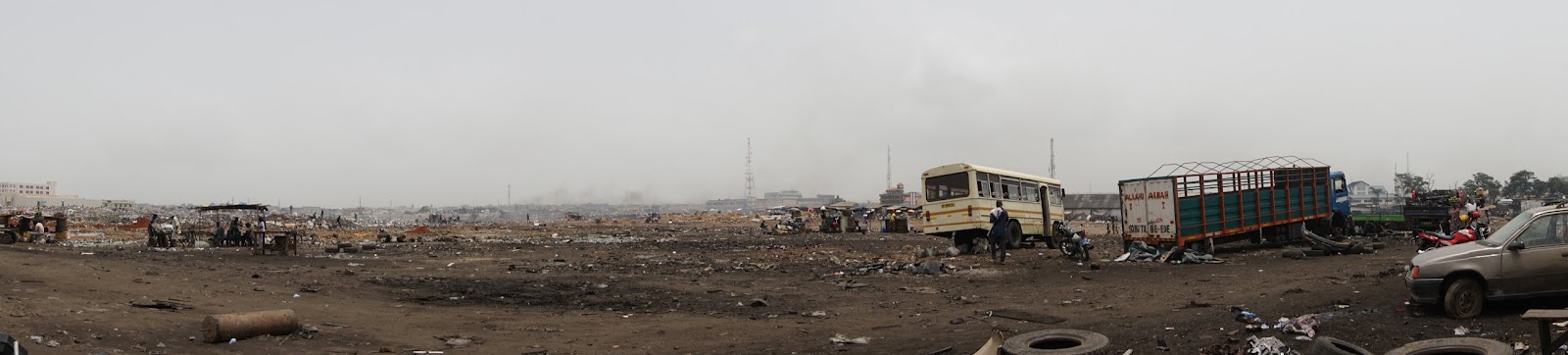
The Africans with roles in the #ewastehoax of Agbogbloshie aren't throwing the pity party.  But when they find themselves profiled by Western media, or as an NGO's "A Place Called Away," they have something... attention.  Ozark natives invested in New York City's fascination with poverty through Barney Google, Snuffy Smith, Little Abner, and Hollywood's fixation on Beverley Hillbillies and Green Acres;  So too, Africans can't help but try to turn the sour story into lemonade.

Accusations of Denial, Hoax, and Racism Haunt Agbogbloshie Ghana

2015-04-15 07.38.35.jpg
 
Yesterday I mentioned Mr. Jim Puckett's Op Editorial in Resource Recycling - Exporting Deception: The Disturbing Trend of Waste Trade Denial. I will have a chance to respond in Resource Recycling next week, in simpler terms than I traditionally write by blog.  The blog is directed at the best and brightest in our field.

The masthead photo of Agbogbloshie, by Amaia Benito, shows three young men, standing near the side of the Odaw River Lagoon, burning auto harness wire.  A 1990s CRT monitor case, used to carry the wire after burning, implies that there is e-waste, too.

No doubt.  When Wahab and Emmanuel and I interviewed the wire burners (27 at the site) last April, they estimated that 20-50 pieces of electronics arrived there each day.

That is in the largest slum of a city of more than 3 million people.
  • The hard working, poor men are not a hoax.
  • The "e-waste" is not a hoax.
  • The toxics are not a hoax.
  • The import of second-hand devices isn't a hoax.
These are specifically what Jim rebuts, and it appears he purposefully misses the point. I have never claimed the Odaw River is clean, or that we should ignore the environment in African cities, nor that Africans import second hand goods.
  • What is a hoax is that 400-600 sea containers full of western waste is dumped at the site each month
  • It is a hoax that the goods that Africans pay to import are quickly dumped 80-90% of the time.
  • It is a hoax that the Basel Convention has been amended and the trade in repair is illegal.  
  • It is a hoax that Agbogbloshie's a very large dump, much less one of the largest in the world for "ewaste".

And it's a hoax that "e-waste" ruined a pristine, lush, Odaw River. The exaggerations of Agbogbloshie trump the reality.  I objected to the exaggeration of African import crime in an interview with Jim Puckett in 2005, but no one had yet studied his claims of "75%-80% dumping" (and he had then as yet to later deny his claim).  Finding something I didn't say and responding to that, instead of what I did say, will fool some of the people, some of the time.

Extensive peer-reviewed studies and World Bank reports on teledensity in Africa can't simply be labelled "denial" and "associated" with tobacco and climate change skepticism.  And citing news sources that cited your own *claims* hardly matches wits with extensive research by Memorial U, ASU, MIT, and the UN.

In his editorial, Jim Puckett has repeatedly accused me of "ad hominem" attacks.  The claims he makes about Josh Lepawsky of Memorial University, Reed Miller of MIT, and researchers from US International Trade Commission aside... Jim would have a legitimate complaint if I have, as he implies in the article, called him a racist.

If Jim has really misunderstood me, my apologies and condolences.  But as likely he hasn't.


Declaring Victory: Dig a Hole in the Meadow for BAN

Bluegrass Arkansas history meets African American Rap.

Dig a Hole, Dig a Hole in the meadow, dig a hole in the cold cold ground.

This racist boycott of poor people who repair and reuse rich people stuff is over 2015.


Plenty to read here if you've just stumbled upon #freejoebenson #freehurricanebenson

It seems the BBC cut a wire on a TV and gave it to a Nigerian expat, and he sold it to his friend in Lagos, who repairs them, who resold it to to the BBC for 40Quid (about $65), which is about roughly 30 times the value of the scrap copper etc.

The BBC ran the story that the Nigerian exPat was "exporting e-waste" and the poor bugger got 16 months prison time.

The UN Environmental Programme meanwhile analyzed sea containers, including Poor Bugger Benson's, and found 85-93% totally good, working and repaired items.  That isn't "e-waste".

But Mr. Benson is in jail.

And all you people dancing for #povertyporn, all you #parsitesofthepoor, you #whitesaviorcomplex who are surprised to find yourselves hashtagged are - I hope - gonna have this song (from United World College UWC veteran band Gangstagrass) ringing in your ears when the media asks you where you got the statistic that 80% of electronics exports are dumped and burned by #primitives?

BAN.org

I'm not going to Africa to prove anything. It has been proved and acknowledged.  Joe Benson is innocent and is in jail because media believed a fake, disavowed statistic.

Longtime readers know I've been saying this for a long time.

Dig a hole, dig a hole in the meadow...


retroworks (652802) writes"What could possibly be worse than dumping 75%-80% of obsolete used "e-waste" in African dumps to be burned by children scavenging wires? What could be worse than violating international law?

How about lying that the crimes occurred in the first place?

Ghanain Emmanuel Nyaletey, an electronics repair technician who grew up a few blocks away from Agbogbloshie, has published an editorial questioning why the press has failed to correct its false reporting on the "e-waste export crisis". In April, Nyaletey will fly back to Ghana, with reporters, working on a documentary of the "e-waste hoax". http://retroworks.blogspot.com...

Seven months after the prison sentence for UK-based, Nigerian born TV repairman Joe Benson, the original source (Basel Action Network) of the "world's largest e-waste dump" story (Agbogbloshie scrapyard in Accra, Ghana) denies ever, ever stating that it has knowledge of foreign dumping in Africa. After the Guardian and the Independent and BBC ran stories claiming to follow "cut wires", UNEP studies of the "seized containerloads" found a range of 85%-93% of used electronics imported to Ghana and Nigeria were repaired or reused. The UN funded study found that the used electronics were more likely to be used than brand new product (raising questions of how much ESD "waste" is being resold after warranty return), that cities in Emerging Markets were generating up to 1/3 per capita as much electronic scrap as OECD nations (which would make them a larger net source than the West). Further, the study found that "geeks of color" like Nyaletey who repair and repurpose western imports earn six times more than the national average wages for their home nation (Nigeria, Ghana studies). Nyaletey painstakingly documents the findings from the 2011 and 2012 UN funded studies, and questions why white environmentalists are still trying to "save Africa" from reuse and repair.

2012 Study of Nigeria "E-Waste Assessment" http://www.basel.int/Portals/4...
2011 Study of Ghana "E-Waste Assessment" http://www.basel.int/Portals/4...

While the environmental organization BAN now denies being the source of the "80% waste" statistic, Memorial University researcher Josh Lepawsky has tracked the organizations orphaned statistic through peer-reviewed reports on "e-waste exports" over the past 15 years, and found it to be one of the most frequent citations in scholarly research on the topic. http://scalar.usc.edu/works/re...

If not from western "waste ships", what IS the source of the electronics shown at the African dumps? Cities like Accra and Lagos have millions of households with television (and refrigerators, and computers, etc.). World Bank estimated in 2003 that Nigeria had over 6 million households with television. Twenty six percent of Ghana households had televisions 15 years ago. http://www.econstats.com/wdi/w...

Meanwhile, 3 separate documentaries are in the works based on interviews with "Hurricane" Joe Benson. Benson has provided documentation that his cost of shipping, per unit, was much greater than scrap value, and has documented how he returned unrepairable appliances back to UK recycling centers free of charge, saying there is no earthly motive to ship waste. A petition to #freejoebenson will be circulated by Nyaletey in Ghana, and is now available online http://www.ipetitions.com/peti...
http://news.slashdot.org/story..."


Injury Box Blog: Pics Parasites Poverty

Last week I "kinda severely" injured my left hamstring in two winter-home-weatherization related incidents.  What has been frustrating has been to be home-bound but unable to sit still, upright in a chair for long.  Makes for halting, sporadic blogging.

Last weekend's post "Missing Poverty: Poverty Comedy" was messy, but I'm kind of excited by something that turned up from inside it.   The parallels between 1960s Ozarks and 2010s West Africa is not exactly uncanny, we've even been there before.  But the Hans Rosling videos I've been engrossed by this winter helped me generalize my subjective insights.


In 2009, South Korea became the first former recipient of OECD economic assistance to join the assistance giving committee.   South Korea was admitted to the OECD in 1996, 25 years after OECD was defined.  The 1961 original OECD membership list was whites - only (not even Japan was considered "developed").  Kids in college today are getting a message about "developing world" from people who considered South Korea a charity case, and they are getting the message on Samsung handheld devices (which they use to shop for Hyundais and Subarus in another tab).

You can track affluence and progress through lifecycle of appliances.  Koreans bought used products from affluent 1970s Japan.  Selling a first used car to a teenager is not necessarily "exploiting" the teenager.  Selling a starter home to a young family is not making them poor.  The guilt-by-association with poverty dogs the used goods market, and photographic snapshots of poverty should not become a modern soul snatching juju.

It's a fallacy that invokes instincts of nurture and instincts of aversion, and it sways crowds of people who self identify as "Agents of Conscience".   The key is to understand spiritual materialism (the desire to be a good soul) and history of development.  Rosling has shown how the majority of humans, like my Ozark cousins, have emerged from poverty within generational memory.  We need to explain to the Royals that fixing and recycling stuff isn't suffering.

Many places have been wealthy for so many generations that they do not have any institutional recollection of the end of poverty.  But for those of us who can remember, boycotting the poor is not how affluence went down.

7 Steps To Create a Profitable Hoax (#ewastegate)

No one denies that the volume of unwanted electronic scrap is growing.   Gadgets improve lives around the world.   They don't work forever.  But they often have more than one life.

Display devices (more than half of all the e-Scrap) are like used automobiles.  The average life of an automobile (15k miles per year, 200k miles per car) is about 13 years... some last longer, some shorter.   But the average first ownership of cars is less than 50 months, or about 4 years.    


Some people (with means) like to buy new cars every 3-5 years. Same goes for television and video displays.   Just as the cars roll around for twice the number of years they were used by the first owner, there's a secondary market for TVs, PCs, and their display devices.   


How can a do-gooder create a $3M non-profit out of the used appliance (or used car) market? Two parts White Guilt, one part Exotic Locale Photos, one Fake Statistic.  Print millions, move on. 


For more, visit 2010 "Top Ten Myths of #ewastegate"


1.  Create a fake 'e-waste' news crisis  

Tell all the environmentalists that you have a "dirty little secret"... that most of the electronic material they have brought in to recycling centers didn't really get recycled in the USA, or at all.   CBS 60 Minutes, PBS Frontline, NPR, USA Today, BusinessWeek, BBC will come running to you with the microphone.  You are marketing a believable message to people who are already "activated" on the topic (already making the effort to bring old gear for recycling).

This is key, you aren't trying to convince people to care, you are taking people who already care and convincing them of a scandal.   For example:

Another "Poverty Porn" Parody

These are coming out so quickly now.   I think this is a movement.  As the NPR article reports, the reactions against "poverty porn", "parasites of the poor", "accidental racism" and "boycotts of geeks of color" are not something I'm making up.

I have heard the frustrating cries from the technicians in Asia, Africa, and South America for over a decade.

This video parody shows Africans coming together, a la "We are the World", to donate radiators to poor freezing Norwegian children.   The way Norway is presented does have a grain of truth... it is indeed cold there, and the cold is something that would really seem frightening to Africans.  But they hit the out-of-context, Onion-esque, clueless notes that anti-export organizations don't seem aware of...


At FastCoExist.com, Ariel Schwartz and Nathaniel Whittenmore describe some of the same lessons I thought we learned in the 1960s, about "poster child syndrome" (the UNICEF campaign).  From Ariel's article:
"Guilt-tripping is still a commonly used tactic in trying to get people to donate money for the impoverished, though it is slowly being replaced by more hopeful messages from organizations like Mama Hope and Pencils of Promise. Nathaniel Whittemore explains in a Co.Exist post from earlier this year that this is strategic: "It supposes that after decades of being battered over the head by relief organizations flaunting horror images, there’s not much left but table scraps in the guilt bucket," he writes.
Fair Trade Recycling is a movement to recognize the crazy good things about repair and trade and even recycling in the emerging markets.   I could never have predicted the animosity directed towards technicians and recyclers in emerging markets, promoted by the very people I hung out with in college.  Remember the "boycott" of Fair Trade Cotton at Victoria's secret?

E-Waste Poster Children are everywhere.

I'm still working on the individual examples for the "legal malpractice" case.  It's just something I want to be very careful with, something that has to be done right.

More from the NPR article about the video, below.
"The video is humorous, but there is a serious message.  The point is that images of helpless Africans are just as inaccurate as the idea of helpless freezing Norwegians.   A lot of Africans cannot relate to the patronizing videos and development initiatives."
"The organization says it has certain goals with the video. "
"Among them that fundraising "should not be based on exploiting stereotypes" and that media should have more respect in portraying suffering children."

Memorial Day: Fear and Greed, Part 3


There is a cynical expression in Africa, used in response to "fears of the rich".   Why worry about toxics which may kill me seven years from now, when there are so many things that may kill me today?

Just as there are Useless Lists of Jobs Beneath Wealthy People, there are fears and phobias that the emerging markets don't have on their list of priorities.  That can be an opportunity for exploitation.  Yesterday's post described how EPA's Environmental Justice team came on board to make sure that "a clean local environment" was a right for every American citizen.

I learned today about careers in actuarial science (CNN).  It's about the statistics of risk and benefit, which (those who know me, know) I attribute to most of my life success.  (Taking credit for good luck, others call it).  Wikipedia 2012.05.28
An actuary is a business professional who deals with the financial impact of risk and uncertainty. Actuaries provide expert assessments of financial security systems, with a focus on their complexity, their mathematics, and their mechanisms (Trowbridge 1989, p. 7).
Actuaries mathematically evaluate the likelihood of events and quantify the contingent outcomes in order to minimize losses, both emotional and financial, associated with uncertain undesirable events. Since many events, such as death, cannot be avoided, it is helpful to take measures to minimize their financial impact when they occur.
According to the article, actuaries are one of the most sought-after degree holders, with virtually 0% unemployment.   What I'm curious about is what a professional actuary would say about "recycling" and "reuse" endeavors, with their associated benefits and risks, in a developing nation?  

One of the saddest stories I remember from Peace Corps in Africa was a young woman who spent a year teaching farmers to cultivate fish ponds.  Her favorite and most apt farmer/student lost his 1 year old son, who drowned in the fish pond she helped to dig, and she quit the service and returned to California.  Perhaps an actuary would say that the protein in the diet is worth the risk, if you learn from the lost life and make the fish ponds a little safer.  (Yes, this is similar to the story of the boy I helped bury who drowned in his father's well.  Not digging wells is not an option.  I taught by twins to swim by the time they were two years old).

Unlike the Peace Corps volunteers, the villagers really don't have much of an option to move to San Francisco.  If they try illegal emigration, that has its own risks.  My best friend from Africa married my Peace Corps replacement and they moved to the USA.  He was a muslim who fell into drinking in the USA, lost his family, and has been in and out of prison.

Finding a scapegoat for the things that killed us today is rarely useful.  The amount of fear that we can realistically project onto something that may kill us seven years from now is also practically useless, unless we find a scapegoat to leverage... the answer to that "unless" depends on the wealth of the scapegoat.  The environmental justice and Stewardship philosophies may not be built upon this attraction to leveraged wealth... but they cannot help but be influenced by it.

We can blame ourselves, or government, for the fish ponds.   We can blame corporations for the stewardship of the toxics.  But like actuaries on a battlefield, the entrepreneurs I've met in slums and emerging markets don't wait around for someone to blame.  They find the most value they can, the smartest way that they can.  It's not waiting for a big multinational corporation to pay for a modern shredder.   It's not taking back an exhausted 1980s TV from Lagos for repair.  The best thing they can do is get a laptop which needs the fan cleaned, or a computer with a dead capacitor, and repair it, earning a months wages in forty five minutes.  It may be safer for the white volunteer's shiny conscience to escape that, or say they shouldn't have had to make that choice.   I didn't leave, and don't intend to.

When a risk is a consequence of trade, and the trade is a good or service between someone wealthy and someone poor, it might be about exploitation and it might be about race.   But sometimes a cigar is just a cigar.  The actuarial science of life for the developing world says that Foxconn and contract management and low wages are a better path out of the poorest ditch than the promises of Mao or Al Qaeda.  Having a boss sucks.  But having a fair boss, or a good trading partner, doesn't suck nearly as much.

Basel Convention vs. OECD Convergence: Export Facts

WE ARE THE 17 PERCENT.


The worst recycling practices in the world need to be cleaned up.  R2 and E-Stewards, along with different state and federal stewardship laws, create a space which Moral Recyclers need when there are tough choices to be made on recycling price points.

I agree with Basel Action Network and Computer Takeback, at least half the time.   We agree about the situation of the poorest three billion people, or half of the six billion people who do not live in OECD countries.  Lead poisoning of children is not a myth, it's a heartbreaking environmental crime.

This is why I'm so upset to see my friends falsely accused of causing it.  Good exports are different than bad exports.

Rationally, let's look at the numbers.

"Non-OECD" does not mean "primitive". It's 83% of the world, and 50% of the world economy.  I am a staunch defender of geeks and technicians who happen to live in "non-OECD" nations, who operate impressive repair, refurbish, contract manufacturing, elective upgrade, white-box manufacturing facilities, which create sustainable economies and internet access.
  1. Half (50%) of the Global Economy is in Non-OECD countries.
  2. Of OECD raw material exports, about half (50%) are mined ore and timber.  Half are recycled.
  3. Of the recycled portion (including e-waste), it is alleged that 80% of sales are to 83% of the world's population.
  4. During the past decade, growth of internet access in the non-OECD nations grew at ten times the rate as OECD nations.  They need the monitors, even used ones, for video display.
So OECD exports 80 percent of its used monitors (either shredded as raw material, or for reuse) to this 83 percent of the world.   The surprising thing would be ...anything else.  The non-OECD nations are growing, projected to be 60% of the world economy by 2030.   They are younger economies, which have less scrap and more virgin land.  Internet there is exploding.  The older economies have more scrap, and less mining and forestry as a percent of their economy.

Poisoned children in Guiyu China is not a scam or a hoax.  The hoax is that E-Stewards lends them a dime or does anything to help those children.  This is not a beauty contest, where the NGO with the most heartfelt answer gets the contract.  Fair trade recycling means locating the people doing fantastic things, like IFIXIT and WR3A members, and giving them incentives and compensation to create sustainable comfort and prosperity.  Boycotting 83% of the world because the worst 30% of the world is so, so, so sad... It's not a final answer.


And the worst recycling, even in Guiyu, beats beats lead mining in Kabwe. We have to let the developing world reuse and recycle, while giving them the financial incentives to do so in a safe and clean manner.
Fair trade is a real methodology for dealing with e-waste, based on data, trade. We don’t address “primitive” recycling practices in one area of China by boycotting the best recycling practices in the world in another part of China, or another country.
One man’s opportunity for exploitation is another person’s chance for cooperation. The ban on interracial marriage was also a bad idea,no matter how many pictures of unhappy marriages the opponents take. Love will conquer all. And I love the geeks of color in the converging economies of the rapidly developing world.
(Reprinted in Motherboard.tv   More stats below)